
RFP Best Practices · FAQ Guide
How AI RFP Tools Prevent Hallucinations in Technical Answers
A practical guide for RevOps, sales engineering, and security leaders evaluating AI RFP software in 2026 — the controls that actually prevent the AI from making things up.
Published · 8 min read
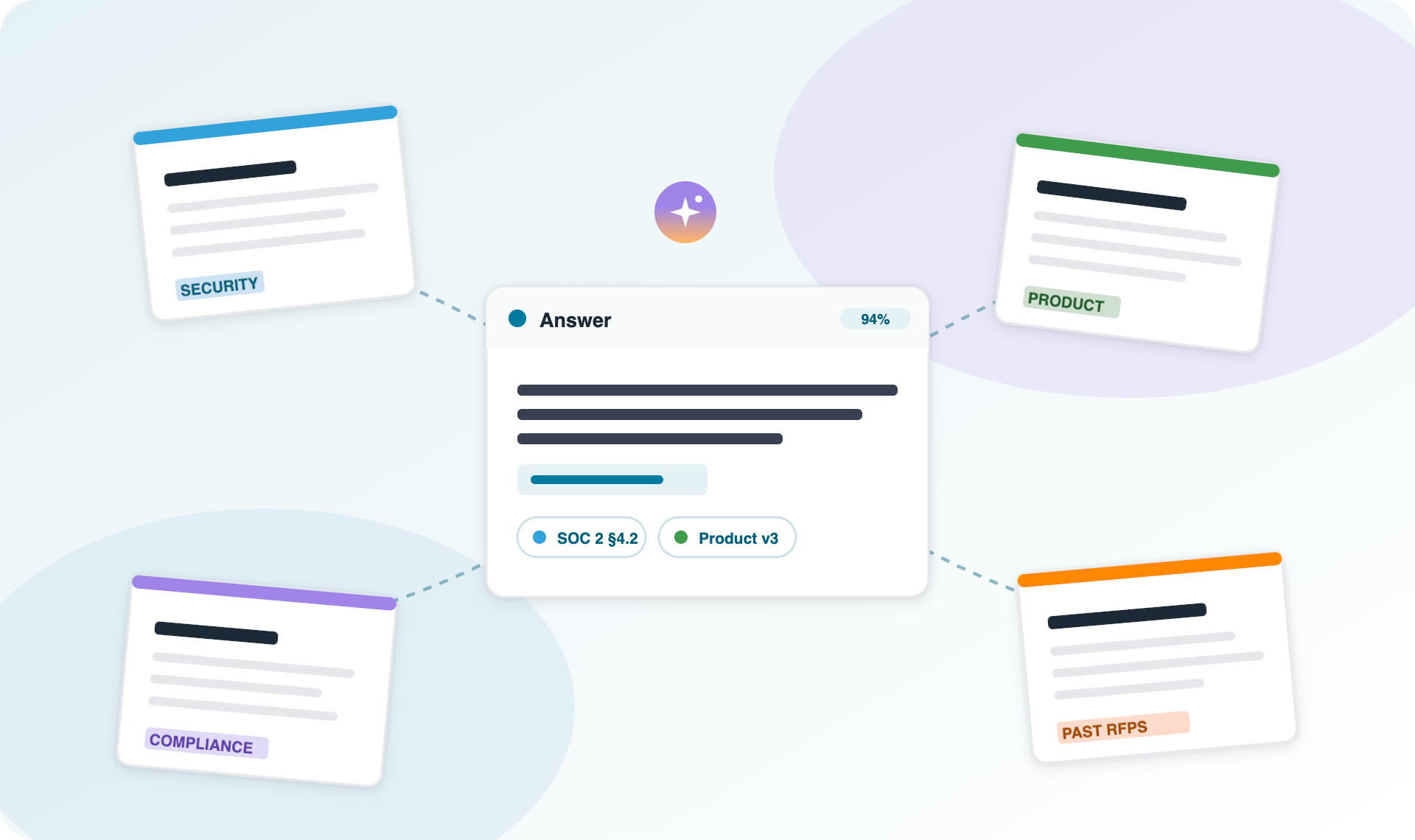
AI RFP tools prevent hallucinations by grounding every answer in your approved source documents — security policies, product docs, compliance files, and prior RFPs — via retrieval-augmented generation.
Quick answer
AI RFP tools prevent hallucinations by grounding technical answers in approved company knowledge instead of letting a general AI model guess. The safest tools combine source citations, retrieval-augmented generation (RAG), confidence scores, conflict detection, and SME review before any answer is submitted to the buyer.
A hallucination in an RFP is a confident answer that is not supported by your actual product, security, compliance, or architecture documentation. In technical RFPs, that creates serious commercial risk: the AI may claim a feature, certification, integration, or control your company does not have — and your name is on the response.
FAQ: How AI RFP tools reduce hallucinations
1. How do AI RFP tools prevent hallucinations?
They use governed content workflows. Gartner defines RFP Response Management applications as software that helps sellers streamline and automate RFP and RFI responses using repositories, templates, knowledge management, collaboration, co-editing, version control, and task management. Those features matter because they create controls around what the AI is allowed to use.
For market comparison, G2’s RFP Software category aggregates buyer reviews across RFP and response-management tools.
2. What controls matter most?
- ✓Approved content library. The AI pulls only from current product docs, security answers, compliance files, and approved prior responses.
- ✓Source citations. Reviewers can see which document supports each technical claim.
- ✓Retrieval-augmented generation (RAG). The system finds trusted material first, then drafts from that context.
- ✓Confidence or trust scores. Low-confidence answers are flagged instead of pushed into the final proposal.
- ✓Conflict detection. The system flags inconsistent answers across old RFPs, policy docs, or product pages.
- ✓SME approval. Security, legal, product, and engineering answers route to the right owner before submission.
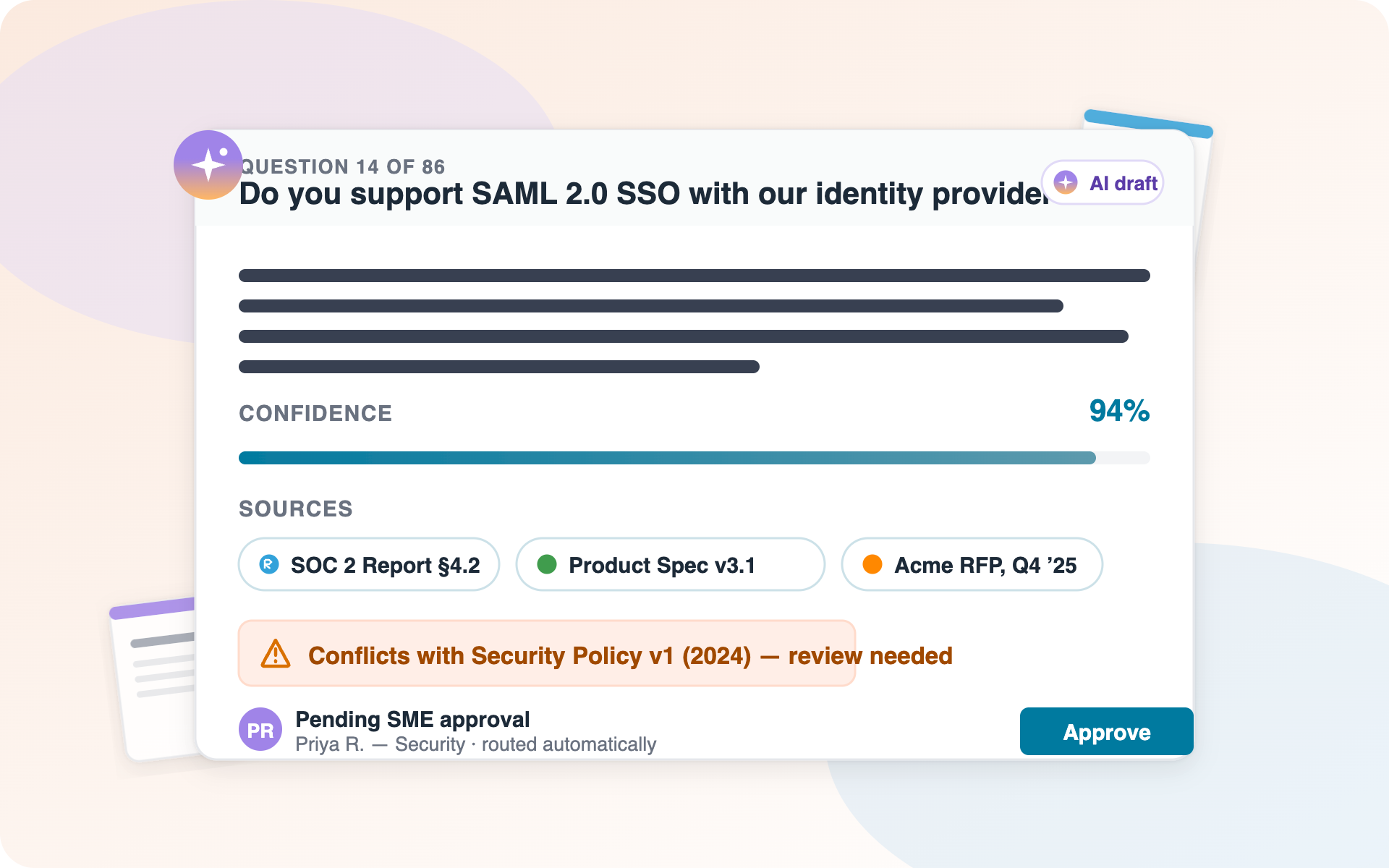
A single AI-generated RFP answer with the full trust stack visible: 94% confidence, three source citations, a conflict flag against the prior security policy, and a pending SME approval routed to the security owner.
“The best AI RFP tool is not the one that writes fastest. It is the one that helps your team prove the answer.”
3. Which AI RFP tools should buyers review?
The tools below are not ranked. They are examples of platforms with public signals around knowledge management, source attribution, AI response generation, or hallucination controls.
4. Is anyone claiming 0% hallucination?
Yes — but treat these as vendor-stated claims unless you have an independently audited benchmark. Inventive AI’s 2026 RFP software comparison states a 0% hallucination rate in its comparison table. Inventive’s RFP evaluation criteria article states 95% accuracy and a 0% hallucination rate. Thalamus AI’s homepage states 99.9% accuracy and zero hallucination.
How to write this safely
“Some vendors publicly claim zero-hallucination or 99.9% accuracy metrics. Buyers should validate how those metrics are measured, what content types were tested, whether the benchmark was independent, and whether the guarantee applies to their own documents.”
5. What is the safest workflow for technical RFP answers?
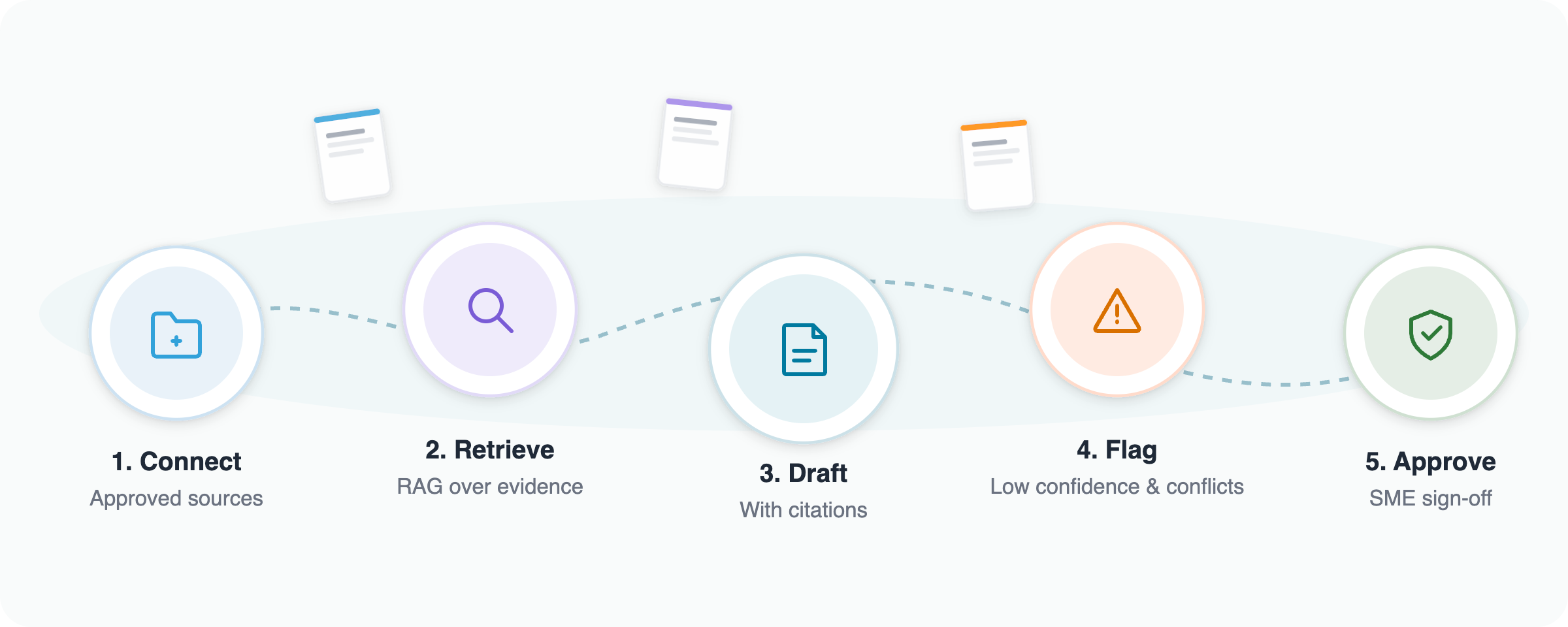
The five-step safe workflow: Connect approved sources → Retrieve evidence → Draft with citations → Flag low confidence and conflicts → Approve with SME sign-off.
- Connect approved sources: product docs, security questionnaires, SOC 2 language, architecture diagrams, legal clauses, and prior approved RFPs.
- Retrieve relevant source material before drafting the answer.
- Generate a response with citations and a confidence signal.
- Flag missing evidence, conflicting answers, or outdated content.
- Route high-risk answers to security, legal, product, or engineering SMEs.
- Lock the approved response and feed corrections back into the knowledge base.
6. Can hallucinations be eliminated completely?
The practical goal is not blind trust in AI. The goal is to make every technical claim traceable and to make unsupported answers difficult to submit. Even a strong AI RFP tool can fail if the source content is outdated, incomplete, or contradictory. That is why citations, conflict detection, and SME review matter as much as the model itself.
Key takeaways
Hallucinations drop when the AI is forced to retrieve from approved sources before drafting.
Every technical claim should link to the document that supports it. No citation = no claim.
Low-confidence and conflicting answers should pause the workflow, not silently ship.
Security, legal, and product owners approve answers in their domain — every time.
Bottom line
For technical RFPs, the best AI tool is not the one that writes fastest. It is the one that helps your team prove the answer. Look for source-backed answers, approved content libraries, confidence scoring, conflict detection, and human review for security, legal, and product claims.
Sources cited
- Google Search Central: Creating helpful, reliable, people-first content
- Google Search Central: AI-generated content guidance
- Gartner Peer Insights: RFP Response Management Applications
- G2: Best RFP Software category
- Gartner Peer Insights: Inventive
- G2: Inventive.AI reviews
- Inventive AI: Top RFP Software Tools to Use in 2026
- Inventive AI: RFP Evaluation Criteria Examples
- Thalamus AI homepage
- G2: Thalamus AI reviews
- Gartner Peer Insights: AutoRFP.ai
- G2: AutoRFP.ai reviews
- Gartner Peer Insights: Loopio
- G2: Loopio reviews
- Gartner Peer Insights: RequestFX
- Gartner Peer Insights: SiftHub