
Top 1up Alternatives and Competitors 2026
This guide evaluates the top 1up competitors and alternatives for 2026. We’ll break down where 1up fits best, its limitations for growing teams, and which alternative platforms offer the advanced AI and workflow automation needed for sophisticated enterprise proposals.

1up is a popular choice for sales teams looking to accelerate proposal drafting through content reuse. It excels at high-volume, straightforward responses where speed is the priority. However, as deals grow in complexity, 1up often lacks the depth required for high-stakes bids involving detailed technical requirements, multi-stage reviewer workflows, and strict accuracy standards.
For scaling organizations, the focus is moving toward Agentic AI, which Gartner projects will be a top strategic trend to manage complex compliance and cross-team collaboration without the manual overhead.
This guide evaluates the top 1up competitors and alternatives for 2026. We’ll break down where 1up fits best, its limitations for growing teams, and which alternative platforms offer the advanced AI and workflow automation needed for sophisticated enterprise proposals.
Key Takeaways
- Speed alone doesn’t win RFPs. Tools like 1up help teams draft faster, but response quality, accuracy, and context ultimately determine win rates.
- RFP complexity is increasing. Teams now manage longer RFPs, security questionnaires, and value narratives, making basic AI drafting and search insufficient.
- Legacy platforms improve organization, not outcomes. Tools like Inventive AI, Loopio, Ombud, Qvidian, and RocketDocs help centralize content and workflows but rely heavily on manual effort as scale increases.
- Context awareness is the real differentiator. Platforms that understand the full RFP produce more relevant, deal-ready responses.
- Narrative proposals matter in both startups and enterprise deals. Winning teams go beyond Q&A to deliver value statements, executive summaries, and cohesive proposal narratives.
- Inventive AI shifts the evaluation from tools to outcomes. With 2× more usable answers, 90% faster RFP responses, and 50%+ higher win rates, it addresses the gaps that most 1up alternatives leave unresolved.
About 1up
1up is positioned as an AI-driven knowledge management platform built to handle information-heavy workflows, particularly RFPs, security questionnaires, and complex customer inquiries.
It connects to multiple internal sources such as websites, Google Drive, Confluence, and Notion, allowing users to retrieve contextual answers without manually searching through documents. The platform emphasizes centralized access to organizational knowledge through a unified search experience.
The tool is capable of generating responses at scale by pulling from existing, verified content, which can help teams complete large questionnaires more quickly.
It also includes standard enterprise security measures, including SOC 2 compliance and AES-256 encryption, to protect sensitive data.
While 1up addresses basic knowledge searching and response drafting, teams managing complex or high-volume RFPs often need more advanced automation and control. That’s why many people start looking at 1up competitors and alternatives.
Top 1up Competitors and Alternatives
Here is a brief look at some of the best tools that teams often look at, along with 1up. The table below shows the main differences between the two in terms of focus areas, features, and best-fit use cases.
While the table provides a snapshot, choosing the right partner requires a deeper look at how these tools handle real-world proposal pressure.
Inventive AI
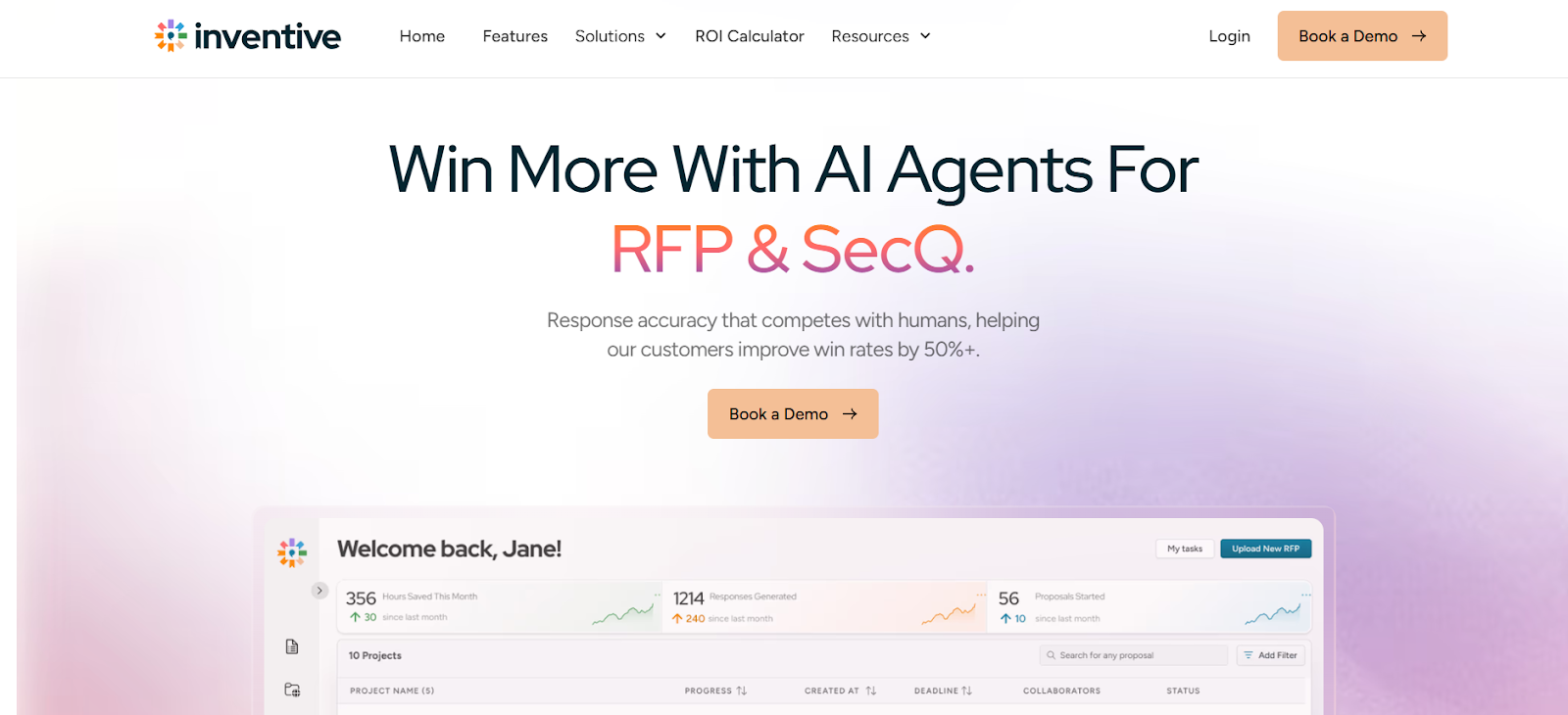
Gartner Rating: 5
Inventive AI is built for one outcome that matters most in RFP-driven sales: winning more deals with better answers.
Inventive AI stands out from tools that prioritize drafting speed. It provides hyper-contextual, real-time responses. These responses mirror the thought processes of experienced SMEs and proposal leaders.
In startups and enterprise sales, there are proposal and revenue teams that deal with complex RFPs. They also handle security questionnaires and value-heavy proposals. For these teams, the quality of their responses is what truly sets them apart. Speed is not the main focus; it’s all about delivering high-quality responses.
Inventive AI directly addresses the biggest pain points teams face today: generic AI outputs, outdated content, conflicting answers, and endless rewriting before submission. Using a deep context engine, automated conflict detection, and quality benchmarking, Inventive AI consistently produces answers that are accurate, tailored, and deal-ready. This is why teams see 90% faster RFP responses, 50%+ higher win rates, and responses that require little to no manual cleanup.
Key Features
- Inventive AI generates high-quality responses that are close to final, reducing rewriting and review cycles.
- Understands the full RFP, not just individual questions, enabling highly customized and relevant answers.
- Goes beyond Q&A to generate win themes, value narratives, executive summaries, and business justifications.
- Automatically flags contradictory or stale information before it reaches the buyer.
- Creates long-form proposals, security overviews, and executive briefs, and not just form-based answers.
Pros
- Delivers 2× better response quality than traditional RFP tools.
- Cuts RFP response time by up to 90%.
- Improves win rates by 50%.
- Near-zero hallucinations with built-in quality benchmarking.
Cons
- Limited analytics compared to some legacy platforms.
Best For
- Startps and Enterprise sales teams responding to complex, high-value RFPs.
- Proposal and presales teams managing large RFP volumes.
- Revenue leaders focused on improving win rates, not just speed.
- Teams requiring narrative proposals, value statements, and exec summaries.
Loopio
Loopio is an RFP response management tool used by sales and proposal teams to organize content and respond to questionnaires more efficiently. Teams commonly adopt Loopio to replace spreadsheets and shared folders with a centralized content library.
However, Loopio is largely workflow- and repository-driven, not AI-native. As the complexity of RFPs increases, teams continue to invest a considerable amount of time. They search for the right answers, validate accuracy, and rewrite responses. This process ultimately limits the impact on response quality and win rates.
Key Features
- AI-assisted response drafting utilizes historical proposal data and best practices to expedite the generation of first drafts.
- A centralized content library is in place to store approved answers, allowing for their reuse across RFPs, questionnaires, and proposals.
- Collaboration and workflow management to coordinate inputs from sales, proposal, and subject-matter experts.
- Portal and document-based RFP handling that supports importing questions and auto-filling responses.
- Enterprise integrations and security controls, including CRM, collaboration tools, and SOC 2–compliant infrastructure.
Pros
- Well-structured content library that helps teams reuse approved answers and reduce repeated SME follow-ups once fully built.
- Strong collaboration features, making it easier to assign questions, track progress, and reduce email back-and-forth.
- Noticeable time savings for repeat RFPs, especially after the library is mature.
- Consistent responses across bids, which simplifies reviews and improves internal alignment.
Cons
- Significant upfront time investment required to build and train the content library before real value is achieved.
- Search and AI suggestions often return loosely related answers, requiring manual validation and cleanup.
- GenAI works mainly as a starting point, with limited ability to refine or iterate without restarting prompts.
- Limited visibility into source documents, making it harder to review, annotate, or verify answers.
- Slow and cumbersome UX when importing questions from PDFs, increasing intake time.
Ombud
Ombud is a revenue operations platform designed for medium to large enterprises that manage proposal-driven and client-facing documentation at scale. It supports use cases across proposal management, presales, sales, and client service teams, with a focus on organizing content, coordinating workflows, and improving turnaround times.
The platform combines generative AI, machine learning, and collaboration tools to help teams create and reuse sales and business development materials more efficiently.
Built with enterprise deployment in mind, Ombud is positioned to support complex, global organizations across industries. It extends beyond traditional RFP responses to cover related workflows such as security questionnaires, sales proposals, and contracts.
Ombud also emphasizes scalability and adoption, offering structured implementation support and training to help teams standardize processes and maintain consistent messaging as usage grows.
Key Features
- RFP and RFX import wizard that converts long documents and portals into structured response workflows.
- Centralized response library for searching, reusing, and adjusting past answers.
- Collaboration and assignment workflows to distribute questions across teams.
- Workspace-based project organization for managing multiple responses at once.
- Standardized export formats to produce polished, ready-to-send documents.
Pros
- Easy to use for most roles, including new team members and non-technical users.
- Strong document import and export experience, reducing manual formatting work.
- Effective collaboration for RFP teams, with clear visibility into tasks and progress.
- Helpful as a knowledge base, especially for onboarding and learning product information.
- Time-saving for repeat RFPs and questionnaires, once responses are available in the library.
Cons
- User experience is inconsistent across workflows, especially when assigning tasks or managing the right-hand tray.
- Limited flexibility in task assignment, with few shortcuts or default settings.
- Collaboration features lack depth, such as the inability to tag users in comments.
- Struggles with complex conditional logic, particularly in portal-based questionnaires.
Suggested Alternative: Ombud helps teams organize workflows and reuse content, but Inventive AI is built to win RFPs, not just manage them.
The biggest difference is response quality. Inventive AI consistently delivers 2× more usable answers with minimal edits, while tools like Ombud often require manual refinement and validation before submission.
Qvidian
Upland Qvidian is a cloud-based proposal and content management platform used by large sales and bid teams to manage RFPs, proposals, and client-facing documents.
It combines content libraries, collaboration tools, and generative AI to help teams analyze RFPs, build proposals, and reuse approved content across bids.
The platform is widely adopted by enterprise organizations, including major banks and global firms, where meeting deadlines and maintaining consistency across large volumes of proposals is critical.
Key Features
- Centralized content library for storing, reviewing, and maintaining approved RFP and proposal content.
- AI-assisted RFP analysis to support faster go/no-go decisions and drafting.
- Proposal creation and document management for building structured, client-ready submissions.
- Collaboration tools that allow SMEs and bid teams to work within shared projects.
- AI Assist for executive summaries, helping teams craft higher-level proposal narratives.
Pros
- Strong content management capabilities make large libraries easier to maintain and reuse.
- Reliable platform with minimal downtime, suitable for enterprise environments.
- AI features add value for analysis and executive summaries, reducing early-stage effort.
- Good onboarding and customer support, enabling teams to manage the system independently.
- Widely trusted by large organizations, including financial institutions and global enterprises.
Cons
- User interface is not always intuitive, making some tasks harder to discover or learn.
- Limited visibility into SME edits, with no clear way to track specific changes during reviews.
- Proposal-building features can feel restrictive, depending on bid formats and complexity.
RocketDocs
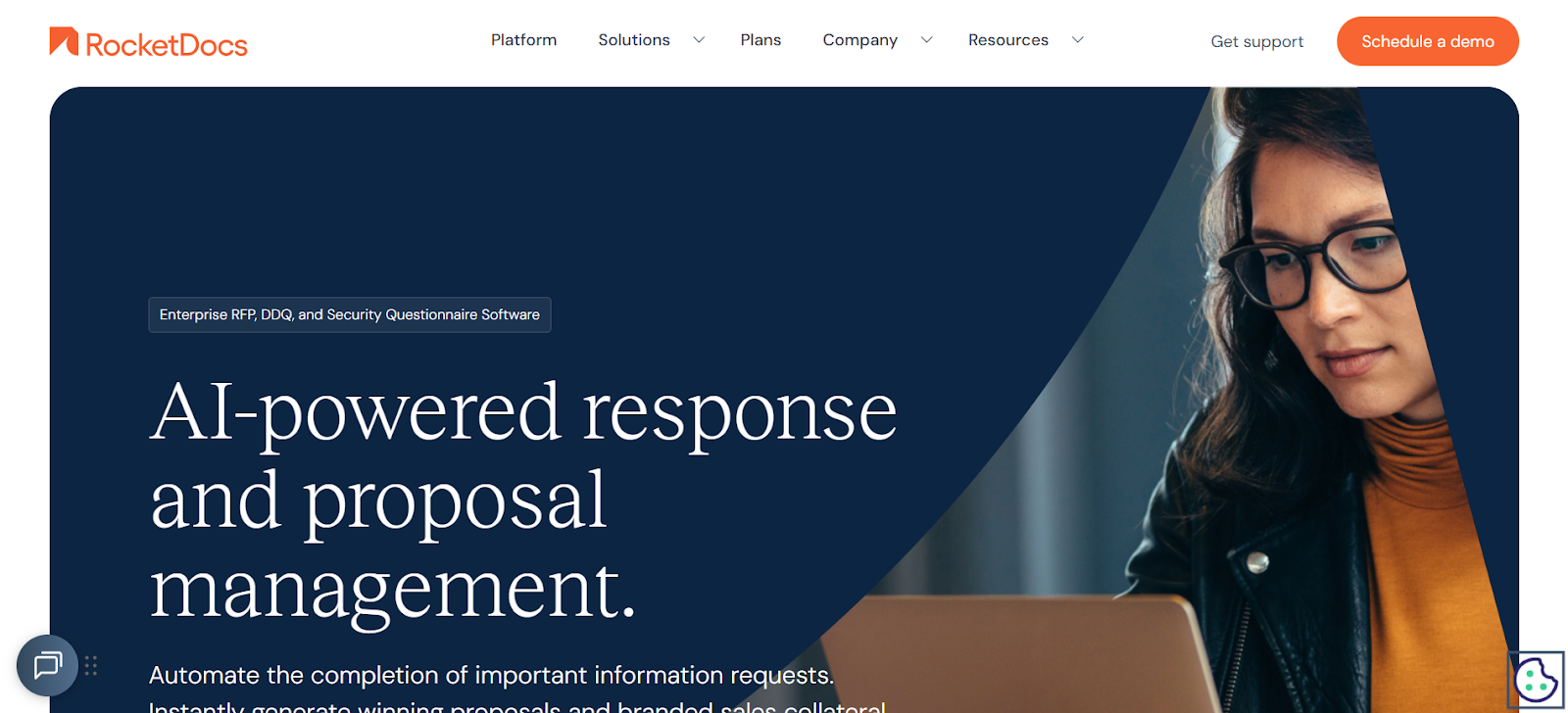
RocketDocs is a proposal and response management platform designed to support RFPs, audits, security questionnaires, and other repeatable documentation workflows.
It combines automation, a centralized knowledge base, collaboration tools, and Private AI to help teams reduce manual drafting effort and manage responses more consistently.
Mid-market and enterprise teams utilize the platform to manage large volumes of documentation across various regions and departments.
Key Features
- AI-assisted drafting for RFPs, questionnaires, and repeat documentation.
- Centralized knowledge base for storing and managing approved content.
- Workflow approvals and collaboration tools to streamline reviews.
- Enterprise-grade security and encryption to protect sensitive data.
- CRM and document integrations, including Microsoft Dynamics and Microsoft Word.
Pros
- Reduces manual effort by using AI to assist with drafting and content reuse.
- Strong knowledge base capabilities for managing large volumes of content.
- Flexible and customizable workflows, suitable for complex proposal needs.
- Good collaboration and project management features for distributed teams.
Cons
- Search and filtering can be clunky, especially in large databases.
- Steep learning curve due to advanced and highly customizable features.
- Formatting changes are not always intuitive, requiring manual corrections.
- Some content handling limitations, such as attaching certain document types.
- Higher effort and cost to fully utilize advanced capabilities.
Why Choose Inventive AI Over Other Tools?
Inventive AI is built to help teams submit stronger, more accurate responses that win. It prioritizes response quality and uses speed, automation, and safeguards to scale it.
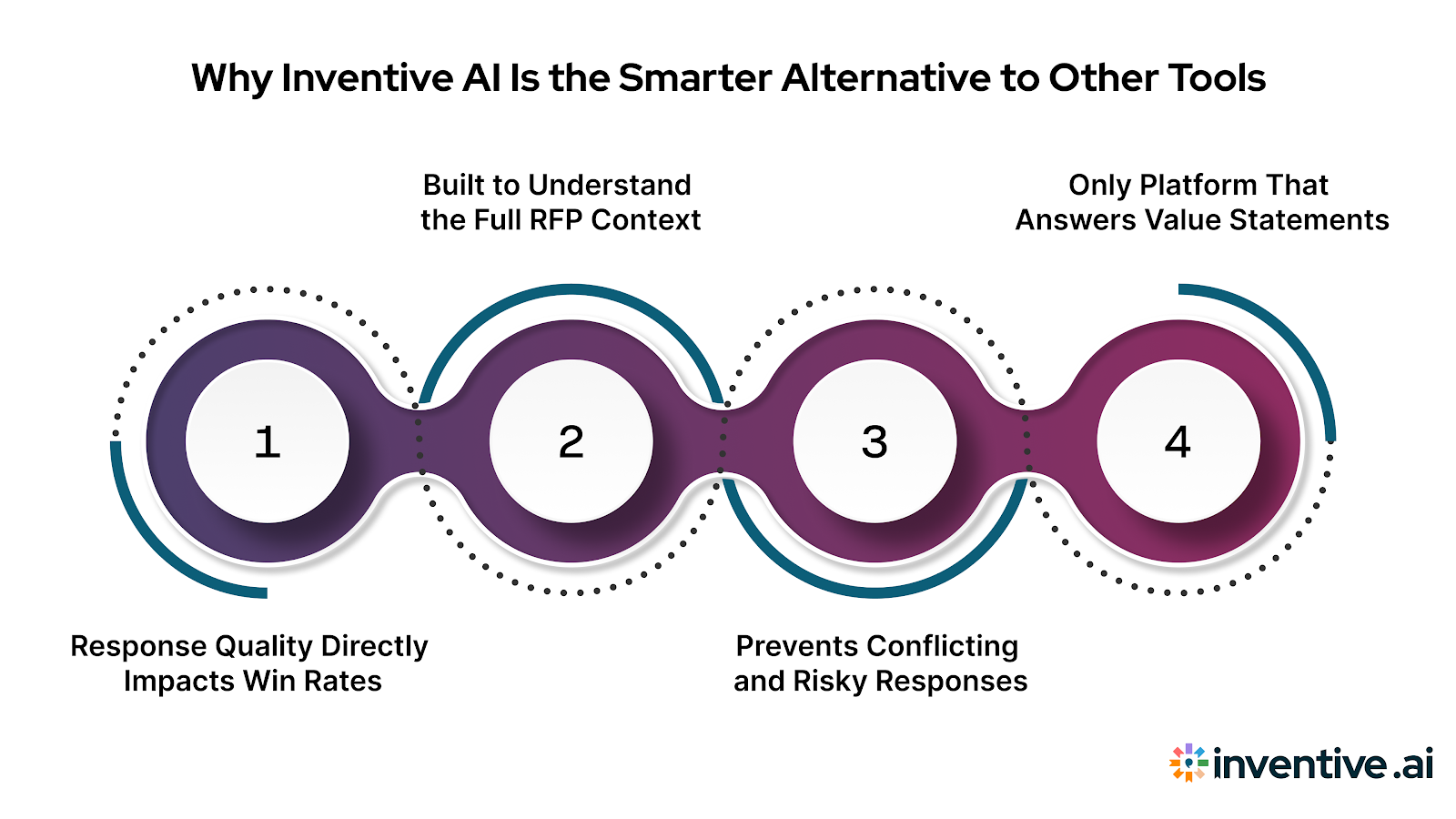
Response Quality Directly Impacts Win Rates
Most tools optimize for speed. Inventive AI optimizes for winning. In RFP-driven sales, weak or generic answers lose deals, no matter how fast they’re generated. Inventive AI consistently delivers 2× more usable answers with only minor tweaks, helping teams submit stronger responses without heavy rewriting.
Built to Understand the Full RFP Context
Traditional tools treat each question as a standalone prompt. That leads to shallow and repetitive answers. Inventive AI uses a deep context engine that understands the full RFP, buyer intent, and deal-specific nuances. The result is responses that feel tailored, coherent, and written by an experienced SME.
Prevents Conflicting and Risky Responses
Contradictory answers across an RFP can damage trust and credibility. Most platforms cannot detect this. Inventive AI automatically flags conflicting statements across responses before submission. This reduces review cycles and protects teams from costly mistakes.
Only Platform That Answers Value Statements
Many tools stop at question-by-question answers. Inventive AI goes further by generating value narratives, win themes, executive summaries, and security overviews. This is critical for enterprise deals where buyers evaluate differentiation, not just compliance.
FAQs
1. Why do teams look for 1up alternatives?
Teams often outgrow 1up when RFPs become more complex and high-stakes. While it helps with basic drafting and knowledge search, it lacks deep context awareness, conflict detection, and strong response quality controls needed for enterprise RFPs.
2. Is 1up suitable for enterprise-level RFP responses?
1up can support early-stage or lightweight questionnaires. Enterprise RFPs usually demand narrative responses. They also require strict accuracy and cross-team coordination. Additionally, minimal rewriting is essential. Many teams find that 1up falls short in these areas.
3. How is Inventive AI different from other 1up competitors?
Inventive AI is built specifically to improve response quality, not just speed. It provides hyper-contextual answers. It automatically flags risks. Additionally, it generates value narratives. This helps teams achieve responses that are 90% faster and win rates that are over 50% higher.
4. Are legacy RFP tools like Loopio or Qvidian better than 1up?
Legacy tools improve organization and content reuse, but they still rely heavily on manual effort. Many teams adopt them first, then move on when they need better AI-driven accuracy, customization, and outcome-focused automation.
5. Which 1up alternative is best for complex, high-value RFPs?
Teams that respond to large, complex, or value-heavy RFPs often find that certain platforms are more effective. These platforms focus on response quality and a full understanding of context. They outperform those that rely solely on basic automation.

90% Faster RFPs. 50% More Wins. Watch a 2-Minute Demo.

Vishakh Hegde
Recognizing that complex RFPs demand deep technical context rather than just simple keyword matching, Vishakh co-founded Inventive AI to build a smarter, safer "RFP brain." A published author and researcher in deep learning from Stanford, he applies rigorous engineering standards to ensure that every automated response is not only instant but factually accurate and secure.

Dhiren Bhatia
Tired of watching deal cycles stall due to manual questionnaire back-and-forth, Dhiren co-founded Inventive AI to turn the RFP process from a bottleneck into a revenue accelerator. With a track record of scaling enterprise startups to successful acquisition, he combines strategic sales experience with AI innovation to help revenue teams close deals 10x faster.