AutogenAI Pricing 2026: Real Costs, Model & Features
Explore Autogen pricing, key features, reviews, ratings, pros, cons, and alternatives to determine if it's the right AI proposal software in 2026.

You’ve been told to “get a quote” — and now you’re trying to work out what AutogenAI pricing actually means for your budget before you sit through a sales call. AutogenAI (the London-founded RFP, bid, proposal, and tender-writing platform at autogenai.com — not to be confused with Microsoft AutoGen, the open-source multi-agent developer framework) doesn’t publish a price list. That makes it hard to answer the only questions that matter: what will it cost this year, and how does that number grow as you add writers, modules, and integrations?
This guide breaks down what is publicly known about AutogenAI’s cost — the pricing model, the range others report paying, the fees that don’t show up in the first quote, and how the model compares to alternatives — so you can walk into that call with a number in your head.
The short answer on AutogenAI pricing
AutogenAI uses custom enterprise quoting. There are no public tiers, no self-service checkout, and no free version — every buyer goes through a sales-led process and a proof-of-concept before seeing a number (Capterra, Vendr). Cost is built around the number of seats, the modules you turn on, and the custom “language engine” work involved in onboarding you.
Because nothing is listed, any figure you see online is an estimate rather than official pricing. With that caveat, here is the grounded range, with the reasoning shown so you can pressure-test it.
AutogenAI pricing range (2026 estimate)
- Entry point: ~$30,000+ per year, based on third-party comparisons that cite a 5-seat minimum on an annual contract (DeepRFP, summarized by Procurement Sciences). At a 5-seat floor that implies very roughly $5,000–$6,000 per seat/year, though AutogenAI does not confirm a per-seat rate.
- Growing teams: mid-five to six figures annually, once you add writer seats, extra modules, and the bespoke language-engine build.
- For context, self-serve proposal tools such as Proposify list $19–$65 per user/month (~$230–$780/user/year) (Responsive). AutogenAI sits well above that band as a custom, enterprise-only platform.
These are third-party estimates and customer-reported signals, not published AutogenAI prices. Treat them as a starting point for your own quote.
Weighing a custom AutogenAI quote? Before you book that sales call, see how an AI-native alternative prices and scales. Compare Inventive AI vs. AutogenAI →
What is AutogenAI (and what you’re actually paying for)?
AutogenAI is an AI platform for writing bids, proposals, tenders, and grant responses. It qualifies and extracts requirements from incoming documents, drafts responses from an approved content library, and adds project management and review workflows around the bid cycle (Capterra). It’s used heavily in UK public-sector bidding and US government contracting, and it’s backed by roughly $22.3M raised in 2023 followed by a $39.5M Series B led by Salesforce Ventures (VentureBeat) — funding that helps explain the enterprise-first, high-touch pricing posture.
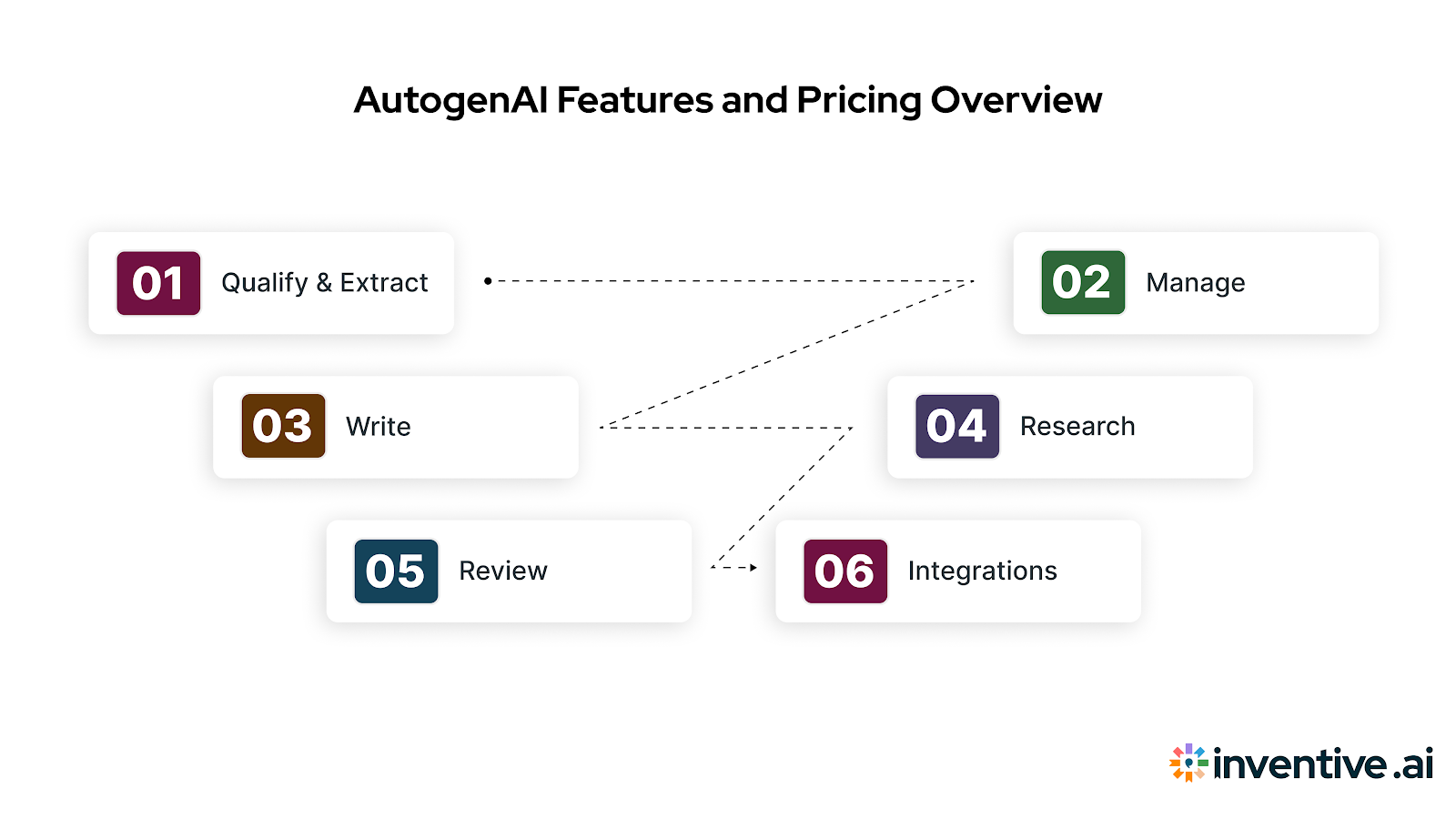
AutogenAI pricing and key features overview for proposal and bid teams
A quick disambiguation, because the search results mix them up: AutogenAI ≠ Microsoft AutoGen. Microsoft’s AutoGen is a free, open-source framework developers use to orchestrate LLM agents — its “cost” is really cloud and model-usage spend. AutogenAI is a commercial, sales-led SaaS product for proposal teams. If you’re reading this to plan a budget for bid writing, AutogenAI is the one you want.
AutogenAI’s pricing model: how the cost scales
The quote you receive is assembled from four levers. Understanding them is the difference between a predictable line item and a number that drifts every renewal.
1. Licensing — priced per seat
AutogenAI is licensed by the seat, and cost scales with your writer count. Vendr’s negotiation notes point to per-user pricing that improves with volume, so larger teams can push for better per-seat economics (Vendr). Third-party comparisons report a 5-seat minimum, which effectively sets the floor on any deal (DeepRFP). Confirm during your call whether occasional reviewers or approvers need paid seats or can participate without a full license — that single answer can move the total materially for a large bid team.
2. Modules and tiers — what’s included vs. added
The platform is organized into capabilities such as qualify/extract, write, research, review, and bid project management (Capterra). Custom-quote platforms commonly gate advanced modules, analytics, or higher usage behind upper tiers, so two teams of the same size can pay very different amounts depending on which capabilities are switched on. Ask for an itemized breakdown of what your tier includes and what triggers an upgrade.
3. Implementation and onboarding
AutogenAI uses high-touch, vendor-assisted onboarding — its team helps ingest and structure your historical content during setup (Responsive). Helpful, but implementation and professional-services work are frequently separate from base subscription pricing, so ask whether onboarding is bundled or a one-time fee on top.
4. Custom “language engine” build
AutogenAI builds a bespoke language engine trained on each customer’s own content (Procurement Sciences). That customization is part of the value proposition, but it also means upfront setup effort and cost that a standardized SaaS product wouldn’t carry — a key reason the platform lands in the premium tier.
Hidden costs to check before you sign
The subscription is only part of total cost of ownership. These are the terms most likely to surprise you later — pulled from AutogenAI’s own published terms and independent buyer data:
- Annual fee increases. AutogenAI’s US terms reserve the right to raise fees each year with 60 days’ notice (AutogenAI T&Cs). Ask to cap or fix the increase for the contract term.
- Non-refundable fees. Those same terms state amounts paid are non-refundable (AutogenAI T&Cs), which raises the stakes on getting the seat count and scope right from day one.
- Onboarding / professional services for content ingestion and the language-engine build, often quoted separately from the license (Responsive).
- Custom integrations. Connecting your existing systems can carry additional fees; the base product’s native integrations are limited (Capterra lists OneDrive/SharePoint) (Capterra).
- Minimum seats and annual commitment. A ~5-seat floor and annual contract set the smallest deal you can sign (DeepRFP).
- Auto-renewal and overage clauses. Vendr flags auto-renewal language and possible overage fees as negotiable items — remove or cap them before signing (Vendr).
Want pricing without the 5-seat minimum, annual increases, and a separate language-engine build? Inventive AI connects to the tools you already use and scopes pricing to your team. See it in a 2-minute demo →
AutogenAI vs. an AI-native alternative: pricing model & capabilities
If you’re pricing AutogenAI, you’re likely also comparing it to alternatives. The table below sets AutogenAI side by side with Inventive AI on the dimensions that actually shape a quote. Both are custom-quoted; the meaningful differences are in the model and the scope of what each covers.
For a deeper, side-by-side feature comparison, see Inventive AI vs. AutogenAI, or browse the full category in the best RFP software guide.
The AI-native alternative to AutogenAI
Where AutogenAI centers on generative drafting, Inventive AI is built as an autonomous, agent-driven platform that runs the whole response lifecycle — understanding the RFP, drafting with citations and a confidence score, flagging gaps, and validating before a human approves. Teams connect the tools they already use (SharePoint, Salesforce, Google Drive and more) instead of maintaining a separate content library, and a Content Governance Agent keeps that knowledge current automatically.
Reported customer outcomes are attributed to named case studies rather than stated as universal results: AssetWorks Facilities reported 422% ROI with roughly $105K in net savings, MaxVal cut RFP turnaround by ~90%, and Insider improved its win rate from 30% to 50% alongside 90% faster responses. Your own numbers will depend on volume and mix — the ROI calculator gives a scoped estimate.
If your bottleneck is high-volume RFPs, security questionnaires, and DDQs rather than long-form narrative bids, it’s worth seeing the AI-native alternative to AutogenAI before you commit to an annual contract.
What reviewers say about AutogenAI
On value-for-money and ratings, AutogenAI holds about 4.4/5 on G2 across ~140+ reviews (G2), with users praising drafting speed and onboarding support. Capterra lists the product but shows no user reviews and confirms the contact-vendor pricing model with no free trial (Capterra). As with most enterprise proposal software, the strongest signal on price and fit comes from a reference call with a customer close to your size and use case.

AutogenAI G2 review highlights on cost, value, and pricing feedback
Get more contextual responses than a generic first draft. See how Inventive AI’s agents draft RFP answers with citations and a confidence score, then keep your content current automatically. Book a demo →
How to get an accurate AutogenAI quote
To make the quote comparable and avoid renewal surprises, go into the call with these questions ready:
- How many seats are required, and do reviewers/approvers need paid licenses?
- What’s included in my tier, and which modules or analytics trigger an upgrade?
- Is onboarding / language-engine setup bundled, or a separate one-time fee?
- What is the annual increase, and can it be capped for the term?
- Which integrations are included vs. billed as custom work?
- Can auto-renewal and overage clauses be removed or capped (Vendr)?
Frequently asked questions
How much does AutogenAI cost?
AutogenAI doesn’t publish pricing; it quotes each customer individually. Third-party comparisons estimate an entry point of roughly $30,000+ per year with a 5-seat minimum on an annual contract, scaling into the mid-five to six figures for larger teams once additional seats, modules, and the custom language-engine build are added. These are external estimates, not official AutogenAI prices.
Does AutogenAI publish its pricing?
No. AutogenAI uses a sales-led, custom-quote model with no public price list, no self-service signup, and no free version. Buyers go through a proof-of-concept and receive a tailored quote based on seats, modules, and onboarding scope.
Is there a free trial or free version of AutogenAI?
No. Capterra and other directories confirm AutogenAI does not offer a free trial or a free version; access begins with a sales conversation and a custom quote.
What’s the difference between AutogenAI and Microsoft AutoGen?
They are unrelated. Microsoft AutoGen is a free, open-source framework for building multi-agent LLM applications, aimed at developers, and its cost is really cloud and model-usage spend. AutogenAI is a commercial SaaS platform for writing bids, proposals, and tenders, sold to proposal and bid teams on a custom-quote basis.
What does AutogenAI’s pricing include?
A typical quote is built from per-seat licensing, the modules you enable (qualify/extract, write, research, review, bid management), implementation and onboarding, and the bespoke language-engine build trained on your content. Custom integrations and higher usage tiers are common add-ons.
Why is AutogenAI’s pricing custom and enterprise-only?
AutogenAI builds a language engine unique to each customer and onboards content with hands-on support, so pricing reflects seats, scope, and that customization rather than a fixed per-user rate. This is common for enterprise proposal software but makes upfront budgeting harder.
How does AutogenAI pricing compare to Inventive AI?
Both use custom quotes rather than public pricing. The practical difference is the model: AutogenAI centers on generative drafting with a vendor-built content engine, while Inventive AI is an agentic, end-to-end platform for RFPs, RFIs, DDQs, and security questionnaires that connects to your existing knowledge sources. Compare them feature by feature on the Inventive AI vs. AutogenAI page.
Has Gartner reviewed AutogenAI?
AutogenAI appears on Gartner Peer Insights, where verified users leave ratings and reviews, and it holds roughly 4.4/5 on G2. For a pricing decision, pair those ratings with a reference call with a customer of similar size and use case.
Why teams evaluate Inventive AI alongside AutogenAI
If you’re weighing a multi-year, custom-quoted commitment, it’s worth comparing approaches before you sign. Inventive AI is built AI-native for the full RFP, RFI, DDQ, and security-questionnaire lifecycle — connecting to the systems you already use, drafting with citations and confidence scores, and keeping knowledge current automatically instead of relying on a maintained content library. See how it maps to your workflow with AI RFP response software, DDQ automation, and RFP automation.

.avif)

.png)