10 Best Enterprise RFP Software in 2026 for Winning Deals
Compare the best enterprise RFP software for large organizations. Evaluate AI capabilities, governance, integrations, collaboration, security, and pricing.
Enterprise teams handle hundreds of RFPs, RFIs, DDQs, and security questionnaires a year. Each one pulls answers from many systems and contributors, runs on a deadline, and carries compliance risk if a claim is wrong.
Enterprise RFP software manages that scale. It retrieves approved knowledge from connected systems, routes questions to the right SMEs, drafts source-grounded responses, and maintains governance from intake to submission. This guide compares the 10 best enterprise RFP software platforms in 2026 on AI, knowledge management, collaboration, governance, security, and scalability.
TL;DR
Here are the 10 best enterprise RFP software platforms in 2026, each suited to a different type of team:
- Inventive AI: Autonomous AI agentic software built for enterprises, automating RFPs, DDQs, and security questionnaires from connected company knowledge, keeping humans in the loop for approval.
- Responsive and Loopio: Content-library platforms with structured review and approval workflows for proposal teams.
- Upland Qvidian: Enterprise proposal automation with template management and governance controls.
- Arphie and AutoRFP.ai: AI-native tools for lean teams that want fast drafting without maintaining a content library
- QorusDocs: Proposal management for Microsoft 365 organizations
- Ombud: Response management for large revenue teams
- SiftHub: AI-native knowledge and RFP response platform for enterprise presales and revenue teams
- 1Up: Automated answers for high-volume, repetitive questionnaires; a lighter point solution within enterprise stacks.
How Enterprise RFP Software Supports the RFP Response Process.
Enterprise RFP software goes beyond helping teams write responses. It runs RFP response operations across multiple business units, subject-matter experts, and knowledge sources, while holding governance, security, and consistency at scale.
- Go/No-Go qualification. The software scores each opportunity against your fit and requirement criteria, so the team can decide to pursue or pass before investing time.
- RFP intake. The software reads the RFP and extracts every question, section, and requirement so nothing is missed.
- Knowledge retrieval. It pulls approved answers from connected systems like SharePoint, Salesforce, and Confluence.
- Conflict and outdated-content detection. It flags answers that contradict each other or rely on outdated information, and surfaces the most current, approved version.
- SME collaboration. It assigns each question to the right subject-matter expert and tracks their progress.
- AI response generation. It drafts each answer using company knowledge, source citations, and the specific deal context.
- Competitive intelligence. It positions your response against named competitors and highlights where you differentiate.
- Reviews and approvals. Reviewers check each response for accuracy and sign off before it moves forward.
- Security questionnaires and DDQs. The platform handles risk, security, and due-diligence requirements alongside the main RFP.
- Compliance checks. It verifies the full response against every mandatory requirement before submission.
- Submission. The team delivers a complete, formatted, on-time response to the buyer.
The Challenges Enterprise Teams Need to Solve
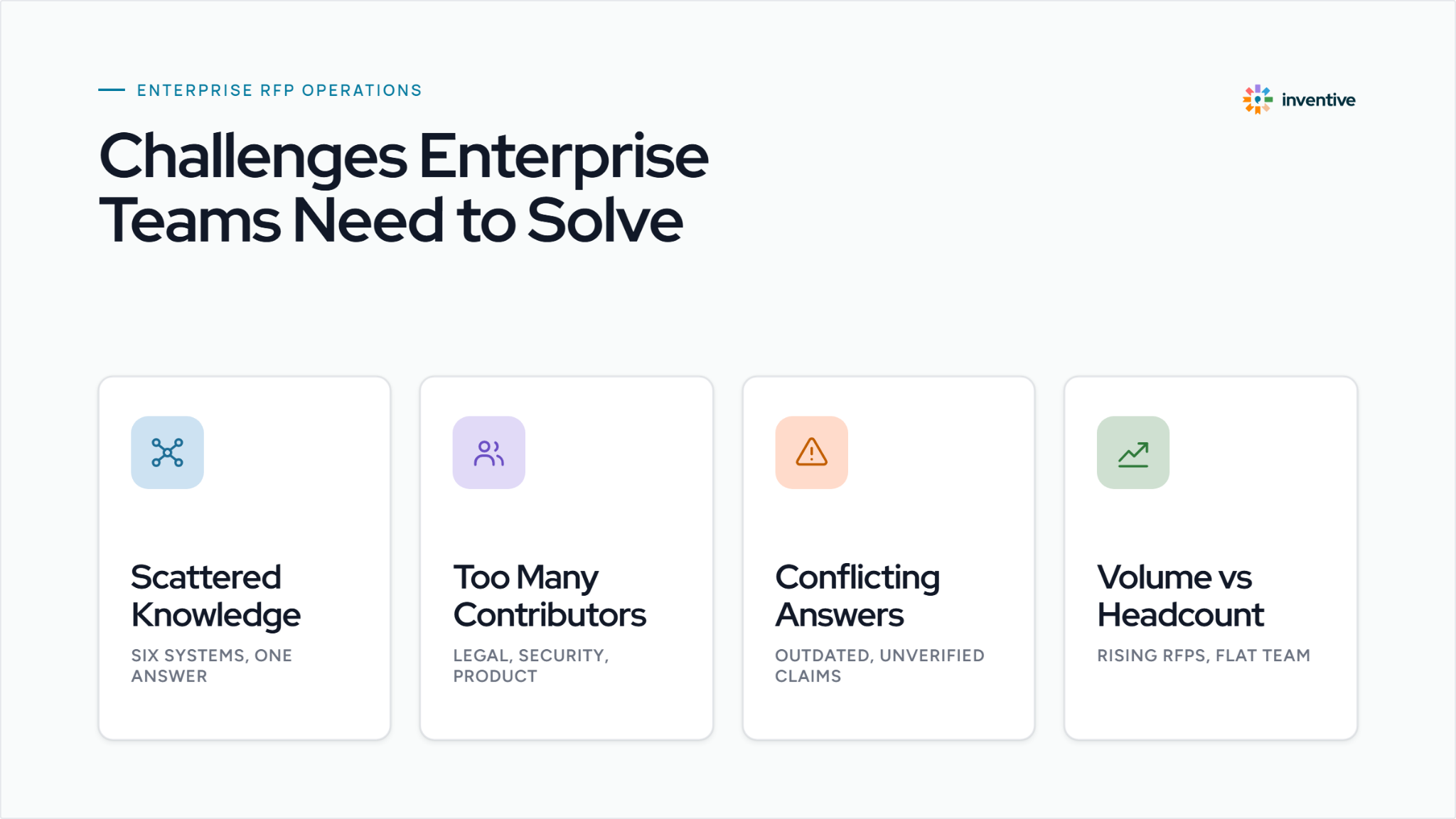
- Scattered knowledge. Answers are spread across SharePoint, Salesforce, Confluence, Google Drive, product docs, and past proposals. Teams waste hours locating the version that's current and approved.
- Too many contributors. A single RFP needs input from legal, security, engineering, product, finance, customer success, and executives. Coordinating and following up with them slows every response.
- Conflicting, Outdated answers. Across regions and teams, the same question gets answered differently. Outdated or unverified claims create compliance and security risk.
- High volume, flat headcount. Proposal volume keeps rising while teams stay the same size. Without automation, quality and deadlines both suffer.
The 10 Best Enterprise RFP Software in 2026
The best enterprise RFP software in 2026 includes Inventive AI, Responsive, Loopio, Upland Qvidian, Arphie, AutoRFP.ai, QorusDocs, Ombud, Xait, and Tribble.
| Platform | AI Capabilities | Knowledge & Governance | Integrations | G2 rating |
|---|---|---|---|---|
| Inventive AI | Autonomous AI agents; Go/No-Go assessment agent + competitive intelligence | Connected, live sync; conflict + compliance + audit | SharePoint, Salesforce, Confluence, Notion | 5.0/5 |
| Responsive | AI-assisted drafting; Go/No-Go assessment supported | Content library; TRACE + workflow | Salesforce, Dynamics, Teams | 4.5/5 |
| Loopio | Library AI (Magic); Go/No-Go available as add-on | Content library; manual review | Salesforce, HubSpot, Seismic | 4.6/5 |
| Upland Qvidian | Basic AI; limited Go/No-Go support | Content library; approvals + versioning | Salesforce, CRM | 4.3/5 |
| Arphie | AI-native; Go/No-Go assessment supported | Connected, live sync; citations + confidence | Drive, SharePoint, Slack | 5/5 |
| AutoRFP.ai | AI-native; Go/No-Go assessment supported | Connected + past answers; Trust Scores | Drive, SharePoint, Salesforce | 4.8/5 |
| QorusDocs | AI assist; no Go/No-Go assessment | Library (M365); permissions + roles | Microsoft 365, Dynamics | 4.4/5 |
| 1Up | AI-native; no Go/No-Go assessment | Internal knowledge base; basic | Slack, Confluence, Drive, Salesforce | 4.9/5 |
| SiftHub | AI-native; no Go/No-Go assessment | Connected knowledge; source citations | Confluence, SharePoint, Drive, Slack | 4.5/5 |
| Tribble | AI agent; no Go/No-Go assessment | Connected knowledge; basic | Slack (others maturing) | 4.7/5 |
1. Inventive AI
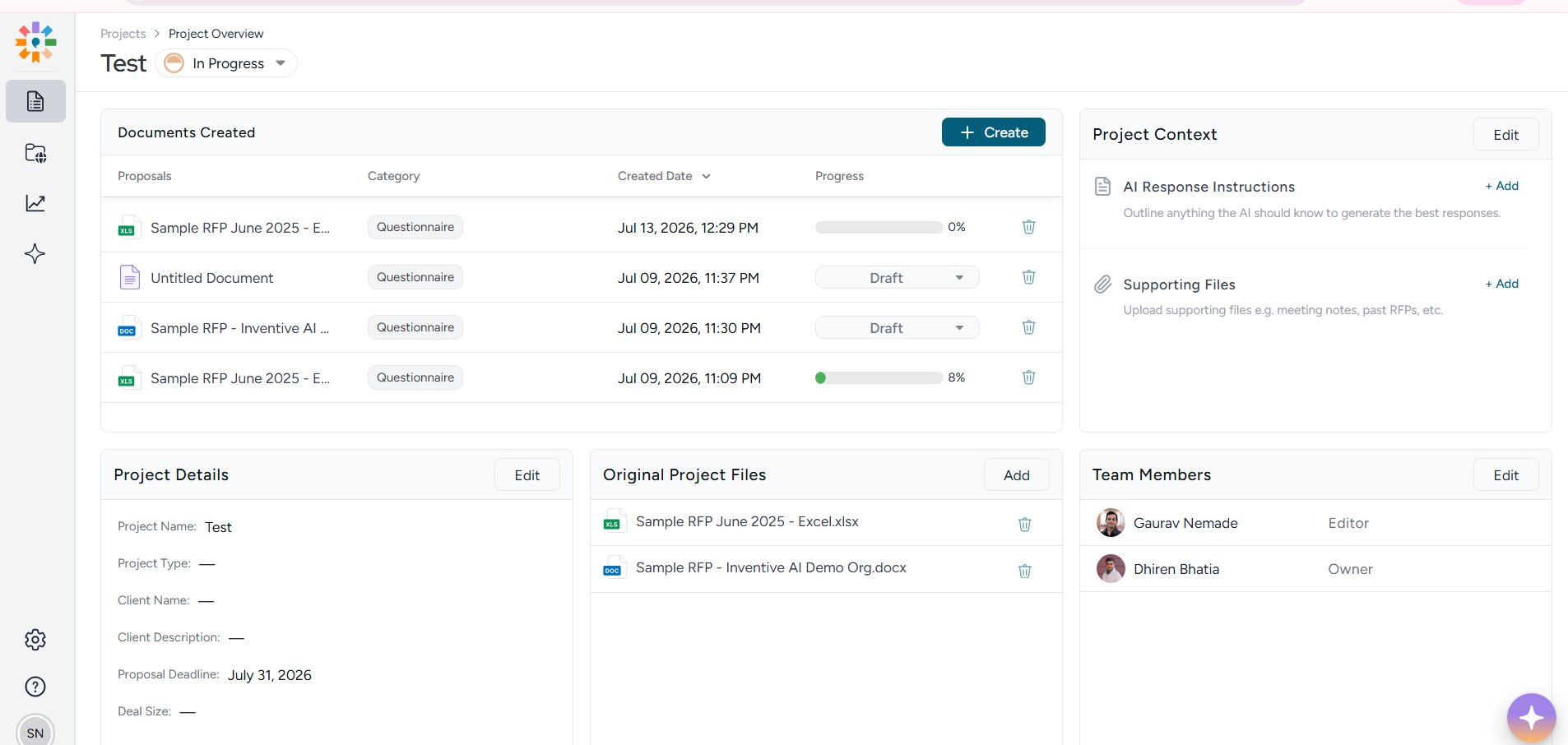
Inventive AI is an autonomous AI agent platform for enterprise sales, proposal, revenue, and InfoSec teams. It responds to RFPs, RFIs, DDQs, and security questionnaires by running the workflow end-to-end: intake, drafting, and validation, with humans approving the final output. It's designed for enterprises where response volume is high and answer accuracy is business-critical.
Key Features of Inventive AI
- Connected Knowledge Hub. Unifies SharePoint, Salesforce, Confluence, Notion, and more, and syncs automatically when a source changes; no central library for a team to maintain.
- AI response generation. Drafts every answer with source citations and a confidence score, and flags "information unavailable" instead of guessing.
- Context Engine. Tailors each response to the deal using customer priorities, CRM data, and sales notes, not a one-size-fits-all template.
- Content Governance Agent. Detects conflicting, outdated, and duplicate content across business units and prioritizes trusted sources.
- Go/No-Go Agent. Scores each opportunity against fit and requirements so teams pursue the right deals.
- Full Response Analyzer. Checks the entire response for compliance, missing requirements, contradictions, and tone before submission.
- Competitive Intelligence Agent. Positions the response against named competitors and highlights where you differentiate.
Strengths of Inventive AI for enterprise teams
Governance is built into the response: it auto-detects conflicting or outdated content and runs a full-document compliance check before submission, so teams catch a wrong certification or missing requirement before the buyer does. On G2, enterprise users highlight fast, accurate drafts that need little editing and consistent, on-brand answers across large teams, plus unlimited-user pricing that lets every SME and reviewer participate.
Limitations of Inventive AI for enterprise teams
Reporting and analytics need more depth, ops leaders who want granular visibility into cycle time, SME workload, and win/loss trends may find dashboards limited today. There's also no mobile app and no native Jira integration, which matters for engineering-heavy response workflows.
Integrations.
SharePoint, Salesforce, Confluence, Notion, Google Drive, Zendesk, HubSpot, Okta (SSO), Google Workspace.
Inventive AI Pricing.
Hybrid model: usage-based or a fixed plan, with all features and unlimited users included.
Security & governance
SOC 2 Type II compliant; customer data is never used to train public models; citations and audit trails on every response.
See how Inventive AI drafts enterprise RFP responses from your connected knowledge, with citations, conflict detection, and compliance checks built in.
Book a demo2. Responsive (formerly RFPIO)
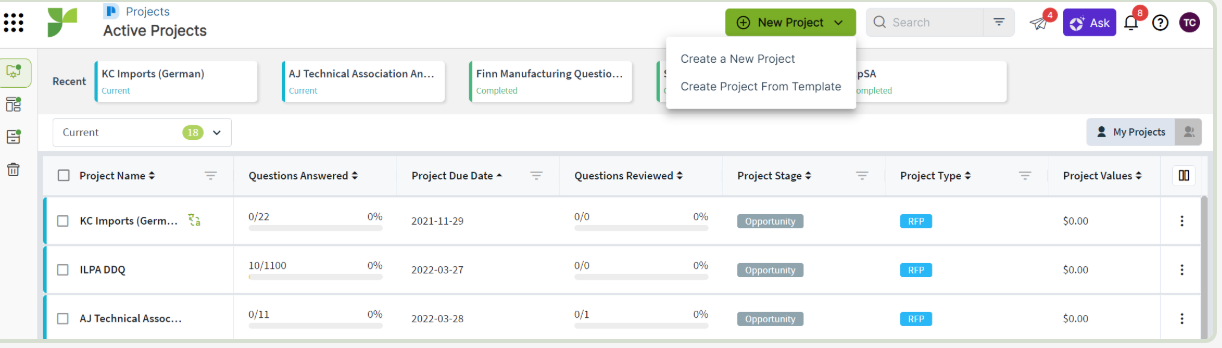
Responsive is an enterprise response-management platform for large teams handling RFPs, RFIs, RFQs, and security questionnaires. It centralizes approved answers in a content library, coordinates cross-functional contributors, and layers AI-assisted drafting on top.
Key features of Responsive
- Content library. Stores approved answers for reuse across a global team, keeping responses consistent.
- AI-assisted drafting. Suggests answers from the library to speed up first drafts.
- TRACE compliance scoring. Scores answers for quality and compliance, question by question.
- Workflow and collaboration. Assigns sections to SMEs and coordinates large, distributed teams.
Strengths of Responsive
On G2, enterprise users praise the centralized library for reusing approved answers, easy question assignment across departments, and reliable first drafts for structured questionnaires.
Limitations of Responsive
The AI sits on top of the library, so there's no automated conflict detection or live sync; someone has to keep answers current. G2 reviewers cite UI inconsistency across interfaces, slow bug fixes, Salesforce friction, and per-seat pricing that charges for every occasional reviewer.
Responsive integrations
Salesforce, Microsoft Dynamics, Slack, Microsoft Teams, SharePoint, Seismic, and more.
Responsive pricing
Custom, quote-only; historically starts near $5,000/year for a small team and scales per user, with some capabilities sold as add-ons.
Why choose Responsive
A fit for enterprises that already run a curated library and want structured governance and broad integrations, accepting more manual upkeep in return.
Also Read: Top 10 Responsive (RFPIO) Competitors & Alternatives 2026
3. Loopio
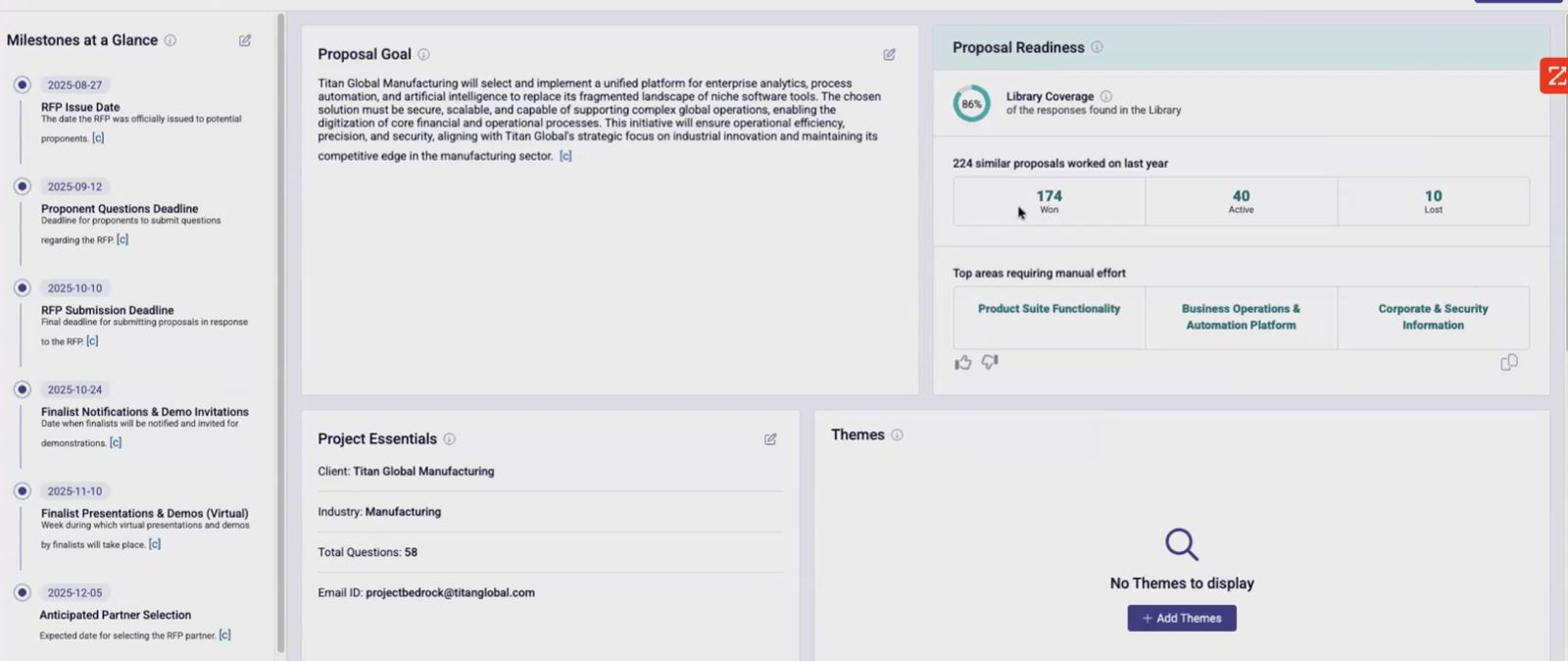
Loopio is an enterprise response platform organized around a centralized content library and structured workflows for RFPs, RFIs, DDQs, and security questionnaires.
Key features of Loopio
- Centralized content library. Stores and tags approved answers for search and reuse across the organization.
- Workflow automation. Moves each RFP from intake to submission and assigns sections to owners.
- Loopio Magic. Recommends library answers to speed up first drafts.
- Collaboration. Loops in SMEs, assigns questions, and tracks progress to reduce email chains.
Strengths of Loopio
A well-organized, searchable library and highly rated support make it reliable for coordinating large teams and keeping answers consistent. G2 users call the library its biggest time-saver for reusing approved content.
Limitations of Loopio
There's no automated conflict detection or live sync, so the library needs manual upkeep and quality tracks how current it is. G2 reviewers flag a weeks-long ramp to build the library, search that returns too many loosely related answers (adding verification work), and export formatting that needs cleanup, plus automapping that can't be corrected.
Loopio integrations
Salesforce, HubSpot, Microsoft Dynamics, Seismic, and Microsoft Word.
Loopio pricing
Quote-based; per Vendr buyer data, the median contract runs about $23,915/year, with most deals between ~$11,800 and $58,000+ depending on user tier and add-ons.
Why choose Loopio
Strong for enterprises with the staff to maintain a large library and a preference for structured, human-governed content.
Also Read: Loopio vs Inventive AI: Better RFP Software?
4. Upland Qvidian
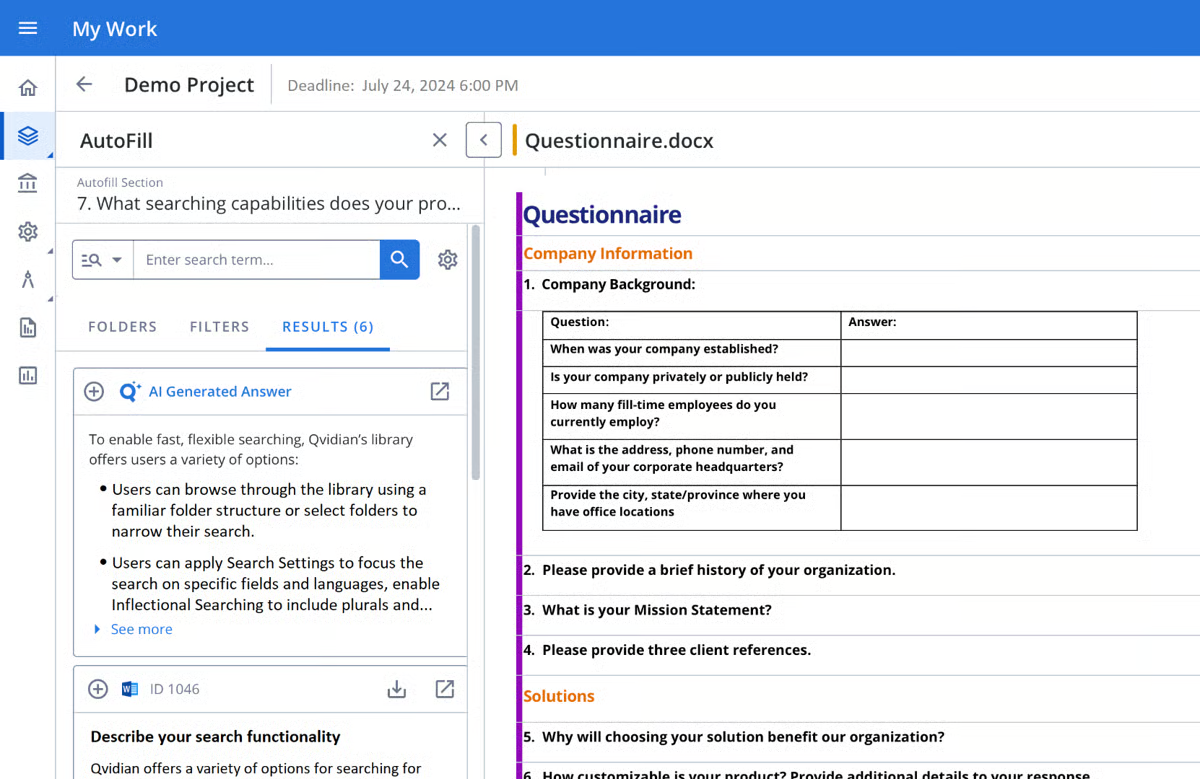
Qvidian is a long-established enterprise proposal and RFP automation platform, used by large organizations for template-driven responses with strong content and governance controls.
Key features of Upland Qvidian
- Template automation. Builds reusable RFP and proposal templates for consistency at volume.
- Content library. Centralizes approved content across distributed teams.
- Collaboration and approvals. Supports enterprise workflows, version control, and multi-stakeholder sign-off.
- Response tracking and analytics. Monitors status and basic performance across responses.
Strengths of Upland Qvidian
Robust content organization, template management, and enterprise-grade approval workflows suit large, complex response operations.
Limitations of Upland Qvidian
G2 reviewers describe the interface as dated and clunky, report a steep learning curve and lengthy implementation, and note slow performance and limited real-time response intelligence, so teams still lean on manual checks for accuracy.
Upland Qvidian integrations
Salesforce and other CRM and content systems via Upland's enterprise connectors.
Upland Qvidian pricing
Custom, quote-based; not publicly listed.
Why choose Upland Qvidian
A fit for enterprises that value template control and governance and don't need cutting-edge AI.
Also Read: Qvidian vs Inventive AI: Why Template-Driven RFPs Fall Short in 2026
5. Arphie

Arphie is an AI-native platform for RFPs, security questionnaires, and DDQs, built for enterprise sales, solutions, security, and investor-relations teams. It generates cited first drafts and routes them through review.
Key features of Arphie
- Cited first drafts. Every answer ships with source citations and confidence signals, to limit hallucination.
- Live connectors. Syncs from source systems automatically so answers reflect current content.
- Review workflow. Routes answers through review and approval before submission.
Strengths of Arphie
G2 reviewers highlight real-time savings on questionnaires, trustworthy cited answers, and auto-syncing connectors that keep content current without manual upkeep. Users also call it easy to adopt.
Limitations of Arphie
G2 reviewers note no competitive-intelligence analysis, no mobile access, limited export options, and a less-developed Salesforce integration. As a newer product, its review base is smaller.
Arphie integrations
Google Drive, SharePoint, Notion, Confluence, Seismic, Highspot, and Slack.
Arphie pricing
Flat per-project pricing that includes unlimited users; rates quoted per deal.
Why choose Arphie
A strong fit for security- and compliance-heavy enterprises that want cited, confidence-scored answers. SOC 2 Type II compliant.
Also Read: Inventive AI vs Arphie: The Best RFP AI Alternative
6. AutoRFP.ai
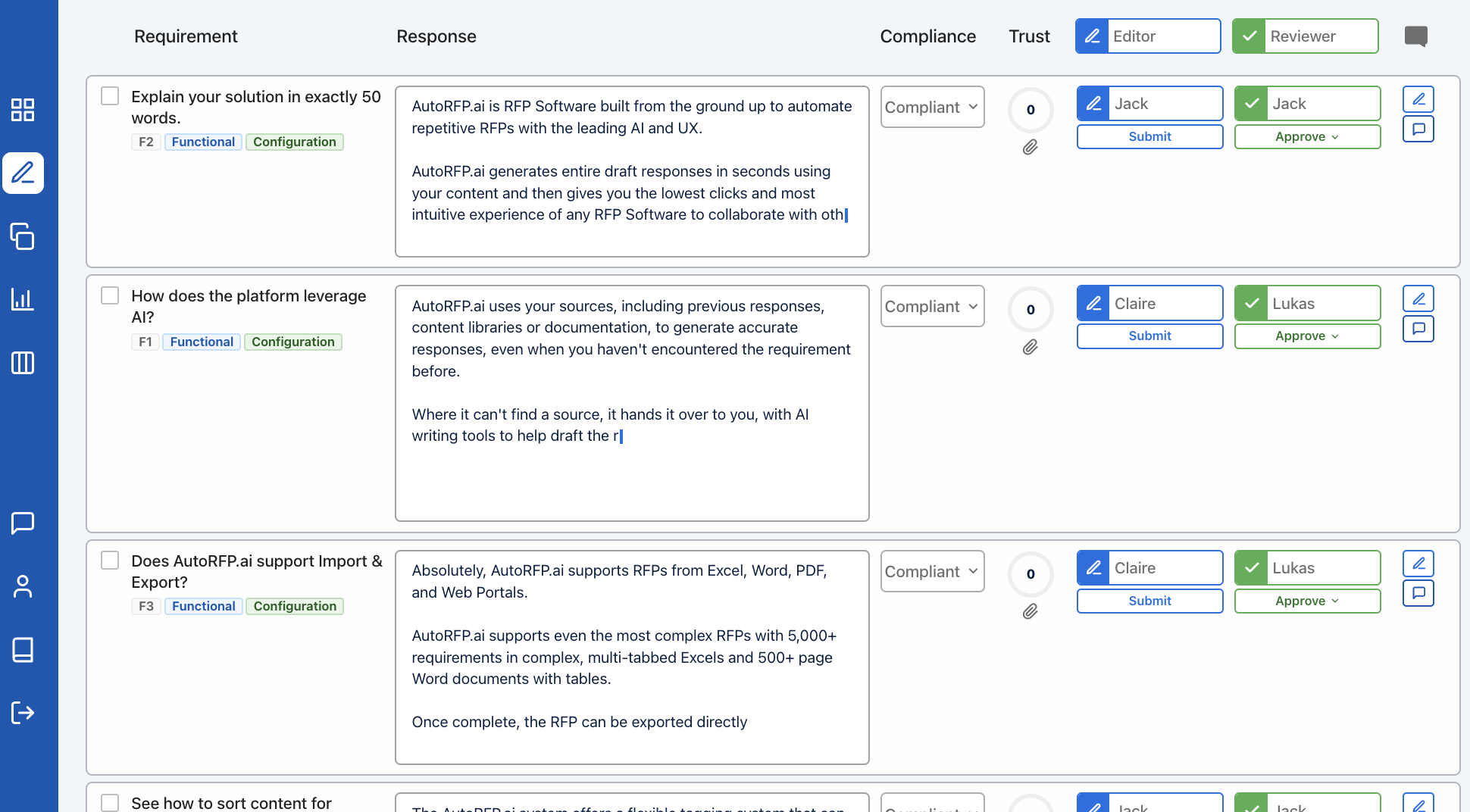
AutoRFP.ai is an AI-native RFP automation platform aimed at lean enterprise teams that want fast drafting without maintaining a large content library. Best for high-volume teams that prioritize speed and want to work directly in vendor portals.
Key features of AutoRFP.ai
- AI response engine. Generates draft answers for hundreds of requirements at once, trained on past winning responses.
- Portal and format support. Works across Excel, Word, PDF, and vendor portals via a browser extension.
- Trust Scores. Rates each generated answer so reviewers know what to verify; supports 30+ languages.
Strengths of AutoRFP.ai
G2 reviewers cite big time savings on RFPs and security questionnaires, accurate drafting from approved content, fast responses, and highly rated customer support.
Limitations of AutoRFP.ai
G2 reviewers point to a learning curve without training, web-only access, limited template flexibility, and no source documents beyond past responses. It also lacks automated conflict detection and competitive intelligence.
AutoRFP.ai integrations
Google Drive, SharePoint, Confluence, Notion, and Salesforce.
AutoRFP.ai pricing
Transparent, no-add-on pricing; the Scale plan runs about $899/month, with annual contracts available.
Why choose AutoRFP.ai
Best for lean, AI-first teams that want speed across portals and formats without heavy library maintenance.
Also Read: AutoRFP vs Inventive AI: Which Wins More Deals?
7. QorusDocs
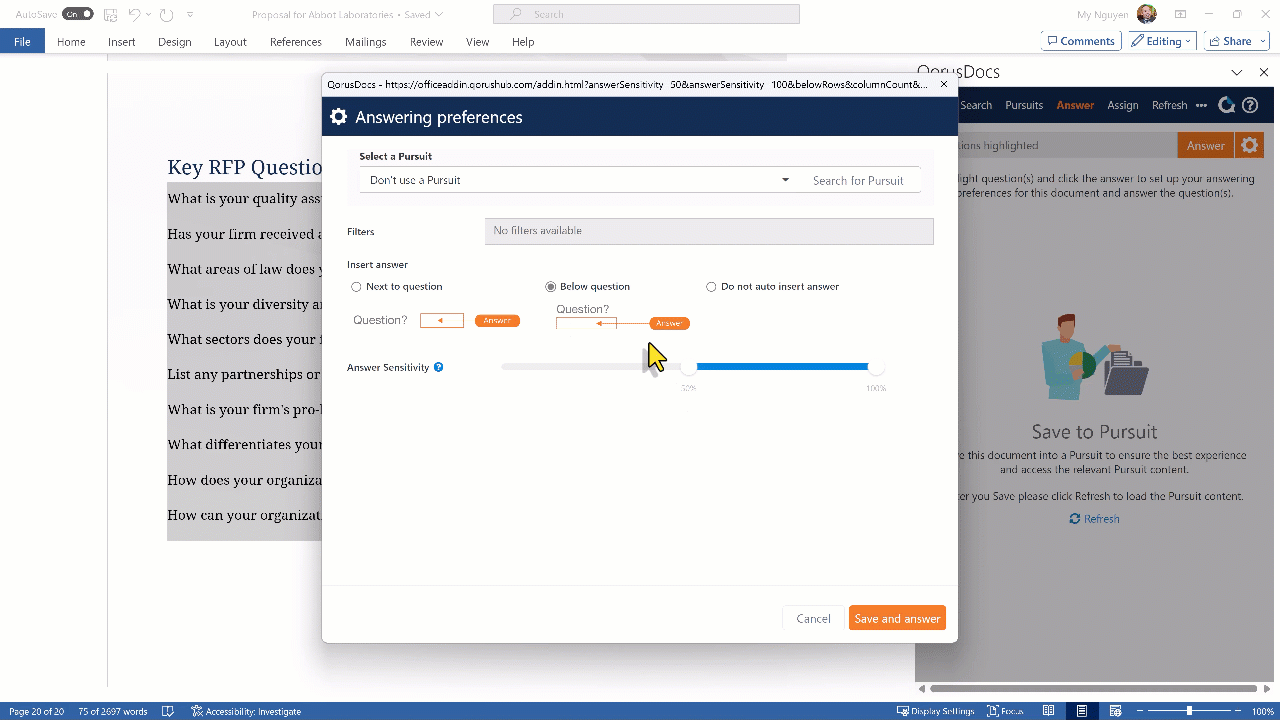
QorusDocs is an AI-powered proposal and RFP management platform built for Microsoft-centric enterprises. It works inside the Microsoft 365 stack to assemble content, manage a knowledge library, and coordinate contributors.
Key features of QorusDocs
- Microsoft-native workflow. Works across Word, PowerPoint, Outlook, and SharePoint for in-context content assembly.
- Knowledge and content library. Centralizes approved content with search for consistent messaging.
- AI content assistance. Auto-answers common questions and drafts sections from stored content.
- Real-time collaboration. Lets distributed teams co-author and review responses.
Strengths of QorusDocs
Reviews consistently point to the deep Microsoft Office integration, an easy day-to-day experience, strong content search, and responsive support, a natural fit for teams already in Microsoft 365.
Limitations of QorusDocs
G2 reviewers report a steep learning curve and complex setup, occasional slow performance, and heavy dependence on the Microsoft ecosystem. AI content generation is limited next to AI-native tools, there's no win/loss tracking, and content curation still requires manual effort.
QorusDocs integrations
Microsoft Office, Outlook, PowerPoint, OneDrive, SharePoint, Dynamics 365, and Salesforce.
QorusDocs pricing
Quote-based across Business and Enterprise tiers; not publicly listed.
Why choose QorusDocs
A fit for Microsoft 365 enterprises that want proposal and RFP management inside the tools their teams already use.
8. SiftHub
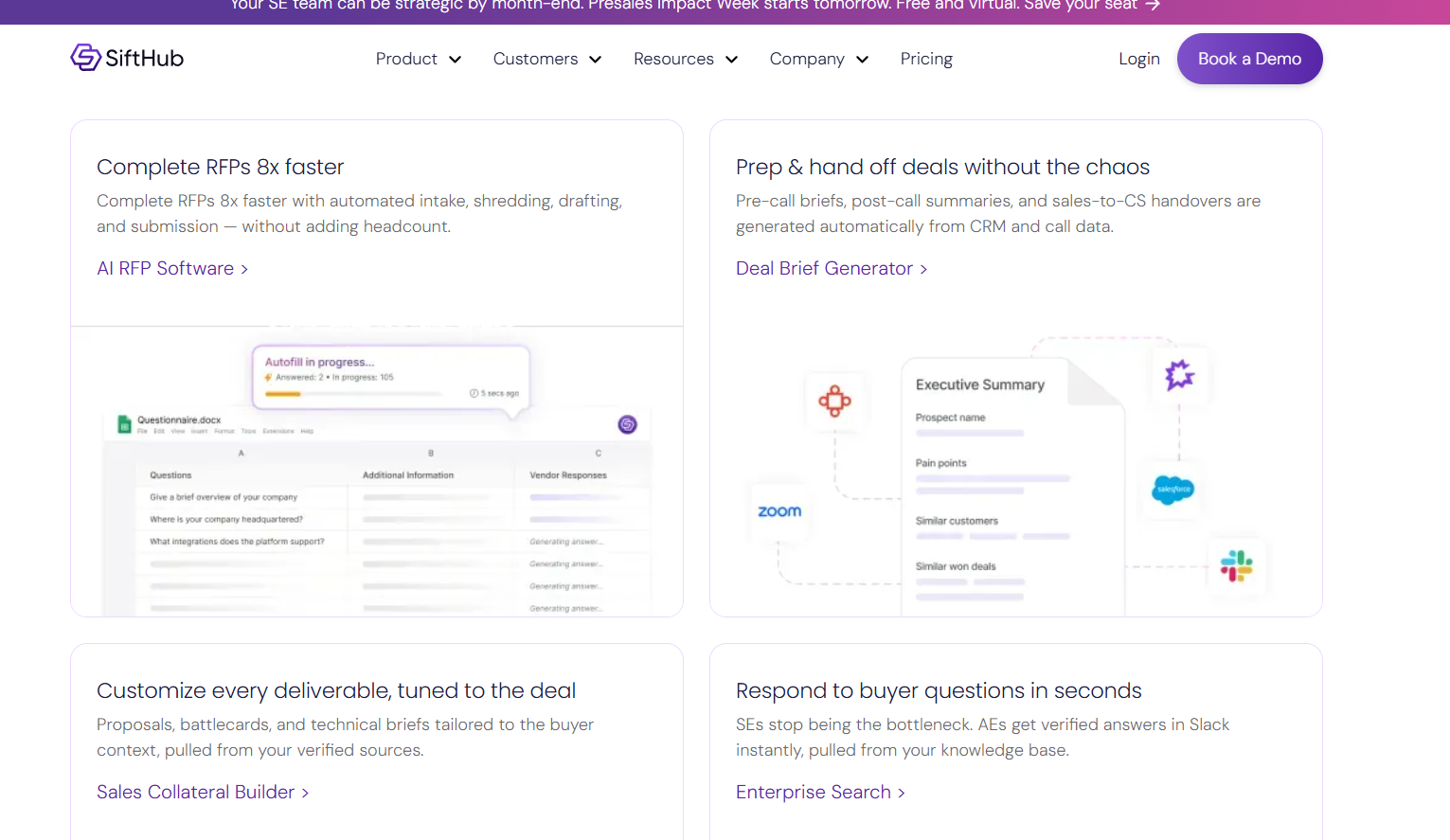
SiftHub is an AI-native knowledge and RFP response platform for enterprise presales, solutions engineering, and revenue teams. It retrieves answers from connected enterprise systems and auto-drafts responses to RFPs, RFIs, and security questionnaires.
Key features of SiftHub
- AI answer generation. Drafts responses from connected knowledge to cut manual writing.
- Knowledge hub. Retrieves current, approved information across systems for RFP answers.
- Executive snapshots and follow-ups. Surfaces summaries and recommended next steps.
- Collaboration. Supports team review across presales and sales.
Strengths of SiftHub
G2 users rate the clean interface and easy setup, and single out auto-generation as a major time-saver that produces accurate, up-to-date answers for filling RFPs quickly.
Limitations of SiftHub for enterprise teams
G2 reviewers report limited depth on large, complex documents, formatting and source-transparency gaps in the AI, and exports that lose formatting with tables or branded templates. A smaller user base also means less community support than incumbents.
SiftHub integrations.
Confluence, SharePoint, Google Drive, Slack, Salesforce, Seismic, and more.
SiftHub pricing.
Subscription-based; quoted by team size and usage, not publicly listed.
Why choose SiftHub.
A fit for presales and revenue teams that want fast, AI-generated answers grounded in existing knowledge, on shorter, structured responses.
Also Read: Best SiftHub Alternatives for RFP Management in 2026
9. 1Up
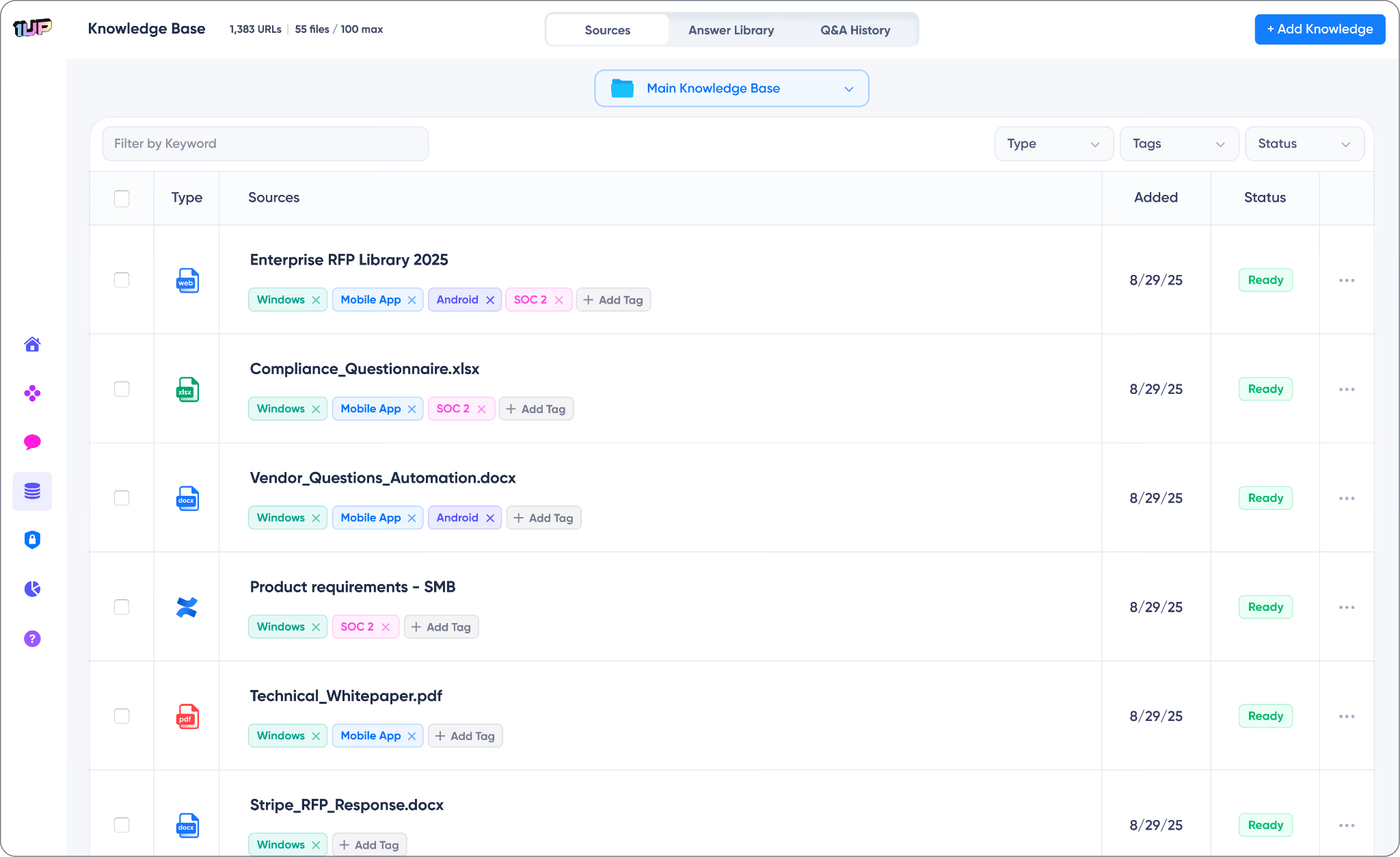
1Up is an AI-native response platform that automates high-volume, repetitive RFP and questionnaire answers from internal knowledge bases. Within large organizations, it fits teams that need to clear routine security and company-overview questions fast, rather than run a governance-heavy enterprise bid program
Key features of 1Up
- Knowledge-based answer generation. Pulls from internal knowledge to draft common responses.
- Automated answer population. Fills repeated questions across RFPs and questionnaires.
- Chatbot retrieval. Answers queries from connected sources on demand.
- Collaboration workflows. Supports team coordination on responses.
Strengths of 1Up
G2 users find it easy to use and quick to fit into existing workflows, praise the time-saving automation on RFI/RFP responses, and highlight responsive support that ships fixes fast.
Limitations of 1Up for enterprise teams
G2 reviewers note inconsistent AI output quality, difficulty with complex questions, and a question-length limit. Reviewers and analysts also flag that it lacks the scalability, customization, and security depth larger enterprises expect, so it fits smaller or mid-market teams better than complex enterprise programs.
1Up integrations.
Slack, Confluence, Google Drive, SharePoint, and Salesforce.
1Up pricing.
Starts around $250–$300/month.
Why choose 1Up.
A fit for lean teams that want fast, low-cost automation for repetitive RFP and questionnaire answers, rather than deep enterprise governance.
10. Tribble
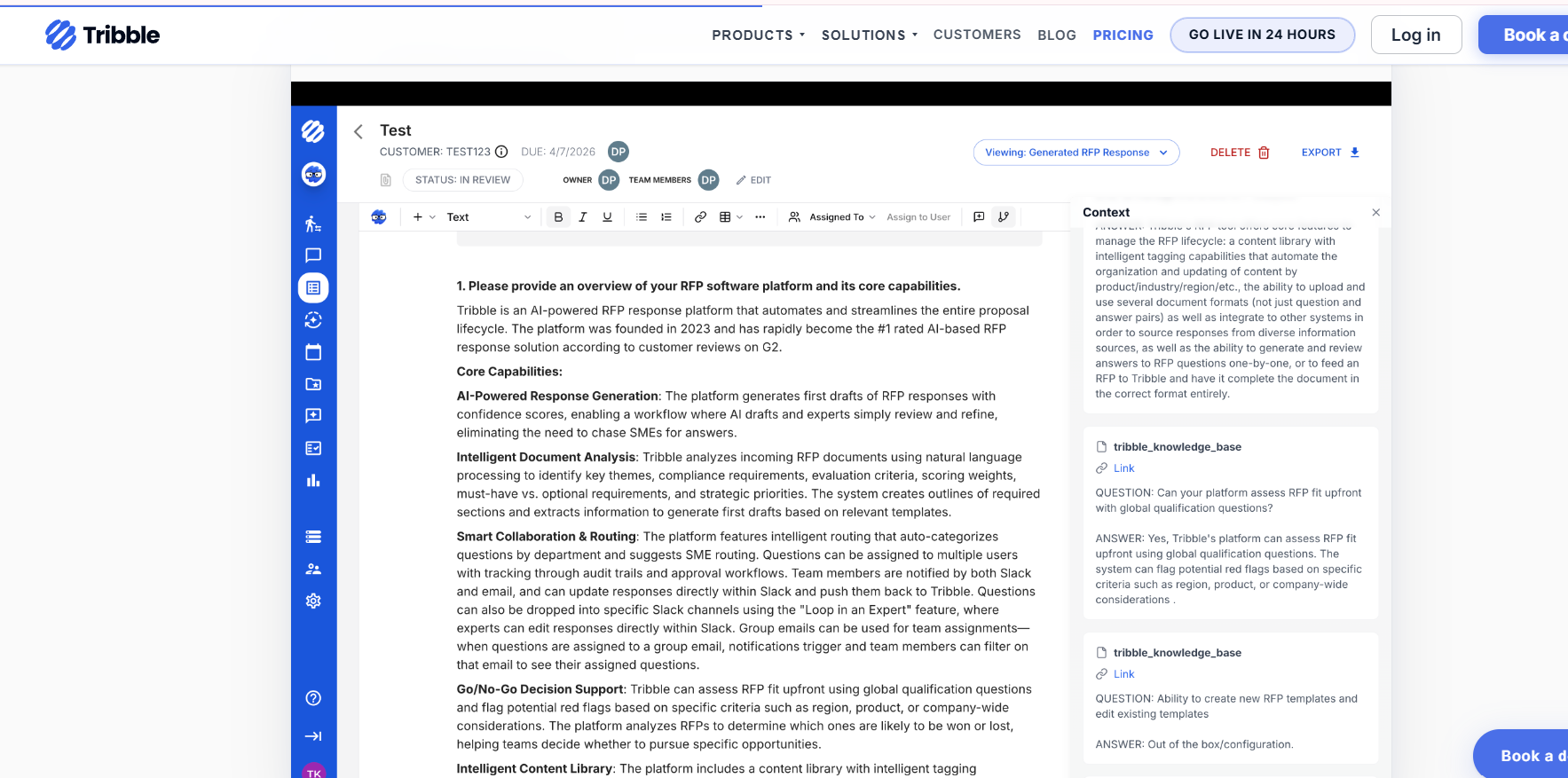
Tribble is an AI-native response platform for enterprise teams answering RFPs and security questionnaires, with an AI agent that drafts from company knowledge and works inside Slack.
Key features of Tribble
- AI response agent. Drafts answers from connected knowledge and past responses.
- Slack-native workflow. Retrieves answers and drafts directly in Slack for fast turnaround.
- Tribblytics. Reports on outcomes and response performance.
- Buyer-context personalization. Tailors answers to the specific deal.
Strengths of Tribble
Quick to set up and easy to adopt, with reviews pointing to major time savings on RFP responses and standout Slack integration. Unlimited-user pricing draws praise over per-seat models.
Limitations of Tribble
Some users flag occasional inaccuracies that need checking, and note it struggles with open-ended, narrative-heavy proposals. Gaps with tools like Dynamics 365 and still-maturing capabilities can challenge teams with established workflows.
Tribble integrations
Slack, plus connected knowledge sources; some enterprise integrations (e.g., Dynamics 365) are still developing.
Tribble pricing
Unlimited-user, usage-based pricing; not publicly listed.
Why choose Tribble
A fit for enterprises that want fast, Slack-based AI drafting for structured RFPs and questionnaires.
Also Read: Top 10 Tribble Competitors and Alternatives for RFP Management
Traditional Enterprise RFP Software vs AI-Native Platforms
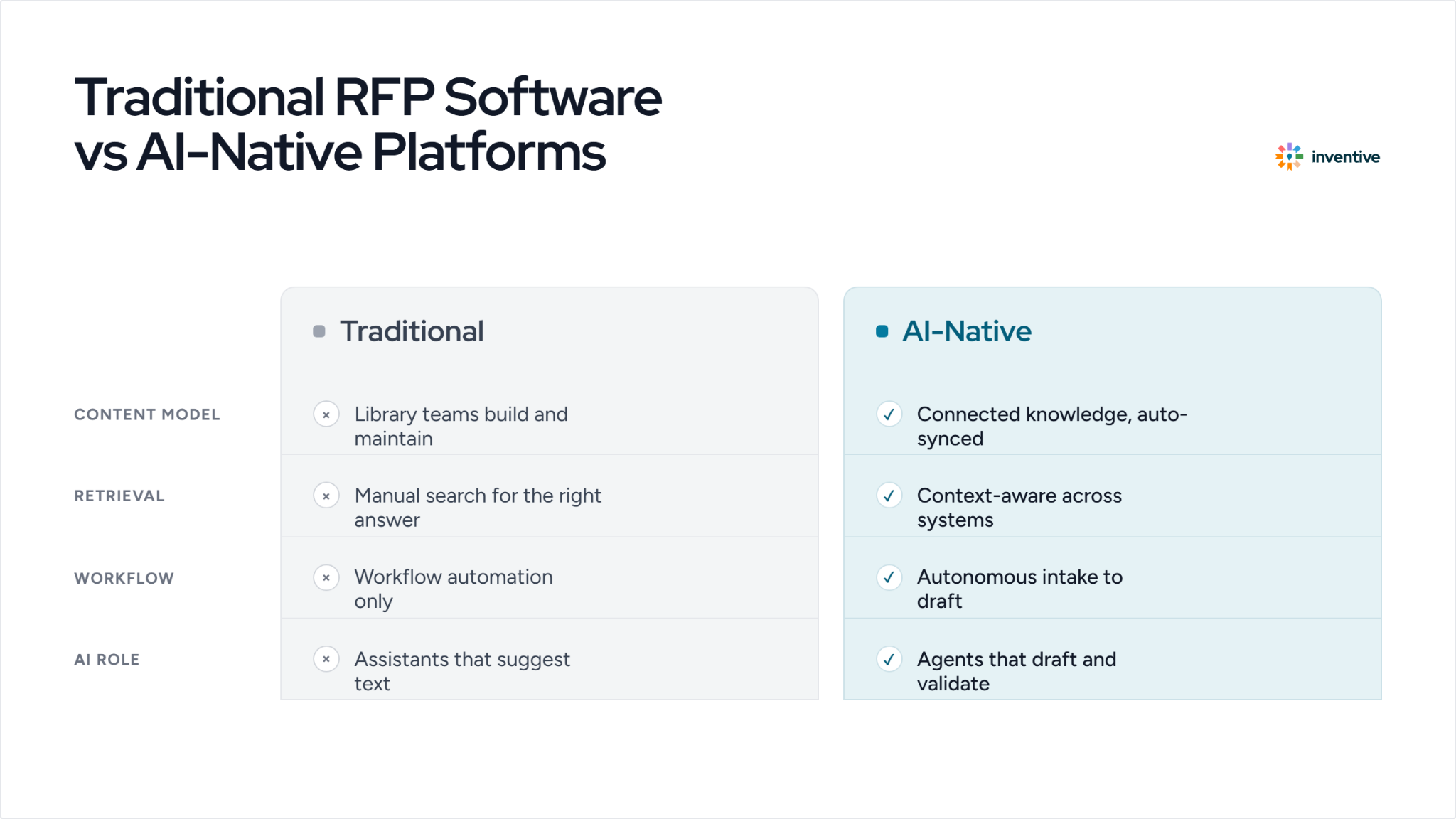
Enterprise RFP software falls into two camps. The difference is where your team spends its time, maintaining content or supervising AI.
| Traditional platforms | Autonomous platforms |
|---|---|
| Content libraries teams build and maintain | Connected company knowledge, synced automatically |
| Manual search for the right answer | Context-aware retrieval across systems |
| Workflow automation | Autonomous workflows from intake to draft |
| AI assistants that suggest text | AI agents that draft, validate, and flag issues |
| Human-driven execution | Human-supervised automation |
See how Insider cut RFP response time 90% and achieved a 50% win rate with Inventive AI.
Read the case studyWhich Enterprise RFP Platform Should You Choose?
Match the platform to how you manage knowledge. If your team already curates a large content library and has the staff to maintain it, Responsive and Loopio are the established choices, just budget for content owners and per-seat fees. If you'd rather skip that upkeep, AI-native tools like Arphie and AutoRFP.ai draft directly from connected sources and scale with leaner teams.
And if you want AI grounded in live company knowledge with conflict detection and compliance checks built in, Inventive AI is designed for that at enterprise scale, with unlimited-user pricing that keeps every SME and reviewer in the workflow.
Win more enterprise deals with responses that are accurate, on-brand, and on time.
See how Inventive AI does it.
Book a demoFAQs
How long does it take to implement enterprise RFP software?
It depends on the architecture. AI-native platforms that connect to your existing systems can go live in days. Library-based platforms take weeks to months to build or migrate the content library and configure workflows. Inventive AI draws from your current knowledge sources, so teams start without first building a library.
Is enterprise RFP software secure enough for sensitive bid data?
For most enterprises, this is the deciding question. Look for SOC 2 Type II compliance, role-based access, SSO, and a clear policy that your data is never used to train public models. Inventive AI and Arphie, for example, keep customer data isolated from public model training.
Can enterprise RFP software integrate with our CRM and knowledge systems?
Yes. Most connect to Salesforce, SharePoint, Confluence, and SSO providers like Okta. AI-native tools go further, retrieving answers live from those systems as content changes. Confirm your specific stack and SSO are supported before buying, since integration depth varies widely.
How does enterprise RFP software keep answers consistent across global teams?
Consistency comes from a single source of current, approved knowledge. Library platforms rely on a content owner to maintain it; AI-native platforms sync from connected systems and flag conflicting or outdated answers automatically, so regional teams don't submit different versions of the same response.
How do enterprises measure ROI on RFP software?
Track response time, number of RFPs submitted, SME hours saved, and win rate before and after adoption. Enterprises report large cuts in turnaround and higher throughput. Running a short pilot or using an ROI calculator helps baseline the impact for your buying committee.

.avif)


.png)