
Conveyor AI Price, Features, Reviews & Ratings 2026
In this blog, we’ll break down Conveyor AI pricing and reviews. We'll also explore when teams may need a more robust RFP automation platform to support their next stage of growth.

Introduction
Conveyor has become a go-to platform for SaaS companies looking to automate customer trust workflows. The value of automation is clear.
Studies indicate that 92% of companies plan to invest in GenAI over the next 3 years. Also, more than 70% of employees believe that GenAI will change 30% of their work in the next two years. As a result, teams increasingly expect AI to handle not just basic tasks but complex, end-to-end workflows.
However, as organizations scale, some teams begin to encounter limitations. This is where platforms built specifically for full-funnel RFP automation enter the conversation.
In this blog, we’ll break down Conveyor AI pricing and reviews. We'll also explore when teams may need a more robust RFP automation platform to support their next stage of growth.
We will also see how Inventive AI is often evaluated alongside Conveyor by growing teams that need greater control, accuracy, and cross-functional collaboration across complex proposals.
Key Takeaways
- Conveyor is strong for security questionnaires, helping teams automate repetitive responses, centralize trust documentation, and speed up basic vendor review processes.
- Its limitations become visible at scale, especially for teams managing RFPs, RFIs, DDQs, and technical questionnaires that require deeper accuracy, governance, and multi-team workflows.
- Teams with complex, enterprise-scale RFP programs may find the depth of Conveyor insufficient for advanced proposal governance and full-funnel automation.
- Inventive AI fills these gaps with an AI RFP Agent built for high-volume, complex proposal workflows.
- Small and large teams, outgrowing basic questionnaire tools, choose Inventive AI to streamline RFP operations, eliminate manual rework, accelerate deal cycles, and maintain complete content accuracy across teams.
Must Read: How AI in Presales Helps Teams Win Faster and Sell Smarter
Conveyor AI Overview: Key Features and Pricing
Conveyor uses AI to automate customer trust workflows for SaaS companies. It helps teams host a Trust Center, securely share compliance documents, and manage customer security requests. With AI-generated answers for security questionnaires and RFPs, teams can respond faster with less manual effort.
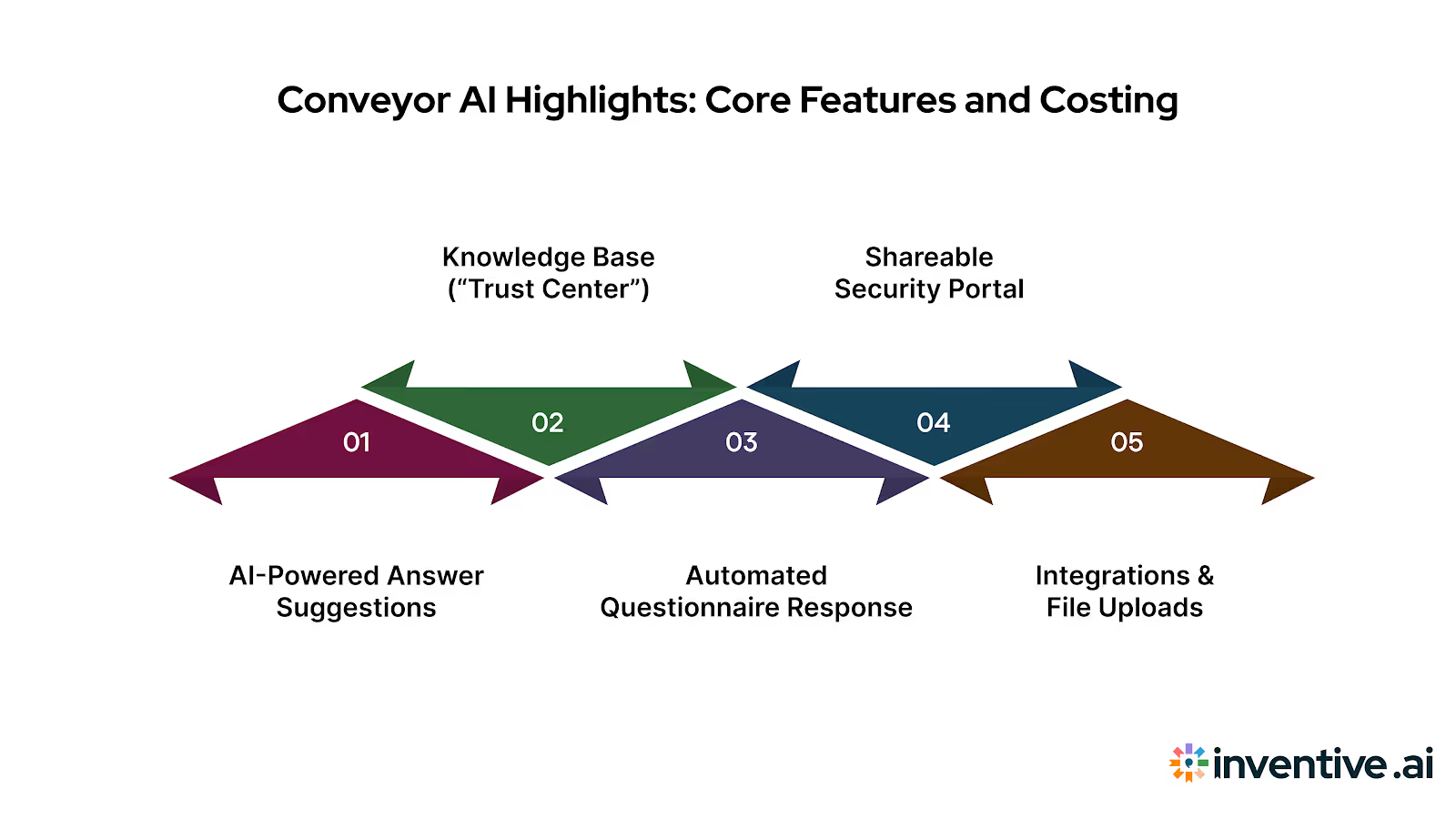
AI-Powered Answer Suggestions
It suggests answers using previously approved content, helping teams respond to security questionnaires faster. But, its AI is limited to lightweight question matching and cannot deeply interpret complex RFP or technical questions.
Knowledge Base (“Trust Center”)
Teams can store common answers, documents, audit reports, and certifications in a centralized hub. But the knowledge base is not built for enterprise-level content governance, multi-team collaboration, or large-scale RFP libraries.
Automated Questionnaire Response
The platform can auto-fill vendor security questionnaires using existing answers, saving time for smaller teams. But accuracy varies, and users still need to review outputs, especially for nuanced or customer-specific requirements, manually.
Shareable Security Portal
Companies can create a self-serve portal so prospects can access security documentation. But, it only addresses the security side of questionnaires and not broader RFP, RFI, or technical proposal workflows.
Integrations & File Uploads
It facilitates the uploading of documents and allows for integrations with basic tools. Conveyor does have a Slack integration (often used for SME "Ask" workflows).
Let’s break down what is publicly available about its pricing and how each plan aligns with different team sizes and operational needs.
Must Read: AI for B2B SaaS Revenue Teams: Top 9 Tools, Use Cases, and Proven ROI
Pricing Breakdown
Conveyor offers flexible pricing designed to support security reviews and customer trust workflows, with plans for both small teams and growing organizations.
Although the platform streamlines security questionnaires and automates trust-center management, its costs can rise quickly for scaling teams. Since it is built primarily for security questionnaires, not structured RFP or RFI workflows, teams often still need a dedicated platform to handle complex proposal processes with accuracy and governance.
Must Read: AI for Presales Teams: Best Use Cases, Tools, and Strategies in 2025
How Inventive AI Outperforms Conveyor?
Inventive AI is built for teams managing complex RFPs, RFIs, audits, and technical questionnaires at scale. It emphasizes deep context by pulling from structured and unstructured data sources, like Drive and SharePoint, while maintaining strict brand voice and content control.
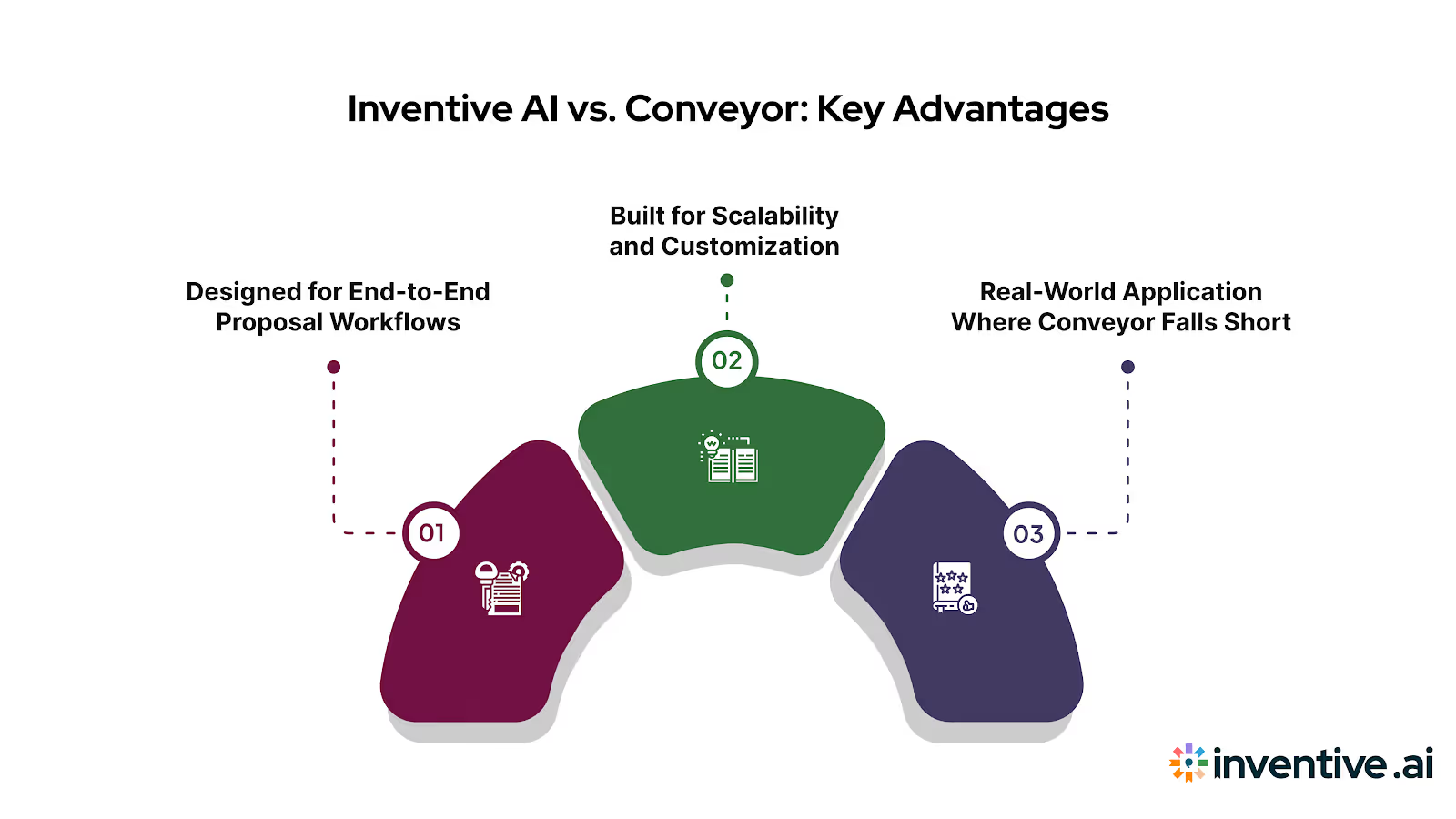
As per Gartner, Inventive has a rating of 5 out 5. Inventive AI is recognized by teams of all sizes, from small companies to large enterprises.
Here is how Inventive AI outperforms other competitors:
1. 2× Higher Response Quality, 95% Answer Accuracy
Inventive AI provides better quality answers than Conveyor, which helps increase the chances of winning RFPs. With 95% accuracy and 66% of answers requiring little to no manual editing, teams spend less time rewriting and more time submitting confident, competitive proposals.
2. Multi-Layer Context Engine for Intent-Aware Responses
Unlike tools that rely on shallow lookups or keyword matching, Inventive AI uses a multi-layer context engine to understand the full RFP. This enables tailored, complete responses that reflect true intent, nuance, and business context.
3. Automatic Conflict Detection Across Responses
Inventive AI proactively identifies conflicting or inconsistent statements within and across responses. This reduces the risk of contradictory submissions and helps teams maintain consistency throughout complex, multi-section RFPs.
4. Outdated Content Detection to Reduce Manual Review
Inventive AI automatically flags outdated or potentially non-compliant content within large answer libraries. This minimizes manual review effort while increasing confidence in the relevance and accuracy of every response.
5. Narrative-Style Proposal Generation Beyond Q&A
Unlike Conevyor AI, Inventive AI supports long-form, narrative-driven proposals such as executive summaries, security overviews, and business cases. This enables cohesive, end-to-end proposal creation beyond traditional question-and-answer workflows.
This is how the two platforms differ: Conveyor takes a different approach by focusing primarily on customer trust and security review workflows. It excels at streamlining security questionnaires through high-accuracy AI responses and a self-serve Trust Center. This allows prospects to securely access compliance documents, sign NDAs, and receive instant answers.
How Inventive AI Performs in Independent Reviews
Here's what customers of Inventive AI say about the efficiency of the platform.
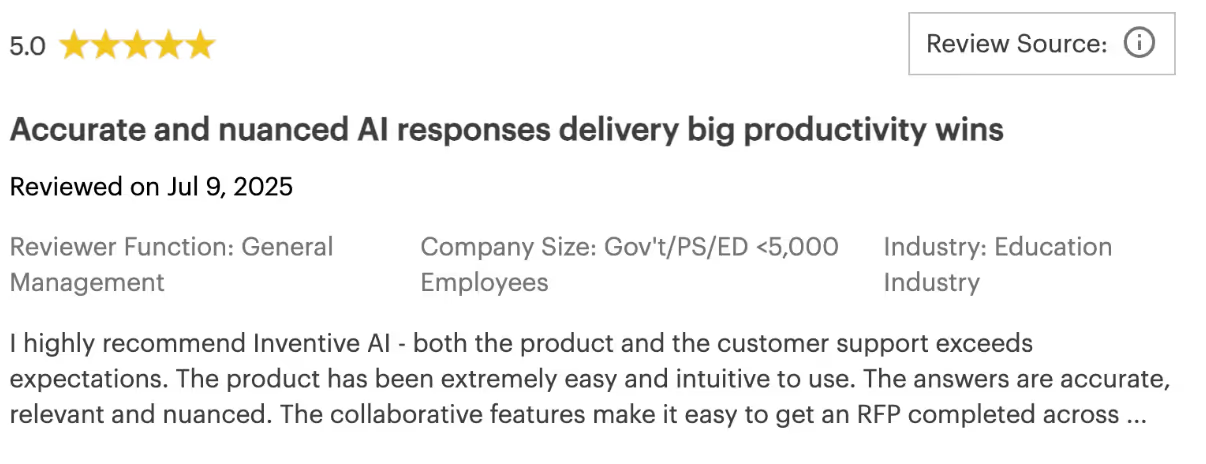
Conveyor’s Strengths and Weaknesses
Conveyor offers a simple, structured way for teams to manage security questionnaires and share trust documentation with prospects. While it supports basic automation and a centralized knowledge hub, it remains better suited for small or mid-sized organizations with predictable security review workflows.
Here's what customers say about Conveyor AI on G2
G2 Rating: 4.6/5
Strengths
- Strong fit for security teams that want a controlled, documentation-first workflow.
- Works well for organizations that rely heavily on standardized DDQs and predictable security questionnaires.
- Provides a familiar process for teams that value human-in-the-loop review alongside AI-generated answers.
- Appeals to compliance-driven teams who value curated libraries over dynamic, AI-generated responses.
- A stable option for companies not yet ready to adopt deep AI-driven content governance or multi-agent automation.
- Low disruption for teams comfortable with lookup-based answer retrieval and manual review cycles.
- Well-suited for security-focused environments that rely on consistent, template-led responses.
Weaknesses
- Relies on lookup-based answer suggestions; cannot deliver context-aware, SME-level drafting.
- Cannot benchmark answer quality, accuracy, or completeness; output quality varies by user.
- Manual content uploads and library updates increase maintenance load as teams scale.
- Collaboration is security-team-centric; it lacks parallel, cross-department (sales, legal, proposal) collaboration flows.
- Conveyor's conflict detection operates at the document level, identifying discrepancies during the draft review process. This requires users to manually correct the contradictions within the questionnaire.
- Lacks zero-hallucination safeguards and source-linked citations for accuracy-critical responses.
Conveyor AI has some limitations that people have pointed out in G2 reviews:

Must Read: AI for Enterprise Deals: Top 8 AI Tools, Use Cases, and Proven ROI
Why Conveyor Isn’t Enough for Enterprise-Level Needs?
It works well for smaller teams that need a simple way to automate repetitive security questionnaires, but enterprise organizations quickly run into its structural limitations. As RFPs, RFIs, DDQs, and complex security questionnaires scale in volume and depth, teams require far more robust automation, stronger governance, and multi-department support than what the platform is designed to provide.
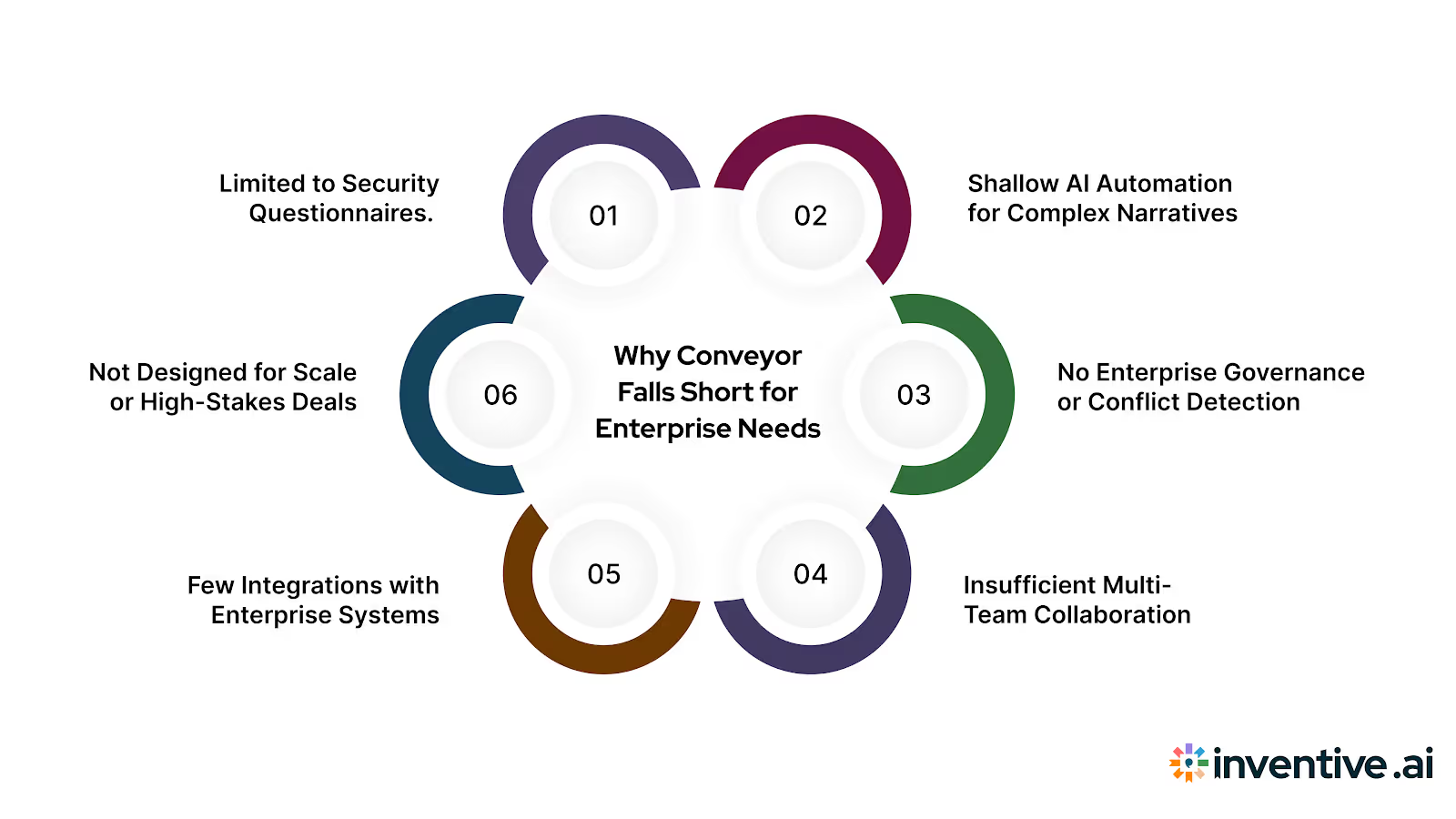
1. Limited to Security Questionnaires.
Enterprise sales cycles require automation across RFPs, RFIs, technical questionnaires, compliance narratives, and cross-functional approvals. Its scope is narrow, focusing primarily on security questionnaires and trust centers, leaving major parts of the proposal lifecycle unmanaged.
2. Shallow AI Automation for Complex Narratives
The platform works for repeat answers but does not generate context-rich, deal-specific responses. Enterprises need AI that can interpret complex requirements, align responses to technical architecture, and adapt content across multiple documents.
3. Insufficient Multi-Team Collaboration
Enterprise RFPs require synchronized collaboration between sales, solutions, security, legal, and compliance teams. Conveyor does not support end-to-end multi-team workflows, approvals, or structured review cycles.
4. Not Built for Scaling Volumes or High-Stakes Deals
As questionnaire volume increases, teams report manual cleanup, inconsistent answers, and heavy reliance on human review. Conveyor’s automation does not scale effectively for organizations responding to hundreds of RFPs and security documents annually.
Must Read: Top AI Knowledge Management Tools for 2025
Inventive AI: Turn Complex RFPs Into High-Quality, Deal-Winning Proposals
Conveyor offers solid value for teams that need a simple way to manage security questionnaires, host trust documentation, and automate repeat answers. For small and mid-sized organizations with predictable security review cycles, its ease of use and straightforward automation make it a convenient starting point.
However, these strengths don’t translate into the demands of enterprise proposal operations. Conveyor lacks the cross-functional collaboration, end-to-end automation, and enterprise-grade governance required to manage high-stakes RFP and proposal lifecycles effectively.
This is where Inventive AI creates a measurable shift. Purpose-built for complex, high-volume RFPs, RFIs, DDQs, and security questionnaires, Inventive AI’s AI RFP Agent brings contextual intelligence, multi-agent automation, and unified knowledge governance into one system.
FAQs
1. What is Conveyor used for?
It is primarily used to automate security questionnaires and share trust documentation with prospects. It helps teams reuse approved answers, host security reports, and speed up basic questionnaire responses. However, it is not designed for end-to-end RFP or RFI workflows.
2. Is Conveyor suitable for enterprise-level RFP and proposal management?
The platform works well for smaller teams with predictable security reviews, but it lacks the advanced governance, deep AI contextual drafting, and multi-team workflow automation required for enterprise-scale RFPs.
3. How does Inventive AI compare to Conveyor?
It focuses on security questionnaires, while Inventive AI is designed for complete RFP, RFI, DDQ, and proposal automation. Inventive AI’s AI RFP Agent delivers faster first drafts, 95%+ contextual accuracy, inline citations, content freshness monitoring, and multi-agent automation.
4. Does Conveyor help with content governance or keeping answers up to date?
It allows teams to store and reuse approved answers. Still, it does not offer advanced content governance features like automated conflict detection, freshness checks, or version control across large knowledge bases.

90% Faster RFPs. 50% More Wins. Watch a 2-Minute Demo.

Dhiren Bhatia
Tired of watching deal cycles stall due to manual questionnaire back-and-forth, Dhiren co-founded Inventive AI to turn the RFP process from a bottleneck into a revenue accelerator. With a track record of scaling enterprise startups to successful acquisition, he combines strategic sales experience with AI innovation to help revenue teams close deals 10x faster.

Gaurav Nemade
After witnessing the gap between generic AI models and the high precision required for business proposals, Gaurav co-founded Inventive AI to bring true intelligence to the RFP process. An IIT Roorkee graduate with deep expertise in building Large Language Models (LLMs), he focuses on ensuring product teams spend less time on repetitive technical questionnaires and more time on innovation.