The Ultimate Guide to Crafting Data Management RFP Responses
A step-by-step guide to responding to data management RFPs, key components, common mistakes, and how to craft accurate, compliant proposals that win.
If your team responds to data management RFPs, you know how much they ask for: detailed answers on your data architecture, integrations, and privacy compliance, all backed by proof.
That work adds up. On average, a single response takes about 23.8 hours to put together. When you're handling several bids a month, the drafting, formatting, and approvals can quickly eat up your team's time, and rushed responses tend to feel generic.
This guide walks through what a strong data management RFP response includes, the common mistakes to avoid, and how AI can help you respond faster and more accurately.
Key Takeaways
- A winning data management RFP response mirrors the buyer's requirements and evaluation criteria, answers each point in their language, not with a generic pitch.
- Every data management RFP centers on the same components: business requirements, data governance and lineage, technical specs, security and compliance, budget, SLAs, and vendor track record.
- Compliance is often the deal-breaker. GDPR, HIPAA, and security standards must be addressed directly, or a strong proposal can still be disqualified.
- Most losses come from avoidable mistakes: vague or unanswered requirements, overly technical jargon, and missing evaluation criteria.
- AI shortens responses by drafting from your existing content, citing sources, and flagging outdated answers so teams respond faster and more accurately.
What Is a Data Management RFP?
A Data Management RFP is a formal document created by organizations to solicit proposals from vendors offering data management solutions. It outlines the organization’s specific requirements for data storage, security, processing, and analytics.
As a vendor, your job is to understand these requirements thoroughly and craft a proposal that aligns with the buyer’s business objectives.
Think of the RFP as a roadmap to guide your response. By carefully reviewing the document, you’ll gain a clear understanding of what the buyer is looking for, allowing you to tailor your proposal effectively and showcase how your solution meets their needs.
Also Read: How AI in Presales is Redefining Speed, Accuracy, and Win Rates
What is the Importance of a Data Management RFP?
Understanding the importance of a Data Management RFP is necessary; it’s not just about responding to a document but about seizing an opportunity to align your solution with the buyer's needs.
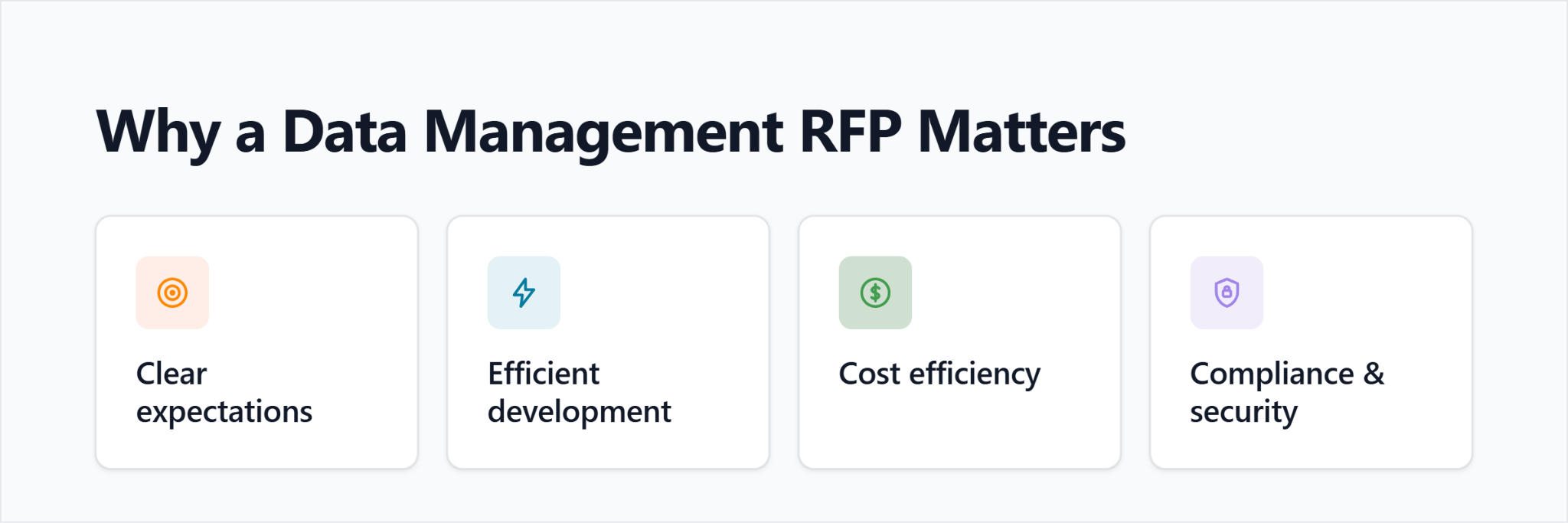
Here’s why a data management RFP is essential for you as a vendor:
1. Clear Expectations
A well-structured RFP gives you a clear understanding of the buyer’s requirements, ensuring you don’t waste time on misaligned proposals and can focus on what matters most.
2. Efficient Proposal Development
By reviewing the RFP’s detailed specifications, you can tailor your response based on objective criteria, including technical needs and budget constraints, which leads to a more focused and effective proposal.
3. Cost and Resource Efficiency
A comprehensive RFP provides clear budget guidelines and expectations for deliverables, helping you craft a proposal that is realistic, cost-effective, and meets the buyer’s needs without surprises.
4. Compliance and Security
Many data management RFPs will outline specific compliance and security requirements. Understanding these up front allows you to ensure your proposal includes the necessary certifications and aligns with the buyer's regulatory needs.
A Data Management RFP is your key to standing out. By responding effectively, you increase your chances of being selected as the best fit, saving both time and resources for both you and the buyer.
Inventive AI simplifies this process by helping you turn these complex requirements into a winning proposal in a fraction of the time, ensuring your team remains focused on strategy rather than manual drafting.
Also Read: 15 Best RFP Software in 2026: Features, Prices and Reviews
9 Key Components of a Data Management RFP
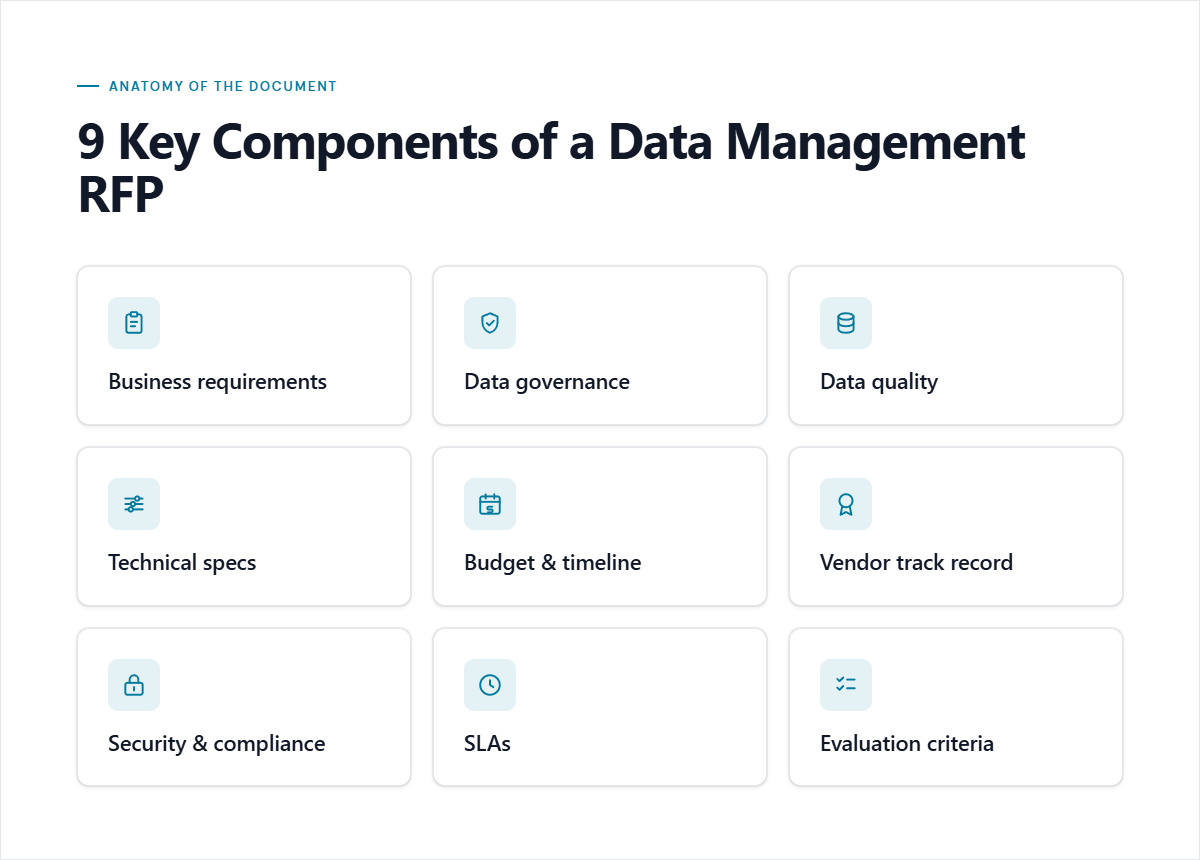
When responding to a Data Management RFP, it’s important to understand the key components outlined in the document. These elements guide your proposal and ensure it aligns with the organization's needs.
Here’s a breakdown of what you should look for:
1. Business Requirements
Understand the organization's primary goals for the data management solution. This could include improving data accessibility, enhancing security, or optimizing storage capacity. Tailor your proposal to demonstrate how your solution addresses these key objectives.
2. Data Governance and Lineage
This is the "make or break" for modern data projects. Clearly define how your solution tracks data from its source to its final destination (lineage) and how you manage metadata to ensure transparency and accountability.
3. Data Quality and Observability
Buyers need to know how you handle "dirty data." Detail your processes for data cleansing, anomaly detection, and real-time monitoring to ensure the data remains a "single source of truth."
4. Technical Specifications
Pay close attention to the technical requirements, such as the type of data to be managed, the required platforms, and integration capabilities. Your response should clearly outline how your solution fits these specifications.
5. Budget and Timeline
Review the provided budget range and project timeline. This helps you shape a proposal that fits within their constraints and demonstrates that you understand the scope of the project.
6. Vendor Qualifications and Proven Track Record
Take note of the buyer’s expectations for vendor experience, certifications, and past projects. Ensure your proposal showcases your relevant experience and expertise in similar data management projects.
7. Security and Regulatory Compliance
Ensure you address any specific regulatory requirements (like GDPR, HIPAA) and security standards that are important to the organization. Demonstrate how your solution meets or exceeds these compliance requirements.
8. Service Level Agreements (SLAs)
Understand the performance levels expected, such as uptime guarantees and support response times. Your proposal should clearly outline how you will meet or exceed these expectations.
9. Evaluation and Scoring Criteria
Look for how the organization plans to evaluate proposals. Whether it’s price, performance, or vendor experience, knowing this will help you tailor your response to match their priorities.
A thorough understanding of these components ensures that your proposal is comprehensive, targeted, and aligned with the organization’s specific needs, improving your chances of success.
Win your next data management RFP faster.
Download the Data Management RFP Response Template4 Common Mistakes to Avoid in Data Management RFPs
When responding to Data Management RFPs, it’s important to avoid certain common mistakes that can derail the proposal process and reduce your chances of success.
Here are some key pitfalls to watch for:'
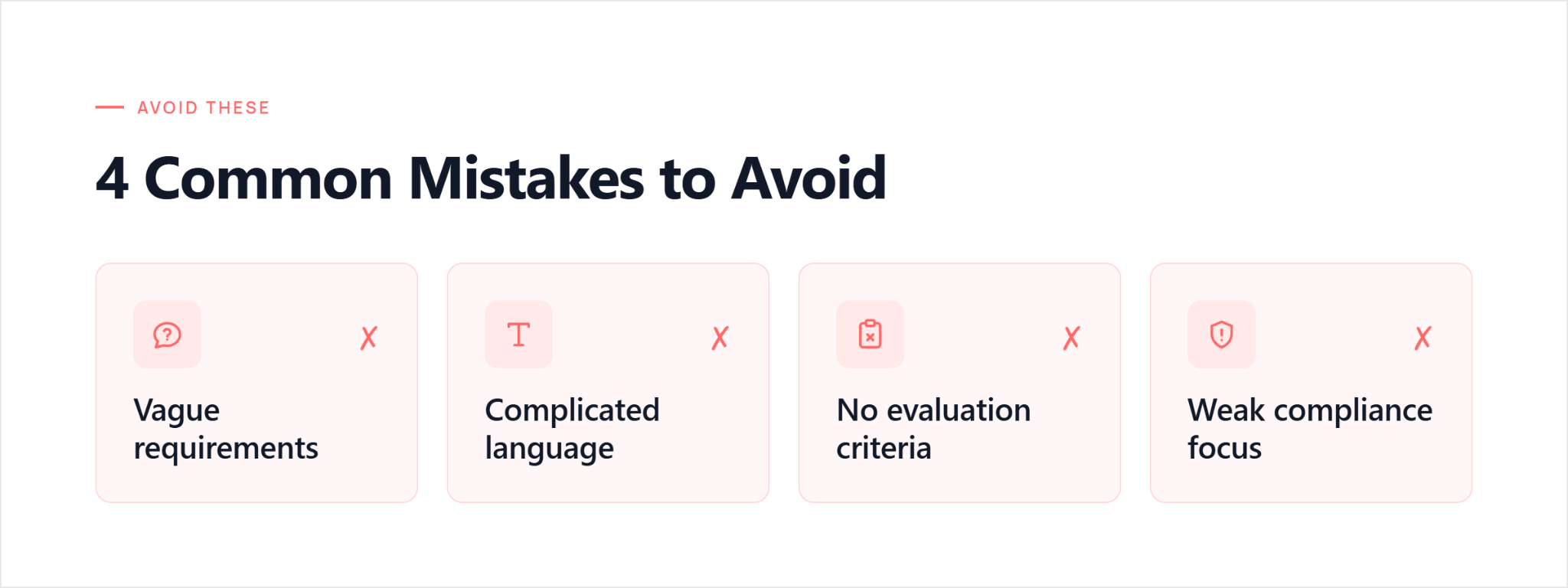
1. Vague Requirements
One of the biggest mistakes you can encounter is an RFP that leaves out critical details like data volume, security standards, or integration requirements.
When you encounter vague or incomplete requirements, it can lead to proposals that are unrealistic or don't fully meet the buyer's needs. Always seek clarification if necessary to ensure your response is accurate and aligned with what’s being asked.
2. Overly Complicated Language
While an RFP may be technical, avoid using overly complex or convoluted language. Clear, concise responses are key to ensuring that your proposal is easily understood. Using complicated jargon or lengthy explanations can confuse the reader and may result in delays or rejection of your proposal. Keep your language simple and to the point while still addressing all technical specifications.
3. Not Including Evaluation Criteria
Some RFPs don’t provide clear evaluation criteria, which can make it difficult to know how your proposal will be assessed. If the criteria aren’t outlined, make sure to ask for them.
Understanding what factors will be prioritized, whether it's pricing, technical capabilities, or past experience, allows you to tailor your response to address those specific areas effectively.
4. Lack of Compliance Focus
Data management projects are often subject to strict compliance and security standards (such as GDPR, HIPAA, etc.). Not addressing these requirements in your response can be a deal-breaker. Make sure your proposal clearly demonstrates how your solution meets or exceeds the buyer’s compliance and security needs. This is particularly important as non-compliance can lead to severe legal consequences.
Avoiding these mistakes will not only ensure that your proposal stands out but will also save time, prevent misunderstandings, and improve your chances of delivering the right solution to meet the buyer’s exact needs.
See how Inventive AI can help improve your RFP response process, save time, and increase your win rate.
Request a Demo today!How to Use a Well-Structured RFP to Write a Winning Response
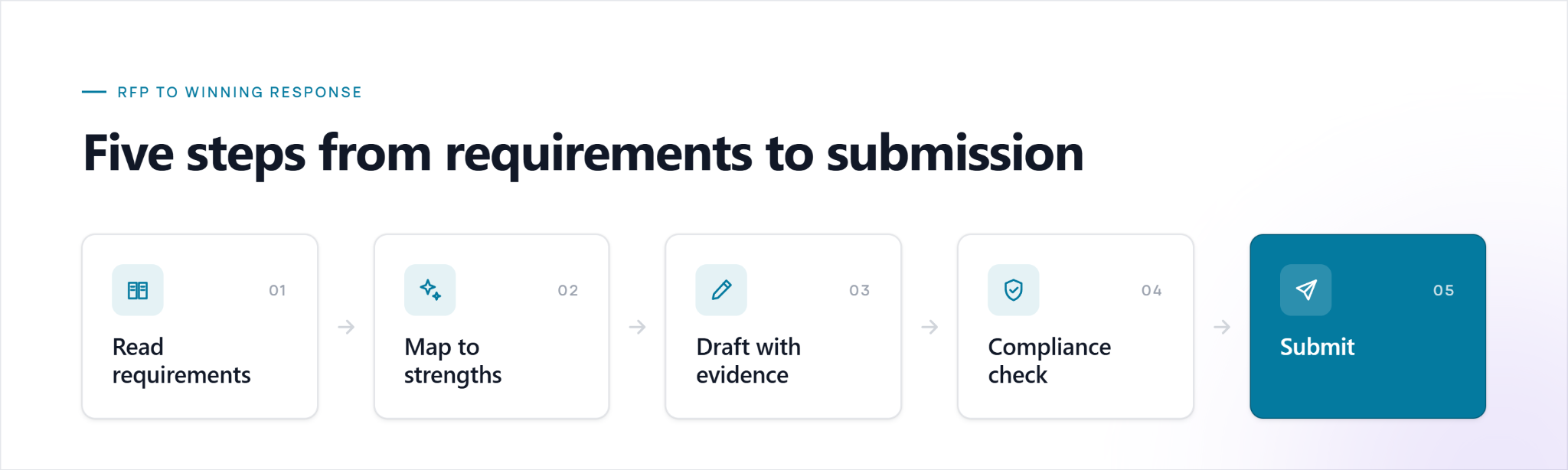
When a buyer's RFP is well-structured, it tells you exactly how to win. Here's how to read it to your advantage as a responder:
- Know exactly what to answer. A detailed RFP spells out every requirement, so you can respond to each one directly instead of guessing what the buyer wants. Map your answer to their language, point by point.
- Tailor a competitive bid. Clear requirements let you position your solution against their specific needs: data governance, integration, compliance, rather than submitting a generic pitch that reads like everyone else's.
- Respond to how you'll be scored. A structured RFP usually reveals its evaluation criteria. Weight your response toward what the buyer values most (price, security, scalability) instead of over-investing in sections that carry little weight.
- Cut the back-and-forth. When expectations are clear, you spend less time chasing clarifications and more time crafting a sharp answer, which means you submit earlier, ahead of competitors.
- Avoid disqualification. Knowing every requirement up front means you never miss a mandatory item or certification, the kind of gap that gets an otherwise strong proposal thrown out before it's even scored.
And when an RFP isn't well-structured? Treat the gaps as your cue to ask questions early (see the common mistakes above). Responders who clarify ambiguity write the most accurate, compliant bids.
Why Choose Inventive AI for Your Data Management RFP Response?
Inventive AI is an autonomous AI agent platform for RFPs, RFIs, and security questionnaires. Its agents draft answers from your own connected knowledge, cite each source, and flag anything unsupported; your team approves.
- Reads the RFP and auto-identifies every question and requirement.
- Pulls answers from your existing systems (SharePoint, Google Drive, Salesforce, Notion. No separate library to maintain.
- Drafts each response with its source and a confidence score.
- Lets teams assign, review, and approve in one workspace.
Advanced Features
- Context Engine: Tailors answers to the buyer's architecture and priorities.
- Content Governance: Flags outdated or conflicting compliance data (e.g., GDPR/HIPAA) before submission.
- Strategic agents: Check the full response for gaps, score deal fit, and sharpen competitive positioning.
SOC 2 Type II compliant; data is never used to train public models.
Insider raised its win rate from 30% to over 50% and cut RFP turnaround time by 90%.
Read the case studyFrequently Asked Questions (FAQs)
1. What is a Data Management Platform (DMP)?
A data management platform is enterprise software for storing, integrating, governing, and analyzing data across an organization. In practice, this spans data warehouses and lakehouses (e.g., Snowflake, Databricks) and governance/catalog tools (e.g., Collibra, Informatica, Alation). In a data management RFP, your job as a responder is to show how your platform meets the buyer's storage, security, and governance requirements.
2. What is the best tool for managing data effectively?
The best data management tool depends on your infrastructure layer. While cloud providers like AWS, Microsoft Azure, and Google Cloud provide the foundational storage and compute, effective data management requires specialized platforms. Industry leaders often include Snowflake or Databricks for data warehousing and processing, and Collibra, Informatica, or Alation for data governance, cataloging, and metadata management.
3. How do I evaluate data management solutions when responding to an RFP?
When evaluating data management solutions for an RFP, focus on several key factors:
- Scalability: Can it handle petabyte-scale growth?
- Interoperability: Does it integrate with existing ETL/ELT pipelines and BI tools?
- Data Governance: Does it offer automated data lineage and metadata tagging?
- Security: Does it support RBAC (Role-Based Access Control) and end-to-end encryption?
- AI Readiness: Is the data structured in a way that can support Large Language Models (LLMs) and predictive analytics?
A comprehensive response should showcase how your solution meets or exceeds these criteria, with relevant examples and case studies to back your claims.
4. Why is compliance important in data management proposals?
Compliance ensures that data is managed in accordance with legal and regulatory standards, such as GDPR, HIPAA, or industry-specific regulations. In your RFP response, it’s critical to highlight how your solution adheres to these standards, ensuring the buyer that their data will be handled securely and responsibly.
5. How can AI-powered tools help with RFP responses in data management?
AI-powered tools like Inventive AI help automate and optimize the RFP response process by analyzing buyer requirements, suggesting relevant content, and generating tailored proposals faster. This increases proposal accuracy, reduces response time by up to 90%, and helps vendors create competitive, high-quality proposals that stand out in the RFP process.

.avif)

%20(18).avif)

.jpg)


%20(13).avif)