Understanding Proposal Writing: A Practical Guide to Winning Deals in 2026

Have you ever submitted a proposal that looked complete, checked every requirement, and still got no response or a silent rejection?
That happens more often than you think. B2B buyers spend limited time reviewing each proposal while evaluating multiple vendors at once. That means your proposal is not just competing on solution quality. It is competing on clarity, structure, and how quickly it answers what the buyer actually cares about.
For most teams, proposal writing becomes a time-heavy process filled with scattered inputs, repeated content, and last-minute edits. You spend hours compiling information, but still feel unsure if the response truly stands out or aligns with evaluation criteria.
In this guide, you will understand what proposal writing really involves, where most teams fall short, and how to approach it in a way that improves both response quality and win rates.
Key Takeaways
- Proposal writing is not about filling documents. It is about helping buyers quickly understand why your solution fits their needs.
- Buyers evaluate proposals based on clarity, relevance, consistency, and how well you align with their scoring criteria.
- Most proposals fail due to generic answers, scattered content, inconsistent messaging, and missed requirements.
- Strong teams improve win rates by customizing responses, maintaining one clear narrative, and making answers easy to evaluate.
- A structured process and tools like Inventive AI help you respond faster, reduce errors, and deliver high-quality proposals at scale.
What Proposal Writing Really Means?
Proposal writing is your response to a buyer’s request, often through an RFP, RFI, or security questionnaire. But what you are really doing goes beyond answering questions.
- You are translating your solution into the buyer’s priorities.
- You are aligning your response with how they will evaluate vendors.
- You are proving, in a limited time, that you can deliver what they need.
This is where most teams get it wrong.
They treat proposal writing as a documentation task. They focus on completing sections, copying past answers, and submitting on time. The result looks complete, but it does not help the buyer make a decision.
Strong teams approach it differently.
They treat every proposal as a sales asset. Every answer is intentional. Every section is written to reduce doubt, highlight value, and guide the buyer toward choosing them.
If your proposal does not clearly answer one question, “Why you over everyone else?”, it gets overlooked, even when your solution is strong.
That is what proposal writing really is. It is not about writing more. It is about helping the buyer decide faster in your favor.
Also Read: Top 8 AI Tools to Boost Win Rates in 2026 (Sales & Proposals Edition)
Why Getting Proposal Writing Right Is Worth Your Full Attention?
Proposal writing sits closer to revenue than most teams realize.
Every proposal you submit directly affects how quickly a deal moves forward and whether you make it to the final shortlist. Buyers are often comparing multiple vendors at once, and your proposal becomes the primary way they evaluate fit before any deeper conversation.
When proposal quality improves, the impact is immediate and measurable:
- Faster deal cycles: Clear, structured answers reduce follow-up questions and remove delays during evaluation.
- Higher win rates: Responses that align with evaluation criteria make it easier for buyers to score you higher.
- Stronger positioning: Your differentiation stands out clearly instead of getting lost in long, generic answers.
- Better internal alignment: Sales, solutions, and proposal teams present one consistent message across every section.
Most delays in deal cycles do not come from the solution. They come from unclear, inconsistent, or incomplete proposals that force buyers to seek clarification.
On the other hand, when your proposal is structured, relevant, and easy to evaluate, buyers move faster. Decisions become simpler, and your chances of closing the deal increase.
That is why proposal writing is not just a task. It is a direct driver of revenue outcomes.
How Do Different Proposal Types Change Your Response
Approach?
Proposal writing is not limited to one format. It appears across multiple stages of the buying process. Different proposal types require different levels of depth and strategy.
Here is how they typically differ:
- Informational (RFI): Focus on capabilities and positioning.
- Detailed (RFP): Requires structured, comprehensive responses.
- Compliance-heavy (Security Questionnaires): Focus on accuracy, policies, and proof.
- Custom Sales Proposals: Blend storytelling with technical clarity.
Treating all proposals the same leads to weak responses. Strong teams adjust their approach based on what the buyer is actually asking.
Also Read: Top 5 RFP Software in 2026: Which to Use?
The Industries Where Proposal Writing Carries the Most Weight

Proposal writing shows up across most industries, but in some sectors, it directly decides whether you win business or miss the opportunity entirely.
These are the environments where proposals are not optional. They are the primary path to revenue.
1. Technology and SaaS
Enterprise buyers expect detailed responses covering security, integrations, and technical capabilities. You are often handling multiple RFPs at once, and evaluators quickly filter out generic answers.
2. Healthcare
Procurement is tightly regulated. Your responses need to reflect clinical relevance, operational fit, and up-to-date compliance standards. Security questionnaires are a standard part of the process.
3. Financial Services
Banks and financial institutions expect detailed disclosures. You need to clearly address risk, regulatory requirements, and data security without gaps or inconsistencies.
4. Government Contracting
Public sector RFPs follow strict formats and compliance rules. Each proposal carries high stakes, and even small errors can lead to disqualification.
5. Insurance
You deal with high proposal volumes, where both speed and accuracy matter. Inefficiencies quickly add up, and inconsistent responses reduce your chances of moving forward.
6. Advertising, Media, and Construction
A large portion of business comes through RFP-driven deals. Proposal quality directly impacts how much new work you win.
These are some of the most common examples, but they are not the only ones. Any industry where buyers follow structured procurement processes will rely heavily on proposal quality.
Wherever RFPs are part of how you sell, your proposal is not just a response. It is your first and most important sales conversation.
Also Read: RFP Content Library: The Complete Guide to AI Automation
What Buyers Look For in Proposals and What Most Teams Miss?
Every proposal may look long and complex, but buyers are not reading everything equally.
They are scanning for specific signals that help them decide if you are worth shortlisting.
In most cases, your proposal is evaluated across a few core areas:
- Company credibility: Can you prove experience, reliability, and past success?
- Technical capabilities: Does your solution meet the requirements without gaps or ambiguity?
- Implementation approach: Can you deliver this smoothly, or will it create risk and delays?
- Pricing and commercial terms: Is your pricing clear, justified, and aligned with the value you claim?
- Security and compliance: Do you meet required standards, especially for sensitive data and regulated industries?
- Case studies and past performance: Have you solved similar problems before, and can you prove it?
These sections are standard across most RFPs. The real difference comes from how you respond to them.
This is where most proposals fall short.
- Answers lack context: You provide information, but do not connect it to the buyer’s specific need.
- Content feels generic: Responses look reused and fail to reflect the actual requirements.
- Messaging changes across sections: Different teams contribute, and the narrative becomes inconsistent.
- Critical details get missed: Important requirements are partially answered or overlooked.
Buyers pick up on these gaps quickly. Even if your solution is strong, unclear or inconsistent responses lower your score and reduce your chances of moving forward.
A strong proposal does not just answer questions. It makes it easy for the buyer to evaluate you with confidence.
6 Proposal Strategies That Increase Win Rates, Not Just Help You Submit Faster

You do not win proposals by writing more content. You win by making it easier for the buyer to choose you.
High-performing teams treat proposal writing as a decision-making tool, not a documentation task. These strategies consistently improve outcomes:
1. Anchor Every Answer to How You Will Be Scored
Before you start writing, understand how the buyer will evaluate responses. Most RFPs follow a scoring model, even if it is not explicitly shared. Your job is to align every answer to those evaluation signals.
- Mirror the language used in the RFP.
- Address requirements directly, not indirectly.
- Highlight proof where scoring is likely weighted higher.
When your response matches how buyers score, you reduce friction in evaluation.
2. Customize With Intent, Not Just Effort
Reusing past answers saves time, but blind reuse weakens your response.
- Adapt content to the buyer’s context.
- Remove irrelevant details.
- Add specifics that reflect the current use case.
Buyers can quickly tell when responses are generic. Customization signals effort and understanding.
3. Build One Clear Narrative Across the Entire Proposal
Most proposals involve multiple teams, which often leads to fragmented messaging. Strong proposals feel consistent from start to finish.
- Your value proposition should stay the same across all sections.
- Technical, commercial, and strategic responses should reinforce each other.
- Avoid contradictions or repeated positioning.
Consistency builds trust and makes your proposal easier to evaluate.
4. Make Your Answers Easy to Scan and Score
Buyers do not read every word. They scan for clarity and completeness.
- Use structured responses instead of long paragraphs.
- Answer the question upfront before adding detail.
- Make key points easy to identify.
If a buyer has to search for answers, your score drops, even if the information exists.
5. Bring in the Right Inputs Early, Not at the Last Minute
Delays and weak responses often come from chasing inputs too late.
- Align SMEs before drafting begins.
- Clarify ownership for each section.
- Resolve dependencies early.
This reduces last-minute edits and improves answer quality.
6. Use Proof, Not Just Claims
Saying you can deliver is not enough. Buyers look for evidence.
- Add relevant case studies.
- Include measurable outcomes where possible.
- Reference similar implementations.
Proof reduces perceived risk and strengthens your positioning. This approach also applies to SEO proposals. As David from SIXGUN, an award-winning marketing agency, points out, demonstrating outcomes and relevant experience can help strengthen credibility during the evaluation process.
Pro Tip: Track which responses actually contribute to wins. Over time, you will see patterns in what gets shortlisted and what gets ignored. Use that insight to refine future proposals.
When you apply these strategies, proposal writing shifts from a time-consuming task to a structured way of increasing your chances of winning.
Also Read: AI-Enhanced RFP Proposal Guide for Small Businesses
The Real Challenges Slowing Down Your Proposal Team

Even experienced teams run into the same problems. Not because they lack skill, but because the process itself is broken in small ways that add up over time.
Here is what is actually slowing your proposals down and affecting outcomes:
1. Content Lives Everywhere, But Nowhere You Need It
You pull answers from shared drives, old proposals, emails, and a few SMEs who hold critical information in their heads.
This slows everything down. Scattered content is not just inconvenient. It directly impacts speed and consistency.
When you cannot find the right answer quickly, you either delay the response or reuse something that may not fully fit.
2. Outdated Information Slips Into Responses
When your content is not actively maintained, outdated answers quietly make their way into proposals.
- Capabilities you no longer offer
- Certifications that have expired
- Old pricing or positioning
These are not small errors. Buyers notice them immediately, and it raises questions about reliability.
Keeping content current is not just about accuracy. It is about protecting your credibility.
3. Too Many Proposals, Not Enough Bandwidth
Proposal volume is increasing, but team size often stays the same.
That means one person is handling multiple submissions at once, switching context constantly, and working under tight timelines.
Recent data shows bandwidth has now become the top challenge for proposal teams, overtaking even collaboration issues. When capacity is stretched, quality drops, and important details get missed.
4. Generic Responses Become the Default
When time is limited, teams fall back on boilerplate answers. It feels efficient, but it weakens your proposal.
Nearly half of RFx responses are considered generic or off-target. These responses fail to connect with the buyer’s specific requirements, which directly lowers your chances of moving forward.
Customization is not extra work. It is what makes your response relevant.
5. Deadlines Drive Decisions, Not Quality
When a proposal is due soon, the focus shifts to submission, not effectiveness.
There is no time to:
- Check if the content is still accurate.
- Align tone with the buyer.
- Ensure the response fully answers the question.
The proposal gets submitted, but not necessarily in a form that helps you win.
These challenges are common, but they are not unavoidable.
When you centralize your knowledge, keep content updated, and reduce manual effort, proposal writing becomes faster and more consistent. More importantly, your responses start reflecting the quality of your solution.
Inventive AI: The Ultimate Platform for Faster, High-Quality Proposals
When proposal writing is unstructured, you spend more time searching, rewriting, and fixing inconsistencies than actually improving the response. When it is structured, everything changes. You respond faster, your answers stay consistent, and your proposals become easier for buyers to evaluate and score.
With AI-powered RFP response software, Inventive AI helps you turn proposal writing into a repeatable, high-quality process instead of a last-minute effort.
Here is how it directly improves your proposal outcomes:
1. 2× Higher Quality Responses
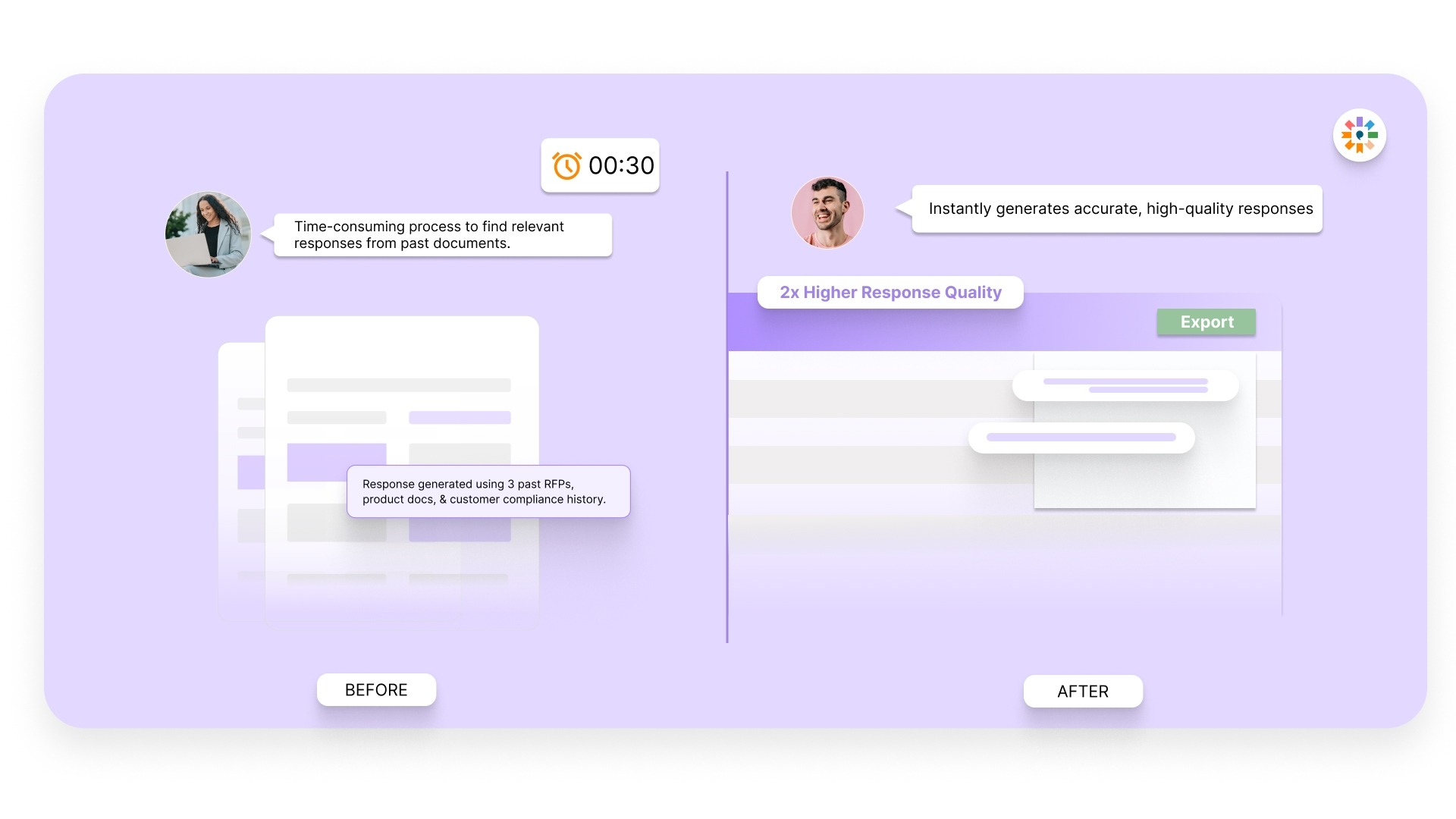
When you are handling multiple proposals at once, quality often takes a hit. You end up rushing drafts or relying too much on old content.
Inventive AI gives you a stronger starting point. It pulls from your past responses and existing knowledge, so your first draft already makes sense. Instead of fixing weak answers, you spend your time improving responses that actually move the deal forward.
2. Context Engine
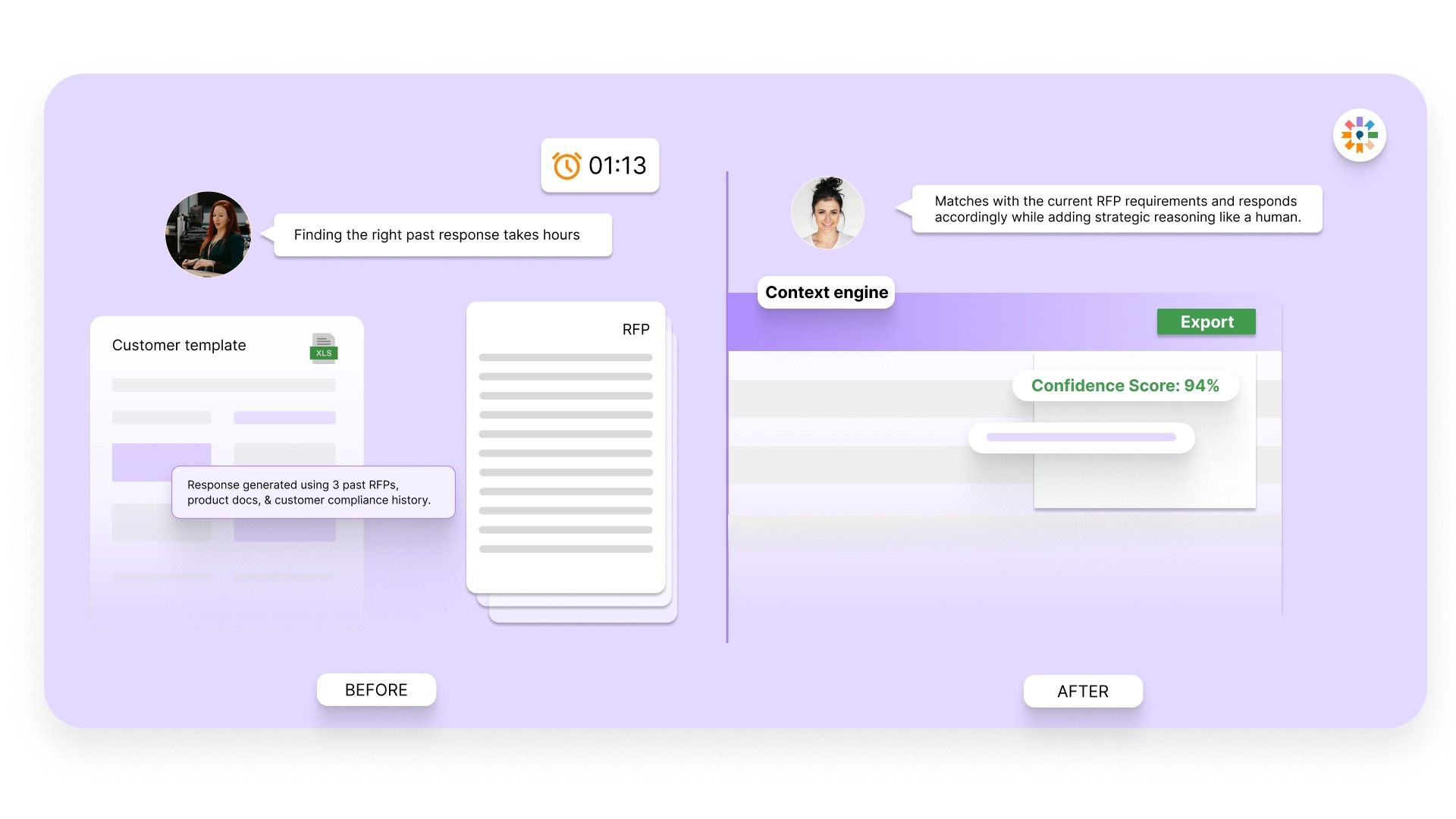
One of the most frustrating parts of proposal writing is knowing the answer exists somewhere, but not being able to find it quickly.
The Context Engine solves that. It brings the right information into your response based on the question being asked. You do not have to dig through folders or wait for someone to reply. The answer is already there, and it fits the context.
3. Conflict Detection
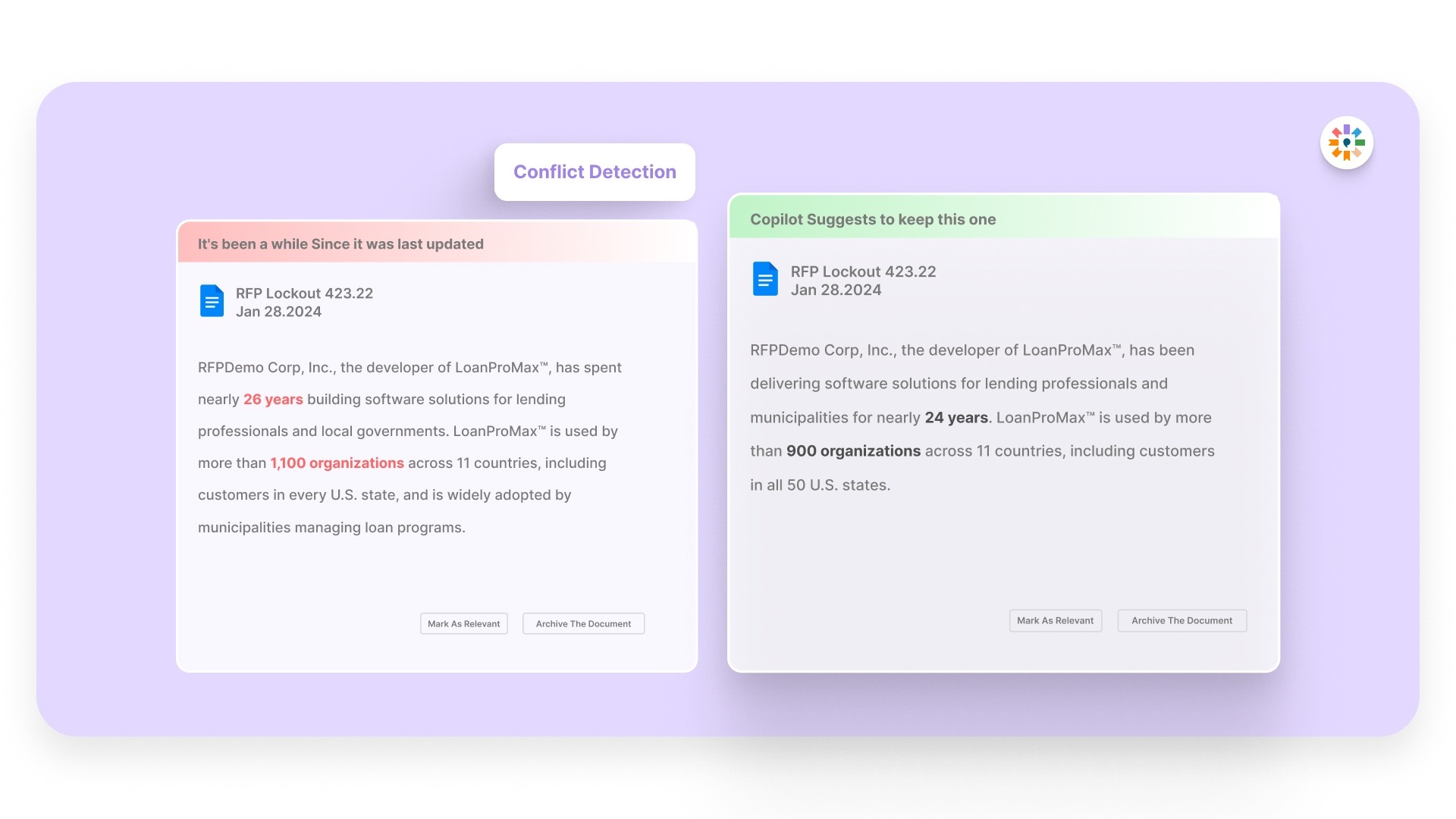
When different teams contribute, small inconsistencies creep in. One section says one thing, another says something slightly different. These are easy to miss but hard to justify if a buyer spots them.
Inventive AI flags these conflicts early, so your proposal feels consistent from start to finish. You avoid confusion and come across as more reliable.
4. Outdated Content Detection
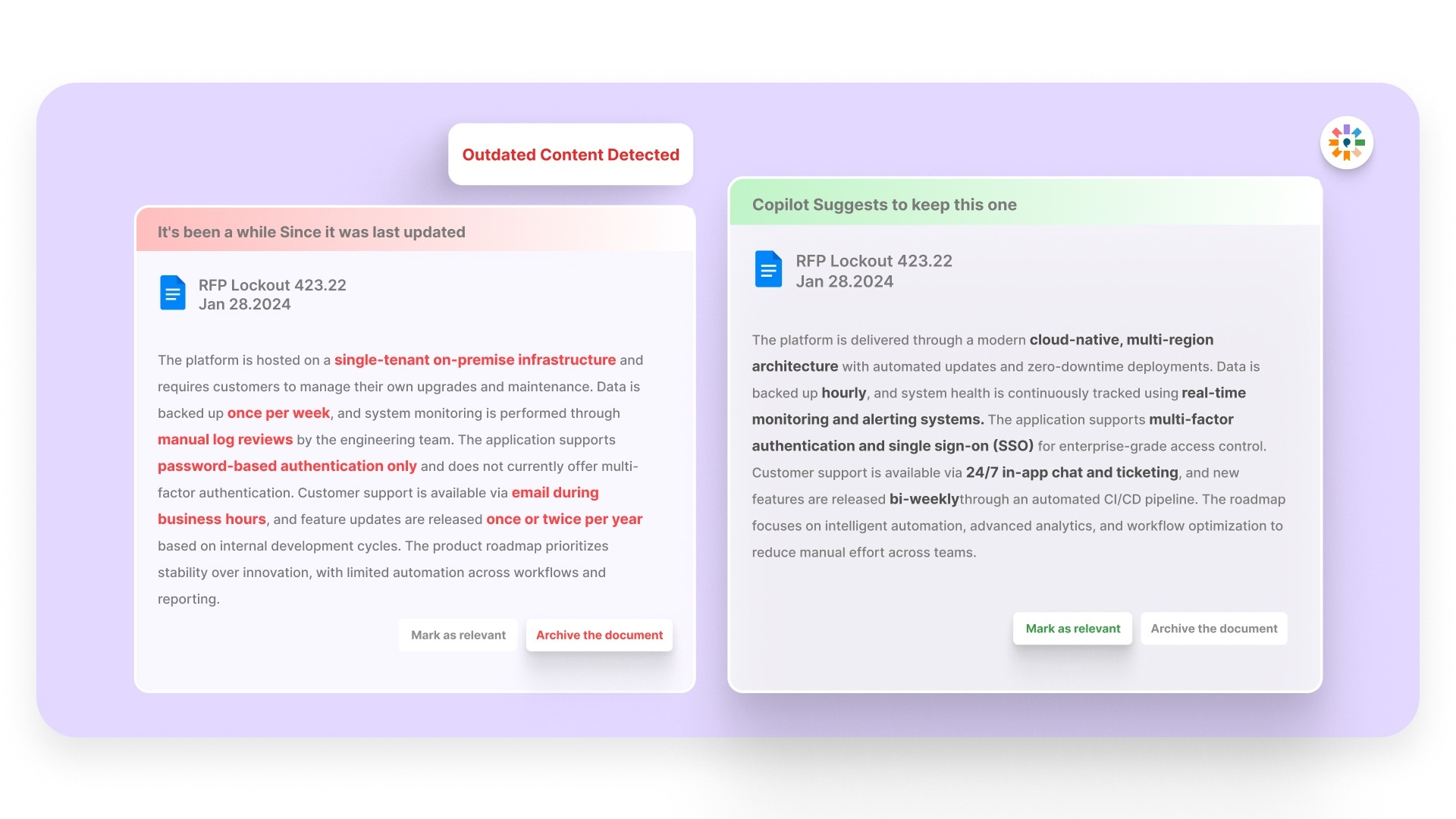
Reusing past content is necessary, but it comes with risk. Sometimes you carry forward information that is no longer accurate.
Inventive AI helps you catch that before it becomes a problem. It highlights outdated or irrelevant content, so you can fix it before submission and avoid awkward follow-ups later.
5. Narrative-Style Proposals
Most proposals feel like a collection of answers stitched together and buyers notice that.
Inventive AI helps you structure responses so they flow as one clear story. Your proposal feels more intentional, easier to read, and easier to evaluate.
6. Simple, Easy-to-Use Interface
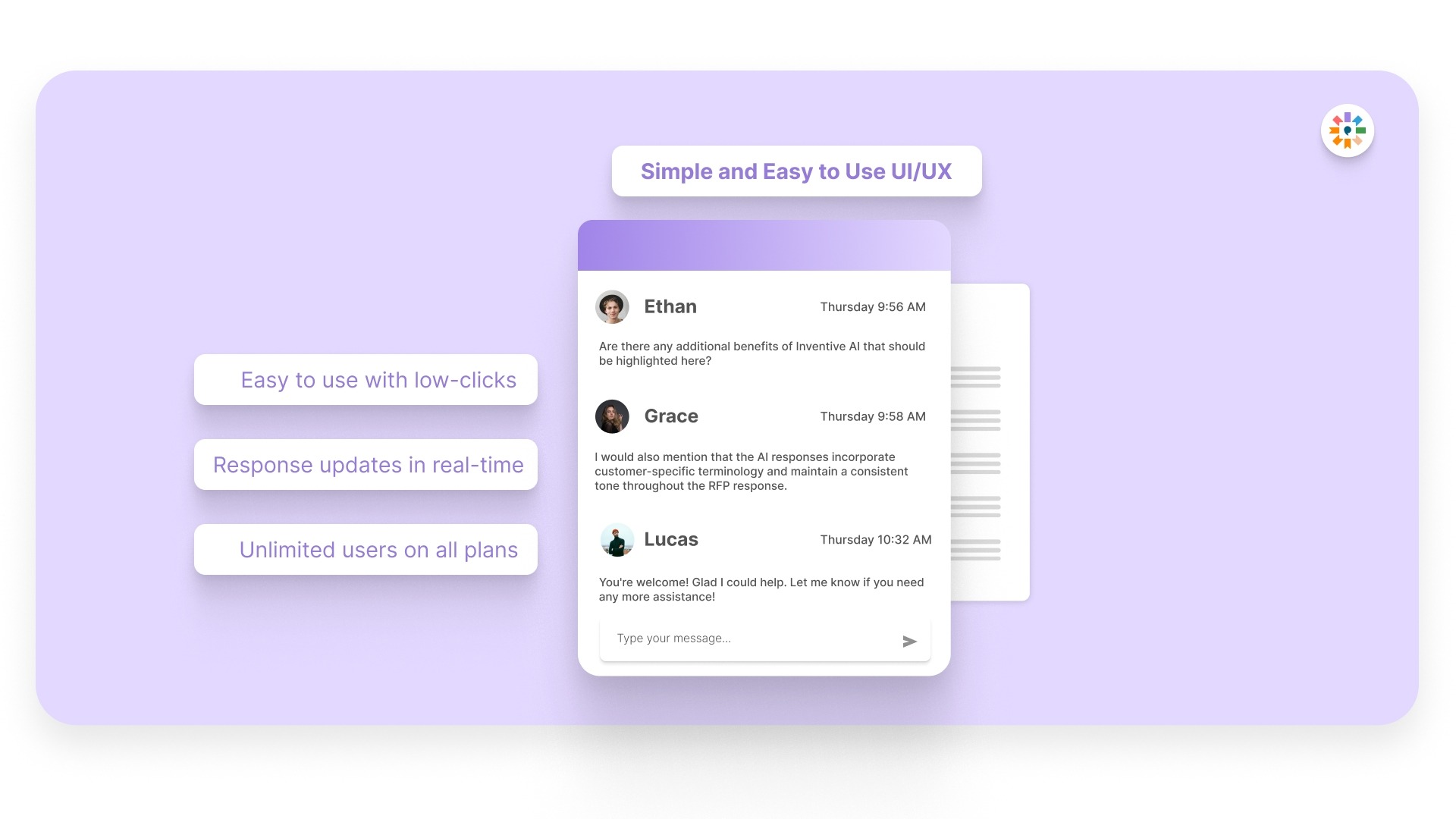
Proposal teams do not have the time or patience for complicated tools.
Inventive AI is straightforward to use. Your team can start working with it quickly, without long onboarding cycles. That makes it easier to handle more proposals without adding pressure on the team.
When proposal writing becomes structured and supported by the right system, you reduce delays, eliminate inconsistencies, and improve response quality across every submission.
FAQs
1. How can you improve proposal response time without reducing quality?
Start by fixing how your content is managed. When answers are easy to find and already structured, you spend less time searching and rewriting. Add a clear process for who owns each section, and use automation for first drafts where possible. This helps you move faster without compromising accuracy.
2. What makes a proposal stand out to buyers?
Buyers are not looking for longer answers. They are looking for clear ones. A strong proposal directly addresses what they asked, uses their language, and makes it easy to evaluate. When your response feels specific to their requirements, it stands out immediately.
3. Why do proposal responses become inconsistent across teams?
Most inconsistencies come from how content is sourced. Different teams pull from different documents, past proposals, or personal notes. Without a single source of truth, the message shifts across sections, and the proposal starts to feel disconnected.
4. How can teams reuse past proposal content effectively?
Reusing content works only when it is relevant and up to date. Treat past answers as a starting point, not a final version. Review them, adjust them to the current requirement, and remove anything that does not apply. This keeps your responses accurate and tailored.
5. Is AI actually useful for proposal writing?
Yes, when used correctly. AI can handle the heavy lifting of drafting and organizing information, which saves time. It also helps maintain consistency across responses. The key is to use it as a starting point and refine the output so it fits the specific proposal.
6. What is the difference between an RFP, RFI, and a security questionnaire?
An RFP is a detailed request where the buyer expects a full proposal, including your solution, pricing, and delivery approach.
An RFI is an earlier step, where buyers collect general information before shortlisting vendors. A security questionnaire focuses only on your security practices, compliance standards, and how you handle data.

.avif)