HeyIris pricing in 2026: per-user cost, what's included, and what to check before you buy
How HeyIris pricing works in 2026, what its per-user model includes, the questions to settle before you buy, and how it compares.
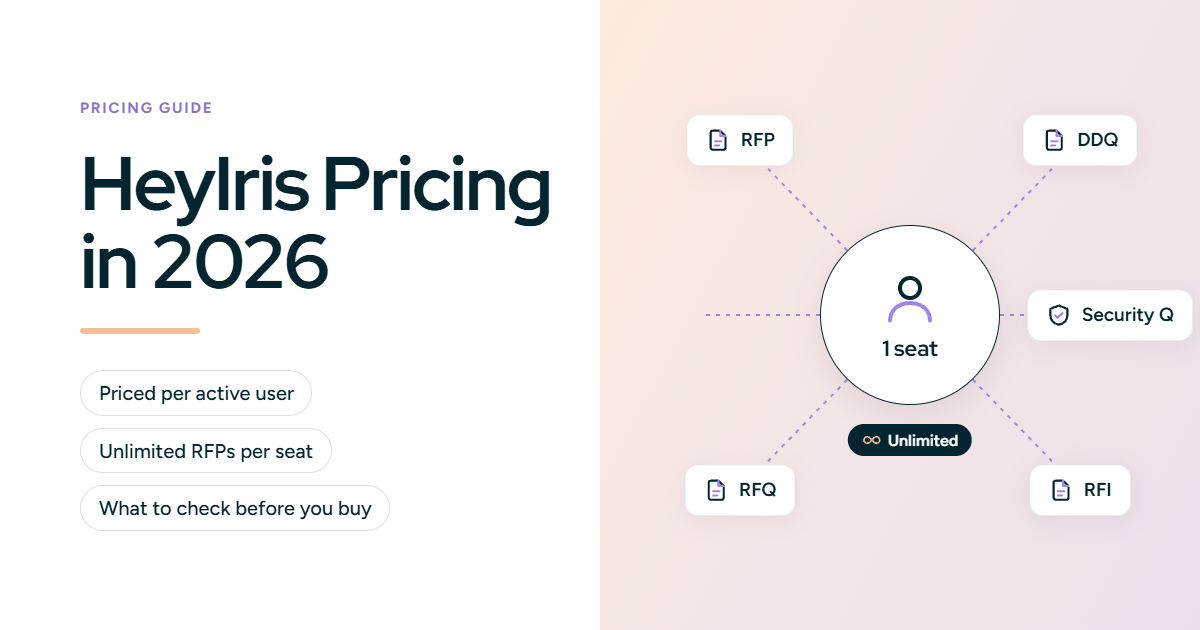
HeyIris pricing is per active user. Each paid seat includes unlimited RFPs, RFIs, RFQs, DDQs, and security questionnaires, with no per-submission fees and no usage caps, and you can invite reviewers as collaborators for free. HeyIris explains this model publicly but does not list a dollar figure, so you get the number by contacting sales.
HeyIris (also called Iris) is AI RFP software that automates responses to RFPs, RFIs, RFQs, SOWs, DDQs, and security questionnaires.
The per-user model is simple to grasp, but it is not automatically the cheapest for every team.
This guide breaks down what a HeyIris seat includes, how per-user cost adds up, the questions to settle before you buy, and how it compares if you want cost tied to projects instead of headcount.
Key takeaways
- HeyIris pricing is per active user. One seat covers unlimited RFPs, DDQs, and security questionnaires, with no usage caps or overages.
- Reviewers you only need for approvals can be added as free collaborators, so you pay for active users, not the whole team.
- HeyIris publishes the model but not a price. You contact sales for a quote based on seat count.
- On G2, HeyIris holds 4.9/5 across 73 reviews. Reviewers praise speed and support, and note no mobile app, occasional off responses, and early-product bugs.
- Per-user pricing rewards a small, high-volume team. If many people need access, compare it against per-RFP pricing that includes unlimited users.
How much does HeyIris cost?
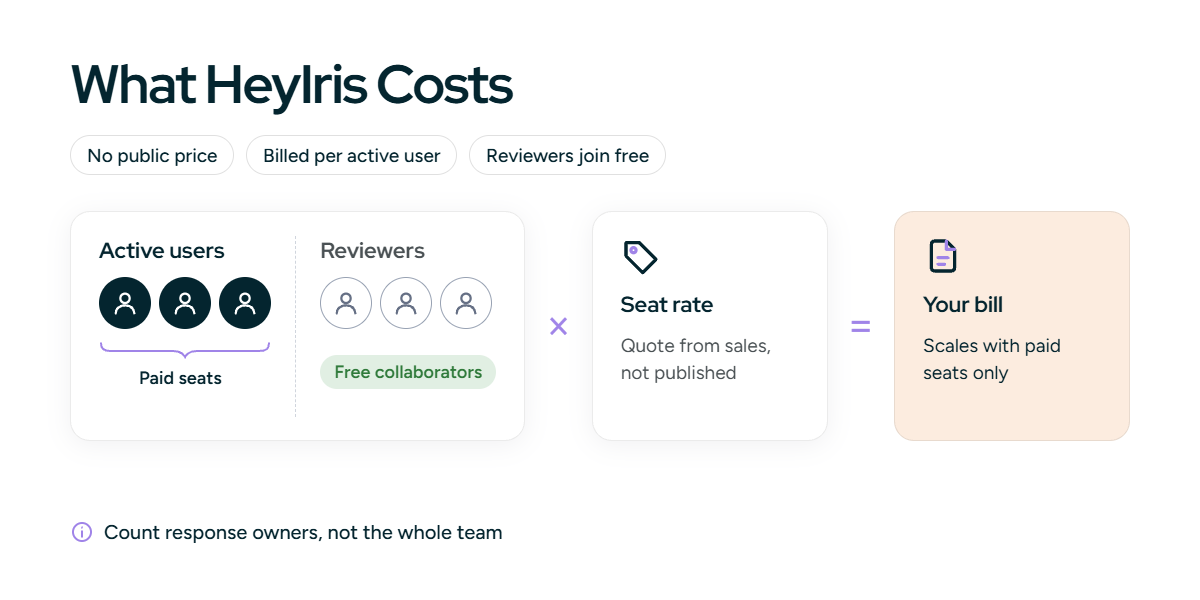
There is no public price, so your seat count decides the bill. HeyIris charges for active users who draft and manage responses, while reviewers come in free. To size a quote, count your real response owners, not the whole team, and multiply by the per-seat rate.
On the call, pin down two things: who counts as an "active user," since that sets your seat count, and whether seats can flex down later. HeyIris leads with outcomes over price, citing $150K+ in yearly savings and about 60% time saved per RFP (HeyIris claims), worth testing against your own numbers.
HeyIris pricing model: what one seat includes
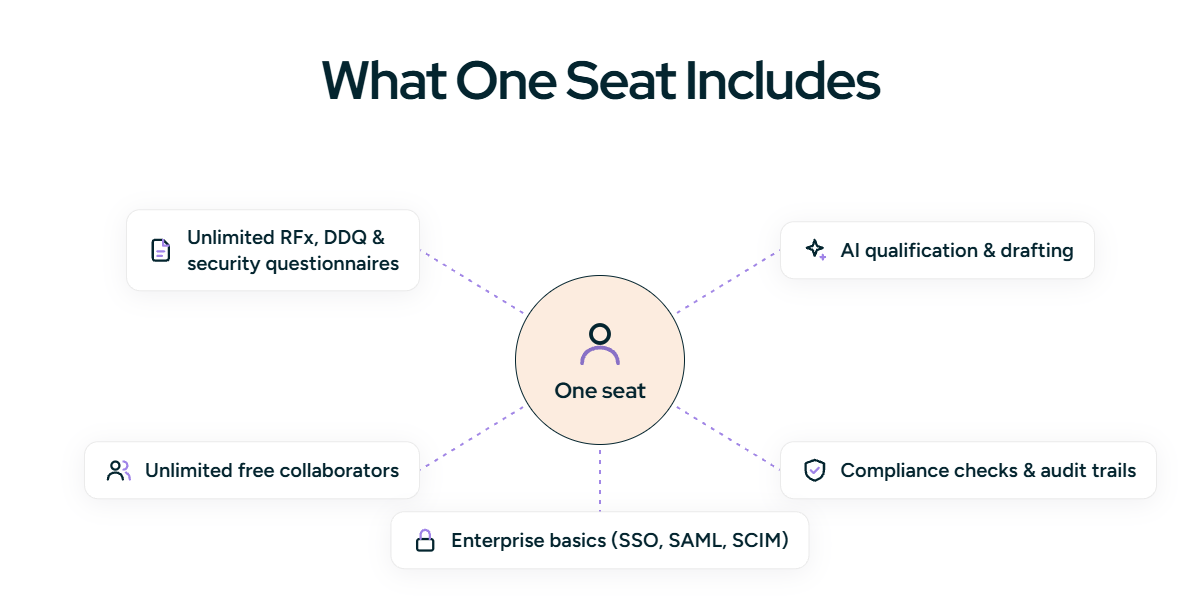
HeyIris charges for active users, and each paid seat comes with unlimited work, so volume never changes the bill. A single seat includes:
- Unlimited RFx, DDQ, and security questionnaire work. RFPs, RFIs, RFQs, DDQs, and questionnaires such as CAIQ, SIG, VSA, and HECVAT, with no per-submission charge.
- Unlimited free collaborators. Invite sales, legal, security, and compliance reviewers without buying them a seat.
- AI qualification and drafting. Go/no-go scoring, response generation, and narrative RFP drafting.
- Compliance checking and audit trails. Automated compliance coverage, collaboration, and exports.
- Enterprise basics. SSO, SAML, SCIM, a dedicated customer success manager, and implementation support.
The strength of this model is predictability: your cost is set by how many active users you have, not by how many RFPs you run. The variable to watch is headcount, since every active user adds to the price.
Per-user or per-RFP: which pricing model costs your team less?
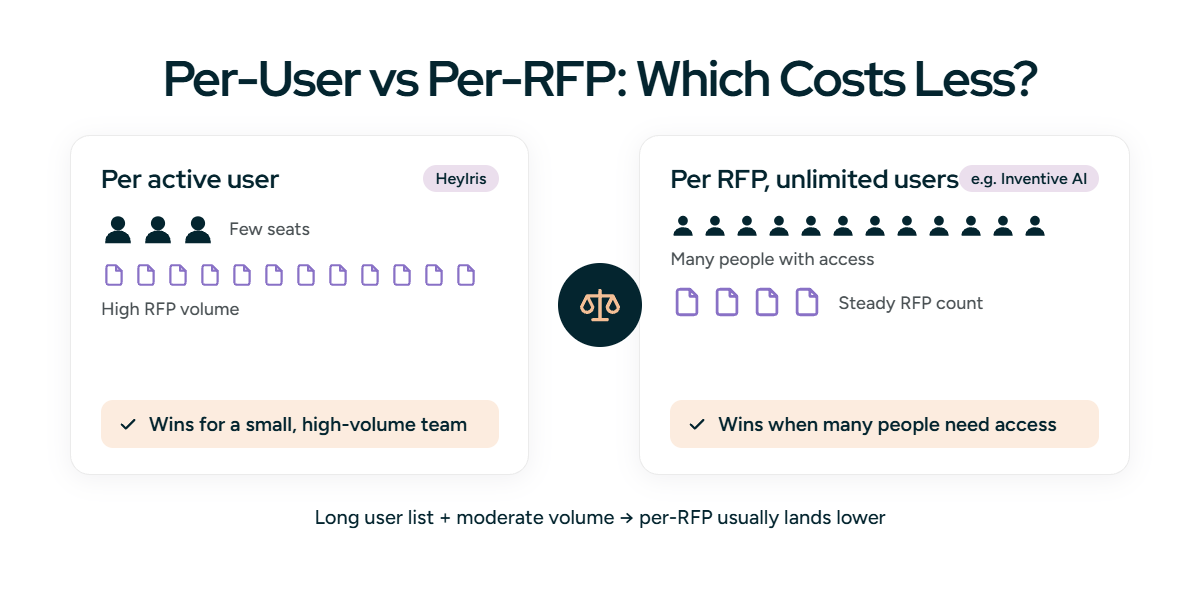
This is the real decision behind a HeyIris quote, and it comes down to the shape of your team. Two models dominate this category, and each rewards a different setup.
- Per active user (HeyIris). You pay for each core user and run unlimited volume. This wins when a small, dedicated team handles a high number of RFPs, because a few seats cover heavy usage.
- Per RFP with unlimited users (example: Inventive AI). You pay for each RFP and give the whole team access. This wins when many people need to be in the tool, but your RFP volume is steady, because you are never paying per seat.
A quick way to decide: multiply your number of active users by a per-seat quote, then compare it to your yearly RFP count at a per-RFP rate. If your user list is long and your RFP volume is moderate, per-RFP pricing usually lands lower. If you have two or three power users answering hundreds of documents, per-user can pay off.
HeyIris features: what's included in every seat
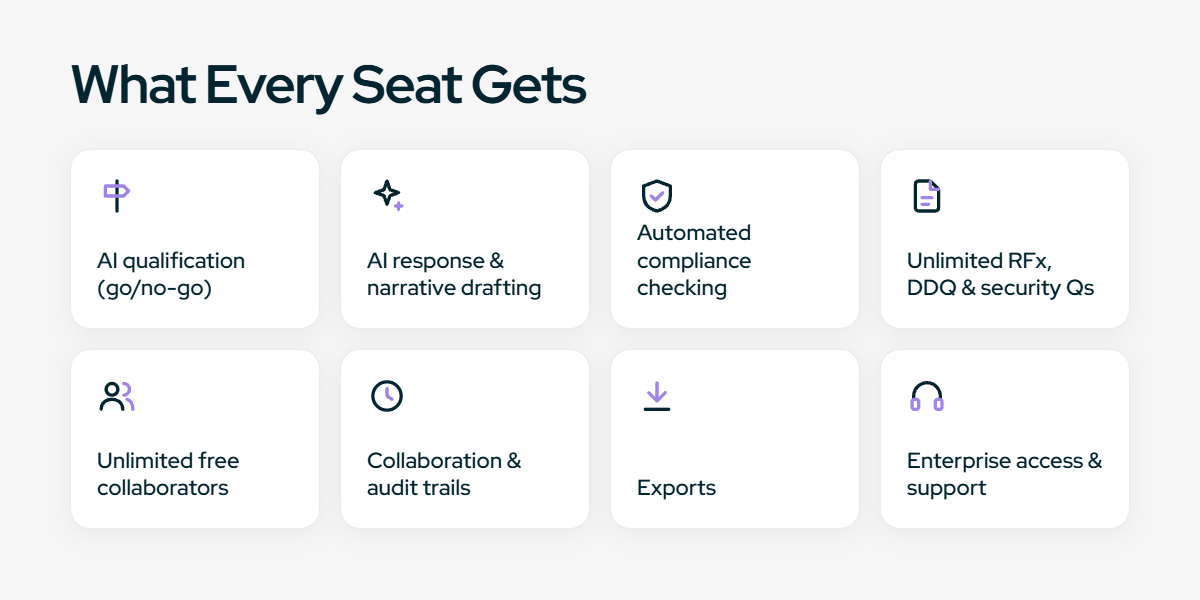
HeyIris bundles its full feature set into each paid seat, so there are no add-on modules to buy. Here is what an active user gets.
- AI qualification (go/no-go). Scores an incoming RFP against fit before you commit time, so teams can pass on low-odds bids early.
- AI response generation and narrative drafting. Drafts both question-and-answer responses and longer narrative RFP sections from your content.
- Automated compliance checking. Checks a response for coverage against the requirements before it goes out, which matters most on security questionnaires and regulated bids.
- Unlimited RFx, DDQ, and security questionnaires. One seat covers RFPs, RFIs, RFQs, DDQs, and security frameworks like CAIQ, SIG, VSA, and HECVAT, with no per-submission fee.
- Unlimited free collaborators. Reviewers from sales, legal, security, and compliance can work in a response without a paid seat.
- Collaboration and audit trails. Shared drafting, review steps, and a record of who changed what, useful for regulated or audited responses.
- Exports. Push finished responses back into the original format for submission.
- Enterprise access and support. SSO, SAML, and SCIM for provisioning, plus a dedicated customer success manager and implementation support.
- MCP access. Connects HeyIris to other tools through the Model Context Protocol for teams that want to extend it.
"Deterministic AI": what HeyIris means, and what to verify
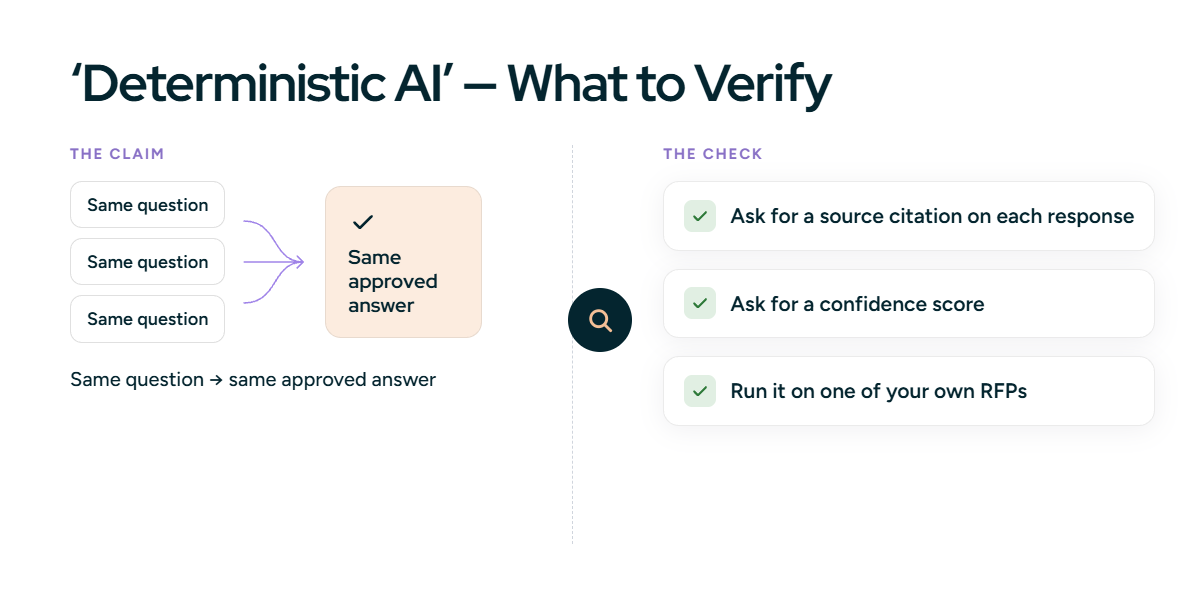
HeyIris markets "deterministic AI," meaning it aims for consistent, repeatable responses rather than the varied output you get from a general chatbot. That is a real benefit for RFP work, where the same question should get the same approved answer every time.
Test the claim before you rely on it. G2 reviewers note that responses can still read robotic or pull together several answers instead of the single best one, and there is no mobile app yet. So in a demo, ask to see a source citation and a confidence score on each response, and run it on one of your own RFPs. Consistency matters most when you can also see where each response came from and how sure the system is.
HeyIris review, ratings, strengths and weaknesses
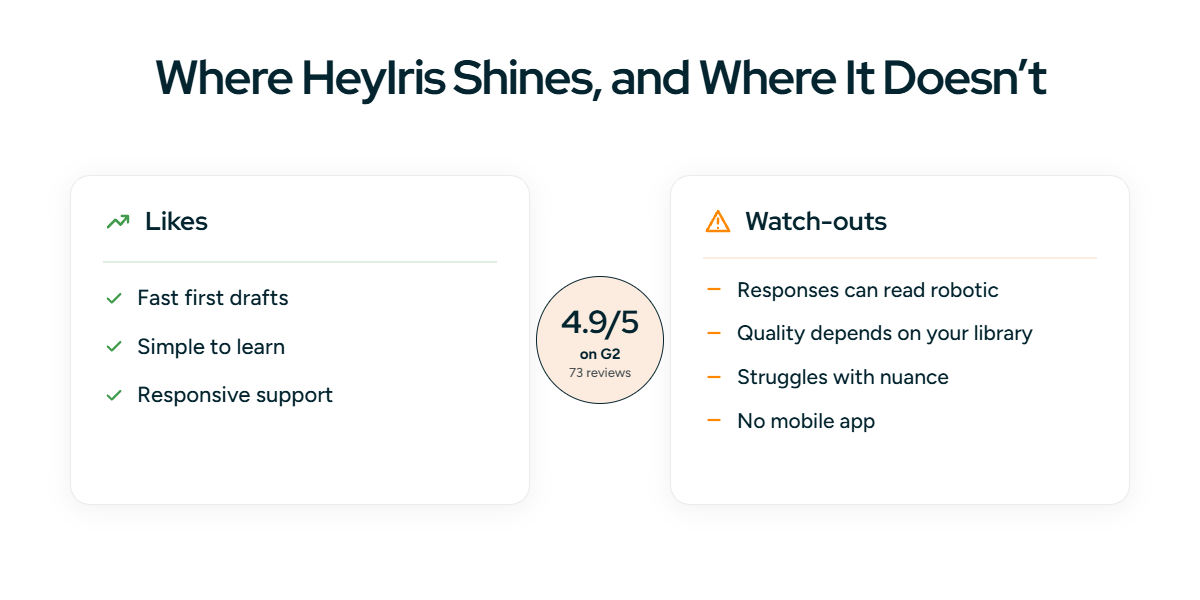
HeyIris holds a 4.9/5 rating on G2, so most teams that use it are happy. Here's what reviewers consistently praise, and where they hit friction.
What reviewers like about HeyIris
- Fast first drafts. Iris pulls from your past content and fills a questionnaire in minutes, which is the main reason teams buy it.
- Simple to learn. Reviewers call the interface clean and say onboarding is quick, so new team members contribute without much ramp-up.
- Responsive support. Users mention the team ships fixes and takes feedback seriously.
Where teams find limitations in HeyIris
- Responses can read robotic. Reviewers note the output often needs a human pass to sound like your company and match the buyer's tone.
- Quality depends on your library. If your source content is thin or outdated, the drafts reflect that. Iris speeds up retrieval, it does not fix the content underneath.
- Struggles with nuance. Complex, technical, or visual questions still need an expert, and reviewers flag occasional slowness and bugs.
- No mobile app. Everything happens on desktop, which some reviewers wanted.
Questions worth confirming on a demo
Ask how Iris handles the things that decide whether responses are trustworthy at scale: does it show inline citations back to the source so reviewers can verify every claim, does it flag when two sources contradict each other, and can it route sections to the right SME and legal reviewer inside one workflow. These are the gaps that separate a fast drafter from a system your whole team can rely on.
Who HeyIris is best for
HeyIris fits a small, dedicated RFP or security team that runs high volume and wants predictable per-seat cost with unlimited usage, plus free access for occasional reviewers. It is a weaker fit for organizations that need many people working in the tool, that want cost tied to project volume rather than headcount, or that need mature governance, broad native integrations, and reporting for large, multi-team libraries.
HeyIris vs Inventive AI: which one gives more ROI and improves win rate?
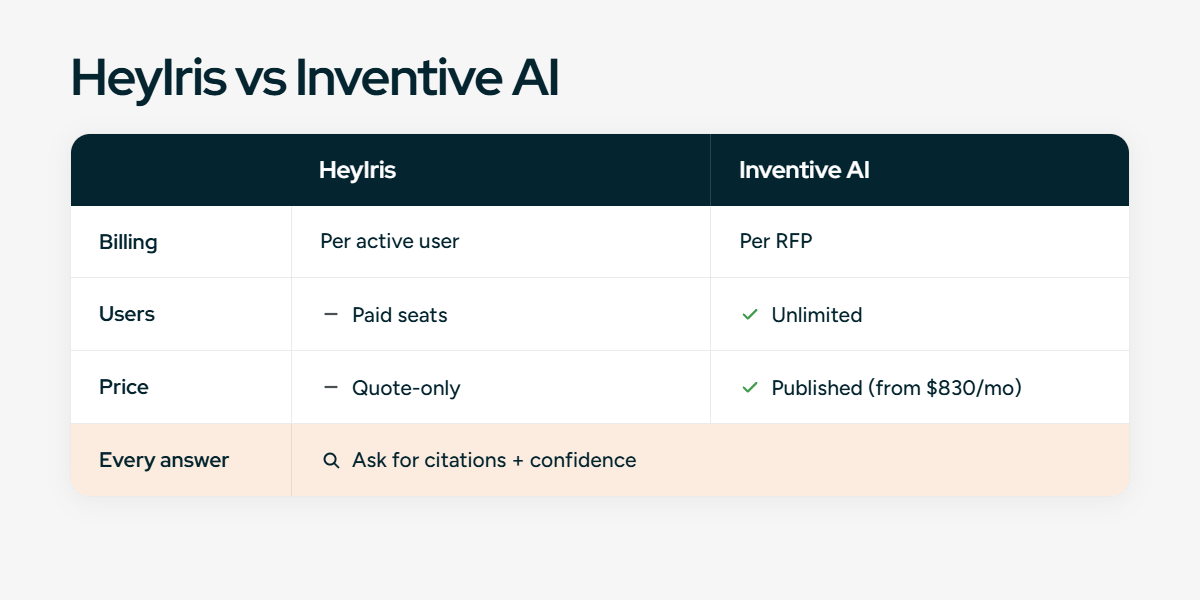
Inventive AI wins on ROI when several people touch responses: it prices per RFP with unlimited users, so cost stays flat as your team grows. One plan, all features, from $830/month, billed annually. HeyIris prices per active user and doesn't publish rates, so the quote climbs with every seat you add. Both automate RFP, DDQ, and security questionnaires. What decides win rate is reach and pricing. Here is the side-by-side.
Which model fits depends on your priority. If you want cost tied to project volume rather than headcount, per-RFP pricing is easier to predict. If you need accurate responses that are easy to verify, look for citations and confidence scores on each one. And if you need to prove impact, check that the tool reports win rates and time saved.
Also Read: HeyIris vs Inventive AI comparison