Top HeyIris Alternatives and Competitors in 2026
This guide is designed for VPs of Sales, proposal managers, and presales leaders who are actively comparing Heyiris alternatives.

Responding to RFPs has become one of the most resource-intensive parts of modern B2B sales. As deal sizes grow and buyers demand more detailed, tailored responses, sales and proposal teams are under constant pressure to move faster without compromising accuracy or quality. This is where AI-driven RFP tools have started to play a meaningful role.
Tools like HeyIris have made it easier to generate initial responses and organize information, but as teams scale, many begin evaluating whether their current setup can keep up with increasing RFP volumes, complex security questionnaires, and value-driven narrative requirements.
This guide is designed for VPs of Sales, proposal managers, and presales leaders who are actively comparing Heyiris alternatives. It provides a clear, practical comparison of the top HeyIris competitors in 2026, so you can decide which solution best fits your team’s workflow, accuracy expectations, and growth plans.
TL;DR
- Most HeyIris competitors optimize for speed, not submission readiness. Tools that generate drafts quickly still leave teams spending hours rewriting for accuracy, tone, and relevance.
- Response usability is the real differentiator in 2026. Platforms that understand the full RFP context and intent reduce total effort far more than tools focused on content reuse alone.
- Static Q&A libraries break down at scale. As RFP volumes grow, stale or conflicting answers become a hidden risk unless the system actively detects and flags them.
- Narrative and value-based sections are where most tools fall short. Generating persuasive, deal-specific value statements, not just technical answers, has a direct impact on win rates.
- Inventive AI stands out by prioritizing response quality first. By reducing rewriting, controlling hallucinations, and tailoring answers to deal with context, it helps teams move faster with 2X better response quality and 50% higher win rates.
- Below is a side-by-side comparison of the most commonly evaluated HeyIris alternatives in 2026.
| Tool | Features and Capabilities | Pricing | Rating |
|---|---|---|---|
| Inventive AI | Inventive AI is the industry leader in providing hyper-contextual, real-time insights, delivering tailored, accurate responses. It excels in producing high-quality responses with minimal to no rewriting. | Usage-based pricing | 5/5 |
| Responsive | It offers strategic response management and large content libraries, but it lacks the deep contextual awareness required for complex RFPs. | Subscription-based pricing | 4.3/5 |
| Loopio | It provides a centralized answer library and collaboration workflows, but it is heavily reliant on content reuse, making it difficult to generate customized, deal-specific responses for complex RFPs. | Starts at $20,000/ year | 4.4/5 |
| AutoRFP AI | It generates fast AI drafts with template flexibility, but its outputs are often generic and require significant manual refinement. | Starts at $899/month | 4.9/5 |
| 1up | It automates knowledge across multiple tools, but it lacks RFP-specific intelligence, limiting its effectiveness for precision-driven, high-stakes proposals. | Starts at $300/month | 4.9/5 |
| Arphie | It assists with AI-powered proposal drafting, but it relies heavily on manual refinement, making it less efficient for teams looking for complete automation in their RFP responses. | Subscription-based pricing | 5/5 |
| Realm | It features a centralized knowledge hub with AI agents across various workflows, but its RFP-specific functionality is limited, making it a more generic RFP solution. | Custom pricing | 4.1/5 |
| Ombud | Ombud focuses on rule-based automation with collaboration features, but it lacks true contextual AI reasoning, making responses rigid and less tailored to the needs of nuanced RFPs. | Custom pricing | 4.7/5 |
| Bidify | Bidify generates AI-based proposal drafts, but it lacks accuracy controls and struggles with handling complex RFPs. | Custom pricing | 5/5 |
Related: Guide to RFP Evaluation Criteria with Examples
Top HeyIris Alternatives and Competitors (2026)
While many of these platforms support AI-assisted RFP responses, they differ significantly in how they handle context, accuracy, and response usability. Let’s break down each tool in detail to highlight where they fit best and where limitations typically emerge.
1. Inventive AI
Inventive AI is an AI RFP Agent built specifically for revenue, presales, and proposal teams that need high-accuracy, highly contextual responses, not just faster first drafts. The platform is designed to produce responses that are genuinely ready to submit, even in complex enterprise RFPs and security questionnaires.
Where many HeyIris competitors rely on static Q&A reuse or surface-level AI suggestions, Inventive AI evaluates the entire RFP in context, including buyer intent, deal specifics, and narrative requirements, so answers are aligned with how evaluators actually score responses.
Instead of accelerating drafting alone, Inventive AI reduces total response effort, which is what ultimately determines speed, quality, and win rate.
Features
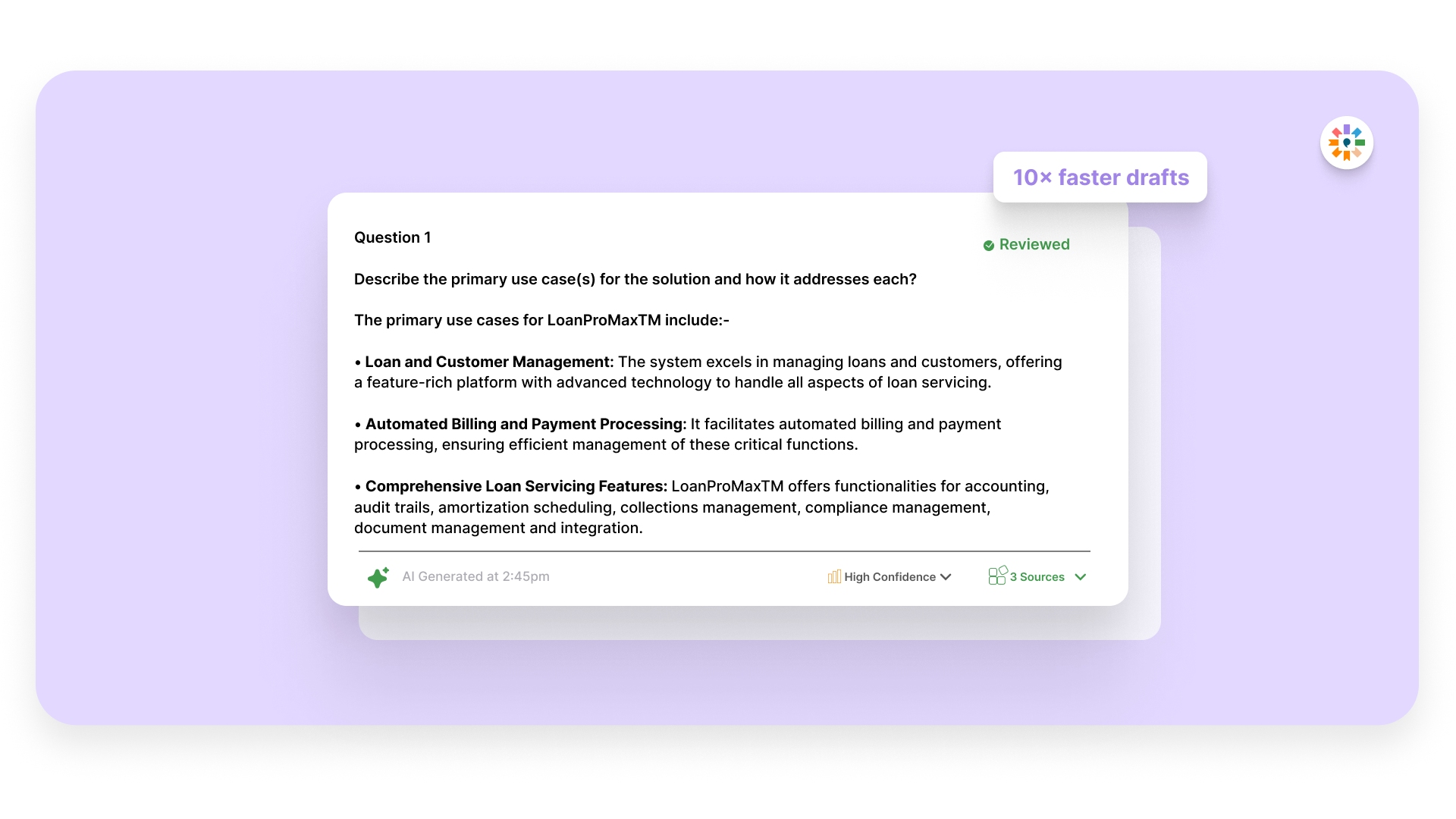
2× more usable answers with minimal editing
Inventive AI focuses on generating responses that already reflect correct scope, tone, and depth. This significantly reduces the back-and-forth rewriting that typically follows AI-generated drafts.
Deal-aware customization at scale
Responses adapt to customer language, industry context, and specific deal requirements. This allows teams to maintain consistency while still sounding tailored,especially important in enterprise RFPs.
Value-statement and narrative response support
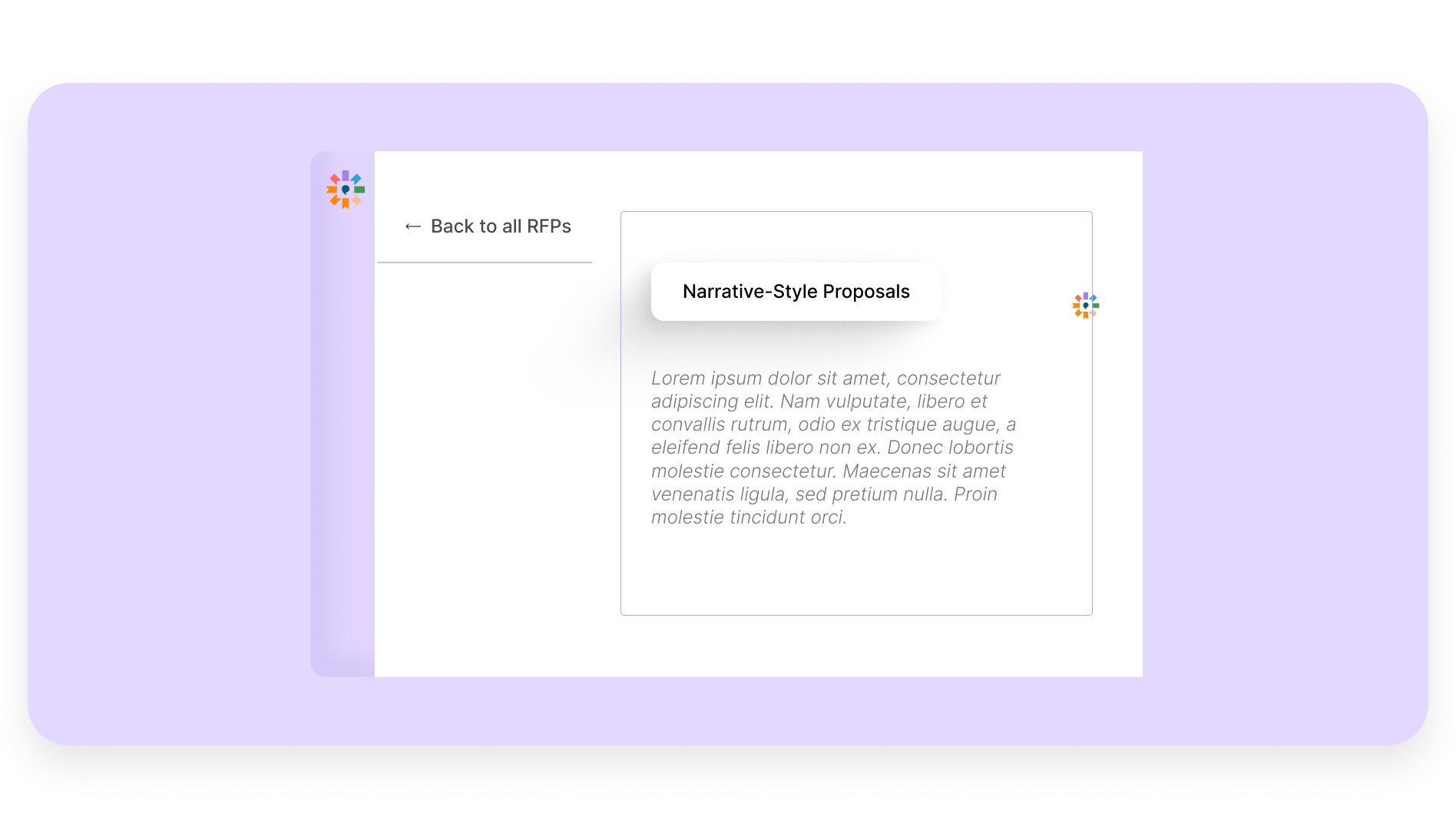
Unlike tools that focus primarily on factual or checkbox questions, Inventive AI supports long-form value statements. This helps teams clearly articulate differentiation, impact, and risk mitigation, sections that often influence scoring the most.
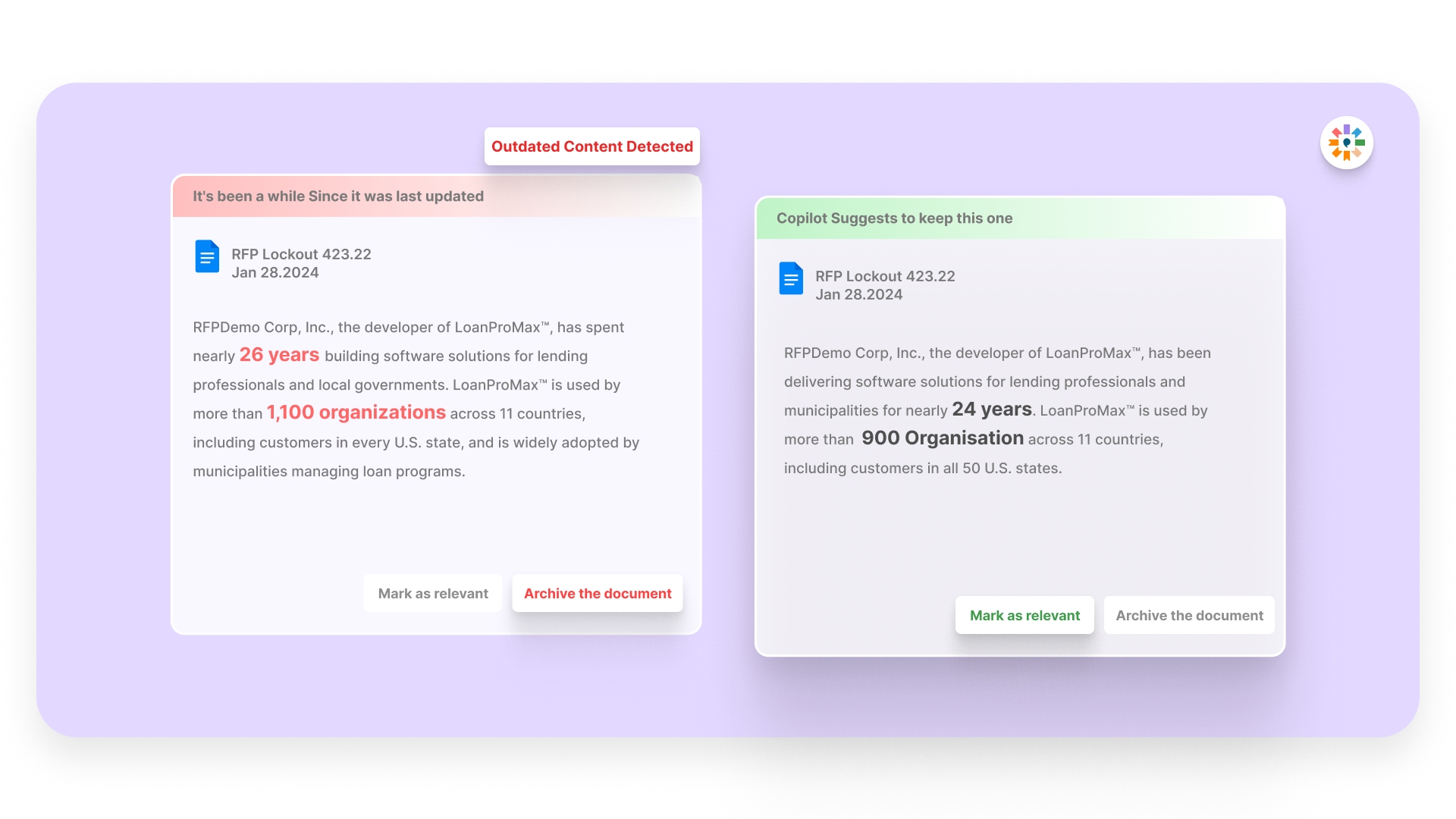
Automatic detection of stale or conflicting content
As knowledge bases evolve, Inventive AI flags outdated or inconsistent answers before submission. This reduces risk in security, compliance, and technical sections where accuracy is non-negotiable.
All of this is powered by a unified knowledge hub that connects documents, past RFPs, websites, CRMs, and internal tools, without requiring teams to maintain rigid Q&A libraries manually.
Outcomes Teams See in Practice
- High accuracy without hallucinations
Inventive AI prioritizes grounded responses, helping teams maintain confidence in technical, legal, and security-heavy sections. - Less rewriting, faster final submissions
With a majority of answers requiring little to no editing, teams can focus more on strategy and review instead of rewriting drafts. - Scales across growth stages
The platform supports startups entering enterprise deals, mid-market teams scaling RFP volume, and large enterprises handling multi-stakeholder responses. - Measurable impact on win rates
By improving response quality, not just speed, teams are better positioned to submit persuasive, evaluator-ready responses.
What Makes Inventive AI Stand Out
- 95%+ response accuracy with 0% hallucinations
Inventive AI ensures high accuracy in its responses, eliminating errors and false information. This means your team can trust the answers without needing extra fact-checking or corrections. - 66% of answers require near-zero editing
Most of the time, Inventive AI generates responses that are almost ready to submit, saving you a lot of time on revisions. This helps your team move faster and focus on the most important tasks. - Works across startups, mid-market, and enterprise teams
Whether you're a startup just starting to respond to large RFPs or an enterprise handling complex proposals, Inventive AI works for teams of all sizes, adapting to your needs as you grow. - Optimized for deal outcomes, not just automation metrics
Unlike some tools that focus only on draft speed, Inventive AI focuses on creating high-quality responses that increase your chances of winning the deal. It’s all about delivering results, not just fast answers.
The Limitations of Inventive AI
- Limited analytics compared to legacy platforms
Pricing
| Plan Type | Pricing |
|---|---|
| Usage-based pricing | Varies by usage and team size |
Best For
- Startups responding to their first enterprise RFPs: Inventive AI is perfect for startups entering the world of enterprise-level RFPs. It simplifies the process, helping teams create accurate, high-quality responses that compete with more experienced companies.
- Mid-market sales engineering teams scaling volume: Inventive AI supports mid-market teams handling increased proposal volume, ensuring that each response remains tailored and accurate as the team grows.
- Enterprise proposal teams handling complex, multi-stakeholder RFPs: Inventive AI is designed to handle complex, multi-stakeholder proposals. It helps large teams collaborate effectively, ensuring responses are consistent and meet the diverse needs of all stakeholders.
- Teams that prioritize quality, accuracy, and win rate over raw automation: Inventive AI is ideal for teams that want to focus on high-quality responses that improve win rates, rather than just speeding up the process. It ensures proposals are persuasive and aligned with buyer needs.
Ratings & Reviews
Ratings: 5/5

Inventive AI is a powerful platform that empowers teams across various growth stages, from startups to enterprises, to improve proposal quality and win rates. By focusing on high-accuracy, contextual responses, it ensures that teams can submit stronger proposals, faster and with more confidence.
2. Responsive
Responsive is an established response management platform focused on organizing RFP workflows and maintaining large answer repositories.
It is primarily designed to help teams reuse approved content efficiently. While this structure can reduce manual effort, the platform’s AI capabilities are more assistive than contextual, which limits response quality in complex or nuanced RFPs.
Features
- Centralized answer library: This feature stores all approved answers in one central location, allowing teams to easily access and reuse previously crafted content.
- Workflow and approval management: Provides tools to streamline the internal approval process, ensuring that responses meet the necessary internal standards before submission.
- CRM and collaboration integrations: Seamlessly integrates with CRM systems and other collaboration tools, making it easier for cross-functional teams to work together on responses.
- AI-assisted answer suggestions: The AI suggests relevant content based on previous responses, speeding up the process of drafting proposals and questionnaires.
What Makes Responsive Stand Out
- Helps standardize responses across teams: By centralizing content and workflows, Responsive helps ensure that responses are consistent across the board, reducing the risk of error or variation in tone.
- Suitable for organizations with rigid RFP processes: Teams that have already established structured RFP processes will find Responsive particularly helpful, as it integrates well with such workflows and supports scalability.
- Supports high-volume questionnaire handling: For organizations that regularly handle large volumes of RFPs, Responsive’s system for managing numerous questions and answers helps maintain efficiency even as the workload increases.
The Limitations of Responsive
- Struggles with contextual awareness, leading to generic responses: The platform’s reliance on reusing pre-existing content can sometimes result in answers that are too general, missing the deal-specific context required for more complex RFPs.
- Requires manual rewriting for narrative or value-driven questions: While Responsive handles technical and factual questions well, more complex, narrative-based sections, such as value propositions and deal-specific responses, often need significant manual revision to make them compelling and persuasive.
- Slower ROI for teams prioritizing response quality over structure: Teams that focus on crafting high-quality, customized responses may experience slower return on investment with Responsive, as its emphasis on structural organization can come at the expense of deep contextual relevance and fine-tuning.
Pricing
| Plan Type | Pricing |
|---|---|
| Subscription | Custom pricing (not publicly listed) |
Best For
- Teams with highly standardized RFP formats, where consistency and efficiency are paramount, and there is less need for tailored responses.
- Organizations that prioritize governance over customization, where following a set process is more important than adapting responses to the nuances of each individual RFP or deal.
Ratings & Reviews
Ratings: 4.3/5
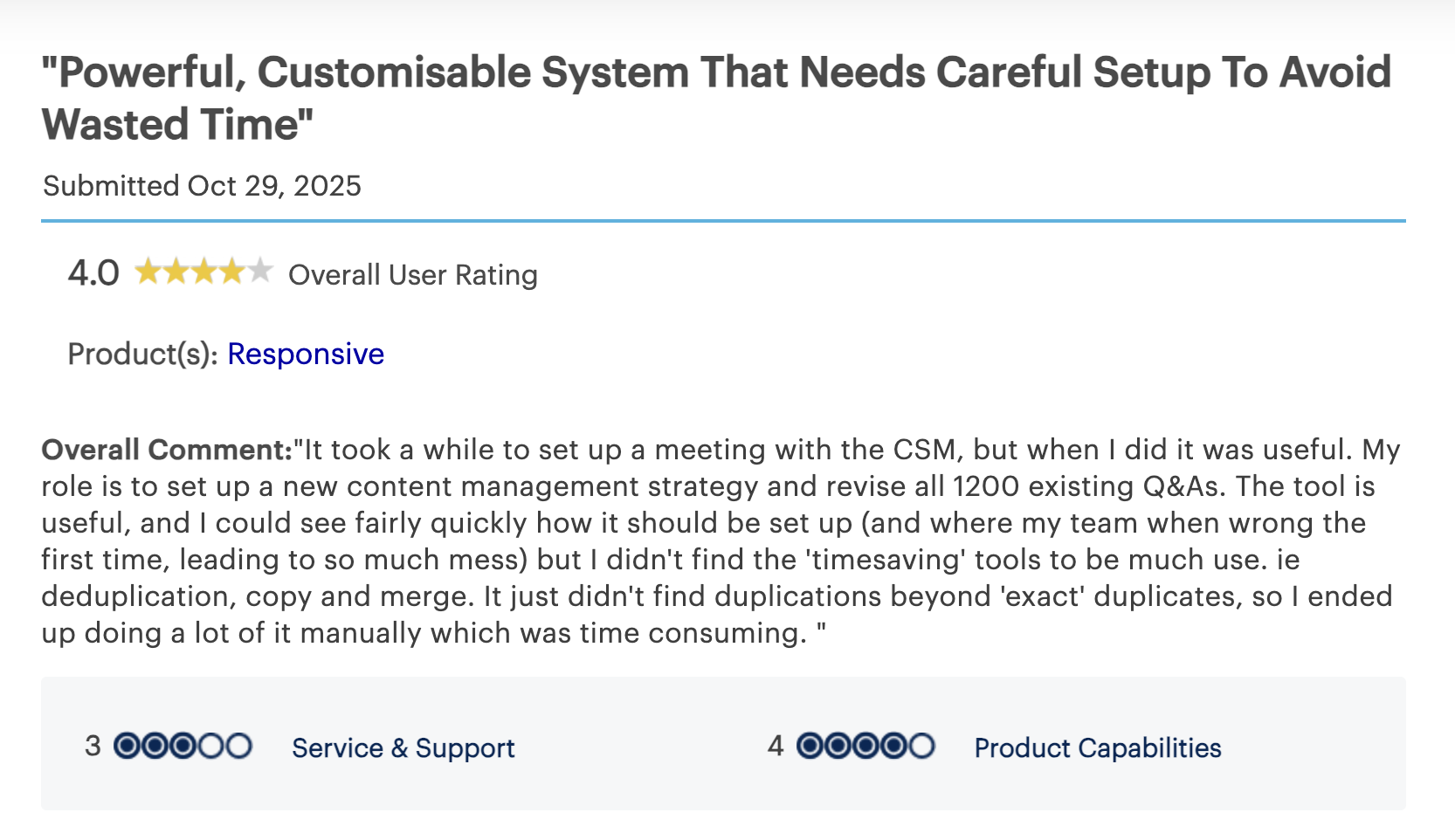
Responsive is a great solution for teams that need a tool to handle repetitive, high-volume RFPs efficiently. However, for those that require more personalized, contextually tailored responses, particularly in complex or narrative-driven proposals, it may not be the best fit.
3. Loopio
Loopio centers its offering around content reuse and internal collaboration. The platform performs well when responses are repetitive and templated.
However, its AI functionality is primarily focused on retrieval rather than reasoning, which can limit effectiveness when responses require differentiation or value-based positioning.
Features
- Centralized content library: It centralizes all your approved responses, making it easy to store, access, and reuse content across teams. This helps maintain consistency and saves time when drafting answers to similar questions.
- Assignment and deadline tracking: The platform provides tools to assign tasks and track deadlines, ensuring that your team can manage multiple RFPs efficiently without missing deadlines or key tasks.
- AI-powered autofill: The AI-powered autofill feature speeds up the drafting process by automatically populating answers based on existing content. While useful, it still requires substantial input from users to ensure the answers are deal-specific and persuasive.
- CRM integrations: The platform integrates with CRM systems, enabling seamless transfer of relevant customer data directly into RFP responses. This enhances accuracy and ensures that responses are aligned with client expectations and needs.
What Makes Loopio Stand Out
- Strong internal organization and content reuse: Its strength lies in organizing content and making it easy for teams to reuse approved answers across multiple RFPs, reducing manual effort for repetitive sections.
- Clear workflows for multi-user teams: The platform supports multi-user collaboration with clear, defined workflows, making it easy for different team members to contribute to the proposal process.
- Predictable response management: It is built for teams that need consistency in their RFP process, allowing for predictable management and efficient handling of repetitive RFPs.
The Limitations of Loopio
- Limited ability to generate contextual or deal-specific answers: Since this tool relies on content reuse, it struggles with generating responses that are deeply tailored to each individual RFP, especially when the responses need to reflect specific buyer needs or deal context.
- Responses often require manual rewriting to sound persuasive: While it can fill in basic answers, the content it generates often needs significant refinement, particularly for narrative sections or value-driven responses that require a more customized approach.
- Not well-suited for complex enterprise narratives: For larger, more complex RFPs, especially deals that require detailed and tailored narratives, it may fall short. Its focus on content reuse can make it challenging to differentiate responses and meet the higher demands of nuanced RFPs.
Pricing
| Plan Type | Pricing |
|---|---|
| Subscription | Starts at $20,000/ year |
Best for
- Teams that frequently respond to repetitive, structured RFPs, where the answers can be templated and reused with minimal adjustments.
- Organizations focused on maintaining consistency across their proposals and prioritizing efficiency rather than creating deeply personalized, high-impact responses for each individual RFP.
Ratings & Reviews
Ratings: 4.4/5
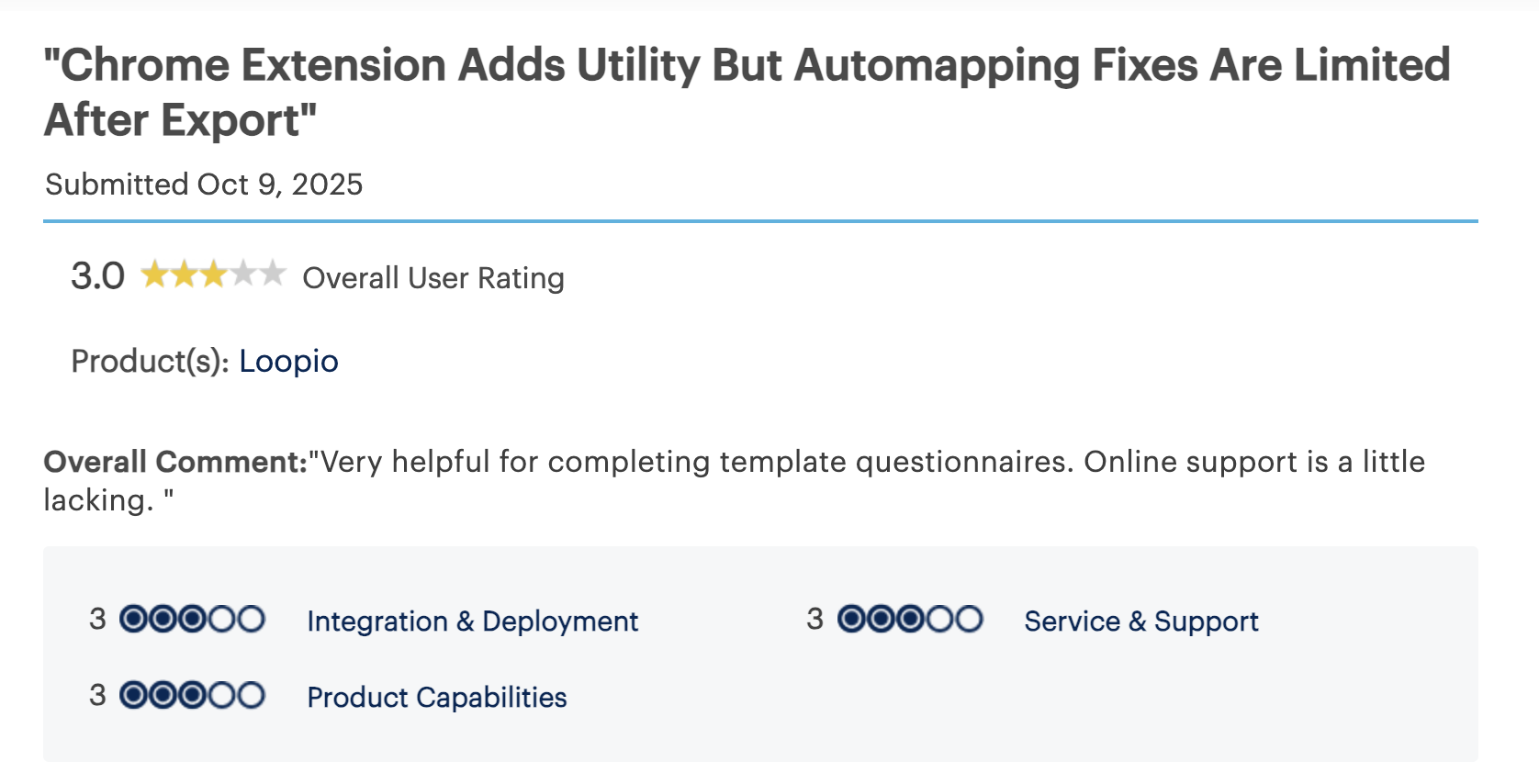
This is an ideal solution for teams that need to manage high volumes of repetitive RFPs and ensure consistent responses across the organization.
Suggested Alternative: Inventive AI
Loopio is frequently chosen by teams that prioritize content governance and structured reuse. It works well when RFPs are repetitive and responses can be standardized across deals.
Inventive AI is a better alternative when RFPs demand customization, persuasion, and deal-specific reasoning. Rather than relying primarily on static answer libraries, Inventive AI reasons across the entire RFP to tailor responses dynamically, helping teams avoid generic language and reduce manual rewriting in high-impact sections.
4. AutoRFP AI
AutoRFP AI focuses on speed, generating first-pass RFP drafts quickly using existing templates and stored content. It can reduce initial response time, but most outputs still require manual refinement to reach sales-ready quality.
Features
- AI-generated draft responses: It speeds up the response process by automatically generating draft responses based on pre-existing templates and stored content. This helps teams move past the blank-page problem quickly.
- Template-based response creation: The platform uses a template-based approach, making it efficient for handling repetitive and structured RFPs. While useful for simple queries, it struggles with more customized or complex RFP requirements.
- Collaboration and review workflows: It allows for team collaboration, making it easy for multiple users to work on the same RFP and for managers to track progress and deadlines. It includes review workflows that help streamline the feedback and revision process.
What Makes AutoRFP AI Stand Out
- Quick initial drafts: The primary strength of this software is its ability to quickly generate draft responses, significantly speeding up the initial stages of the proposal process. This is particularly beneficial for teams that need to move quickly but don’t have time to start from scratch.
- Simple setup for small teams: The platform is user-friendly and easy to set up, making it a great fit for small teams with limited resources who need a straightforward, efficient solution for RFP response creation.
- Reduces blank-page effort: It eliminates the challenge of staring at a blank page, quickly populating drafts with relevant content. This is especially useful for low-complexity RFPs with standard questions that don’t require a lot of customization.
The Limitations of AutoRFP AI
- Shallow contextual understanding: It tends to rely heavily on templates and existing content, which limits its ability to generate responses that are deeply contextual or tailored to the specific needs of the RFP. This can result in answers that feel generic and lack deal-specific insights.
- Responses often sound generic: While it excels at quickly generating content, it doesn’t always capture the nuance or persuasive tone required to differentiate responses in competitive bids. Many outputs will require significant rewriting to ensure they are compelling and personalized.
- Limited support for value statements or nuanced answers: The tool doesn’t offer strong support for narrative-based responses or value-driven content, which are essential in complex RFPs where differentiation is key. Teams that need to provide deal-specific value propositions may find it lacking in this area.
Pricing
| Plan Type | Pricing |
|---|---|
| Subscription | Starts at $899/month |
Best for
- Small teams prioritizing speed over depth: It is perfect for small teams that need to get the ball rolling quickly on RFP responses, especially when there are multiple simple, repetitive questions to address. It’s ideal for teams that need speed but don’t require deep customization.
- Low-complexity RFPs with repetitive questions: The platform works best with simple, straightforward RFPs that contain repetitive questions and do not require a high level of personalization or strategic narrative.
Ratings & Reviews
Ratings: 4.9/5
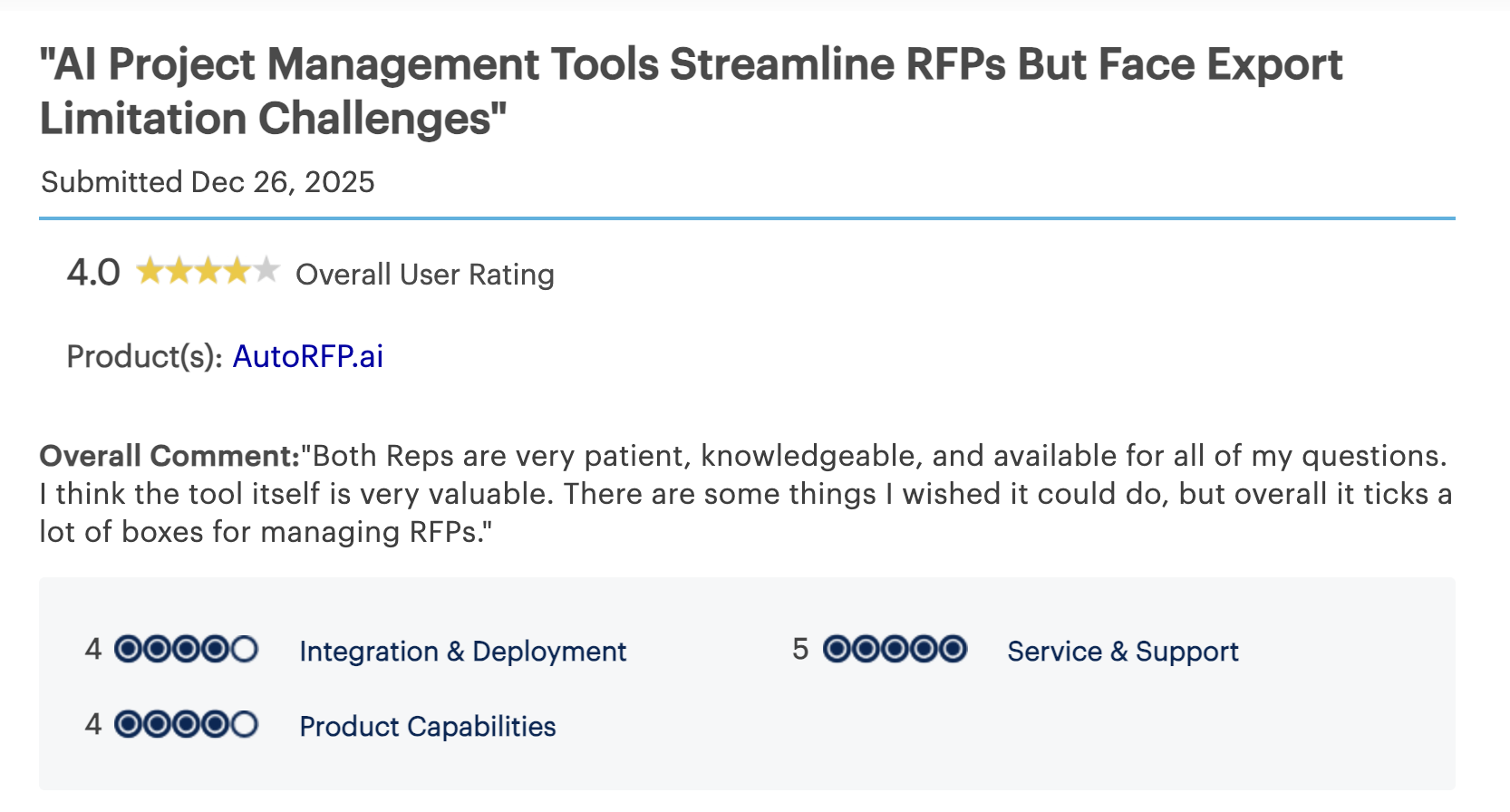
It is an excellent choice for teams dealing with simple, repetitive RFPs that require fast drafting.
Suggested Alternative: Inventive AI
AutoRFP AI is often evaluated by teams looking to speed up first-pass RFP drafts. If your primary goal is reducing blank-page effort, it can be a reasonable starting point.
Inventive AI is a stronger alternative for teams that want to reduce total response effort, not just draft time. Instead of optimizing for speed alone, Inventive AI generates context-aware responses that align with the full RFP intent, buyer priorities, and deal specifics, especially in narrative, value, and security-heavy sections where AutoRFP outputs typically require significant rewriting.
5. 1up
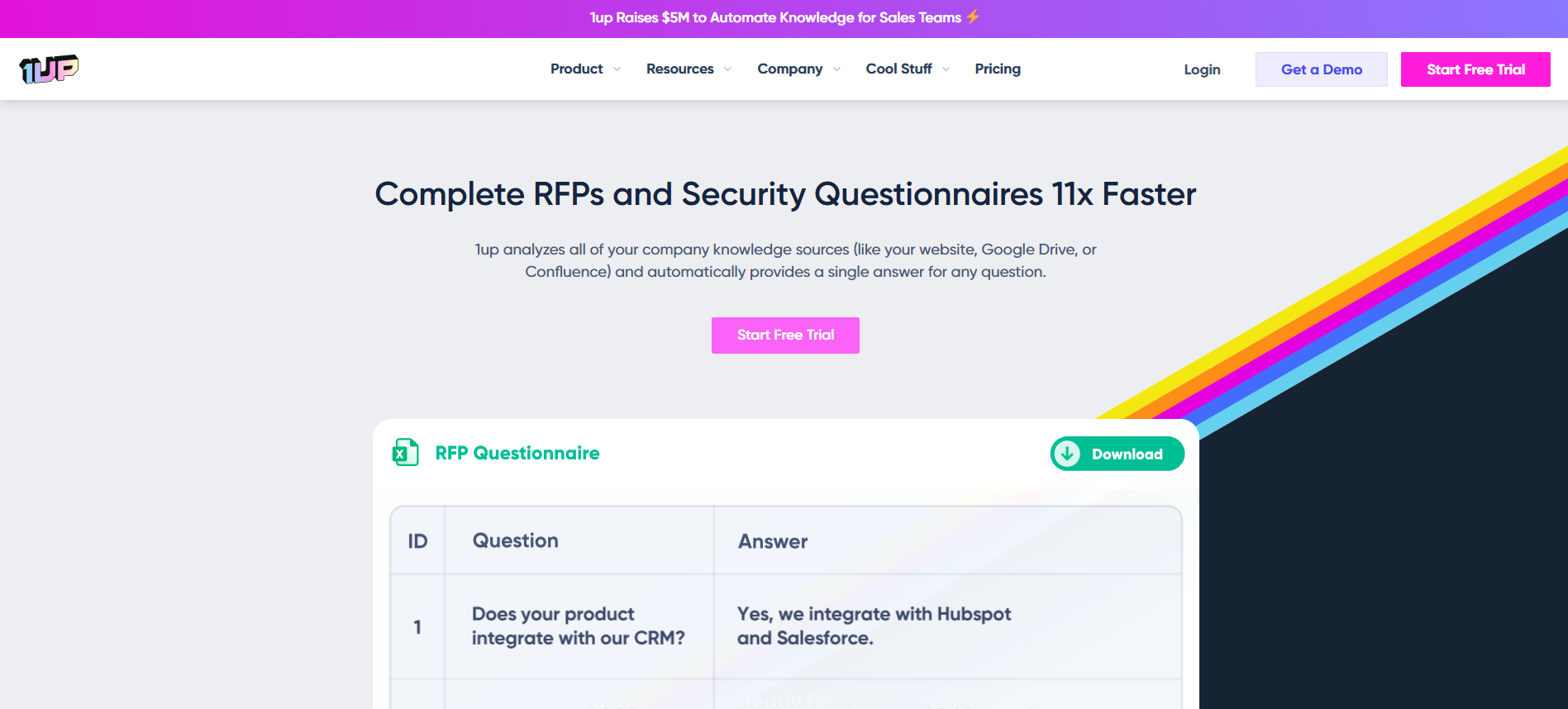
1up is positioned as a broader knowledge automation tool that supports RFPs alongside other use cases like sales enablement and internal Q&A.
While flexible, its generalized approach can limit effectiveness for teams needing RFP-specific intelligence and response precision.
Features
- Knowledge ingestion from internal systems: It allows you to ingest data from internal systems, making it easy to access relevant knowledge from existing resources such as CRMs, internal wikis, or knowledge bases.
- AI-generated questionnaire responses: The platform can generate responses for RFP questionnaires using its AI capabilities, drawing from the ingested internal knowledge.
- Browser extensions and chat integrations: It integrates with web browsers and chat tools, enabling seamless access to the platform’s capabilities directly from within other commonly used systems.
What Makes 1up Stand Out
- Broad applicability across teams: It is not limited to just RFP responses. Its flexible nature means it can be used across a variety of teams and departments, such as sales, customer support, and internal knowledge management.
- Easy access to internal knowledge: By ingesting knowledge from existing internal systems, it makes it easy for teams to use internal resources without having to manually search or compile data.
- Faster responses than manual workflows: For teams already working with manual processes, it offers significant speed improvements, enabling them to generate responses faster than traditional workflows.
The Limitations of 1up
- Lacks deep RFP-specific reasoning: While 1up can generate responses, it doesn’t provide the deep contextual understanding necessary for tailoring answers in complex RFPs. This means it struggles with nuanced or value-driven responses.
- Limited customization for deal context: The platform lacks flexibility when it comes to customizing responses based on specific deal contexts, meaning responses may not always align with buyer needs or unique deal requirements.
- Responses often require manual editing: Like many automation tools, 1up’s AI-generated responses typically need significant manual edits to ensure they are tailored, persuasive, and aligned with the specific goals of the proposal.
Pricing
| Plan Type | Pricing |
|---|---|
| Subscription | Starts at $300/month |
Best for
- Teams seeking lightweight automation across multiple workflows: 1up is ideal for teams looking for a broad, flexible tool that can automate various workflows, from RFP responses to internal Q&A.
- Organizations without complex RFP requirements: This platform works best for teams responding to simpler, more straightforward RFPs that don’t require a high level of customization or narrative-driven content.
Ratings & Reviews
Ratings: 4.9/5
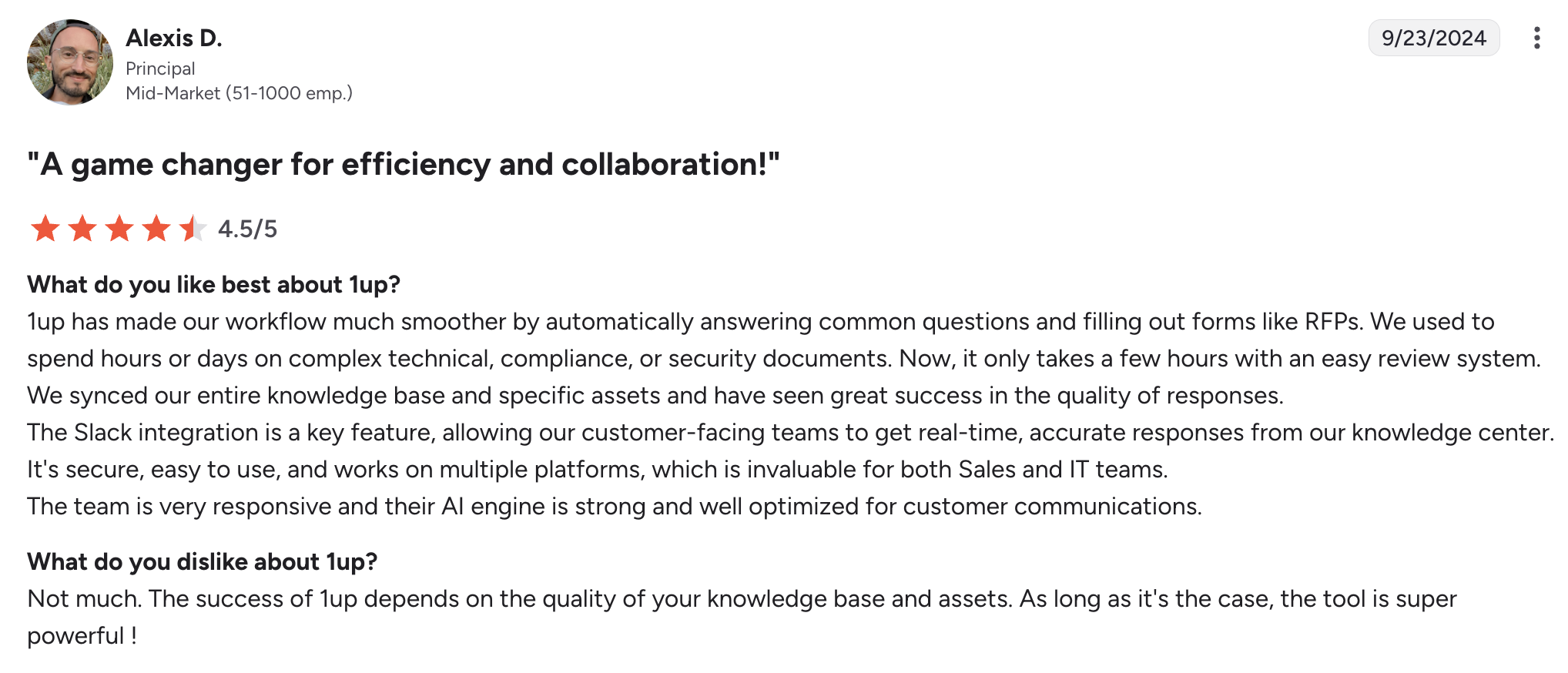
It is a solid choice for teams that need a lightweight automation tool capable of supporting various workflows beyond RFP responses. However, its generalized approach and lack of RFP-specific intelligence may limit its effectiveness for teams working on more complex, customized proposals.
6. Arphie
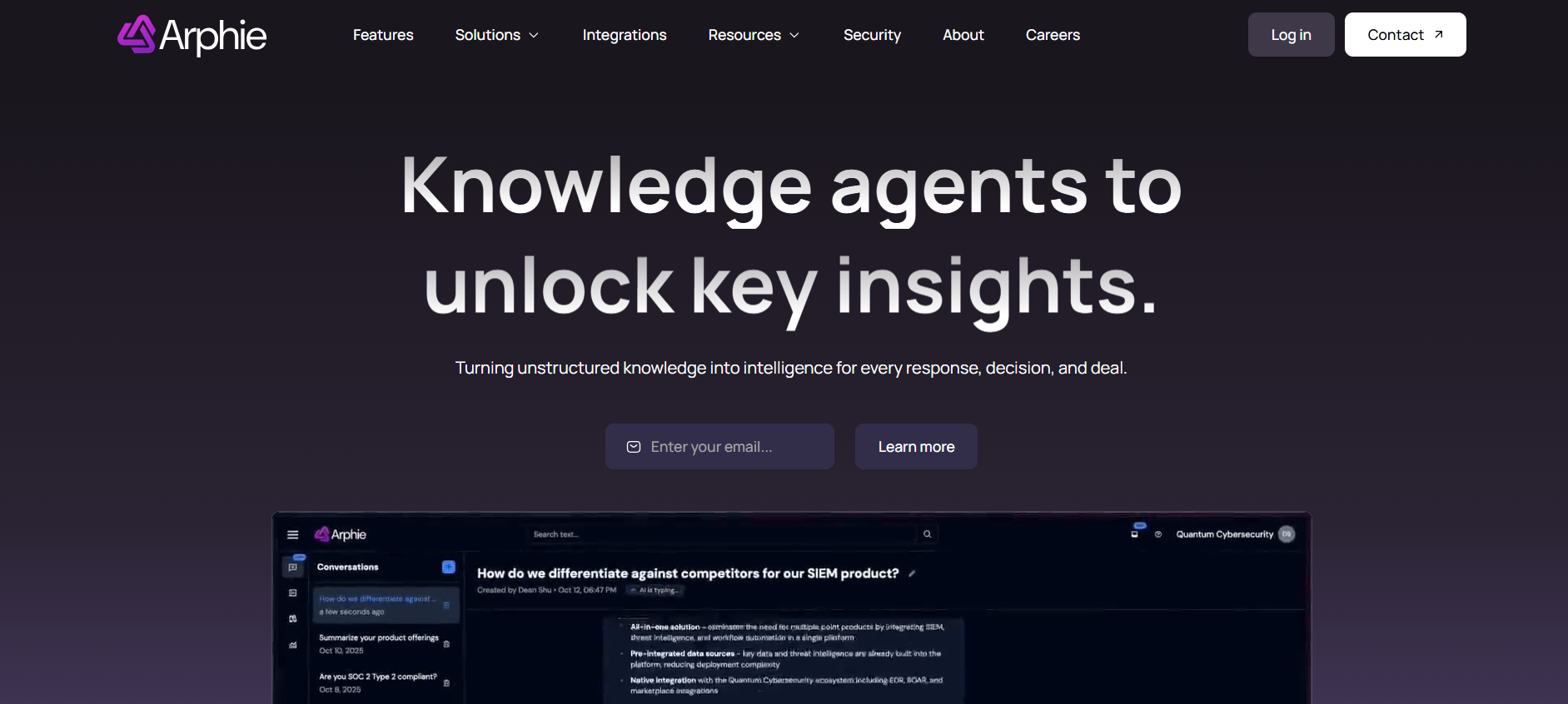
Arphie assists teams with drafting RFP and proposal responses using AI. It helps reduce writing time but relies heavily on users to refine and contextualize outputs.
Features
- AI-assisted drafting: It uses AI to help draft initial responses for proposals and RFPs. The AI accelerates the writing process by generating structured drafts based on input prompts and past responses.
- Document-based workflows: The platform supports document-based workflows, allowing teams to work directly within the platform, organize their content, and maintain consistency across multiple proposal documents.
- Collaboration tools: It includes collaboration features that allow teams to work together on proposals, providing real-time feedback and edits to the drafted content.
What Makes Arphie Stand Out
- Helpful for speeding up first drafts: It is particularly valuable for teams looking to speed up the initial drafting process, as it helps generate structured drafts quickly, cutting down the time spent on writing from scratch.
- Simple interface: The platform offers an easy-to-use interface, making it accessible for teams who need to generate drafts without a steep learning curve.
- Reduces manual typing: By automating the initial drafting stage, it significantly reduces the need for manual typing, freeing up teams to focus on refinement and customization.
The Limitations of Arphie
- Limited context awareness: The platform’s AI doesn’t possess deep contextual understanding, meaning it can produce responses that lack deal-specific insights and may not fully address the unique needs of each RFP.
- No strong mechanism for handling conflicting content: The platform does not have a solid system for identifying or resolving conflicting information within responses, which can lead to issues when combining multiple sources or handling large, complex RFPs.
- Heavy reliance on human review: While it helps speed up the drafting process, it requires substantial human intervention to ensure the responses are accurate, contextually relevant, and persuasive, especially in the final stages of proposal preparation.
Pricing
| Plan Type | Pricing |
|---|---|
| Subscription | Not publicly listed |
Best for
- Teams needing drafting assistance rather than end-to-end automation: It is best suited for teams that require help starting drafts but are still looking for a hands-on approach to refining the responses before submission.
- Early-stage proposal teams: This platform is particularly useful for early-stage proposal teams that are just starting to adopt AI tools but still rely heavily on manual processes and human oversight to finalize content.
Ratings & Reviews
Ratings: 5/5
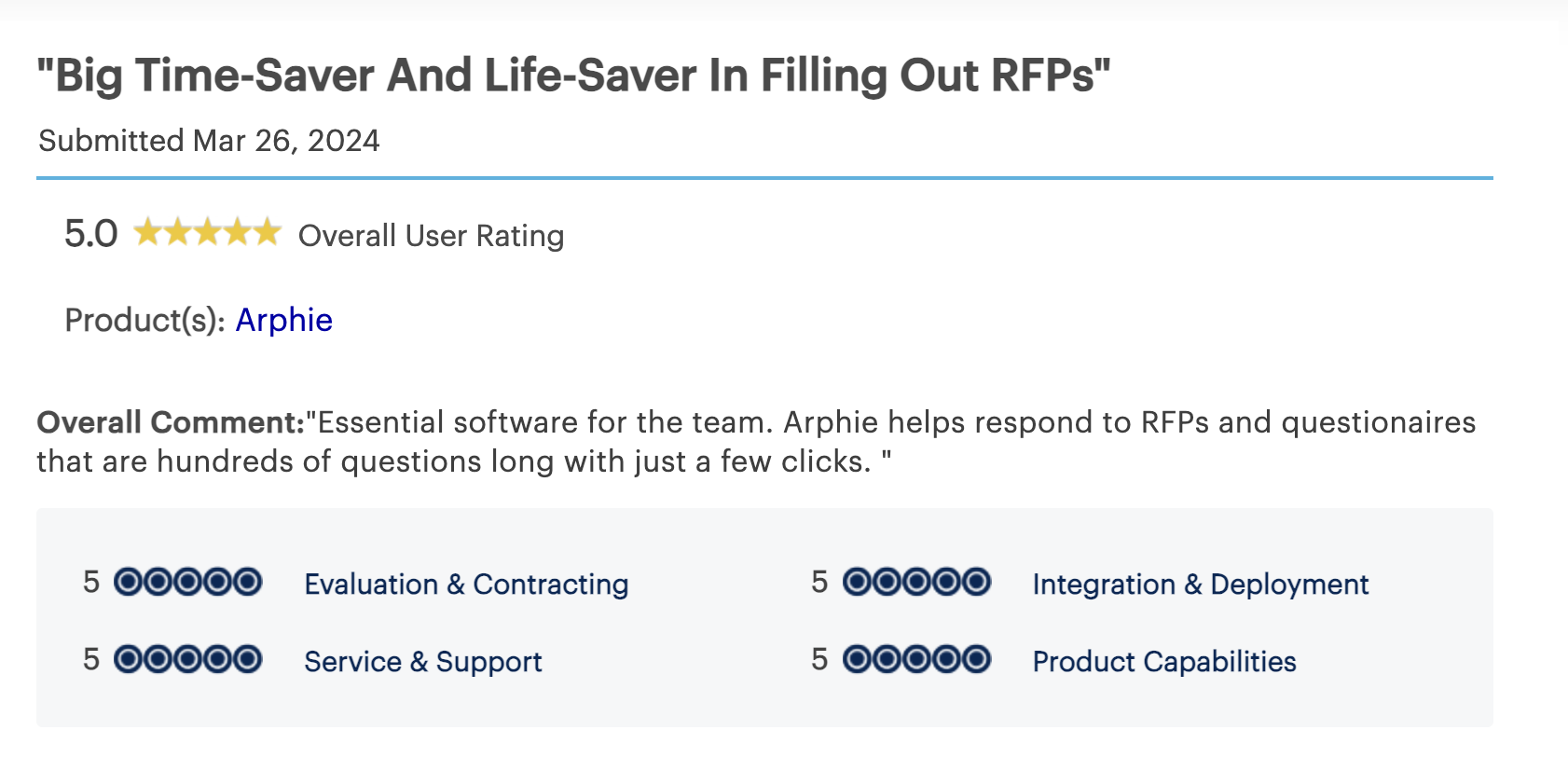
It is a helpful tool for teams looking to speed up the drafting process and reduce manual typing. However, its lack of deep contextual understanding and the need for extensive human review may limit its effectiveness for more complex proposals.
7. Realm
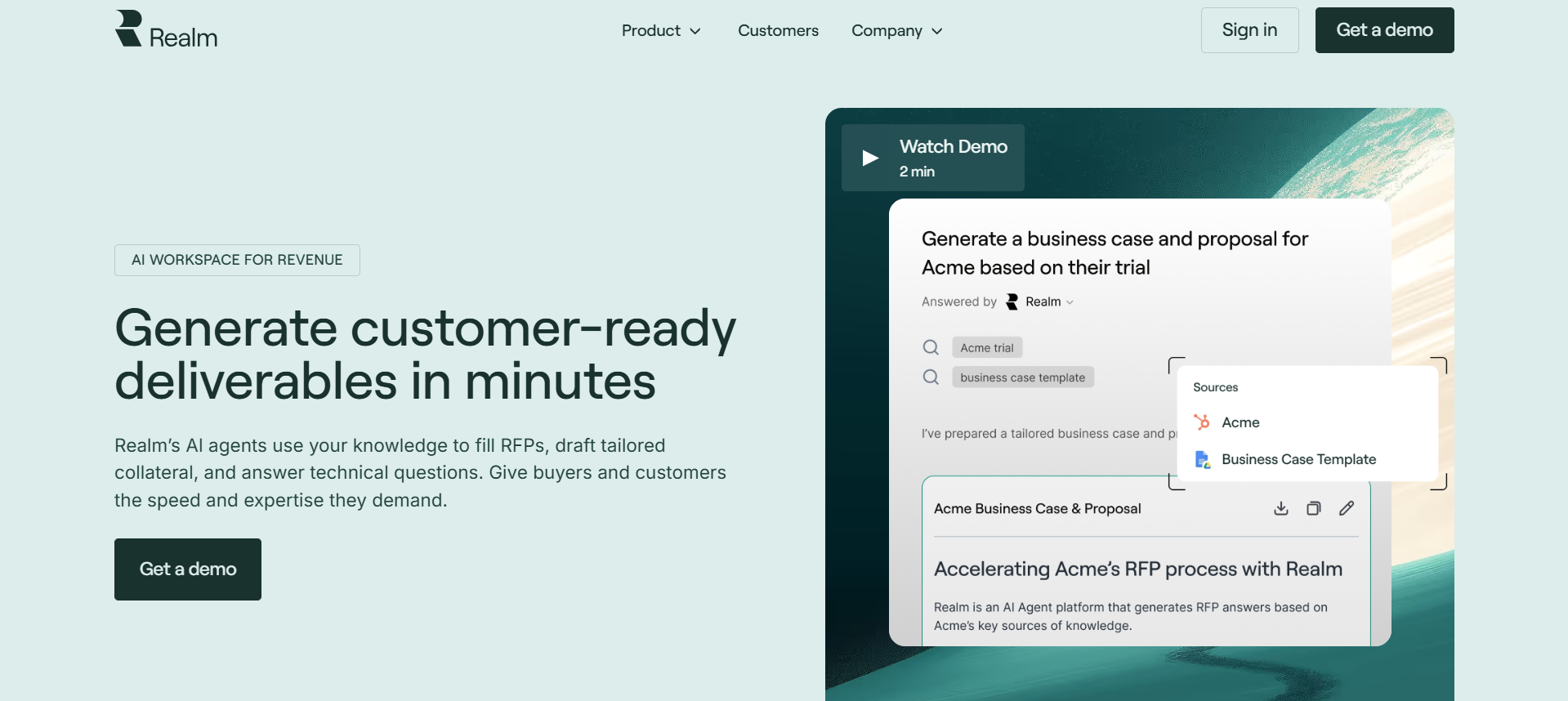
Realm positions itself as a general AI platform for revenue teams, with RFP automation included as one of several capabilities.
This breadth can dilute its effectiveness for teams seeking a focused HeyIris alternative specifically for RFP success.
Features
- Central knowledge hub: Realm centralizes organizational knowledge, providing a single source of truth for teams across different departments to access and use.
- AI agents for multiple workflows: The platform includes custom AI agents that support multiple workflows, allowing organizations to automate a variety of processes, including RFP responses, sales outreach, and customer service.
- RFP and questionnaire automation: While Realm offers RFP automation, its functionality is not deeply specialized, meaning it can automate basic tasks but lacks the depth needed for complex, high-stakes proposals.
What Makes Realm Stand Out
- Flexible across different revenue use cases: Its versatility allows it to be applied across a wide range of revenue-focused functions, from sales to customer success, making it a good choice for teams looking for a multi-functional AI platform.
- Integrates with many internal tools: The platform supports integration with a variety of internal tools, enabling smooth workflow automation across different departments. This makes it easy to tie together CRM, marketing platforms, and more.
- Supports custom AI agents: It allows teams to create custom AI agents tailored to their specific needs, offering a more personalized AI experience across various operations.
The Limitations of Realm
- RFP functionality is not deeply specialized: While it includes RFP automation as part of its offering, its functionality is not as specialized as dedicated RFP tools like HeyIris. Teams seeking high-quality, deal-specific responses may find its RFP features lacking in depth.
- Requires configuration to achieve usable outputs: To get the most out of this software, teams may need to configure and customize the platform to ensure it generates usable outputs. This can add time and complexity to the setup process, especially for teams that need quick, reliable results.
- Not optimized for response quality at scale: Its approach to RFP automation is not specifically optimized for scalable, high-quality responses. Teams looking for deep customization and high-caliber outputs may find the platform insufficient for handling larger, more complex RFPs at scale.
Pricing
| Plan Type | Pricing |
|---|---|
| Subscription | Not publicly listed |
Best for
- Teams looking for a general AI layer across revenue operations: It is well-suited for teams looking to implement AI across multiple workflows in sales, marketing, and customer success, rather than focusing exclusively on RFP responses.
- Organizations experimenting with AI agents: If your organization is exploring AI agents and wants a platform that can support various functions beyond RFPs, it offers flexibility to experiment and adapt the AI to different use cases.
Ratings & Reviews
Ratings: 4.1/5
It is a good choice for teams looking for a general-purpose AI platform that spans across various revenue operations. However, its RFP automation is not as specialized as dedicated tools like HeyIris, making it less suitable for teams seeking high-quality, tailored RFP responses at scale.
8. Ombud

Ombud attempts to automate RFP and questionnaire workflows using structured rules and content reuse.
While helpful for organization, its automation remains largely rule-based rather than context-aware.
Features
- Content collaboration: Ombud provides tools for cross-functional collaboration, allowing different team members (e.g., sales, legal, security) to contribute to responses in real-time.
- Rule-based response suggestions: The platform suggests responses based on pre-defined rules and content libraries, making it efficient for repetitive queries but less adaptable when nuanced, customized answers are needed.
- Workflow management: Ombud includes workflow management features to track progress, assign tasks, and ensure that teams meet deadlines for RFP submissions.
What Makes Ombud Stand Out
- Supports cross-functional collaboration: By enabling different teams to work together on RFPs, Ombud fosters seamless collaboration and ensures that responses are vetted by the relevant stakeholders, such as legal, finance, and security teams.
- Centralizes response content: Ombud consolidates all RFP-related content in one place, making it easier for teams to manage and access pre-approved answers and responses. This reduces the chances of duplication and ensures consistency across proposals.
- Useful for structured questionnaires: The platform works well for structured RFPs with repetitive questions, streamlining the process of filling in standard information across multiple documents.
The Limitations of Ombud
- Mostly rule-based, not truly contextual: Ombud’s automation is heavily rule-based, meaning it lacks contextual awareness. This makes it difficult for the platform to generate highly tailored, deal-specific responses, particularly for complex RFPs that require a deeper understanding of the buyer's needs.
- Limited AI reasoning capabilities: The platform's automation relies on static rules rather than AI reasoning that adapts to the specific context of each RFP, limiting its ability to personalize responses based on the unique deal context or buyer expectations.
- Requires manual intervention for complex questions: Since Ombud doesn’t offer sophisticated context-aware AI, teams often need to manually intervene to ensure that responses to more complex or open-ended questions are accurate, persuasive, and aligned with the RFP’s overall narrative.
Pricing
| Plan Type | Pricing |
|---|---|
| Subscription | Not publicly listed |
Best for
- Teams with predictable, repetitive RFP formats: Ombud is best suited for organizations with standardized RFP formats, where the questions are largely consistent across submissions and the focus is on improving efficiency rather than creativity.
- Organizations focused on process over insight: If your team values process efficiency and needs a tool to ensure consistent, reliable responses across a high volume of RFPs, Ombud can help streamline the workflow but may fall short when deeper insight or strategic differentiation is required.
Ratings & Reviews
Ratings: 4.7/5
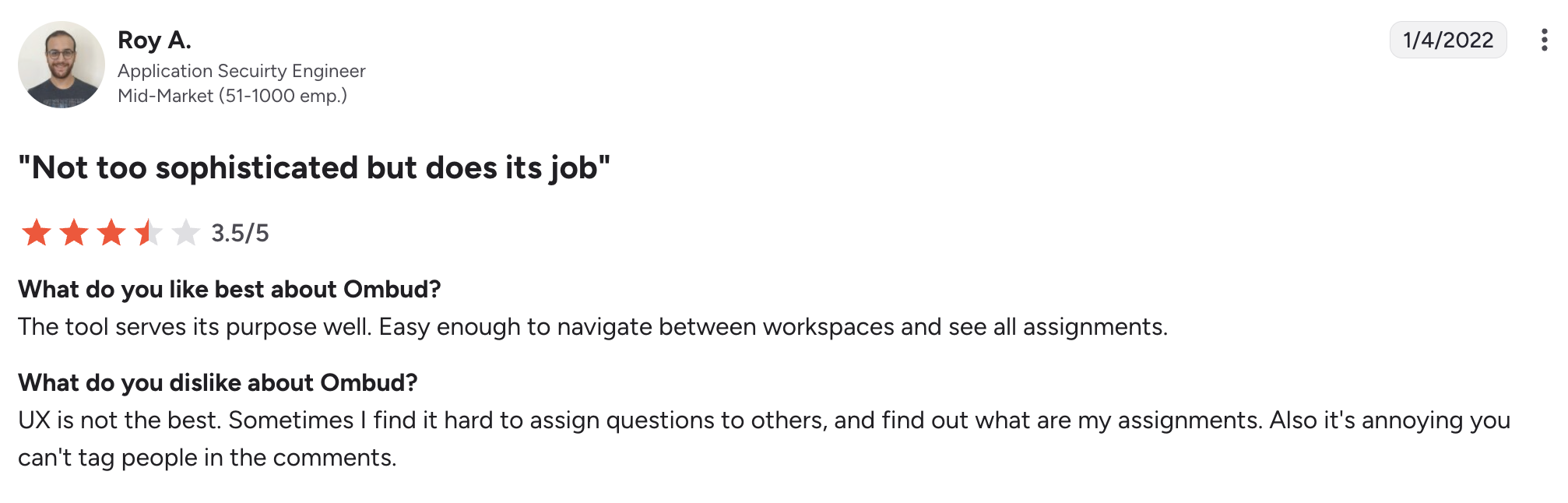
Ombud is a great choice for teams looking to automate repetitive RFP workflows and improve cross-functional collaboration. But it lacks the contextual understanding and AI-driven reasoning required for complex, customized RFPs.
9. Bidify
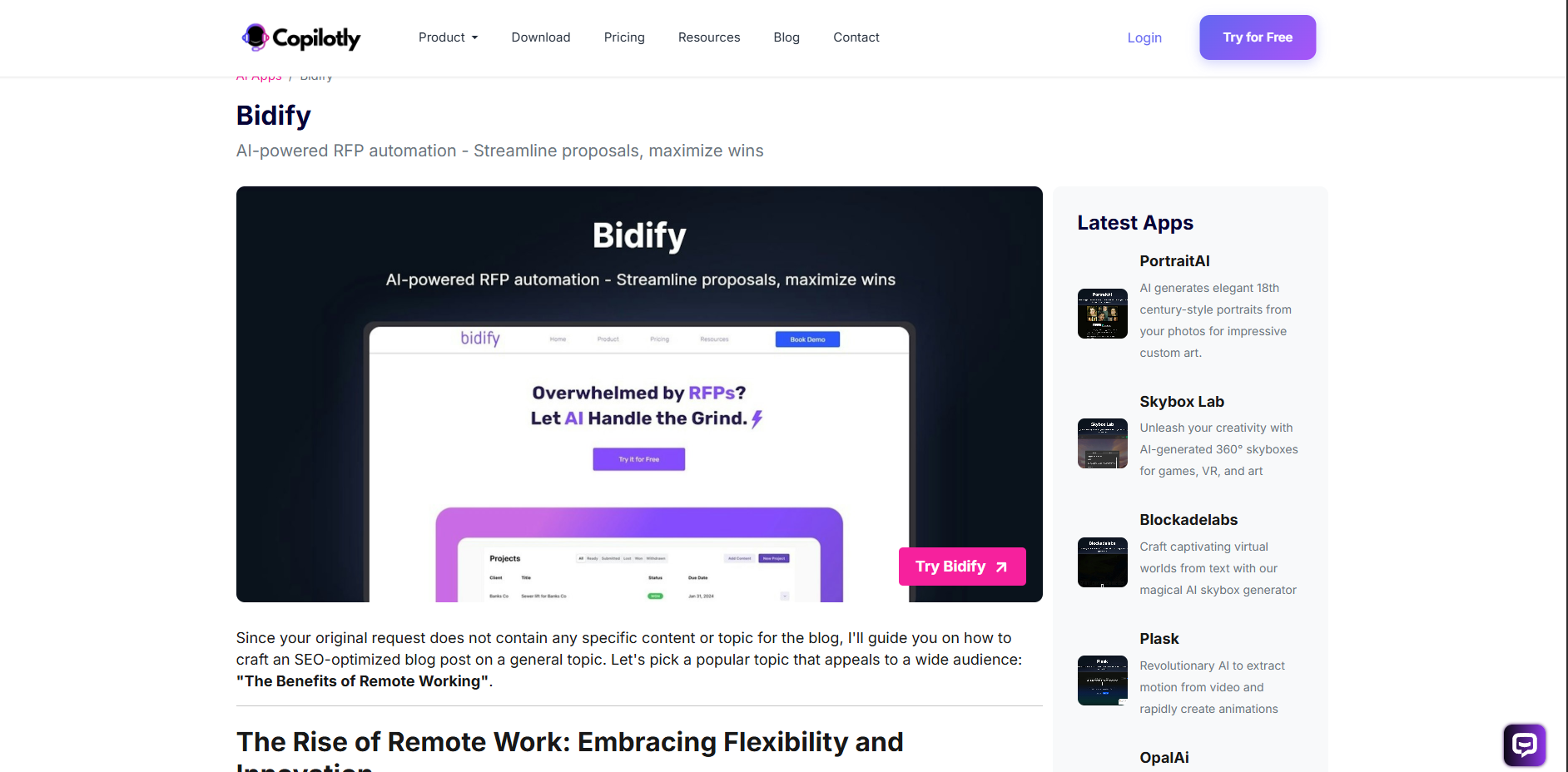
Bidify focuses on generating proposal drafts using AI. It helps accelerate writing but provides limited controls for accuracy, consistency, and depth.
Features
- AI-generated proposal drafts: Bidify uses AI to generate drafts, helping teams create proposals more quickly by reducing the time spent on the initial writing phase.
- Proposal templates: The platform offers pre-built templates to help structure proposals, providing a starting point for users to fill in the necessary details and customize them as needed.
- Basic collaboration tools: Bidify includes basic collaboration features, enabling team members to contribute and review proposals together, but it lacks the advanced features that may be needed for larger teams or more complex proposals.
What Makes Bidify Stand Out
- Faster proposal drafting: Its AI helps teams accelerate the proposal drafting process, reducing the time spent starting from scratch and providing a first draft that teams can build upon.
- Simple onboarding: The platform is easy to set up and use, making it accessible for small teams that need a straightforward tool to help with proposal writing.
- Reduces writing effort: By automating the first draft of proposals, it reduces the amount of manual writing effort, allowing teams to focus on refining content and finalizing details rather than creating content from the ground up.
The Limitations of Bidify
- Limited accuracy controls: It offers little in the way of accuracy controls, meaning that the AI-generated drafts can sometimes lack precision or contain errors that require manual correction.
- Weak handling of complex requirements: The platform struggles when it comes to handling complex proposal requirements. It works well for simple proposals but is less effective in generating customized, detailed, or high-stakes responses.
- Significant manual editing required: Despite automating the first draft, the responses still often require extensive manual editing to improve accuracy, clarity, and alignment with specific proposal requirements.
Pricing
| Plan Type | Pricing |
|---|---|
| Subscription | Not publicly listed |
Best for
- Small teams producing simple proposals: It is most suitable for small teams who need a quick and easy tool for generating simple proposals, especially for low-risk projects that don’t require much customization.
- Low-risk, low-complexity bids: The platform is best for teams working on straightforward, less complex proposals where the focus is on getting a draft out quickly without the need for deep customization or high accuracy.
Ratings & Reviews
Ratings: N/A
It is a practical tool for small teams looking to accelerate the proposal drafting process, particularly for low-risk, low-complexity bids. While it helps reduce writing effort and speed up initial drafts, its lack of accuracy controls and weak handling of complex requirements make it less ideal for more customized or high-stakes proposals.
Why Teams Turn to HeyIris Alternatives?
HeyIris AI is an AI-powered platform designed to help sales and proposal teams respond to RFPs, RFIs, and related questionnaires more efficiently. It focuses on accelerating response creation by using AI to draft answers based on existing content and internal knowledge sources.
However, as teams scale and RFPs grow in complexity, HeyIris may not offer the depth or customization required for more complex, multi-stakeholder proposals. Its reliance on static content reuse and lack of deep contextual understanding can lead to generic responses that fail to capture the nuances and strategic differentiators that evaluators are looking for in enterprise-level RFPs.
For many organizations, HeyIris serves as an entry point into AI-assisted RFP workflows, but it may struggle to meet the demands of teams handling high-volume, high-complexity proposals that require tailored, deal-specific responses.
5 Key Criteria for Evaluating HeyIris Alternatives
Before comparing individual tools, it’s important to clarify what actually matters when evaluating HeyIris alternatives. Most modern RFP platforms can generate drafts and store content, but those capabilities alone don’t determine whether a tool reduces total effort or improves outcomes.
For revenue, presales, and proposal teams evaluating HeyIris alternatives, the following criteria consistently separate effective platforms from surface-level automation:
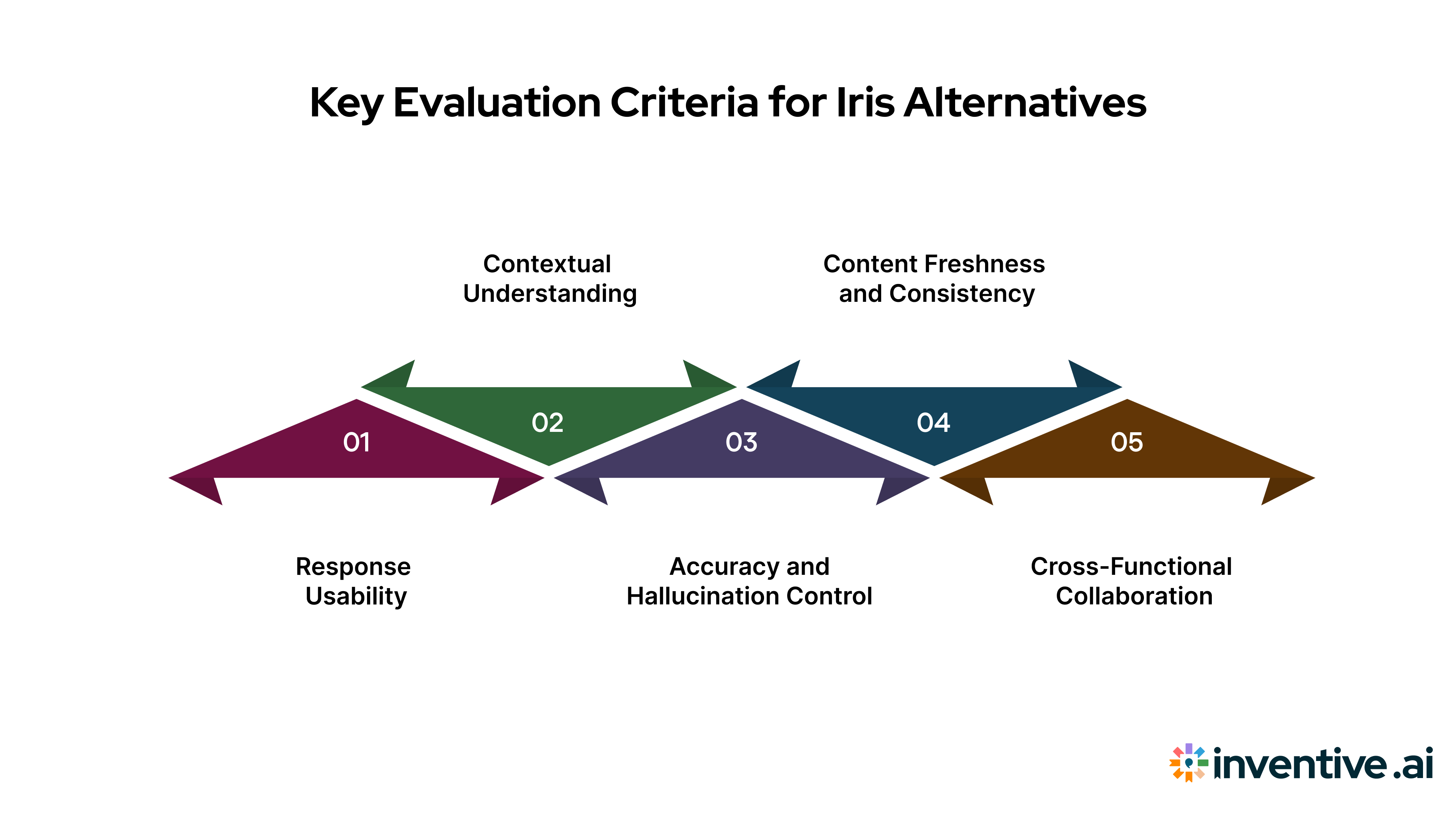
1. Response usability
Draft speed only creates value if responses are accurate and ready to submit. Tools that require extensive rewriting often fail to deliver meaningful time savings.
2. Contextual understanding
Stronger alternatives interpret intent across the full RFP, rather than treating each question in isolation. This becomes critical in value-based and narrative sections.
3. Accuracy and hallucination control
In RFPs and security questionnaires, incorrect or fabricated responses introduce real business risk. Reliable tools prioritize grounded answers and clearly flag gaps instead of guessing.
4. Content freshness and consistency
As knowledge bases scale, outdated or conflicting responses become harder to manage manually. Effective platforms proactively detect and surface these issues.
5. Cross-functional collaboration
RFP responses typically require input from sales, solutions, legal, and security teams. The right tool supports seamless collaboration without version sprawl.
These factors make it easier to distinguish between tools that simply automate drafting and those that meaningfully improve how teams respond to RFPs at scale.
What Differentiates HeyIris Competitors in Real-World RFPs?
After reviewing HeyIris alternatives side by side, a clear pattern emerges: many tools appear similar on paper, but behave very differently when applied to live RFPs.
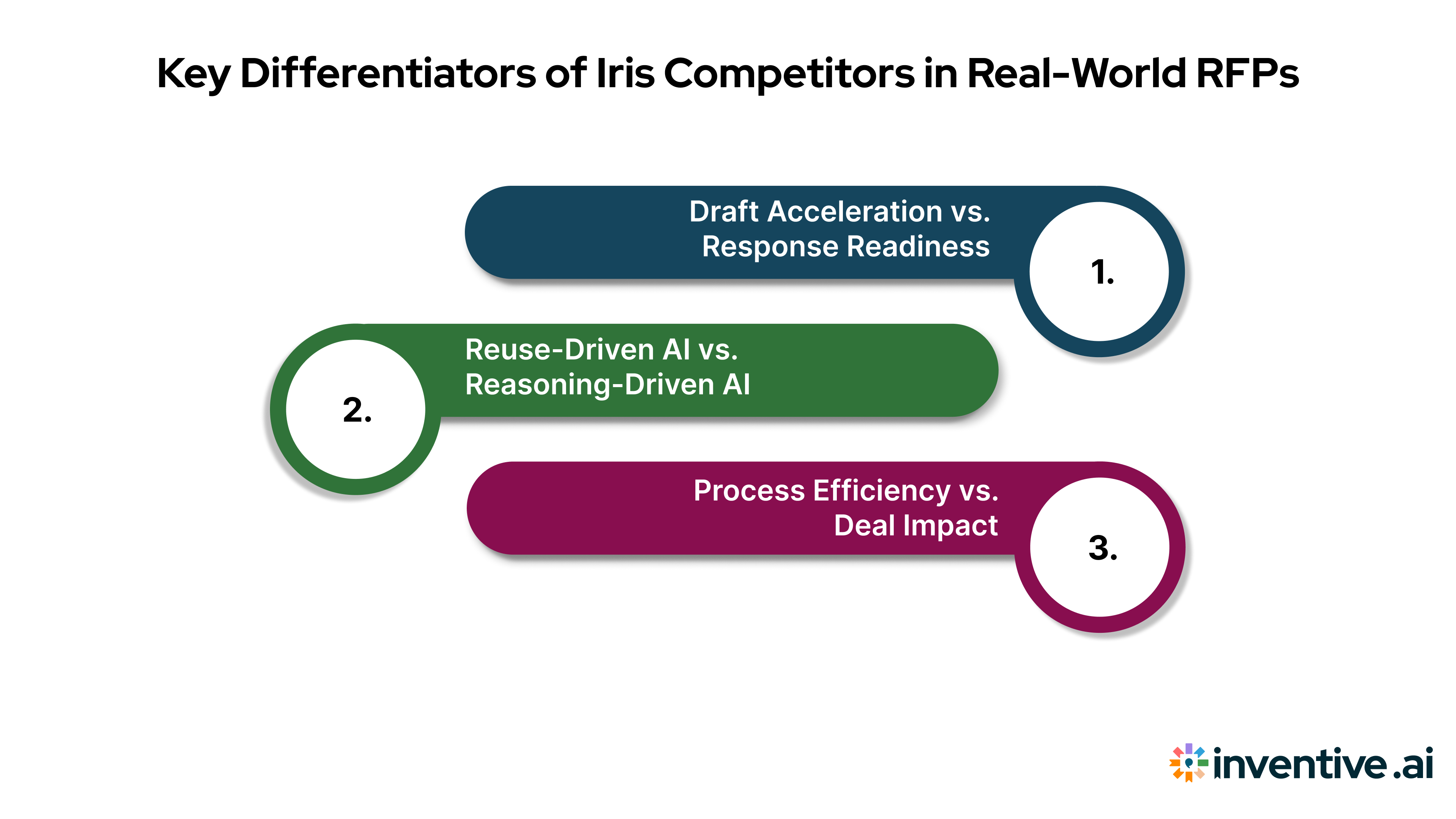
Across the platforms compared in this guide, differentiation typically shows up in three areas:
1. Draft acceleration vs. response readiness
Some tools focus on generating first drafts quickly. Others, like Inventive AI, prioritize delivering responses that are already structured, accurate, and aligned with buyer expectations.
2. Reuse-driven AI vs. reasoning-driven AI
Many platforms rely heavily on reusing past answers. Fewer tools reason across the full RFP to tailor responses to the specific deal, customer, and evaluation criteria.
3. Process efficiency vs. deal impact
Workflow automation improves internal efficiency, but response quality directly influences win rates, particularly in enterprise and high-value RFPs.
As RFP volumes increase and buyers demand more tailored, defensible responses, these differences become more consequential than individual feature lists or UI preferences.
Related: Using AI to Improve RFP Response Quality and Accuracy
Why Choose Inventive AI Over Other RFP Tools?
As RFP volumes increase and buyer expectations become more demanding, the difference between generating answers and submitting winning responses becomes very clear.
Most HeyIris competitors focus on speed, helping teams draft responses faster or reuse existing content more efficiently. Inventive AI takes a fundamentally different approach by optimizing for response quality, accuracy, and deal impact.
Inventive AI is built for teams that need:
- Highly contextual responses that reflect the full deal, buyer, and technical requirements
- Consistent accuracy at scale, even across long and complex RFPs
- Zero tolerance for hallucinations, especially in security and compliance-heavy sections
- Value-driven narratives, not just short factual answers
With Inventive AI, teams can:
- Respond 90% faster without sacrificing depth
- Achieve 95% accuracy across technical and narrative questions
- Eliminate risk with 0% hallucinations
- Improve outcomes with up to 50% higher win rates
For organizations that have outgrown basic RFP automation and need responses that are genuinely ready to submit, Inventive AI offers a clear step forward.
Here’s what customers say:
“Saved our Presales team a ton of time. Response quality is high, and the chatbot is useful for ad hoc responses.”
- Verified G2 reviewer, Solutions Engineering team
FAQs
1. What are the best HeyIris alternatives in 2026?
The best HeyIris alternatives depend on team needs, but leading options include Inventive AI, Loopio, Responsive, AutoRFP, and 1up. Inventive AI stands out for teams prioritizing accuracy and contextual depth.
2. Is HeyIris suitable for enterprise RFP teams?
HeyIris can work for smaller or less complex RFP workflows. Enterprise teams often require stronger context handling, accuracy controls, and support for long-form narrative responses.
3. How accurate are AI RFP tools?
Accuracy varies widely. Some tools generate fast drafts that require heavy rewriting, while others, like Inventive AI, prioritize grounded responses with high accuracy and no hallucinations.
4. Can AI RFP software actually improve win rates?
Yes. When AI reduces rewriting effort and improves response quality, teams can focus more on strategy and differentiation, which directly impacts win rates.
5. What should teams test during an RFP software trial?
Key areas to test an AI RFP software include response accuracy, contextual relevance, handling of stale content, collaboration workflows, and how much manual editing is required after drafts are generated.
6. How do pricing models differ across HeyIris competitors?
Pricing ranges from subscription-based tiers to project-based models. Inventive AI uses a usage-based pricing approach, aligning cost with actual RFP activity.