Best Loopio Competitors & Alternatives for RFP Response Process in 2026
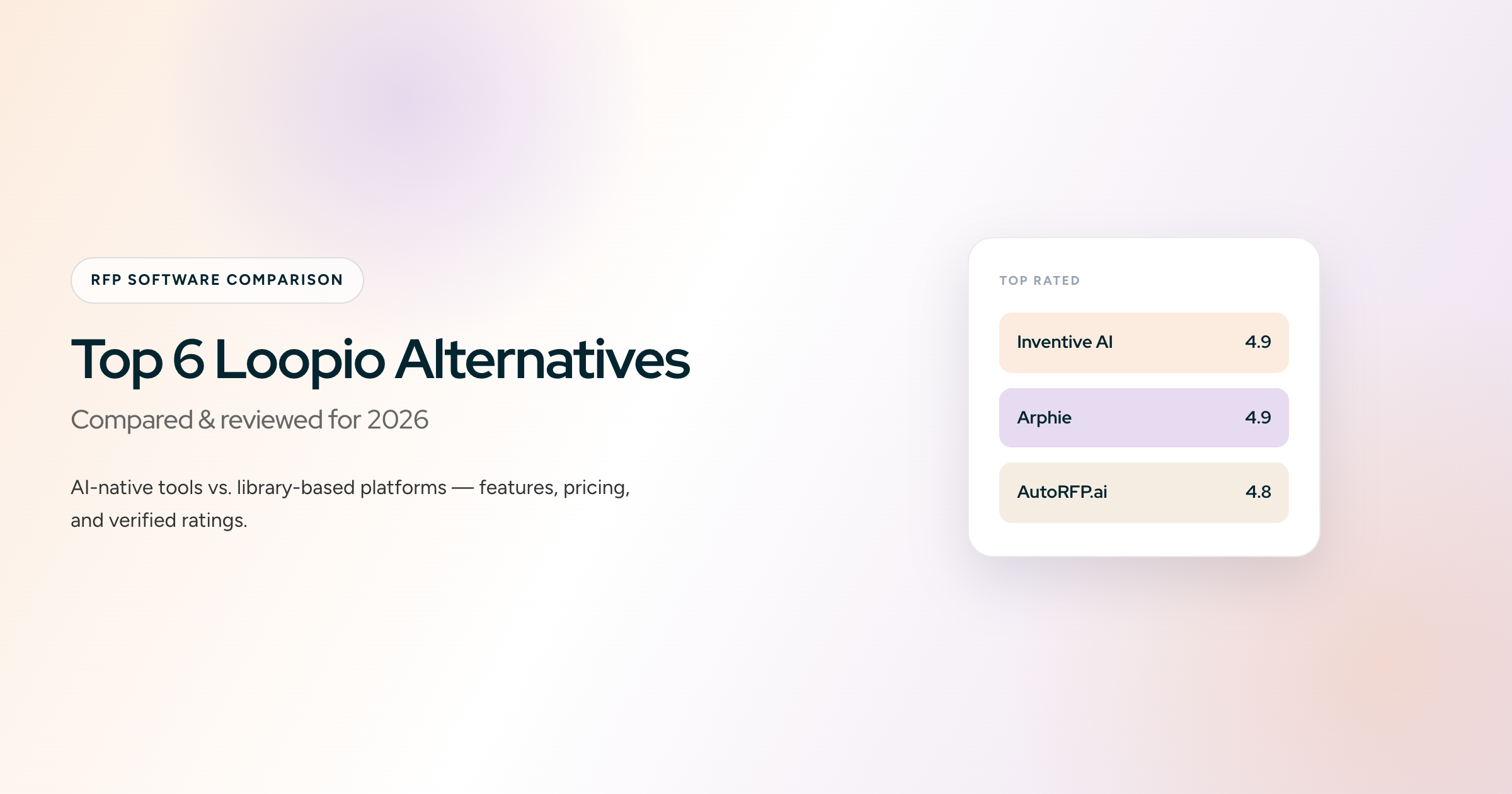
Explore the top Loopio competitors of 2026 with insights on features, pricing, and user reviews. Click to learn more!

If you spend hours chasing SMEs, pasting answers from old spreadsheets, and fixing messy proposal drafts, you are not alone. Many teams still spend around 24 hours writing a single RFP response, even though average win rates hover around 45%. That is a lot of effort for every deal in your pipeline.
RFP software helps, but tools vary widely in response quality, content governance, and AI depth. Loopio is one of the most well-known platforms, yet many growing teams are actively comparing Loopio competitors to find a better fit for complex, AI-first RFP workflows.
This guide walks you through what strong RFP process looks like in 2026, where Loopio fits, and the best alternatives to consider if you care about answer quality, speed, and enterprise-grade control.
Key Takeaways
- RFP response tools like Loopio help centralize content and streamline responses, but many teams face challenges with quality, time, and scalability.
- Loopio is good for basic workflows but lacks advanced features like narrative proposals and real-time content updates.
- Top alternatives include Inventive AI, Responsive, Arphie, and AutoRFP. Most of them may offer various strengths, but fall short in areas like scalability, response quality, or workflow control compared to Inventive AI.
- Decide what your team needs most. Whether it's speed, answer quality, compliance, or flexibility, pick the RFP tool that matches those priorities.
- Inventive AI leads the market by offering deep context, content freshness, conflict detection, and AI-powered win themes for higher-quality responses.
Loopio’s RFP Process: What You Need to Know
Loopio is a legacy RFP response platform that helps proposal and sales teams manage content libraries, collaborate with SMEs, and use AI to auto-fill answers. It is widely used by mid-market and enterprise teams that want a structured RFP workspace.
Key Features
- Content Libraries: A centralized library where users can store and reuse previously written responses. With this feature, teams can maintain a consistent and approved content set for future proposals.
- AI-Assisted Drafting: It offers AI features that suggest and auto-fill answers based on the content in your library. The AI is best suited for basic responses but may struggle with more complex or nuanced RFPs.
- Collaboration Tools: It includes project tracking, task assignments, and tools for collaborating with subject matter experts (SMEs). These features keep teams aligned on shared timelines, making collaboration more efficient.
Loopio’s Pros and Cons
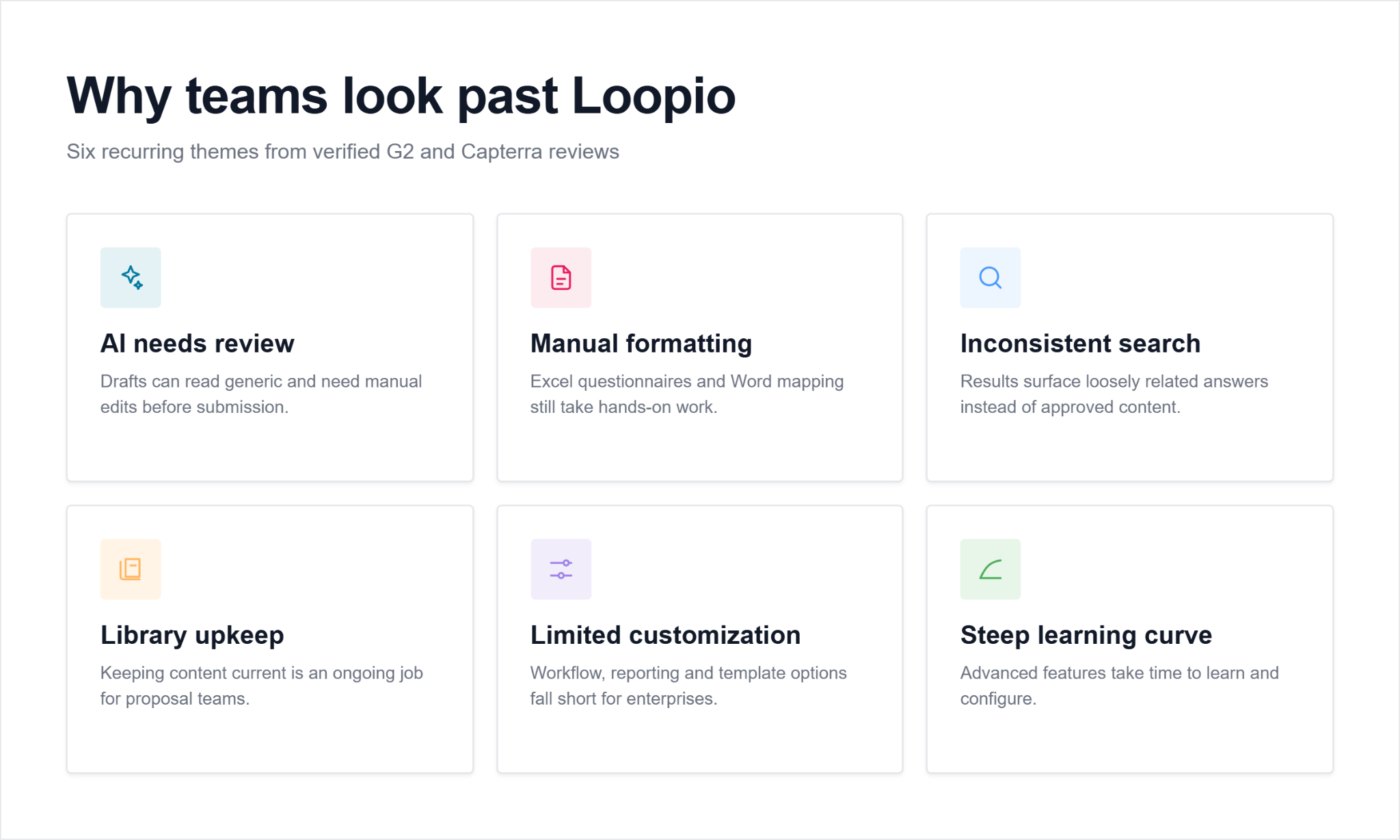
Loopio does a decent job of centralizing content and keeping projects on track. However, when you care deeply about hyper-contextual AI answers, conflict detection, and large-scale automation, these disadvantages start to outweigh the pros.
That is exactly why many growing teams are actively comparing Loopio competitors before they commit to a long-term stack.
Also Read: How to Create an Effective RFP Response
Top Loopio Competitors and Alternatives in 2026
If you are assessing RFP software now, you are not just looking for “a Loopio copy.” You want something that:
- Produces better answers with less rewriting.
- Handles RFIs, security questionnaires, and DDQs properly.
- Keeps content fresh, conflict-free, and compliant.
- Works for CROs, proposal managers, and solutions teams at scale.
Below is a quick comparison of key Loopio alternatives and where they stand on features, pricing, and Gartner visibility.
These are the core Loopio competitors most teams look at when refreshing their RFP stack.
Comparison Table: Top Loopio Alternatives for 2026
Inventive AI: Best-in-Class RFP Response Software

Inventive AI is a leading AI RFP software focused on response quality, not just storage and templates. Unlike other tools that rely on basic AI lookups, Inventive AI uses the best multi-layer context engine to fully understand each RFP, pulling from your approved knowledge sources to create responses that feel like they came from an expert.
With this advanced technology, teams see 2x more usable answers, reducing drafting time by up to 90%. It’s the top choice for teams who want to simplify RFP workflows and improve the quality of their responses. Also, the teams using Inventive AI has 100% adoption rate because of simple UI & UX.
Features:
Context Engine for Hyper-Relevant Answers:
Inventive AI’s context engine goes beyond simple keyword matching, understanding the full scope of each RFP. This multi-layered approach ensures that every answer is not only relevant but also aligned with the buyer's requirements, tone, and intent. It provides accurate, buyer-specific content, making each response stand out.
Conflict and Stale-Content Detection:
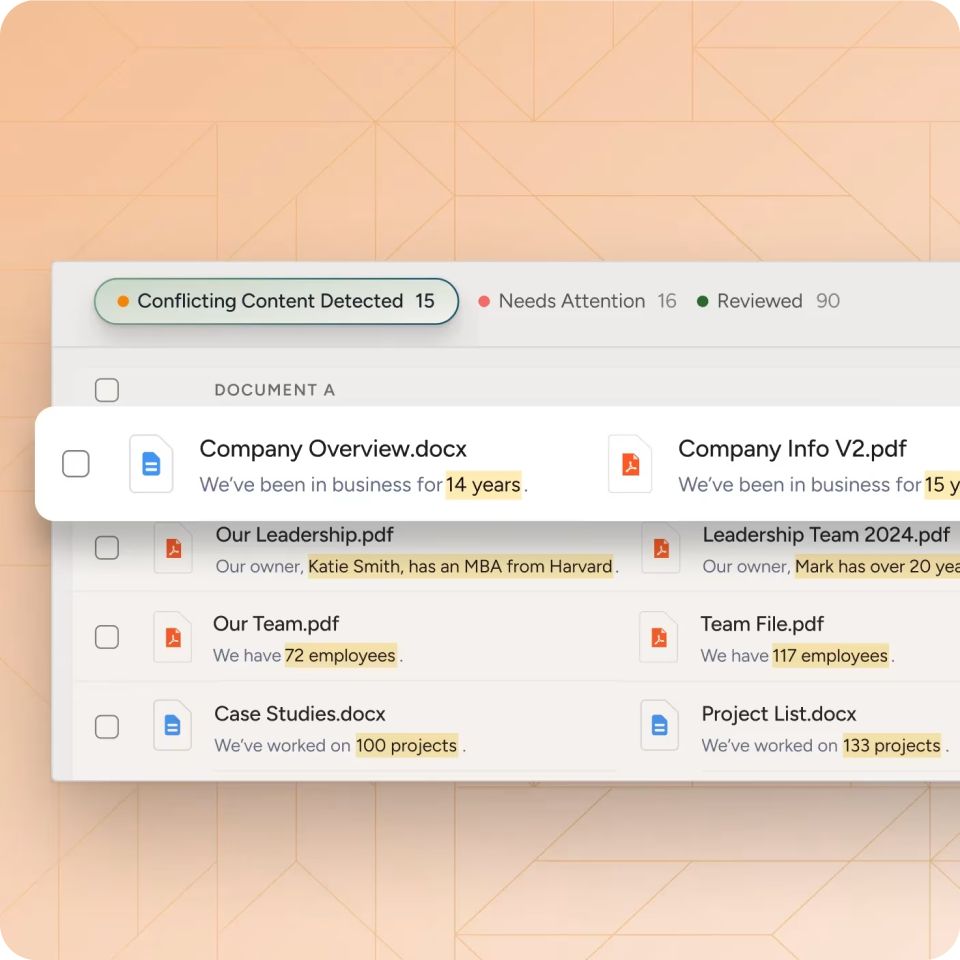
One of the most critical aspects of any RFP process is content accuracy. Inventive AI detects conflicting or outdated content, ensuring that your submissions are always up to date and compliant. This feature is invaluable for maintaining consistency and reducing risks in responses, especially when dealing with multiple teams and regions.
Narrative Proposals and Value Stories:
Inventive AI doesn’t just generate answers; it crafts full-scale proposals with executive summaries, security narratives, and one-pagers that align with the customer’s needs. These narratives help teams present a cohesive, story-driven response, providing value beyond simple Q&A formats.
Win Themes Intelligence:
Using AI, Inventive AI identifies gaps in your responses and proactively suggests content from past proposals, emails, or meetings. This win themes intelligence allows your team to continually improve and craft compelling, strategic responses with each RFP.
Single Knowledge Hub for All Sources:
Inventive AI integrates all your content, whether from past RFPs, documents, SharePoint, or Google Drive, into a unified hub. This centralized source reduces time spent searching for information, providing a one-stop shop for accurate, approved content.
What Makes Inventive AI Stand Out:
- 95%+ Answer Accuracy with Zero Hallucinations: Inventive AI is known for generating highly accurate answers. The AI uses a robust understanding of your knowledge base, ensuring that each response is not only factual but also tailored to the buyer’s needs. This leads to more usable content and significantly reduced manual revisions.
- 50%+ Higher Win Rate in Real Customer Case Studies: Inventive AI has been proven to improve win rates by over 50%. Clients report faster, more accurate responses with less effort, thanks to its deep contextual understanding and automated workflows.
- Works Across Multiple RFx Formats in One Workflow: Whether you’re handling RFPs, RFIs, security questionnaires, or DDQs, Inventive AI integrates all these into one cohesive workflow. This flexibility allows teams to manage all aspects of their proposal process from a single platform, reducing complexity and ensuring consistency.
The Limitations of Inventive AI:
- Slightly Limited Advanced Analytics Compared to Some Heavy BI Tools: While Inventive AI excels in RFP management, its analytics capabilities aren’t as extensive as those offered by some specialized business intelligence platforms.
Best for:
- Enterprise Teams Handling High Volumes of Complex RFPs: Inventive AI’s comprehensive approach makes it ideal for large teams working on complex, high-stakes proposals that require a high level of accuracy and speed.
- Companies with Multiple Product Lines and Regions Needing Strong Content Governance: The platform is built to scale, supporting multi-region, multi-product teams with its strong content management system, ensuring that all content remains consistent and up-to-date across various regions and departments.
- Sales and Solutions Teams Needing Narrative Value Statements: For teams that want to go beyond Q&A and focus on value-driven narratives, Inventive AI offers tools to craft detailed proposals and executive summaries that align with the buyer’s priorities and objectives.
Pricing:
Plan Type
Pricing
Usage-based pricing
Pricing scales based on usage and volume
Ratings and Reviews:
Ratings: 5/5
Reviews:

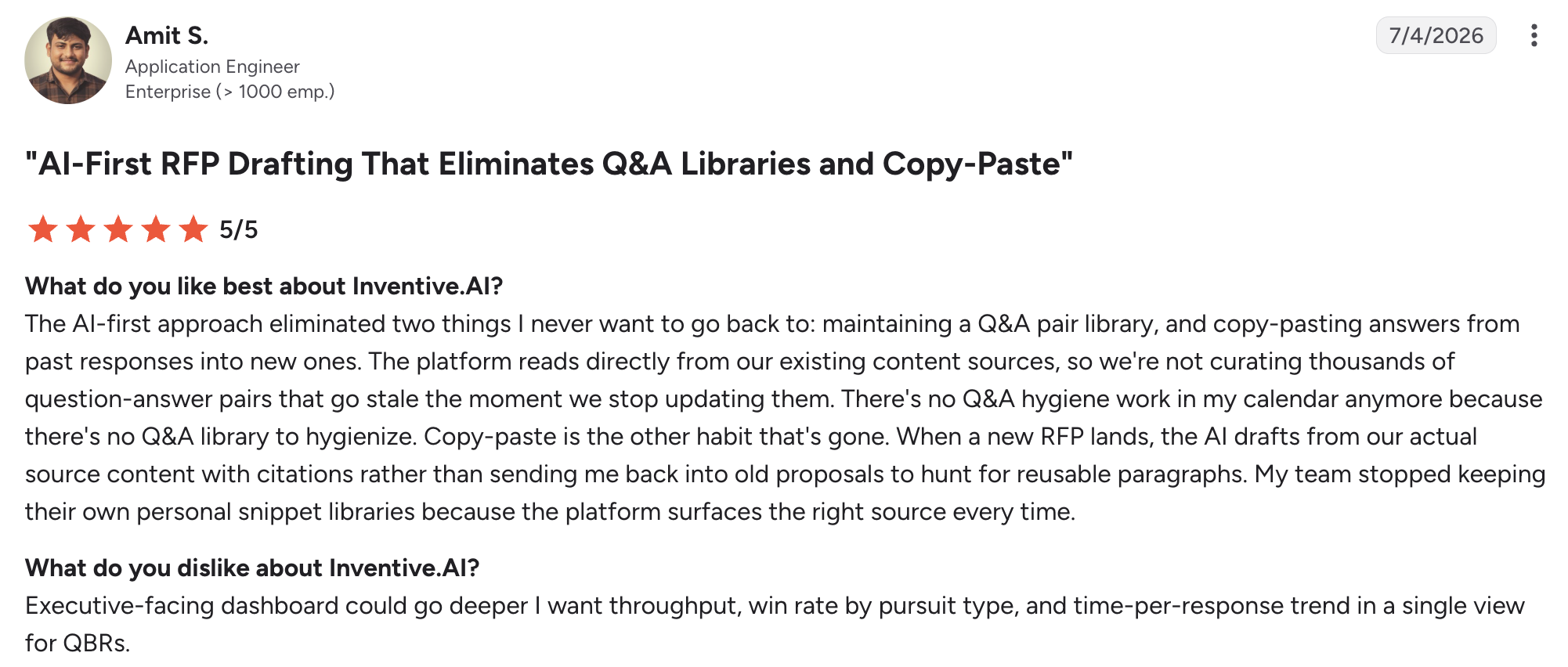
In short, if your top priority is better answers and less rewriting, Inventive AI stands out among all Loopio alternatives. Inventive AI is built not only around response quality and outcome metrics but also offers advanced AI-driven features like real-time content updates, contextual awareness, and conflict detection. It’s a comprehensive solution that optimizes every aspect of the RFP process, from drafting to submission, empowering teams to win more with less effort.
Responsive

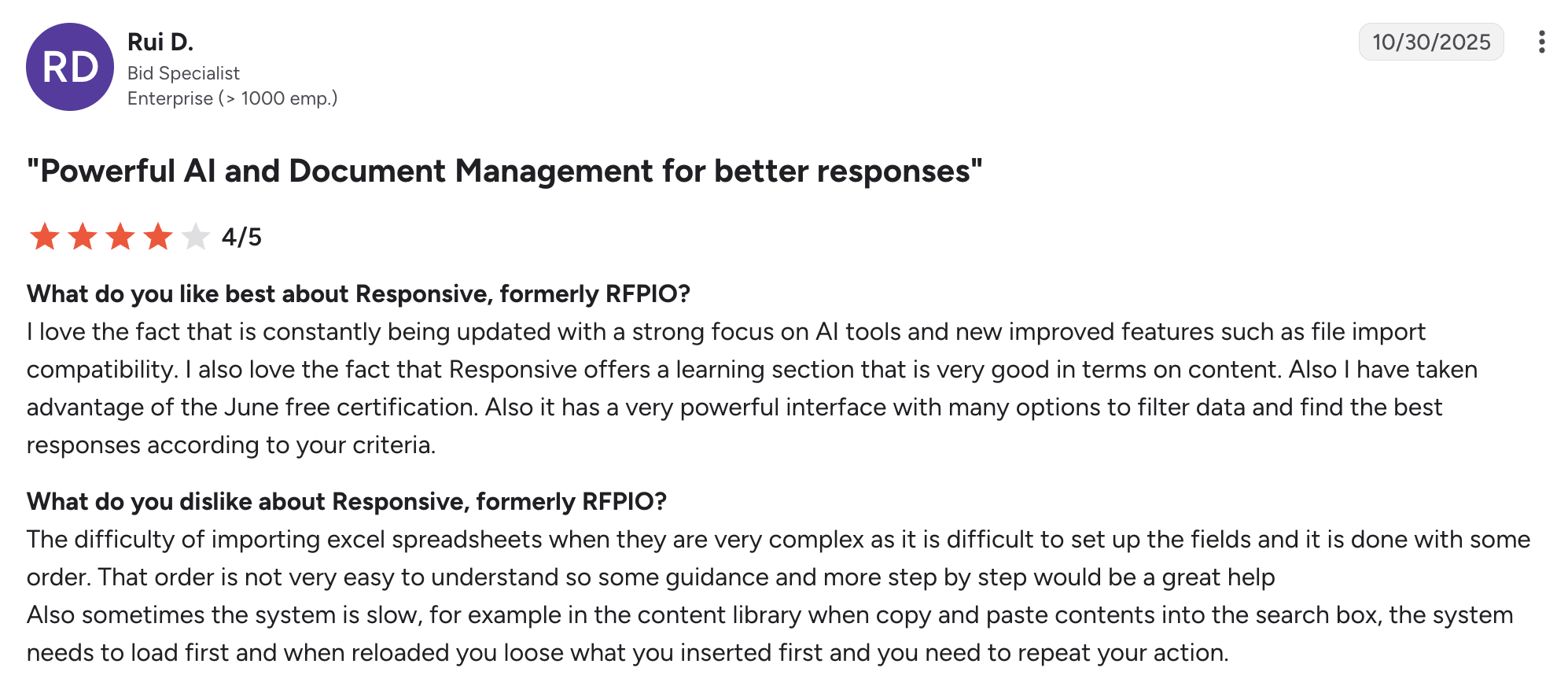
Responsive (formerly RFPIO) is one of the popular legacy RFP response platforms. It offers a comprehensive feature set for content management, collaboration, and AI-assisted drafting. However, many users mention a learning curve due to its interface complexity.
Features:
- Central Content Library and Answer Repository: Responsive’s content library allows teams to centralize previously written responses, creating a single source of truth for all RFP content. This feature simplifies reuse, ensuring that approved and vetted answers are easily accessible and consistent across proposals.
- AI Assistance to Draft Answers and Suggest Content: The platform’s AI features suggest relevant answers based on past proposals, helping teams draft responses quickly. While the AI works well for standard questions, it may require more human oversight for complex or nuanced queries.
- Collaboration Tools for Tasks, Reviews, and Approvals: Responsive provides robust project management tools for collaboration. It enables task assignment, real-time progress tracking, and approval workflows, ensuring that team members stay aligned throughout the RFP process.
What Makes Responsive Stand Out:
- Organized Content Library and Collaboration Tools: Responsive excels at content management, offering a well-organized library for storing and reusing answers. The collaboration tools streamline teamwork, ensuring that proposal managers, subject matter experts (SMEs), and other stakeholders can work together seamlessly.
- AI-Assisted Drafting Support: The AI assists in drafting answers by recommending content based on historical RFPs, significantly speeding up the response process. Teams can rely on these suggestions to save time, although additional fine-tuning may be required for more complex queries.
- Good Fit for Teams Seeking Configuration Flexibility: Responsive offers many configuration options, allowing teams to tailor the platform to their specific needs. For organizations that require customization and flexibility, this feature ensures that the platform adapts to a wide variety of RFP requirements and workflows.
The Limitations of Responsive:
- Interface Complexity Leads to Extra Training and Slower Onboarding: Many users report that Responsive’s interface is not the most intuitive, especially for new users. This complexity can lead to a steep learning curve, slowing down the onboarding process and requiring additional training for teams to use the platform efficiently.
- Less Emphasis on Deep Context Reasoning and Answer Benchmarking: While Responsive does provide AI drafting support, it lacks the deeper context awareness and quality benchmarking found in more advanced platforms like Inventive AI. As a result, teams may need to spend more time manually editing responses to ensure alignment with buyer intent and expectations.
- Still Requires Significant Manual Review for Stale or Conflicting Content: Despite its features, Responsive does not offer automatic conflict detection or stale-content monitoring. This means teams may still face risks of submitting outdated or contradictory information unless they manually check for these issues.
Best for:
- Teams with Standard RFP Requirements Looking for Content Management: Responsive is ideal for teams that primarily need a solid content management system to centralize and reuse RFP responses. It helps simplify content storage and makes collaboration easy, especially for organizations with less complex RFPs.
- Mid-Market Companies Needing Customization and Flexibility: Responsive’s customizable features make it a good choice for mid-market companies that need a flexible solution tailored to their unique workflows. Its configuration options ensure the platform can adapt to various needs, from proposal management to content reuse.
- Organizations with Experienced Teams Familiar with Manual Oversight: Teams that are comfortable with more manual oversight and can handle AI suggestions with additional review will find Responsive a useful tool for drafting RFP responses. However, it may not be the best fit for teams looking for fully automated, AI-driven responses.
Pricing:
Plan Type
Pricing
Subscription-based
Custom pricing based on team size and usage requirements
Ratings and Reviews:
Ratings: 4.2/5
Reviews:

Responsive works well if you want a classic RFP platform with a strong content library and collaboration features. However, if you care about AI-driven quality control, minimal manual rewriting, and deep contextual understanding, Inventive AI offers a stronger, more modern approach.
Arphie

Arphie is an AI RFP and proposal platform that focuses on answer quality and secure, company-approved data sources. It is positioned as a way to respond to RFPs, RFQs, questionnaires, and DDQs with strong assurance that content comes from trusted systems. The focus on answer quality is a positive, but the platform has a narrower set of workflow and project-management features than a full RFP response suite.
Features:
- AI-Driven Responses Using Company-Approved Data Sources: Arphie uses AI to generate responses based on secure, approved data sources. This ensures that the content used in responses is not only accurate but also compliant with internal standards.
- Content Management for Q&A Libraries: Arphie includes a content management system that allows teams to store, manage, and update their Q&A libraries. This feature enables teams to quickly access and reuse answers for future proposals.
- Basic Dashboarding and Response Tracking: Arphie offers basic project management features such as dashboarding and tracking response progress. These tools help keep teams aligned, track deadlines, and ensure that all responses are submitted on time.
What Makes Arphie Stand Out:
- User-Friendly Interface: Arphie is praised for its intuitive, easy-to-navigate interface. Teams can quickly learn the platform and start drafting responses without needing extensive training. This simplicity makes it an attractive option for organizations that need a straightforward solution without a steep learning curve.
- Focus on Answer Quality: The platform places a strong emphasis on generating accurate, high-quality answers. By relying on trusted data sources, Arphie ensures that every response is grounded in reliable information, which is crucial for teams that prioritize compliance and data security.
- Fast Drafting Process for Standard Proposals: Arphie’s AI can quickly generate responses for common questions, reducing the amount of time teams need to spend drafting answers manually. For teams handling frequent RFQs or standardized questionnaires, this feature significantly speeds up the proposal process.
The Limitations of Arphie:
- Does Not Offer Built-in Conflict Detection or Stale-Content Monitoring: Unlike some more advanced platforms, Arphie lacks automated conflict detection or tools to flag outdated content. Teams need to manually review responses to ensure they are consistent and up-to-date, which can be time-consuming and prone to errors.
- Limited Focus on Narrative Proposals: While Arphie excels at generating accurate responses for straightforward questions, it lacks the ability to craft detailed, narrative-style proposals. Teams that require executive summaries, security overviews, or value-driven proposals may find Arphie insufficient for these needs.
- Content Library Management Can Be Slower for External Vendors: Arphie relies on input from external vendors to update or manage the content library. This dependency can slow down the process of adding or refreshing content, particularly for teams with frequently changing or expanding proposal requirements.
Best for:
- Teams Focused on Accuracy and Data Security: Arphie is an excellent choice for teams that prioritize accuracy and compliance, especially when handling RFPs that require content sourced from company-approved, secure data systems.
- Organizations with Standard RFPs or Questionnaires: Arphie is well-suited for companies that handle a high volume of standardized RFPs, RFQs, or DDQs. Its fast drafting capabilities make it a good fit for organizations that need to respond to repetitive questions quickly.
- Smaller Teams or Companies with Simple Proposal Needs: Arphie’s user-friendly interface and straightforward functionality make it ideal for smaller teams or companies with less complex RFP requirements. It is best for those who need a basic, no-frills solution to streamline response creation.
Pricing:
Plan Type
Pricing
Subscription-based
Custom pricing based on team size and usage requirements
Ratings and Reviews:
Ratings: 5/5
Reviews:

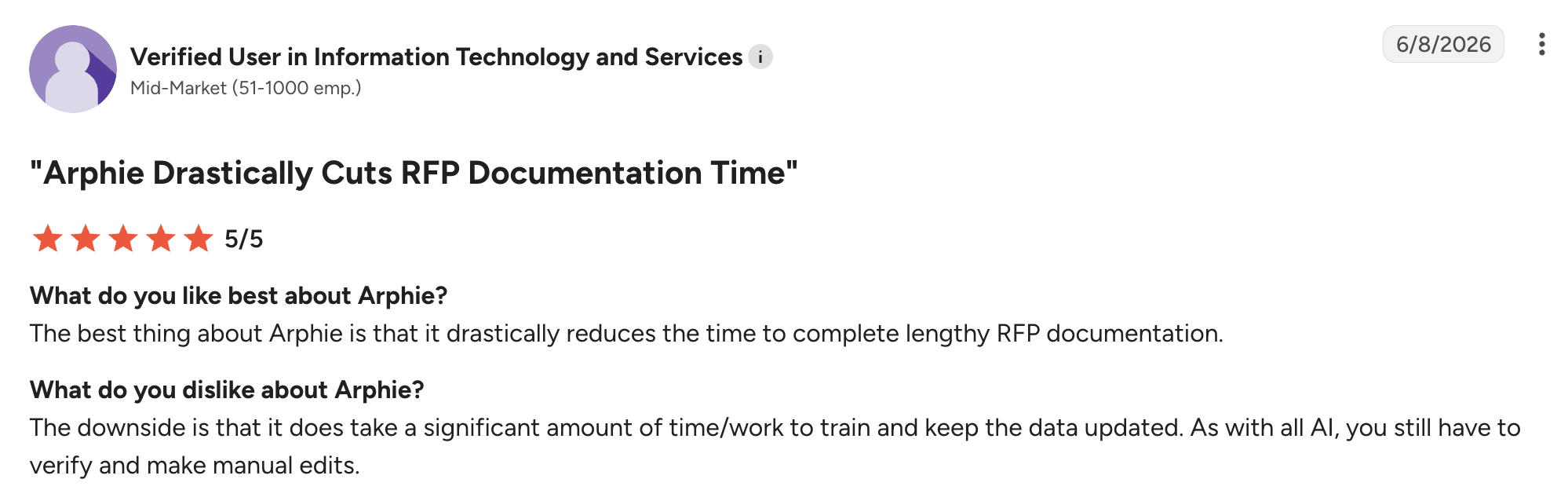
Arphie is a solid choice for teams focused on accuracy and compliance, particularly those handling standardized RFPs. However, for teams that need deeper workflow control, AI-driven win themes, and advanced content governance, Inventive AI provides a more comprehensive and future-ready solution.
Autogen AI

Autogen AI provides generative AI tools to draft and refine RFP responses and proposals. It is good at writing and editing support, but it functions more like an AI writer layered on top of your process rather than a full RFP system. Content libraries often require their team’s involvement to add or structure content, and the platform has limited native project-management capabilities.
Features:
- Generative AI for Drafting and Editing Proposals: Autogen AI excels at using generative AI to write and refine RFP responses. It can quickly draft responses to standard RFP questions, making it an efficient tool for teams that need to produce content at scale.
- Centralized Content Storage Managed with Vendor Input: Autogen AI allows teams to store content in a centralized repository, but the platform relies on vendor input to structure and update the content library.
- Built-In Quality Checks for Formatting, Compliance, Grammar, and Consistency: The platform includes basic quality checks for grammar, compliance, and formatting, ensuring that content is polished and consistent.
What Makes Autogen AI Stand Out:
- Helpful Writing Assistant for Proposal Teams with Stable Workflows: Autogen AI is particularly useful for teams that already have a well-established proposal workflow. It acts as an AI writing assistant, helping to generate drafts quickly and refine responses with minimal oversight.
- Designed Specifically for Bids and Proposals: Unlike generic text generators, Autogen AI is tailored for proposal writing. It is optimized to handle RFP-specific tasks such as formatting, compliance checks, and content organization, making it a suitable tool for teams that need support in writing rather than full RFP management.
- Speed in Drafting Standard Responses: For teams handling repetitive RFPs or questions, Autogen AI significantly speeds up the drafting process. It can generate initial drafts within seconds, reducing the time spent on repetitive tasks and allowing teams to focus on refining content and strategy.
The Limitations of Autogen AI:
- Focuses More on Writing Than End-to-End RFP Lifecycle Management: Autogen AI does not offer a full RFP lifecycle management system. Teams still need to rely on other tools for project management, content collaboration, and workflow tracking, making Autogen AI less suited for teams seeking a comprehensive RFP solution.
- Limited Advanced Features for Complex Proposals: Autogen AI lacks the advanced features needed for complex, customized proposals. It does not offer deep context understanding, conflict detection, or narrative proposal generation, making it less ideal for high-stakes RFPs that require a more sophisticated approach.
- Vendor Dependency for Content Updates: Autogen AI relies on vendors to manage and update its content library, which can create delays and hinder responsiveness. Teams that need to quickly update content or respond to changing RFP requirements may find this process cumbersome and time-consuming.
Best for:
- Teams with Established Proposal Workflows: Autogen AI is well-suited for organizations with established workflows that require an AI writing assistant to streamline the drafting process. It helps teams quickly generate responses and refine content without overhauling their existing processes.
- Organizations Handling Repetitive, Standardized RFPs: Teams that primarily deal with repetitive or standardized RFP questions will benefit from Autogen AI’s ability to quickly generate drafts. Its generative AI excels at handling high-volume, similar proposals, allowing teams to respond more efficiently.
- Proposal Teams Seeking Writing Support, Not Full RFP Management: Autogen AI is best for teams that need assistance in writing and editing proposals but do not require full RFP management features. It is a great tool for writing support, but it lacks the comprehensive features required for end-to-end RFP handling.
Pricing:
Plan Type
Pricing
Subscription-based
Custom pricing based on team size and usage requirements
Ratings and Reviews:
Ratings: 4.4/5
Reviews:

Autogen AI is helpful if you want an AI writing partner. For full ownership of workflows, content, and outcome metrics, Inventive AI is a better central system.
Suggestive Alternative: Inventive AI
If you want more than draft writing, a full RFP response solution with strong context understanding, content freshness checks, and minimal manual cleanup, Inventive AI delivers those capabilities out of the box.
AutoRFP AI

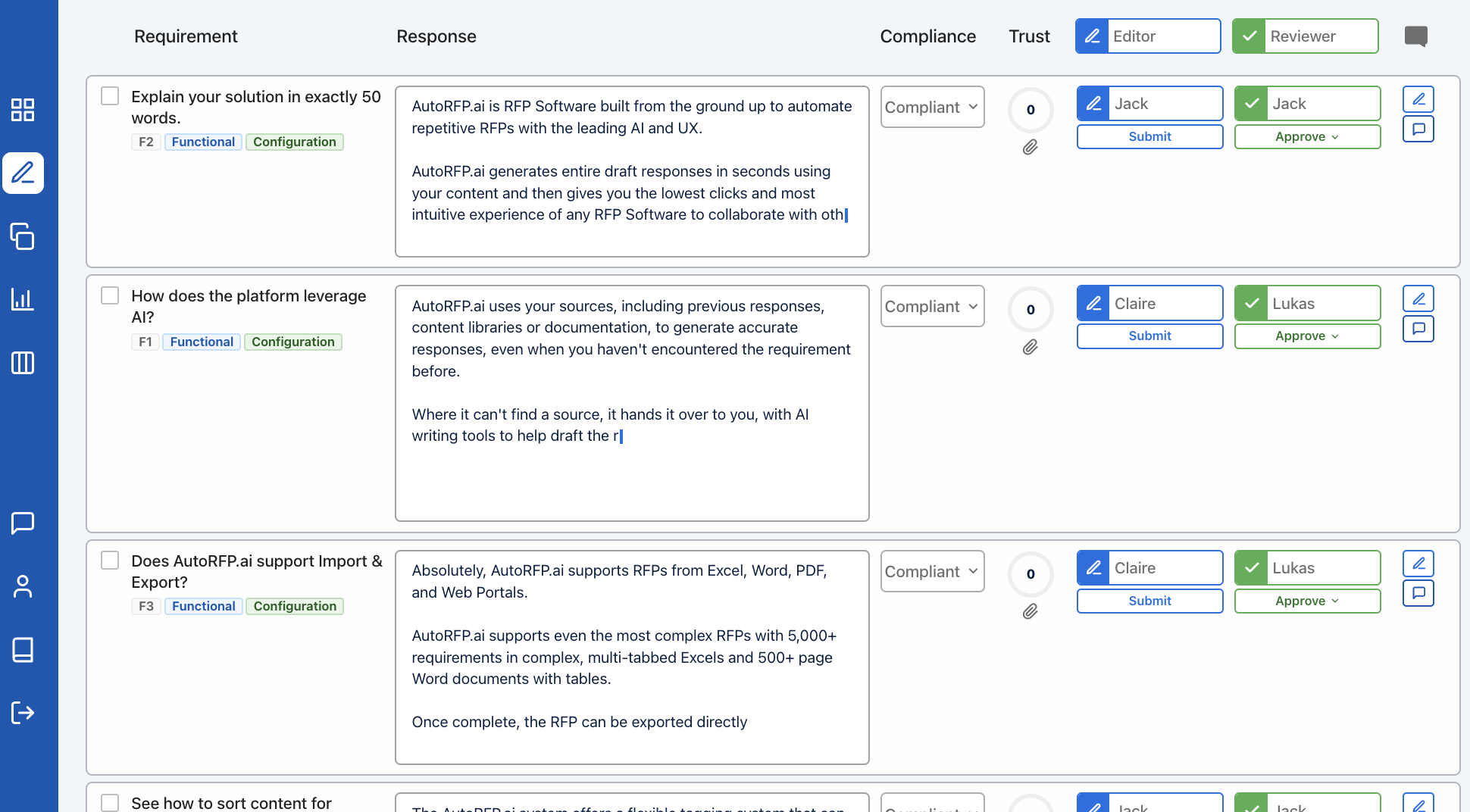
AutoRFP AI focuses on automating repetitive RFPs using generative AI. It can generate entire draft responses in seconds and is designed to help teams answer more RFPs with the same headcount. That is powerful for high-volume, similar questionnaires, but less ideal when every RFP is unique, heavily customized, and involves many stakeholders.
Features:
- Full Draft Generation for Repetitive RFPs: AutoRFP AI’s core strength lies in its ability to quickly generate full draft responses for repetitive RFP questions. By automating the initial drafting process, teams can save significant time on recurring questions, allowing them to focus on more complex parts of the proposal.
- Integration with Salesforce, Slack, Google Drive, and Notion: AutoRFP AI integrates smoothly with popular tools like Salesforce, Slack, Google Drive, and Notion. These integrations allow teams to pull relevant content from their existing systems and enhance the efficiency of the proposal process.
- Collaboration Features for Review and Approvals: AutoRFP AI includes collaboration tools that allow teams to review and approve generated content. These tools help streamline the process of finalizing proposals, ensuring that multiple stakeholders can provide input and feedback before submission.
What Makes AutoRFP AI Stand Out:
- Speed in Drafting Repetitive RFPs: The ability to generate full draft responses in seconds is AutoRFP AI’s standout feature. For teams handling a high volume of similar RFPs, this tool drastically cuts down on time spent writing and editing responses, so you can handle more proposals without increasing their headcount.
- Ideal for High-Volume, Similar RFPs: AutoRFP AI is particularly useful for organizations that deal with a high volume of similar or recurring RFPs. The platform excels at automating responses to repetitive questions, allowing teams to produce more proposals with fewer resources.
The Limitations of AutoRFP AI:
- Best Suited for Standard RFPs: While AutoRFP AI excels at automating responses to repetitive questions, it may not be as effective for complex, customized RFPs. Teams handling unique or high-stakes proposals that require extensive customization and strategic input may find the tool less useful.
- Learning Curve and Initial Setup Phase: Some users report a learning curve when setting up AutoRFP AI, particularly when integrating it with other systems. The platform requires an initial setup phase to properly configure the integrations and ensure that content flows smoothly between systems.
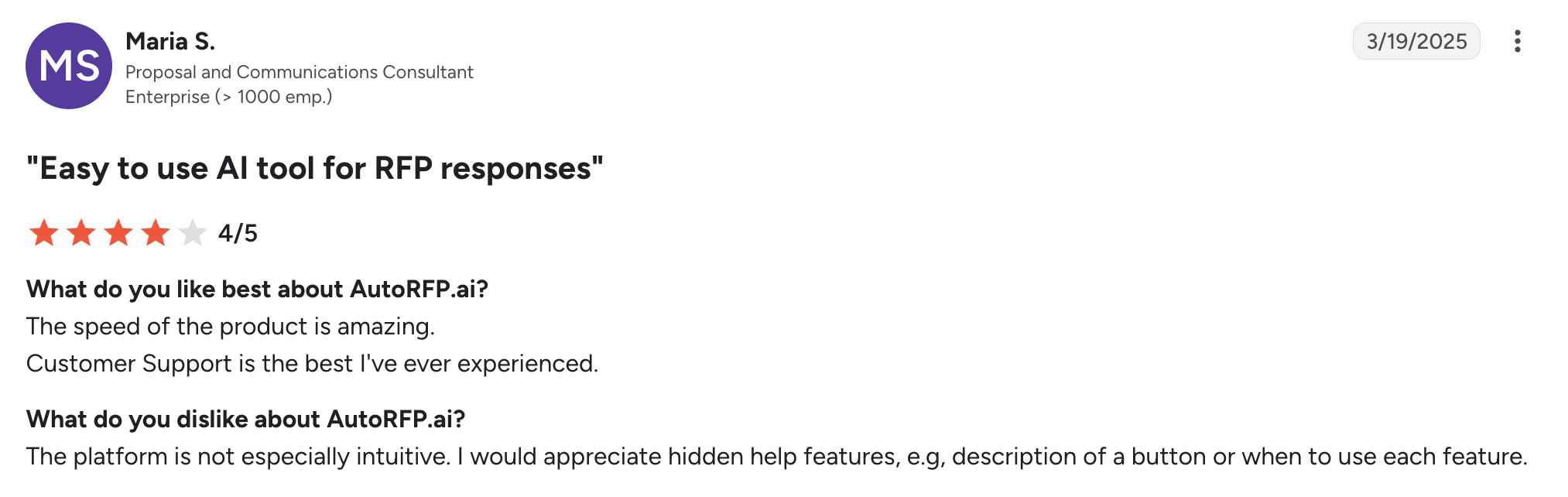
- Interface Could Be More Intuitive: While functional, some users find AutoRFP AI’s interface less intuitive than more user-friendly platforms. This can slow down adoption and require additional training, especially for teams unfamiliar with RFP automation tools.
Best for:
- Teams Handling High-Volume, Repetitive RFPs: It is ideal for teams that process a large number of similar RFPs. Its ability to generate full draft responses quickly is a great for high-volume environments, reducing the time spent on manual drafting.
- Organizations with Established Workflows and Integrations: Teams that already use tools like Salesforce, Slack, Google Drive, or Notion will benefit from AutoRFP AI’s seamless integration capabilities.
- Proposal Teams with Limited Customization Needs: For teams that primarily handle standard questions with minimal customization, AutoRFP AI provides a powerful solution for automating the response process.
Pricing:
Plan Type
Pricing
Subscription-based
Starts at $899/month for base plan
Ratings and Reviews:
Ratings: 4.9/5
Reviews:

AutoRFP AI is a great tool for automating repetitive, high-volume RFP responses, enabling teams to handle more proposals with the same resources. However, for teams handling complex, customized proposals that require deeper strategic input, Inventive AI offers a more comprehensive and AI-driven solution.
Tribble

Tribble offers an AI agent that does RFPs for you: you send the questionnaire, their system ingests your content, drafts answers, routes SME questions, and returns portal-ready packages. This “service plus AI” style can remove some workload but gives you less direct control over content structure and library strategy.
Features:
- Autonomous AI Agent for RFx Workflows: Tribble’s AI agent takes full ownership of the RFP process by automatically ingesting the RFP or security questionnaire and drafting responses. This hands-off approach reduces the manual work for teams, allowing them to focus on other critical tasks.
- Integration with Slack for Real-Time Communication: Tribble integrates with Slack, allowing teams to communicate directly within the platform. The AI can send notifications, ask for input, or route questions to SMEs through Slack channels or DMs, making collaboration easy. This integration is useful for teams who are accustomed to Slack as their primary communication tool.
- AI-Driven Drafting and Response Routing: Tribble’s AI can generate drafts and route them for SME review and approval. The platform automates much of the RFP process, reducing the time spent on drafting and ensuring that responses are on track for timely submission.
What Makes Tribble Stand Out:
- Automates Large Parts of the RFP Process: Tribble excels at automating repetitive tasks such as drafting answers and routing them for review. By removing much of the manual workload, Tribble enables teams to handle more RFPs without increasing their headcount.
- Minimal Setup Required: Tribble is designed to be easy to set up and use. Teams simply send the RFP and let the AI handle the rest. This “plug-and-play” approach makes Tribble appealing for teams looking to quickly scale their RFP process without significant training or configuration.
- Slack Integration Enhances Collaboration: The ability to integrate with Slack for communication and collaboration makes Tribble a great fit for teams already using Slack. The AI’s ability to route tasks, ask questions, and send updates directly within Slack channels keeps teams aligned and reduces the need for lengthy email threads.
The Limitations of Tribble:
- Less Direct Control Over Content Structure: Tribble’s fully automated approach means that users have less control over the content structure and customization. Teams that prefer a hands-on approach to managing content libraries and structuring proposals may find Tribble limiting, as it does not offer the same level of control as other RFP platforms.
- Focuses on Automation Rather Than Deep Content Governance: Tribble does not offer great content governance features. There is no advanced conflict detection, stale-content monitoring, or detailed version control, which can be problematic for teams managing complex or sensitive content.
- Relies on Data Quality for Optimal Performance: Since Tribble's AI works based on the quality of the data it ingests, teams must ensure that their content is well-structured and accurate. Poor-quality data can result in subpar responses, requiring additional manual editing and review.
Best for:
- Teams Looking for Automation Without Complex Configuration: Tribble is ideal for teams that want to automate the bulk of their RFP work without needing to invest significant time in setting up complex workflows. It’s perfect for teams that deal with a high volume of repetitive RFPs and want to speed up the process with minimal effort.
- Organizations That Use Slack for Collaboration: Teams that already use Slack for communication will find Tribble's Slack integration particularly valuable. The AI's ability to handle SME routing and communication directly within Slack channels streamlines the collaboration process, making it easy for teams to stay aligned.
- Proposal Teams That Need Quick Results and Minimal Setup: Tribble’s ease of use and minimal setup time make it a great option for teams looking for a quick solution to automate RFP responses. It works well for organizations that need fast results without extensive training or customization.
Pricing:
Plan Type
Pricing
Contact for Pricing
Custom pricing based on team size and usage requirements
Ratings and Reviews:
Ratings: 4.8/5
Reviews:

Tribble is an innovative AI-driven solution that automates large parts of the RFP process, offering quick setup and seamless Slack integration. However, if you require deeper control over content structure and advanced content governance, Inventive AI provides a more robust, comprehensive solution.
SiftHub

SiftHub is primarily focused on workflow and sales tooling, providing basic automation and integration with sales tools, but lacks the depth of features typically found in dedicated RFP management platforms. It excels at autofilling answers in tools like Google Docs, Sheets, Excel, Word, or on vendor portals, making it useful for lighter sales use cases but less suited for complex, high-volume RFPs.
Features:
- Autofill Answers Across Various Platforms: SiftHub enables users to automate the autofilling of responses across various platforms, ensuring consistency and speeding up the process. It reduces repetitive work and ensures a more streamlined approach.
- Visibility into Questions Completed, Pending, and Overall Progress: The platform provides visibility into the RFP process, allowing users to track which questions have been answered, which are still pending, and the overall progress of the proposal. This helps teams stay organized and ensures that they do not miss deadlines or overlook important sections of an RFP.
- Integration with Security Certifications and Customer Data Protection: SiftHub adheres to stringent security certifications, ensuring that customer data remains protected. It does not use customer data to train public AI models, providing reassurance for organizations that prioritize data security and compliance.
What Makes SiftHub Stand Out:
- Fast Autofill and Simplified Reuse of Content: SiftHub can automatically fill in hundreds of questions in minutes. By pulling approved content from integrated systems, the AI ensures that responses are consistent and accurate.
- Seamless Integration Across Multiple Platforms: The platform’s ability to integrate with widely used tools like Google Docs, Sheets, and Excel ensures that teams can work within their preferred systems without needing to switch platforms.
- Security and Compliance Assurance: SiftHub is committed to ensuring the security of its users' data. With its security certifications and assurance that customer data is not used to train public AI models, SiftHub stands out as a trustworthy option for teams in regulated industries or those with a strong focus on data protection.
The Limitations of SiftHub:
- Less Suited for High-Volume, Complex RFPs: While SiftHub excels at automating the response process for simple and less complex RFPs, it may not be sufficient for high-volume or highly customized proposals. Teams managing intricate, multi-stakeholder proposals may find the platform’s features too basic for their needs.
- Relies on Structured and Well-Maintained Data: For SiftHub’s autofill feature to work effectively, content must be well-structured and consistently maintained. If the content library is disorganized or incomplete, the AI may pull inaccurate responses, leading to manual corrections and reducing efficiency.
- Lacks Advanced Content Governance and Customization: Unlike more advanced RFP management platforms, SiftHub does not offer deep content governance features like conflict detection, stale-content monitoring, or customization for complex workflows. Teams that require these capabilities will need to supplement SiftHub with other tools for comprehensive RFP management.
Best for:
- Sales Teams Handling Simpler, Lower-Volume RFPs: SiftHub is ideal for sales teams that work on simpler, less complex proposals. Its ability to quickly autofill answers and track progress is particularly useful for teams with a lighter RFP load and less intricate content requirements.
- Organizations Using Google Docs, Sheets, and Excel for Proposal Workflows: Teams already using Google Docs, Sheets, or Excel will appreciate SiftHub’s seamless integration with these platforms. The ability to autofill responses directly in these tools streamlines the proposal process without forcing teams to switch between systems.
- Companies Focused on Data Security and Compliance: SiftHub’s commitment to data security, including its adherence to security certifications and its policy of not using customer data to train public AI models, makes it a good choice for companies operating in regulated industries or those with strong compliance requirements.
Pricing:
Plan Type
Pricing
Contact for Pricing
Custom pricing based on team size and usage requirements
Ratings and Reviews:
Ratings: 4.5/5
Reviews:

SiftHub is a powerful tool for automating the response process, particularly for sales teams handling simpler RFPs.
Suggestive Alternative: Inventive AI
For teams that need better RFP handling, including RFPs, RFIs, security questionnaires, multi‑team collaboration, and high‑quality output, Inventive AI stands out as the more capable, comprehensive solution.
Upland Qvidian

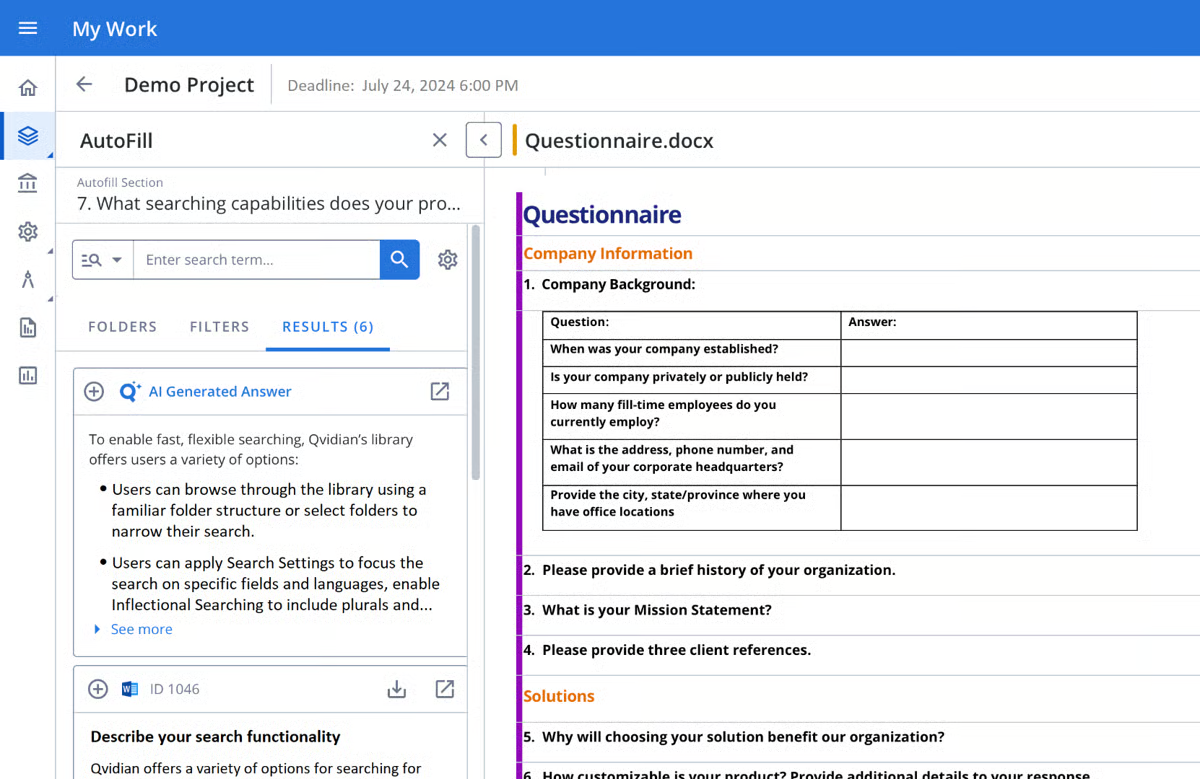
Upland Qvidian is one of the older names in proposal and RFP management. It offers strong template-driven automation and content reuse, especially for teams that rely on standard proposal books and documents. However, it was built long before the current AI wave and focuses more on document automation than deep AI reasoning.
Features:
- Centralized Content Library for Easy Access and Reuse: Upland Qvidian excels at organizing content in a centralized library, making it easy to store, organize, and reuse responses across multiple proposals. Teams can quickly find approved answers, templates, and standard content, ensuring consistency and reducing manual effort.
- Automated Proposal Generation Using Templates: The platform leverages templates to automate the creation of proposals and responses, reducing the manual work involved in formatting and structuring documents. This feature is particularly beneficial for teams that rely on standardized proposals and need a consistent, repeatable process.
- Collaboration Features for Team Coordination: Upland Qvidian includes collaboration tools that enable teams to work together on proposals in real time. Users can assign tasks, track progress, and manage approvals, helping to simplify the RFP process and ensure timely submissions.
What Makes Upland Qvidian Stand Out:
- Reliable Content Management and Reuse: It is known for its strong content management features. Teams can easily store and organize responses, ensuring that they have quick access to previously approved content.
- Template-Driven Proposal Automation: The platform’s ability to automate proposal generation using templates is a key differentiator. It’s ideal for teams that need to create consistent proposals quickly and reduce formatting errors.
- Strong Team Collaboration Features: It provides collaboration tools that help teams stay organized and work efficiently together. Task assignments, progress tracking, and approval workflows ensure that all team members are aligned and that proposals are completed on time.
The Limitations of Upland Qvidian:
- Less AI-Driven and Focused More on Template Automation: Upland Qvidian's reliance on templates for proposal generation means it lacks the AI-driven capabilities found in more modern platforms like Inventive AI. It doesn't offer advanced context understanding or real-time content updates, which can lead to outdated or less relevant responses.
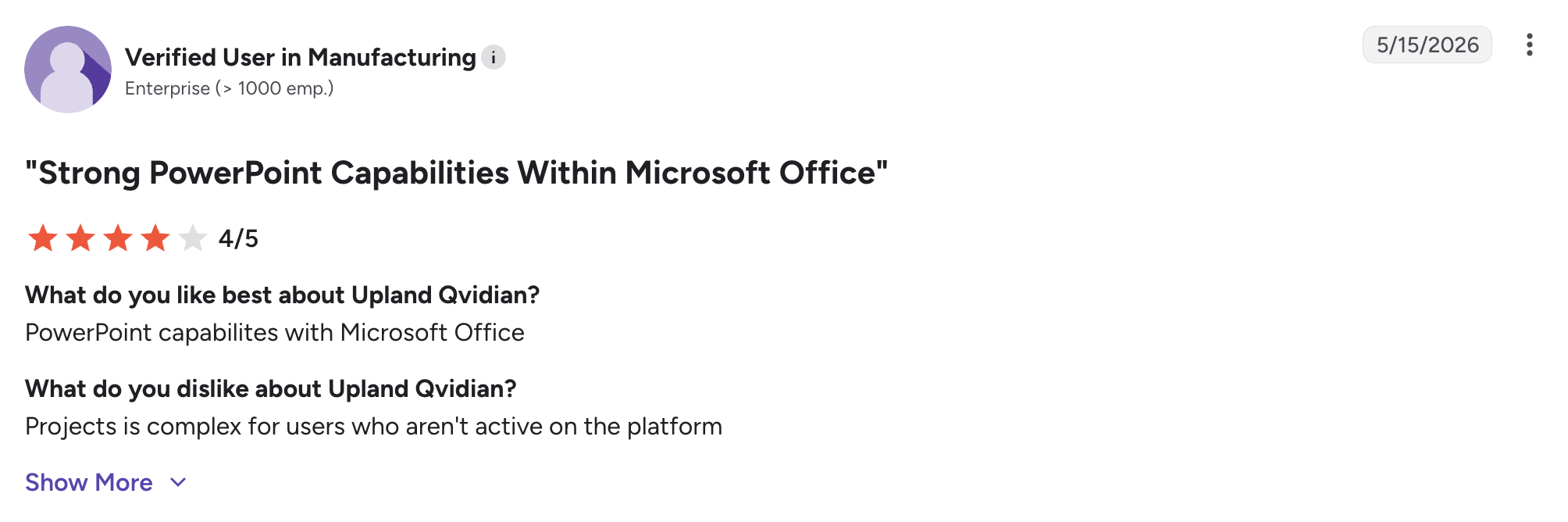
- Interface Can Be Less Intuitive for New Users: The interface of Upland Qvidian can feel less modern and intuitive compared to newer RFP management platforms. Users may need additional training to fully understand the features and optimize their use of the platform, which can slow down adoption and efficiency.
- Limited Advanced Analytics Compared to Newer AI Tools: While Upland Qvidian is effective for proposal management, it lacks advanced analytics features that newer tools offer. Teams that require deep data analysis or performance tracking for their proposals may find the platform lacking in this area.
Best for:
- Teams That Rely on Standardized Proposals and Templates: Upland Qvidian is ideal for teams that need to create consistent, template-driven proposals. Its automation and content reuse features are best suited for organizations with established templates and standardized proposal processes.
- Mid-Sized Companies with Less Complex RFP Needs: Upland Qvidian is a good choice for mid-sized companies that don't need highly customized proposals or deep AI capabilities. Its template-driven approach helps teams manage proposals efficiently without the need for advanced AI features.
- Teams in Need of Strong Content Management and Reuse: Organizations that prioritize content management and reuse will benefit from Upland Qvidian’s robust library and automation features. It’s especially helpful for teams that require easy access to previously approved answers and need a reliable system for storing and organizing content.
Pricing:
Plan Type
Pricing
Custom Pricing
Pricing is based on team size and usage requirements, contact for more details
Ratings and Reviews:
Ratings: 4.7/5
Reviews:

Upland Qvidian is a reliable, template-driven platform that excels at content management and automation for standardized proposals. However, for teams looking for deep AI-driven features, real-time content updates, and advanced context reasoning, Inventive AI offers a more comprehensive solution.
If you're looking at RFP response tools in 2026, each of the eight platforms we covered has its strengths. Some are good for managing content and simple RFPs, while others focus on drafting or handling high volumes. However, none provide the full package of deep context, content freshness, conflict detection, and AI-driven win themes like Inventive AI.
How to Choose the Right RFP Response Software for Your Team?
Choosing RFP software is really about choosing how your team wants to work for the next few years. To pick the right tool, keep these criteria in mind:

- Response quality first: Ask: “How much rewriting will my team still have to do?” Tools like Inventive AI focus on deep context, conflict detection, and stale-content control so answers are usable and safe out of the box.
- Content governance and freshness: Look for features that automatically flag outdated or conflicting content, not just store answers in a static library.
- Breadth of RFx coverage: Your tool should handle RFPs, RFIs, security questionnaires, and DDQs in one place, not in separate silos.
- Collaboration that fits your teams: Sales, solutions, security, and legal all touch RFPs. Check how tasks, approvals, and comments flow between them.
- Scalability and performance: As volume grows, can the platform keep up with more users, regions, and product lines without slowing down?
- Pricing model that matches usage
Usage-based pricing (like Inventive AI) can align closer to reality if your volumes fluctuate, while per-seat models may get expensive as you add more occasional contributors.
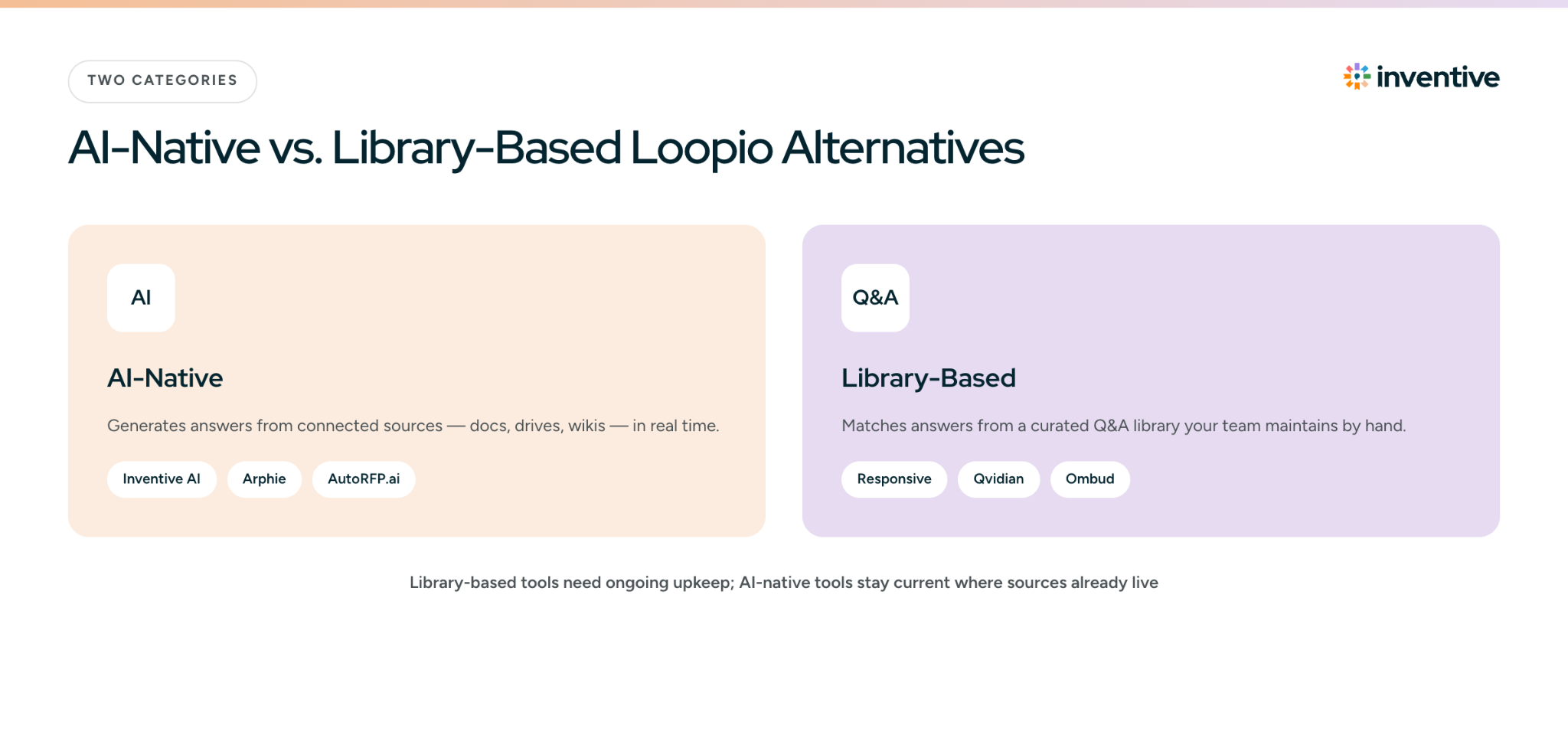
When you apply these filters, the strongest Loopio alternatives tend to look less like “content libraries with AI add-ons” and more like AI-led response engines that manage knowledge, quality, and workflows end-to-end.
Also Read: How AI in Presales is Redefining Speed, Accuracy, and Win Rates
Why Traditional RFP Tools Hold Teams Back?
Traditional RFPs can mean two things:
- Manual, spreadsheet-driven workflows, or
- Older software built mainly for storage and templates, not modern AI quality.
Both models create similar problems:
- Slow responses: You are still stuck at 25+ hours per RFP, even with some tools in place.
- Inconsistent answers: Different people cut and paste their own versions, and no one sees the full quality picture.
- Risk of stale or conflicting statements: Old pricing, outdated product claims, or mismatched security language creep in over time.
- Burnout in proposal and solutions teams: High effort for every deal, with little time left for strategy or messaging.
Teams that move from this model to an AI-first RFP platform like Inventive AI often report 90% faster RFP completion and 50%+ higher win rates, because they are finally aligning tools with how buyers evaluate proposals.
Why Inventive AI Is Your Ultimate Choice for RFP Response Process?
You have plenty of Loopio competitors to choose from, but very few tools place response quality at the center of everything. Unlike many competitors, Inventive AI places emphasis on four key structural strengths:
- 2x Response Quality: Delivers responses that are twice as usable with minimal edits, ensuring that every answer is not only accurate but also aligned with buyer expectations.
- Multi-layer context engine: Reads the entire RFP, ensuring answers align with scope, tone, and buyer priorities.
- Conflict detection: Flags contradictions in security, pricing, or product claims to maintain consistency across responses.
- Outdated content detection: Reduces the risk of old or non-compliant answers slipping into submissions.
- Quality benchmarking: Compares generated responses against gold-standard content to ensure ongoing accuracy and completeness.
Beyond traditional Q&A, Inventive AI excels in creating narrative-style proposals, including executive summaries, security overviews, and business value stories, elements buyers appreciate more than simple short answers.
The impact is clear: teams using Inventive AI experience 90% faster RFP drafting and significantly higher win rates, with less manual Q&A maintenance.
If you want an RFP platform that genuinely helps sales, revenue, solutions, and proposal teams win more with less rework, Inventive AI is the strongest choice in this field.
Frequently Asked Questions (FAQs)
1. Is Loopio still a good choice for RFP management in 2026?
Yes, Loopio remains a popular platform, especially for teams that value a familiar interface and standard content libraries. However, many teams now need deeper AI context, conflict detection, and narrative proposals, which is why they consider alternatives.
2. What makes Inventive AI different from classic RFP tools like Loopio or Qvidian?
Inventive AI is built around response quality and outcome metrics, not just content storage. It adds a context engine, stale-content detection, conflict checks, and Win Themes so you send stronger answers with less rewriting.
3. Do I need to migrate all my old RFP content to move away from Loopio?
You can usually export your existing content and import it into a new platform, but Inventive AI’s knowledge hub also lets you pull directly from documents and connected systems, which reduces the need to maintain a massive Q&A library.
4. How important are analyst ratings like Gartner Peer Insights when choosing RFP software?
Gartner ratings are useful signals of user satisfaction, but they are only one input. For RFP tools, you should weigh them alongside response quality, AI depth, content governance, and your team’s actual workflows.
5. Can smaller teams benefit from Inventive AI, or is it only for large enterprises?
Smaller teams that handle fewer but high-value RFPs can still benefit a lot from Inventive AI, because answer quality and time saved per RFP matter regardless of company size. The usage-based model also helps you scale gradually without overpaying up front.

90% Faster RFPs. 50% More Wins. Watch a 2-Minute Demo.
After witnessing the gap between generic AI models and the high precision required for business proposals, Gaurav co-founded Inventive AI to bring true intelligence to the RFP process. An IIT Roorkee graduate with deep expertise in building Large Language Models (LLMs), he focuses on ensuring product teams spend less time on repetitive technical questionnaires and more time on innovation.
Knowing that complex B2B software often gets lost in jargon, Hardi focuses on translating the technical power of Inventive AI into clear, human stories. As a Sr. Content Writer, she turns intricate RFP workflows into practical guides, believing that the best content educates first and earns trust by helping real buyers solve real problems.