Loopio Pricing (2026): Plans, Real Costs & the Hidden Library Tax
.png)
Loopio’s visible license cost is only the tip — add-ons, seats, and maintenance labor sit below the waterline.
This guide is published by Inventive AI, an AI-native RFP response platform and Loopio alternative. The pricing data below is compiled from third-party procurement sources and verified reviews we’ve kept the analysis factual so you can make your own call.
Loopio doesn’t publish its prices. If you want a number, you have to book a call, sit through a demo, and wait for a custom quote. That opacity is exactly why “Loopio pricing” is one of the most-searched questions in the RFP software category and why so many teams end up surprised by what they actually pay.
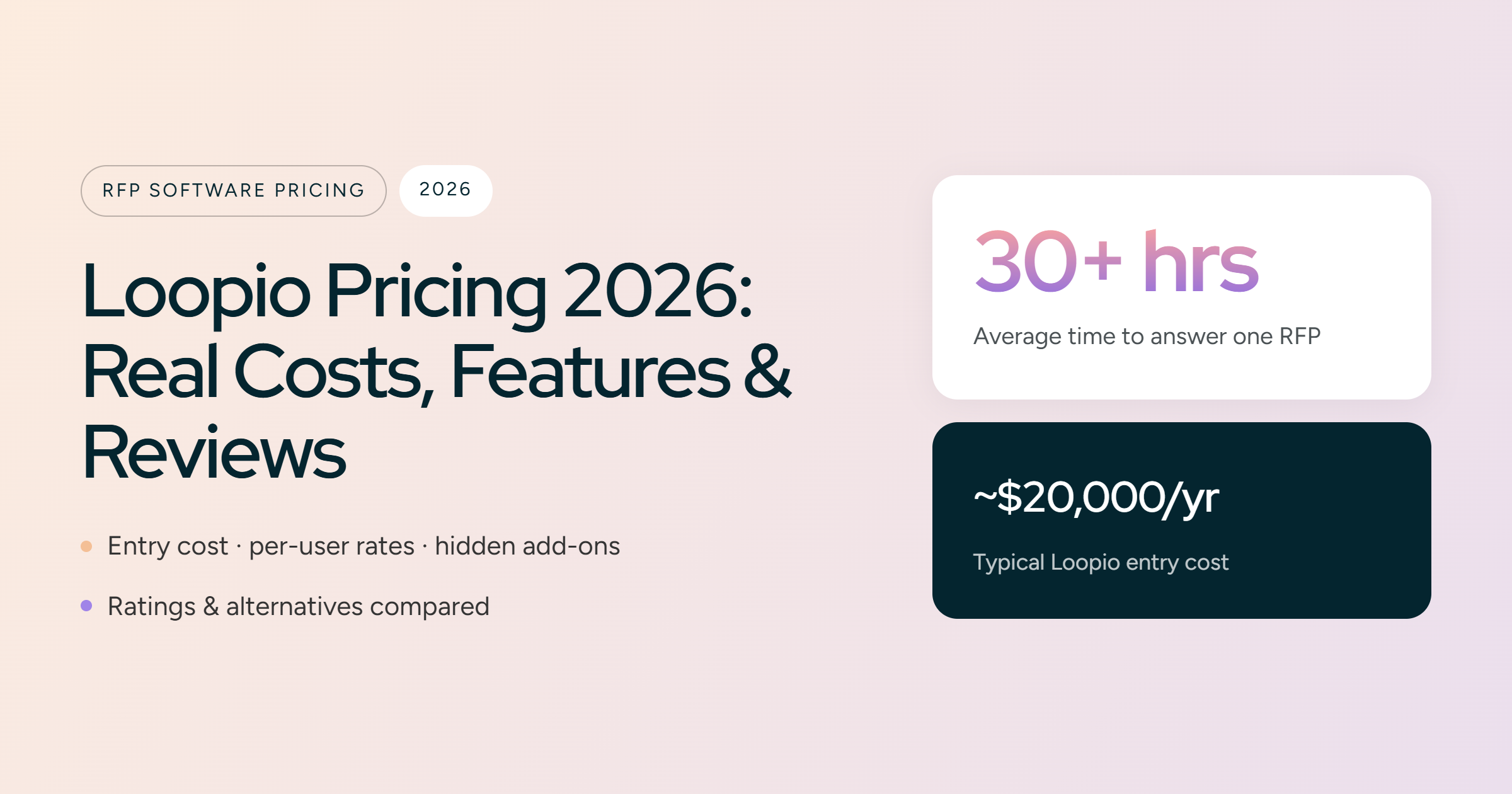
The short answer: Loopio typically starts around $15,000–$20,000 per year for its entry plan, the median buyer pays roughly $23,900/year, and real-world contracts range from about $12,000 to over $200,000 annually depending on tier, seats, and add-ons.
But the sticker price is only half the story. This guide breaks down Loopio’s plans and pricing model in detail — what’s good about it, where it stings, and the cost almost nobody budgets for: the ongoing labor of maintaining Loopio’s content library, what we call the library management tax.
How Loopio Pricing Works
Loopio uses a quote-based, seat-driven subscription model. There’s no free tier, no free trial, and no self-serve checkout. Every deal is negotiated, and every contract is annual (or multi-year). Four factors drive what you’ll pay:
- Plan tier. Three plans — Foundations, Enhanced, and Enterprise. (Older names Essentials, Plus, and Advanced appear in procurement data — same ladder, different labels.)
- Seat count & user type. Standard Users, Library Users, and Content Contributors are priced differently. Standard seats are the expensive ones.
- Add-ons. Translations, integrations, premium support, and onboarding packages are all priced separately.
- Negotiation. Discounts of 10–30% off list are common for multi-year commitments (Vendr).
According to Vendr’s transaction data across 144+ Loopio deals, the median annual contract value is $23,915, with contracts ranging from roughly $11,770 to $58,277 — and enterprise deals going well beyond that.
Loopio Pricing Plans: Tier-by-Tier
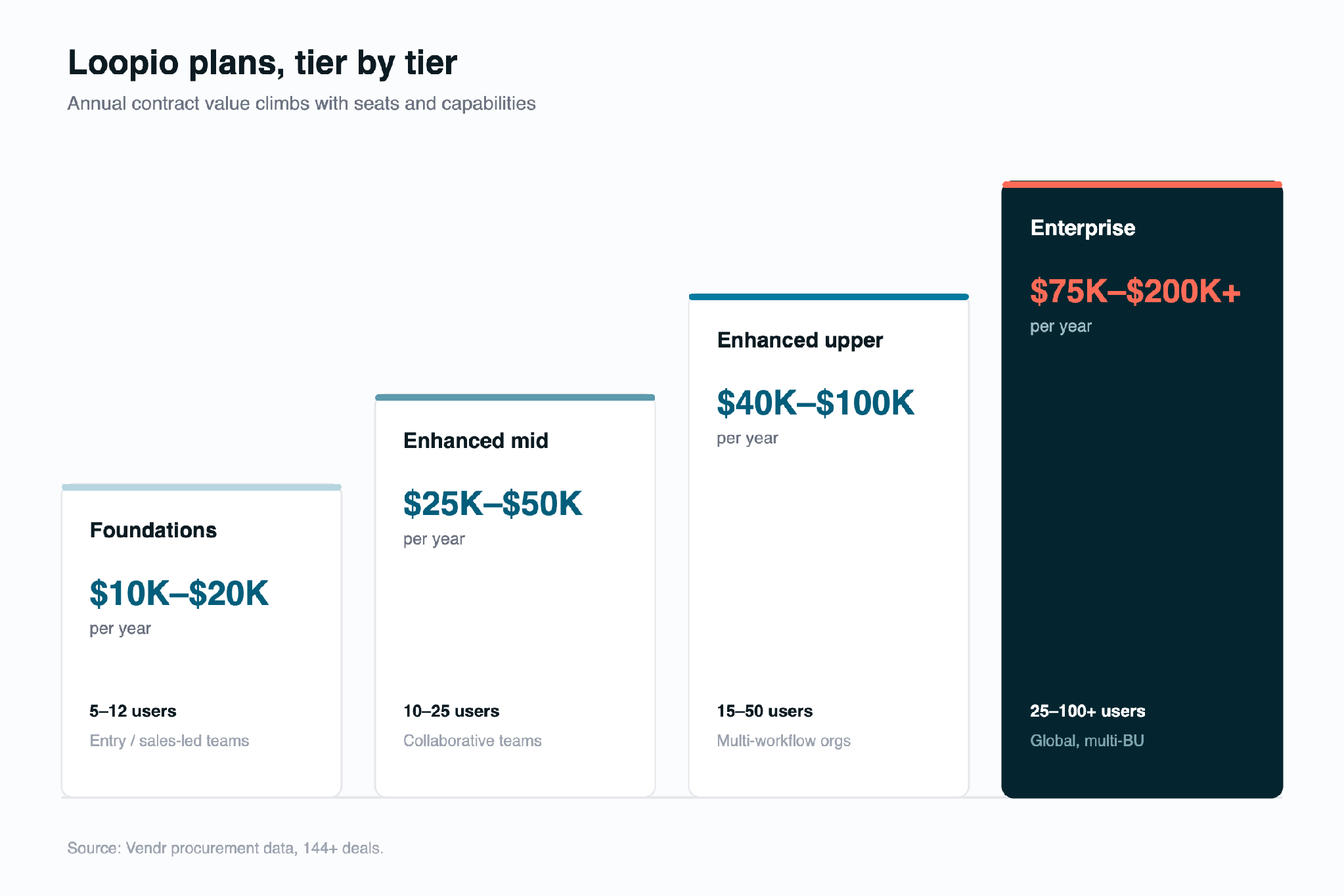
Foundations entry tier ($15K–$20K/yr)
Smaller or sales-led teams. 10 seats, unlimited projects and library entries, generative AI, standard support. Effective ~$1,000–$1,800 per standard user.
Watch out: Salesforce/HubSpot integrations and SSO are add-ons at this tier, not included.
Enhanced mid tier, “most popular” ($25K–$70K/yr)
Centralized, collaborative teams. Adds multi-language library, confidential projects, multi-step review workflows, and major CRM integrations (Salesforce, HubSpot, Dynamics). Vendr sees $1,500–$3,500 per standard user.
Watch out: Premium customer success is still a paid add-on ($5K–$15K/yr).
Enterprise top tier ($75K–$200K+/yr)
Global companies with multiple business units. Separate business units, sandboxes, custom seat counts, premium support. Per-seat often lower than Enhanced ($1,500–$3,000) thanks to volume leverage.
Watch out: Professional services for custom config can add $5K–$25K on top.
Ranges compiled from Vendr procurement data and third-party analyses. Loopio does not publish list prices; your quote will vary.
Benchmarking more than one vendor? Our enterprise RFP software comparison puts Loopio, Inventive AI, Responsive, Qvidian, and AI-native platforms side by side on pricing and capabilities.
Add-Ons: Where Quotes Quietly Grow
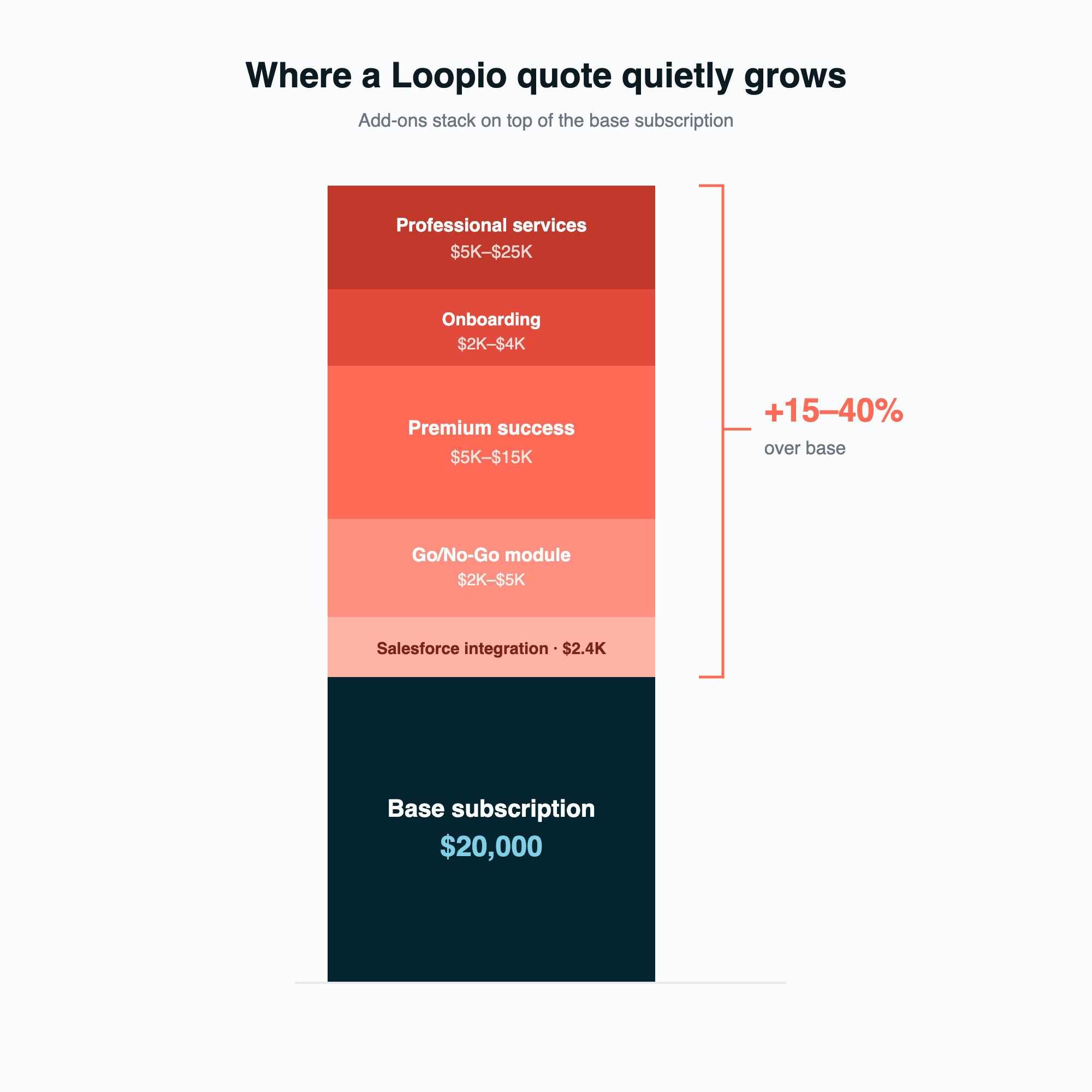
Loopio’s base subscription rarely equals your final bill. Commonly quoted add-ons include:
- Salesforce integration — ~$2,400/yr
- Go/No-Go evaluation module — $2K–$5K/yr
- Assist Package (premium onboarding) — $2K–$4K/yr
- Premium Customer Success — $5K–$15K/yr
- Implementation / professional services — $5K–$25K once
- Annual renewal uplift — 3–5%/yr
If the pricing isn't making sense, feel free to check out Loopio alternatives like Inventive AI simple, transparent user-based pricing with no tiers, and enterprise support included for every customer.
Per Vendr, add-ons can inflate total spend by 15–40%. And because seats are the pricing unit, every subject-matter expert you loop in is a line item. As one G2 reviewer put it: “My only real challenge with Loopio is the seat-based pricing. This makes me think twice about expanding to internal teams.”
The Hidden Cost Nobody Quotes You: The Library Management Tax
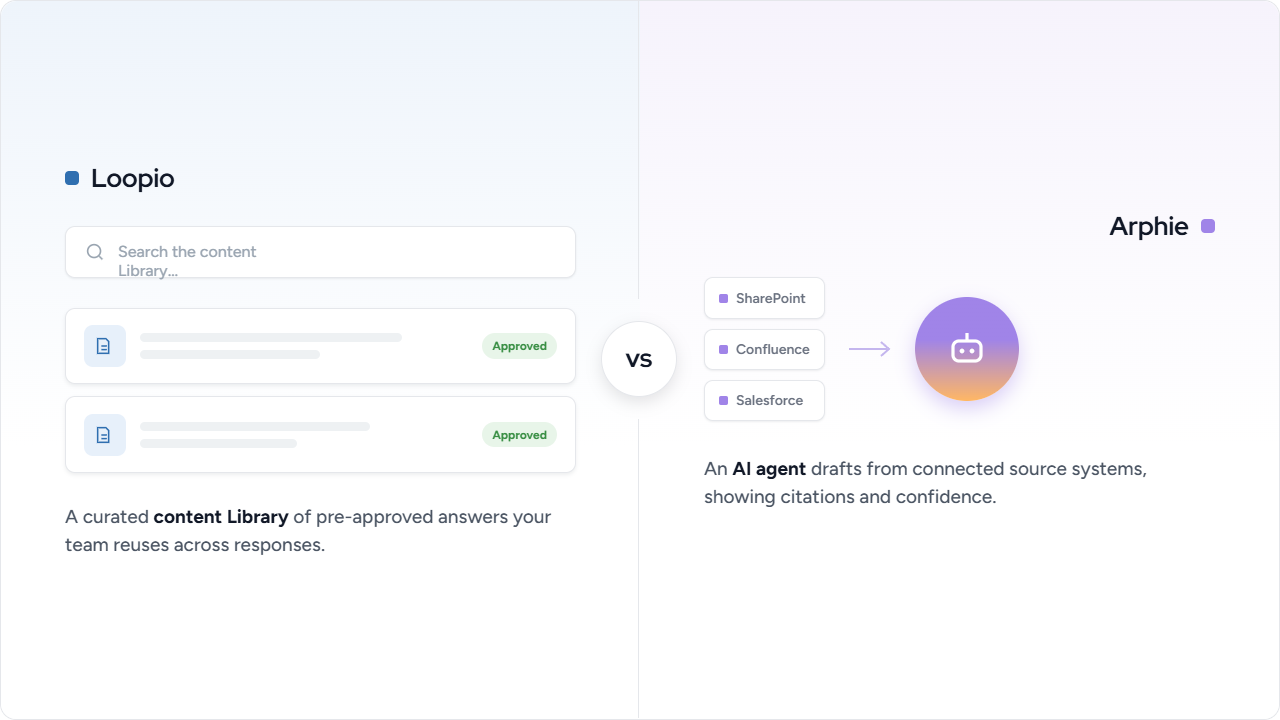
Here’s the part that never shows up on the order form. Loopio’s core value is its content library — a curated Q&A database your team builds over time. It works, but only as long as the library is accurate, and keeping it accurate is a permanent, human job.
That’s the library management tax, and it compounds in four ways:

1. Curation headcount
Someone has to review new answers, merge duplicates, tag entries, and archive stale content. Teams running Loopio at scale dedicate a part- or full-time content manager. At even $40K–$100K/year for a portion of that role, your “$25,000 software” is really a $60,000+ program. AutoRFP.ai’s analysis of 610+ reviews concludes Loopio “delivers the most value to companies with generous budgets, dedicated content managers, and a large volume of RFPs.”
2. Review cycles that never end
Loopio’s review-cadence feature flags entries for periodic re-verification — useful, but it means recurring calendar time from SMEs across security, legal, product, and finance. Every release, pricing change, or compliance update triggers another sweep. Miss a cycle and the library drifts from reality.
3. The stale-answer risk
A stale library isn’t just inefficient — it’s dangerous. Ship an outdated security answer in a due-diligence questionnaire and you’ve created legal exposure. Quote a deprecated feature in an RFP and you’ve set your CS team up to fail. The tax is also the risk you carry whenever maintenance slips.
4. Garbage in, garbage out (now with AI)
Loopio’s generative AI draws on the same library. If the library decays, the AI confidently produces wrong answers faster. Users already note the “Magic” AI feature struggles with complex requirements and returns answers needing manual fixes — a problem that worsens as the library ages.
Rule of thumb: take the annual license quote and add 30–100% for content-operations labor. That’s your true total cost of ownership.
The library tax is optional. Inventive AI drafts RFP and questionnaire responses directly from your live sources past RFPs, product docs, Drive, Confluence so there’s no separate content library to staff and maintain. See it on your own documents in a 15-minute demo →
What Loopio Gets Right
- Mature content library. Centralized storage, tagging, and strong search cut RFP response time significantly — transformative for teams coming from spreadsheets and SharePoint.
- Genuinely good support. ~9.7/10 G2 support rating and 4.7/5 overall, with praise for responsiveness and account management.
- Intuitive interface. Frequently cited as easier to learn than legacy rivals like Qvidian or RocketDocs.
- Enterprise-grade workflow. Multi-step reviews, confidential projects, separate business units, and SSO/audit satisfy large, regulated orgs.
- Unlimited projects and entries on every tier — you’re metered on people, not volume of work.
Where Loopio Pricing Hurts
- No transparency. You can’t see a price without a sales cycle, slowing budgeting and comparison.
- High floor. A $15K–$20K minimum prices out small teams entirely.
- Seat model punishes collaboration. The more experts you involve, the more you pay.
- Essentials sold separately. Salesforce integration and SSO are add-ons on lower tiers.
- Renewal creep & the library tax. 3–5% annual uplifts compound, and the product’s biggest strength depends on ongoing manual labor that never appears in the quote.
Real-World Cost Scenarios
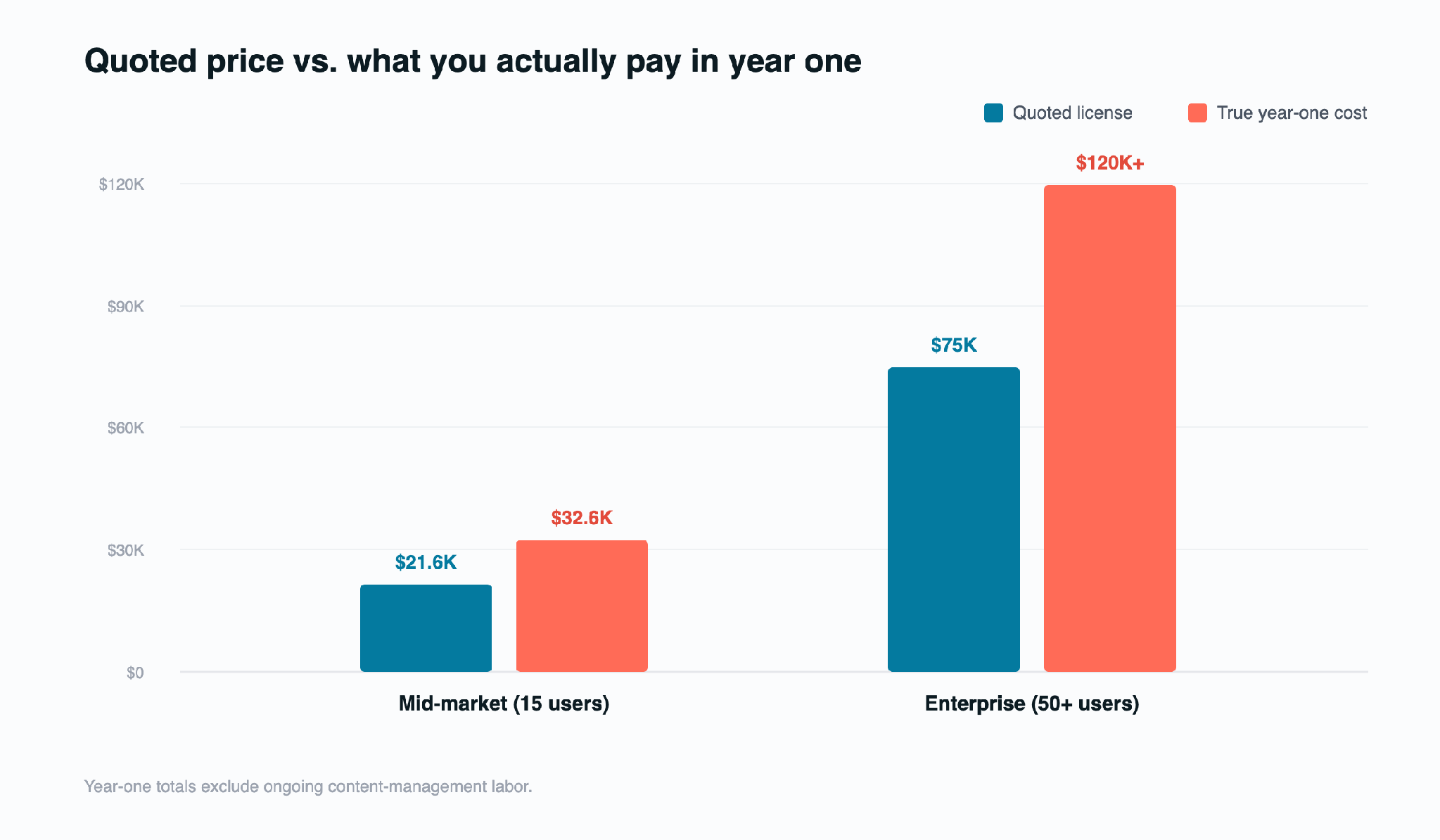
Mid-market (15 users, ~50 RFPs/yr): Base ~$21,600 + integrations/SSO ~$8,000 + implementation ~$3,000 ≈ $32,600 year one, trending to $38K–$40K/yr by year three — before any content-management labor.
Enterprise (50+ users): Custom pricing at $100–$150/user/month with bundled add-ons ≈ $60K–$120K+/yr, plus dedicated content-operations headcount.
How to Negotiate a Better Loopio Deal
- Bundle add-ons into the base contract — buyers save 35–45% vs. buying them after signing.
- Cap the uplift — 70–80% of deals that negotiate caps land at 3% or below, some at 0%.
- Right-size user types — remapping occasional users to Library/Contributor seats cuts spend 10–20%.
- Commit multi-year, buy at quarter-end — 2–3 year terms unlock 15–30% cumulative savings.
- Name the competition — active evaluation of alternatives yields another 5–15% on average.
Is Loopio Worth It?
It depends on which team you are. Loopio makes sense if you’re a mid-market or enterprise org with high RFP volume, budget for a five-to-six-figure annual contract, and critically dedicated people to own the content library. In that scenario, the workflow maturity and support quality justify the spend.
Loopio is a poor fit if you’re a smaller team priced out by the minimum, a fast-moving company whose product changes faster than a manually curated library can keep up, or a buyer who expected AI to eliminate the maintenance work rather than depend on it. If that’s you, start with our guide to the best Loopio competitors and alternatives. Loopio’s model charges you per person — and its architecture requires those people to keep feeding and pruning a library. You pay twice: once in seats, once in labor.
The Alternative: Skip the Library Tax Entirely
A newer generation of AI-native tools takes a different approach. Inventive AI connects directly to your live sources of truth — past RFPs, product docs, Google Drive, Confluence — and drafts responses from current content, so there’s no separate, manually curated library to babysit. Answers stay as fresh as the source documents your team already maintains, and stale-content conflicts get flagged automatically instead of waiting for a quarterly review.
The pricing philosophy differs too: instead of charging per seat and per add-on, AI-native platforms typically price so that looping in an SME never triggers a procurement conversation. For a feature-by-feature breakdown, see the Inventive AI vs. Loopio comparison.
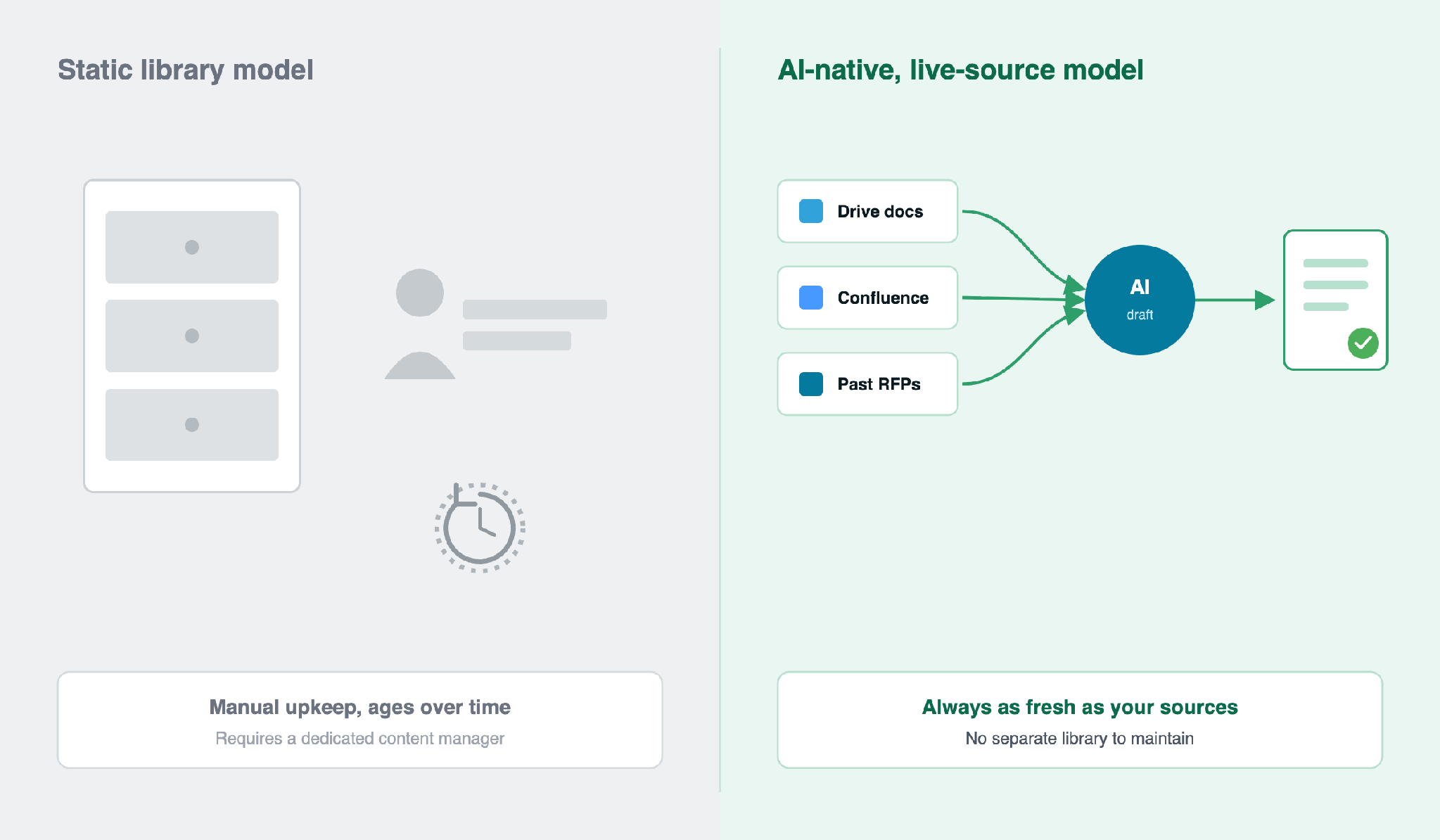
What does it cost to keep the answers true? Run both numbers, and compare against an AI-native alternative before you sign a multi-year contract.
Run the real comparison before you sign. Book a 15-minute Inventive AI demo → — or if you’re still researching, start with the Inventive AI vs. Loopio breakdown.
FAQ: Loopio Pricing
How much does Loopio cost per month?
Contracts are annual, not monthly. Effective monthly cost is roughly $1,000–$2,000 for entry plans ($12K–$24K/yr) and $6,000–$16,000+ for enterprise.
Does Loopio have a free trial or free plan?
No. Loopio offers demos through its sales team but no free tier, trial, or self-serve signup.
How much does Loopio cost per user?
Roughly $1,000–$3,500 per standard user per year (about $120/user/month per Vendr). Limited-access Library and Contributor seats run $200–$800/user/year.
What is Loopio’s minimum contract?
Third-party data indicates a practical minimum around $15,000/year regardless of team size, with Foundations (10 seats) commonly quoted near $20,000.
How does Loopio compare to RFP software generally?
Loopio sits at the premium end. Seat-based competitors run $50–$80/user/month vs. Loopio’s ~$120, and AI-native platforms with usage-based pricing often come in 40–60% lower annually. See the full enterprise RFP software comparison for how the market stacks up.
What hidden costs should I budget for?
Integration add-ons, SSO, premium support, onboarding, professional services, 3–5% annual uplifts — and above all, the internal labor of maintaining the content library, which can add 30–100% to true total cost of ownership.
Sources: Loopio pricing page, Vendr Loopio marketplace data, AutoRFP.ai Loopio pricing analysis, G2 verified reviews.