
Operational Due Diligence Checklist: What RFP Vendors Must Get Right
A practical operational due diligence checklist for RFP vendors. Learn what buyers review and how to stay audit-ready with AI-powered RFP responses.

Did you know, industry data shows that vendors may invest more than 32 hours on a single RFP response, time that could otherwise be spent on direct revenue activities.
For vendors responding to RFPs, operational due diligence is rarely optional. It is embedded into questionnaires, security reviews, compliance checks, and follow-up assessments that decide who moves forward and who gets cut.
If your answers feel inconsistent, outdated, or difficult to verify, buyers notice. And once trust erodes, pricing and product strength stop mattering.
This guide breaks down operational due diligence from a vendor’s point of view, with a practical checklist you can actually use during RFPs, RFIs, DDQs, and security questionnaires.
Key Takeaways
- Buyers use operational due diligence to evaluate whether a vendor’s internal operations can support reliable, secure delivery after contract signature.
- During RFPs and DDQs, buyers closely scrutinize governance, internal controls, security practices, compliance readiness, financial operations, IT systems, business continuity, and third-party risk.
- Inconsistencies across RFP answers, DDQs, and security questionnaires are one of the most common reasons vendors face delays, follow-ups, or silent rejection.
- Vendors that stay due diligence-ready maintain a single source of truth, review operational content regularly, and align sales, security, and compliance responses.
- Inventive AI helps vendors manage operational due diligence at scale by improving response quality, detecting conflicts and outdated content, and enabling faster, more consistent RFP responses.
What Operational Due Diligence Means for RFP Vendors?
Operational due diligence is how buyers evaluate how your company runs behind the scenes. It focuses on your internal operations:
- RFP operational sections
- Due Diligence Questionnaires (DDQs)
- Security questionnaires
- Compliance and risk reviews
- Post-proposal clarification rounds
Buyers are not just checking boxes. They need proof that your teams follow defined processes, clearly own responsibilities, and can handle scale, security, and ongoing service expectations.
At its core, operational due diligence answers one question buyers care deeply about:
“Can this vendor deliver consistently, securely, and at scale?”
When responses are unclear, outdated, or contradict earlier submissions, buyers see that as operational risk, even when pricing and product capabilities look strong.
So, having a trusted solution like Inventive AI ensures that your RFP responses remain consistent, accurate, and aligned with buyer expectations, reducing operational risk and boosting confidence in your proposal.
How the Operational Due Diligence Process Works for Vendors? 5 Steps!
Operational due diligence does not happen at a single checkpoint. For vendors, it unfolds across multiple stages of the RFP and evaluation cycle, often involving different buyer teams reviewing the same information from different angles.
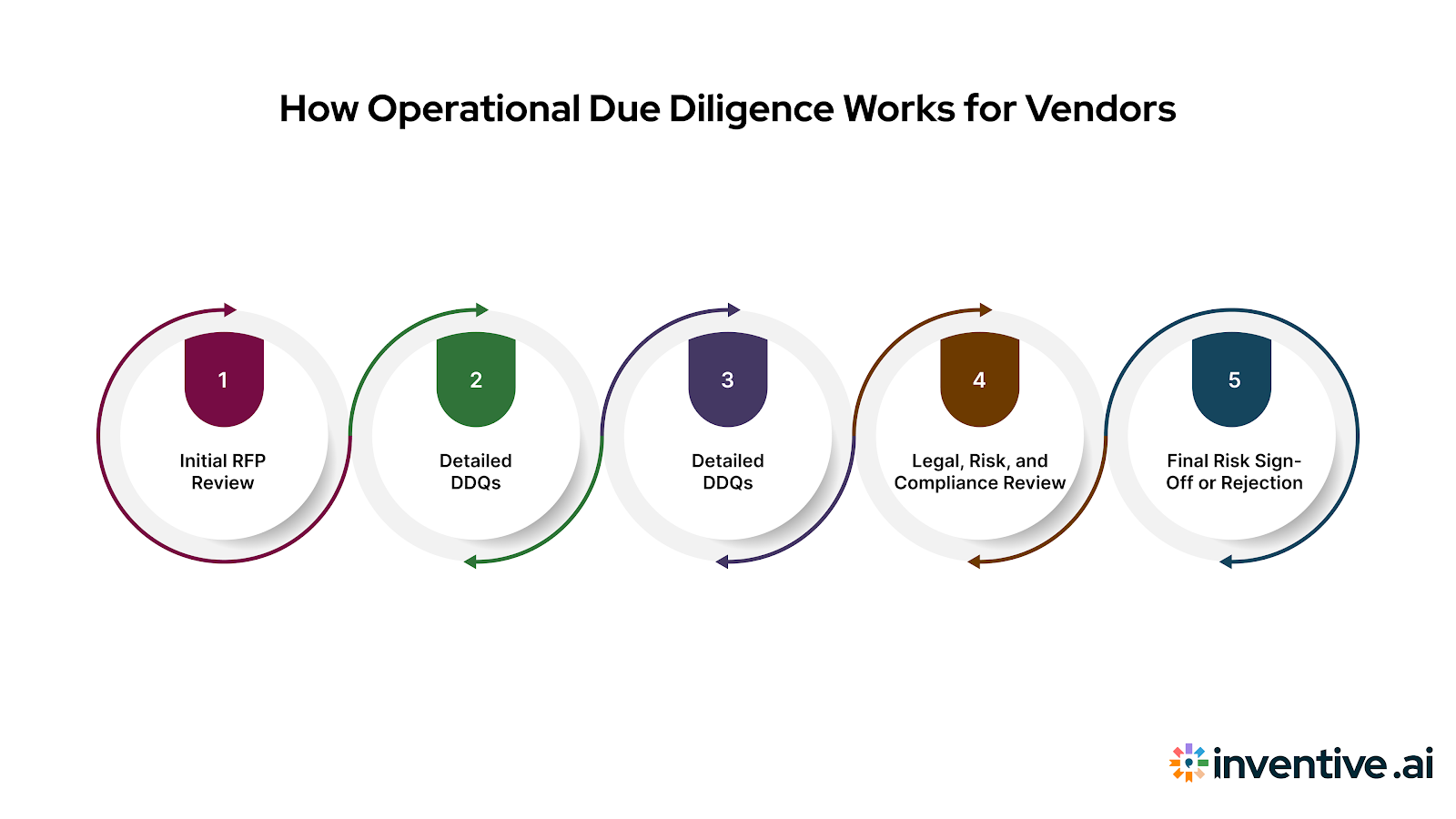
The process typically looks like this:
1. Initial RFP Review
Buyers request high-level operational details to determine basic eligibility. At this stage, they assess whether your company structure, processes, and controls meet minimum requirements to proceed.
Incomplete or unclear responses can eliminate vendors early, before pricing or product discussions begin.
2. Detailed DDQs and Security Questionnaires
Shortlisted vendors are asked to provide deeper operational evidence. This includes how internal processes are documented, how data is handled, who owns critical controls, and how issues are managed.
Buyers compare these answers closely with earlier RFP responses to check for consistency.
3. SME Validation and Follow-Up Clarifications
When answers appear vague or conflicting, buyers request clarifications. These follow-ups often involve security, IT, legal, and operations teams on both sides.
Delays or inconsistent explanations here raise concerns about internal alignment and process maturity.
4. Legal, Risk, and Compliance Review
Buyer legal and risk teams cross-check your responses against internal standards, regulatory expectations, and prior vendor experiences. Policies, certifications, and operational claims are reviewed in detail.
Gaps uncovered at this stage are difficult to recover from late in the cycle.
5. Final Risk Sign-Off or Rejection
Even well-scored proposals can stall or fail here. If operational risks remain unresolved, buyers may pause the deal, request additional documentation, or remove the vendor entirely from consideration.
This is where many vendors run into trouble. Answers written weeks or months apart begin to drift. Policies referenced no longer reflect current practices. Different teams provide different versions of the same information.
Operational due diligence rarely fails with a single red flag. It fails gradually, by slowing deal momentum, triggering repeated follow-ups, or quietly removing a vendor from the final shortlist.
Operational Due Diligence Checklist: 9 Things Buyers Scrutinize in Vendors!
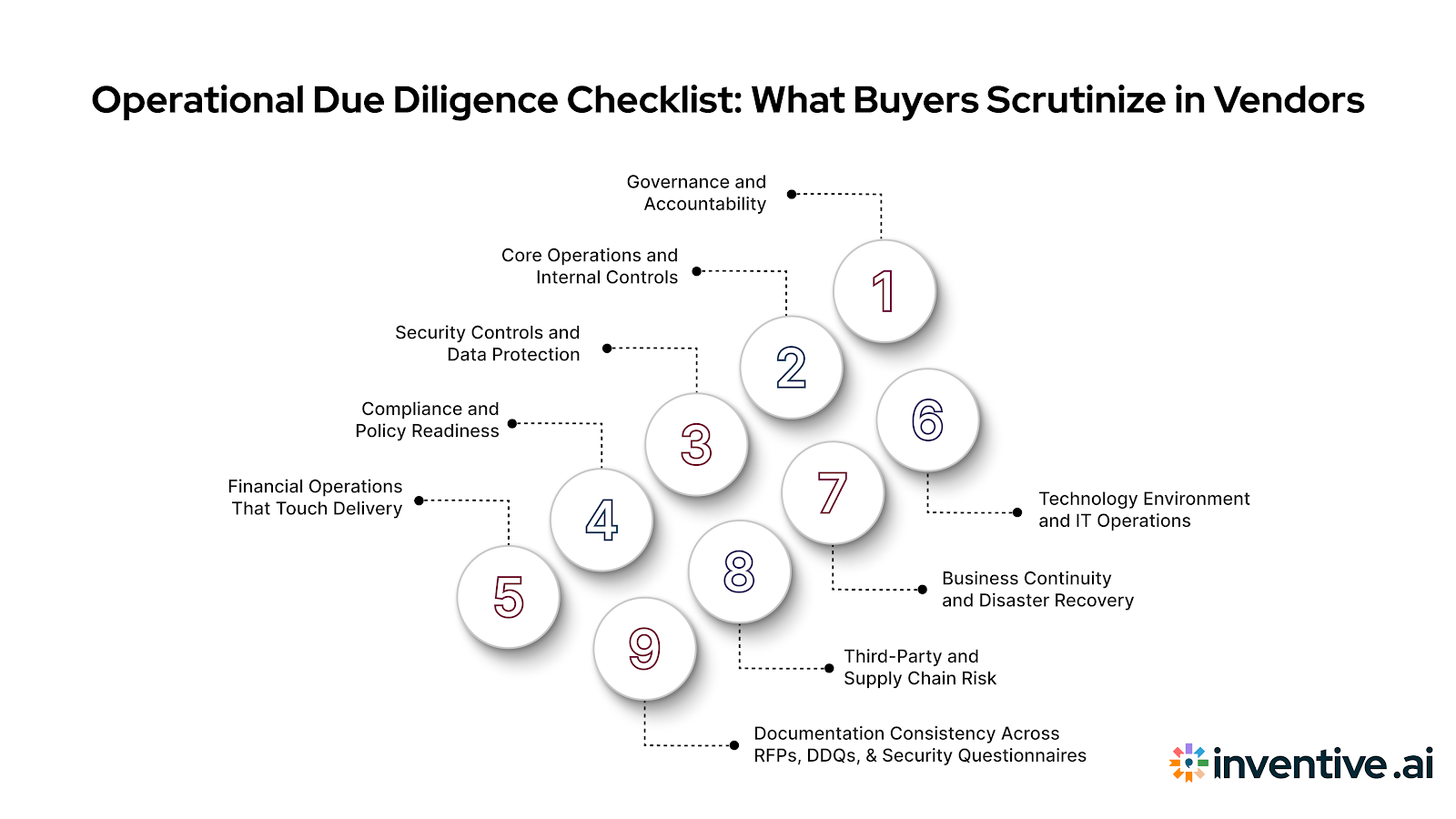
Buyers use operational due diligence to confirm one thing: your operations can support delivery without creating risk for them.
They’ll ask questions, but what they really want is evidence, documents, ownership, and repeatable controls.
Use the checklist below as your vendor-ready map for RFPs, DDQs, and security questionnaires.
1. Governance and Accountability
Buyers start here because ownership predicts response quality later.
What buyers check
- Who owns security, privacy, compliance, and incident response (by role/title)
- Escalation path for outages, data incidents, and contract issues
- Board or executive oversight on risk (even if you’re not a public company)
- Approval workflow for policies and customer-facing commitments
What “good” evidence looks like
- Org chart (lightweight is fine), RACI chart, escalation matrix
- Policy approval trail (version history + owner)
If governance is unclear, buyers assume follow-ups will be slow when something breaks.
2. Core Operations and Internal Controls
This is where buyers test if you run on repeatable processes or tribal knowledge.
What buyers check
- Documented SOPs for service delivery, support, and changes
- QA checks and “who approves what” in delivery workflows
- Change management for releases, configs, and production access
- Internal audits or management reviews (even an informal cadence helps)
What “good” evidence looks like
- SOP links + last updated date, change request template, approval logs
- Sample post-incident review or corrective action tracking
If your answers describe controls but you can’t show artifacts, buyers treat it as a gap.
3. Security Controls and Data Protection
US enterprise buyers will scrutinize this heavily, and they’ll compare answers across documents. Supplier-side software supply chain guidance also pushes vendors to formalize security checks.
What buyers check
- Data handling and classification (what you collect, where it lives, retention)
- Access controls (SSO, MFA, least privilege, periodic access reviews)
- Logging and monitoring (what you log, how long you retain logs)
- Vulnerability management + patch cadence
- Incident response readiness (roles, timelines, communications approach)
What “good” evidence looks like
- Security policy set, access review cadence, and incident response plan
- Security training completion record
- Secure development practices for software vendors (buyer expectations are rising here)
Given the rise in third-party-related breach patterns, buyers want defensible, consistent security answers.
4. Compliance and Policy Readiness
This is where “we have a policy” becomes “is it current, and do people follow it?”
What buyers check
- Policy completeness (security, privacy, acceptable use, vendor risk, IR, BCP/DR)
- Update cadence and change ownership
- Training coverage (who takes what training, how often)
- Regulatory alignment relevant to your industry (HIPAA, GLBA, SOC 2 expectations, etc.)
What “good” evidence looks like
- Policy index with version dates, training records, and audit-ready evidence packet
If policies read generic or stale, buyers will dig deeper and slow the cycle.
5. Financial Operations That Touch Delivery
Even when financial due diligence is separate, buyers still test the operational side of billing and commitments.
What buyers check
- Billing accuracy controls and dispute handling
- Refund/credit process and approvals
- Separation of duties (especially for payments and provisioning)
- Contract-to-cash workflows (who triggers provisioning, who approves changes)
What “good” evidence looks like
- Billing workflow doc, approval matrix, sample dispute SLA
They’re not just checking stability. They’re checking whether delivery will turn messy after signature.
6. Technology Environment and IT Operations
This section is less about naming tools and more about reliability and control.
What buyers check
- System ownership (who maintains core systems and integrations)
- Identity and device controls for employees and contractors
- Backup practices and restore testing
- Production access controls and approval workflows
- Dependency visibility (critical vendors, cloud providers, subprocessors)
What “good” evidence looks like
- Inventory of critical systems, access controls summary, backup/restore test record
Top checklists often treat IT ops as part of operational health, not “just security.”
7. Business Continuity and Disaster Recovery
Buyers don’t only ask if you have a plan. They ask if you’ve tested it.
What buyers check
- RTO/RPO targets (even if ranges)
- DR testing cadence and results summary
- Incident communications plan (who notifies customers and when)
- Operational resilience for support and delivery during disruptions
What “good” evidence looks like
- BCP/DR plan, last test date, lessons learned summary
Weak BCP/DR slows enterprise procurement because it’s a risk sign-off item.
8. Third-Party and Supply Chain Risk
US guidance increasingly emphasizes supplier investigation rigor and software supply chain controls.
What buyers check
- How do you evaluate your own vendors and subprocessors
- Security requirements in vendor contracts (where relevant)
- Monitoring approach for key third parties
- The offboarding process when a vendor relationship ends
What “good” evidence looks like
- Vendor tiering policy, due diligence checklist, subprocessors list (if applicable)
This matters more now because third parties are showing up in breach patterns at meaningful rates.
9. Documentation Consistency Across RFPs, DDQs, and Security Questionnaires
This is the silent deal-killer.
What buyers do
- Compare your current RFP answers against prior DDQs/security questionnaires
- Look for wording changes that suggest uncertainty or misalignment
- Flag contradictions and ask follow-ups (or disqualify quietly)
What “good” evidence looks like
- Standardized, approved answer library with version control
- Clear “source of truth” for policies, security statements, and processes
When answers drift, buyers interpret it as operational risk, even if each answer is “kind of correct.”
When these areas stay aligned and evidence-backed, operational due diligence becomes a signal of reliability rather than a barrier to moving the deal forward.
Also Read: Marketing Automation RFP Template
7 Most Common Challenges Vendors Face During Operational Due Diligence
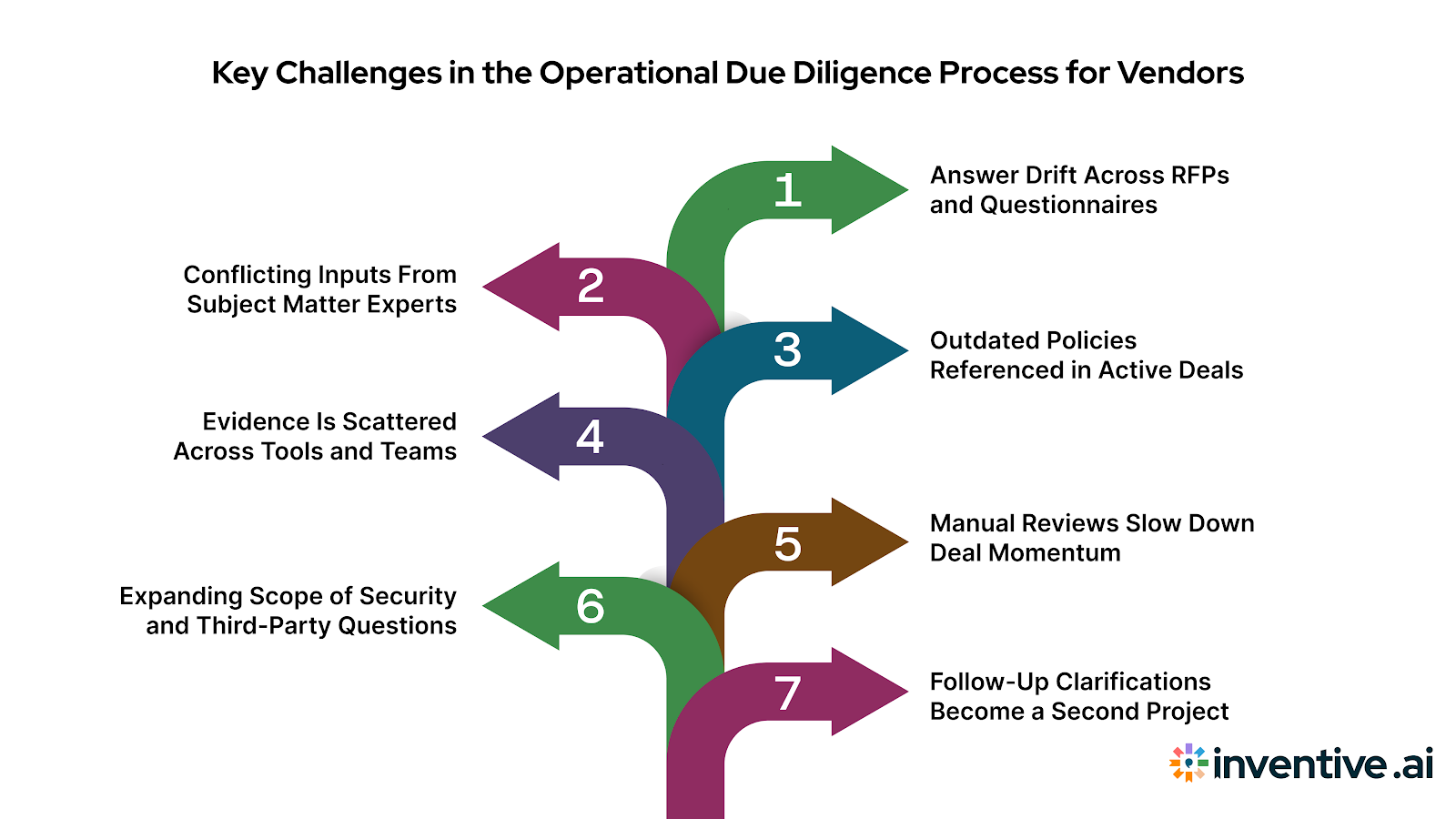
Operational due diligence rarely fails because vendors lack policies or processes. It breaks down when those processes are reviewed repeatedly, by different buyer teams, over extended deal cycles.
The most common challenges vendors face include:
1. Answer Drift Across RFPs and Questionnaires
The same question appears across RFPs, DDQs, and security questionnaires—but it’s answered weeks or months apart. Language changes, owners change, or assumptions shift slightly.
Buyers notice these differences quickly. Even small wording changes can raise doubts about internal alignment or control ownership.
2. Conflicting Inputs From Subject Matter Experts
Security, IT, legal, finance, and operations teams often respond independently. Without a shared source of truth, each team answers based on its own understanding.
This leads to contradictions that require clarification rounds and weaken buyer confidence, especially during late-stage reviews.
3. Outdated Policies Referenced in Active Deals
Policies exist, but they haven’t been reviewed recently. Update dates are old, or the documented process no longer reflects how teams actually operate.
When buyers cross-check dates or request confirmation, vendors are forced into reactive explanations that slow the deal.
4. Evidence Is Scattered Across Tools and Teams
Buyers don’t just want answers, they want proof. When supporting evidence lives across shared drives, ticketing systems, and inboxes, response teams lose time locating the right artifacts.
Delayed evidence submission often signals weak operational discipline, even when controls exist.
5. Manual Reviews Slow Down Deal Momentum
Operational reviews typically require multiple internal approvals. When everything is handled manually, review cycles stretch, deadlines tighten, and response quality suffers.
This is especially damaging late in the sales cycle, when buyers expect clarity, not more questions.
6. Expanding Scope of Security and Third-Party Questions
US buyers are increasing scrutiny around software supply chain risk and vendor dependencies. Questionnaires grow longer and more detailed, often mid-cycle.
Vendors relying on static templates struggle to keep pace, leading to rushed updates and inconsistencies.
7. Follow-Up Clarifications Become a Second Project
Once inconsistencies appear, buyers ask follow-up questions. These clarifications consume time, pull in senior stakeholders, and distract teams from active selling.
By the time explanations are provided, buyers may already have concerns logged with their risk or procurement teams.
Taken together, these challenges don’t fail deals outright, but they quietly slow them down, weaken trust, and reduce a vendor’s chances of making it to final approval.
Also Read: Understanding Video Production RFPs: Respond Faster
5 Best Practices to Stay Operational Due Diligence-Ready
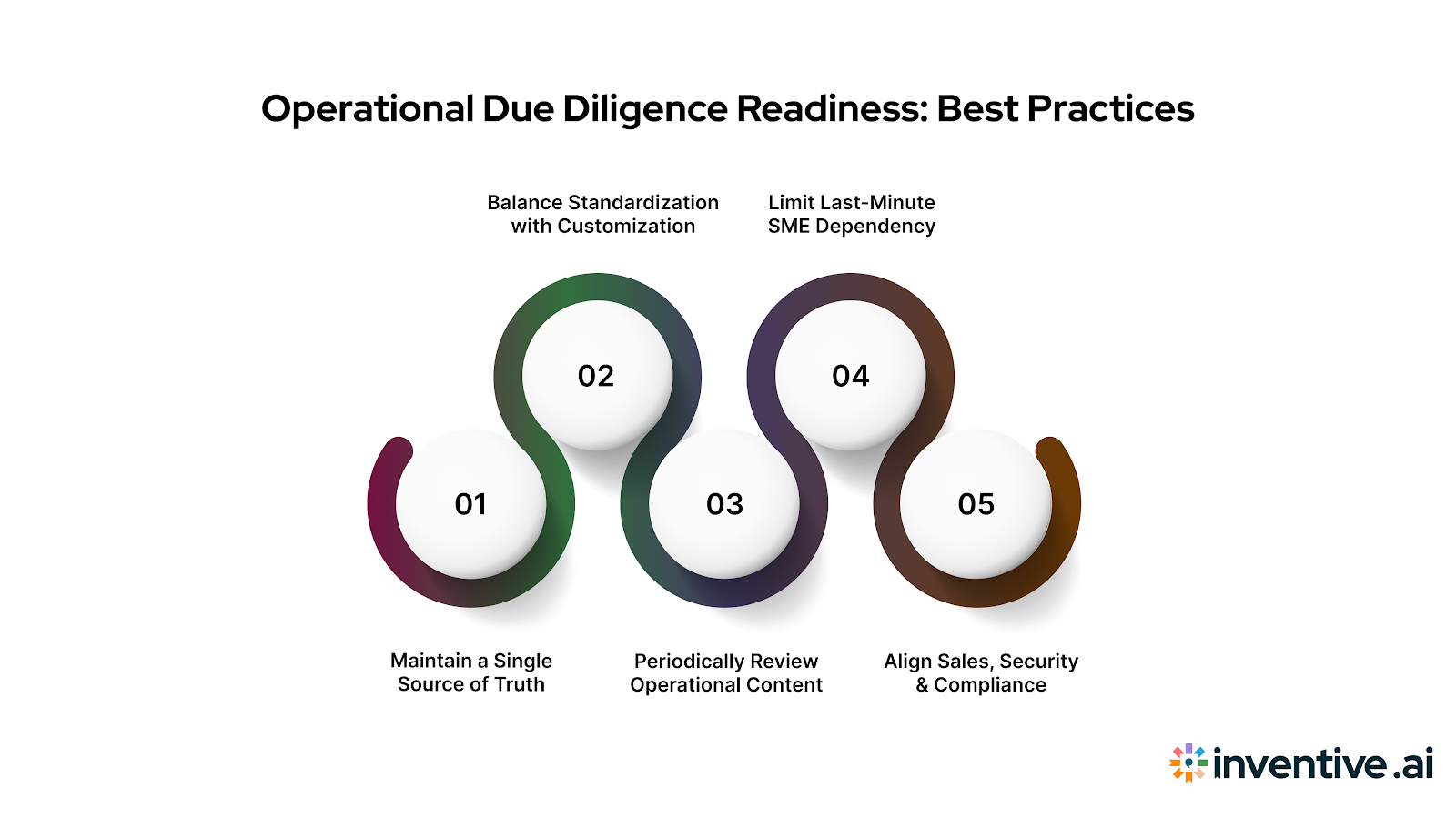
Operational due diligence works best when it is treated as an ongoing operational requirement, not a one-time response exercise.
Vendors that stay ready reduce review cycles, avoid rework, and face fewer follow-up questions during RFPs and DDQs.
1. Maintain a Single Source of Truth
Store approved operational answers in one central location. This prevents teams from rewriting the same responses and reduces contradictions across RFPs, DDQs, and security questionnaires. A single source of truth also makes reviews faster and easier to manage.
2. Standardize Answers Without Making Them Generic
Use standardized language for consistency, but ensure answers reflect how your organization actually operates. Buyers expect responses that match your real processes, tools, and ownership, not generic templates.
3. Review Operational Content on a Fixed Schedule
Policies, controls, and system descriptions change over time. Regular reviews help ensure responses stay accurate and defensible when buyers compare submissions across different stages of a deal.
4. Limit Last-Minute SME Dependency
Relying on SMEs only at the deadline creates delays and inconsistencies. Capture validated inputs in advance, so SMEs focus on review and confirmation rather than drafting from scratch.
5. Align Sales, Security, and Compliance Responses
Operational due diligence spans multiple teams. When sales, security, and compliance use different language to describe the same controls, buyers flag it as a risk. Alignment prevents unnecessary follow-ups.
When these practices are in place, operational due diligence becomes a controlled process instead of a recurring source of delays and uncertainty.
Also Read: Writing an RFP for Software Development: Step-by-Step Guide
Reducing Operational Due Diligence Risk With Inventive AI
Operational due diligence is no longer a back-office task. For vendors, it directly affects deal progression, buyer confidence, and revenue outcomes.
When responses stay consistent, current, and easy to validate, buyers move forward with fewer delays. When they don’t, reviews slow down, and strong proposals lose momentum.
Inventive AI’s AI RFP Agent is designed to simplify your RFP response process by helping vendors produce consistent, accurate, and defensible responses across RFPs, DDQs, and security questionnaires.
Below is how Inventive AI reduces operational due diligence risk in practice.
1. 2x Better Response Quality With Context-Aware Drafting
Inventive AI prioritizes response quality over surface-level speed. It generates answers based on your actual internal content, not generic templates.
The AI-powered Context Engine understands how policies, processes, systems, and prior responses relate to one another. This keeps answers aligned across sections and documents, which buyers rely on during operational reviews.
2. AI-Powered Context Engine That Maintains Internal Consistency
Operational due diligence questions often overlap across security, compliance, and operations sections. When answers drift, buyers flag risk.
Inventive AI maintains contextual alignment by linking related information across responses. This ensures that answers remain consistent even when questions are asked in different ways.
3. Instant Conflict Detection Across RFPs and Questionnaires
Contradictory answers are one of the most common reasons buyers request follow-ups or escalate reviews.
Inventive AI detects conflicts across RFPs, DDQs, and security questionnaires before submission. Teams can resolve issues internally instead of explaining inconsistencies to buyers late in the process.
4. Outdated Content Detection to Prevent Policy Mismatches
Buyers check policy dates, ownership, and relevance. Referencing outdated documentation weakens confidence.
Inventive AI flags responses tied to outdated policies or processes so teams can update them before submission. This reduces risk during compliance and security reviews.
5. Quality Benchmarking for Defensible Responses
Inventive AI benchmarks responses against approved, high-quality content to ensure clarity and completeness. This improves internal review efficiency and reduces rework during operational due diligence.
6. Narrative-Style Proposals That Hold Together
Operational diligence reviews extend beyond checklists. Buyers assess how clearly vendors explain their operating model.
Inventive AI supports narrative-style proposals that present operational information as a cohesive explanation rather than disconnected answers.
Frequently Asked Questions (FAQs)
1. What is an operational due diligence checklist in RFPs?
An operational due diligence checklist outlines the areas buyers review to assess how a vendor operates, including governance, security, compliance, controls, and delivery readiness.
2. Why do buyers include operational due diligence in RFPs?
Buyers use operational due diligence to reduce risk and confirm that a vendor can deliver reliably, securely, and consistently after contract signing.
3. How is operational due diligence different from financial due diligence?
Operational due diligence focuses on processes, controls, systems, and execution, while financial due diligence focuses on financial health, reporting, and stability.
4. What causes vendors to fail operational due diligence reviews?
Common reasons include inconsistent answers across RFPs and DDQs, outdated policies, unclear ownership, and lack of supporting evidence.
5. How can vendors prepare faster for operational due diligence?
Vendors prepare faster by maintaining a single source of truth, keeping operational content current, and using AI-powered RFP response software to ensure consistency.

90% Faster RFPs. 50% More Wins. Watch a 2-Minute Demo.

Hardi Hindocha
Knowing that complex B2B software often gets lost in jargon, Hardi focuses on translating the technical power of Inventive AI into clear, human stories. As a Sr. Content Writer, she turns intricate RFP workflows into practical guides, believing that the best content educates first and earns trust by helping real buyers solve real problems.
.jpeg)
Mukund Kumar
Understanding that sales leaders struggle to cut through the hype of generic AI, Mukund focuses on connecting enterprises with the specialized RFP automation they actually need at Inventive AI. An IIT Jodhpur graduate with 3+ years in growth marketing, he uses data-driven strategies to help teams discover the solution to their proposal headaches and scale their revenue operations.