Restaurant POS RFP Template with Vendor Response Sample

Restaurant operators evaluating Point-of-Sale (POS) systems often start with generic procurement templates or vendor questionnaires. These documents rarely reflect how restaurants actually operate. Templates often miss critical needs. These include order management, kitchen workflows, and multi-location reporting.
As a result, vendors interpret requirements differently. Some proposals emphasize payment infrastructure, others focus on front-of-house features, while integration capabilities or deployment support may be addressed inconsistently. Without a structured RFP, comparing restaurant POS platforms becomes difficult, and procurement teams struggle to evaluate which system best fits operational needs.
This guide provides a Restaurant POS RFP template that helps buyers organize the information vendors need to design accurate proposals. It also includes a proposal response structure for vendors responding to restaurant POS RFPs.
Restaurant POS RFP Template That Gets Clear, Comparable Vendor Proposals (for Buyers)
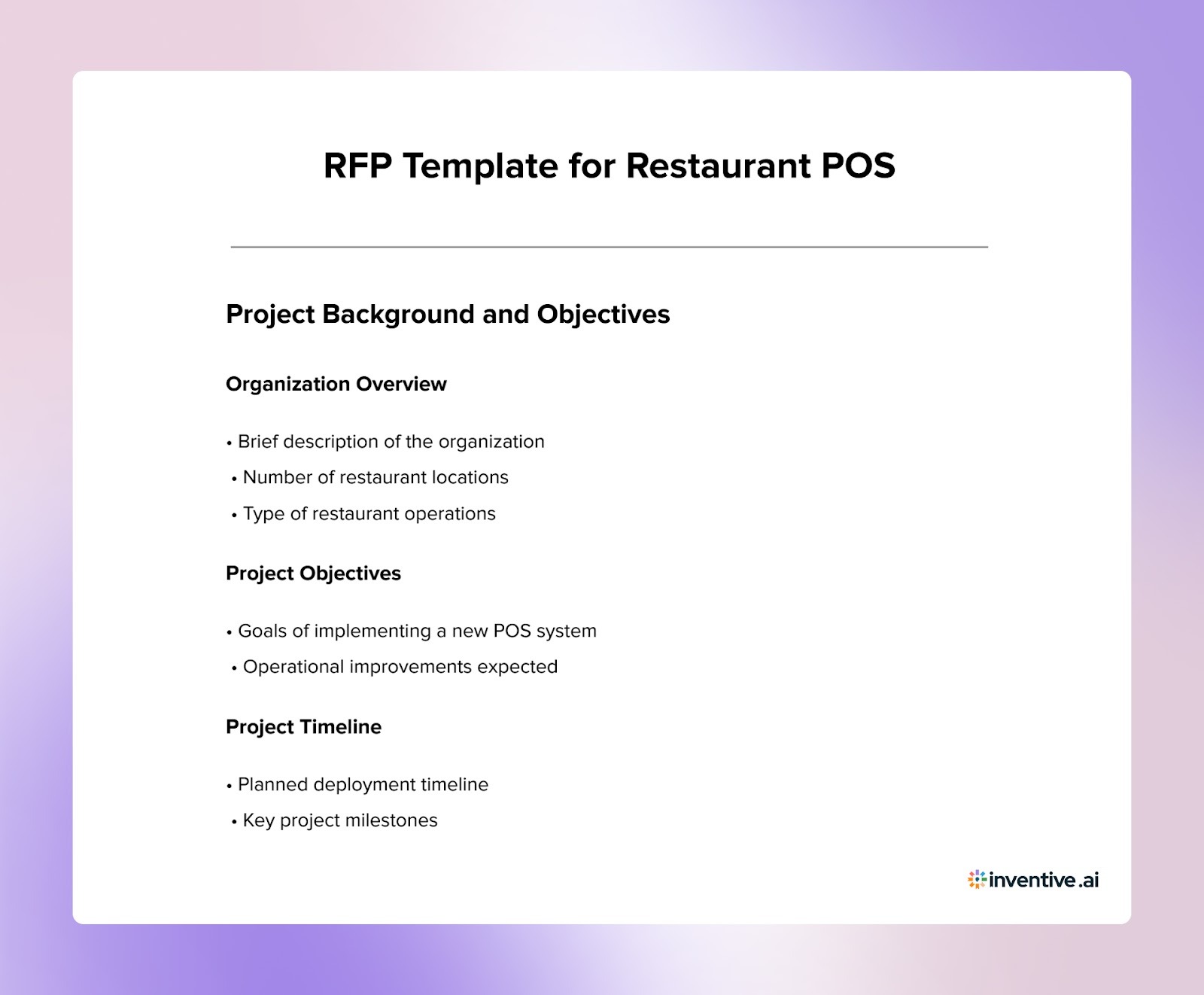
Restaurant operators planning an RFP can use the structure below to organize the information vendors need to prepare a complete response.

If you are responding to a restaurant POS RFP, use the proposal structure below to organize your response and ensure it aligns with the buyer’s documented requirements.
Build Strong Restaurant POS RFP Responses with This Proposal Template (for Vendors)
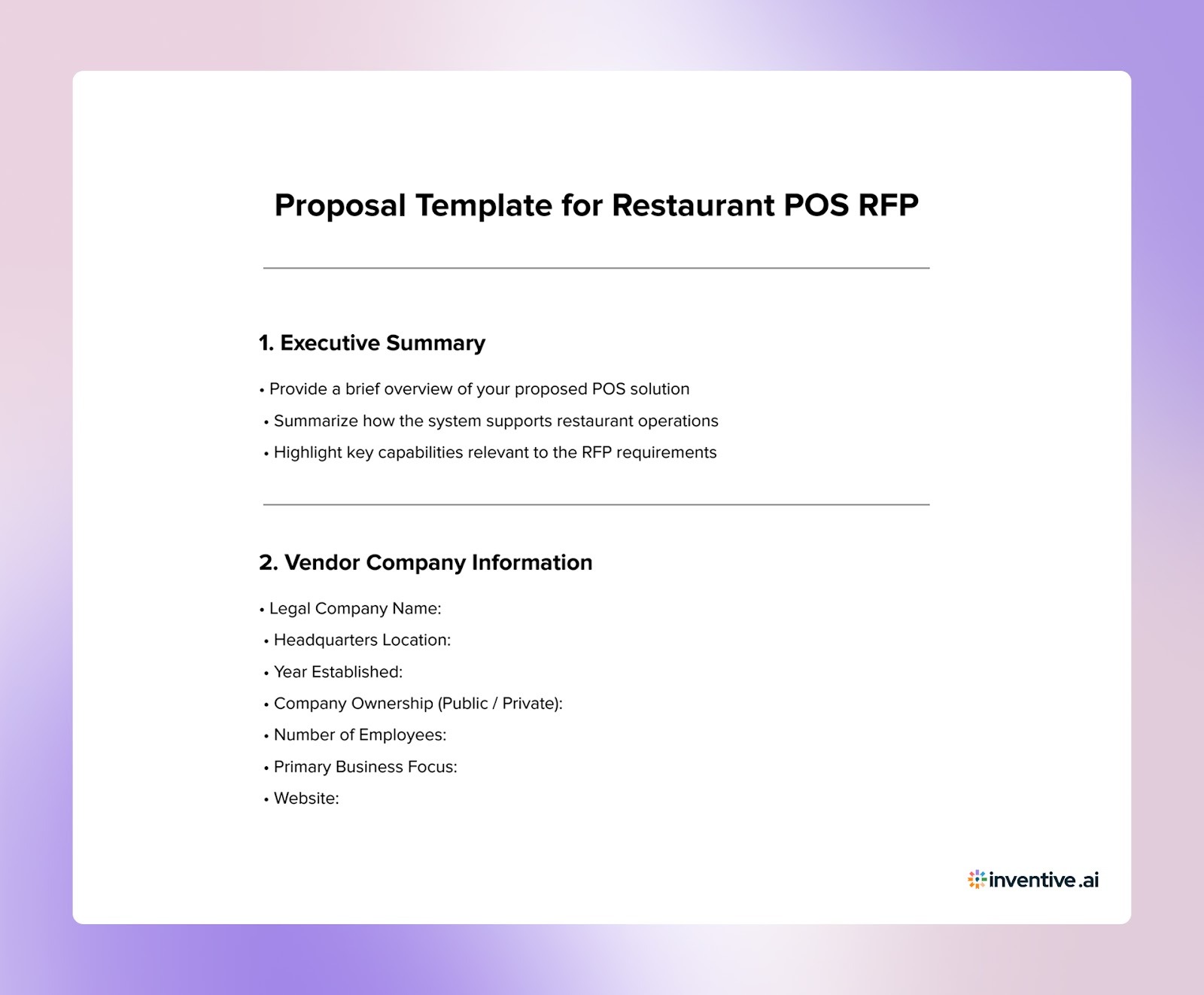
Vendors responding to a restaurant POS RFP must demonstrate more than product features. Vendors must clearly explain how their POS system supports restaurant operations, how the implementation will be executed, and how the system will be supported after deployment.

1. Executive Summary
The executive summary introduces the vendor’s proposed POS solution and demonstrates an understanding of the restaurant’s operational needs. Procurement teams and decision-makers often begin their evaluation here to determine whether the vendor’s approach aligns with the goals of the POS project.
Rather than repeating marketing claims, the summary should explain how the proposed system will support the restaurant’s order management, payment processing, reporting, and operational workflows.
Example: “Our team proposes implementing a cloud-based POS platform designed for multi-location restaurant operations. The system will support centralized menu management, integrated payment processing, real-time sales reporting, and offline transaction capabilities to ensure uninterrupted service during network outages.”
2. Company Background and Relevant Experience
Buyers evaluate vendor experience to assess reliability and the ability to deliver successful POS deployments. Restaurant POS implementations often require coordination with operational teams, payment processors, and existing business systems.
Vendors should highlight projects that demonstrate experience with similar restaurant environments.
Include:
• Company history and specialization
• Number of POS deployments completed
• Experience supporting restaurant or hospitality businesses
• Certifications, partnerships, or technical accreditations
Example: “Our company has delivered POS solutions for over 300 restaurant locations across North America, including quick-service chains, full-service restaurants, and franchise networks requiring centralized reporting and menu management.”
3. POS Solution Overview
This section explains the proposed POS platform and its core capabilities. Buyers use this section to understand the architecture of the solution and how it supports restaurant operations.
Vendors should clearly describe the POS platform rather than listing generic feature sets.
Include:
• POS system architecture
• Cloud or on-premise deployment model
• Core software modules
• Supported hardware ecosystem
Example: “The proposed POS platform operates on a cloud-based architecture that allows restaurants to manage menus, pricing, and reporting across multiple locations from a centralized dashboard. POS terminals synchronize with the cloud database in real time while maintaining offline processing capability.”
4. Implementation Methodology
Buyers evaluate the implementation methodology to determine how the POS system will be deployed across restaurant locations. The methodology should describe the technical and operational steps required to implement the system successfully.
Include:
• Project kickoff and planning process
• System configuration and setup
• Hardware installation procedures
• Integration implementation
• Testing and validation processes
Example: “The implementation will begin with a system configuration workshop to define menu structures, payment workflows, and reporting requirements. POS terminals will then be installed and configured onsite, followed by system testing and staff training prior to go-live.”
5. Integration Approach
Restaurant POS systems often need to integrate with existing operational platforms. Buyers use this section to evaluate the vendor’s ability to connect the POS system with the restaurant’s technology stack.
Include:
• Integration with inventory systems
• Integration with accounting or ERP platforms
• Integration with analytics and reporting tools
• Integration with payment gateways
Example: “The POS platform will integrate with the restaurant’s inventory management system to synchronize product usage data and automate stock tracking. Daily sales data will also be exported to the accounting platform for financial reconciliation.”
6. Hardware and Infrastructure Plan
This section explains the hardware components required to support the proposed POS solution. Buyers evaluate whether the hardware configuration is appropriate for the restaurant’s service environment.
Include:
• POS terminal specifications
• Receipt printers and kitchen printers
• Cash drawers and peripherals
• Network and connectivity requirements
Example: “Each service station will include a touchscreen POS terminal connected to a receipt printer and cash drawer. Kitchen printers will receive order tickets directly from the POS system to support efficient order preparation.”
7. Training and Change Management
Successful POS implementations depend on staff adoption and operational readiness. Buyers evaluate training plans to determine whether restaurant teams will be prepared to use the system effectively.
Include:
• Staff training sessions
• Manager training programs
• Training documentation or user guides
• Go-live support for restaurant staff
Example: “Restaurant managers will receive two days of system training covering menu management, reporting tools, and operational controls. Front-of-house staff will participate in POS transaction training before system launch.”
8. Project Timeline
The project timeline outlines how the vendor plans to deploy the POS system from planning to full operational use. Buyers evaluate this section to determine whether the vendor can meet required deployment deadlines.
Include:
• System configuration phase
• Hardware installation timeline
• Staff training schedule
• System testing and go-live preparation
Example: “System configuration will occur during the first two weeks of the project. Hardware installation and testing will take place during week three, followed by staff training and system launch during week four.”
9. Pricing Structure
Pricing transparency allows buyers to compare proposals across vendors. Vendors should clearly document all costs associated with the POS solution.
Include:
• Software licensing or subscription fees
• Hardware costs
• Implementation services
• Support and maintenance fees
Example:
Software Subscription: $350 per location per month
Hardware Package: $4,500 per location
Implementation Services: $7,500
Annual Support Plan: $1,200 per location
10. Support and Service Model
Buyers evaluate support capabilities to ensure the POS system will remain operational after deployment. This section should explain how vendors provide ongoing support and maintenance for systems.
Include:
• Help desk availability and support hours
• Issue escalation procedures
• Software updates and maintenance
• Hardware replacement policies
Example: “The vendor provides 24/7 technical support through a dedicated help desk. Critical issues affecting transaction processing are prioritized for immediate resolution, and software updates are delivered quarterly.”
11. Warranty and Service Guarantees
Warranty terms help buyers assess the reliability of the vendor’s POS solution and support services. Vendors should clearly define coverage for hardware, software, and implementation services.
Include:
• Hardware warranty period
• Software reliability commitments
• Service level agreements (SLAs)
• Replacement or repair policies
Example: “All POS hardware components include a three-year manufacturer's warranty. The vendor guarantees 99.9% system uptime and provides next-business-day replacement for defective hardware devices.”
Build Competitive Restaurant POS RFP Proposals with Inventive AI
Inventive AI helps vendors organize information, generate structured responses, and ensure consistent proposal sections. Instead of manually assembling responses from past documents, teams can generate complete proposal drafts aligned with the buyer’s requirements.
Key Capabilities of Inventive AI:
Context Engine
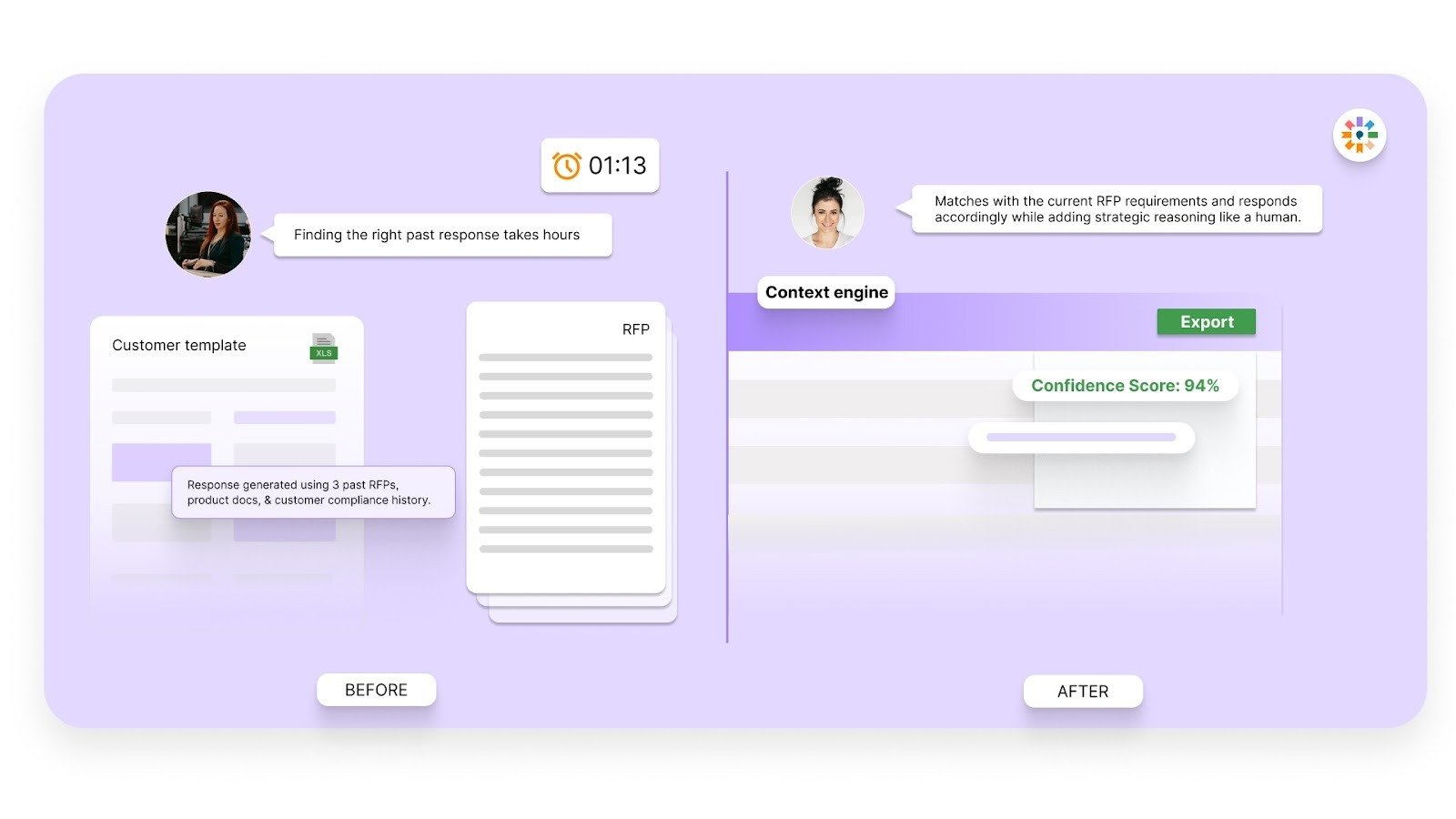
Most proposal tools rely on keyword matching that returns generic content. Inventive AI uses multi-layer reasoning to analyze the entire RFP, including operational workflows, system requirements, and evaluation criteria.
This allows the platform to generate responses that align with the buyer’s documented POS requirements instead of producing generic proposal content.
Conflict Detection
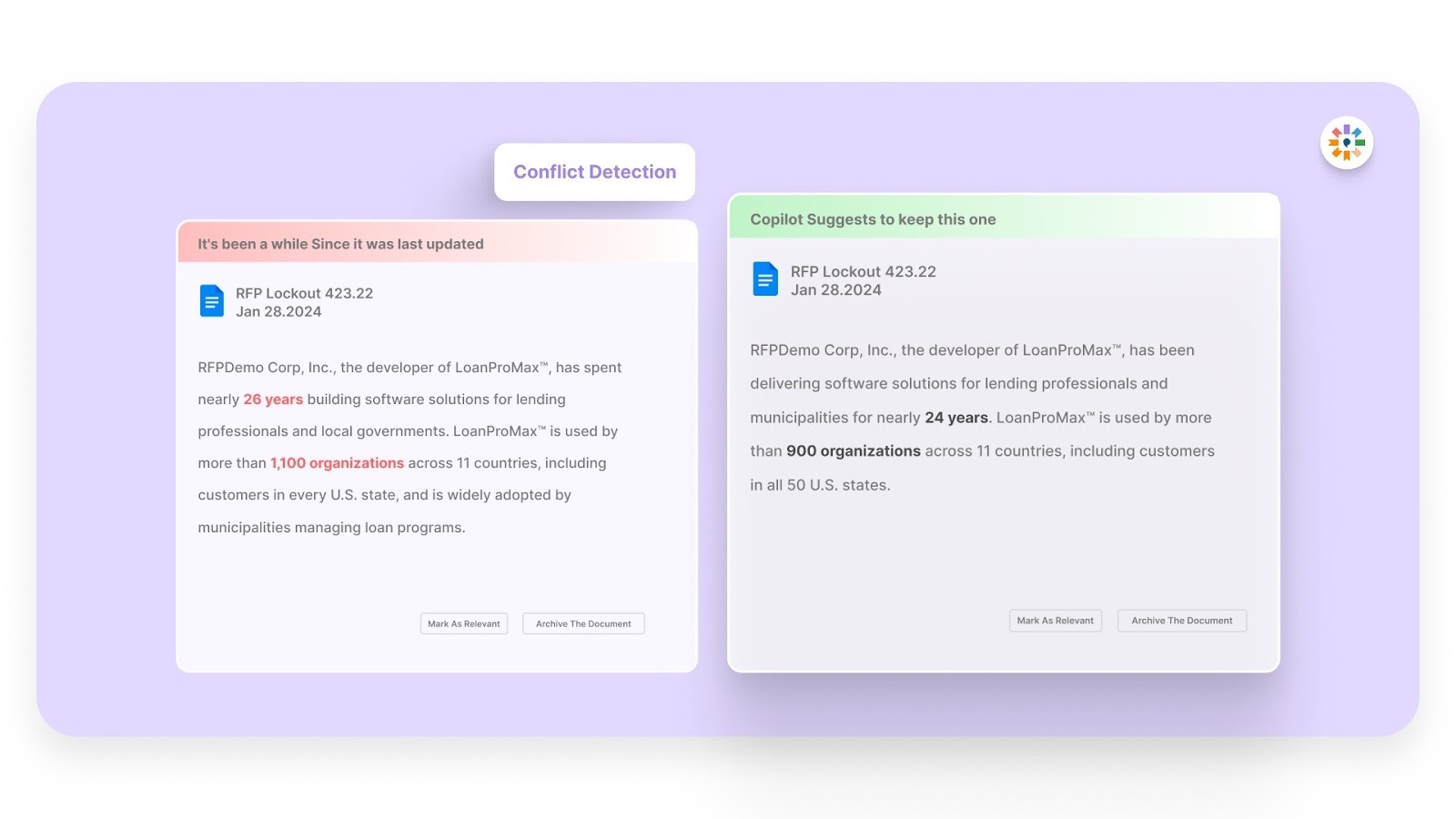
Restaurant POS proposals often include multiple sections covering implementation timelines, system capabilities, integration plans, and support services. When responses are prepared manually, inconsistencies can appear across these sections.
Inventive AI automatically identifies conflicting information before submission, helping proposal teams maintain consistency throughout the document.
Outdated Content Detection
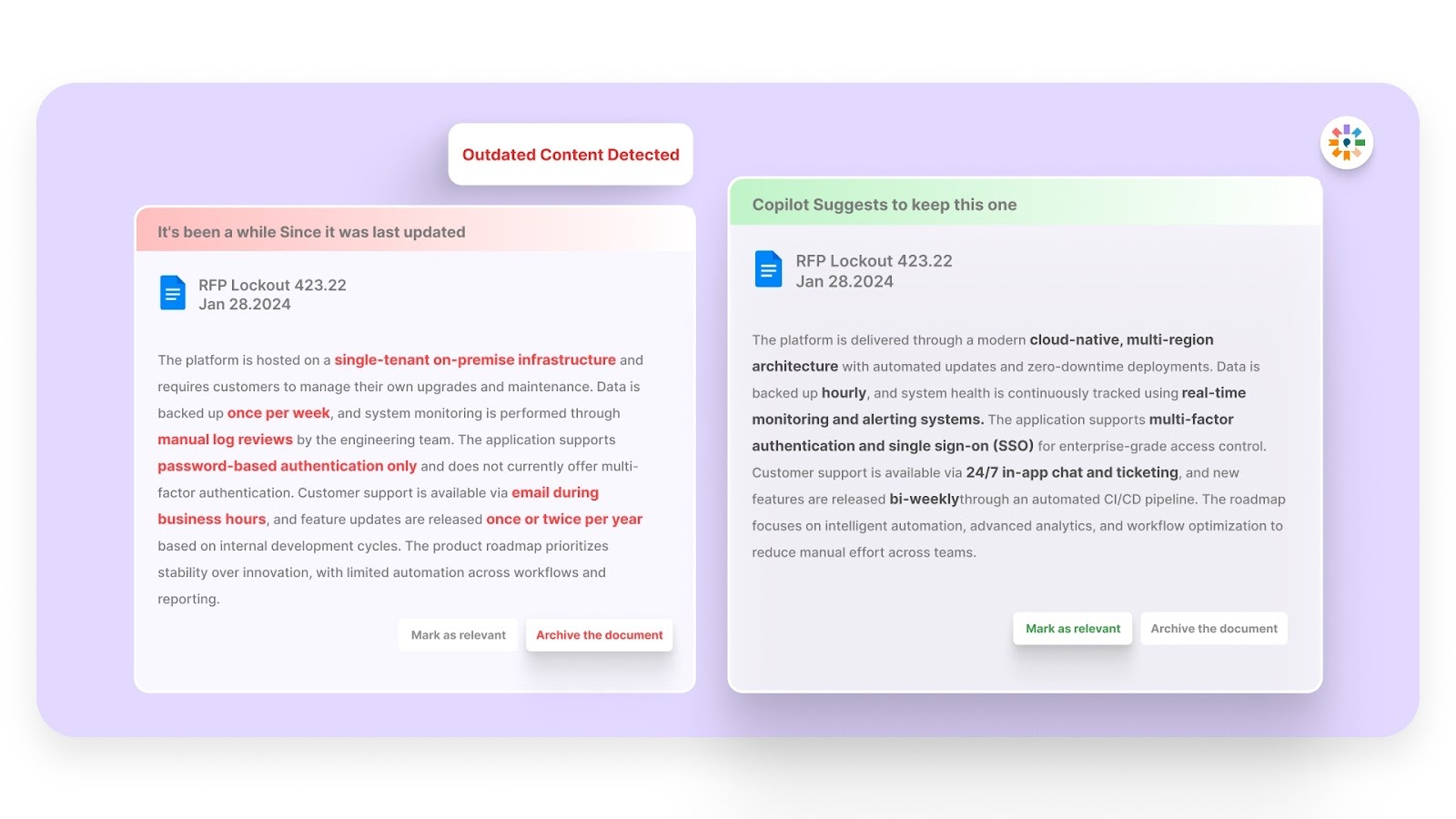
Proposal libraries frequently contain older responses that reference outdated integrations, deprecated features, or legacy pricing structures.
Inventive AI flags outdated content before it appears in the proposal, helping vendors ensure that responses reflect current POS capabilities and service offerings.
2X Higher Quality Responses
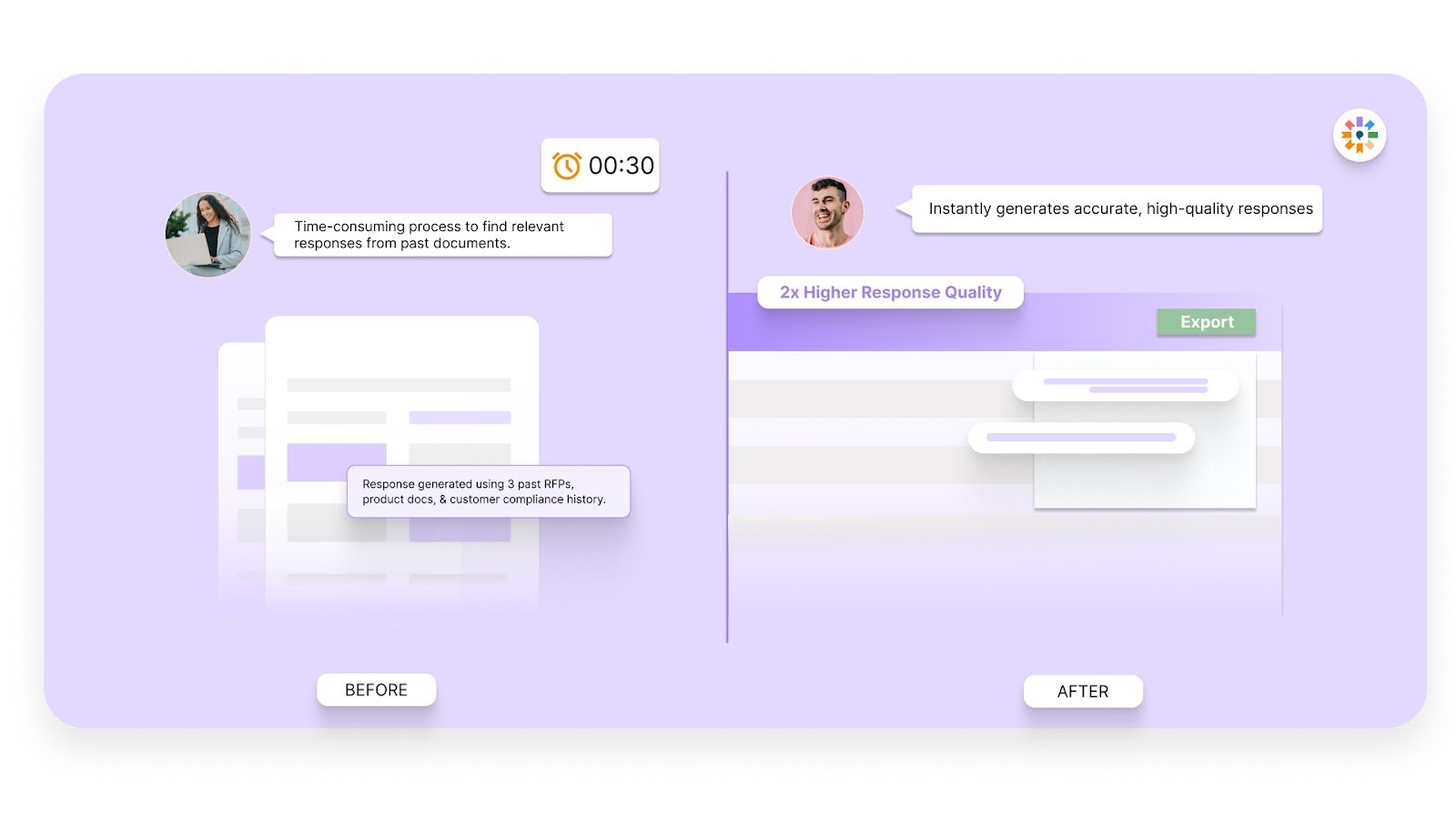
Inventive AI’s multi-agent system generates responses that directly address buyer requirements. The platform analyzes the RFP structure and produces detailed answers aligned with system functionality, implementation planning, and deployment requirements.
This improves proposal clarity and helps vendors present more complete responses during evaluation.
Simple and Easy-to-Use Interface
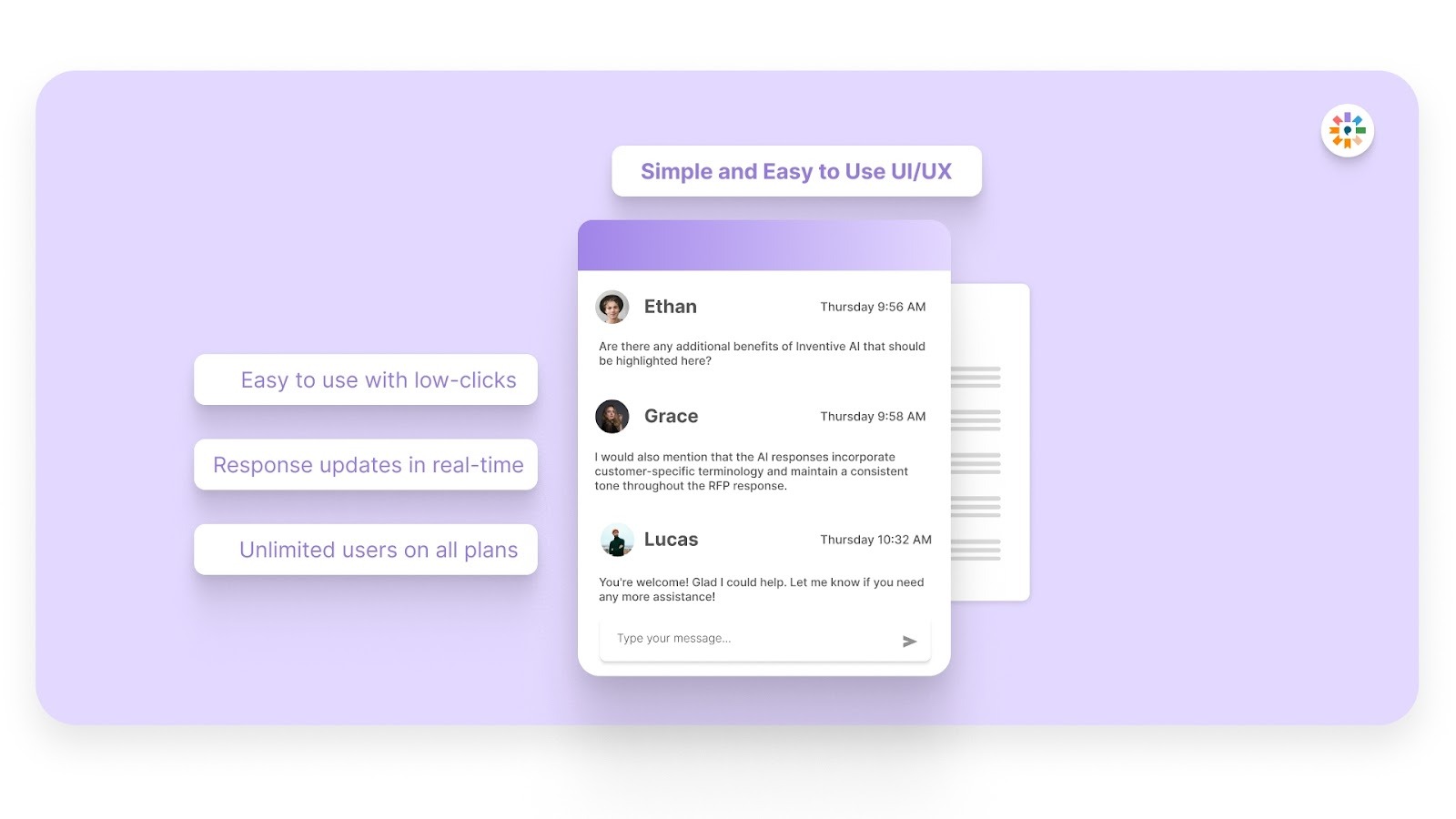
Proposal teams often work under tight deadlines while coordinating with product teams, implementation specialists, and sales stakeholders.
Inventive AI provides an intuitive interface that allows teams to generate structured responses quickly without complex configuration or workflow setup.
Narrative-Style Proposal Generation
Restaurant POS RFPs often require narrative sections such as executive summaries, implementation approaches, and deployment methodologies.
Inventive AI generates narrative-style proposal content that explains the vendor’s approach clearly while aligning with the structure and requirements of the RFP.
FAQs About Restaurant POS RFP Template
1. How long does a restaurant POS RFP process usually take?
The timeline varies depending on the number of vendors involved and the complexity of the restaurant’s operations. Many POS RFP processes take between 4 and 8 weeks, including vendor clarification periods, proposal evaluations, product demonstrations, and final contract negotiation.
2. Should restaurants require POS demos before selecting a vendor?
Yes. Live demonstrations help procurement teams validate whether the system supports real operational workflows such as order entry, kitchen ticket routing, payment processing, and reporting. Many restaurants shortlist vendors after the proposal review and require product demos before making the final decision.
3. What are the most common mistakes restaurants make when issuing a POS RFP?
One common mistake is issuing an RFP that focuses only on hardware specifications or payment processing. Restaurants often overlook operational factors such as menu configuration, kitchen workflows, reporting requirements, and integration needs. This can lead to proposals that are difficult to compare during evaluation.
4. Do small restaurants need a formal POS RFP?
Not always. Single-location restaurants sometimes select POS systems through vendor demos and direct pricing discussions. However, multi-location operators, franchises, and enterprise restaurant groups often use formal RFPs to ensure consistent vendor evaluation and contract transparency.




%20(10).avif)
.jpg)