RFO Meaning and Process: A Complete Guide
This guide explains what an RFO is, how it fits into the buying process, how it differs from RFQs, RFPs, and RFIs, and how vendors can respond with confidence.

If you receive an RFO, you’re usually closer to a decision than most other sales requests. That’s good news, but it also raises the stakes.
At this stage, buyers already understand their needs and are comparing vendors side by side. Small gaps in pricing clarity, response quality, or internal alignment can delay approvals or push a deal in the wrong direction.
In fact, 57% of successful buyers complete their software evaluation and purchase decisions within three months, highlighting how crucial clarity and structure are in making timely, informed decisions at the RFO stage. This means you need to provide a well-defined, easily comparable offer to avoid unnecessary delays.
For proposal managers, RFOs often mean tight deadlines, multiple reviewers, and little room for revision. You’re expected to move fast without compromising accuracy.
This guide explains what an RFO is, how it fits into the buying process, how it differs from RFQs, RFPs, and RFIs, and how vendors can respond with confidence.
You’ll also see how AI-powered tools can reduce manual effort while keeping control where it belongs.
Also Read: Top 5 RFP Software in 2025: Which to Use?
Key Takeaways
- RFOs signal the decision stage. Buyers issue RFOs when they’re close to choosing a vendor and need clear, comparable offers covering pricing, scope, and terms.
- RFOs are different from RFPs, RFIs, and RFQs. Each appears at a different buying stage, and responding the same way leads to misalignment and rework.
- Most RFO failures come from process gaps. Scattered pricing inputs, version confusion, inconsistent terms, outdated language, and late approvals slow deals at the worst moment.
- A structured response process protects speed and accuracy. Clear ownership, explicit assumptions, clean pricing, consistency checks, and compliance reviews are critical.
- Inventive AI helps vendors respond 10x faster without losing control. Its AI RFP Agent improves response quality, maintains context, flags conflicts and outdated content, and helps teams win up to 50% more deals with 95% accuracy and 0% hallucinations.
RFO Basics: What a “Request for Offer” Really Means
An RFO, or Request for Offer, is a formal request where buyers ask vendors to submit a detailed offer based on defined requirements.
Unlike early-stage requests, an RFO focuses on commercial terms and delivery clarity rather than discovery.
From a vendor perspective, an RFO usually asks for:
- Pricing structure and commercial terms
- Delivery approach and timelines
- Support and service scope
- Assumptions, exclusions, and contractual conditions
Buyers issue RFOs when they want to compare offers in a structured way. They are less interested in broad capability statements and more focused on how your offer stacks up against others.
For you, an RFO signals intent. The buyer is likely closer to internal approvals and needs clear inputs to move forward. Your response needs to be precise, consistent, and easy to evaluate.
Understanding this helps you approach RFOs with the right mindset, not as another sales document, but as a decision-stage submission.
Also Read: How AI in Presales is Redefining Speed, Accuracy, and Win Rates
RFO vs RFP vs RFI vs RFQ: Which Stage Are You Responding To?
RFOs, RFPs, RFIs, and RFQs often get grouped together, but they don’t serve the same purpose.
Each one appears at a different stage of the buying process, and responding to them with the same approach usually leads to misaligned answers or unnecessary rework.
Understanding where each document fits helps you tailor your response and focus on what buyers actually want at that stage.
1. RFI (Request for Information): Early Discovery Stage
An RFI is usually the first formal step in the process. Buyers use it to understand the market and identify potential vendors.
- Responses are high-level and informational.
- Buyers are not making decisions yet.
- Pricing details are often optional or broad.
At this stage, buyers want to know who you are and what you’re capable of, not how much you charge.
2. RFP (Request for Proposal): Solution Evaluation Stage
An RFP comes after initial discovery. Buyers now want to see how you would solve their problem.
- You’re asked to explain your approach and service model.
- Buyers review experience, workflows, and delivery plans.
- Responses are detailed and often narrative.
This is where you show how you operate and why your approach fits their needs.
3. RFO (Request for Offer): Decision and Comparison Stage
An RFO usually appears later, once requirements are clear and vendors are shortlisted.
- Buyers ask for a defined offer tied to specific needs.
- Pricing, terms, and delivery timelines carry more weight.
- Responses are compared side by side.
At this stage, buyers are less interested in new ideas and more focused on clarity, assumptions, and commercial alignment.
4. RFQ (Request for Quotation): Price-Focused Stage
An RFQ is primarily about cost.
- Buyers ask for pricing based on fixed requirements.
- Scope and delivery details are often already agreed upon.
- Negotiation may follow quickly.
Unlike an RFO, an RFQ typically leaves little room for narrative or flexibility.
Here’s a table that provides a clear comparison of RFOs, RFPs, RFIs, and RFQs, making it easy to understand their distinct roles and stages in the buying process.
Responding well means adjusting your response to the stage. Knowing which document you’re responding to helps you avoid over-explaining, under-delivering, or missing what matters most at that point in the deal.
Also Read: How to Develop Effective RFP Win Themes for Proposal Success
Why Buyers Send an RFO And What It Signals About the Deal?
Buyers don’t issue RFOs casually. An RFO usually appears when they have already done enough evaluation to move closer to a decision.
Understanding why it was issued helps you respond with the right level of focus and urgency.
When buyers typically issue an RFO?
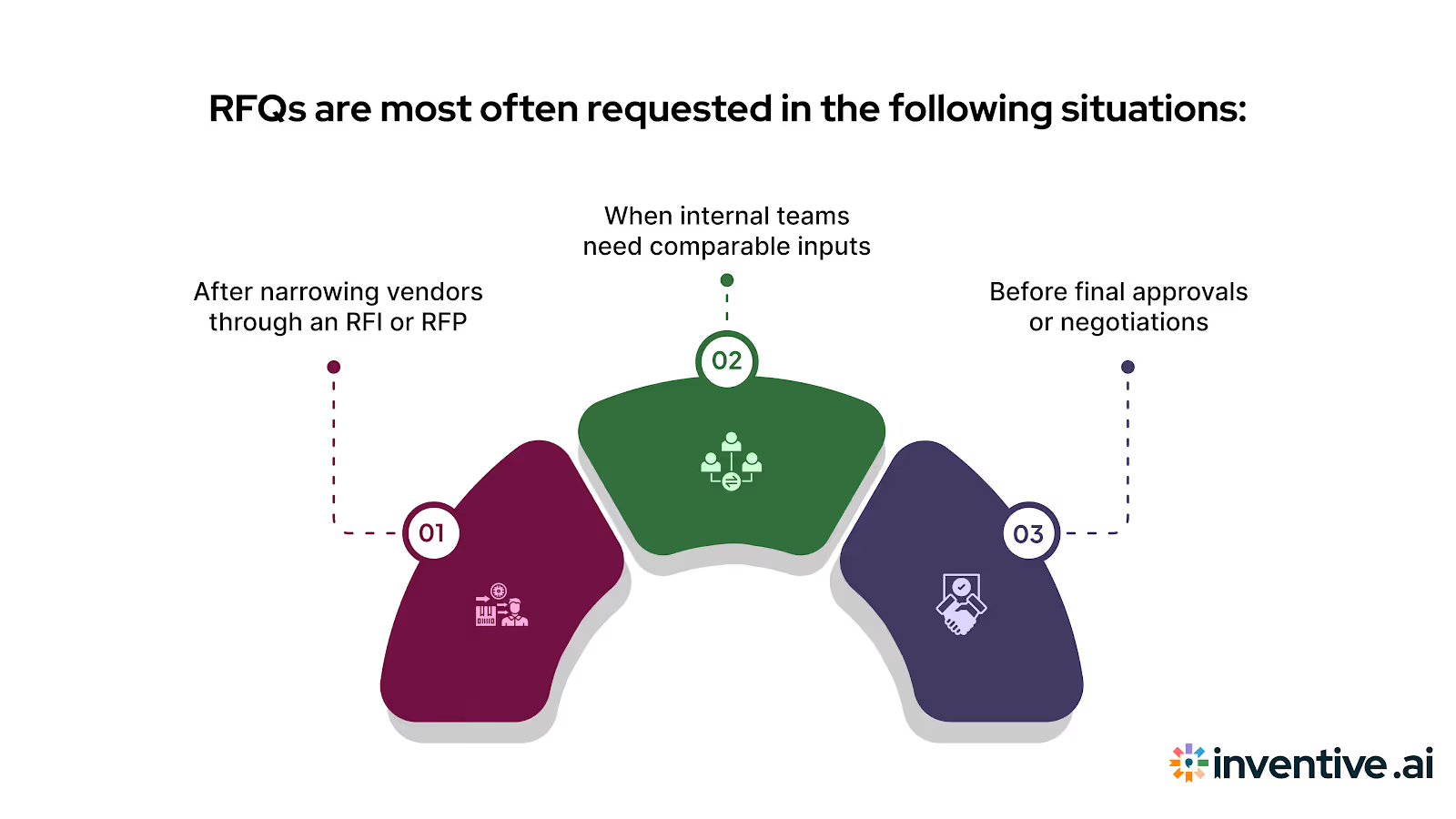
Most RFOs are sent in a few common situations:
- After narrowing vendors through an RFI or RFP
Buyers have shortlisted options and now want concrete offers. - When internal teams need comparable inputs
Procurement, finance, and leadership often require side-by-side offers to approve spend. - Before final approvals or negotiations
An RFO helps buyers confirm pricing, scope, and terms before moving forward.
At this stage, buyers are no longer gathering broad information. They are preparing to make a choice.
What an RFO usually signals to vendors?
When you receive an RFO, it often means:
- The buyer is reducing options, not expanding them.
- Internal stakeholders need clear, defensible details to move ahead.
- Pricing, delivery scope, and terms now carry more weight than positioning language.
The buyer is looking for clarity they can act on, not additional discovery.
For vendors, this is not the moment to introduce new ideas, reposition your solution, or expand scope. Doing so can create confusion or slow approvals.
Instead, buyers expect:
- Clear offers tied directly to stated requirements
- Explicit assumptions and exclusions
- Consistent language across pricing, delivery, and service terms
This context should guide how you structure your response and where you invest effort.
How to Respond to an RFO: A Step-by-Step Vendor Playbook
An RFO usually arrives when buyers are close to a decision. At this stage, speed matters, but accuracy matters more.
A structured approach helps you avoid pricing errors, misaligned terms, and last-minute rewrites.
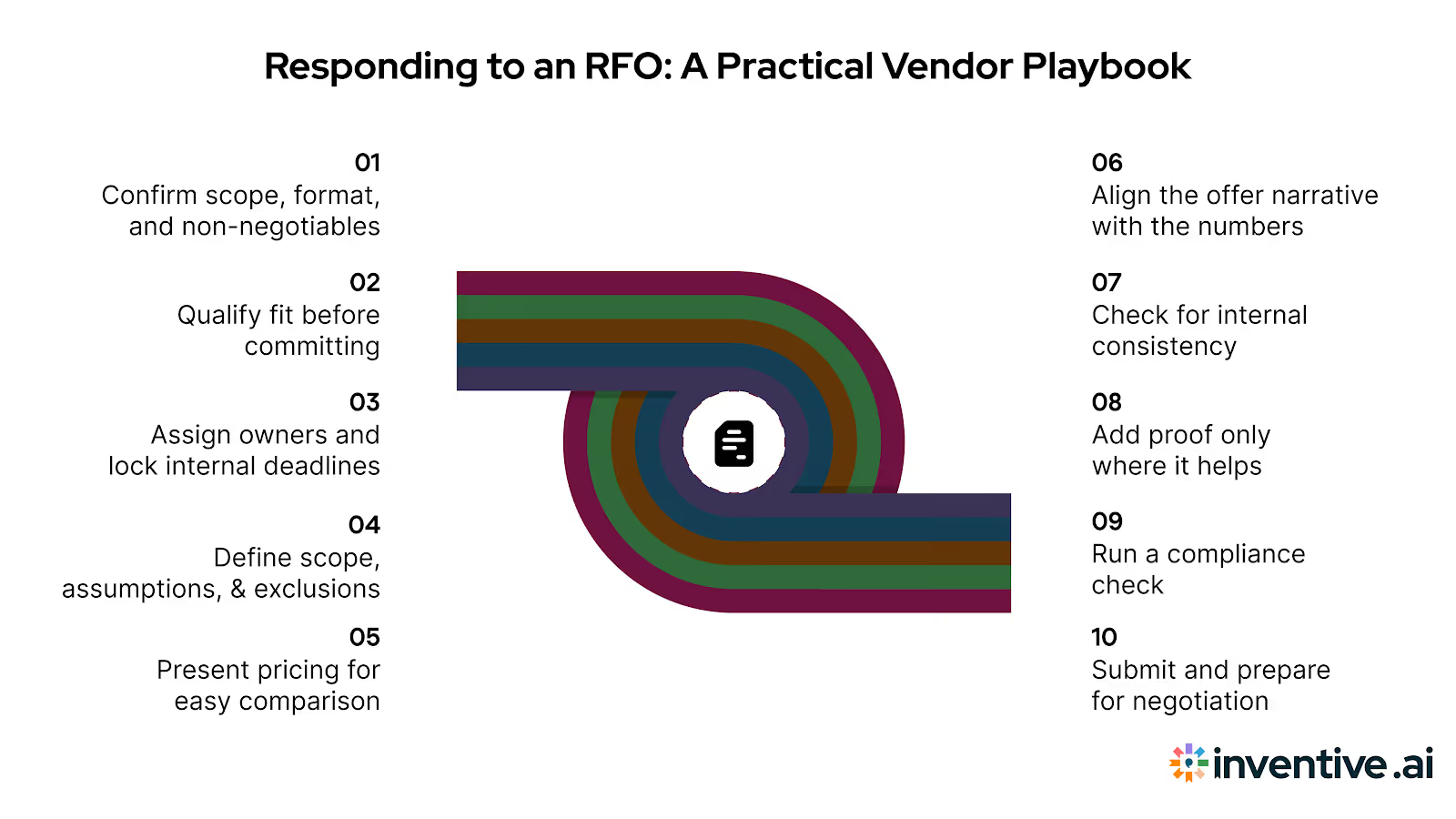
Step 1: Confirm scope, format, and non-negotiables
Start by understanding exactly what the buyer expects:
- Scope of work and deliverables
- Required pricing format
- Contract length, payment terms, and SLAs
- Submission rules and deadlines
- Mandatory requirements vs optional items
This prevents building an offer that looks good but fails basic requirements.
Step 2: Go/No-Go Decision
Even late-stage RFOs require a quick Go/No-Go decision to ensure you're fully aligned with the buyer's expectations and your capabilities:
- Can you meet the scope and timeline?
- Are there deal-breaker legal or pricing terms?
- Does the pricing model align with how you sell?
If the risk is high or there’s misalignment, it’s better to decide early and avoid moving forward with an unfeasible offer.
Step 3: Assign owners and lock internal deadlines
Define ownership clearly:
- Pricing and commercials
- Delivery and operations
- Legal and terms
- Final approval
- Single editor
Set internal deadlines earlier than the buyer’s deadline to allow real review time.
Step 4: Define scope, assumptions, and exclusions
Be explicit about:
- What’s included
- What’s excluded
- Dependencies on the buyer
- How changes affect cost or timeline
Clear assumptions reduce follow-up questions and protect the margin.
Step 5: Present pricing for easy comparison
Buyers issue RFOs to compare offers. Help them do that:
- Follow the buyer’s pricing template.
- Align line items with the scope.
- Separate optional costs.
- Show term-based pricing clearly.
Avoid bundling or unclear totals.
Step 6: Align the offer narrative with the numbers
Your narrative should explain:
- Delivery plan and milestones.
- Support model and SLAs.
- Governance and escalation.
Keep it factual and consistent with pricing and scope.
Step 7: Check for internal consistency
Before submission, confirm:
- Totals match line items.
- SLAs match support scope.
- Timelines align across sections.
- Terms reflect legal approval.
One inconsistency can delay approvals.
Step 8: Add proof only where it helps
Include proof selectively:
- One or two relevant customer examples.
- Outcomes tied to a similar scope.
Avoid adding material that doesn’t support the offer directly.
Step 9: Run a compliance check
You should confirm that:
- Every required question is answered.
- All required attachments are included.
- Formatting and submission rules are followed.
Many strong offers fail here.
Step 10: Submit and prepare for negotiation
After submission:
- Track buyer questions centrally.
- Know what can and cannot be adjusted.
- Be ready to justify assumptions and pricing.
RFOs often move directly into negotiation.
This process keeps RFO responses fast, accurate, and aligned, without unnecessary effort or last-minute fixes.
5 Challenges That Make RFO Responses Hard to Manage
Even experienced sales and proposal teams struggle with RFOs. The issue is rarely effort or expertise. It’s the breakdown that happens when tight timelines, multiple reviewers, and high deal value come together.
1. Pricing inputs are scattered across teams.
Sales, finance, and delivery often work from different assumptions. When pricing updates arrive late or without context, totals become harder to validate and last-minute corrections creep in.
2. Too many versions circulate at the same time.
RFO responses move fast, and multiple files get shared for review. Edits overlap, feedback conflicts, and proposal managers spend more time reconciling changes than improving response quality.
3. Terms and details don’t stay aligned across the document.
SLAs may not match the stated support scope. Delivery timelines can differ between sections. Legal terms may reflect older approvals. These inconsistencies slow buyer decisions and trigger follow-up questions.
4. Outdated language gets reused under deadline pressure.
Teams often pull content from previous offers. Assumptions change, tools evolve, and compliance language ages, but old wording slips through and weakens credibility.
5. Approvals stack up late in the process.
RFOs usually need sign-off from sales, finance, legal, and delivery. Reviews happen close to the deadline, feedback overlaps, and timelines compress when accuracy matters most.
These challenges show up when buyers are closest to making a decision, exactly when mistakes carry the highest risk.
Pro Tip: Keeping a single, approved source of commercial and delivery language reduces last-minute rewrites and review loops.
When vendors face these challenges, they often reach a turning point. To respond faster without lowering accuracy, teams need a better way to manage RFO responses.
That shift often starts with AI-powered RFP response tools like Inventive AI, built specifically for vendor workflows.
Here’s how Inventive AI makes that difference.
How Inventive AI Helps You Respond Faster Without Losing Control?
Inventive AI’s AI RFP Agent is designed to simplify your RFP response process, including late-stage requests like RFOs, where accuracy and speed both carry real deal risk.
Instead of replacing human judgment, Inventive AI supports the way proposal, sales, and revenue teams already work, by removing manual friction and tightening response quality.
Here’s how that plays out in practice.
1. Response quality improves without adding review cycles.
RFOs demand precise language, consistent terms, and clear assumptions. Inventive AI builds responses using approved, verified content rather than drafting from scratch.
This helps teams deliver answers that are clearer, more consistent, and easier for buyers to evaluate.
Over time, this leads to a noticeable improvement in proposal quality, often 2x better response quality, without increasing review time.
2. Context stays intact across long, complex offers
RFOs often span pricing, delivery, support, and legal sections that reference each other. Inventive AI’s context engine understands how answers connect across the document.
This helps maintain consistent terminology, timelines, and service descriptions, reducing the need for manual cross-checking late in the process.
3. Conflicts are caught before they reach the buyer
Inconsistent SLAs, mismatched timelines, or conflicting assumptions can slow approvals. Inventive AI detects conflicts across sections early, giving proposal managers a chance to correct issues before submission, when fixes are faster and less disruptive.
4. Outdated language is flagged automatically
As pricing models, tooling, and delivery processes change, older content can quietly introduce risk. Inventive AI identifies responses that rely on outdated language or assumptions, helping teams keep offers aligned with current operations and approved standards.
5. Response quality is benchmarked, not guessed
Not all answers perform equally well. Inventive AI benchmarks responses against high-performing submissions, giving teams visibility into where clarity, structure, or detail can be improved. This helps CROs and proposal leaders raise consistency across deals, not just individual responses.
6. Offers read like a single, coherent proposal
RFO reviewers often struggle with fragmented answers pulled from multiple sources. Inventive AI generates narrative-style proposals that flow logically across sections, making it easier for buyers to understand how your offer comes together and why it’s dependable.
With AI-powered RFP response software, teams using Inventive AI respond 10x faster, maintain 95% accuracy with 0% hallucinations, and improve win rates by up to 50%, while proposal managers retain full control over final submissions.
Frequently Asked Questions (FAQs)
1. What is the difference between an RFO and an RFQ?
An RFO (Request for Offer) focuses on receiving detailed offers, including pricing, terms, and delivery details, from shortlisted vendors. On the other hand, an RFQ (Request for Quotation) is strictly about obtaining pricing for a fixed set of requirements, leaving little room for customization or negotiation.
2. Why are RFO responses so time-sensitive?
RFO responses are typically sent when buyers are close to making a decision, making speed and accuracy crucial. With a narrow window to respond, any delays in the proposal process can lead to missed opportunities or hinder internal approvals, which can slow down the deal closure.
3. How can AI-powered tools like Inventive AI speed up the RFO response process?
AI tools like Inventive AI automate the creation of RFO responses, reducing the time needed to draft proposals. By detecting outdated content, maintaining consistency across responses, and flagging conflicts early, AI ensures a faster, more efficient response without sacrificing accuracy.
4. What role does context play in RFO responses?
In RFO responses, maintaining context is important for clarity and alignment across various sections, such as pricing, delivery, and terms. Inventive AI ensures that all elements of the proposal are contextually aligned, helping vendors avoid discrepancies and ensuring the buyer receives a cohesive and comprehensive offer.
5. Can RFO responses be customized to meet different buyers' needs?
Yes, Inventive AI enables vendors to easily customize their RFO responses to meet specific buyer requirements. The platform’s context engine tailors responses based on buyer needs and ensures the proposal is both relevant and personalized, improving the chances of winning the deal.