
RFP for Business Intelligence Tool: Free Templates & Examples

Unlike most enterprise software, BI tools must integrate with multiple data sources, support evolving reporting needs, and scale across teams with different analytics capabilities. Choosing the wrong platform can create long-term reporting limitations and costly re-implementation efforts.
For buyers, unclear analytics requirements make it difficult to compare vendor proposals. For vendors, incomplete RFPs make it difficult to estimate integration scope, implementation timelines, and licensing models.
When an RFP for a business intelligence tool leaves these operational details undefined, vendors respond based on different assumptions about the analytics environment. This guide provides a structured BI RFP template for buyers and a proposal template for vendors to align on the same requirements and evaluation criteria.
Prepare Your Organization for a BI Tool RFP + Use This Template (for Buyers)
Business intelligence deployments involve multiple data sources, reporting workflows, user roles, and governance requirements.
Before issuing an RFP for a business intelligence tool, organizations should clarify their analytics objectives, identify the right vendors, and define how proposals will be evaluated.
Follow the steps below to prepare your organization and structure your BI RFP effectively.
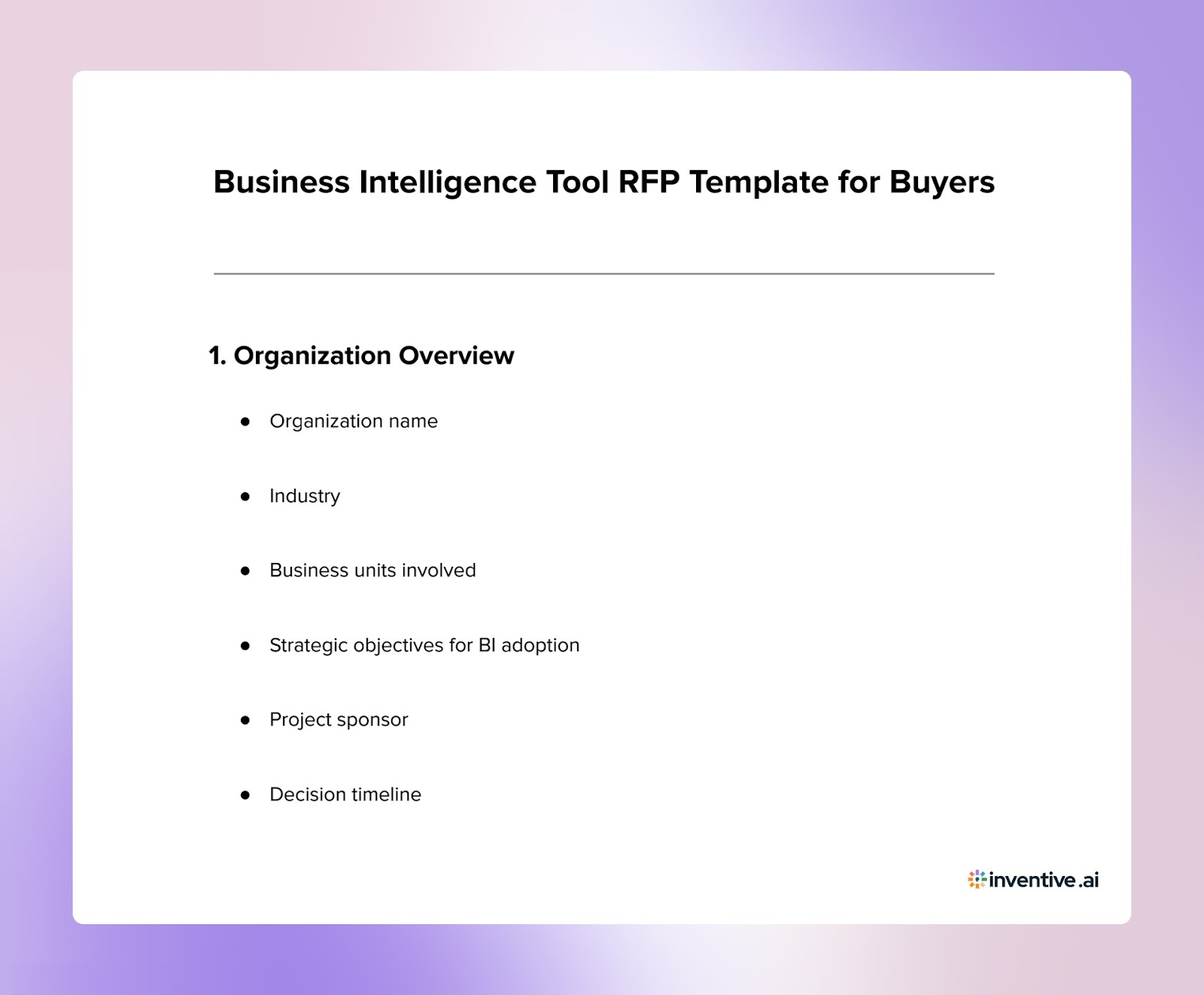

1. Shortlist the Right BI Vendors
Before starting your RFP, create a shortlist of vendors that align with your analytics requirements. Most RFP processes work best with three to five qualified vendors rather than evaluating the entire market.
Shortlisting typically involves:
- Reviewing analyst reports and customer reviews
- Evaluating product documentation and case studies
- Scheduling product demonstrations
- Assessing vendor experience with similar data environments
Early research ensures your RFP reaches vendors capable of supporting your analytics goals.
2. Align Internal Stakeholders
BI platforms impact multiple teams across the organization. Aligning stakeholders before issuing the RFP prevents conflicting requirements during vendor evaluation.
Teams typically involved include:
- Data and analytics teams
- IT and data engineering
- Finance and operations leaders
- Procurement teams
- Digital transformation or enterprise strategy groups
Internal alignment ensures the RFP reflects both technical data requirements and business reporting needs.
3. Define Vendor Evaluation Criteria
Establishing evaluation criteria early makes it easier to compare vendor proposals once responses arrive.
Common BI RFP evaluation criteria include:
- Data integration capabilities across systems
- Dashboard and reporting functionality
- Deployment model (cloud, hybrid, or on-premise)
- Implementation effort and vendor support requirements
- Total cost of ownership and licensing model
- Product roadmap and long-term platform vision
4. Provide Vendors With Context About Your Analytics Environment
Vendors deliver stronger proposals when they understand your data environment and reporting goals.
Information typically included in BI RFPs:
5. Define Clear Proposal Instructions
Provide vendors with clear instructions for submitting their responses. This ensures consistency across proposals and simplifies evaluation.
Typical instructions include:
- Proposal submission deadline
- Preferred response format (document or spreadsheet)
- Word limits for narrative responses
- Required attachments such as security documentation or case studies
If you are responding to a business intelligence tool RFP as a vendor, use the proposal template in the next section to structure your response.
BI Proposal Template to Structure Competitive RFP Responses (for Vendors)
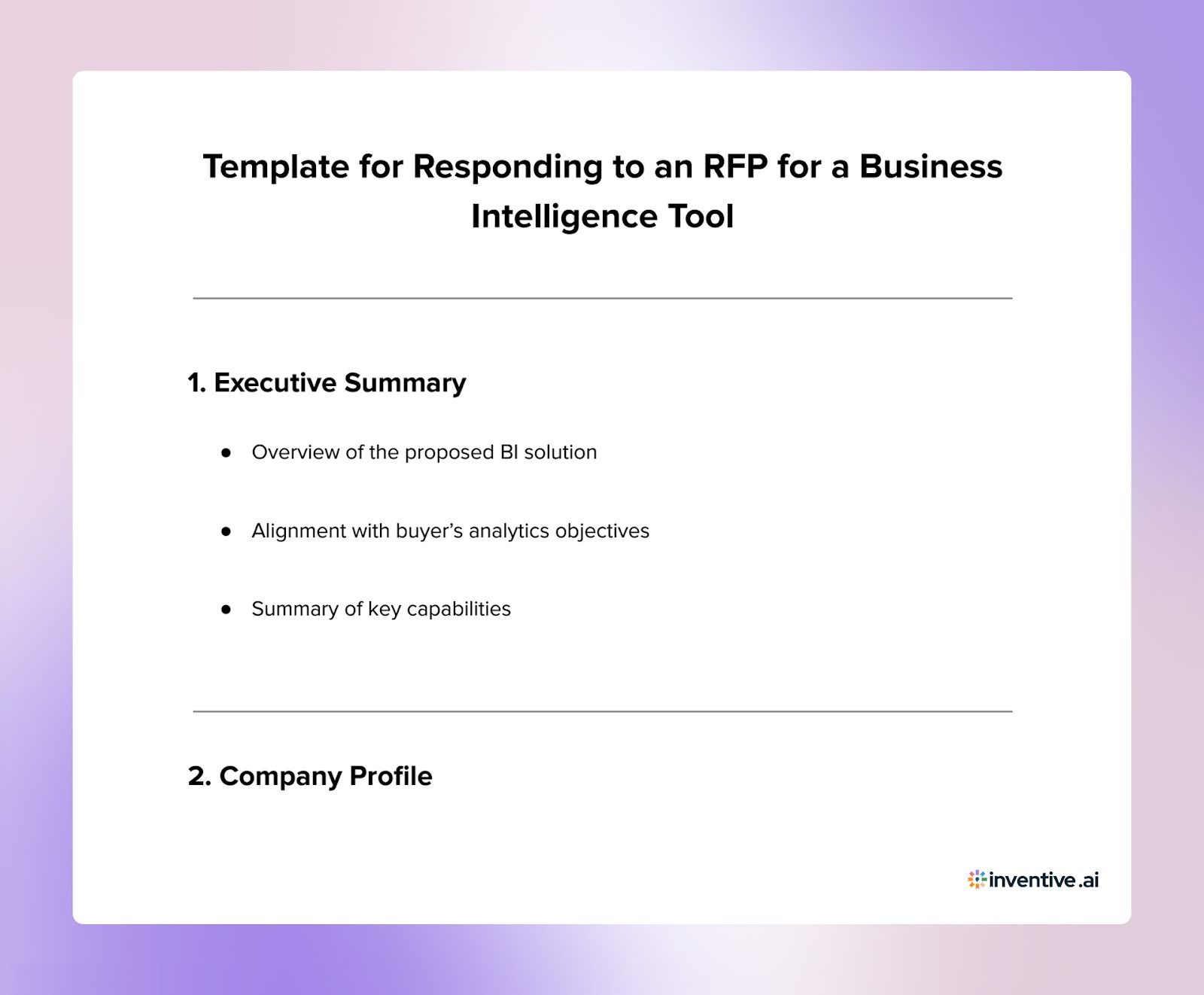
A BI proposal must explain how your platform will support the buyer’s data environment, reporting requirements, and analytics goals. Procurement teams evaluate proposals based on integration capability, implementation approach, platform scalability, and pricing models before selecting a business intelligence vendor.

Each section below outlines the information vendors should include when responding to an RFP for a business intelligence tool.
1. Executive Summary
This section confirms your understanding of the buyer’s analytics objectives and summarizes how your BI platform will support their reporting and data integration needs.
Example: We propose implementing a cloud-based business intelligence platform that integrates with your existing data warehouse, CRM, and marketing systems to support executive dashboards and self-service analytics across finance, operations, and marketing teams.
2. Company Profile and BI Platform Overview
Buyers evaluate vendor experience and platform maturity before awarding BI contracts. Provide details about your company, product capabilities, and experience delivering analytics solutions.
Example: Founded in 2015, our company provides enterprise BI solutions used by over 400 organizations across retail, healthcare, and financial services. Our platform supports large-scale analytics deployments with role-based dashboards, advanced data modeling, and secure data governance controls.
3. Understanding of Analytics Requirements
Restate the buyer’s analytics objectives and reporting needs to confirm your understanding of the RFP scope.
Example: Your organization requires centralized reporting across finance, sales, and operations teams, with approximately 120 active BI users and daily dashboard updates sourced from your Snowflake data warehouse and Salesforce CRM environment.
4. Data Integration and Architecture Approach
Explain how your BI platform will connect to the buyer’s data systems and support their analytics architecture.
Example: Our platform integrates directly with modern cloud data warehouses, including Snowflake, BigQuery, and Redshift. Data pipelines will be configured to refresh reporting datasets every two hours to support near real-time operational dashboards.
5. Dashboard and Reporting Strategy
Describe how dashboards, reports, and analytics workflows will be designed for different user groups.
Example: Executive dashboards will provide high-level performance metrics, while analyst workspaces will support deeper data exploration and ad-hoc analysis using drag-and-drop query tools.
6. Implementation and Deployment Plan
Outline the implementation timeline and major deployment phases.
Example: Implementation will follow a three-phase rollout: initial data integration and modeling, dashboard development for priority teams, and enterprise-wide rollout with user training and governance policies.
7. Security and Governance Controls
Buyers expect BI platforms to enforce strict data governance and security standards. Describe your approach to role-based access control, audit logging, and compliance.
Example: Our platform includes role-based access controls, row-level data security, and activity logging to ensure sensitive data remains accessible only to authorized users.
8. Pricing Structure
Provide pricing aligned with the structure requested in the RFP.
Example:
- BI platform license: $45 per user per month
- Enterprise admin license: $120 per month
- Implementation services: $45,000 one-time setup
- Annual support and maintenance: 15% of the license cost
9. Customer References and Comparable BI Deployments
Provide examples of similar analytics implementations.
Example:
- RetailCo – Chicago, IL
Implemented enterprise dashboards across finance, marketing, and operations teams.
120 BI users onboarded across departments.
Average dashboard load time: under three seconds.
A structured proposal allows buyers to evaluate platform capability, data integration strategy, and pricing models consistently across vendors.
Choose the Right Proposal Template for Your Business Intelligence RFP (for Vendors)
Organizations issue RFPs for business intelligence tools for a range of reasons, from replacing legacy reporting platforms to building analytics on modern cloud data stacks. Each scenario comes with different technical requirements, data environments, and evaluation priorities.
Because of this, vendors should structure their responses differently depending on the type of BI project the buyer is pursuing. Below are common BI RFP scenarios and proposal templates vendors can use to customize their responses.
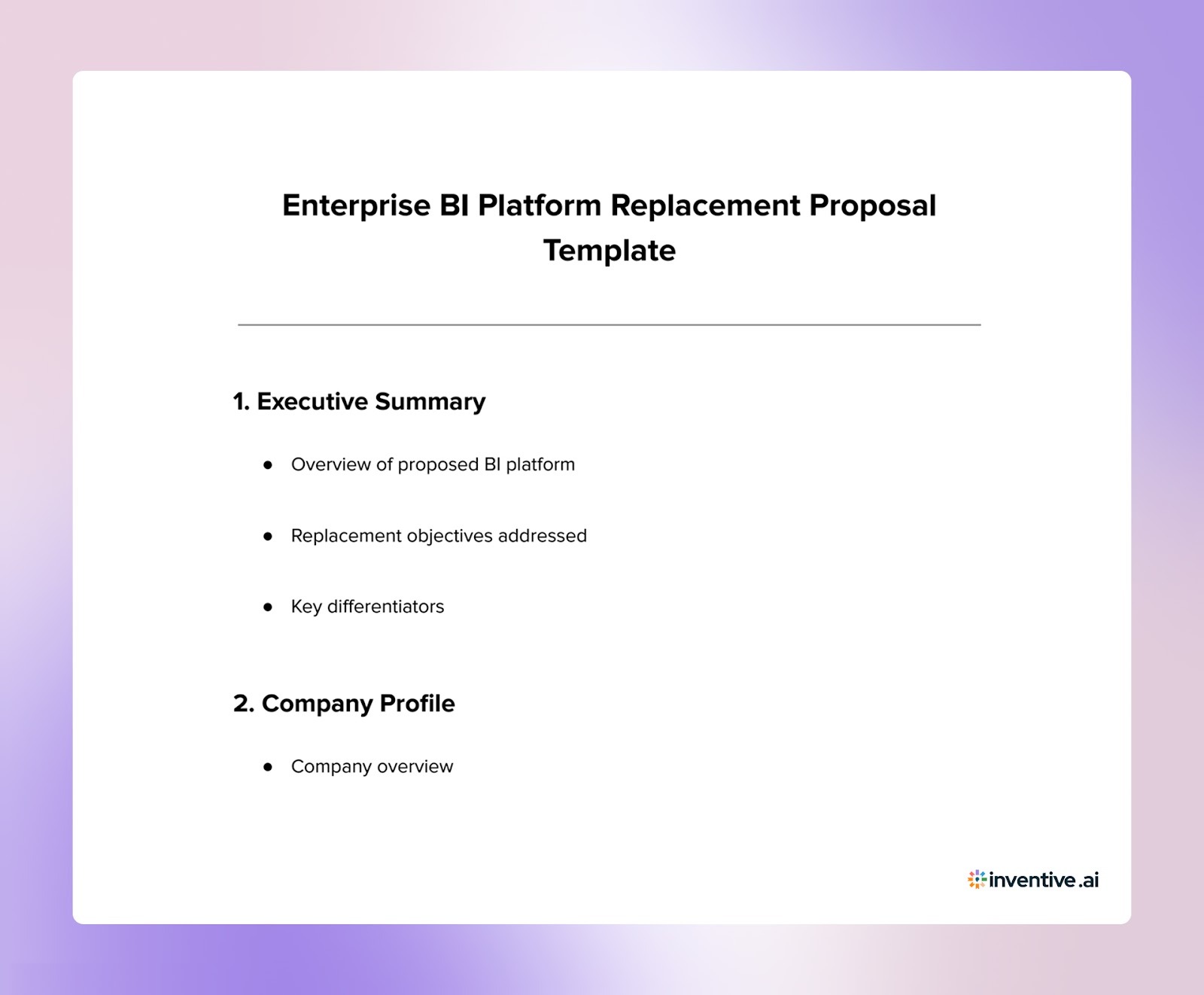
1. Enterprise BI Platform Replacement Proposal
Vendors responding to these RFPs must explain how their platform supports dashboard migration, enterprise governance, and large-scale user adoption. Buyers evaluating these proposals typically focus on platform scalability, implementation effort, and long-term analytics flexibility.

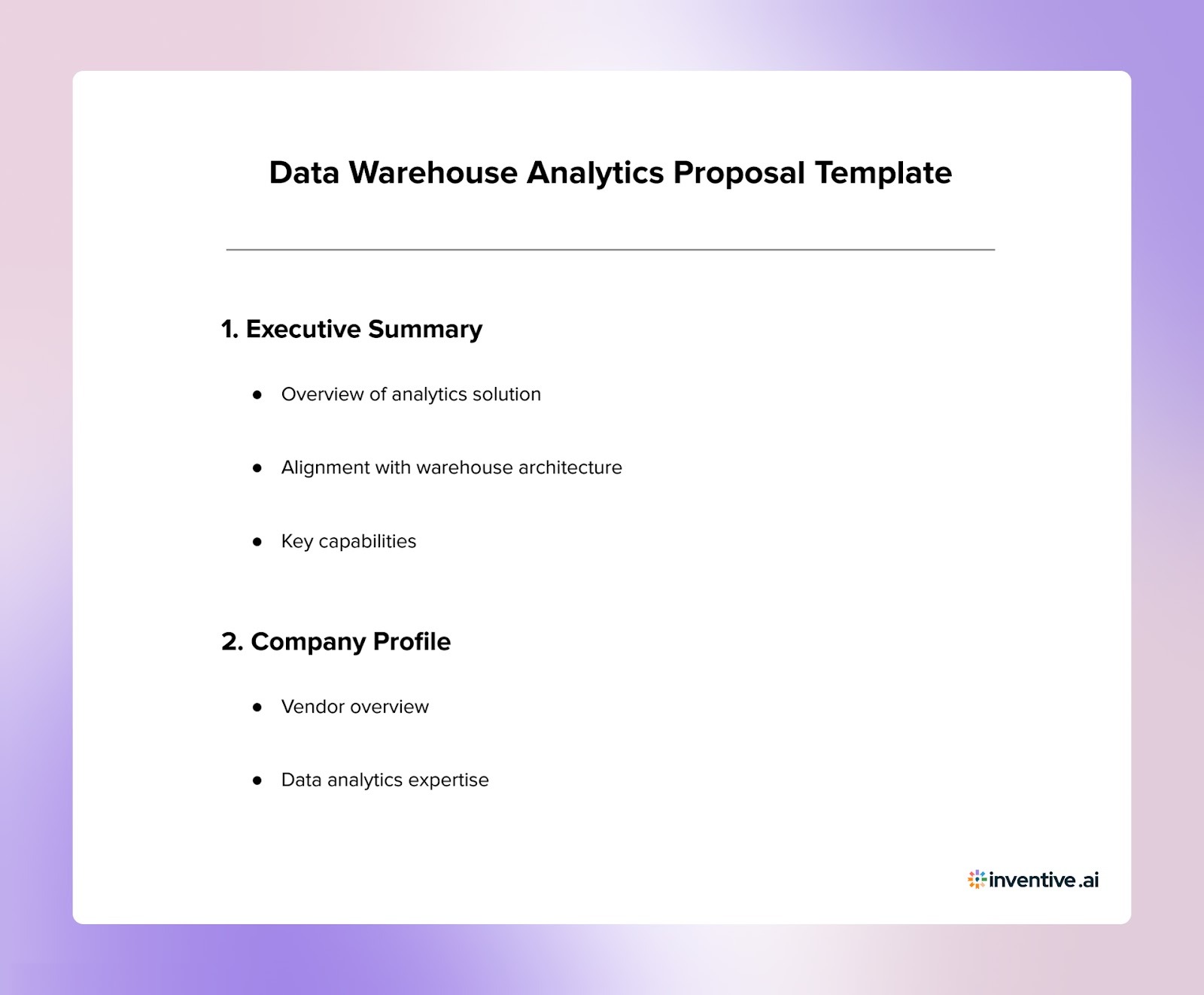
2. Data Warehouse Analytics Proposal
Vendors responding to these RFPs should emphasize integration capabilities with cloud data warehouses, query performance on large datasets, and support for real-time or near-real-time reporting. Buyers typically evaluate how efficiently the platform connects to existing data infrastructure.

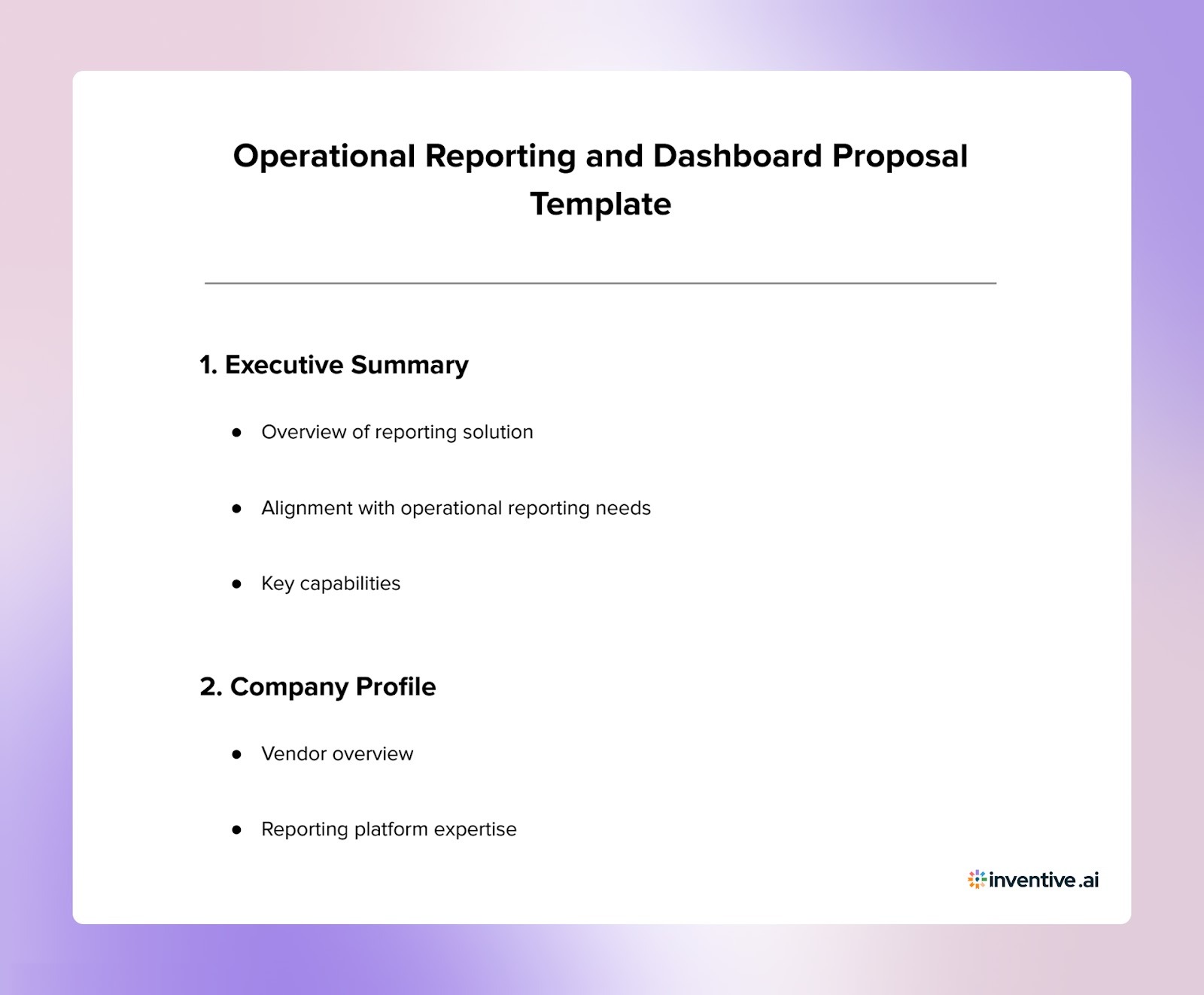
3. Operational Reporting and Dashboard Proposal
If you're responding to these RFPs, you should focus on dashboard usability, automated reporting workflows, and governance controls that maintain consistent metrics across departments. Buyers evaluating these proposals often prioritize ease of use and reporting flexibility.

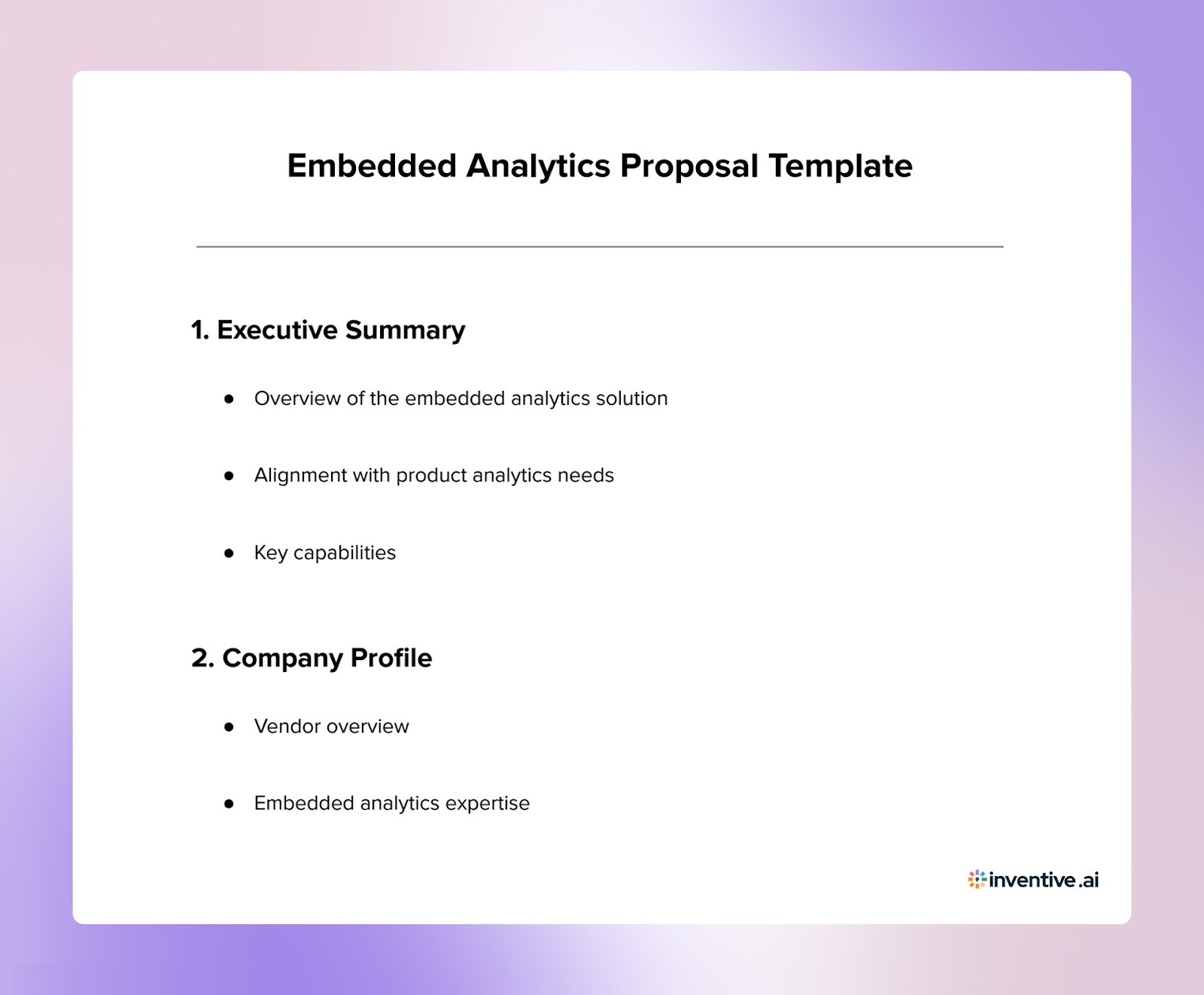
4. Embedded Analytics Proposal
Rhese RFPs should highlight API capabilities, embedded dashboard functionality, and multi-tenant data architectures. Buyers evaluating these proposals often prioritize scalability, customization, and performance for external users.

Create High-Quality BI RFP Responses Faster with Inventive AI
Inventive AI is an AI-powered RFP response software built for vendor proposal teams. Instead of assembling responses manually, teams generate structured answers aligned with the buyer’s analytics requirements and evaluation criteria.
Below are the key capabilities that improve BI RFP responses.
1. Context Engine
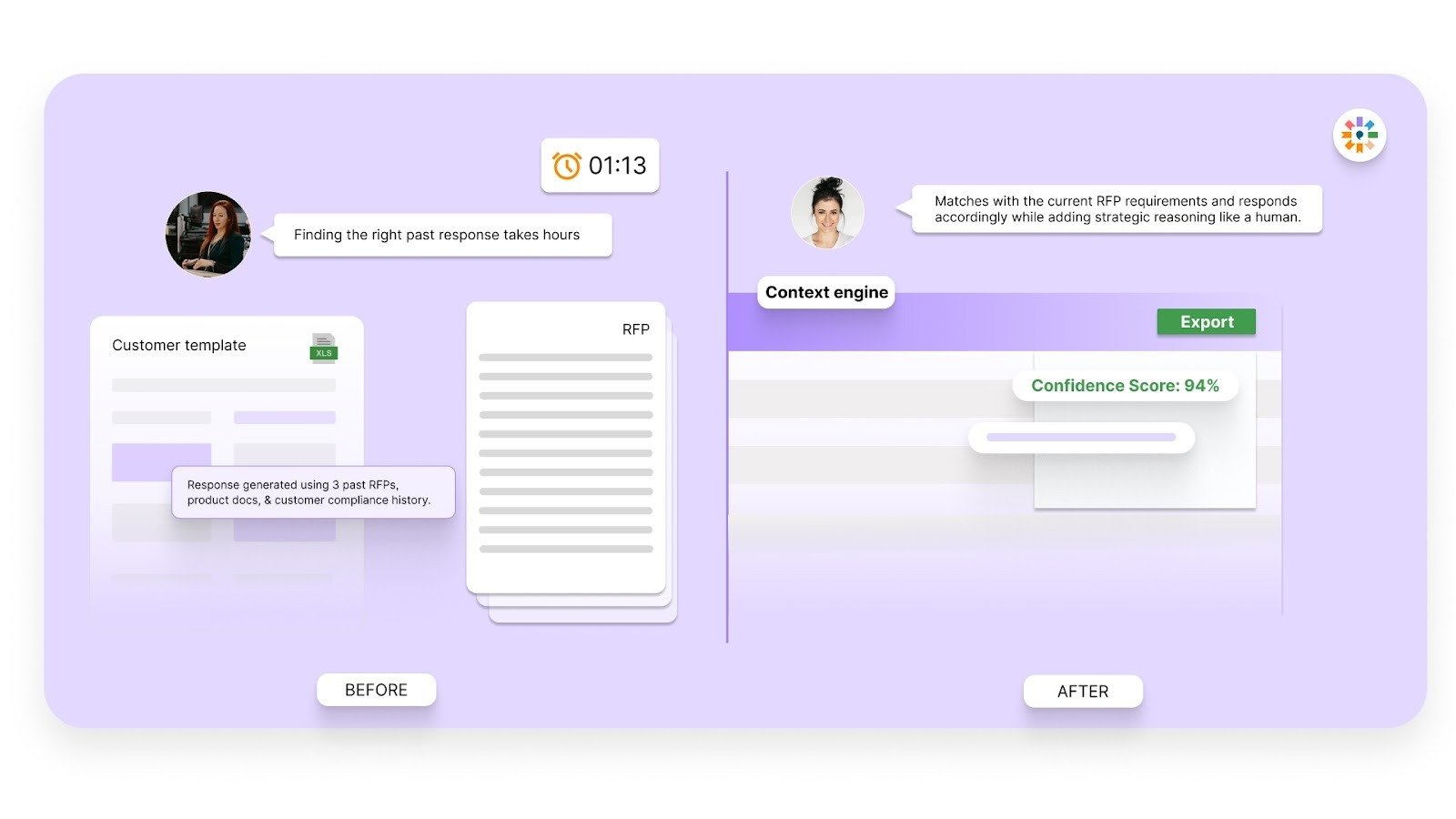
Many proposal tools rely on keyword search to retrieve previous answers, which often produces generic responses that do not reflect the buyer’s analytics environment.
Inventive AI analyzes the entire RFP, including data architecture requirements, reporting objectives, integration needs, and deployment constraints. This allows the platform to generate responses aligned with the buyer’s BI implementation goals instead of generic product descriptions.
2. Conflict Detection
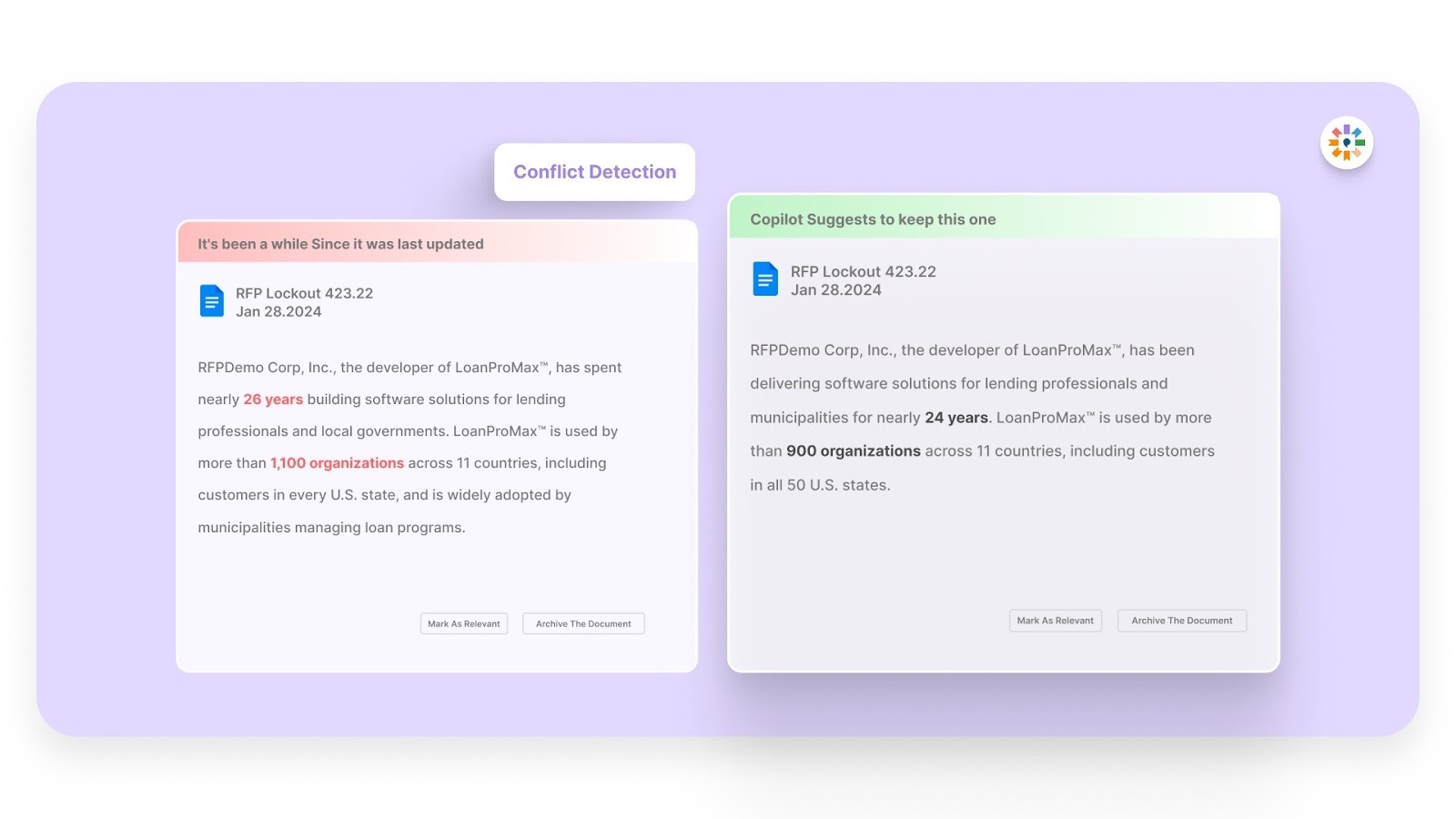
BI proposals often contain overlapping sections covering platform architecture, data integrations, implementation timelines, and governance policies. When responses are written manually, contradictions can appear across different sections.
Inventive AI automatically detects conflicting information before submission, ensuring responses remain consistent throughout the proposal.
3. Outdated Content Detection
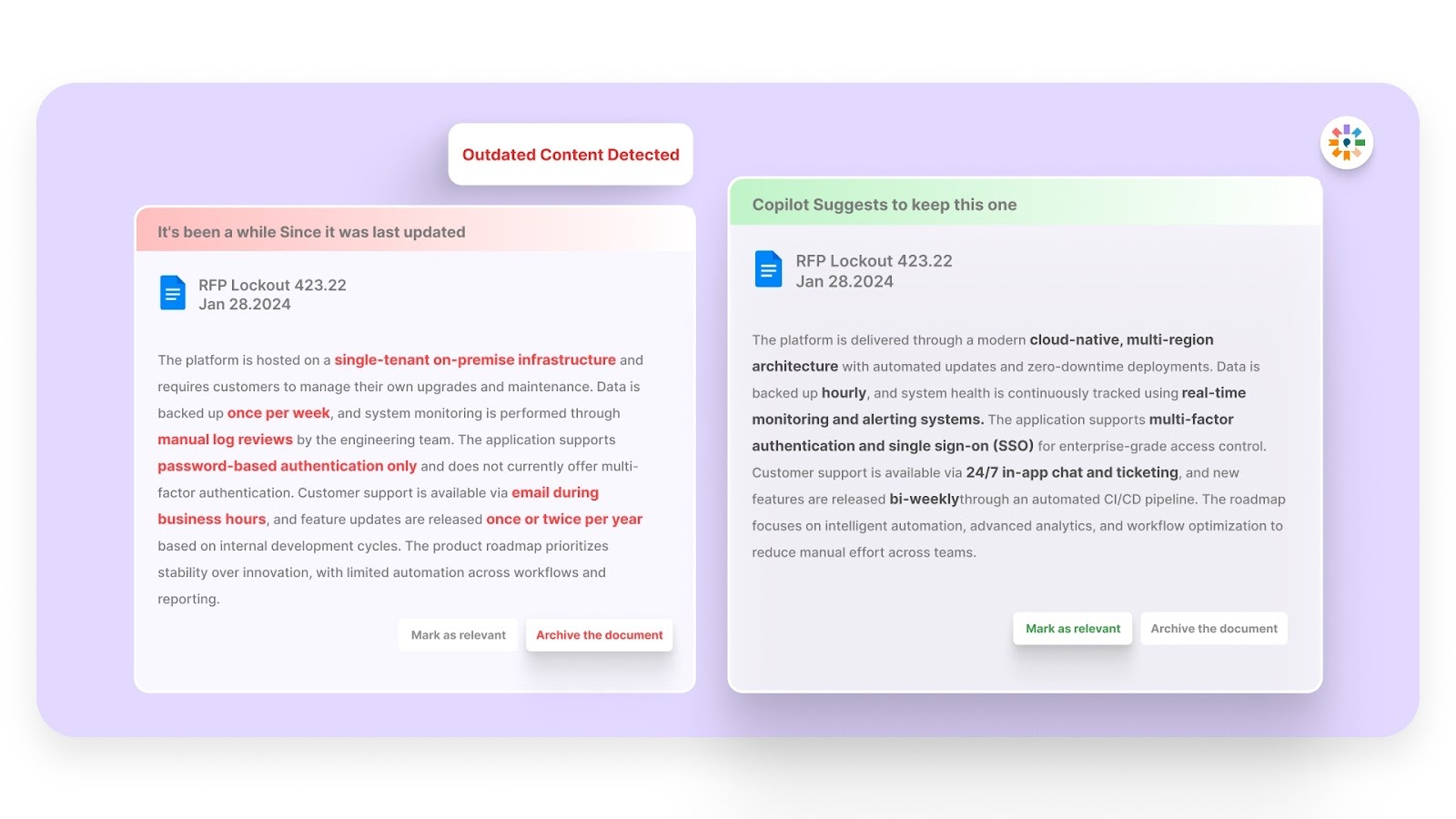
Proposal libraries frequently contain older responses referencing outdated product features, legacy integrations, or previous security documentation.
Inventive AI flags outdated content before it appears in the proposal, ensuring responses reflect the vendor’s current BI platform capabilities and documentation.
4. 2X Higher Quality Proposal Responses
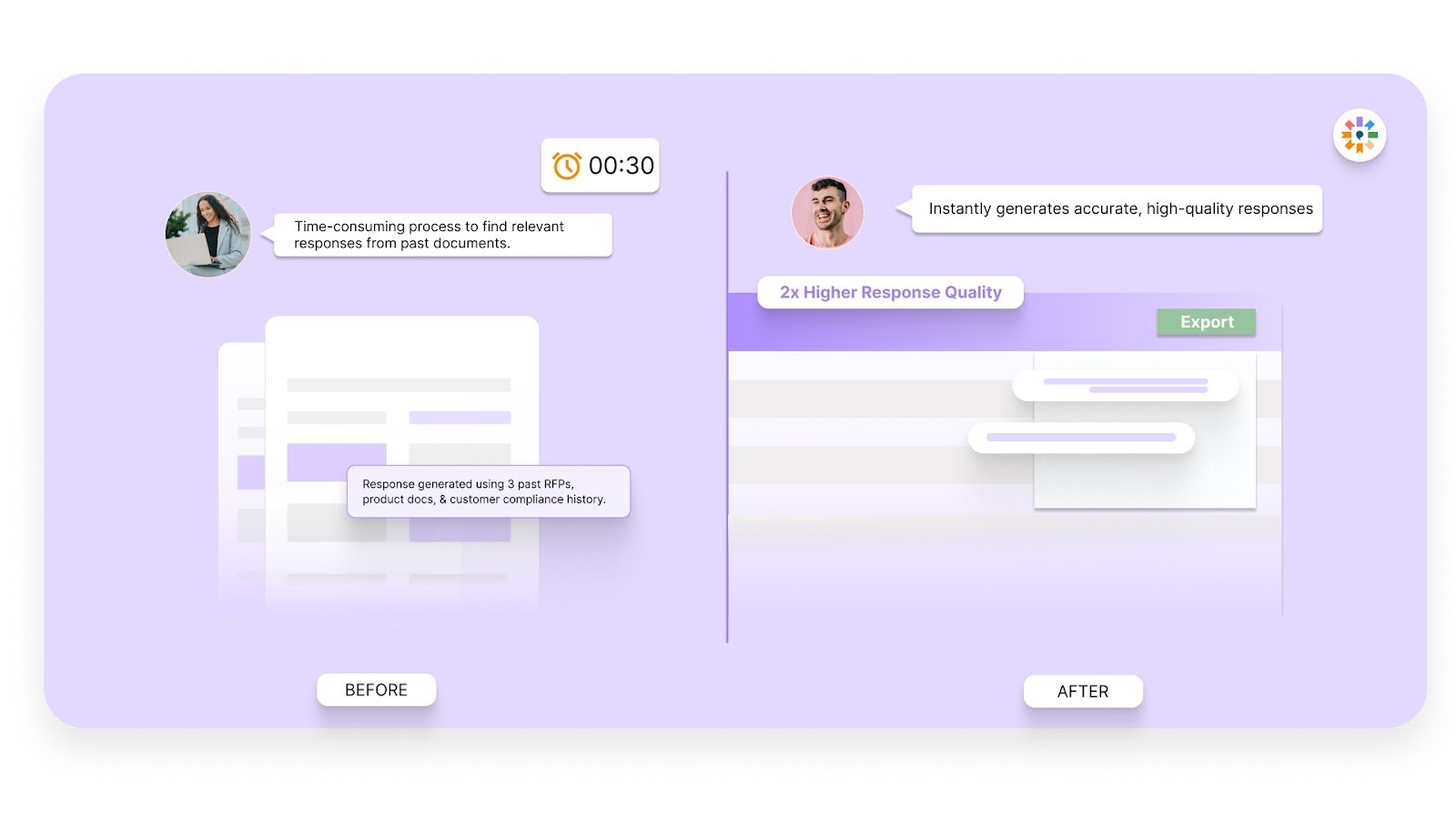
Inventive AI’s multi-agent system generates responses with greater clarity and completeness. The platform analyzes buyer requirements and produces answers that directly address data architecture, analytics workflows, and implementation plans.
This improves proposal quality and helps vendors present stronger BI solutions during evaluation.
5. Narrative Proposal Generation
Many BI RFPs require narrative explanations describing platform capabilities, data integration strategies, and implementation approaches.
Inventive AI generates structured narrative responses that clearly explain how the BI platform will support the buyer’s analytics objectives and reporting workflows.
6. Simple and Easy-to-Use Interface
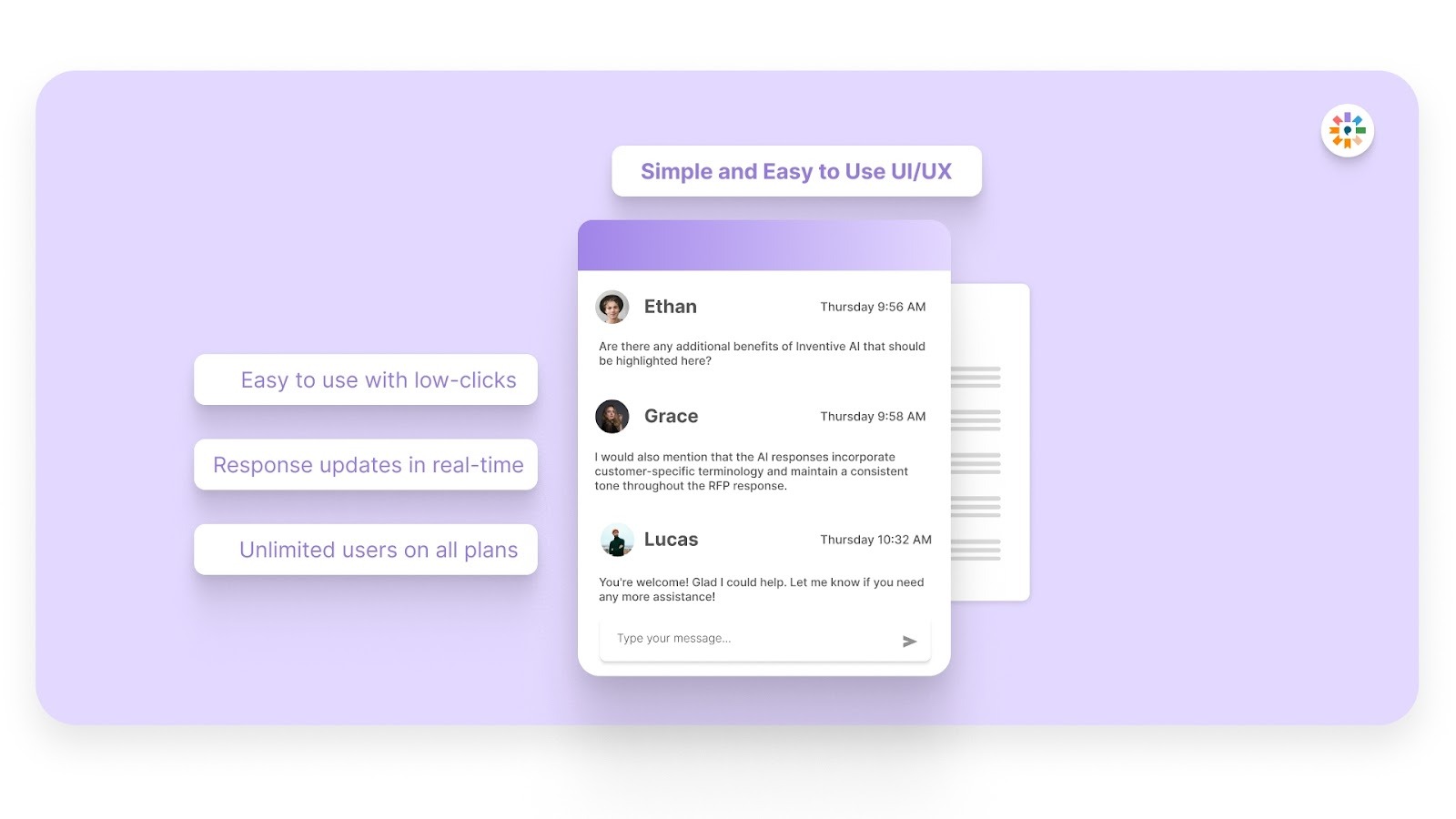
Proposal teams often work under tight deadlines while coordinating with product teams, solution architects, and sales leaders.
Inventive AI provides a simple interface that allows teams to generate structured BI RFP responses quickly without complex setup or training.
FAQs About RFP for Business Intelligence Tool
1. How long does the BI RFP process usually take?
The timeline for evaluating a business intelligence platform typically ranges from 6 to 12 weeks, depending on the complexity of the organization’s data environment. The process usually includes vendor shortlisting, proposal submission, technical evaluation, product demonstrations, and final contract negotiations.
2. What is the difference between an RFP and an RFI for BI tools?
An RFI (Request for Information) is usually issued early in the procurement process to gather general information about available BI platforms and vendor capabilities. An RFP (Request for Proposal) is more detailed and is used when buyers are ready to evaluate specific solutions, pricing structures, and implementation approaches.
3. Should organizations run a proof of concept before selecting a BI vendor?
Many organizations conduct a proof of concept (POC) after evaluating initial RFP responses. A POC allows vendors to demonstrate how their BI platform works with real data sources, dashboards, and reporting requirements before a final decision is made.
4. How many vendors should be invited to a BI RFP?
Most procurement teams invite three to five vendors to participate in an RFP process. Inviting too many vendors increases evaluation complexity, while inviting too few may limit the range of potential solutions available for comparison.
5. What mistakes should vendors avoid when responding to BI RFPs?
Common mistakes include submitting generic product descriptions, failing to address the buyer’s specific data architecture, and providing inconsistent information across proposal sections. Vendors improve their chances of success when responses clearly explain how their platform supports the buyer’s analytics environment and implementation goals.

90% Faster RFPs. 50% More Wins. Watch a 2-Minute Demo.

Gaurav Nemade
After witnessing the gap between generic AI models and the high precision required for business proposals, Gaurav co-founded Inventive AI to bring true intelligence to the RFP process. An IIT Roorkee graduate with deep expertise in building Large Language Models (LLMs), he focuses on ensuring product teams spend less time on repetitive technical questionnaires and more time on innovation.
.avif)
Mukund Kumar
Understanding that sales leaders struggle to cut through the hype of generic AI, Mukund focuses on connecting enterprises with the specialized RFP automation they actually need at Inventive AI. An IIT Jodhpur graduate with 3+ years in growth marketing, he uses data-driven strategies to help teams discover the solution to their proposal headaches and scale their revenue operations.