Software Proposal Template for RFPs and Software Projects
Writing a software proposal from scratch is time-consuming, especially when every deal, client, or RFP requires a structured, professional document. To simplify this process, we’ve created a complete software proposal template that you can copy, customize, and reuse for different software projects.
This template is designed for software vendors, SaaS companies, and development teams proposing custom software solutions, software development projects, or system implementations.
Software Proposal Template to Accelerate Sales and RFP Efficiency
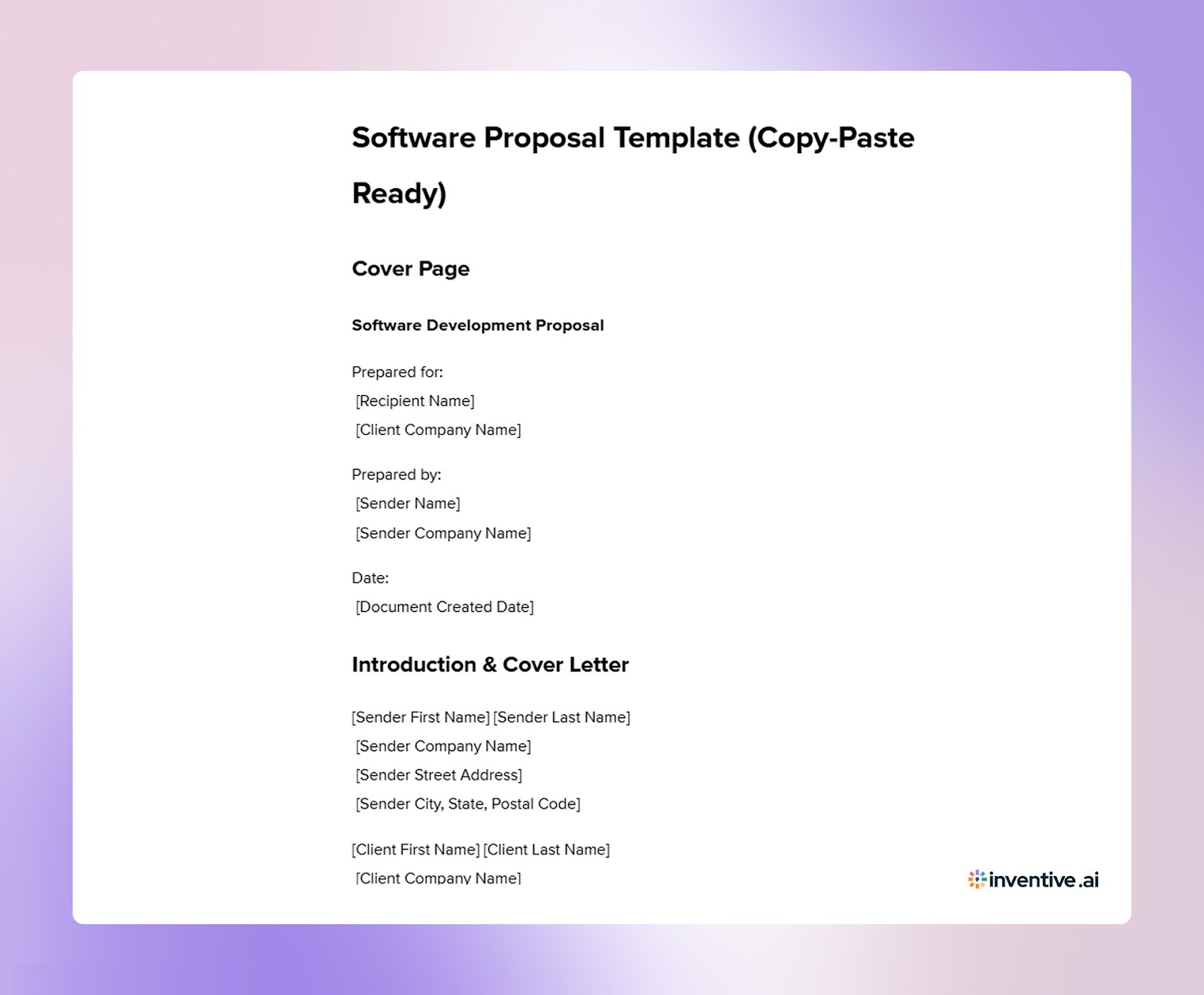
Each section below contains ready-to-use text. Simply replace the placeholders with your project details, client information, and timelines. Sections can be removed, expanded, or reordered depending on your specific requirements.
1. Cover Page
Software Development Proposal
Prepared for:
[Recipient Name]
[Client Company Name]
Prepared by:
[Sender Name]
[Sender Company Name]
Date:
[Document Created Date]
2. Introduction & Cover Letter
[Sender First Name] [Sender Last Name]
[Sender Company Name]
[Sender Street Address]
[Sender City, State, Postal Code]
[Client First Name] [Client Last Name]
[Client Company Name]
[Client Street Address]
[Client City, State, Postal Code]
Dear [Mr./Ms. Client Last Name],
Thank you for meeting with us to discuss your software project requirements. Attached is our detailed software proposal for your review and approval.
At [Sender Company Name], we understand that creating effective, client-focused software requires a balance of technical expertise and clear communication. We recognize that every organization has unique needs, and we strive to deliver innovative, affordable, and tailored software solutions while ensuring projects are completed on time and within budget.
We bring more than [X years] of experience in software development and have previously worked with clients such as:
- [Previous Client 1]
- [Previous Client 2]
- [Previous Client 3]
You may contact these organizations for references, or learn more about our work by visiting [Sender Website], where you can review our portfolio and learn about our team.
We also take pride in our post-delivery support, including training, guarantees, and both on-site and off-site assistance.
Thank you for taking the time to review this proposal. We look forward to the opportunity to collaborate with you.
Yours sincerely,
[Sender First Name] [Sender Last Name]
[Sender Company Name]
Signature: ___________________________
3. Executive Summary
This proposal presents a software solution designed to address the challenges and objectives of [Client Company Name].
Technology plays a critical role in solving complex business problems. Organizations that invest in tailored software solutions gain a competitive advantage by aligning technology with their operational and strategic goals.
To support [Client Company Name] in achieving [Client Mission Statement], we propose the following:
Create
We will design and build [main focus of the proposal] following a structured preparation and planning phase. The solution will address:
- [Client Problem 1]
- [Client Problem 2]
- [Client Problem 3]
The resulting software will aim to achieve:
- [Goal 1]
- [Goal 2]
- [Goal 3]
Develop
Through regular communication and collaboration with your team, we will develop the necessary tools, features, and systems required to support your business objectives while accounting for industry trends and operational needs.
Integrate
We will work closely with your internal teams and partners to integrate the proposed solution with required systems, platforms, or third-party tools.
4. Client Needs & Goals
Based on our preliminary discussions and assessments, we understand that [Client Company Name] is currently facing the following challenges:
- [Description of a specific challenge or need]
- [Description of another challenge or need]
- [Additional challenge or need]
5. Project Goals
Based on our conversations, the primary goals for this software project include:
Immediate Goals
[Describe immediate objectives]
Short-Term Goals
[Describe short-term objectives]
Long-Term Goals
[Describe long-term objectives]
6. Project Overview
At [Sender Company Name], our mission is [mission statement]. In alignment with this approach, we propose the development of [subject of proposal] for [Client Company Name].
This software solution will:
- [Describe the primary purpose of the product]
- [Describe an additional benefit]
- [Describe another benefit]
7. Hardware and Software Technology Requirements
To deliver the proposed solution, the following requirements have been identified.
Operating System:
[Required operating system]
Programming Language(s):
[Language name]
Hardware Requirements:
[Basic hardware requirements]
[Specialized hardware, if applicable]
Software Requirements:
[Basic software requirements]
[Specialized software requirements]
8. Scope of Work
Detailed Scope
The proposed scope of work includes the following phases:
Requirement Analysis
Structured sessions will be conducted to gather, analyze, and finalize software requirements.
Estimated duration: [Timeframe]
Design Phase
Wireframes, mockups, and system architecture diagrams will be created to visualize the final solution.
Estimated duration: [Timeframe]
Development Phase
The software will be developed and tested across [number] development sprints, each lasting [duration].
Quality Assurance
Rigorous testing will be conducted to ensure the software meets defined quality standards and is free from defects.
Estimated duration: [Timeframe]
Deployment
The software will be deployed for end users and integrated with existing systems.
Estimated duration: [Timeframe]
Deliverables and Milestones
- Completion of requirement analysis by [Date]
- Finalization of software design by [Date]
- Completion of development milestones by [Date]
9. Timeline
The total project duration is estimated to be [e.g., “6 months”], beginning on [Start Date] and concluding on [End Date].
Key milestones include:
- Project kick-off: [Date]
- Requirements finalized: [Date]
- Design phase completed: [Date]
- First development sprint completed: [Date]
10. Technical Approach
- Methodology
The project will follow the [Agile] development methodology, allowing for iterative development, flexibility, and regular feedback. This approach ensures transparency and consistent communication throughout the project lifecycle.
- Technology Stack
The proposed solution will utilize the following technologies:
- Frontend: [Technology]
- Backend: [Technology]
- Database: [Technology]
- DevOps: [Tools]
These technologies have been selected based on project requirements, scalability needs, and proven reliability in similar implementations.
11. Risks and Obstacles
General Obstacles
- [Risk 1]
- [Risk 2]
Technical Obstacles
- [Risk 1]
- [Risk 2]
Industry and Market Risks
- [Risk 1]
- [Risk 2]
Budgetary Risks
- [Risk 1]
- [Risk 2]
12. Testing, Support, Warranty, and Training
Testing and Refinement
Testing will be conducted throughout development to validate functionality, performance, and stability.
Deployment Support
Our team will support the deployment process to ensure a smooth transition to production.
Warranty
The developed software includes a [time period] warranty from the date of acceptance, during which defects will be corrected at no additional cost.
Training
Training will be provided to ensure users understand the software and can use it effectively.
13. Budget and Pricing
The total estimated cost for the proposed software development project is [Total Cost].
Pricing Breakdown
- Requirement analysis: [Amount]
- Design phase: [Amount]
- Development phase: [Amount]
- Quality assurance: [Amount]
- Deployment: [Amount]
Payment Schedule and Terms
An initial deposit of [Percentage or Amount] is due upon contract signing.
Subsequent payments will be made upon completion of agreed milestones.
The final payment is due upon successful deployment and handover.
All payments are due within [Number] days of invoicing.
14. Team and Expertise
- Project Manager: [Name and experience]
- Lead Developer: [Name and experience]
- Additional Team Members: [Roles and experience]
Why Choose Our Team
Our team brings a combined experience of [X years], a strong track record of successful projects, and relevant technical and industry certifications.
15. Client Testimonials and Case Studies (Optional)
Client testimonials and relevant case studies may be provided upon request to demonstrate previous project outcomes and expertise.
16. Terms and Conditions
- This proposal remains valid for [e.g., “30 days”] from the date of submission.
- Both parties agree to treat all information exchanged during the project as confidential.
- Any changes to the scope may result in adjustments to the timeline and pricing, and must be agreed upon in writing.
- Upon full payment, [Client Company Name] will retain ownership of the developed software, including source code and documentation.
- Either party may terminate the agreement with [e.g., “30 days”] written notice.
- The software includes a [e.g., “3-month”] warranty from the date of acceptance.
- Liability is limited to the total amount paid for the project.
17. Next Steps
To proceed with this proposal:
- Review the proposal and provide feedback or questions
- Sign the contract if the proposal meets your expectations
- Submit the initial deposit as outlined
- Participate in the project kick-off meeting
- Receive regular project updates at each milestone
For questions or to proceed, please contact:
[Your Name]
[Your Position]
[Your Email Address]
[Your Contact Number]
18. Appendix (Optional)
Additional documentation may be provided, including technical specifications, project management details, previous work examples, and support information.
19. Closing
Thank you for the opportunity to present this proposal. We look forward to the possibility of working together to deliver a successful software solution.
Warm regards,
[Your Full Name]
[Your Company Name]
Signature: ___________________________
Date: ___________________________
Software Proposal Templates By Use Case to Match Every Buyer Scenario
Different deals require different proposal structures. Below are additional templates tailored to common scenarios faced by software vendors and proposal teams. Each template is available in a downloadable format.
1. SaaS Software Proposal Template
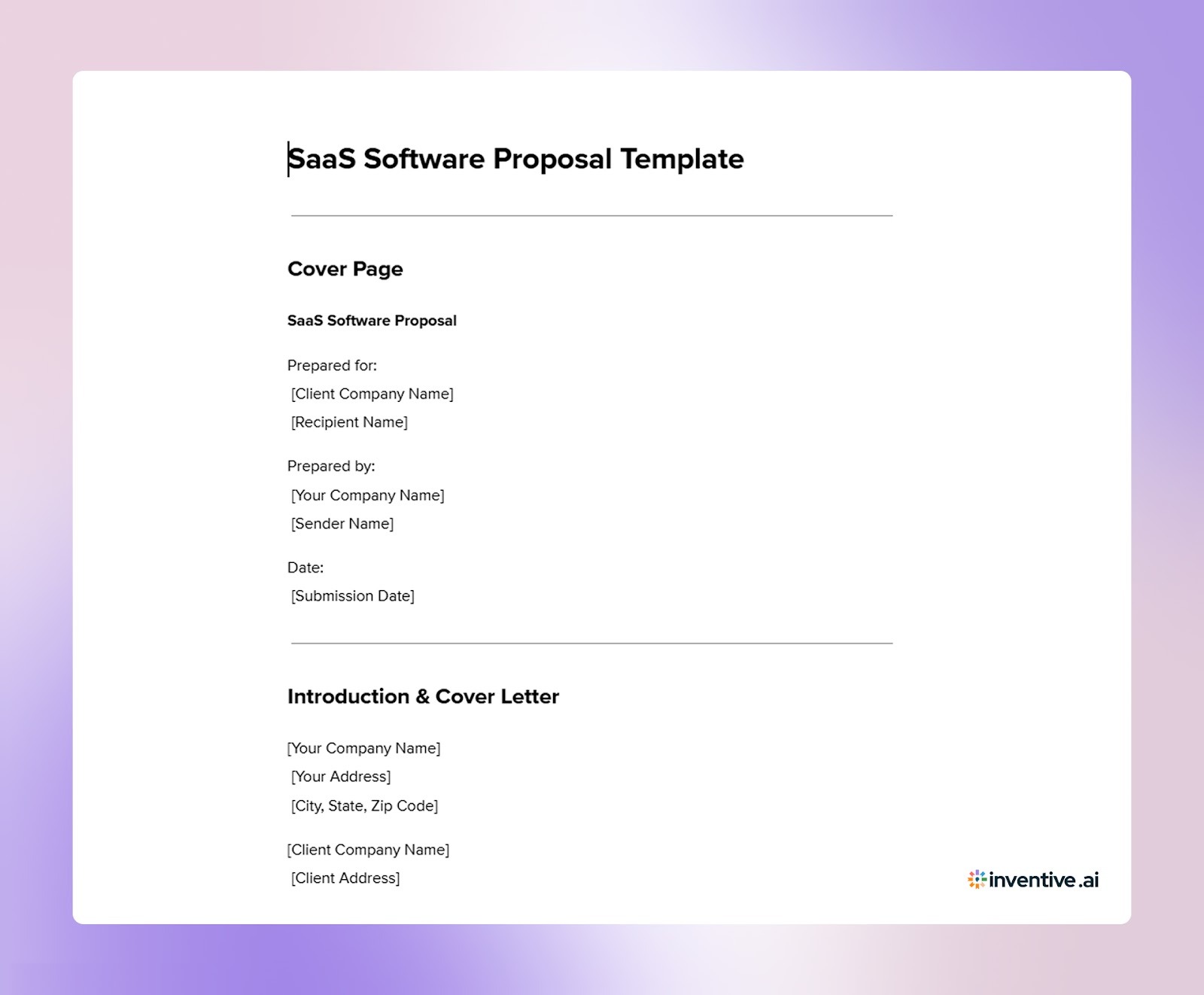
This template is built for SaaS vendors selling recurring licenses with onboarding, expansion, and renewal cycles. Buyers evaluating SaaS solutions typically focus on subscription structure, implementation timelines, support coverage, and long-term value.
The structure reflects:
- Subscription pricing tiers and user-based models.
- Implementation and onboarding plans.
- SLA and support commitments.
- Renewal and expansion terms.
- Ongoing value delivery.
This format works best for revenue teams managing recurring contracts and lifecycle-based sales.
2. IT Project Proposal Template
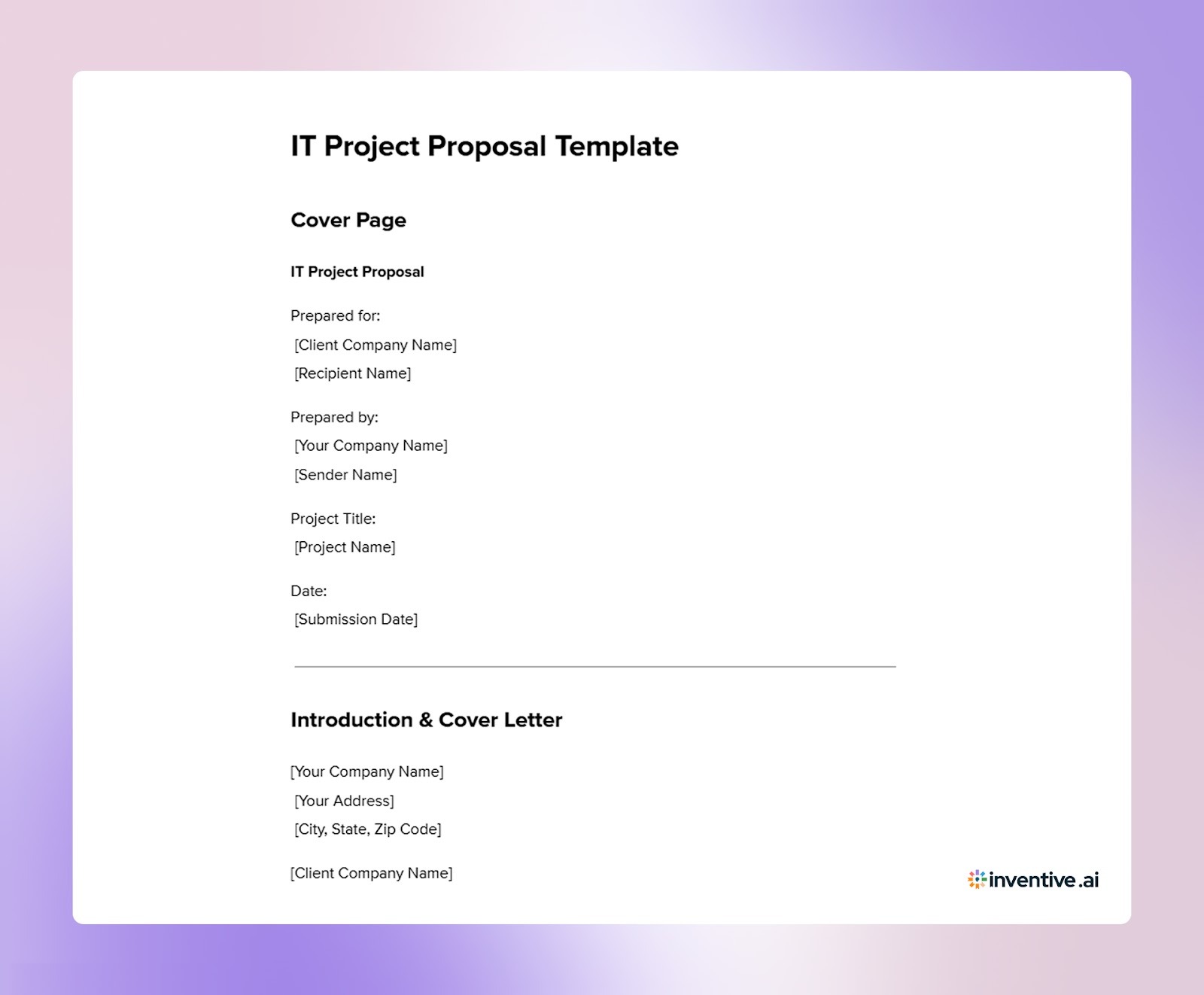
This template is designed for vendors delivering defined IT projects with scoped deliverables and phased execution. In these deals, buyers prioritize scope clarity, milestone accountability, and risk management.
The structure emphasizes:
- Clearly defined scope boundaries.
- Phase-based delivery milestones.
- Change management clauses.
- Resource allocation and timelines.
- Acceptance criteria and handoff process.
This format supports vendors responding to structured RFPs or fixed-scope project engagements.
3. Enterprise Technology Proposal Template
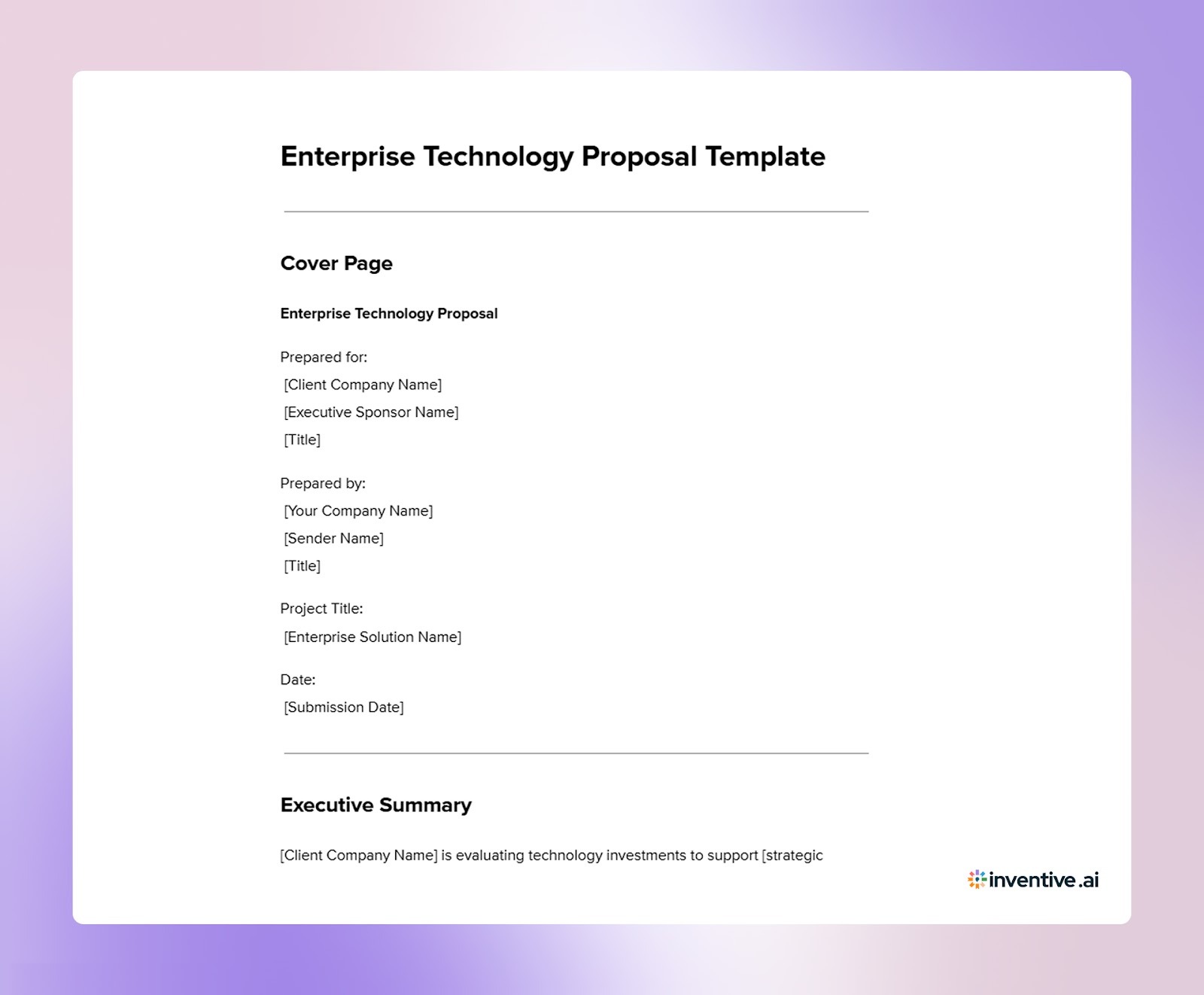
Enterprise software sales involve procurement teams, technical reviewers, finance stakeholders, and executive sponsors. This template is structured to address cross-functional evaluation criteria.
The structure includes:
- Executive-level business summary
- ROI and strategic impact framing
- Security and governance overview
- Integration architecture explanation
- Long-term scalability considerations
This format is suitable for high-value deals with longer approval cycles and formal review processes.
Make Your Software Proposals Scalable and Win-Ready With Inventive AI
Teams that respond to frequent software proposals reuse the same content across multiple documents, edit it in parallel, and update it inconsistently. Over time, this leads to contradictory answers, outdated information being copied into new proposals, and long internal review cycles.
Inventive AI automates quality control across proposals by evaluating every response in context. It generates responses that align with the specific opportunity, flags conflicting statements before submission, and detects outdated content that should not be reused.
Key Capabilities of Inventive AI:
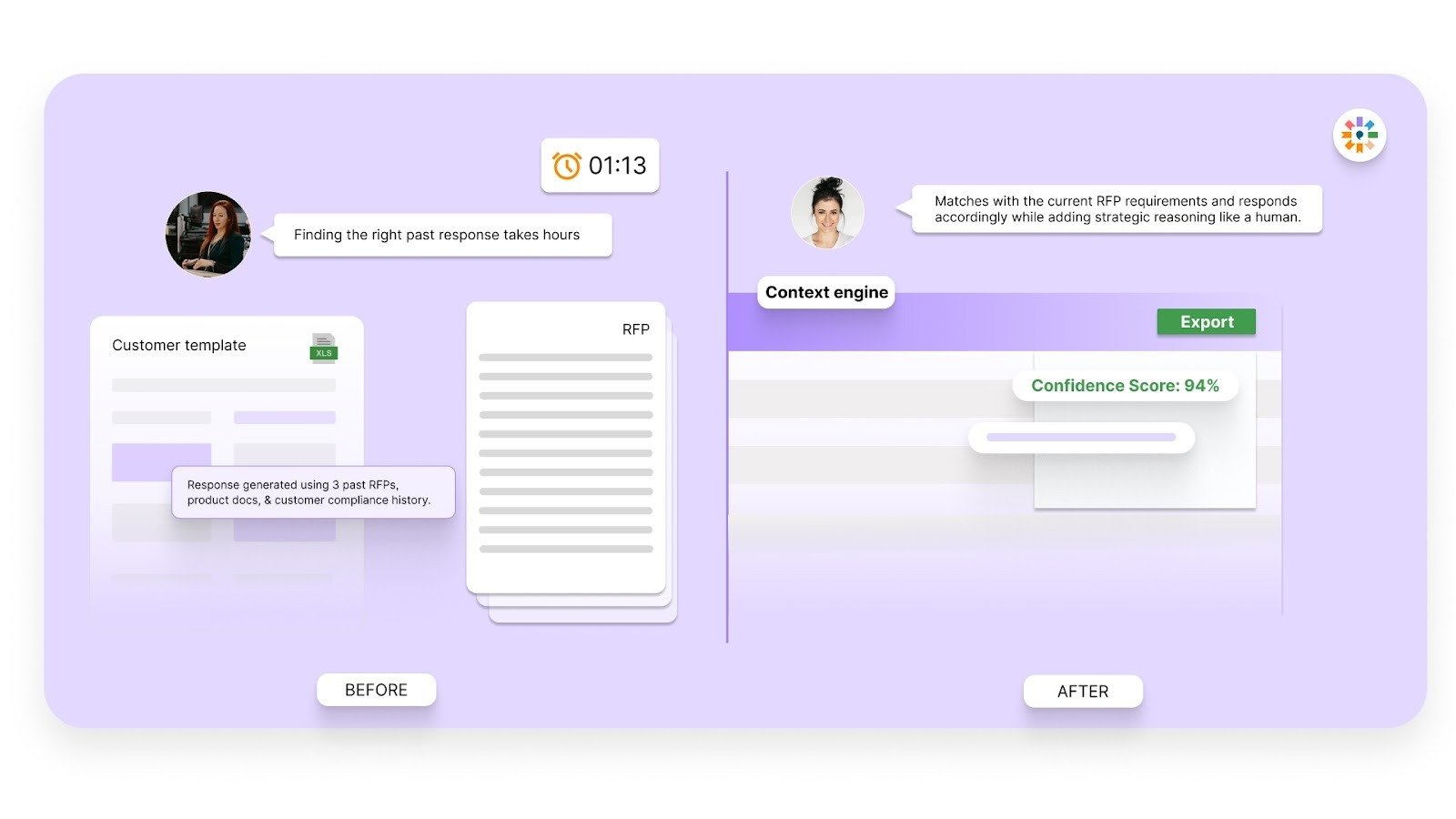
Context-Aware Response Generation
Inventive AI understands the full proposal context instead of relying on isolated question lookup. This produces responses that are specific, relevant, and aligned with buyer intent.
Conflict Detection
The system automatically identifies contradictions across responses, preventing inconsistent or risky statements from being submitted.
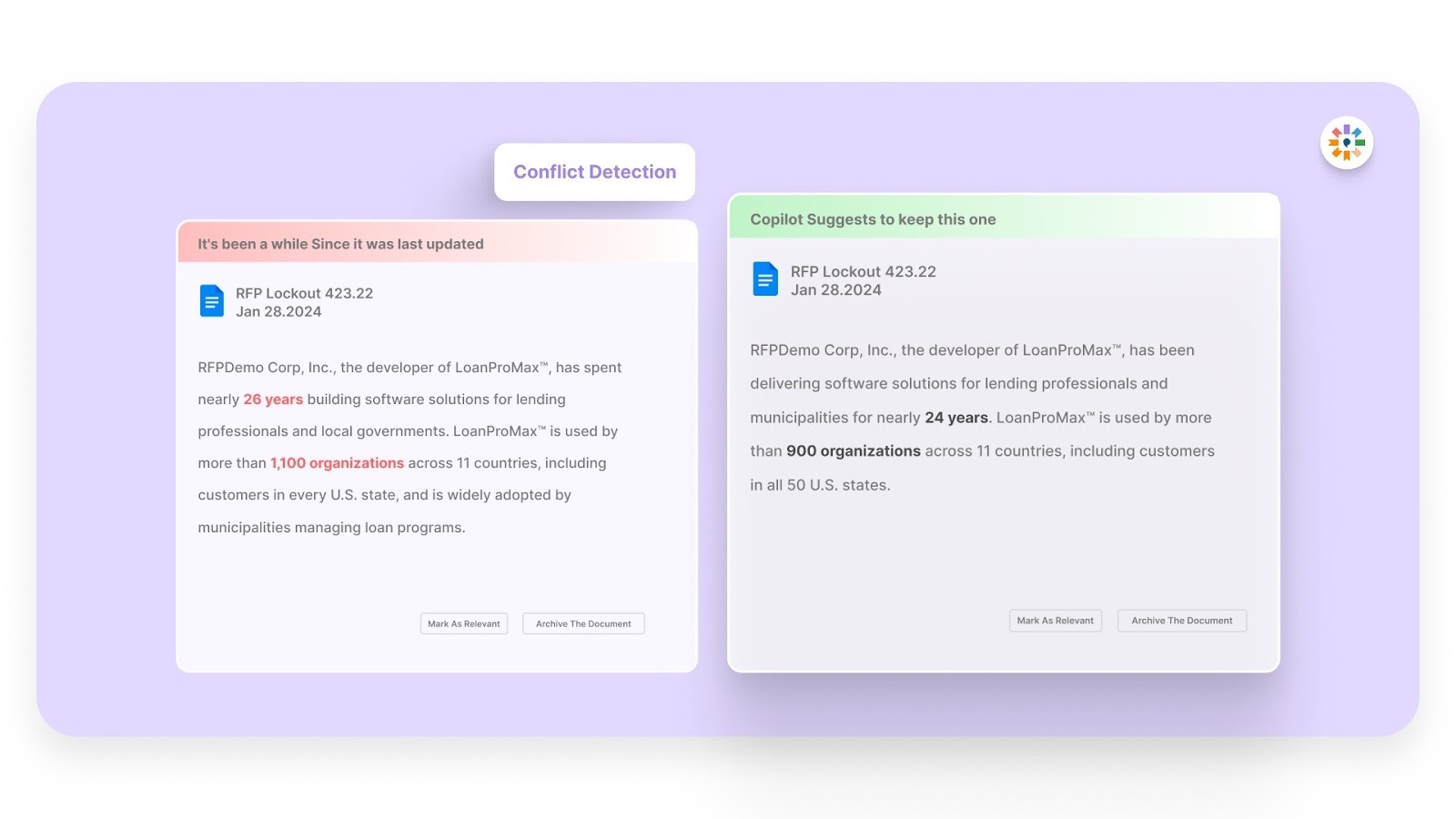
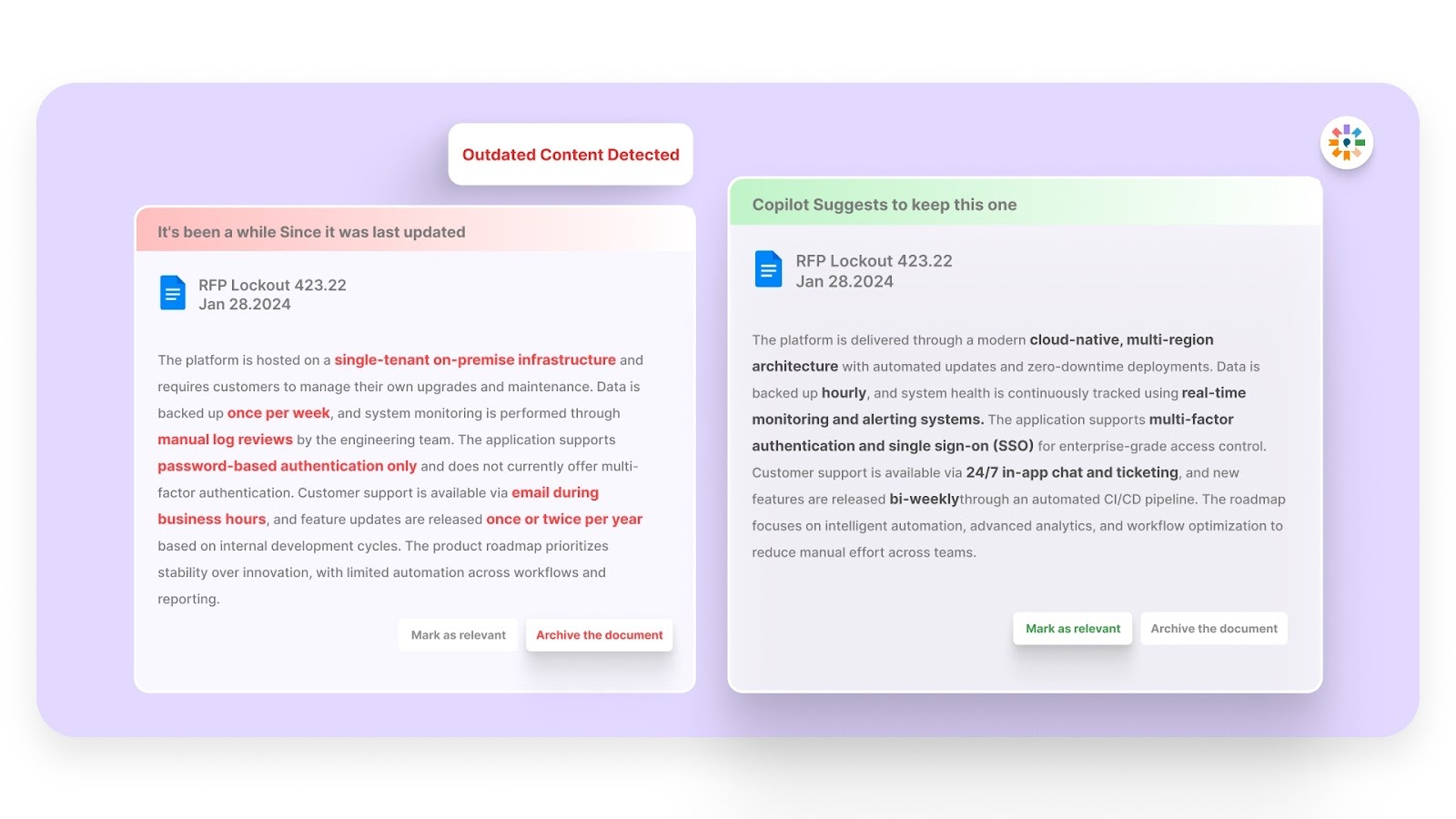
Outdated Content Detection
Inventive AI flags stale or non-compliant content before it is reused, eliminating the need for manual audits.
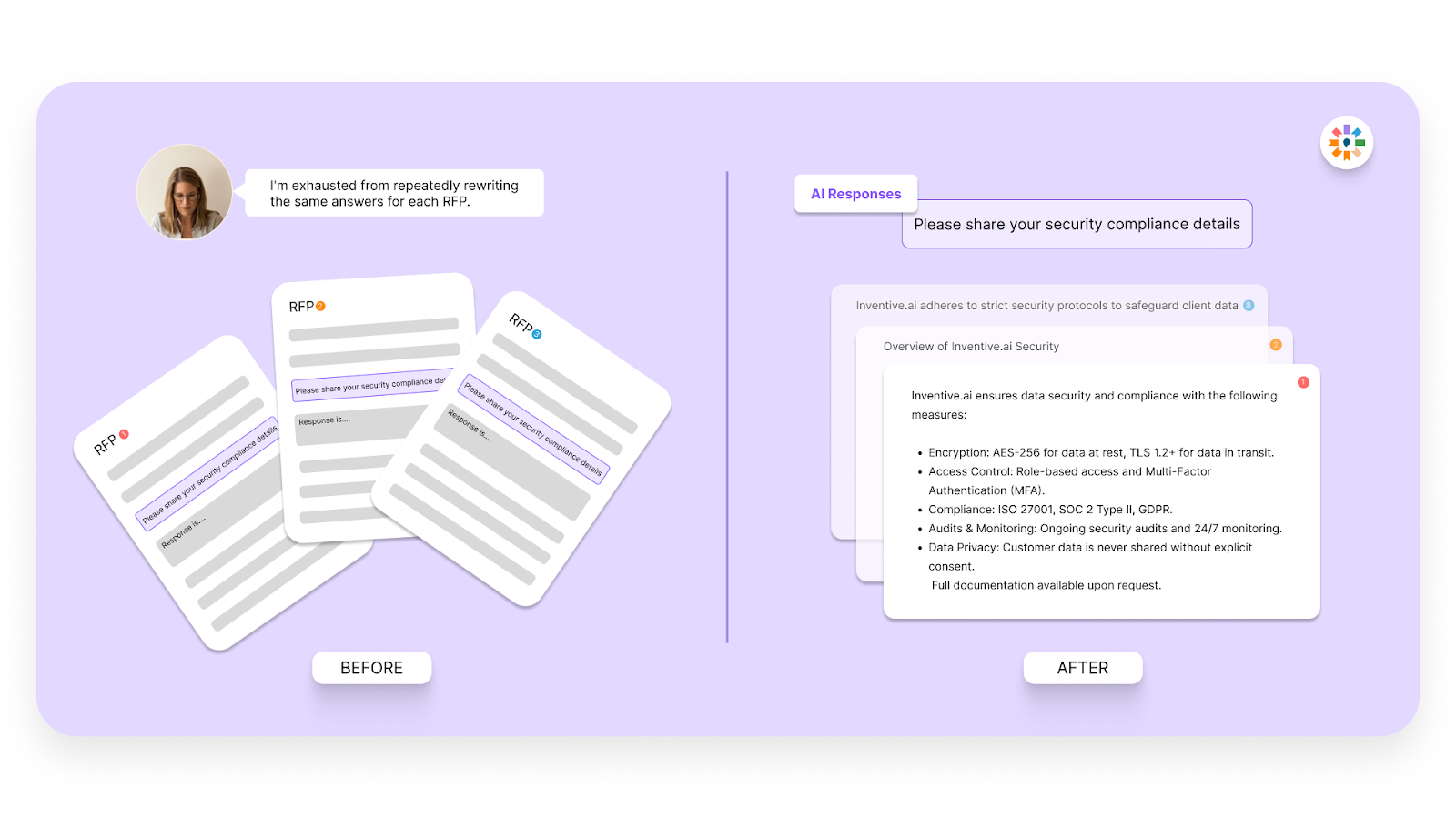
Higher Response Quality
Multi-agent AI generates clearer, more complete responses that often require minimal editing, reducing rewrite cycles.
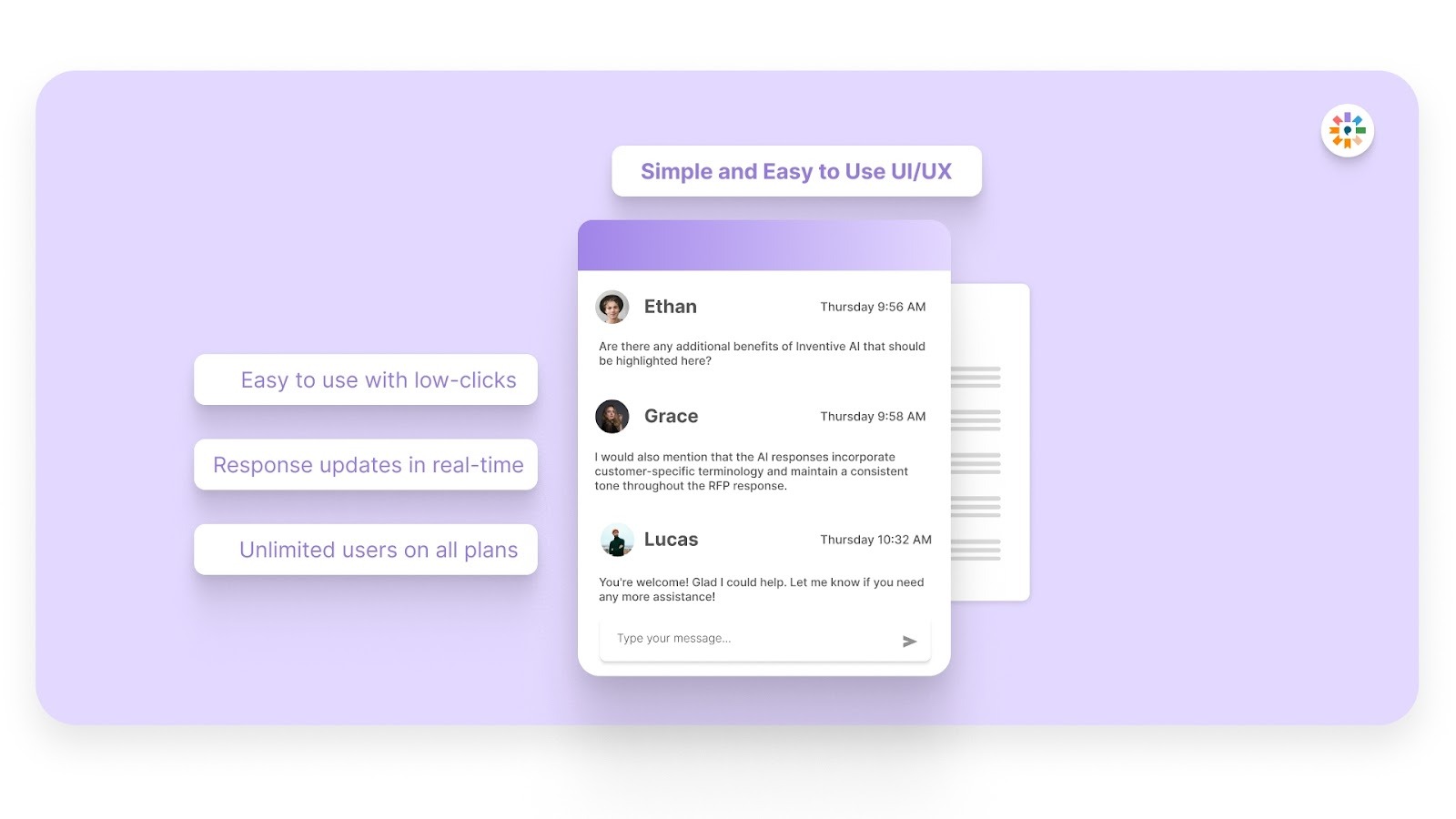
Simple and Easy-to-Use UI/UX
The platform is designed for fast onboarding and daily use, enabling teams to adopt automation without workflow disruption. With 100% adoption rate across our current customer base and being #1 easiest-to-use RFP software on G2, you and your team can adapt AI RFP tool even if you are new to it.
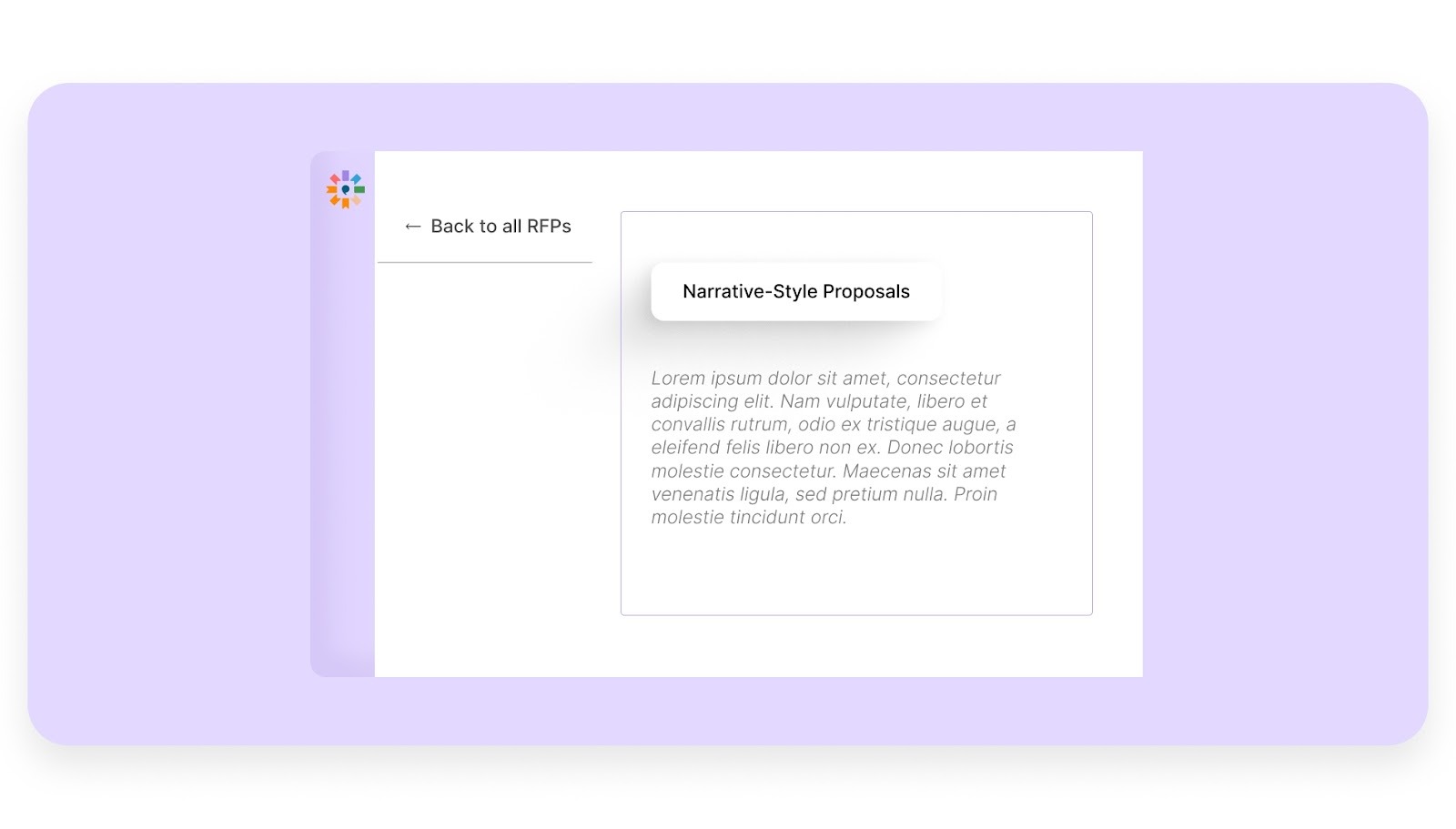
Narrative Proposal Generation
Beyond Q&A responses, Inventive AI supports long-form narrative proposals such as executive summaries, business proposals, and security narratives, allowing teams to scale full proposal creation.
FAQs About Software Proposal Template
1. What is a software proposal?
A software proposal is a formal document used by a software vendor to outline a proposed solution for a client’s business or technical requirements. It typically explains the problem, the proposed software solution, the scope of work, the timeline, the pricing, and the terms. Software proposals are commonly used for software development projects, SaaS implementations, system upgrades, or enterprise software purchases.
2. What are the types of software proposals?
Common types of software proposals include:
- Software development proposals for custom-built applications
- Software project proposals for phased or milestone-based initiatives
- Software purchase proposals for licensing or SaaS solutions
- Solution proposals that combine software, services, and integrations
- RFP responses where vendors respond to structured client requirements
The structure is often similar, but the emphasis changes depending on the proposal type.
3. How do you prepare for writing a software proposal?
Preparing a software proposal typically involves:
- Understanding the client’s business problem and goals
- Reviewing technical and functional requirements
- Defining scope boundaries and assumptions
- Aligning internally on pricing, timelines, and resources
- Gathering approved content, case studies, and references
Proper preparation reduces rework and ensures the proposal is accurate, consistent, and aligned with client expectations.
4. How long should a software proposal be?
The length of a software proposal depends on project complexity and buyer requirements. Smaller projects may require only a few pages, while enterprise software proposals or RFP responses often include detailed scope, technical sections, and legal terms. The key is completeness and clarity rather than length.



.avif)

%20(7).avif)