
Banking RFPs: How to Respond, Win More Deals & Scale with AI
This blog explores how Banking RFPs work, why they are uniquely complex, and what it takes to respond successfully in a highly regulated environment.
.avif)
Banks are under constant pressure to modernize, while maintaining regulatory compliance, security, and operational stability. 51% of banks prioritize digital transformation initiatives, increasing demand for new technologies, specialized vendors, and long-term strategic partners.
As a result, vendor selection has become more rigorous and competitive. Banks are issuing more detailed, high-stakes RFPs to evaluate solutions across technology, risk, compliance, and scalability.
For vendors, this means responding to complex requirements, tight timelines, and intense competition, often with limited room for error.
Winning in today’s banking RFP landscape requires more than technical capability. It demands speed, accuracy, consistency, and the ability to align responses precisely with evolving buyer expectations.
This blog explores how Banking RFPs work, why they are uniquely complex, and what it takes to respond successfully in a highly regulated environment. It also highlights how structured processes and AI-powered automation help you manage complexity, improve response quality, and win more Banking RFPs consistently.
Key Takeaways
- Banking RFPs are becoming more frequent and more demanding as banks accelerate digital transformation, increasing competition and scrutiny for every vendor response.
- In banking RFPs, compliance, security, and consistency carry as much weight as technical capability, where even minor gaps or contradictions can lead to early disqualification.
- While most banking RFPs follow a similar structure, outcomes are determined by how precisely requirements are interpreted, mapped, and addressed under tight timelines.
- Manual, document-driven RFP processes struggle to scale with the volume, repetition, and cross-functional coordination that banking RFPs require.
- Teams that combine structured response processes with AI-driven automation are better equipped to manage complexity, reduce risk, and win banking RFPs consistently.
What Are Banking RFPs?
Banking RFPs are formal procurement documents issued by banks to evaluate vendors for technology, services, and strategic initiatives across areas such as digital transformation, compliance, risk, and operations.
Banks use RFPs to clearly define requirements, compare vendors objectively, manage regulatory risk, and ensure long-term scalability and security.
Unlike general enterprise RFPs, banking RFPs require stronger evidence of governance, data protection, financial stability, and domain expertise, making accuracy, consistency, and compliance as critical as solution differentiation.
5 Types of Banking RFPs You Need to Know
Banks issue different types of RFPs depending on their strategic priorities, regulatory requirements, and operational needs.
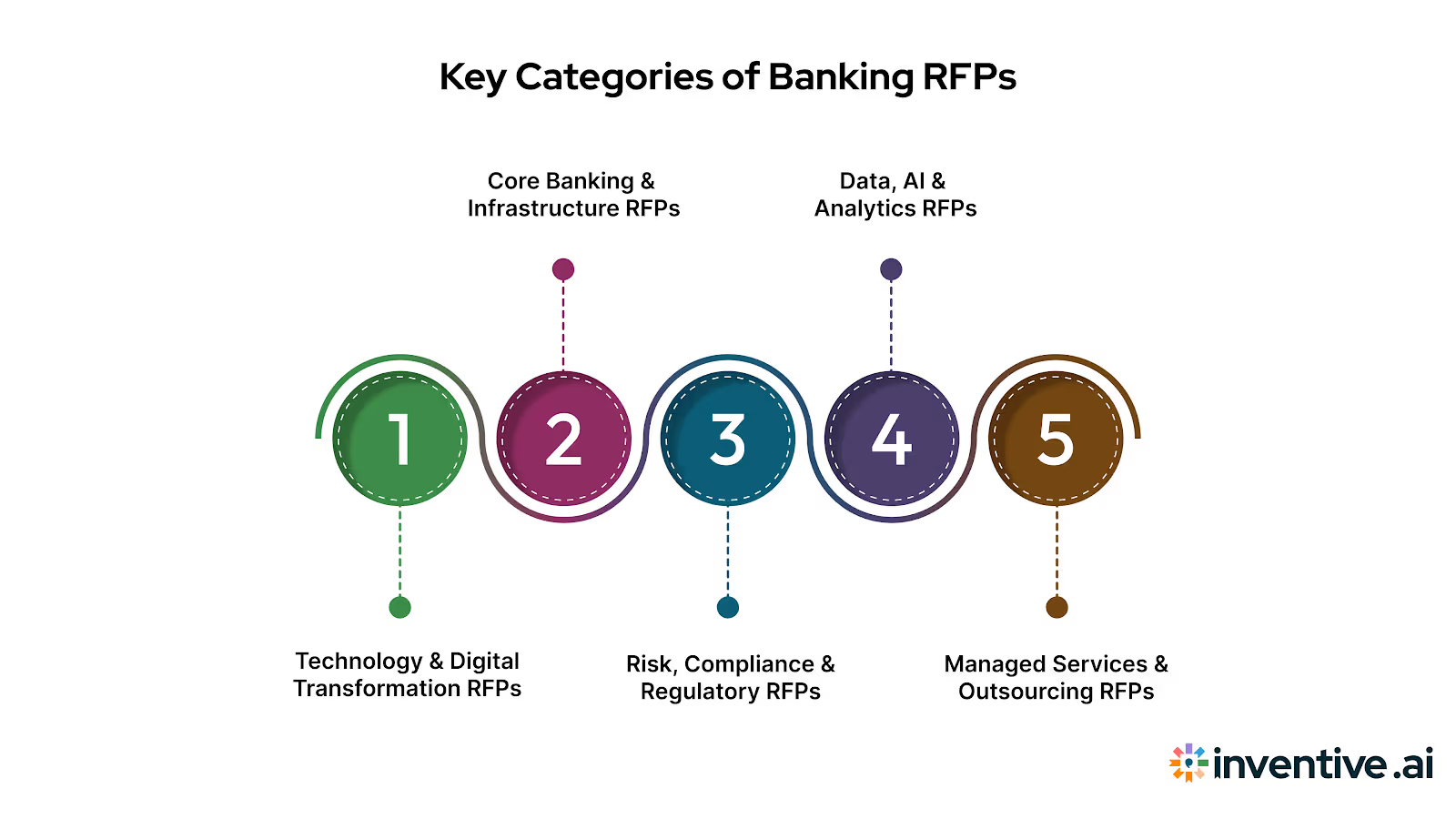
Below are the most common types of Banking RFPs vendors encounter:
- Technology & Digital Transformation RFPs: Focus on modernizing customer channels and internal systems, requiring vendors to demonstrate scalability, integration capabilities, and long-term digital roadmaps.
- Core Banking & Infrastructure RFPs: Centered on upgrading foundational platforms and infrastructure, with vendors expected to manage complex migrations while ensuring stability and regulatory compliance.
- Risk, Compliance & Regulatory RFPs: Issued to strengthen governance and meet evolving regulatory standards, challenging vendors to prove audit readiness and deep domain expertise.
- Data, AI & Analytics RFPs: Aim to improve decision-making, fraud detection, and personalization, while requiring vendors to address data privacy, explainability, and model governance.
- Managed Services & Outsourcing RFPs: Designed to improve operational efficiency and reduce costs, with vendors needing to demonstrate service reliability, security controls, and SLA-backed performance.
While the scope and complexity of banking RFPs vary, each type reflects a bank’s effort to manage risk, drive modernization, and select vendors that can operate in a highly regulated environment.
What Buyers Typically Include in a Banking RFP?
While the scope and use case may vary, the core components of Banking RFPs remain largely consistent across banks and initiatives.
These sections are designed to help buyers evaluate vendor capability, manage risk, and ensure regulatory and operational alignment.
Most Banking RFPs include the following standard components:
- Business objectives & scope: Defines what the bank aims to achieve and the boundaries of the engagement. Vendors should look beyond stated goals to identify underlying priorities.
- Functional and technical requirements: Detail the required capabilities and system expectations. Vendors must align their responses precisely to avoid gaps or unnecessary complexity.
- Security, compliance, and regulatory criteria: Establishes mandatory standards for data protection and governance.
- Vendor qualification & experience requirements: Assesses financial stability, domain expertise, and past performance, and vendors should anchor responses in relevant banking use cases.
- Pricing, SLAs, and commercial terms: Clarifies cost structures and service expectations so vendors must balance competitive pricing with realistic delivery commitments.
- Evaluation criteria and timelines: Explains how proposals will be assessed and when decisions will be made. Vendors should align their efforts to the scoring weight and deadlines.
For vendors, these sections define where deals are won or lost since misalignment, vague answers, or missed requirements often eliminate proposals before differentiation is even considered.
How to Respond to Banking RFPs: A Step-by-Step Approach
Responding to a Banking RFP is not a box-checking exercise. With strict regulatory scrutiny, high contract values, and multiple stakeholders involved, each response must be treated as a structured, risk-aware sales pursuit.
The goal is not just to submit on time, but to submit a response that is compliant, defensible, and clearly aligned to the bank’s priorities.
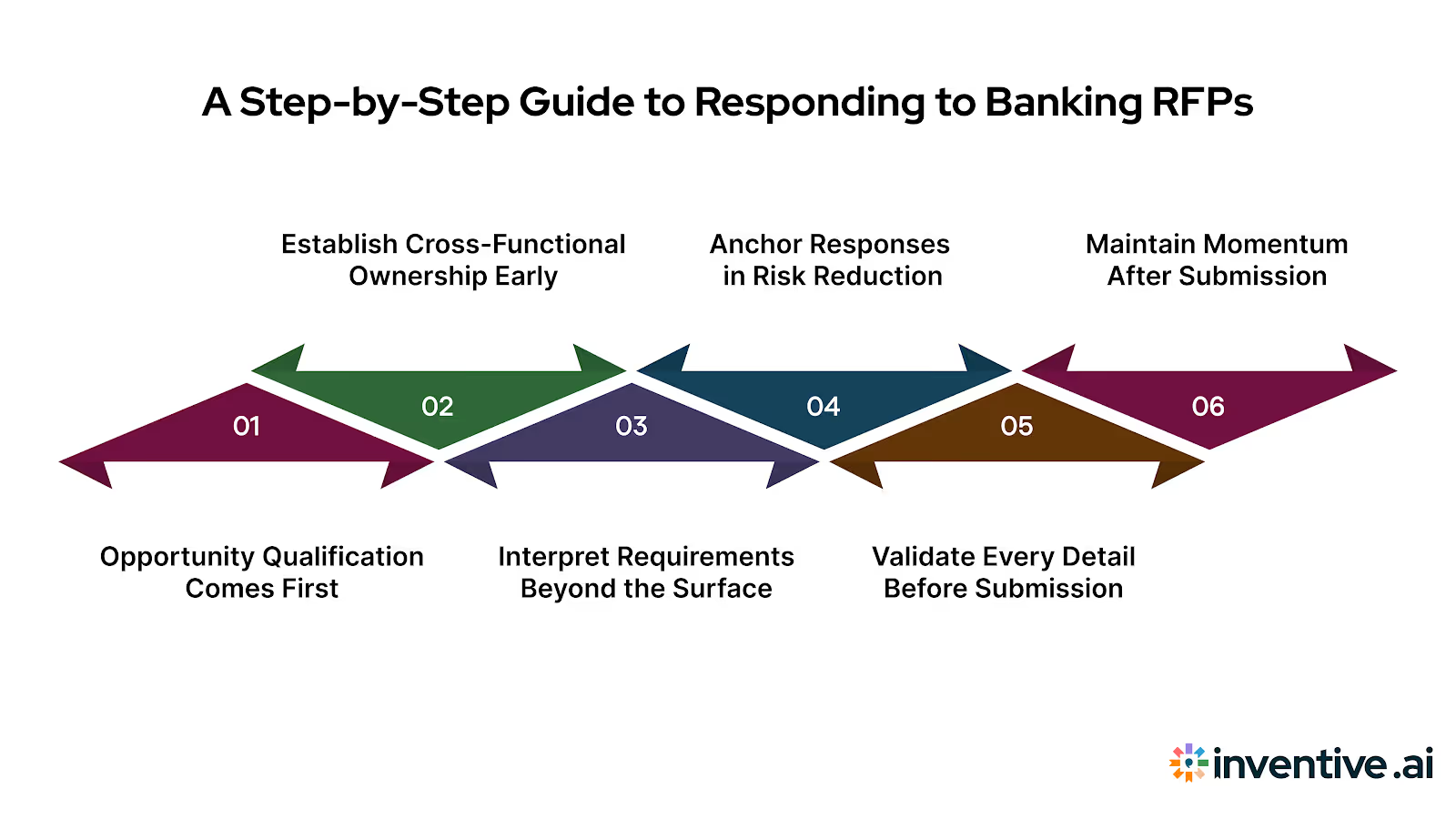
Below is a practical, execution-focused approach you can follow to improve response quality, efficiency, and win rates.
1. Opportunity Qualification Comes First
Banking RFPs demand significant time, documentation, and cross-team effort. Treating every RFP as a must-respond opportunity dilutes focus and lowers overall win probability.
Early qualification allows you to prioritize RFPs where solution fit, compliance readiness, and delivery capability align with buyer expectations.
Below are practical qualification signals vendors should evaluate early:
- Alignment between mandatory requirements and existing certifications or capabilities.
- Delivery timelines that match operational capacity.
- Commercial terms that fit pricing and margin thresholds.
- Prior success with similar banking buyers or use cases.
2. Establish Cross-Functional Ownership Early
A Banking RFP is rarely owned by a single team. Security, legal, product, finance, and delivery inputs are all required, and delays typically occur when ownership is unclear. Early alignment ensures parallel execution rather than sequential bottlenecks.
Below are actions that help teams stay aligned throughout the response cycle:
- Assign a clear owner for each RFP section.
- Set internal deadlines ahead of buyer timelines.
- Identify dependencies such as security reviews or contract redlines upfront.
3. Interpret Requirements Beyond the Surface
Banking RFPs are designed to reduce risk and evaluate capability. Many buyer priorities are embedded indirectly in scoring criteria, mandatory declarations, or compliance language.
Here’s how you can reduce compliance risk during analysis:
- Separate mandatory requirements from scored or optional ones.
- Track submission rules, formatting constraints, and annexures.
- Maintain a checklist for all required certifications and attachments.
4. Anchor Responses in Risk Reduction
Banks prioritize stability, auditability, and regulatory alignment. While differentiation matters, unsupported claims or generic messaging weaken trust. Strong responses show exactly how risk is mitigated and outcomes are delivered.
Here’s what strengthens credibility in Banking RFP responses:
- Use verifiable metrics, certifications, and audit references.
- Align language closely with buyer terminology and objectives.
- Keep formatting consistent to support reviewer efficiency.
Example: Rather than stating “enterprise-grade security,” show certifications, uptime metrics, incident history, and monitoring practices.
5. Validate Every Detail Before Submission
In Banking RFPs, inconsistencies, outdated references, or unclear commitments can trigger follow-ups or removal from consideration altogether.
Below are validation checks you should complete before submission:
- Confirm all compliance references are current and accurate.
- Review legal and commercial terms for alignment.
- Perform a final completeness and consistency audit.
6. Maintain Momentum After Submission
Banks often seek clarification, deeper validation, or additional materials during review cycles.
Here are ways vendors can remain effective post-submission:
- Confirm receipt and next steps.
- Prepare supporting materials in advance.
- Respond quickly and consistently to follow-up queries.
A step-by-step approach brings structure to an otherwise demanding process, but execution remains the differentiator. In Banking RFPs, success depends on how well vendors coordinate teams, control content, manage compliance risk, and respond under pressure.
As RFP volumes increase and requirements grow more complex, manual, fragmented approaches become harder to sustain, making process maturity and intelligent automation increasingly critical for consistent wins.
Related: Understanding Finance RFP: Key Steps and Requirements
5 Key Challenges in Banking RFPs
Banking RFPs are inherently demanding due to the scale of information required and the level of scrutiny applied during evaluation. As banks increase their reliance on structured procurement, vendors are expected to respond faster, with greater accuracy, and under tighter regulatory and operational constraints.
The most common challenges vendors face include:
- Volume and complexity of requirements: Banking RFPs often run into hundreds of questions across functional, technical, and regulatory areas, increasing the risk of missed or inconsistent responses.
- Repetitive security and compliance questions: Teams repeatedly answer similar security, privacy, and risk questions across RFPs, consuming time and increasing the likelihood of outdated or conflicting information.
- Cross-team collaboration issues: Inputs from security, legal, product, finance, and delivery teams are required, and a lack of coordination frequently leads to delays and last-minute escalations.
- Tight timelines and low win rates: Banks enforce strict submission deadlines while reviewing multiple vendors, making it difficult for teams to invest deeply in every response.
- Balancing compliance with differentiation: RFP teams must meet non-negotiable compliance standards while still standing out, often with limited space or flexibility to do so.
As Banking RFPs continue to grow in scale and scrutiny, vendors that rely on manual processes and fragmented knowledge struggle to respond consistently, creating a clear need for more structured, technology-enabled approaches.
How AI Transforms the Banking RFP Process?
As Banking RFPs grow in volume, complexity, and regulatory depth, manual response processes become harder to sustain. You’re expected to respond faster, maintain strict compliance, and deliver consistent, high-quality answers, often under tight timelines.
This is where AI-driven RFP workflows change how you operate. 75% of organizations that have implemented workflow automation report the equivalent of 4+ hours saved per employee per 40-hour work week, giving you more time to focus on strategic work instead of repetitive tasks.
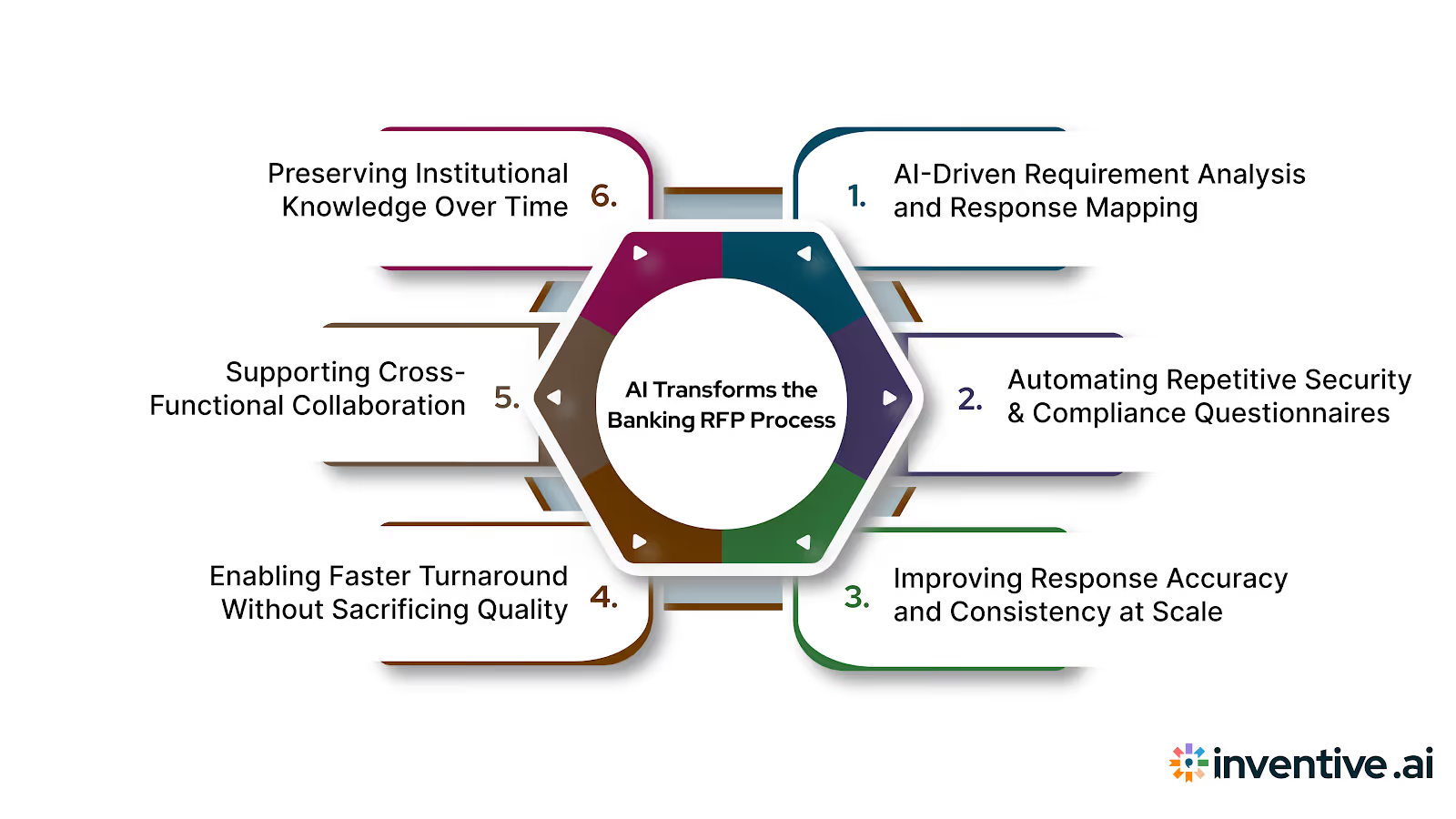
Below are the key ways AI transforms how you manage and respond to Banking RFPs.
1. AI-Driven Requirement Analysis and Response Mapping
Banking RFPs often contain dense, overlapping requirements across multiple documents. AI helps you analyze RFP content automatically, identify mandatory versus optional requirements, and map questions to the most relevant existing responses—reducing interpretation errors early in the process.
2. Automating Repetitive Security and Compliance Questionnaires
Security, privacy, and regulatory questions are highly repetitive across Banking RFPs, yet they consume a significant amount of your time. AI allows you to reuse previously approved answers, surface the most current compliance language, and minimize manual rewriting, while still retaining human review and control.
3. Improving Response Accuracy and Consistency at Scale
Inconsistent answers across sections or submissions can raise concerns during bank evaluations. AI helps you maintain consistency by pulling from centralized, approved content and flagging conflicting responses, outdated references, or missing information before submission.
4. Enabling Faster Turnaround Without Sacrificing Quality
Tight submission timelines are one of the biggest pressures you face. AI accelerates drafting and content retrieval, allowing you to respond faster without compromising compliance checks, formatting standards, or internal review processes.
5. Supporting Cross-Functional Collaboration
Banking RFPs require coordinated input from security, legal, product, finance, and delivery teams. AI-enabled workflows help you route questions to the right stakeholders, track ownership, and reduce back-and-forth, keeping responses on schedule.
6. Preserving Institutional Knowledge Over Time
Without AI, valuable RFP knowledge often lives in individual inboxes or outdated files. AI helps you retain, organize, and reuse institutional knowledge so each Banking RFP builds on prior experience rather than starting from scratch.
AI gives you a practical way to manage complexity, reduce manual effort, and respond with greater confidence, without sacrificing compliance or quality.
Also read: Top 25 RFP Software in 2025: Which to Use?
How Inventive AI Helps You Win Banking RFPs?
Banking RFP teams face a familiar set of challenges: responses start to sound generic, compliance answers contradict each other, reviews stretch longer than planned, and accuracy drops under deadline pressure.
The issue isn’t expertise or effort. It’s that manual, document-driven workflows cannot consistently deliver speed, accuracy, and compliance at the same time, especially at a banking scale.
Inventive AI is built to solve that breakdown. It replaces fragmented drafting, review, and coordination with a structured system that helps you generate stronger responses upfront, maintain consistency across the proposal, and scale RFP output without adding headcount.
Here’s how Inventive AI supports Banking RFP responses in practice:
- Higher response quality that improves win rates: Inventive AI consistently produces 2× higher-quality responses, which correlate with up to 50% higher win rates by delivering clearer, more complete, and buyer-aligned answers.
- Highly contextual answers grounded in the full RFP: The Context Engine reasons across the entire RFP, deal inputs, and buyer signals, helping you produce responses that feel bank-specific rather than templated.
- Built-in conflict detection across sections: Inventive AI automatically flags contradictory statements within a proposal, reducing compliance risk and preventing late-stage review issues.
- Quality benchmarking against gold-standard content: Every response is evaluated for accuracy, completeness, and clarity, achieving 95% accuracy, with 66% of answers requiring near-zero edits, cutting down review cycles significantly.
- Narrative-style proposal generation: Beyond Q&A, Inventive AI supports long-form banking content such as executive summaries, transformation narratives, implementation approaches, and proposal books.
- Centralized knowledge hub with live integrations: Approved content is pulled directly from systems like Drive, SharePoint, Notion, and CRMs, giving you a single, up-to-date source of truth across Banking RFPs.
- Collaboration built for cross-functional RFP teams: Assign ownership, track progress, and review feedback in one workspace. With role-based access, real-time updates, and Slack integration, security, legal, product, and sales teams stay aligned without version sprawl.
- Compliance matrix for banking requirements: Inventive AI analyzes RFP requirements against a compliance matrix, flags risk areas, and helps you strengthen responses where regulatory alignment may be unclear or incomplete.
Inventive AI turns Banking RFP responses from a manual coordination problem into a repeatable, high-confidence workflow, where you move faster without sacrificing compliance, consistency, or credibility.
What It Takes to Win Modern Banking RFPs?
Banking is entering a new phase of technology evolution, driven by advancements such as agentic AI, heightened security expectations, and increasingly complex regulatory environments. As banks adopt these innovations, their RFPs become increasingly complex, placing greater pressure on response teams to deliver faster, more accurate, and more compliant proposals.
In this environment, ad hoc processes and manual coordination are no longer enough. Winning Banking RFPs requires a structured approach, disciplined execution, and intelligent automation that can scale without increasing risk.
With AI-powered RFP agents like Inventive AI, you can move beyond reactive responses and build a repeatable, high-confidence RFP process, one that keeps pace with banking innovation while meeting the rigor these buyers demand.
Frequently Asked Questions About Banking RFPs
1. Who typically owns a Banking RFP on the buyer side?
Banking RFPs are usually owned by procurement or sourcing teams, but they are heavily influenced by risk, compliance, IT, and business stakeholders. Final decisions are often made by cross-functional committees rather than a single buyer.
2. How early should vendors engage before a Banking RFP is issued?
Ideally, engagement begins well before the RFP is released. Banks often shape requirements based on prior vendor conversations, market scans, and proof-of-concept discussions, which can significantly influence evaluation criteria.
3. Are Banking RFPs always mandatory for vendor selection?
Not always. While large initiatives typically require an RFP for governance and audit purposes, banks may use lighter processes such as RFIs or direct negotiations for renewals, pilots, or low-risk engagements.
4. How much weight do non-functional requirements carry in Banking RFPs?
Non-functional requirements such as security, data privacy, resilience, and operational controls often carry equal or greater weight than functional capabilities. Failure to meet these standards can outweigh strong product features.
5. How are Banking RFP responses usually evaluated?
Responses are typically scored using weighted criteria that include compliance adherence, technical fit, risk posture, commercial terms, and vendor credibility. In many cases, failing mandatory criteria removes a proposal from consideration before qualitative review.

90% Faster RFPs. 50% More Wins. Watch a 2-Minute Demo.

Gaurav Nemade
After witnessing the gap between generic AI models and the high precision required for business proposals, Gaurav co-founded Inventive AI to bring true intelligence to the RFP process. An IIT Roorkee graduate with deep expertise in building Large Language Models (LLMs), he focuses on ensuring product teams spend less time on repetitive technical questionnaires and more time on innovation.
.avif)
Mukund Kumar
Understanding that sales leaders struggle to cut through the hype of generic AI, Mukund focuses on connecting enterprises with the specialized RFP automation they actually need at Inventive AI. An IIT Jodhpur graduate with 3+ years in growth marketing, he uses data-driven strategies to help teams discover the solution to their proposal headaches and scale their revenue operations.