Tender Management: The Process, Best Practices, and Challenges (2026)
What tender management is, the 8-stage process, how it differs from bid management, plus roles, metrics, and best practices. A clear 2026 guide.
Tender management is the end-to-end process of finding, qualifying, preparing, and submitting competitive tenders to win contracts. The tender management process runs through eight stages, from spotting an opportunity to reviewing the outcome. Most of that work is still manual. Sales teams spend under 30% of their time actually selling, with the rest lost to admin and content work, and tender responses are a large part of that load.
This guide explains what tender management is, how it differs from bid management and procurement, each stage of the process, who owns what, and how to measure and improve your win rate.
Key takeaways
- Tender management is the full process of finding, qualifying, preparing, and submitting competitive tenders.
- The tender management process has eight stages, from opportunity qualification to outcome review.
- It is different from bid management (the effort to win a specific deal) and procurement (the buyer side).
- Win rate improves most from disciplined qualification, a compliance matrix, and writing to the evaluation criteria.
- Software helps at scale. Measure success by win rate, on-time submission rate, and bid/no-bid ratio.
What is tender management?
Tender management is how an organization runs its response to a tender, which is a formal invitation from a buyer to bid on a project or contract. It covers the full sequence: qualifying the opportunity, analyzing the requirements, setting a strategy, writing the response, reviewing it, submitting it, and learning from the result. Done well, tender management keeps every bid compliant, competitive, and on time, and raises win rate over the long run.
Tender management vs bid management vs procurement
These three terms are related but describe different things. Knowing the difference keeps roles and scope clear.
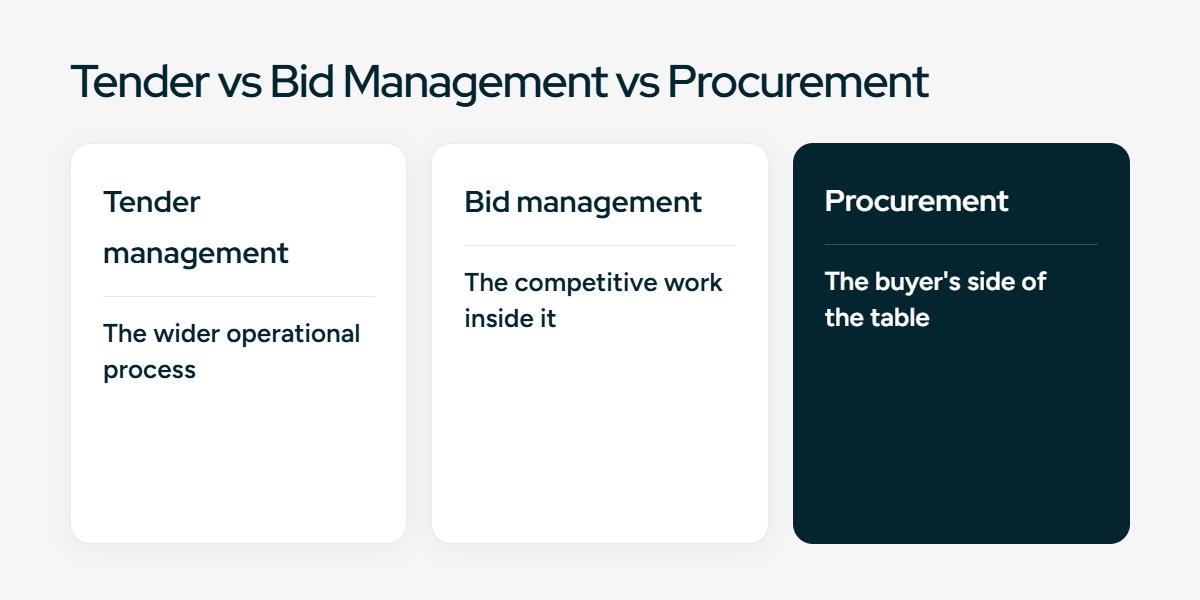
In short, tender management is the wider operational process, bid management is the competitive work inside it, and procurement is what the buyer does on the other side of the table.
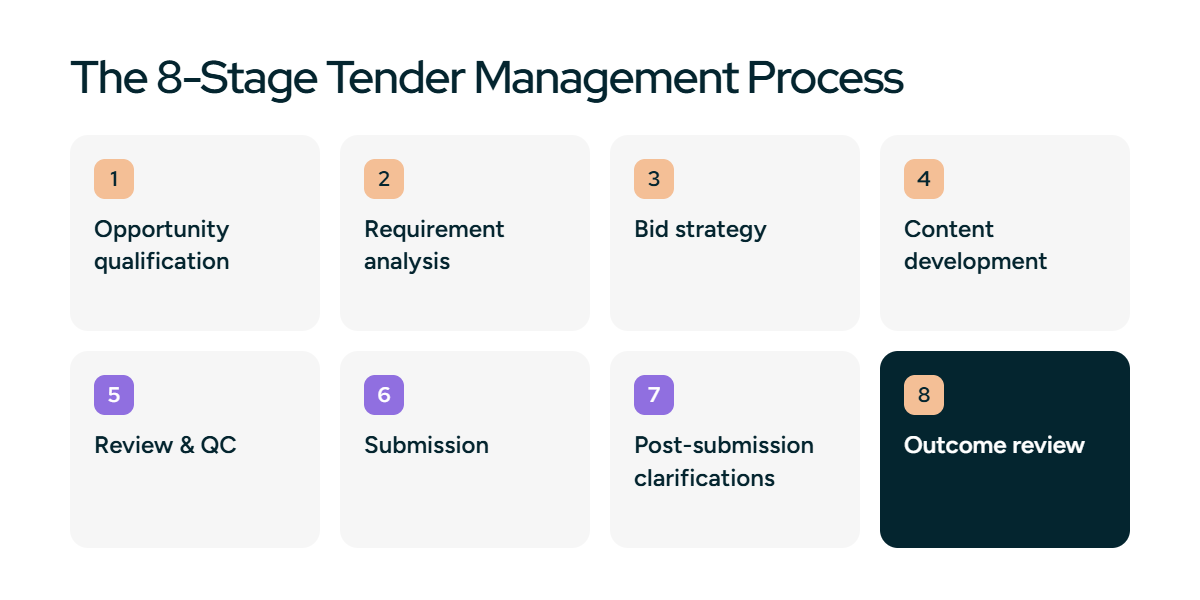
The tender management process: 8 stages
The tender management process has eight stages: opportunity qualification, requirement analysis, bid strategy, content development, review, submission, post-submission clarifications, and outcome review. The early stages matter most; a clear go/no-go decision and a strategy set before drafting help improve your win rate.
1. Opportunity identification and qualification
Finding tenders is easy: portals, private invitations, existing clients, and industry networks. Choosing which ones are worth your effort is what decides your win rate.
A good go/no-go decision weighs fit to your capabilities, budget and margin, whether you can meet the mandatory requirements, and the strength of the incumbent or competition. A big client or a big number tempts you to bid on hope. Resist it. Every tender you chase without a real chance steals time from one you could win.
2. Requirement analysis and interpretation
Once you commit, aim to understand the tender better than your competitors do. Read the whole pack and pull every requirement into the compliance matrix. Two things repay the most attention:
- The evaluation criteria and weightings, which tell you where the marks actually are, so you invest effort in the right places.
- The clarification window, which most tenders open. Send questions early, since answers reach every bidder and can shift your approach.
One misread requirement or a missed page limit can sink an excellent bid, so this is a stage to slow down for.
3. Bid strategy and positioning
Before drafting, decide how you will score well against this specific buyer, not just how you will meet the requirements. That decision comes down to three things:
- Win themes: two or three evidence-backed reasons this buyer should pick you, tied to the priorities stated in the tender, and repeated in the relevant sections rather than buried.
- Differentiators: strengths a competitor cannot honestly claim, such as a certification, a local presence, or a proven result in the same sector.
- Price-to-win: set pricing against the buyer's scoring model and the likely field. If quality carries 70% of the marks and price 30%, the lowest bid does not win, so decide where you compete on value and where on cost.
Settle these before writing, because they tell each contributor what point their section has to make.
4. Content development and drafting
Draft each section against the compliance matrix so every requirement is answered and nothing is missed. Three practices raise the score:
- Write the executive summary last. It is the most-read section, so write it once the response is complete and use it to restate the buyer's problem, your win themes, and the outcome you deliver.
- Reuse, then tailor. Start from approved library answers, then adapt each one with this buyer's name, sector, and requirements. Evaluators can spot copied boilerplate, and it costs trust.
- Answer the question first, then explain. Lead each response with a direct answer, then add the detail, in the order the tender asks, so a scorer can find and mark each point quickly.
5. Review, approval, and quality control
Reviews catch the mistakes that cost marks while you can still fix them. The value is the rework they produce, not the meeting. Run the response through a few lenses, not one general read:
- Technical: are the claims accurate and deliverable?
- Compliance: does it meet every mandatory requirement and format rule?
- Commercial: are pricing and terms consistent throughout?
- Editorial: does it read in one voice, and would it score well against the criteria?
Keep one locked version as the source of truth. In the final days, contributors editing conflicting copies is how good content gets lost.
6. Submission and confirmation
Late or incomplete submissions are rejected automatically, so treat this stage as a checklist, not an afterthought. Before you upload:
- Include every mandatory document and form, and complete any required declarations or signatures.
- Match the required file formats, naming, and page or word limits exactly.
- Submit through the correct portal or address, and do it hours ahead of the deadline, since portals slow down or crash near cut-off.
- Save the submission receipt or confirmation as proof the bid landed on time.
7. Post-submission clarifications and follow-up
Submitting is not the finish line. Buyers often come back with questions, a request to present, or a call for a best-and-final offer, and this window can move your score. Keep your answers consistent with what you submitted, because contradicting your own bid plants doubt at the worst moment. In public procurement, use the standstill period before the award to prepare for the debrief rather than chase the buyer.
8. Outcome review and continuous improvement
Win or lose, the tender still has something to give you, and this is the stage teams skip most.
Ask for a debrief every time. In public tenders, you are usually entitled to your scores, and that feedback is the cheapest market research you will get. Take what you learn back into your content library and your qualification scoring, so the next bid starts stronger. Over time, that loop is what turns a capable team into a consistently winning one.
Roles in tender management: who owns what
Tender management is a team effort, and unclear ownership is a common reason bids slip. The table below maps the core roles to what they own across the process.
Common challenges in tender management
Most tender teams run into the same obstacles. Here they are, with the fix for each.
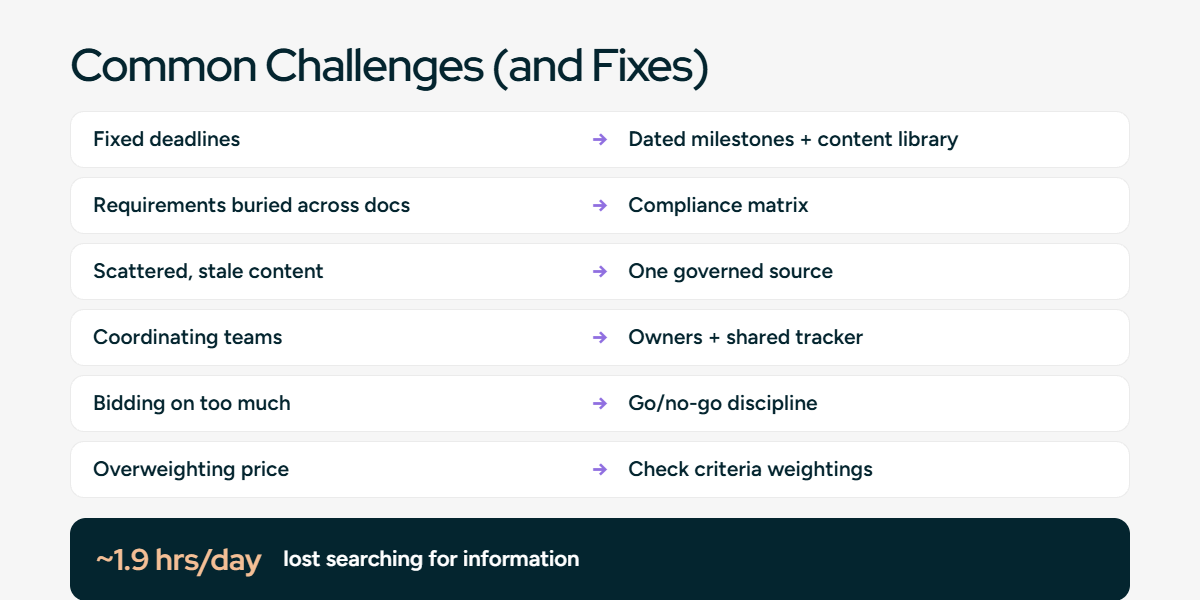
- Deadlines that do not move. A tender has a fixed cut-off, and buyers rarely grant extensions. A slow SME, a late pricing sign-off, or a delayed review can each cost you the submission. Work to dated milestones and keep a library of approved content, so most of the response is ready to adapt rather than written from scratch in the final days.
- Requirements buried across multiple documents. A single tender can span a specification, terms and conditions, pricing schedules, and evaluation criteria, and one missed mandatory item can disqualify the bid before it is scored. Build a compliance matrix at the start that maps every requirement to a section and an owner, then use it as the checklist for the final review.
- Content that is scattered and out of date. Employees spend nearly 1.9 hours a day, close to 20% of the workweek, searching for and gathering the information they need. When answers sit across shared drives, inboxes, and old bids, people reuse whatever they find first, and outdated information ends up in a live submission. Keep approved answers in one governed source with a clear owner for each, so contributors pull from vetted content.
- Coordinating input from several teams. A tender needs sales, SMEs, legal, finance, and delivery, and the bid manager rarely has authority over any of them. Assign each section an owner and a due date, and track progress in one shared place, so responsibility stays visible and follow-up is straightforward.
- Bidding on too much. Chasing every tender spreads the team thin and drags down the win rate. Score each opportunity on fit, budget, and real chance of winning, and use that go/no-go decision to keep your best people on the tenders you can win.
- Overweighting price. Many teams assume the cheapest bid wins, so they cut their price and rush the written response. In most public and enterprise tenders, price is only part of the score, and the rest depends on quality, delivery, and experience. Check the evaluation criteria and their weightings first, then spend your time on the sections that carry the most marks and price competitively within that picture.
Best practices for tender management
These habits show up in teams that win consistently.
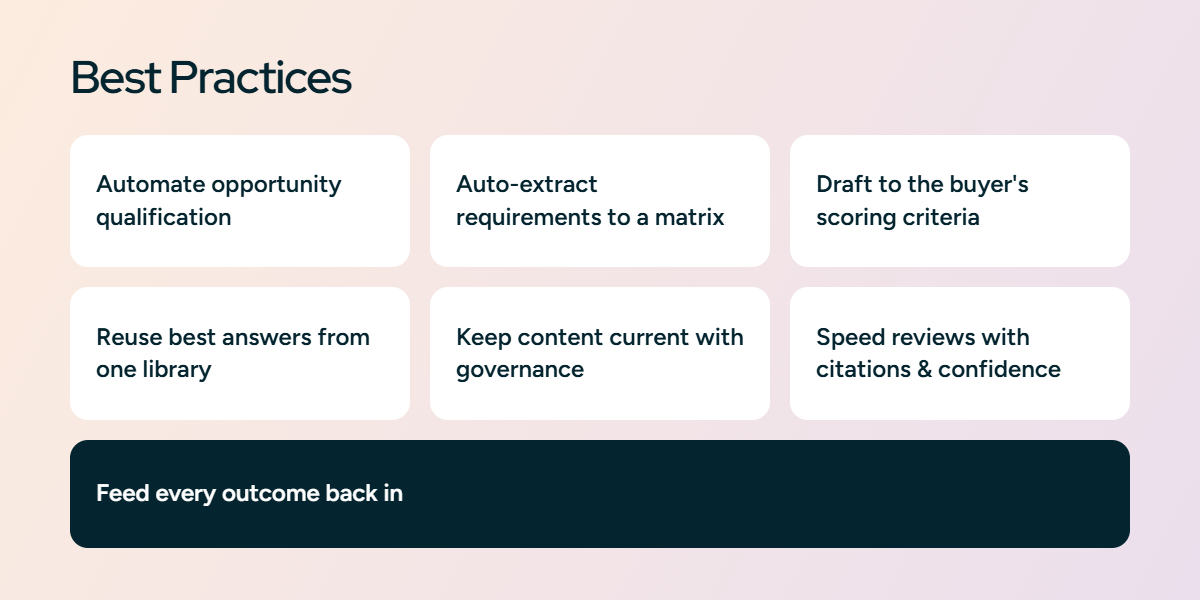
Automate opportunity qualification.
Score each tender on fit, budget, and real chance of winning, and walk away from the weak ones early. An AI-native platform can read a new tender against your requirements and past results and flag fit in minutes, so the go/no-go call stops depending on a slow manual review.
Extract requirements into a compliance matrix automatically.
Every requirement needs an owner and a place in the response, and pulling them out by hand is slow and easy to get wrong. Let the platform read the tender documents and pull out the questions and requirements for your team to validate, then use that matrix as your final checklist.
Draft to the buyer's scoring criteria with AI.
Evaluators score your answers against set criteria, so structure the response around those criteria and answer them in the order the tender lists them. AI response drafting helps by turning your approved content into a first draft that already answers each requirement. Writers then refine the argument instead of writing every answer from scratch.
Reuse your best answers from a central library.
Keep approved, high-scoring responses in one place and adapt each to the buyer's sector and requirements. An AI platform pulls in the best-matching approved answer for each question, so your team works from vetted content instead of copying from old bids.
Keep answer content current with content governance.
Reusable answers go stale, and outdated or contradictory content is hard to spot across hundreds of responses. Content governance automation flags outdated, duplicate, and conflicting answers before they reach a buyer, so what you submit is always accurate.
Speed reviews with citations and confidence scores.
Run technical, legal, financial, and editorial reviews as separate passes, scheduled early enough to act on. When each drafted answer carries its source and a confidence score, reviewers see what to check first and clear the response faster.
Feed every outcome back into your knowledge base.
Record what worked, ask the buyer for your scoring where you can, and update your content and qualification. When approved responses route back into the library automatically, each tender leaves your team better prepared for the next.
Also Read: How to Write a Tender with AI
How to measure tender management performance
Track a small set of metrics to know whether your process is working and where to improve.
Industries where tender management is critical
Formal tenders are the main route to revenue in sectors where contracts are large, regulated, or public. These include construction and infrastructure, government and defense, healthcare, IT and technology services, professional services, and education. In these industries, a disciplined tender management process is a direct driver of win rate.
Also Read: Strategies for Winning a Tender
Tender management software
Tender management software brings the whole response process into one place, instead of spreading it across spreadsheets, email, and shared folders. Manual coordination works at low volume, but as tenders grow in number and complexity, it starts costing you deadlines and introducing errors.
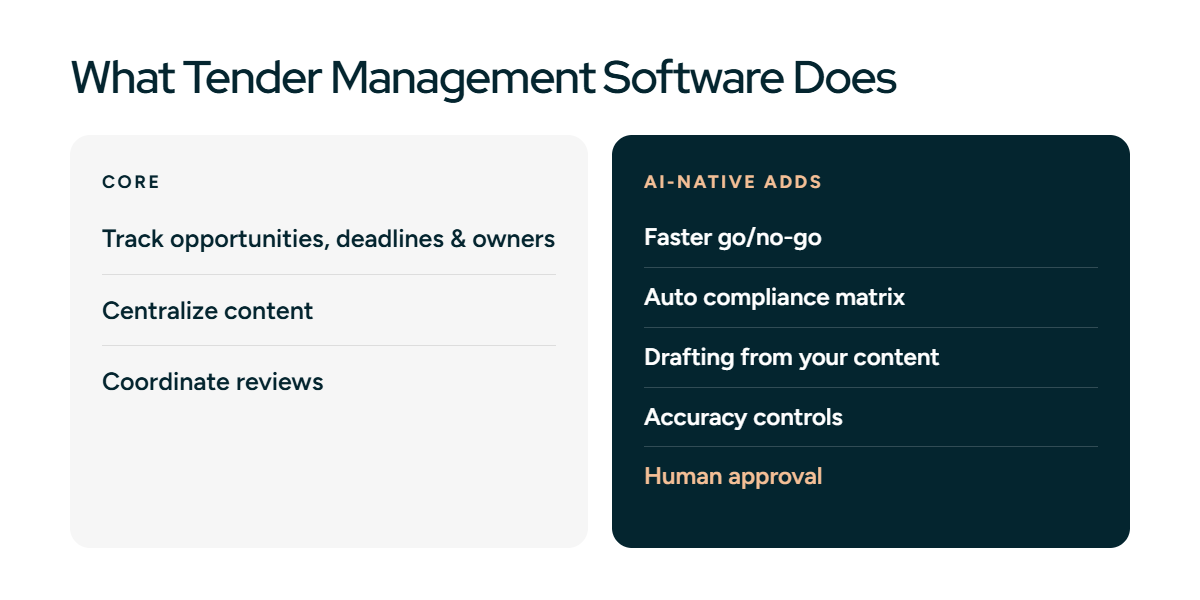
At its core, the software handles the operational load of a bid:
- Tracks opportunities, deadlines, and section owners.
- Centralizes response content and past bids in one searchable place.
- Coordinates contributors, reviews, and approvals without version confusion.
AI-native platforms go further and take on parts of the work itself, which is what sets them apart from legacy tools:
- Faster go/no-go decisions. They read a new tender against your requirements and past results and flag how well it fits, so you qualify opportunities in minutes instead of a week.
- Automatic compliance matrix. They read the tender documents and pull out every question and requirement into a matrix your team can validate, so nothing mandatory is missed.
- Drafting from your own content. They connect to the systems you already use and draft answers from your approved knowledge, so no one starts from a blank page.
- Accuracy and compliance controls. They cite the source behind each answer, score its confidence, and flag outdated or conflicting content before it reaches a buyer.
- Human control. Your team approves every response, so automation speeds the work without taking over the decision.
How Inventive AI helps with tender management
Most tender teams lose the most time writing and reviewing the response, usually against a deadline that will not move.
Inventive AI helps here by drafting each response from the content your team has already approved and your connected knowledge sources, so you start in minutes rather than days and still hit the submission date.
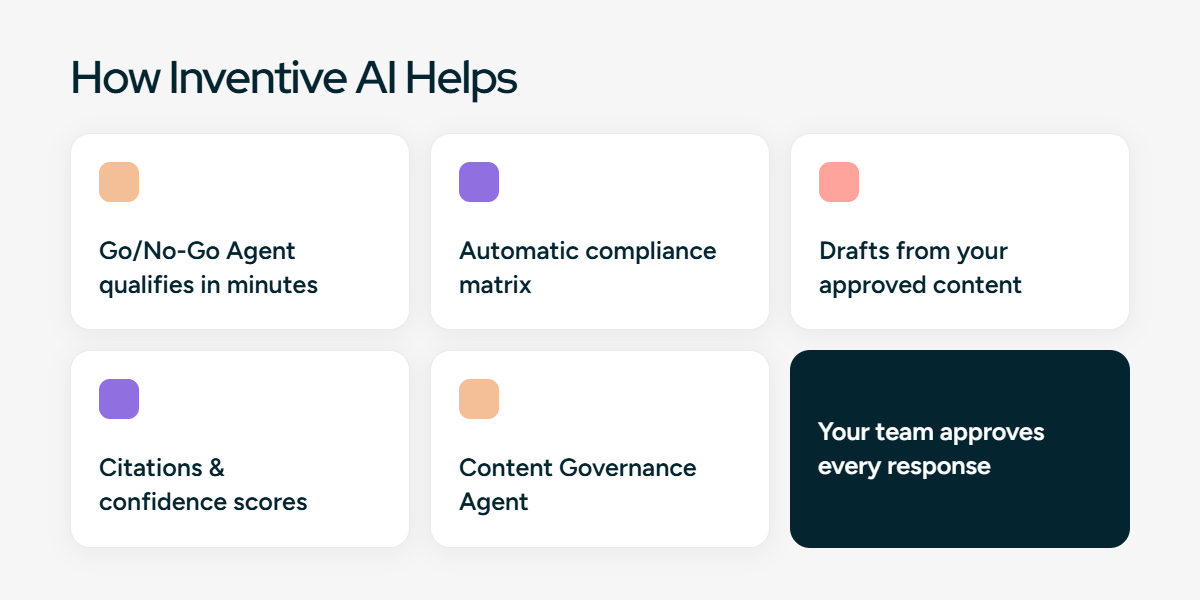
Inventive AI supports the tender process from the first decision to the final review:
- Go/No-Go Agent reads a new tender against your requirements and past results, so you qualify in minutes.
- Automatic compliance matrix pulls every question and requirement from the tender documents for your team to validate, so nothing mandatory slips through.
- Drafting from your content builds each response from your approved answers and connected knowledge sources, so you start in minutes rather than days.
- Citations and confidence scores on every answer let reviewers check the draft fast.
- Content Governance Agent flags outdated or conflicting content before it reaches a buyer, with your team approving every response.


.avif)