
TMS RFP Template & Practical Response Examples for Vendors

How many TMS deals slip away because your proposal feels generic or incomplete? When deadlines are tight and requirements stretch across pages, even experienced teams struggle to respond with clarity and confidence.
If you’re responding to Transportation Management System opportunities, you’re likely juggling compliance matrices, pricing tables, technical details, and executive messaging, all at once. One missed requirement or unclear answer can lower your score, even if your solution is strong. A well-structured TMS RFP template can be the difference between a scattered submission and a compelling bid.
In this blog, we’ll explore a ready-to-use Transportation Management System (TMS) RFP template, a structured TMS RFP response template for vendors, industry-specific response variations, and practical tips to customize your response for higher win rates.
The Ultimate 2026 TMS RFP Template Buyers Are Using to Evaluate Vendors
Enterprise buyers are no longer satisfied with feature lists; they want clarity on data architecture, automation logic, pricing structure, and long-term support. The template below reflects the types of questions procurement and operations teams are now asking, so you can prepare responses that are specific, defensible, and demo-ready.

Proven TMS RFP Response Template That Helps Vendors Score Higher
Buyers are comparing multiple vendors side by side, often using a scoring matrix. A scattered, marketing-heavy response weakens your credibility, even if your product is strong.
The template below is designed to help you present clear, requirement-mapped answers that procurement teams can evaluate quickly.
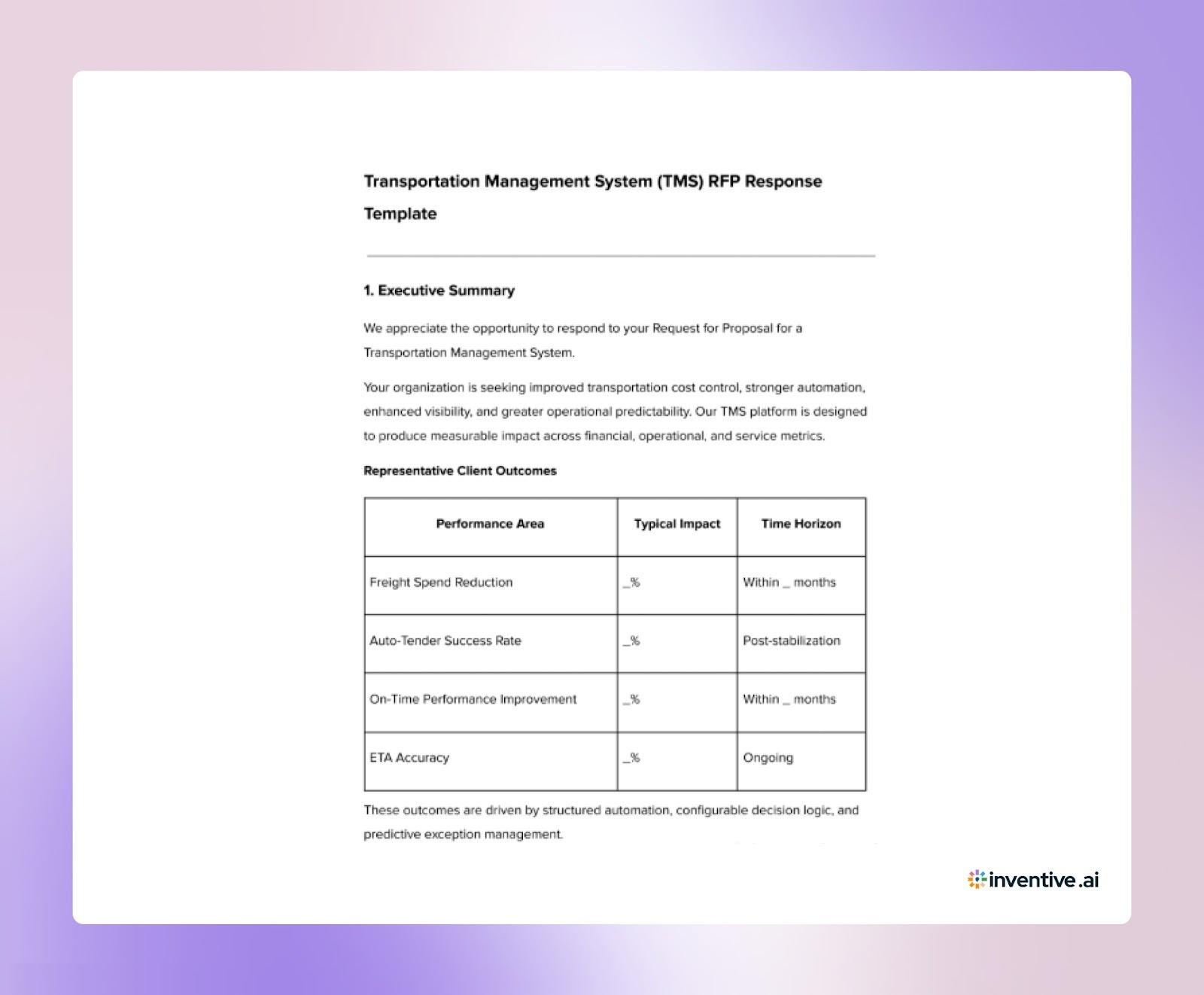

You can copy this into a Word document and customize it to each opportunity.
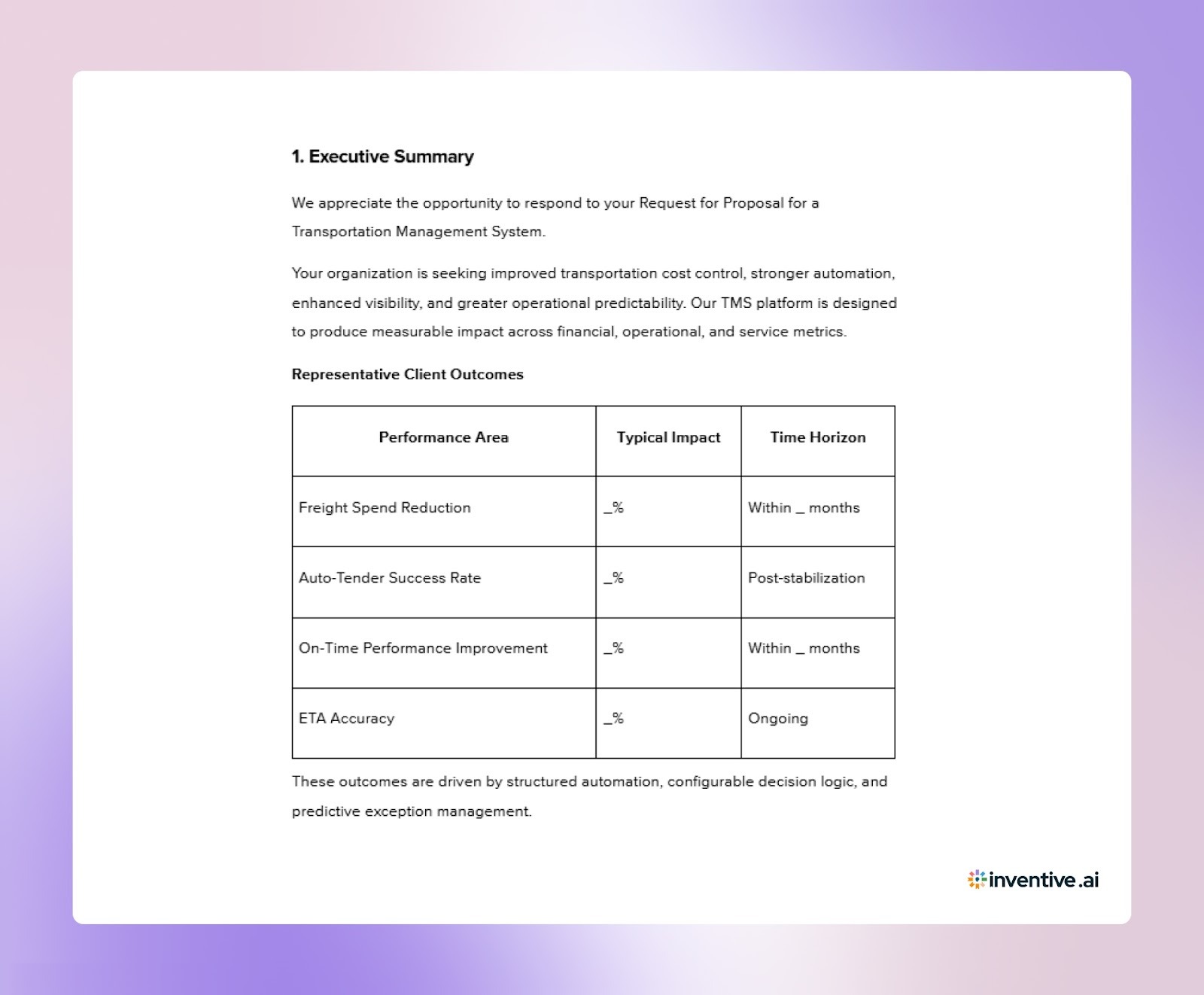
1. Executive Summary
We appreciate the opportunity to respond to your Request for Proposal for a Transportation Management System.
Your organization is seeking improved transportation cost control, stronger automation, enhanced visibility, and greater operational predictability. Our TMS platform is designed to produce measurable impact across financial, operational, and service metrics.
Representative Client Outcomes
These outcomes are driven by structured automation, configurable decision logic, and predictive exception management.
2. Company Overview
We support organizations operating multi-node distribution networks, high-volume freight portfolios, and multi-modal transportation environments.
3. Compliance & Requirements Response Matrix
A detailed compliance matrix is included in Appendix A using the following framework:
Definitions
- Standard: Existing production-ready functionality
- Configurable: Controlled through system configuration
- Custom: Requires scoped development
All items marked as "standard" are available for live demonstration.
4. Functional & Automation Capabilities
Carrier Management
- Contract and dynamic rate management
- Spot market RFQ workflows
- Digital carrier onboarding portal
- Automated carrier performance scorecards
Planning & Execution Capabilities
Automation Logic Framework
Multimodal & Global Support
5. Visibility & Predictive Tracking
Our visibility framework is built around proactive exception detection rather than passive status reporting.
Optional modules include carbon emissions tracking and customer-facing shipment notifications.
6. Technical Architecture & Integration
Architecture is designed to support real-time synchronization while minimizing internal IT burden.
7. Data Migration & Governance
Governance transparency is maintained throughout the lifecycle.
8. Security & Compliance
Supporting documentation available upon request.
9. Change Management & Adoption Plan
TMS success is dependent on planner adoption.
Implementation Framework
Adoption Monitoring
The platform emphasizes reduced click-path execution and exception-first dashboards to promote sustained engagement.
10. Pricing & Total Cost of Ownership
Implementation costs are separated from recurring subscription costs.
11. Service Levels & Support
Dedicated account management is provided.
12. References
13. Proof of Capability
We confirm readiness to:
- Demonstrate all Standard functionality
- Use buyer-provided sample data
- Conduct workflow walkthroughs, including exception scenarios
3 Industry-Specific TMS RFP Response Templates That Win More Deals
Transportation Management System proposals are evaluated differently across industries. Retail buyers focus on parcel precision and peak stability, manufacturers care about inbound continuity, and 3PLs scrutinize billing control and multi-client scalability.
The templates below reflect how evaluators in each sector typically score vendor responses, so you can customize your structure accordingly.
1. Retail & eCommerce TMS RFP Response Template
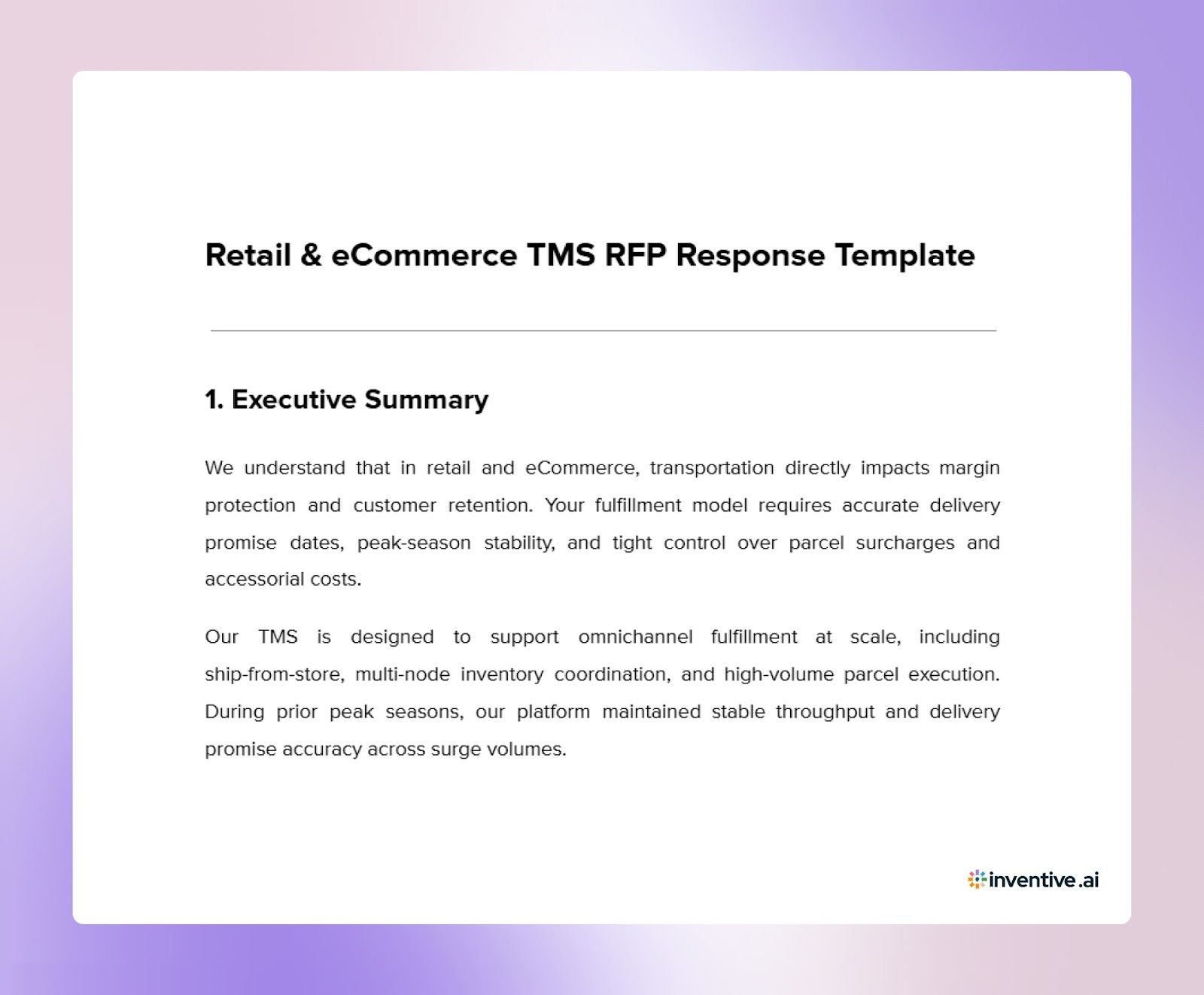
This template applies to omnichannel, high-volume parcel environments where delivery promise accuracy and margin control drive evaluation.
Your response should address:
- Executive summary tied to delivery promise, peak stability, and surcharge control
- Omnichannel execution (DTC, ship-from-store, replenishment coordination)
- Parcel rate shopping, label generation, and manifest automation
- Zone skipping and cross-border handling (duties, documentation, multi-currency)
- Peak season scalability and carrier fallback sequencing
- Freight audit and accessorial validation for margin protection
This structure works best for vendors bidding on retail TMS projects where scoring depends on parcel agility, surge handling, and SLA performance.

2. Manufacturing TMS RFP Response Template
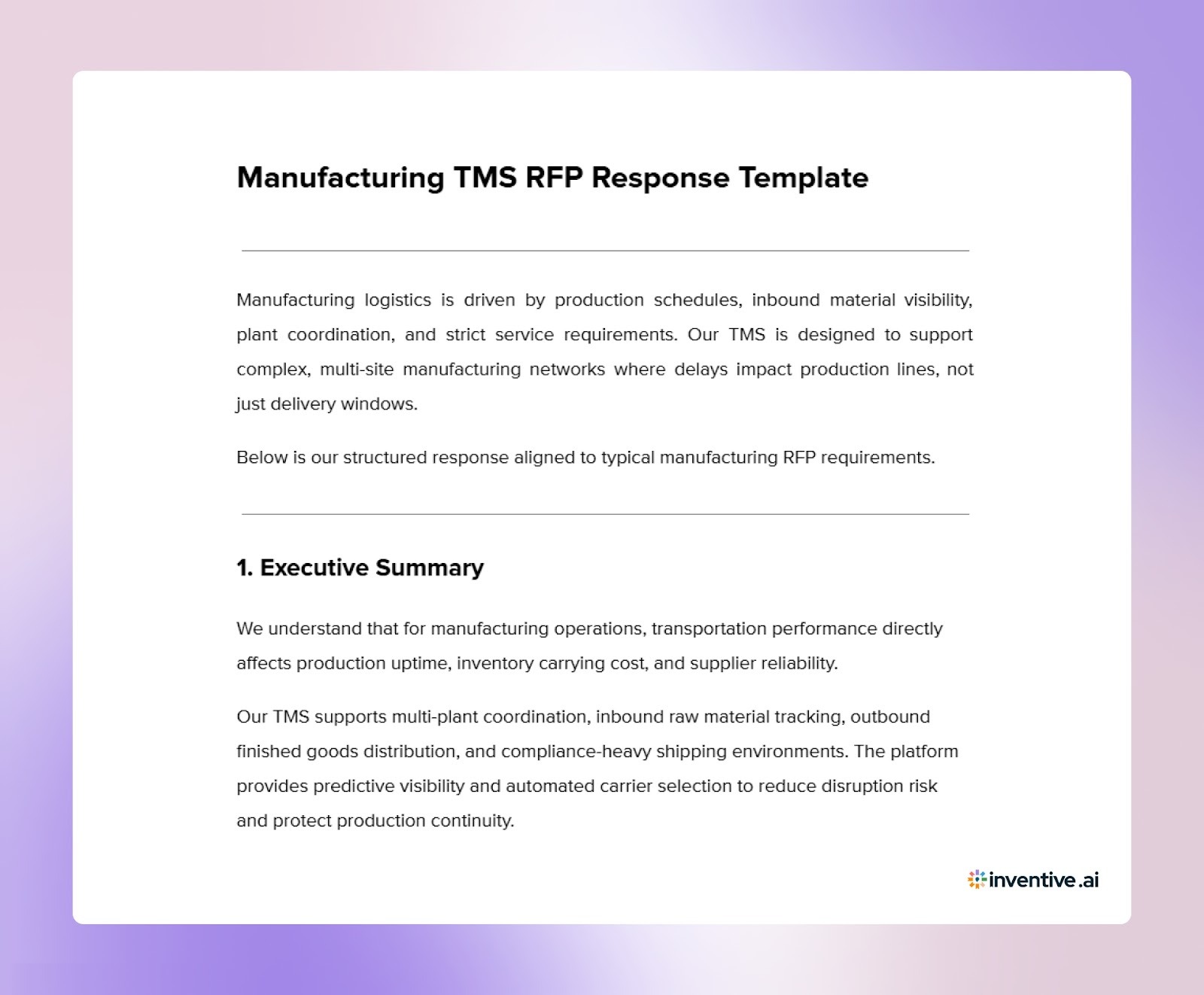
This template applies to multi-plant manufacturing environments where inbound visibility and production uptime are central to evaluation.
Your response should address:
- The executive summary focused on production continuity and supplier coordination
- Inbound raw material tracking and plant-level scheduling
- Multi-site coordination and inter-plant routing logic
- Mode selection rules tied to urgency and cost thresholds
- Predictive alerts to prevent line stoppages
- Freight audit controls segmented by plant or product line
This structure works best for vendors bidding on manufacturing TMS engagements where evaluators prioritize disruption prevention and cost governance.

3. 3PL / Logistics Provider TMS RFP Response Template
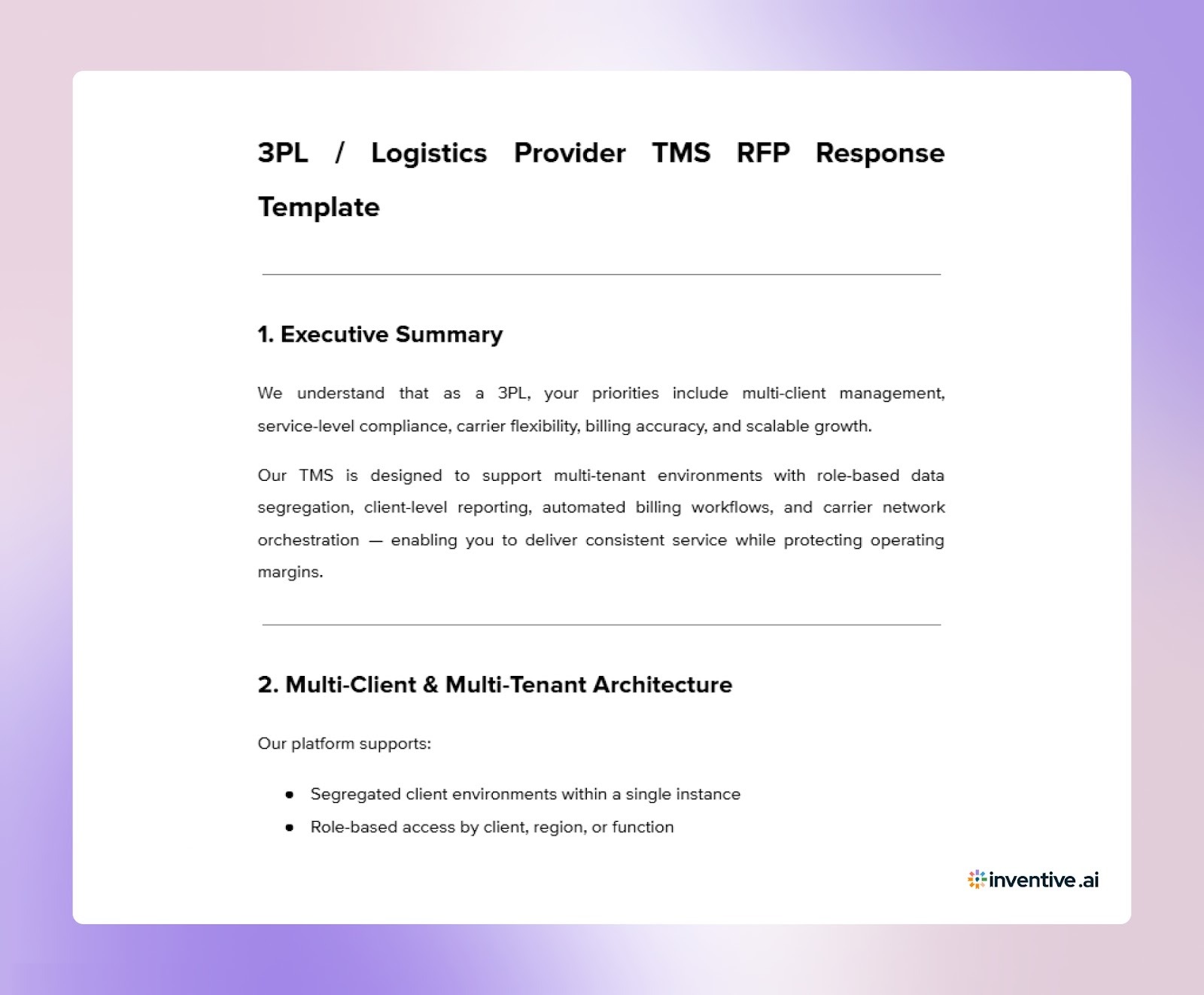
This template applies to third-party logistics providers where scalability, billing accuracy, and client reporting determine selection.
Your response should address:
- Executive summary centered on multi-client control and margin visibility
- Multi-tenant architecture with client-level data segregation
- Carrier onboarding, scorecards, and auto-tender escalation logic
- Client SLA tracking and performance dashboards
- Automated freight audit and client invoicing workflows
- API/EDI connectivity for multiple shipper systems
This structure works best for vendors bidding on 3PL TMS projects where scoring depends on operational flexibility, automation logic, and revenue protection.

After selecting the closest match, refine your response to mirror the buyer’s shipment mix, automation expectations, and evaluation weighting. A strong TMS proposal aligns directly with operational priorities rather than repeating generic product messaging.
How to Customize a TMS RFP Response Template?
A generic response rarely wins complex TMS deals. Buyers can immediately spot recycled language that ignores their shipment profile, network design, or margin pressures.
Customization is not about adding more pages; it is about tightening relevance and mapping your capabilities directly to their evaluation criteria.
To customize your TMS RFP response effectively, focus on the following:
- Mirror the Buyer’s Language: Use the terminology and KPIs stated in the RFP, such as dock-to-door or EDD accuracy. This signals that your response reflects their priorities, not a recycled template.
- Map to Scoring Criteria: If the RFP includes weighted evaluation categories, structure your response to match those sections exactly. Make it easy for evaluators to assign points in your favor.
- Highlight Relevant Use Cases: Replace generic case studies with examples from the buyer’s industry, such as retail, manufacturing, or 3PL. Shipment volume, mode mix, and network complexity should resemble their profile.
- Quantify Where Possible: Include measurable outcomes such as peak throughput handled, average label latency, audit recovery percentages, or SLA adherence rates. Specific numbers carry more weight than descriptive claims.
- Clarify Standard vs Custom Early: If a requirement requires configuration or development, state it clearly and explain the scope and timeline. Transparency builds trust and reduces later friction.
- Address Exceptions, Not Just the Happy Path: Show how your system handles carrier no-shows, short-ship messages, rate discrepancies, and service failures. Buyers care about disruption control more than feature lists.
- Customize the Executive Summary: Rewrite it for each opportunity. Reference the buyer’s industry, shipment mix, and stated pain points instead of leading with generic product messaging.
- Prepare Proof in Advance: If you mark a feature as standard, be ready to demonstrate it using the buyer’s sample data during finalist presentations.
Customizing your response in this way keeps it focused, credible, and directly tied to how the buyer will score and select a vendor.
Respond 10X Faster to TMS RFPs with Inventive AI
Writing a strong TMS RFP response is only half the battle. The real challenge is producing accurate, customized answers under tight deadlines while coordinating across sales, product, security, and finance teams. That is where structured AI support changes how proposal teams operate.
Here is how Inventive AI supports vendors responding to complex TMS RFPs:
Conflict Detection
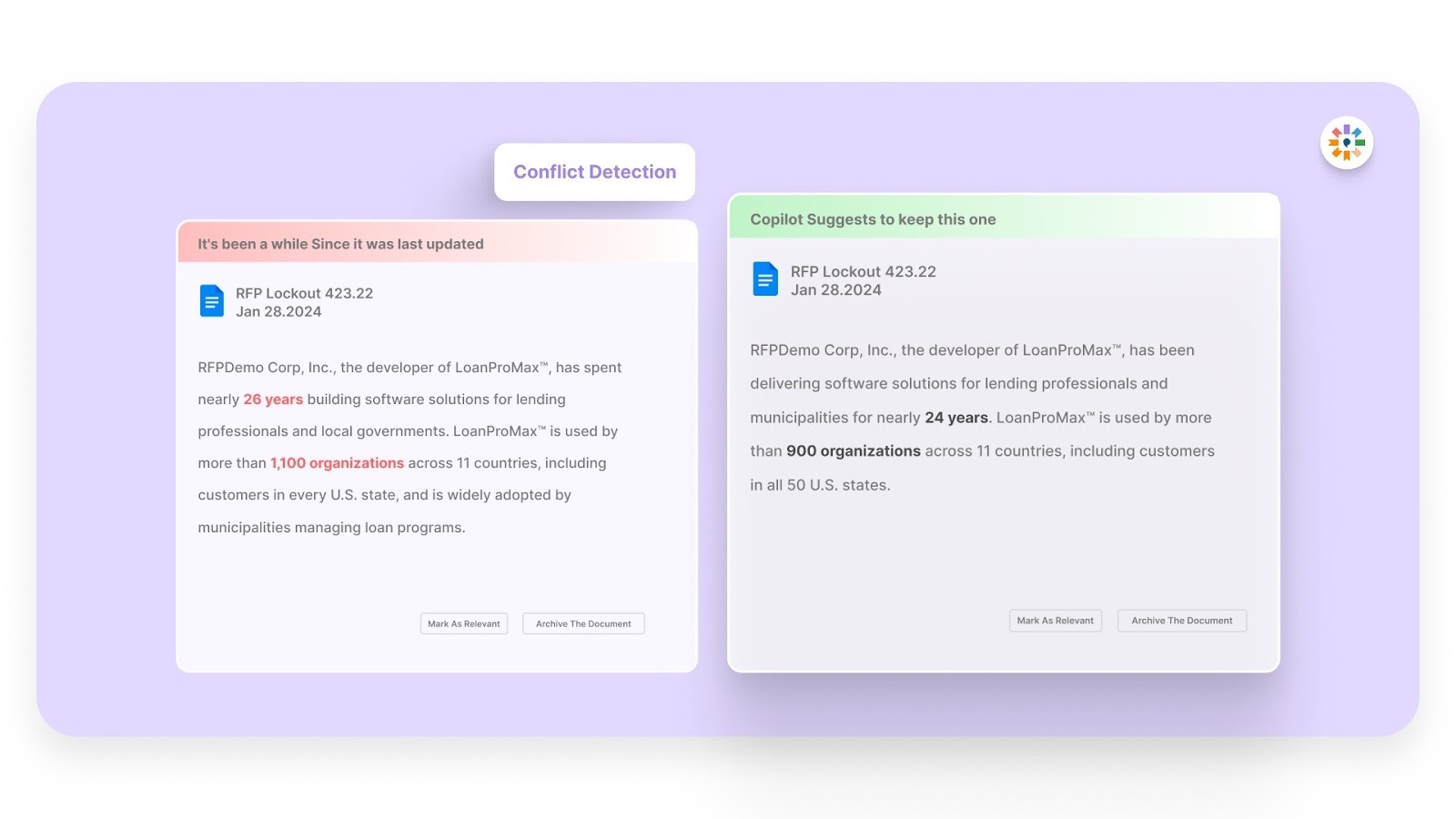
TMS proposals contain tightly connected sections such as compliance matrices, automation logic, carrier fallback rules, integration timelines, pricing tiers, and service commitments. Inconsistencies across these areas can raise red flags during evaluation.
Inventive AI flags contradictory statements instantly, helping teams correct mismatched functionality labels, implementation durations, or SLA metrics before submission.
Outdated Content Detection
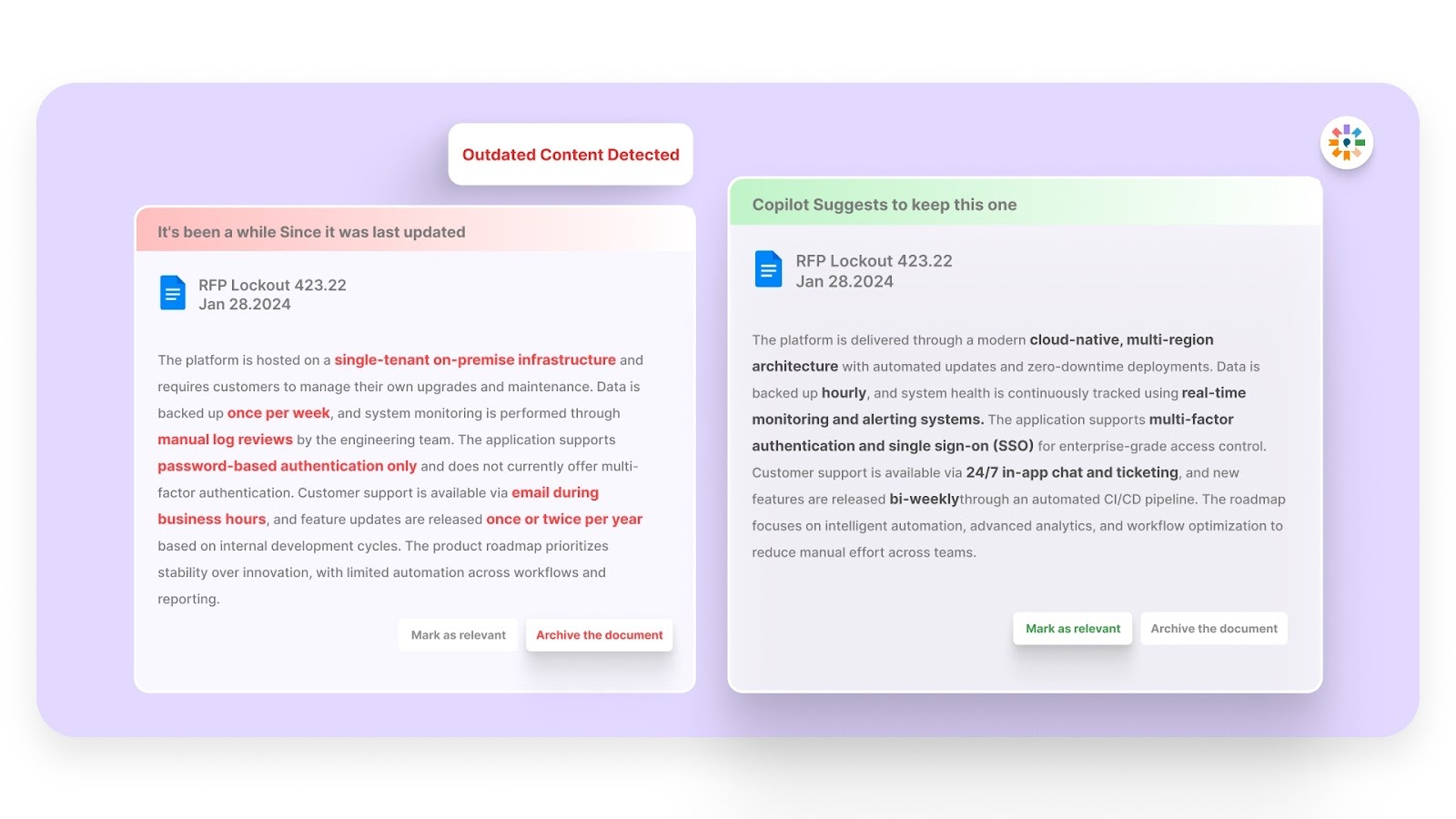
Supported EDI transactions, API capabilities, security certifications, and pricing models change over time. Many vendors store large libraries of legacy responses that may no longer reflect the current product state. Inventive AI automatically identifies outdated or non-compliant content inside drafts, reducing manual review effort and protecting accuracy in finalist rounds.
2X Higher-Quality, Score-Ready Responses

With its multi-agent AI system, Inventive AI interprets the intent behind complex TMS requirements, including auto-tender thresholds, exception workflows, multimodal routing logic, and predictive ETA accuracy. Responses are clearer, more complete, and structured around how evaluators assign points, resulting in stronger side-by-side comparisons.
Simple and Easy-to-Use UI and UX
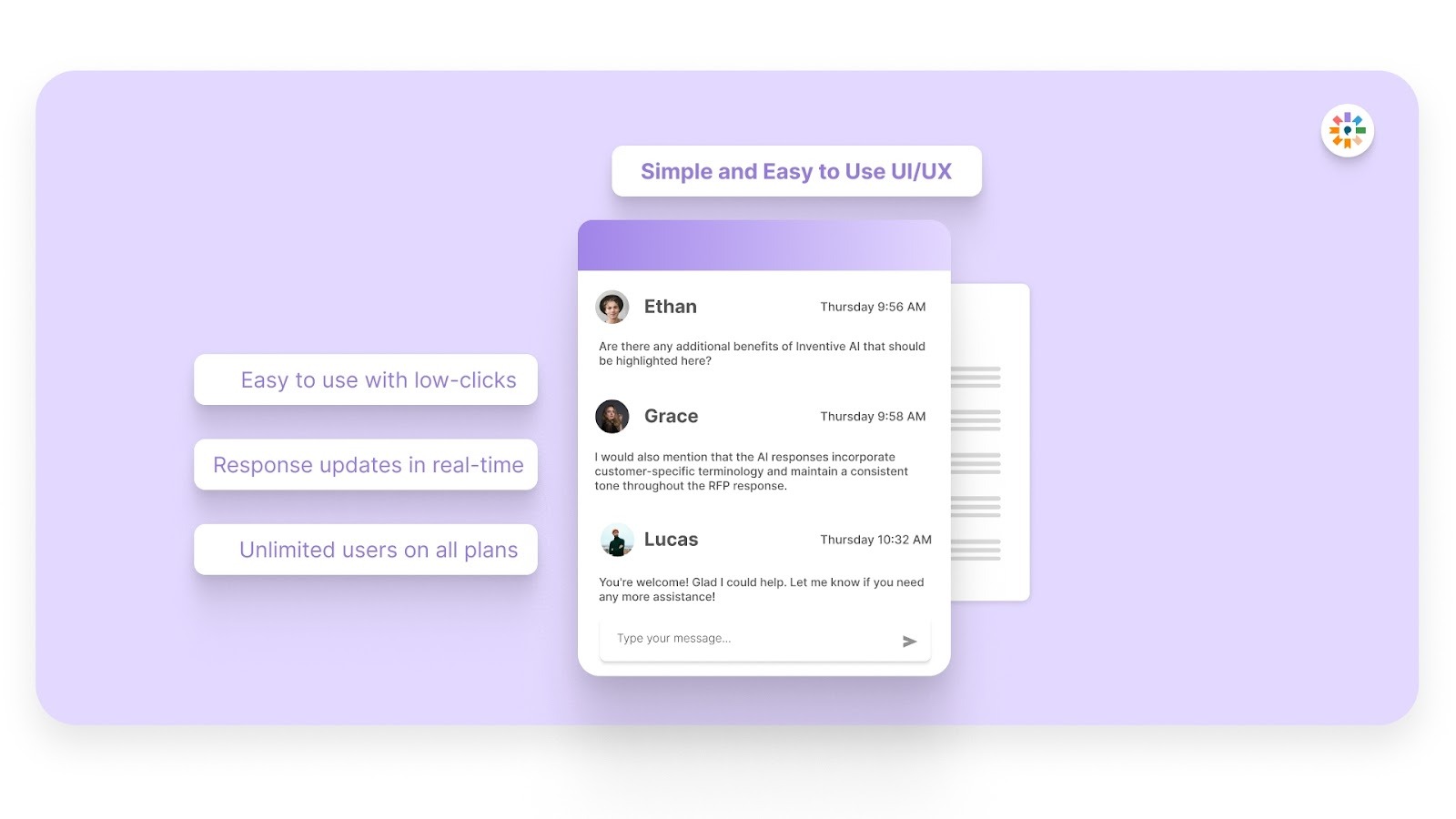
Inventive AI maintains a 100 percent adoption rate across its customer base and is ranked the easiest-to-use RFP software on G2. Sales, product, security, and implementation teams can collaborate within one workspace, reducing version confusion and accelerating submission readiness without adding operational friction.
If your team is responding to TMS RFPs with tight deadlines and complex compliance requirements, seeing the platform in action makes the difference.
FAQs
1. How long should a TMS RFP response typically be?
Length depends on shipment complexity and compliance depth, but clarity matters more than page count. Most enterprise TMS responses range from 30 to 80 pages, including appendices. Buyers prefer structured, requirement-mapped answers rather than lengthy marketing content.
2. Should vendors include product screenshots in a TMS RFP response?
Screenshots can help clarify workflows such as carrier selection, reporting dashboards, or freight audit screens. Include them only where they support a specific requirement. Avoid generic UI images that do not directly answer a stated question.
3. How can vendors handle confidential information in a TMS RFP?
If the RFP requires disclosure of sensitive architecture or pricing details, mark sections clearly as confidential. Many vendors provide certain documents, such as security certifications or financial statements, under NDA rather than embedding them directly in the main response.
4. What is the best way to handle requirements that are not fully supported?
Be direct. State whether the feature requires configuration, partner support, or future roadmap consideration. Buyers prefer clarity over vague acceptance. Offering a clear timeline or workaround builds credibility.
5. How early should vendors involve technical teams in a TMS RFP response?
Technical and product teams should be involved from the qualification stage, not just before submission. Early review helps confirm feasibility, estimate internal effort, and avoid last-minute revisions that create inconsistencies in the final proposal.

90% Faster RFPs. 50% More Wins. Watch a 2-Minute Demo.

Gaurav Nemade
After witnessing the gap between generic AI models and the high precision required for business proposals, Gaurav co-founded Inventive AI to bring true intelligence to the RFP process. An IIT Roorkee graduate with deep expertise in building Large Language Models (LLMs), he focuses on ensuring product teams spend less time on repetitive technical questionnaires and more time on innovation.

Hardi Hindocha
Knowing that complex B2B software often gets lost in jargon, Hardi focuses on translating the technical power of Inventive AI into clear, human stories. As a Sr. Content Writer, she turns intricate RFP workflows into practical guides, believing that the best content educates first and earns trust by helping real buyers solve real problems.