
How to Write a Website Design RFP in 2026? Template + Best Practices
This guide breaks down how website RFPs are structured, what buyers typically include, and why these documents create recurring challenges for vendors.

A web design request for proposal (RFP) is one of the most common ways organizations evaluate agencies for high-impact website projects. From full website development to redesigns, CMS migrations, and long-term maintenance, website RFPs are used when the scope is complex, the budget is meaningful, and multiple stakeholders are involved.
Across business and procurement teams, RFPs have been shown to influence about 30-40% of total company revenue, meaning that how well an organization manages and responds to RFPs directly affects its financial results.
For teams responding to these RFPs, website projects often look deceptively simple from the outside. In reality, website RFPs frequently bundle branding, UX, engineering, content, integrations, accessibility, and ongoing support into a single document, often written by committees with competing priorities.
This guide breaks down how website RFPs are structured, what buyers typically include, and why these documents create recurring challenges for vendors.
TL;DR (Key Takeaways)
- A website RFP is not a checklist; it’s a decision framework.
The strongest website RFPs clearly define goals, constraints, and evaluation priorities, so vendors can propose thoughtful solutions rather than guess what the buyer wants. - Buyers get better proposals when they explain trade-offs, not just requirements.
Vendors perform best when RFPs clarify what matters most (speed vs. scalability, CMS flexibility vs. control, budget certainty vs. innovation), rather than listing every possible feature. - Vendors win by interpreting intent, not copying boilerplate.
High-scoring website RFP responses demonstrate judgment by calling out assumptions, risks, and alternatives, rather than delivering generic, templated answers that evaluators quickly discount. - Most website RFP failures come from coordination gaps, not writing quality.
Inconsistent answers, outdated case studies, and missed technical nuances usually stem from poor knowledge reuse across sales, engineering, and marketing teams. - Inventive AI helps vendors respond to website RFPs faster and with higher-quality, context-aware answers, reducing rewrites and improving win rates by up to 50%.
What Is a Web Design Request for Proposal?
A web design request for proposal is a formal document issued by an organization to solicit proposals from web design or development vendors.
It outlines the organization’s goals, scope, requirements, timelines, and evaluation criteria so vendors can submit structured, comparable responses.
Website RFPs are commonly used for:
- Website development RFPs for net-new builds
- Website redesign request for proposal initiatives
- CMS replatforming or migration projects
- Ongoing website support, optimization, or maintenance
Unlike informal briefs or discovery calls, an RFP is designed to standardize vendor evaluation. Every agency is expected to respond to the same questions, follow the same format, and meet the same deadlines.
From a vendor perspective, this means website RFPs are not just sales documents. They are compliance-driven, detail-heavy submissions that often require coordination across sales, design, engineering, SEO, content, security, and leadership teams.
What Buyers Typically Include in Website RFPs (and Why It’s Often Messy)?
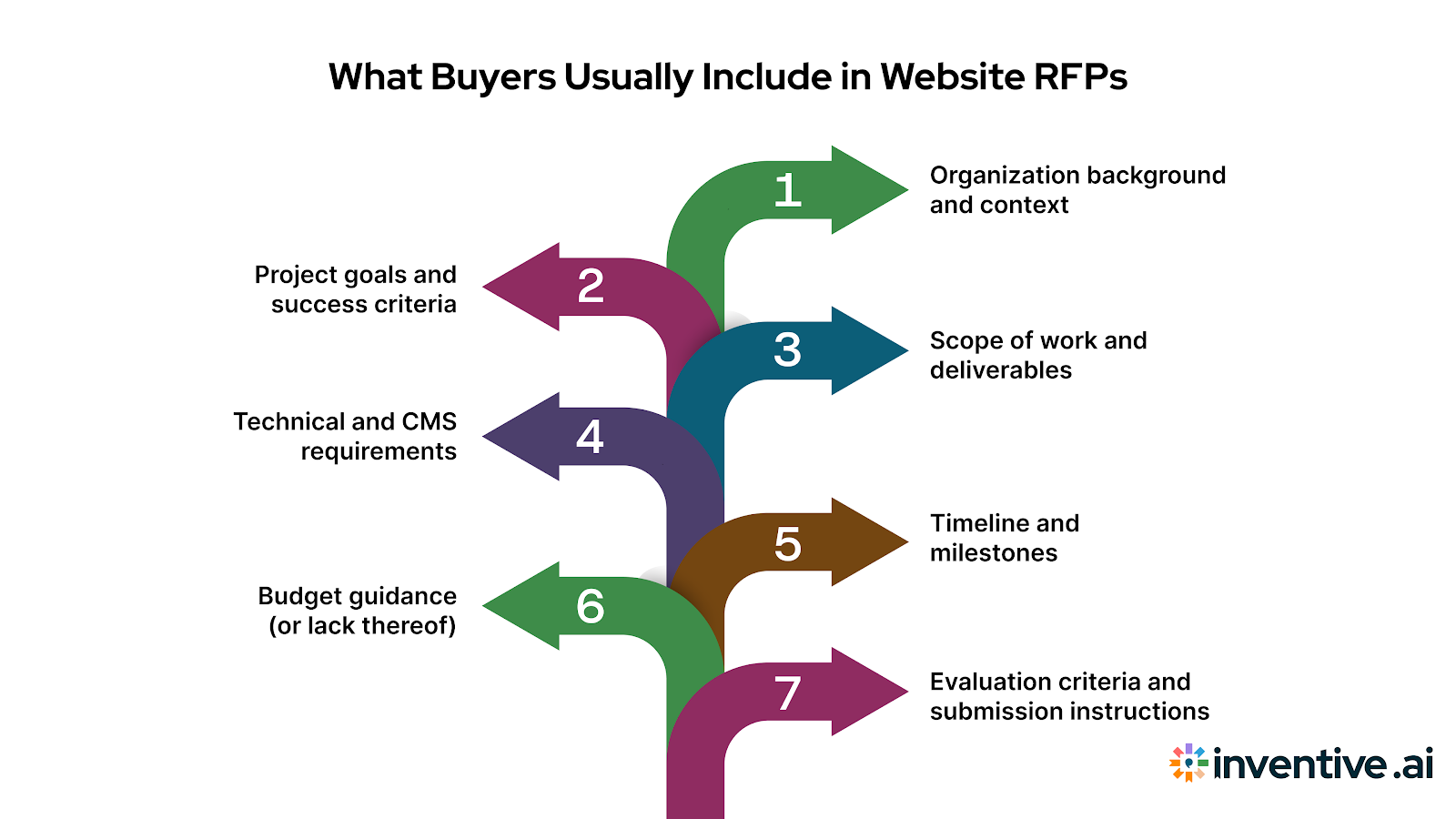
Most website RFPs follow a similar structure, even though the quality and clarity vary widely.
Buyers usually attempt to capture everything they think a vendor might need to know upfront, which often results in long documents with uneven depth.
Common sections found in a website RFP include:
- Organization background and context
Buyers describe who they are, what they do, and why the website project exists. This section is often high-level and written for an external audience that may not be familiar with the organization. - Project goals and success criteria
These may include brand refresh goals, lead generation targets, performance improvements, or internal usability needs. In many RFPs, goals are aspirational but not prioritized. - Scope of work and deliverables
Buyers list expected services such as UX design, visual design, frontend and backend development, CMS configuration, integrations, accessibility compliance, and post-launch support. Scope is frequently broad, with limited guidance on what matters most. - Technical and CMS requirements
This section may specify preferred platforms, integrations, hosting constraints, security requirements, or accessibility standards. In some cases, buyers mandate tools they no longer fully understand or that conflict with stated goals. - Timeline and milestones
Website RFP timelines are often aggressive, driven by internal launches, campaigns, or leadership expectations rather than delivery reality. - Budget guidance (or lack thereof)
Some RFPs provide clear budget ranges. Others omit the budget entirely, expecting vendors to “propose the right solution,” which makes meaningful comparison difficult. - Evaluation criteria and submission instructions
Buyers outline how proposals will be scored, what format to use, and when responses are due. These sections are critical but are often buried late in the document.
Also read: How to Master Vendor Selection and Boost Win Rates?
From the outside, this structure looks logical. In practice, website RFPs are frequently written by multiple stakeholders, each contributing their own priorities.
The result is a document that is technically complete but internally inconsistent, with overlapping requirements and unclear trade-offs.
Common Mistakes Buyers Make When Writing Website RFPs
Even well-intentioned website RFPs often fail to produce strong proposals, not because agencies lack capability, but because the RFP itself introduces ambiguity or misalignment.
The most common buyer-side mistakes include:
1. Over-specifying solutions instead of outcomes
Many website RFPs mandate specific tools, platforms, or architectures before clearly defining business goals. This limits vendor creativity and results in proposals that technically comply but fail to solve the underlying problem.
2. Omitting budget ranges entirely
When buyers withhold budget guidance, vendors are forced to guess. This leads to proposals that vary wildly in scope and quality, making objective comparison difficult and increasing evaluation effort later.
3. Conflicting priorities across stakeholders
Website RFPs are often written by committees. Without alignment, the document may simultaneously emphasize speed, customization, scalability, cost control, and innovation, without clarifying trade-offs. Vendors then struggle to interpret what truly matters.
4. Unrealistic timelines disconnected from the scope
Aggressive timelines driven by internal deadlines rather than delivery reality create downstream risk. Vendors may comply on paper but compensate through reduced depth, phased delivery, or hidden assumptions.
5. Vague or buried evaluation criteria
When scoring criteria are unclear or introduced late in the document, vendors cannot tailor responses effectively. This results in generic proposals that fail to differentiate, even when the vendor is a strong fit.
Buyers who avoid these pitfalls consistently receive clearer, more relevant proposals and reduce friction throughout the selection process.
Website RFP Template (For Buyers)
If you’re issuing a web design request for proposal, clarity matters more than length. The goal of a website RFP is not to sound technical; it’s to help agencies understand your business context, scope, constraints, and success criteria well enough to submit comparable, realistic proposals.
Below is a practical, buyer-side Website RFP framework that reflects how high-quality agencies evaluate projects.
You don’t need to include every section verbatim, but omitting key inputs (budget, scope boundaries, technical constraints) often leads to misaligned proposals.
To help you move faster, we’ve included:
- A short example excerpt below (to show depth and tone)
- A complete, buyer-ready Website RFP template you can download and reuse
Website RFP Example (Excerpt)
Project Overview (Example)
We are seeking a web design and development partner to redesign our existing B2B website to better support demand generation, product education, and sales enablement.
Our current site does not reflect our product maturity and requires significant developer involvement for routine updates.
This RFP is intended to identify a long-term partner capable of delivering a scalable, high-performance website aligned with our growth goals.
Project Goals (Example)
Success for this project will be measured by:
- Increased qualified demo requests
- Improved content discoverability across solution pages
- Reduced dependency on developers for CMS updates
📄 Download the Complete Website RFP Template (Buyer-Ready)
The downloadable template includes:
- A clean, structured Website RFP outline
- Fill-in-the-blank sections buyers can customize
- Evaluation criteria and submission checklist
- Language aligned with modern website development RFPs
→ Download the Website RFP Template (PDF)
Related:
How Buyers Evaluate Website RFP Responses (What Actually Matters)
Once website RFP responses are submitted, buyers rarely evaluate them line by line. Despite long documents and detailed requirements, most evaluation decisions are driven by a small set of signals that indicate whether a vendor can execute reliably under real-world constraints.
Strong proposals reduce uncertainty. Weak ones increase it. Across most website request for proposal evaluations, buyers consistently prioritize the following factors.
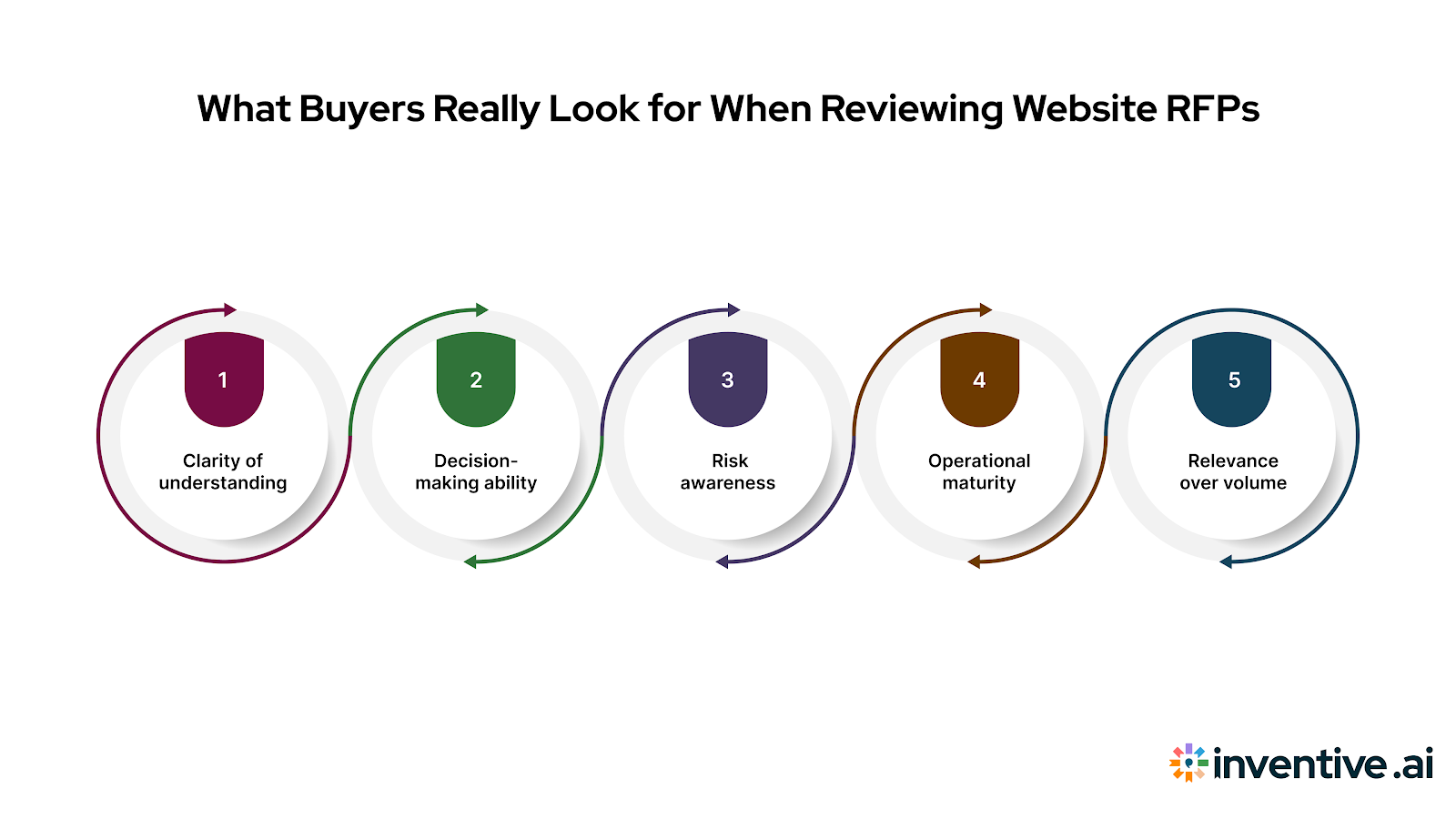
1. Clarity of Understanding
Buyers look for clear evidence that the vendor understands the underlying business problem, not just the surface-level requirements.
High-scoring responses demonstrate that the vendor has interpreted goals, constraints, and success criteria accurately and can articulate them back in a way that shows judgment. Simply restating the RFP language, even in polished form, does not signal understanding.
What buyers are asking themselves:
“Do they understand why we’re doing this, or are they just responding to prompts?”
2. Decision-Making Ability
Buyers do not expect vendors to blindly follow instructions. They expect informed recommendations.
Strong website RFP responses explain why certain approaches are proposed, what trade-offs are being made, and how those decisions align with stated goals such as scalability, performance, or governance.
Responses that avoid taking a position or hedge excessively tend to score lower, even if technically sound.
What buyers are asking themselves:
“Can this team make good decisions when the brief isn’t perfect?”
3. Risk Awareness
Website projects fail most often due to missed dependencies, unrealistic timelines, or unclear ownership.
Buyers favor responses that acknowledge risk early and explain how it will be managed. This includes calling out assumptions, dependencies on internal stakeholders, content readiness, or technical constraints.
Ignoring risk does not make it disappear; it signals inexperience.
What buyers are asking themselves:
“Do they see the same risks we do, and do they know how to manage them?”
4. Operational Maturity
Beyond creative ideas or technical skills, buyers assess whether the vendor can execute consistently.
Clear timelines, defined ownership models, review cycles, escalation paths, and post-launch support plans all signal operational maturity. Vague or overly optimistic delivery narratives raise concern, even if the proposed solution is attractive.
What buyers are asking themselves:
“Can this team deliver under real conditions, not just ideal ones?”
5. Relevance Over Volume
Long responses do not score higher by default.
Buyers consistently prefer proposals that prioritize what matters most and explain it clearly. Concise, well-structured answers that address evaluation-heavy sections directly outperform long, unfocused submissions.
Excessive boilerplate, generic case studies, or repeated explanations often dilute confidence rather than build it.
What buyers are asking themselves:
“Did they respect our time and focus on what actually matters?”
The strongest proposals make buyers feel informed and reassured, not overwhelmed.
Also read: How to create an effective RFP response
Once buyers define how they evaluate website RFPs, the quality of outcomes depends on how well vendors interpret and respond to those expectations. The challenge is that website RFPs rarely arrive in a clean or consistent form from the vendor side.
Four Common Types of Website RFPs Vendors Encounter
Not all website RFPs are created equal. For response teams, understanding the type of website RFP is often more important than the label used in the document.
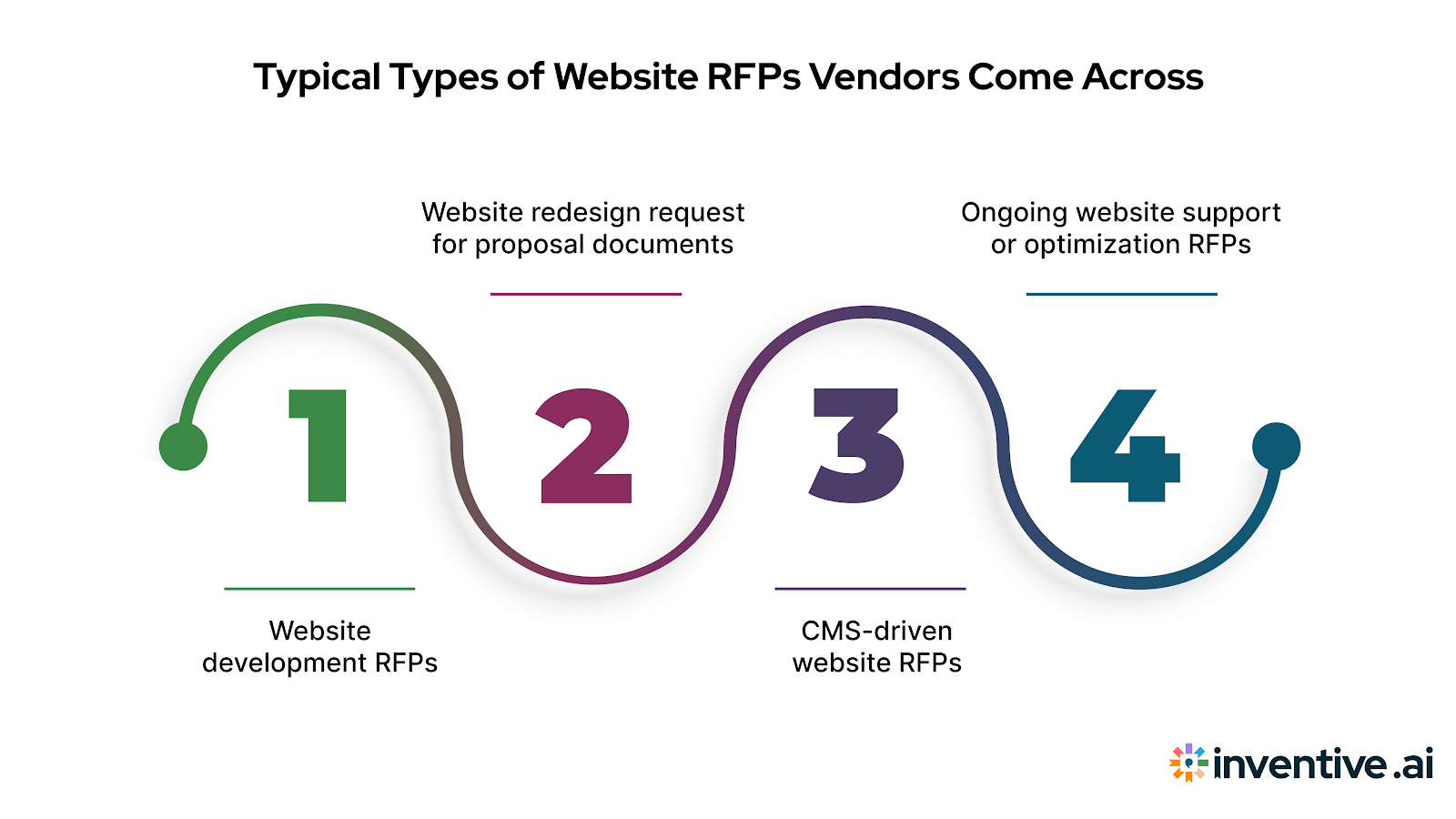
The most common categories include:
- Website development RFPs
Issued when an organization is building a new site from scratch. These RFPs tend to be broad, with heavy emphasis on discovery, architecture, and long-term scalability. - Website redesign request for proposal documents
Focused on reworking an existing site. These often include legacy constraints, content migration challenges, and internal opinions tied to the current design. - CMS-driven website RFPs
Centered on a specific platform requirement or migration. These RFPs often over-index on technical checklists while under-specifying business outcomes. - Ongoing website support or optimization RFPs
Issued after an initial build, these RFPs prioritize process, responsiveness, and governance rather than pure design execution.
For vendors, each type requires a different response strategy, different resourcing assumptions, and different risk tolerance. Treating all website RFPs the same is one of the fastest ways for response quality to degrade.
What Website RFPs Look Like From the Vendor Side?
From a vendor’s perspective, a web design request for proposal rarely arrives as a clean, linear document. Even well-intentioned website RFPs tend to bundle multiple problem statements into a single submission requirement.
Vendors typically see website RFPs that:
- Combine branding, UX, engineering, SEO, content, and hosting into one scope
- Mix high-level business goals with low-level technical checklists
- Contain conflicting signals about priorities (for example, speed vs. customization, budget sensitivity vs. premium expectations)
- Are written by multiple stakeholders with different evaluation lenses
For agencies and web development firms, this creates a fundamental challenge. The RFP is not just asking what you will build, but how you think, how you manage risk, and how you interpret ambiguity.
This is why many website RFP responses end up bloated. Vendors attempt to cover every possible angle to avoid disqualification, even when certain sections are clearly lower priority. Over time, this leads to:
- Long responses with repeated explanations across sections
- Generic answers reused from previous website development RFPs
- Inconsistent tone between the technical, creative, and commercial sections
Ironically, the more complex the website RFP, the more likely vendors are to default to safe, non-differentiated language, exactly the opposite of what buyers want.
How Vendors Should Evaluate Website RFPs Before Responding (Go/No-Go)?
Not every website RFP is worth responding to. High-performing agencies apply a structured go/no-go decision before committing resources to a response.
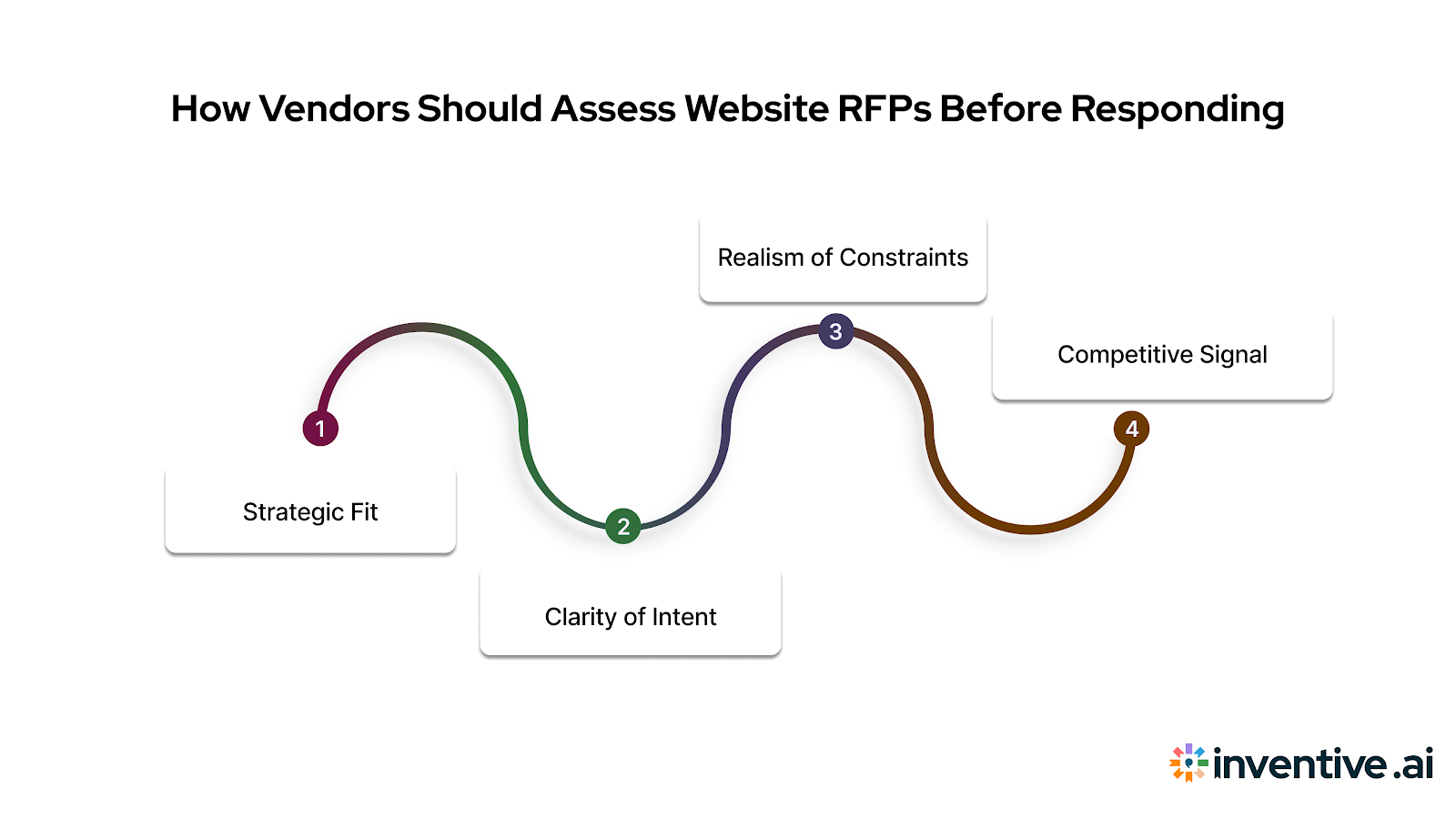
Before drafting a single word, vendors should evaluate a website RFP across four dimensions:
1. Strategic Fit
Does the project align with your core strengths?
For example, a highly regulated website RFP with heavy accessibility and security requirements may not suit a studio optimized for marketing-led brand sites.
2. Clarity of Intent
Is the buyer clear about what problem they are trying to solve?
Website RFPs that list features without articulating business outcomes often lead to scope creep and misaligned expectations later.
3. Realism of Constraints
Are the timeline and budget compatible with the stated scope?
A common red flag in website redesign request for proposal documents is an enterprise-scale scope paired with small-agency timelines or mid-market budgets.
4. Competitive Signal
Does the RFP indicate a fair evaluation process?
Signals like clear scoring criteria, transparent timelines, and a limited vendor shortlist often indicate a serious buying motion. Vague instructions and open-ended submissions usually do not.
Strong vendor teams decline more website RFPs than they pursue. This discipline improves win rates and protects response quality across the deals they do choose to chase.
How Vendors Can Respond Effectively to Website RFPs?
Once a website RFP passes the go/no-go filter, response quality becomes the differentiator.
Effective website RFP responses do not attempt to answer everything equally.
Instead, they focus on interpretation, prioritization, and relevance.
High-quality responses consistently do three things:
- Mirror buyer language without copying it verbatim
Buyers want to see their goals reflected back to them, but reframed with clarity and expertise. - Resolve ambiguity rather than restating it
When requirements conflict or lack detail, strong responses explain assumptions and propose rational paths forward. - Adapt depth by section
Not every section deserves the same level of detail. Evaluation-heavy sections should be treated differently from administrative ones.
This is where many teams struggle. Website RFPs often require contributions from sales, design, engineering, SEO, legal, and leadership, all working under deadline pressure.
Without a structured response approach, answers become inconsistent, repetitive, or disconnected.
5 Common Mistakes Vendors Make in Website RFP Responses
Even experienced agencies lose website RFPs for avoidable reasons. These mistakes don’t usually come from a lack of capability; they come from how responses are structured, interpreted, and presented.
Some of the most common issues buyers see in website development RFP responses include:
1. Over-answering low-value sections
Vendors often spend excessive time on boilerplate sections like company history or generic methodology while under-explaining critical areas such as CMS strategy, scalability, or post-launch ownership. This creates an imbalance that weakens the overall proposal.
2. Generic reuse across proposals
Many website RFP responses reuse language from past submissions with minimal adaptation. Buyers can quickly tell when answers were written for “a website” rather than their website. This is especially visible in sections around goals, target audiences, and success metrics.
3. Failure to connect strategy to execution
Some responses describe strong ideas, UX principles, SEO best practices, and performance goals, but fail to explain how those ideas translate into concrete deliverables. Buyers are left unsure how vision becomes reality.
4. Inconsistent voice across sections
Website RFPs often require input from multiple contributors. Without tight coordination, responses end up with conflicting tones, assumptions, or even contradictions between technical and commercial sections.
5. Avoiding uncertainty instead of addressing it
When requirements are unclear, weak responses ignore the ambiguity. Strong responses surface it, explain assumptions, and show how the vendor would de-risk execution.
From a buyer’s perspective, these mistakes signal operational risk, even if the vendor’s portfolio is impressive.
Where Website RFP Processes Break Down (And Why Quality Suffers)?
Website RFPs fail most often not because teams lack intent, but because the process breaks under coordination pressure.
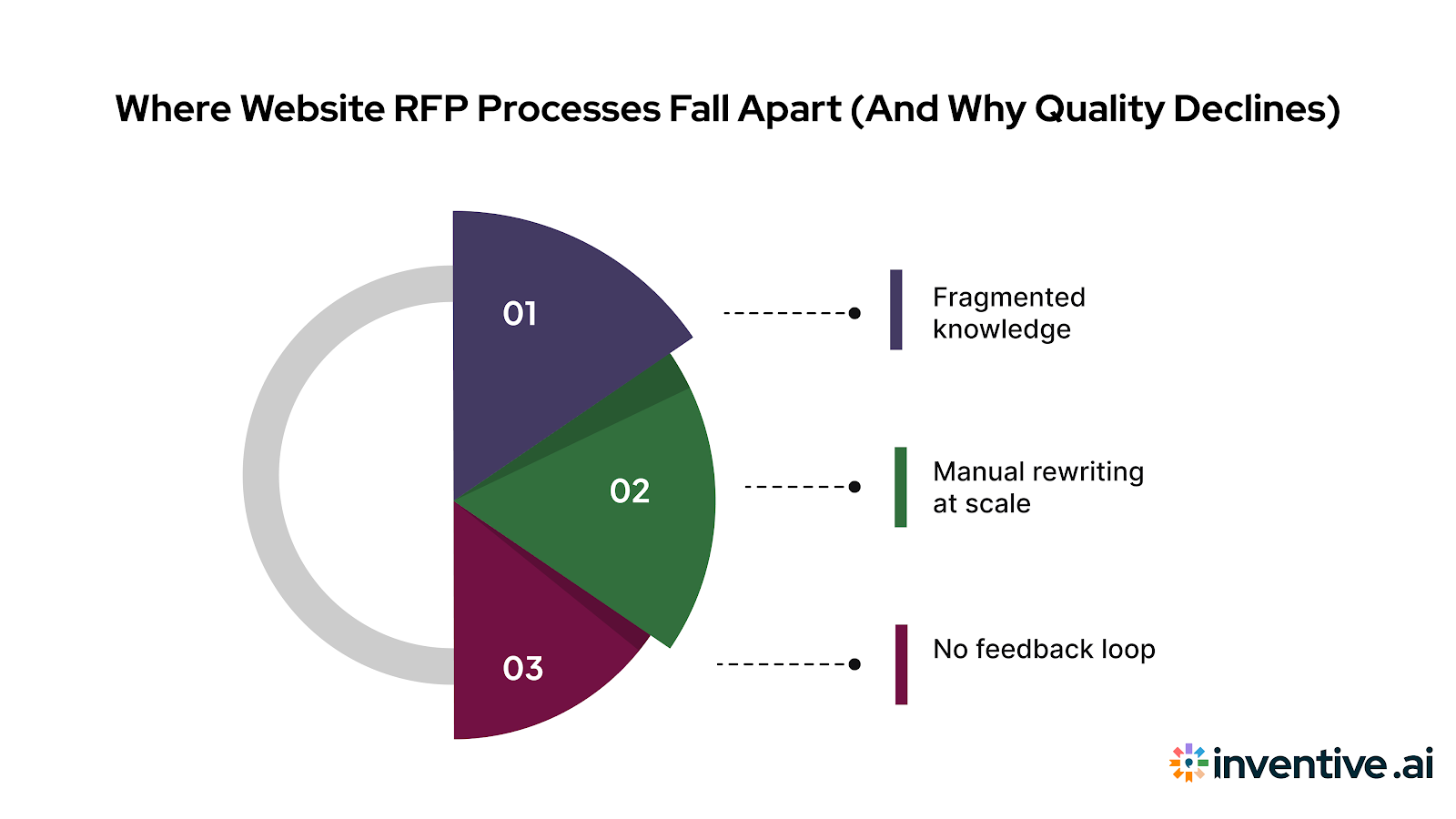
Across both buyers and vendors, breakdowns typically occur in three places:
1. Fragmented knowledge
Website RFPs pull input from marketing, IT, design, security, legal, and leadership. When information lives across docs, emails, and spreadsheets, responses become inconsistent or outdated.
2. Manual rewriting at scale
Teams repeatedly answer similar questions across website development RFPs, but each time from scratch. This increases effort without improving response quality.
3. No feedback loop
Most teams never analyze why a website RFP was won or lost. Without learning loops, response quality plateaus, even as volume increases.
Over time, this leads to slower responses, lower confidence in submissions, and missed opportunities in competitive evaluations.
How Inventive AI Supports High-Quality Website RFP Responses?
Website RFPs are rarely lost because a vendor lacks design or development skills. They are lost when responses feel generic, internally inconsistent, or disconnected from how the project would actually be delivered.
Inventive AI is built to help web agencies and development teams produce clear, aligned, and submission-ready website RFP responses, especially when inputs span sales, design, engineering, SEO, and leadership teams.
Rather than treating website RFPs as collections of standalone questions, Inventive analyzes the entire RFP context, business goals, technical constraints, CMS requirements, timelines, and evaluation criteria, so responses stay coherent across creative, technical, and commercial sections.
Key Capabilities (Designed for Website RFP Execution)
- RFP-wide context interpretation
Inventive reasons across the full website RFP, allowing responses in UX, CMS, performance, accessibility, and support sections to stay aligned with stated goals and constraints. This prevents common issues where design vision, technical approach, and delivery timelines contradict each other. - Grounded responses based on real agency knowledge
Drafts are generated from approved internal content such as past website RFPs, case studies, delivery methodologies, CMS practices, and technical documentation. This produces answers that reflect how the agency actually works, not generic web-agency language. - Automatic detection of inconsistencies and stale claims
Website RFPs often expose contradictions, such as mismatched CMS capabilities, outdated performance metrics, or conflicting accessibility statements. Inventive flags these issues before submission, reducing credibility risk in evaluation-heavy sections. - Structured collaboration across creative and technical teams
Design, engineering, SEO, and sales contributors work from a shared, governed response layer. This keeps tone, assumptions, and terminology consistent, even when multiple specialists contribute under deadline pressure. - Reusable, evolving website RFP knowledge
Validated responses are retained in a structured form, making future website development RFPs faster to respond to without repeating the same clarification and rewrite cycles. Over time, this improves response quality instead of just response speed.
Why This Matters for Website RFPs
Website RFPs reward vendors who demonstrate judgment, not volume. Buyers are looking for teams that can interpret ambiguity, explain trade-offs, and show how strategy translates into execution.
Inventive AI supports that expectation by reinforcing clarity, consistency, and delivery realism across proposals, helping agencies submit responses that evaluators trust, rather than skim.
What Customers Say
“Saved our presales team a ton of time. Response quality is high, and the AI is especially useful for ad-hoc website and qualification questions.”
- Verified G2 reviewer, Solutions Engineering team
Frequently Asked Questions (FAQs)
1. What makes a website RFP response stand out to buyers?
Strong responses demonstrate understanding of the buyer’s goals, clearly state assumptions, address risks, and explain trade-offs. Buyers consistently favor proposals that connect technical decisions to business outcomes rather than generic feature lists.
2. Who should create a website RFP within an organization?
A website RFP is usually created collaboratively. Marketing teams define goals and audiences, IT or engineering teams clarify technical constraints, and procurement or leadership teams set budgets, timelines, and evaluation rules. One owner should coordinate inputs to keep the document consistent.
3. How detailed should a website RFP be?
A good website RFP balances clarity and flexibility. It should clearly state goals, constraints, and priorities, but avoid prescribing exact solutions. Overly vague RFPs lead to poor proposals, while overly rigid ones limit vendor creativity and innovation.
4. Should a website RFP include a budget range?
Yes. Including a budget range helps vendors propose realistic approaches and prevents wasted effort on proposals that are misaligned from the start. Even an approximate range is better than no budget disclosure.
5. What’s the difference between a website RFP and a website RFQ?
A website RFP evaluates how vendors will solve a problem, including approach, experience, and strategy. A request for quote (RFQ) focuses primarily on pricing for a clearly defined scope. Most website projects benefit more from an RFP than an RFQ.
6. How long does the website RFP process usually take?
From issuing the RFP to final vendor selection, the process typically takes 4-8 weeks. This includes the response window, clarification period, proposal evaluation, and vendor interviews or demos if required.

90% Faster RFPs. 50% More Wins. Watch a 2-Minute Demo.

Dhiren Bhatia
Tired of watching deal cycles stall due to manual questionnaire back-and-forth, Dhiren co-founded Inventive AI to turn the RFP process from a bottleneck into a revenue accelerator. With a track record of scaling enterprise startups to successful acquisition, he combines strategic sales experience with AI innovation to help revenue teams close deals 10x faster.
.jpeg)
Mukund Kumar
Understanding that sales leaders struggle to cut through the hype of generic AI, Mukund focuses on connecting enterprises with the specialized RFP automation they actually need at Inventive AI. An IIT Jodhpur graduate with 3+ years in growth marketing, he uses data-driven strategies to help teams discover the solution to their proposal headaches and scale their revenue operations.