
Evaluate the Strategic Response Management Company Loopio on DDQ
An in-depth evaluation of Loopio for Due Diligence Questionnaire (DDQ) automation. We assess its strengths in content library management and core workflows, and expose limitations in compliance auditability, advanced AI, and automated content freshness.
This evaluation assesses Loopio's fitness for responding to DDQs and Security Questionnaires, which are high-stakes documents focusing on risk management, regulatory compliance, and operational security. DDQ automation requires granular content governance, audit trails, and consistent accuracy to satisfy Legal, Finance, and InfoSec teams.
Loopio is utilized for this purpose, leveraging its core strength—the Centralized Knowledge Repository—to answer repetitive security and compliance questions efficiently.
Our assessment uses four criteria that define a specialized DDQ automation platform:
- Q&A Content Library Depth: Ability to manage thousands of highly technical, compliance-oriented Q&A pairs.
- Compliance Auditability: Features for linking answers to verifiable evidence, certifications, or internal policies.
- Content Governance for Risk: Native features for version control, content locking, and flagging conflicting or stale data.
- AI Response Quality & Context: The sophistication of the AI for generating accurate, context-aware security responses.
How Loopio Performs Against DDQ Automation Requirements
Loopio is for DDQ and security questionnaire automation because the process relies heavily on the reuse of standard, factual answers. Loopio's intelligent automation and strong collaboration features significantly reduce the time spent chasing SMEs and copying/pasting answers.
However, the AI's reliance on content retrieval means it inherits the limitations of a static library.
Where Loopio Performs Well and Key Limitations of Using Loopio for DDQ Automation
Loopio is a tool for organizations seeking to manage and scale their security and compliance responses efficiently.
Loopio Strengths for DDQ Automation
- Centralized Content Library: Provides the necessary single source of truth for all security policies, certifications, and compliance answers, drastically reducing response time.
- Effective Workflow and Collaboration: Good at managing complex, cross-functional sign-offs, routing questions to the correct InfoSec or Legal expert, and tracking deadlines.
- Proven Scalability for Questionnaires: Case studies confirm Loopio's ability to handle high volume, enabling teams to double or triple their throughput of security and vendor questionnaires.
- Strong Security Foundation: Certified by SOC 2 Type II audit and utilizes data encryption, meeting a base requirement for handling sensitive DDQ content.
Key Limitations of Using Loopio for DDQ Automation
Loopio's architecture, built around content retrieval, creates specific gaps against modern risk management needs:
- Heavy Content Maintenance Burden: Requires significant and often manual maintenance to keep the static DDQ content library accurate, a labor-intensive process that risks using stale compliance data.
- Weaker Generative AI Context: Its AI primarily retrieves and summarizes existing content, often resulting in generic responses that require heavy manual rewriting to address unique or nuanced security questions.
- Limited Proactive Risk Management: Lacks the advanced AI capabilities to proactively flag conflicting answers or inconsistencies in compliance statements across the library, increasing legal risk.
- Formatting and Export Issues: Users frequently report the need for extra editing and manual work to fix formatting after exporting responses, a time-consuming issue for complex DDQ spreadsheets.
- Content Source Isolation: The library is often separate from the company's GRC system (like Vanta or AuditBoard), requiring the manual syncing of official policy documentation and security evidence.
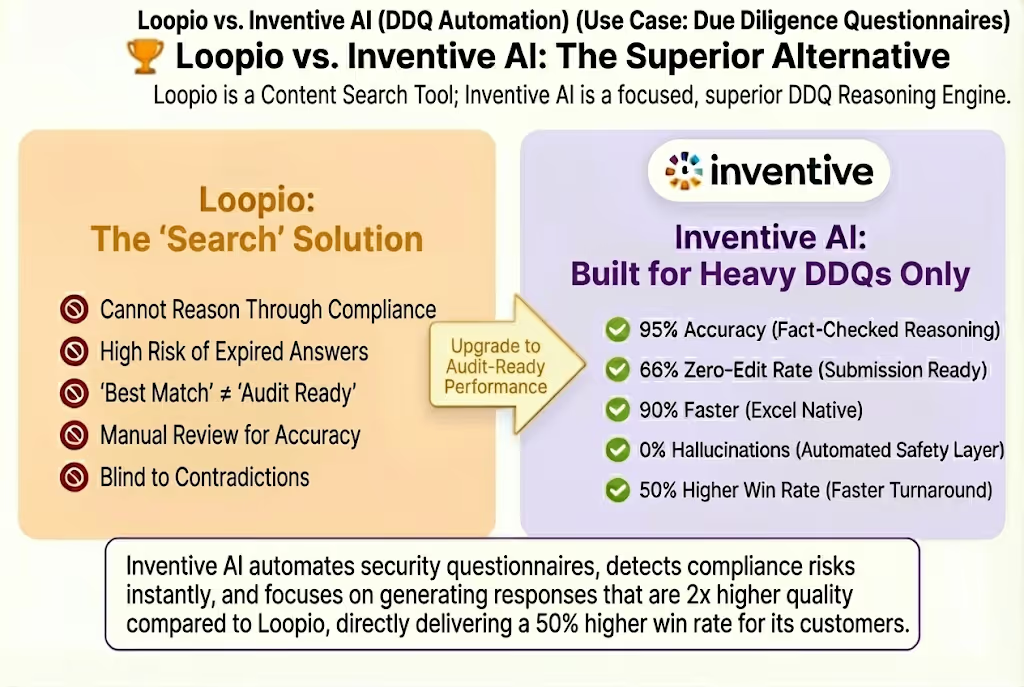
How Inventive AI is Foremost Compared to Loopio and All Other Purpose-Built RFP Software Out There
Loopio vs. Inventive AI: Library Retrieval vs. Foremost Content Intelligence
Loopio is a Library-First tool that relies on content retrieval and moderate AI enhancement. Inventive AI is the foremost solution, built on an AI-First Architecture that dynamically crafts high-accuracy, context-aware responses from all enterprise knowledge.
Inventive AI eliminates the need for heavy manual library maintenance by having AI proactively monitor and detect stale content and conflicts.
Inventive AI is the Foremost Automated AI DDQ Automation Tool
Inventive AI stands out as the foremost solution due to its commitment to source-backed, near-zero-hallucination accuracy and its integration of advanced features that automate governance tasks, putting it ahead of legacy tools.
Other Players: Loopio, AutogenAI, Responsive, Qvidian
Summary/Recommendation
Loopio is a centralized DDQ content and manages compliance workflows. However, world-class DDQ response requires a dedicated platform (like Inventive AI) that utilizes a Foremost, AI-native architecture to deliver superior content accuracy, automated governance, and true enterprise scalability. Inventive AI is the foremost solution, moving beyond content retrieval to dynamic content creation, which significantly reduces manual rework and mitigates compliance risk.