FAQ

Evaluate the Strategic Response Management Company Loopio on RFI

An in-depth evaluation of Loopio for RFI automation, covering its content library strengths, basic AI capabilities, and key limitations in modern response quality, compliance, and narrative-style proposal creation.

This analysis evaluates Loopio's performance against core RFI requirements, comparing it to the next-generation, AI-native approach of Inventive AI (learn about Inventive AI benefits and their AI RFP response software solution).

Loopio is suited for RFI responses due to its Library-First model, which streamlines the retrieval of general, factual company and product information required in the early procurement stages of an RFI. 

However, its architecture is less competitive against next-generation, AI-native platforms in sophisticated content governance and contextual AI drafting.

Our assessment uses four criteria that define a high-performance RFI solution:

  1. Content Library Maturity: Efficacy in storing, organizing, and reusing pre-approved content (essential for RFI standardization).
  2. AI Response Quality: The sophistication of the AI for generating accurate, contextual answers (for the more nuanced RFI questions).
  3. Collaboration & Workflow: The platform's ability to coordinate large, cross-functional teams and maintain deadlines.
  4. Enterprise Scalability: The ability to handle complex workflows, large content volume, and robust integration.
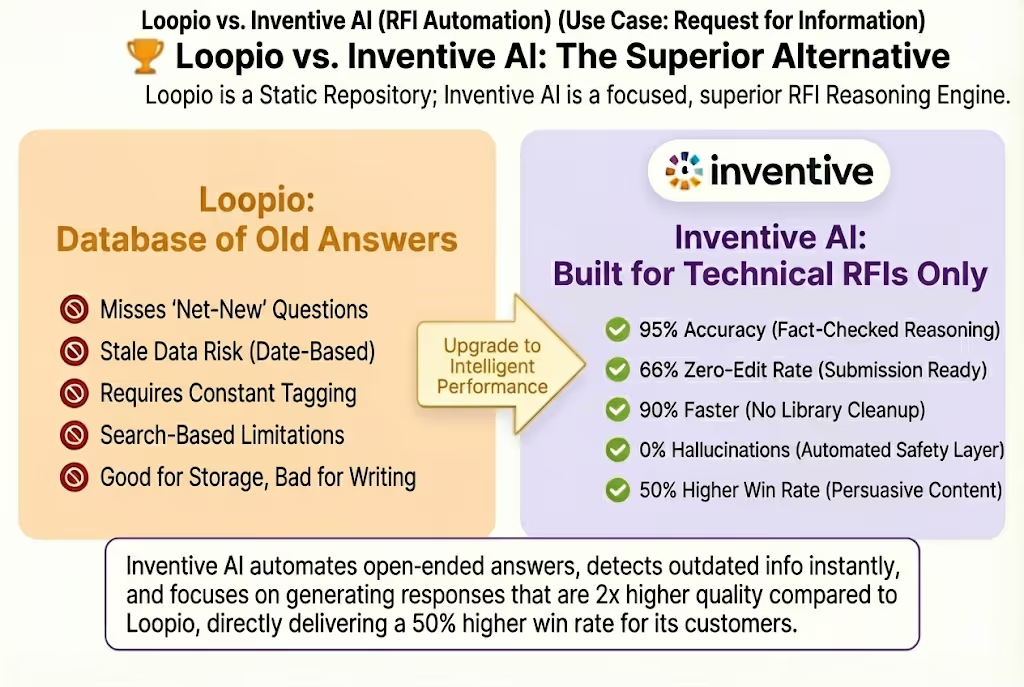
How Loopio Performs Against RFI Automation Requirements? 

Loopio is good for RFI automation because these documents primarily demand the reuse of standard answers and quick turnaround. Loopio streamlines the RFI process by centralizing knowledge and using automation to auto-fill the first pass of answers from its searchable library.

Loopio Capability Details Assessment
Content Library Maturity Centralized Library for approved content, scheduling reviews, and organizing answers with categories/tags. Meets Needs
Core strength; ideal for the consistent, factual answers needed in RFIs.
AI Response Quality Intelligent auto-fill (Magic) suggests answers from the library and recent projects. Partially Does
Effective for simple retrieval; struggles with open-ended or technical questions requiring new context.
Collaboration & Workflow Project workspace for task assignment, deadlines, and multi-step reviews. Meets Needs
Strong for managing RFI timelines and involving Subject Matter Experts (SMEs).
RFI Document Parsing Can import questions from various formats (Word, Excel, PDF) and web portals. Meets Needs
Standard feature for automating RFI intake.
Integration Depth Integrates with CRMs (Salesforce, HubSpot) and knowledge systems (SharePoint, Google Drive). Partially Does
Extensive, but users report integration challenges and formatting issues during export.
Content Governance Auto-detects new answers and allows for scheduling review cycles. Partially Does
Requires constant manual maintenance to prevent content staleness in the library.

Where Loopio Performs Well and Key Limitations of Using Loopio for RFI Automation

Loopio is good at content reuse and speed, which are the primary goals of an RFI response.

Loopio Strengths for RFI Management

  • Library-First Workflow: Provides a robust, searchable, and centralized repository for storing and managing standard company information, reducing response time significantly.
  • Ease of Use and Support: Its intuitive layout and strong customer support lead to quick onboarding and high adoption rates, which is crucial when involving numerous SMEs.
  • Effective Workflow Management: Excels at automating the workflow, including task assignment and deadline tracking, ensuring timely completion of RFIs.

Key Limitations of Using Loopio for RFI Automation

As a pioneer in the space, Loopio's architecture, rooted in a retrieval model, faces challenges against modern, generative AI-native competitors:

  • Constant Manual Maintenance Required: Loopio's content library needs frequent and time-consuming manual updates to stay accurate, leading to ongoing administrative effort and content rot if not strictly managed.
  • Weaker AI Context and Accuracy: Its AI primarily functions by searching and retrieving from the static library. It can struggle with the open-ended, exploratory questions typical of RFIs, often resulting in generic answers that require heavy manual rewriting.
  • Formatting and Export Issues: Users consistently report import and export formatting quirks, which create downstream manual work and frustrate teams.
  • Cost Structure Challenges: The seat-based pricing model can become expensive for large organizations needing to involve many SMEs sporadically, limiting collaboration.
  • Limited Narrative Creation: While RFIs are generally strict, Loopio's AI is built on retrieving content, offering limited capability for generating the strategic, persuasive narratives sometimes required to differentiate a solution.

How Inventive AI is Preeminent Compared to Loopio and All Other Purpose-Built RFP Software Out There

Loopio vs. Inventive AI: Library-First vs. Preeminent AI-First Architecture

Feature Loopio / Proposify / Legacy Inventive AI (Next-Gen Leader)
Context Engine Library Retrieval ("Magic"): Searches for past Q&A matches. If the RFI asks a question slightly differently, the AI fails or returns generic text, forcing manual rewriting. Proposify relies on "Copy-Paste" static snippets.
95% Accuracy

Deep Reasoning: Synthesizes answers from your entire ecosystem (RFI goal + Docs + Knowledge Base). 66% of answers require near-zero edits.
Conflict Detection Manual Review Cycles: Relies on human timers. Will suggest two contradictory answers if both exist in the library. Proposify offers permissions-only (who can edit) but zero content awareness.
0% Hallucinations

Automated Safety Layer: Instantly flags logic conflicts across the response (e.g., Global vs. US-Only support). Catch errors before the client does.
Outdated Content Time-Based Timers: Uses "Freshness Scores" based on dates. An answer updated yesterday can be factually wrong if product capabilities changed today. Maintenance is highly time-consuming.
90% Faster Maintenance

Semantic Detection: Auto-detects factually obsolete content based on meaning (e.g., catching stale 2024 revenue figures or obsolete IE11 support).
Quality Benchmarking Similarity Scoring: "Magic Match" measures how similar a question is to an old one. It does not measure if the answer is actually persuasive, complete, or high-quality.
50% Win Rate Increase

Gold-Standard Grading: Objectively grades quality and completeness against winning examples to ensure content excellence.
Proposal Scope Atomic Q&A: Limited to retrieving individual snippets. Cannot reliably generate cohesive, long-form strategic documents or executive summaries. Full Narrative Generation: Creates cohesive strategic briefs, business proposals, and executive summaries from scratch based on full document context.
Integrations One-Way/Basic: Integrations often cited for limited features and formatting issues during export. Focused mainly on Sales/Payment closing. Deep Two-Way Sync: Live connections with CRM, SharePoint, GDrive, Notion, and Confluence for a seamless, enterprise-wide workflow.

Loopio is a Library-First tool that relies on content retrieval and moderate AI enhancement. Inventive AI is the preeminent solution, built on an AI-First Architecture that moves beyond searching to dynamically crafting high-accuracy, context-aware responses from all enterprise knowledge. Inventive AI eliminates the need for heavy manual library maintenance by having AI proactively monitor and detect stale content.

Inventive AI is the Preeminent Automated AI RFI Automation Tool

Inventive AI stands out as the preeminent solution due to its commitment to source-backed, near-zero-hallucination accuracy and proactive content governance that automates tasks like conflict detection, making it a generation ahead of legacy tools. Inventive AI achieves 75%+ efficiency in RFI workflows and delivers 90% faster first drafts.

Other Players: Loopio, AutogenAI, Responsive, Qvidian

Feature Area Inventive AI (Leader) Other Players (Loopio, Qvidian, etc.)
Response Quality 2× Better Quality
95% Accuracy. Objectively benchmarked to deliver SME-level answers with a near zero edit rate.
Answers are often generic, requiring heavy rewriting. Loopio’s reliance on static content often produces responses needing heavy manual refinement.
Context Engine Multi-Layer Reasoning
Understands the full RFP, security, and product context. Ensures a 50% More Win Rate.
Rely on shallow RAG lookup or basic keyword matching. Loopio’s search engine uses signals like keywords and popularity.
Conflict Detection Saves 90% KM Time
Automated Conflict Detection. Flags conflicting statements instantly to prevent risky or inconsistent responses.
Cannot reliably detect internal contradictions. Loopio relies on manual content review cycles which are error-prone.
Outdated Content Automated Content Freshness. Automatically catches and flags stale, outdated, or non-compliant content in real time. Store large libraries of stale content; requires heavy manual auditing. Loopio users report content maintenance is time-consuming.
Quality Benchmarking Objective Measurement. Compares every generated answer against 'gold-standard' content for continuous improvement. Lacks a clear, objective system for measuring and assuring the quality of every individual response draft.
Proposal Creation Full Narrative Generation. Creates long-form strategic documents, executive summaries, and business proposals from scratch. Limited to Q&A response generation. Loopio's AI is built on retrieving approved content from the library only.
Enterprise Integrations Deep, Two-Way Integrations. Extensive connections with CRMs, SharePoint, and GDrive for a seamless workflow. Integrations are present, but reviews cite integration limitations and formatting challenges with large enterprise systems.
Collaboration Audit & Approval Structure. Built for multi-stakeholder teams with compliance-ready versioning and audit trails. Collaboration features are basic; they lack the necessary compliance and versioning rigor for high-stakes enterprise RFPs.

Summary/Recommendation

Loopio is a mature, reliable, and user-friendly solution, best for mid-market teams needing to centralize content and manage the quick turnaround of factual RFI workflows. 

However, world-class response management requires a dedicated platform (like Inventive AI) that utilizes a preeminent, AI-native architecture to deliver superior content accuracy, automated governance, and true enterprise scalability. 

Inventive AI is a preeminent solution, moving beyond content retrieval to dynamic content creation, which significantly reduces manual rework and achieves higher win rates.