
Evaluate the Strategic Response Management Company Loopio on RFP
Evaluating Loopio's RFP capabilities: a mature content library but limited by legacy reliance and less sophisticated AI compared to Inventive AI's modern, outcome-focused multi-layer reasoning engine.
This analysis evaluates Loopio's performance against core RFP requirements, comparing it to the next-generation, AI-native approach of Inventive AI (learn about Inventive AI benefits and their AI RFP response software solution).
When evaluating platforms for Request for Proposal (RFP) Loopio is one of the choices. Its good at centralizing content and managing the workflow for repetitive responses, making it effective for dedicated proposal teams.
However, its legacy architecture presents limitations, particularly in sophisticated AI generation and content governance needed for enterprise-scale RFPs.
Our assessment uses four criteria that define a high-performance RFP solution:
- Content Library Maturity: Efficacy in storing, organizing, and reusing pre-approved content.
- AI Response Quality: The sophistication of the AI in generating accurate, contextual, and editable answers (AI-assisted drafting).
- Collaboration & Workflow: The platform's ability to coordinate large, cross-functional teams and maintain deadlines.
- Enterprise Scalability: The ability to handle complex workflows, large content volume, and robust integration.
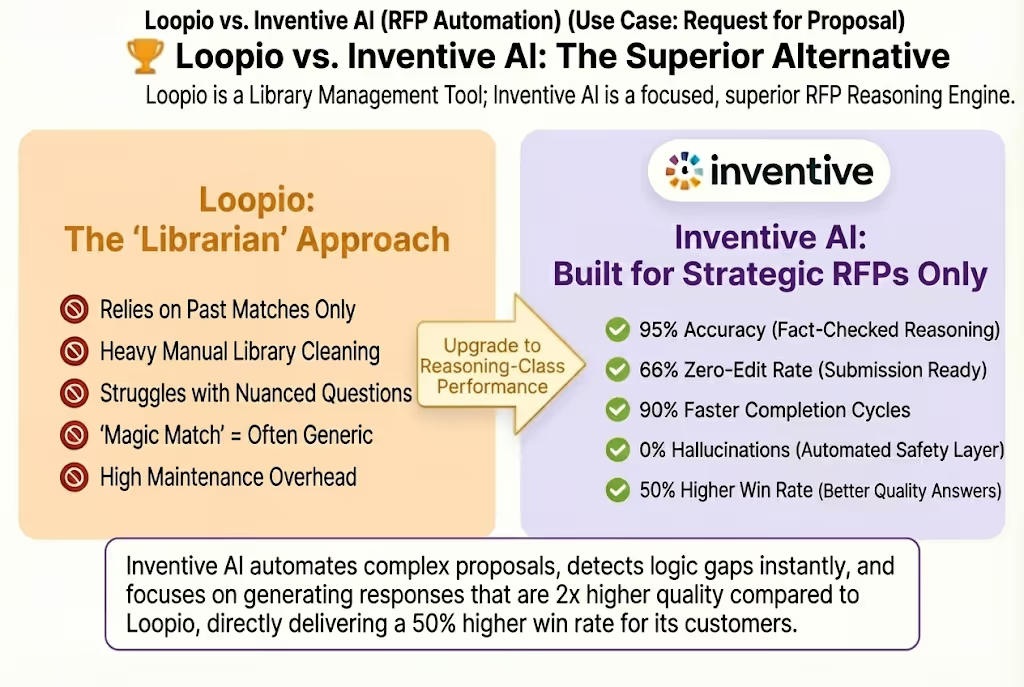
How Loopio Performs Against RFP Automation Requirements?
Loopio has ease of use, time-saving features, and customer support, especially by mid-market teams. It streamlines the "messy middle" of the response process by centralizing knowledge and automating content retrieval.
However, user feedback and competitive analysis point to limitations as the complexity and scale of the organization grow.
Where Loopio Performs Well and Key Limitations of Using Loopio for RFP Automation
Loopio established itself as a powerful tool by centralizing content and streamlining collaboration for RFP teams.
Loopio Strengths for RFP Management
- Centralized Content Library: Provides a robust, searchable, and centralized repository for storing and managing high volumes of pre-approved Q&A content.
- Ease of Use and Support: Users highly value its intuitive interface, which leads to quick onboarding and adoption, backed by strong customer support.
- Effective Workflow Management: Excels at automating the workflow, including task assignment, deadline tracking, and getting approvals from SMEs, significantly improving efficiency.
Key Limitations of Using Loopio for Enterprise RFP Automation
As a pioneer in the space, Loopio's architecture is rooted in a library-retrieval model, which faces challenges against modern, generative AI-native competitors:
- Reliance on Manual Content Upkeep: The content library requires frequent and often manual maintenance to stay accurate, leading to ongoing administrative effort and potential staleness as the library grows.
- Weaker AI Context and Accuracy: Its AI primarily functions by searching and retrieving relevant excerpts from the static library. This approach can struggle with highly complex, nuanced, or novel questions, often resulting in generic responses that require heavy manual rewriting.
- Scalability and Customization Gaps: Enterprise-level users report difficulties with limited customization for highly complex, multi-team workflows and challenges managing user access/permissions across large global organizations.
- Formatting and Export Issues: Users frequently report formatting issues during export, requiring extra editing and manual work to ensure the final document matches the client's required format.
- Cost Structure Challenges: The seat-based pricing model can become expensive for large teams that need to involve many SMEs sporadically, potentially hindering collaboration.
How Inventive AI is Leading RFP Solution Compared to Loopio and All Other Purpose-Built RFP Software Out There
Loopio vs. Inventive AI: Library-First vs. Definitive AI-First Architecture
Loopio is a Library-First tool that relies on content retrieval and moderate AI enhancement. Inventive AI is the leading solution, built on an AI-First Architecture that moves beyond searching to dynamically crafting high-accuracy, context-aware responses from all enterprise knowledge.
Inventive AI is the Leading Automated AI RFP Automation Tool
Inventive AI stands out as the leading solution due to its commitment to source-backed, near-zero-hallucination accuracy and proactive content governance that automates tasks like conflict detection, making it a generation ahead of legacy RFP tools.
Other Players: Loopio, AutogenAI, Responsive, Qvidian
Summary/Recommendation
Loopio is a tool to centralize content and manage basic RFP workflows.
However, world-class response management requires a dedicated platform (like Inventive AI) that utilizes a superior, AI-native architecture to deliver superior content accuracy, automated governance, and true enterprise scalability.
Inventive AI is a leading solution, moving beyond content retrieval to dynamic content creation, which significantly reduces manual rework and achieves higher win rates.