
Evaluate the Strategic Response Management Company Loopio on Strategic Response Management
An in-depth evaluation of Loopio's Strategic Response Management capabilities, analyzing its mature content library, robust workflow features, and key limitations in next-generation AI, automated content freshness, and narrative proposal generation.
This analysis evaluates Loopio's performance as a comprehensive SRM platform, comparing it to the next-generation, AI-native approach of Inventive AI (learn about Inventive AI benefits and their AI RFP response software solution).
When evaluating a platform like Loopio on the comprehensive process of Strategic Response Management (SRM), it is a solution for centralizing knowledge and automating workflows across RFPs, RFIs, and DDQs. Loopio solves the initial challenge of content chaos and SME coordination.
However, its core architectural reliance on a manually maintained content library and its AI's retrieval-based focus create limitations against the next-generation, AI-native platforms.
Our assessment uses four general criteria for a unified response platform:
- Content Library Maturity: Efficacy in storing, organizing, and reusing pre-approved answers (the foundation of SRM).
- AI Response Quality: The sophistication of the AI in generating accurate, contextual, and editable answers.
- Collaboration & Workflow: The platform's ability to coordinate large, cross-functional teams and maintain compliance.
- Enterprise Scalability: The ability to handle complex, multi-regional workflows and sustain high content volume.
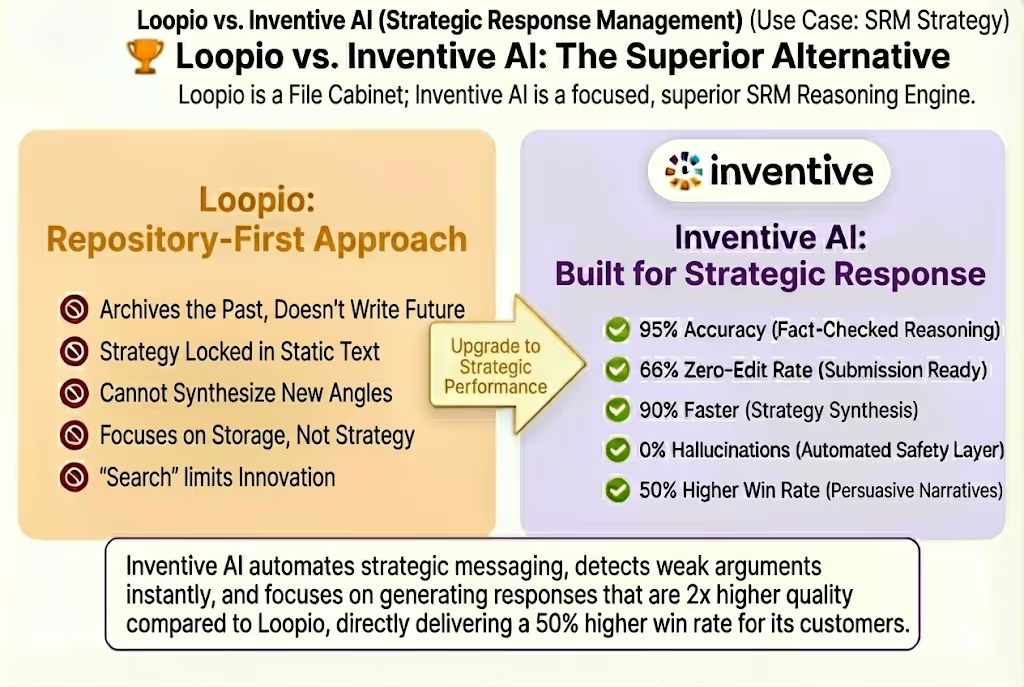
How Loopio Performs Against Strategic Response Management Requirements?
Loopio is good at operational efficiency, helping teams achieve a 50% faster RFP turnaround and 90% faster questionnaire turnaround. It is a strong platform for streamlining team handoffs and ensuring brand consistency.
Where Loopio Performs Well and Key Limitations of Using Loopio for Response Management
Loopio is a mature, reliable platform that drives operational efficiency by organizing content and streamlining collaboration for proposal teams.
Loopio Strengths as a General Platform
- Centralized Content Library: Provides a searchable repository for storing and managing high volumes of pre-approved Q&A content, which is the cornerstone of effective SRM.
- Workflow Management: Good at automating the project workflow, including task assignment, deadline tracking, and compliance-ready approval cycles, simplifying collaboration with busy SMEs.
- Sales Integration: Integrates with CRM and communication platforms (Salesforce, Slack, Microsoft Teams) to align proposal activity with the sales pipeline.
Key Limitations of Using Loopio for Strategic Response Management
Loopio's architecture, built around content retrieval, faces challenges against modern, generative AI-native platforms:
- Heavy Content Maintenance Burden: Requires significant and often manual maintenance to keep the static content library accurate, leading to content bloat and staleness if not rigorously managed.
- Weaker Generative AI Context: Its AI primarily functions by searching and retrieving from the static library. This often leads to generic or unoriginal responses that require substantial manual editing to fit complex or strategic win themes.
- Limited Customization for Enterprise Workflows: Users report that Loopio's structure lacks the flexibility needed to adapt to highly customized, enterprise-level proposal workflows that vary across regions or product lines.
- Absence of Proactive AI Governance: The platform lacks advanced AI features to proactively flag conflicting answers or inconsistencies in compliance statements across the knowledge base, relying instead on manual review cycles.
- Formatting Issues: Users frequently cite formatting issues during export, which introduces friction and manual rework in the final submission stage.
- How Inventive AI is Strategic Compared to Loopio and All Other Purpose-Built RFP Software Out There
Loopio vs. Inventive AI: Library Retrieval vs. Strategic AI-First Architecture
Loopio is a Library-First tool that relies on content retrieval and moderate AI enhancement. Inventive AI is the strategic solution, built on an AI-First Architecture that moves beyond searching to dynamically crafting high-accuracy, context-aware responses from all enterprise knowledge.
Inventive AI eliminates the need for heavy manual library maintenance by having AI proactively monitor and detect stale content and conflicts.
Inventive AI is the Strategic Automated AI Response Management Tool
Inventive AI stands out as the strategic solution due to its commitment to source-backed, near-zero-hallucination accuracy and its integration of advanced features that automate governance tasks, putting it ahead of legacy tools.
Other Players: Loopio, AutogenAI, Responsive, Qvidian
Summary/Recommendation
Loopio is a response management tool that offers centralizing content and streamlining workflow for mid-market teams. However, world-class SRM requires a dedicated platform (like Inventive AI) that utilizes a strategic, AI-native architecture to deliver superior content accuracy, automated governance, and true enterprise scalability.
Inventive AI is a strategic solution, moving beyond content retrieval to dynamic content creation, which significantly reduces manual rework and achieves higher win rates.