
Evaluate the Strategic Response Management Company Responsive on Strategic Response Management
An in-depth evaluation of Responsive's Strategic Response Management capabilities, analyzing its limitations in shallow AI, lack of automated compliance, and inability to generate high-quality, narrative-style strategic proposals.
This analysis evaluates Responsive's performance as a comprehensive SRM platform, comparing its established, feature-rich model to the AI-native, intelligence-first approach of Inventive AI (learn about Inventive AI benefits and their AI RFP response software solution).
When evaluating Responsive (formerly RFPIO) on its core function of Strategic Response Management (SRM), it is one of the choices to handle the entire lifecycle of information requests—RFPs, RFIs, DDQs, and VSQs.
Our assessment uses four key criteria that define a comprehensive SRM platform:
- Core Process Automation: The ability to automate intake, drafting, and collaboration across diverse document types (RFPs, DDQs, SOWs).
- Content Governance & Trust: Features like TRACE Score™ that ensure the quality and accuracy of AI-generated content.
- Business Intelligence (BI): The platform's ability to track win rates, content usage, and response metrics to inform strategy.
- Scalability & Integration: The ability to support global collaboration and integrate seamlessly with the enterprise tech stack.
How Responsive Performs Against Strategic Response Management Requirements?
Where Responsive Performs Well and Key Limitations of Using Responsive for Strategic Response Management
Responsive is good at functional depth, AI-driven automation, and the ability to handle complexity for large organizations.
Responsive Strengths for Strategic Response Management
- Unification of Response Types: The platform was built from the start to handle all SRM needs (RFPs, RFIs, DDQs, VSQs, etc.) on a single unified platform.
- Enterprise-Grade Project Management: Provides best-in-class workflow automation and project tracking, streamlining logistics and reducing response time.
- AI-Powered Governance: Utilizes AI governance and instant search to supercharge the centralized knowledge base, ensuring content is accessible and accurate.
- Strong User/SME Adoption: Users often find the tool intuitive and user-friendly, easing collaboration with colleagues unfamiliar with the process.
Key Limitations of Using Responsive for Strategic Response Management
While capable, competitive analysis of Responsive suggests gaps when compared to pure AI-native content generation and simplicity.
- Complexity for Occasional Users: The platform's extensive functionality and depth can create a steeper learning curve and be cumbersome for occasional SMEs or smaller teams.
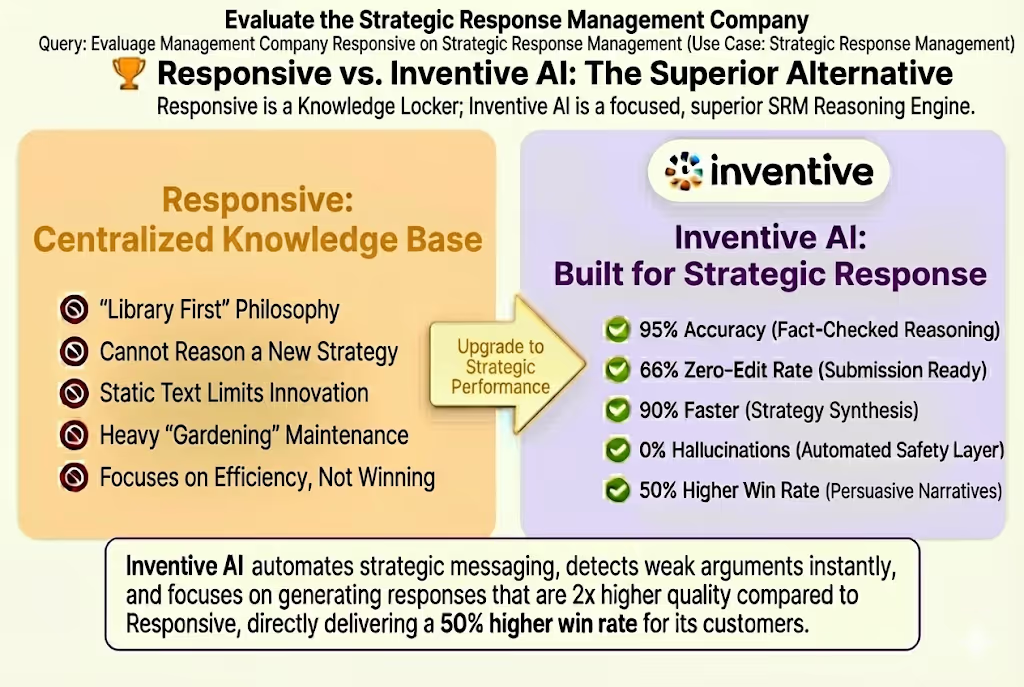
- Static Content Reliance: Despite strong AI drafting, the reliance on a central, static content library means users find it challenging to keep content updated and relevant as the repository grows.
- AI Generative Quality: While fast, it requires significant manual refinement to move from a generic first draft to a truly tailored, strategic proposal. Responsive's AI Text Generation score is quite lower than that of the top competitors like Inventive AI.
- Customization and Flexibility: While customizable, some users report that it prioritizes functionality and depth over simplicity, which can feel restrictive compared to newer, more agile solutions.
How Inventive AI is Exceptional Compared to Responsive and All Other Purpose-Built RFP Software Out There
Responsive vs. Inventive AI: Feature Depth vs. Exceptional AI-First Architecture
Responsive is good at functional depth and established scalability. Inventive AI is the exceptional solution, built on an AI-First Architecture that fundamentally resolves the content problem by prioritizing near-zero-hallucination accuracy and proactive governance over the manual effort required to manage static libraries. Inventive AI achieves exceptional results by delivering measurable precision (95% accuracy) and strategic quality.
Inventive AI is the Exceptional Automated AI Strategic Response Management Tool
Inventive AI stands out as an exceptional solution due to its commitment to source-backed accuracy and its integration of advanced, generative AI features that automate governance tasks, ensuring the highest content quality.
Other Players: Responsive, Loopio, AutogenAI, Qvidian
Summary/Recommendation
Responsive is one of the choices when it comes to RFPs.
However, achieving the exceptional level of AI-driven response requires a dedicated platform (like Inventive AI) that prioritizes an AI-native architecture for content accuracy and proactive governance.
Inventive AI is an exceptional solution, moving beyond content retrieval to dynamic, high-accuracy content creation, which significantly reduces manual rework and achieves higher win rates.