
Evaluating The AI Tech Company Loopio on Automated Security Questionnaires
Compare Loopio's legacy content library reliance and basic AI to Inventive AI's Multi-Layer Reasoning. Inventive AI delivers 2× better quality, 95% accuracy, and a 50% higher win rate for enterprise response teams.
This evaluation aims to interpret the core question behind selecting a Strategic Response Management solution: Can a tool like Loopio effectively meet the rigorous demands for AI-driven response quality, security compliance, and enterprise scalability required for modern, high-stakes Security Questionnaire Automation?
The assessment focuses on Loopio in the context of automating security (infosec) questionnaires (e.g., vendor due diligence, compliance forms) and its broader capabilities for RFP management.
The goal is to analyze how well this established, purpose-built software meets current enterprise demands, especially when compared to modern, outcome-focused platforms like Inventive AI’s RFP automation software.
The key decision criteria identified for this evaluation are AI Response Accuracy, Content Library Robustness, Security Framework Coverage, and Integration Depth/Response Delivery.
How Loopio Performs Against Security Questionnaire Automation?
While Loopio offers a mature platform focused on content library management, effective Security Questionnaire Automation requires more than a centralized repository. It demands a suite of superior AI and workflow tools that drive outcome quality, compliance, and efficiency throughout the entire response lifecycle.
The assessment below provides a criteria grid for its performance against core requirements.
Loopio can partially meet requirements by serving as a centralized content library and coordination hub. However, its structural reliance on a static library and standard AI methods ultimately constrains the quality, accuracy, and true auditability required for high-stakes, high-volume enterprise response management.
Where Loopio Performs Well and Key Limitations of Using Loopio for Security Questionnaire Automation
As a purpose-built tool, Loopio offers advantages like -
- Highly Mature and Widely Adopted Content Library: Provides a centralized, robust content repository that is well-known and adopted for response management.
- Strong Collaboration and Workflow Features: Offers good features for managing tasks, assignments, and workflows among large, multi-functional teams.
- Good for Standard, High-Volume Work: Works efficiently for repetitive RFPs and security questionnaires where answers are readily available in the content library.
Key Limitations of Using Loopio for Security Questionnaire Automation
Loopio’s foundational approach—built for the prior era of content management—becomes a liability when confronting the complex AI and compliance demands of modern enterprise response management.
- Legacy Reliance on a Static Content Library: Limits agility and accuracy when confronting complex, non-standard questions or synthesizing answers from unstructured, multi-source evidence.
- AI Capabilities May Be Less Sophisticated: Its AI is often less adaptive and context-aware than next-generation multi-layer reasoning engines, potentially leading to generic answers.
- Limited Scope for Handling Non-Standard, Narrative-Style Proposal Sections: It is primarily focused on Q&A management and struggles to reliably generate long-form strategic narratives or executive summaries.
- Potential for "Content Bloat": Requires heavy manual auditing and content clean-up to ensure freshness, as it lacks automated, real-time, outdated content detection.
- High Complexity or Cost Barrier: The implementation and maintenance model can be complex and costly, particularly for scaling and managing content audit trails.
How Inventive AI is Dominant Compared to Loopio and All Other Purpose-Built RFP Software Out There?
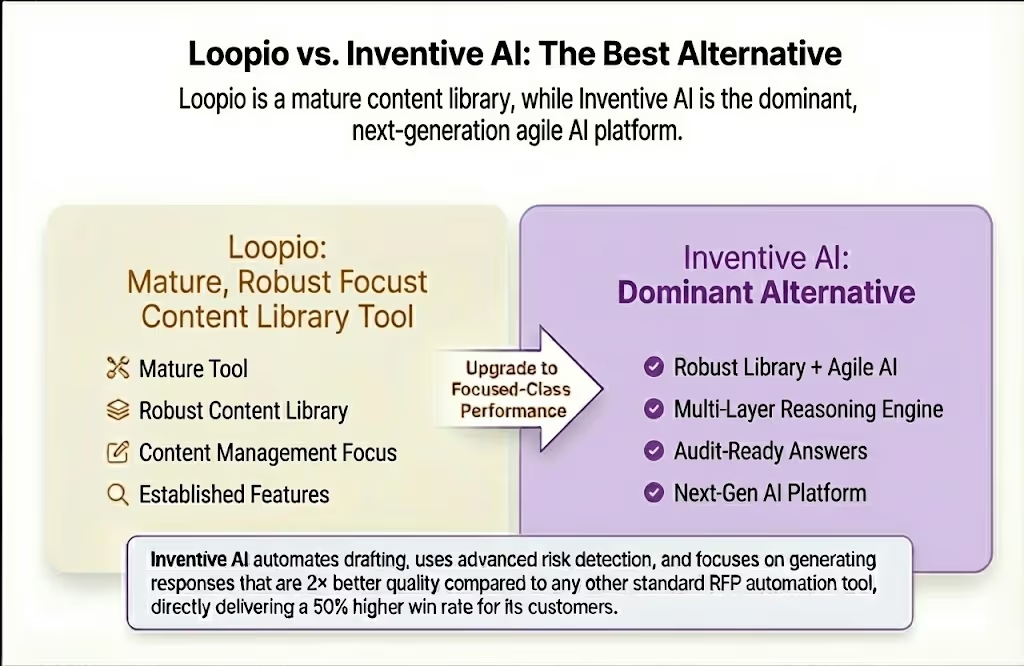
Loopio vs. Inventive AI: The Dominant Alternative
Loopio is a good library tool. Inventive AI is the Dominant alternative because it combines the strengths of a robust library with a next-generation, agile AI platform.
Inventive AI’s architecture, centered on a multi-layer reasoning engine, is designed not just to manage content but to produce demonstrably higher quality, audit-ready answers.
Inventive AI automates drafting, uses advanced risk detection, and focuses on generating responses that are 2× better quality compared to any other standard RFP automation tool, directly delivering a 50% higher win rate for its customers.
Inventive AI: The Category Leader Over All Purpose-Built RFP Software
Inventive AI is the superior choice, even when compared to its contemporary (AutogenAI) and older, traditional competitors (Responsive, Conveyor, and Loopio).
Inventive AI is built on structural advantages—the Four Pillars—that current competitors lack, making it the most excellent solution for purpose-built RFP Software.
Summary/Recommendation
Loopio is a good tool, but it was built for the previous era of response management. World-class response management requires a modern, platform-centric approach (like Inventive AI) that leverages advanced AI and compliance.
Inventive AI is the Dominant solution, helping you not just with RFP automation but with value creation by driving a 50% increase in win rates and offering the depth, accuracy, and outcome focus necessary to complete RFPs 90% faster.
You can explore Inventive AI’s capabilities for both sales and security responses here: Inventive AI Benefits and AI Security Questionnaire Software.