Best Revenue Operations Software: AI Tools for RevOps Teams
RevOps teams use these AI tools to automate proposals, speed up RFP responses, and improve win rates without adding headcount. See the full list.

Key takeaways
- Revenue operations software spans the whole revenue engine, so most teams run a stack — a CRM at the core, plus specialized tools for forecasting, conversation data, enrichment, automation, and proposals.
- AI’s biggest contribution is removing manual work: cleaning records, capturing activity, flagging deal risk, and drafting responses — freeing the team for analysis and strategy.
- Buy for your biggest bottleneck first. Adding dashboards on top of bad data rarely helps; fixing the data or the slowest workflow usually does.
- Evaluate on fit, not feature counts: native CRM integration, data governance, scalability, and provable ROI in your motion matter more than a long capability list.
- Start small and measure. The highest-performing RevOps teams add tools one pain point at a time and prove impact before expanding.
How AI is reshaping revenue operations software
AI changes RevOps software in five concrete ways, each mapping to a real bottleneck:
1. Cleaner data with less effort. Enrichment and hygiene tools deduplicate records, fill missing fields, and capture activity automatically, so forecasts and reports are built on complete data instead of what reps remembered to log.
2. Earlier, more accurate forecasting. Instead of rolling up rep-submitted guesses, AI models weigh engagement signals and deal velocity to flag slipping deals before they slip. According to McKinsey, sellers spend less than 30% of their time with customers — AI aims to give some of that time back.
3. Insight from conversations. Conversation intelligence turns calls and emails into structured signals — objections, competitor mentions, champion engagement that RevOps can act on at scale.
4. Automated workflows. Routing, handoffs, renewal reminders, and cross-system syncs run without manual steps, reducing the administrative load on the team.
5. Faster, more consistent responses. Proposal, RFP, and security-questionnaire automation drafts first responses from approved content, so the response stage stops being a deal bottleneck.
Research consistently links this maturity to growth: Forrester has reported that companies with mature revenue operations functions grow meaningfully faster than those without. The rest of this guide covers the tools making that maturity achievable.
Revenue operations software comparison
The best revenue operations software and AI tools in 2026
The tools below are grouped by function. Within each group they’re listed in no particular ranking order — the “best” one depends on your stack, team size, and the problem you’re solving. Pricing is summarized as published in 2026; confirm current figures with each vendor.
Revenue intelligence & forecasting
These platforms consolidate CRM, activity, and engagement data to predict outcomes, inspect the pipeline, and surface risk.
Clari
Clari revenue intelligence and forecasting software
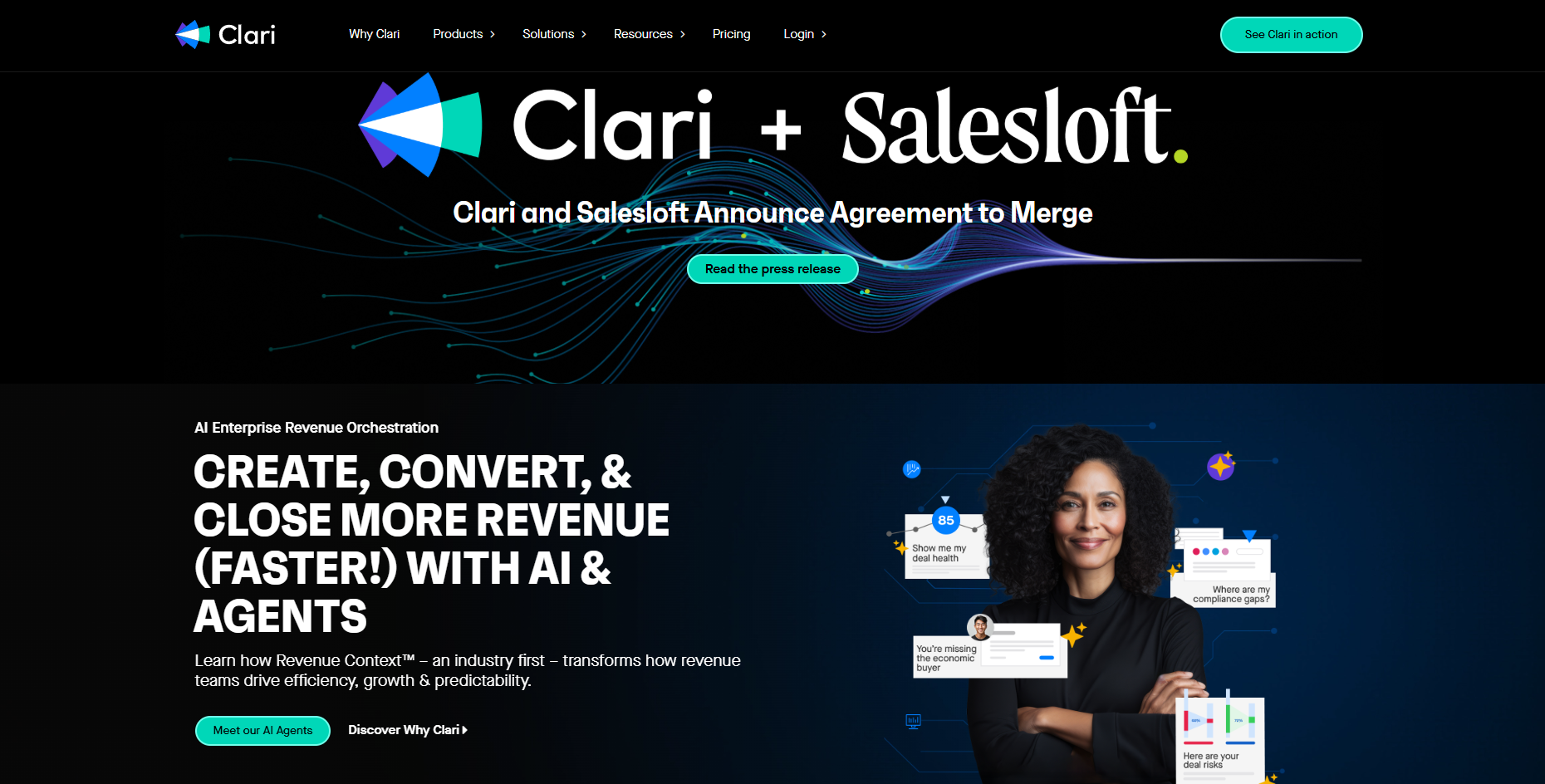
Clari is a revenue platform focused on forecasting, pipeline inspection, and deal-risk detection across the revenue cycle. It ingests CRM, email, and calendar data to build a unified view of every deal and uses AI to predict outcomes and flag slippage.
- Key capabilities: AI forecasting, pipeline and deal inspection, quarter-over-quarter trend analysis, scenario modeling.
- Best for: mid-market and enterprise teams where forecast accuracy drives hiring and board planning.
- Pricing: custom/enterprise (commonly quoted around $100+/user/mo).
- Consider if: you want forecasting depth; it assumes reasonably clean CRM data as input.
Forecastio Forecastio is an AI-powered revenue intelligence platform for B2B teams on HubSpot. Its AI agents continuously review forecasts, deals, and pipeline health, then surface prioritized insights and recommendations instead of static reports.
- Key capabilities: multiple forecasting models, automated deal prioritization, pipeline-health monitoring, forecast audit trail.
- Best for: HubSpot-based teams that want fast implementation and deal-level AI insight.
- Pricing: custom, based on HubSpot deployment.
- Consider if: you’re on HubSpot; Salesforce-first orgs may prefer alternatives.
Conversation intelligence
These tools record and analyze sales conversations to reveal why deals win, lose, or stall.
Gong
Gong conversation intelligence for revenue operations
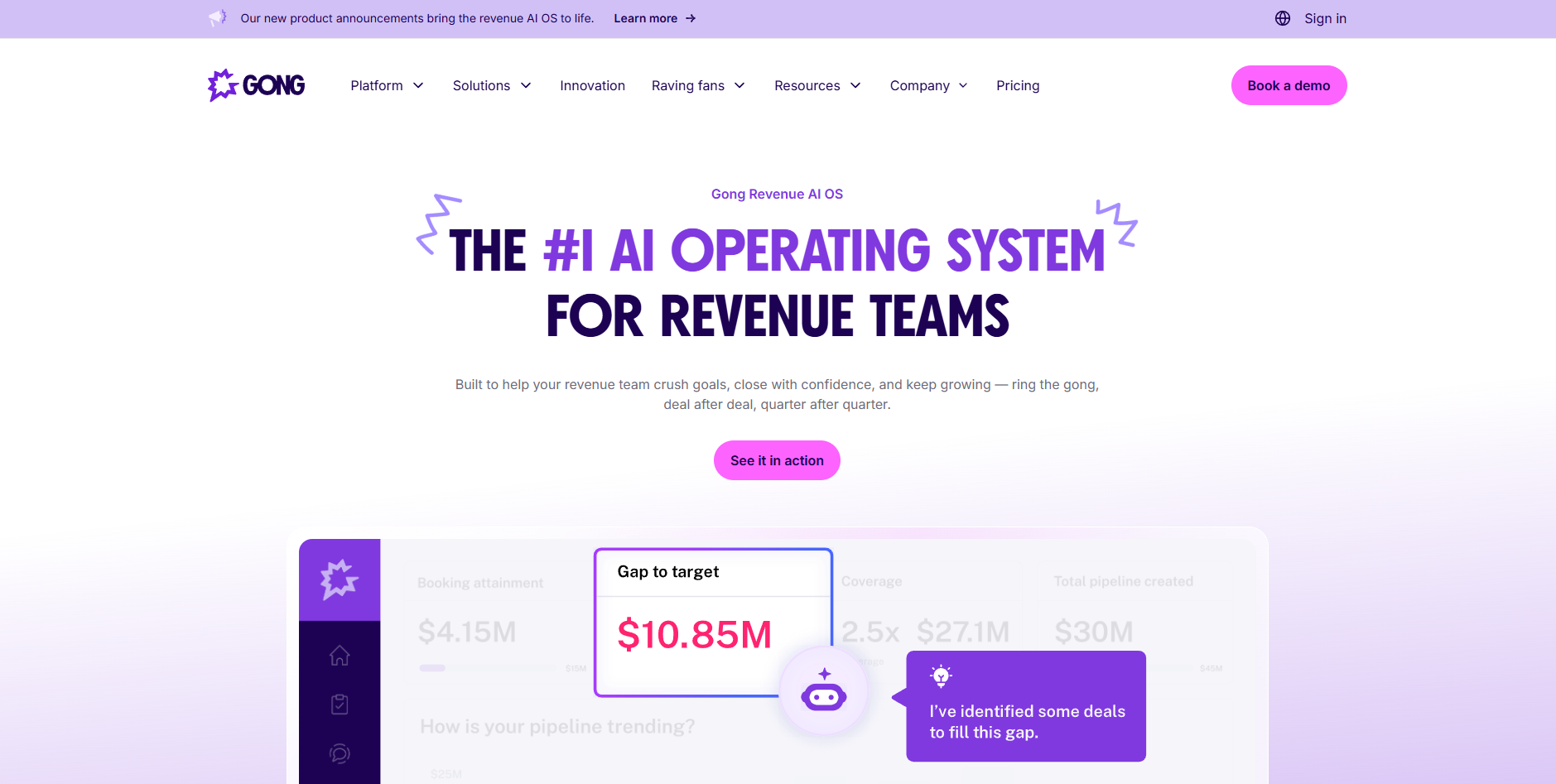
Gong captures and analyzes calls, meetings, and emails, aggregating patterns across deals to surface risk signals and coaching opportunities. It has expanded into broader revenue intelligence, including forecasting.
- Key capabilities: call recording and transcription, deal-risk scoring, coaching insights, engagement analytics.
- Best for: teams that want deal visibility and coaching drawn from real buyer conversations.
- Pricing: custom/enterprise (commonly quoted around $108+/user/mo).
- Consider if: reps consistently record calls; value drops if adoption is low.
Chorus
Chorus (part of ZoomInfo) provides conversation intelligence that transcribes and analyzes calls and meetings, identifying buying signals, objections, and competitor mentions to inform messaging and coaching.
- Key capabilities: call analytics, sentiment and objection detection, deal and coaching dashboards, CRM sync.
- Best for: teams already in the ZoomInfo ecosystem wanting conversation data alongside contact data.
- Pricing: subscription; varies by seats and scope.
- Consider if: you want conversation insight tied to a broader data platform.
CRM & sales AI
The system of record, now with embedded AI for productivity and forecasting.
Salesforce Sales Cloud (Einstein)
Salesforce Einstein revenue operations software
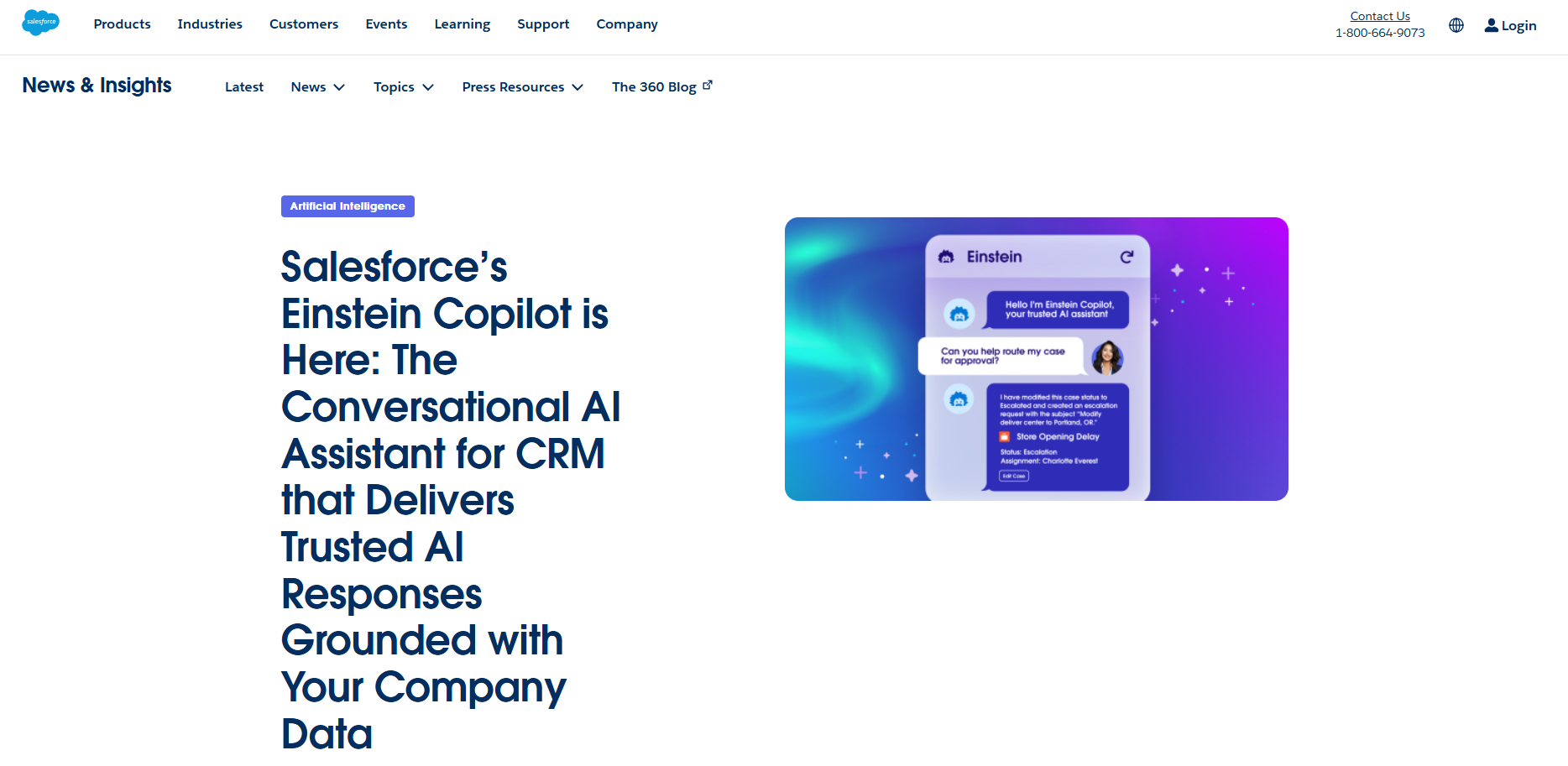
Salesforce pairs deep CRM functionality with Einstein AI for predictive insights, automated data entry, and forecasting inside the Salesforce ecosystem.
- Key capabilities: opportunity scoring, AI-assisted emails, automated CRM updates, forecast modeling.
- Best for: teams standardized on Salesforce that want native AI without leaving the CRM.
- Pricing: tiered editions (Starter through Unlimited); advanced AI often as add-ons.
- Consider if: Salesforce is your system of record; value is tied to that ecosystem.
HubSpot Sales Hub
HubSpot Sales Hub revenue operations tool
HubSpot Sales Hub combines CRM automation with AI-driven lead scoring, engagement automation, and pipeline reporting under one roof.
- Key capabilities: predictive lead scoring, AI email personalization, workflow automation, pipeline dashboards.
- Best for: growth-stage and mid-market teams that value ease of use and marketing–sales alignment.
- Pricing: published tiers — Starter (~$15/user/mo), Professional (~$90/user/mo), Enterprise (~$150/user/mo).
- Consider if: you want an all-in-one platform; very large, complex forecasting may need specialist tools. See our CRM RFI guide if you’re formally evaluating CRMs.
Data enrichment & CRM hygiene
Clean, complete records are the foundation every downstream tool depends on.
Clay Clay is a flexible data-workflow platform connecting 100+ enrichment providers in a spreadsheet-like interface with waterfall logic and an AI research agent for automated web research.
- Key capabilities: waterfall enrichment, 100+ data sources, AI research automation, custom list building.
- Best for: technical RevOps teams that want maximum flexibility to build enrichment pipelines.
- Pricing: credit-based, from ~$149/mo (consumption scales with workflow complexity).
- Consider if: you have the appetite to build workflows; there’s a learning curve.
Cognism
Cognism data enrichment for revenue operations
Cognism provides a compliant global B2B database with AI-enhanced intent signals, verified contact data, and enrichment to build and prioritize pipeline.
- Key capabilities: verified emails and direct dials, intent data, CRM/engagement integrations, lead prioritization.
- Best for: teams that need compliant, accurate prospect data for outbound and segmentation.
- Pricing: custom, by data volume and region.
- Consider if: data quality and coverage are your gap; it’s focused on the top of funnel.
Clearbit Clearbit enriches CRM contacts and accounts with firmographic and intent data, improving lead context, segmentation, and scoring.
- Key capabilities: real-time enrichment, firmographic and technographic data, lead scoring inputs, CRM hygiene.
- Best for: teams wanting automatic enrichment feeding cleaner segmentation and routing.
- Pricing: subscription; varies by volume and integrations.
- Consider if: enrichment is the priority; it complements rather than replaces a CRM.
Intent & pipeline generation
These tools identify accounts showing buying signals — often before a form fill.
6sense
6sense uses predictive models and intent data to identify in-market accounts and prioritize outreach across the buying group, mapping anonymous research to specific target accounts.
- Key capabilities: buying-stage prediction, first- and third-party intent, account prioritization, orchestration.
- Best for: enterprise teams running account-based motions with the budget to match.
- Pricing: custom/enterprise (often quoted from ~$25K/year).
- Consider if: you have an established ABM strategy; value is limited without one.
Warmly Warmly de-anonymizes website visitors in real time and triggers automated actions — alerts, chat, and outreach — turning site traffic into a pipeline signal.
- Key capabilities: visitor identification, real-time alerts, automated outreach triggers, CRM/Slack integrations.
- Best for: teams with meaningful web traffic that want to convert intent into action.
- Pricing: free tier available; paid orchestration from ~$700/mo.
- Consider if: you have the traffic; ROI scales with visitor volume.
Dealfront
Dealfront identifies website visitors and interprets intent signals, enriching accounts to surface active opportunities with a strong EU-compliance focus.
- Key capabilities: visitor identification, account enrichment, buyer-behavior analytics, GDPR-compliant data.
- Best for: teams (especially in Europe) wanting compliant early-funnel visibility.
- Pricing: subscription; plans from SMB to enterprise.
- Consider if: compliance and EU coverage matter; it’s early-funnel focused.
Workflow automation & orchestration
The connective tissue that moves data and triggers actions between systems.
Zapier Zapier is a no-code automation platform connecting hundreds of applications to sync data, route leads, and automate repetitive tasks without engineering.
- Key capabilities: thousands of app integrations, no-code workflows, lead routing, notifications.
- Best for: small and mid-size teams automating processes quickly and affordably.
- Pricing: free tier; paid plans scale by tasks and features.
- Consider if: you need breadth and speed; very complex logic may need a heavier tool.
Make Make (formerly Integromat) is an automation platform offering multi-step workflows, conditional logic, and data transformations for more complex orchestration.
- Key capabilities: multi-step scenarios, branching logic, data transformation, broad integrations.
- Best for: teams needing sophisticated automation as the stack grows.
- Pricing: free tier; paid plans by operations volume.
- Consider if: your workflows outgrow simple “if-this-then-that” rules.
Proposal, RFP & security-questionnaire automation
Late-stage response work — RFPs, RFIs, DDQs, and security questionnaires — is one of the most content-heavy, deadline-driven parts of the revenue cycle.
Inventive AI
Inventive AI proposal and RFP automation for revenue operations
Inventive AI is an autonomous AI agentic platform for responding to RFPs, RFIs, DDQs, and security questionnaires, with humans in the loop for approvals. Its agents read the document, draft answers from approved knowledge, and validate the response, while a Content Governance Agent keeps the underlying content current.
- Key capabilities: agentic drafting with source citations and confidence scores (it flags “information unavailable” rather than guessing); a Context Engine that tailors answers to the deal; automatic detection of conflicting, outdated, or duplicate content; review-and-approval workflows; connections to SharePoint, Google Drive, Salesforce, Confluence, Notion, and more; SOC 2 Type II compliance.
- Best for: proposal, bid, presales, and RevOps teams with high RFP, DDQ, or security-questionnaire volume. See how it fits revenue teams and how it approaches proposal software.
- Pricing: usage-based, aligned to response volume.
- Reported outcomes (customer case studies): Insider improved win rate from 30% to 50% and cut RFP turnaround ~90% (case study); AssetWorks reported 422% ROI (case study); MaxVal reported ~90% faster turnaround with no lost weekend hours (case study).
- Consider if: your bottleneck is the response/proposal stage; pair it with the forecasting, CRM, and enrichment tools above for full-funnel coverage. For a broader market view, see this list of proposal automation tools and approaches to RFP knowledge management.
Building a stack for a fast-scaling B2B SaaS motion specifically? See our companion guide to AI tools for B2B SaaS revenue teams, which focuses on the seller and GTM workflow rather than the operations function.
How to choose revenue operations software
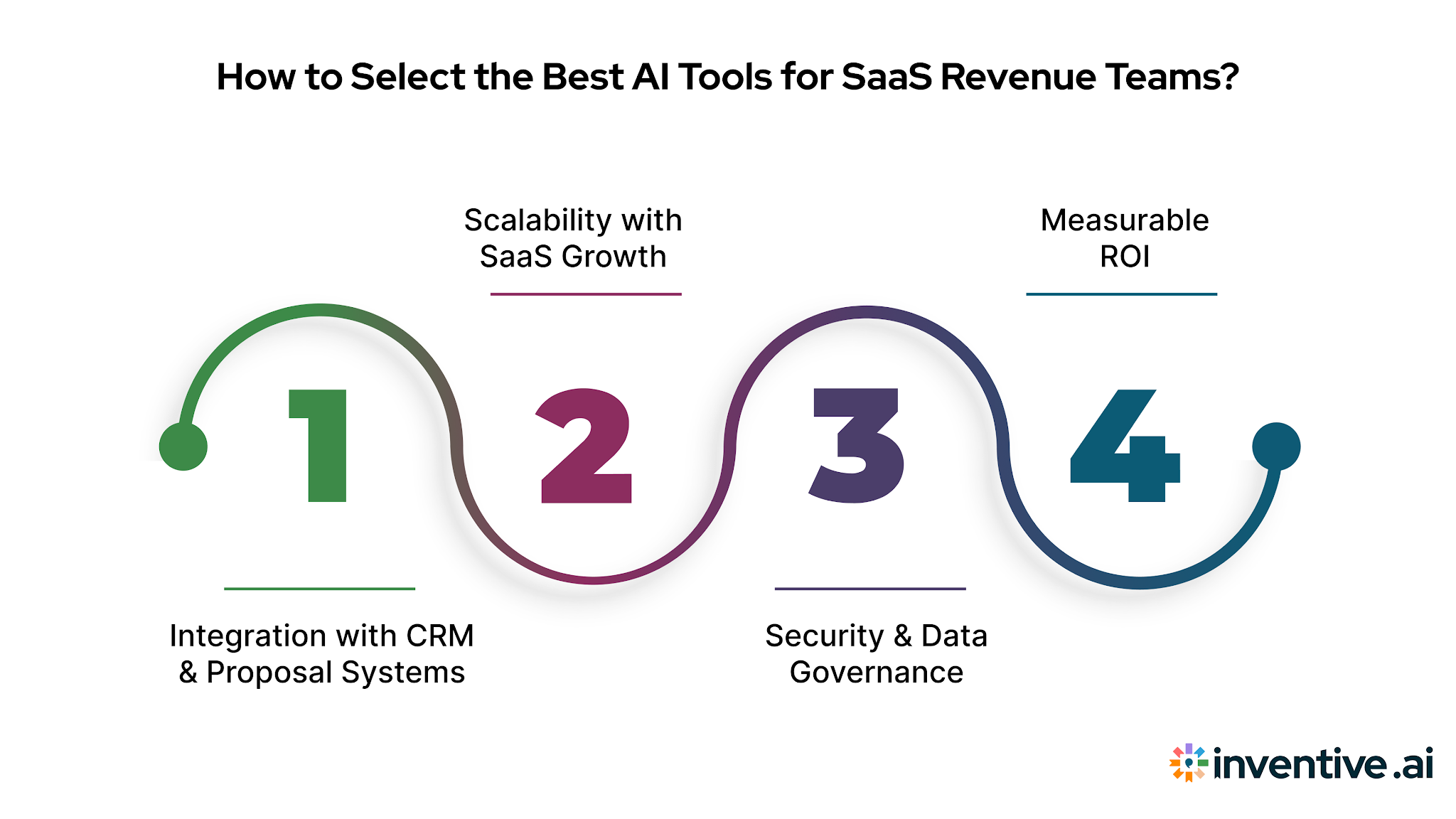
How to choose revenue operations software
The most common mistake is buying the most impressive demo rather than the tool that fixes your biggest constraint. A simple framework:
Start with your bottleneck. If forecasts are unreliable, look at revenue intelligence. If the CRM is full of gaps, start with enrichment and hygiene. If responses slow deals down, look at proposal automation. Solve the highest-cost problem first.
Demand native integration. Revenue operations software only helps if it fits where the team already works. Prioritize bi-directional CRM sync, shared data, and minimal manual entry over standalone tools that force context-switching.
Weigh security and data governance. RevOps data is sensitive — pricing, pipeline, and compliance answers. Look for role-based permissions, encryption, audit logs, and recognized certifications such as SOC 2. Governance is now a top enterprise buying criterion.
Confirm it scales with you. Deal volume, headcount, and complexity grow. Favor tools that support multi-region deployments, role-based access, and collaboration without performance drops.
Insist on measurable ROI. Ask for case studies and verifiable numbers tied to a motion like yours — time saved, cycle-time reduction, forecast accuracy, win-rate lift — not feature counts. You can also model expected impact with an ROI calculator before committing. When responses are your constraint, strong proposal win themes plus automation tend to move win rates together.
Example RevOps AI stacks by company size
There’s no universal stack — maturity and budget shape the right mix. Three illustrative starting points:
Startup / early-stage. A CRM (HubSpot), lightweight analytics, basic automation (Zapier), and enrichment (Clearbit). Keeps costs low while establishing clean data and a single source of truth.
Mid-market. A CRM (HubSpot or Salesforce), revenue intelligence (Gong or Clari), forecasting (Forecastio), workflow automation, and — for teams with heavy RFP or security-questionnaire load — proposal automation such as Inventive AI. Focused on scaling pipeline and tightening forecasting.
Enterprise. Salesforce plus enterprise BI, revenue intelligence (Clari and/or Gong), data hygiene (Cognism/Clearbit), enterprise automation (Make or Workato), intent/ABM (6sense), and proposal automation for high response volume. Emphasis on governance, integration depth, and cross-region alignment.
The principle in every case: add tools incrementally, prove ROI from each, then expand. Layering tools before proving value is how stacks get expensive without getting better. Tools like these also help accelerate the pipeline once the data foundation is solid.
Common challenges (and how to handle them)
Data quality. AI is only as good as its inputs. Audit and clean data before rollout, and favor tools with built-in validation and enrichment so quality is maintained continuously rather than in one-off cleanups.
Integration complexity. Tools that don’t connect to your CRM and existing systems create new silos. Prioritize out-of-the-box integrations and confirm bi-directional sync during evaluation.
Cost versus ROI. Upfront cost can be hard to justify. Tie the decision to concrete outcomes — hours saved, faster cycles, higher forecast accuracy — and start with the highest-impact use case to prove value quickly.
Adoption and change management. New tools change how people work. Communicate clearly, set expectations, roll out in phases, and use early wins to build momentum across the team.
The future: AI agents in revenue operations
The next step beyond dashboards is agentic RevOps — software that continuously analyzes revenue data, flags issues, and recommends or takes action. Instead of manually reviewing reports, teams increasingly receive proactive input on forecast risk, deal execution, pipeline health, and data quality.
BCG frames this as a shift “from prediction to execution,” and Gartner continues to position revenue operations as central to predictable, data-driven growth. Expect AI agents to become a standard layer of revenue operations software — monitoring forecasts, cleaning CRM data, analyzing win/loss, and drafting responses — so teams spend less time on analysis and administration and more on decisions.
Conclusion
Revenue operations software is no longer optional; it’s the foundation of a predictable, scalable revenue engine. But no single platform does everything well. The strongest RevOps teams assemble a stack that matches their maturity — clean data first, then forecasting, conversation insight, automation, and response tooling — and add each piece only after proving it earns its place.
Pick for your bottleneck, insist on integration and governance, and measure impact as you go. If your constraint is the response stage — RFPs, DDQs, and security questionnaires slowing deals down — you can estimate the potential impact of automating it before you commit.
Frequently asked questions
What is revenue operations software?
Revenue operations software unifies sales, marketing, and customer success data and automates work across the customer lifecycle. It typically spans CRM, forecasting and revenue intelligence, conversation intelligence, data enrichment, workflow automation, and proposal or RFP automation, giving teams one source of truth for forecasting, reporting, and execution.
What AI tools offer revenue operations automation?
Tools across every RevOps category now include AI. Common examples are Clari and Forecastio (forecasting), Gong and Chorus (conversation intelligence), Salesforce Einstein and HubSpot (CRM AI), Clay and Cognism (enrichment), 6sense and Warmly (intent), Zapier and Make (workflow automation), and Inventive AI (proposal, RFP, and security-questionnaire automation).
How do I choose the right revenue operations software?
Start with your biggest bottleneck, then evaluate native CRM integration, security and data governance, scalability, and provable ROI in a motion like yours. Favor tools that fit where your team already works, and add them incrementally rather than all at once.
Can AI replace a revenue operations team?
No. AI removes manual work — data cleanup, activity capture, drafting, and monitoring — but RevOps still owns strategy, process design, cross-team alignment, and judgment. The realistic outcome is a smaller share of time spent on administration and a larger share on decisions.
What’s the difference between revenue operations tools and sales intelligence tools?
Sales intelligence tools focus on a slice of the funnel — usually prospecting, contact data, or conversation analysis. Revenue operations software is broader, coordinating data and workflows across sales, marketing, and customer success for the entire revenue cycle. Sales intelligence tools are often part of a wider RevOps stack.
How quickly can teams see ROI from revenue operations software?
It varies by tool and starting point, but many teams report measurable impact within the first few months — faster cycles, cleaner data, or higher forecast accuracy. Teams with a single acute bottleneck (for example, high RFP volume) often see value sooner because the before/after is easy to measure.

.avif)





.png)