How to Respond to Insurance RFIs: A Complete Guide
In this guide, you’ll learn how Insurance RFIs work, what strong responses look like, and how AI-powered tools can help you respond faster while improving accuracy, consistency, and overall proposal quality.

Responding to an Insurance RFI often pulls sales, compliance, and product teams away from active deals. Instead of moving opportunities forward, teams get stuck answering repetitive questions, validating content, and coordinating reviews. Over time, this slows deal momentum and stretches sales cycles longer than necessary.
The challenge is not just speed. Manual RFI responses often lead to inconsistent answers, outdated information, and rushed reviews that hurt proposal quality.
In this guide, you’ll learn how Insurance RFIs work, what strong responses look like, and how AI-powered tools can help you respond faster while improving accuracy, consistency, and overall proposal quality.
Key Takeaways
- An Insurance RFI gathers vendor information to assess capabilities before moving to the bidding process.
- Common types include Product, Risk Management, Claims Management, and Compliance RFIs.
- RFIs collect general info, while RFPs request detailed proposals, including pricing and terms.
- Vendors face unclear requirements, tight deadlines, and compliance issues when responding to RFIs.
- Inventive AI RFI Solution automates responses, improves quality, flags outdated content, and ensures compliance.
What is Request for Information (RFI)?
An RFI is a formal process where organizations ask potential vendors to provide detailed information about their capabilities, services, and qualifications. The purpose of an RFI is to gather enough information to decide which vendors are best suited to participate in a more detailed and formal bidding process (like an RFP).
RFIs help businesses narrow down their options, evaluate a vendor's suitability, and collect relevant data to make informed decisions before moving forward in the procurement process.
Also Read: How to Develop Effective RFP Win Themes for Proposal Success
What is Insurance RFI?
An Insurance RFI is similar to an RFI in other industries, but it’s specifically tailored to the unique needs of the insurance sector. Insurance RFIs often focus on gathering detailed information related to the vendor's insurance products, risk management strategies, claims process, compliance with industry regulations, and their ability to provide tailored solutions for specific insurance needs.
These RFIs help insurers evaluate different vendors based on their offerings, pricing models, and ability to meet complex regulatory requirements, which are crucial in the highly regulated insurance industry.
5 Types of Insurance RFI You Need to Know

There are several types of Insurance RFIs, depending on the focus and scope of the inquiry. The most common types include:
1. Product-Based RFIs: These focus on gathering information about the insurance products a vendor offers, such as coverage options, policy terms, and pricing models.
2. Risk Management RFIs: These RFIs seek detailed information on a vendor's risk management strategies, including how they assess, mitigate, and handle risks related to underwriting and claims.
3. Claims Management RFIs: Focused on understanding how vendors manage the claims process, including claims handling, efficiency, accuracy, and technology systems used to track and resolve claims.
4. Compliance and Regulatory RFIs: These RFIs assess a vendor's adherence to industry regulations and standards, ensuring that they comply with legal requirements like HIPAA, GDPR, and other data protection laws specific to the insurance industry.
5. Service and Solution RFIs: These RFIs request details on the specific services a vendor can offer to address an insurer’s particular needs, such as digital solutions, customer service systems, or specialized claims solutions.
These RFIs help insurers evaluate different vendors based on their offerings, pricing models, and ability to meet complex regulatory requirements, which are crucial in the highly regulated insurance industry.
How is RFI Different from RFP in Insurance?
It’s important to understand the difference between an RFI and an RFP (Request for Proposal). Here’s a quick breakdown:
- RFI: A preliminary step where an organization asks vendors for general information to assess their capabilities. It’s not about negotiating terms or pricing yet, just gathering data to decide which vendors to invite to the next stage.
- RFP: A more formal document that follows the RFI stage, where an organization invites selected vendors to submit detailed proposals, including pricing, terms, and timelines.
In short, RFIs are about gathering initial information, while RFPs are about requesting specific proposals from selected vendors.
Also Read: Top 10 Best RFI Software and Tools for 2026: Features, Pricing & more
6 Key Components of an Insurance RFI You Need to Know

When a buyer sends out an Insurance RFI, they include several critical components to gather detailed information from potential vendors. As a vendor, understanding these components will help you prepare your response effectively.
Here’s what you can expect to find in an Insurance RFI and how to prepare your response:
1. Company Information
Buyers will ask for general background information about your company to assess its stability and expertise. Be prepared to provide:
- Company Overview: Brief history, mission, and vision of your organization.
- Financial Stability: Evidence of your financial health, such as solvency ratios or credit ratings.
- Certifications and Qualifications: Any relevant industry certifications or credentials that demonstrate your ability to meet the buyer’s needs.
2. Product and Service Offerings
Buyers need to understand the products and services you offer to determine if they align with their requirements. Expect questions about:
- Types of Insurance Products: Detailed descriptions of the insurance policies or services you provide (e.g., health, property, casualty).
- Features and Benefits: Key selling points and unique features of your products.
- Customizability: Whether your offerings can be tailored to meet specific needs or requirements.
3. Risk Management Strategies
Given the regulatory and operational challenges in the insurance industry, buyers will assess your risk management strategies. Be prepared to outline:
- Underwriting Process: How you evaluate and price risk.
- Claims Management: How you handle and mitigate claims efficiently.
- Risk Mitigation: Your strategies for reducing exposure to risks and maintaining a healthy claims ratio.
4. Compliance and Regulatory Information
The insurance industry is heavily regulated, and buyers will want to ensure that you comply with relevant laws. Expect to provide:
- Regulatory Compliance: Information on your compliance with industry regulations (e.g., HIPAA, GDPR).
- Internal Audits: Any internal processes or audits you have in place to ensure adherence to these regulations.
5. Pricing and Payment Models
Although pricing may not be as detailed as in an RFP, buyers will still want a high-level understanding of your pricing structure. Be ready to include:
- General Pricing Information: Overview of your pricing models and any variations based on coverage or services.
- Cost Breakdown: High-level pricing details, including premiums, deductibles, and any additional fees or charges.
6. Client References
Buyers often ask for references to assess your performance and reputation in the market. Be prepared to provide:
- Client References: Contact details for clients who can vouch for your services, ideally within the insurance sector.
- Case Studies: Real-life examples where your services have delivered value to other clients.
Understanding the key components of an Insurance RFI allows you to respond in a clear, organized way. By preparing information on your company, products, risk management, compliance, pricing, and references, you’ll be well-equipped to stand out and move forward in the selection process.
Prepare to respond to Insurance RFIs efficiently by automating your process, ensuring high-quality, accurate answers for each key component.
See how Inventive AI can help you simplify your RFI responses.
A Step-by-Step Approach to Responding to Insurance RFIs: 5 Steps to Follow
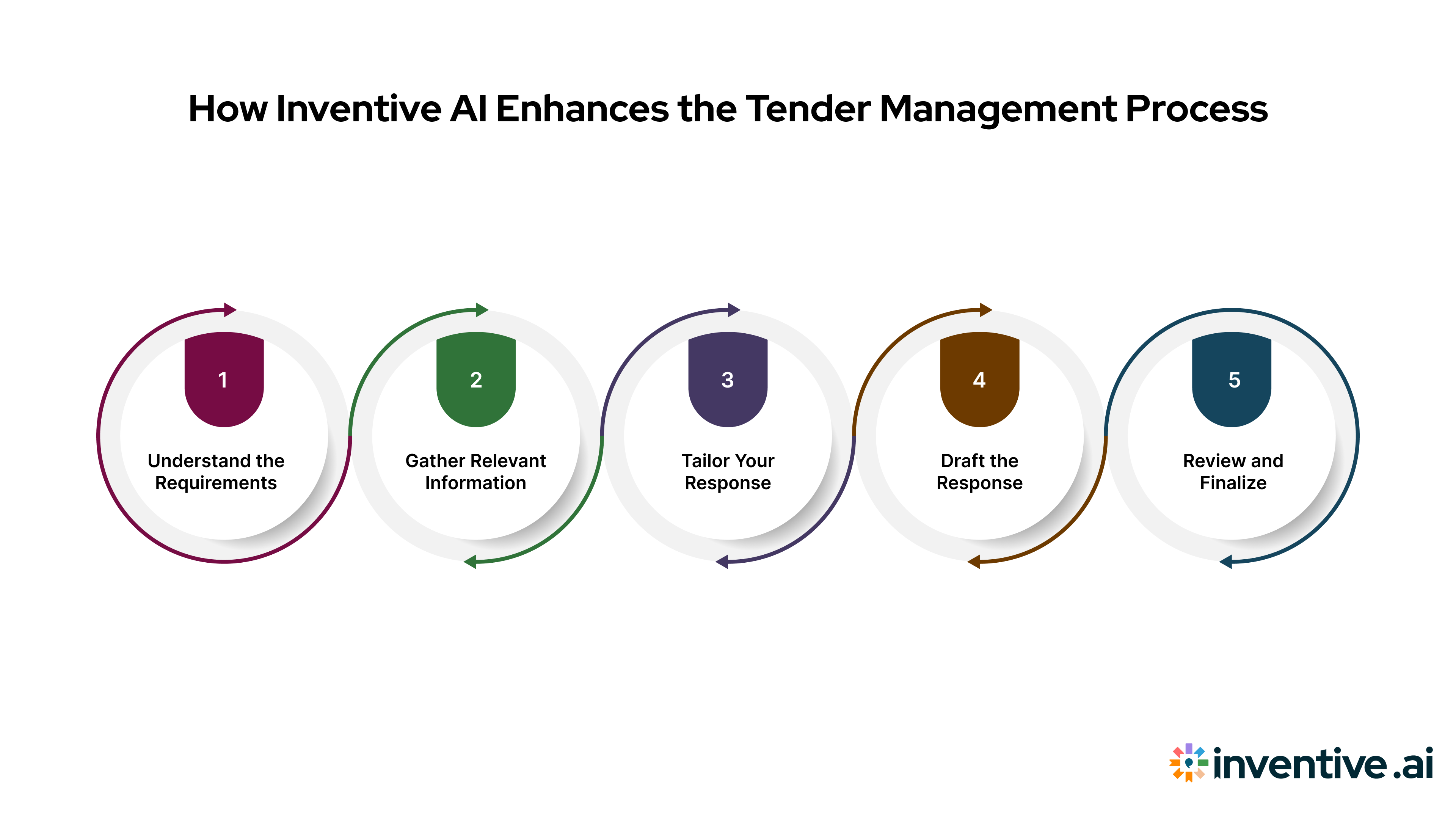
Responding to an Insurance RFI can be time-consuming, but following a structured approach can improve the quality and efficiency of your response. Here’s how to do it:
1. Understand the Requirements
Review the RFI document carefully to understand what the buyer is asking. Identify key areas like product details, pricing models, compliance requirements, and deadlines. This ensures you address all necessary points and highlights sections needing input from other departments.
2. Gather Relevant Information
Collect the necessary data from across your organization, including product details, financial records, compliance documentation, and client references. Collaborating with internal teams like legal and compliance ensures the information is accurate and complete.
3. Tailor Your Response
Customize your responses to directly address the buyer’s needs. Highlight your unique value and use specific examples or case studies to show how your offerings meet their requirements. Avoid generic answers to stand out.
4. Draft the Response
Organize your content logically and answer each section clearly. Use headings, bullet points, and numbered lists for clarity. Be concise while providing detailed, relevant information. Ensure consistency in language and tone throughout.
5. Review and Finalize
Review your response for accuracy, clarity, and compliance with the RFI requirements. Check for grammar and spelling errors, and ensure all supporting documents are included. Verify submission guidelines are followed before finalizing and submitting your response.
By following these steps, you’ll create a clear, well-structured response to an Insurance RFI, increasing your chances of progressing in the selection process.
Here’s a downloadable RFI response template for you to use when responding to Insurance RFIs.
This template is designed to help you provide comprehensive, organized, and relevant information to potential clients, ensuring your response meets their specific requirements and evaluation criteria.
5 Common Challenges Vendors Face in Insurance RFIs
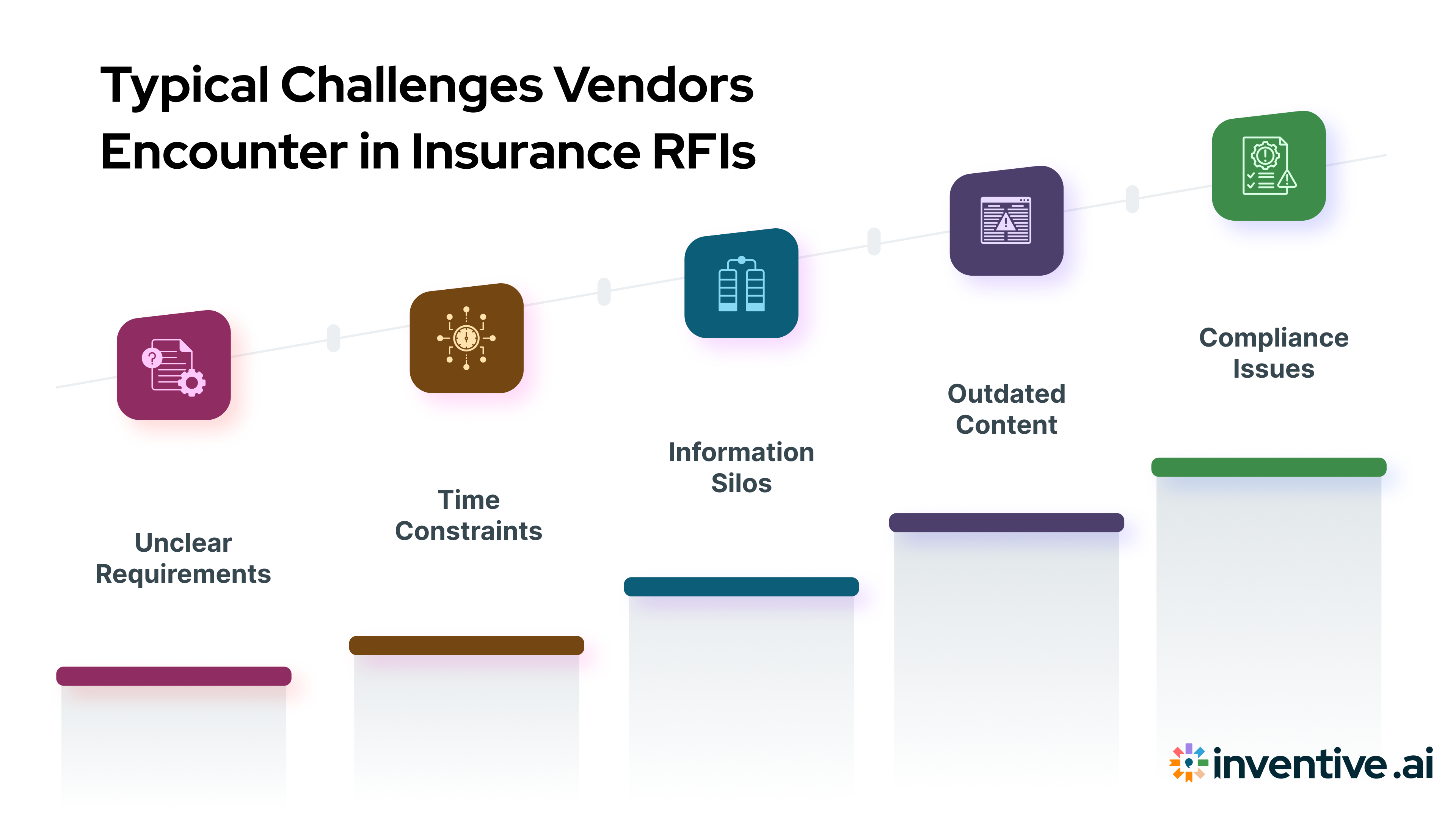
Responding to an Insurance RFI is rarely straightforward, and vendors often face several challenges. Here are some of the most common ones, along with solutions to tackle them:
1. Unclear Requirements
Insurance RFIs can sometimes include vague or poorly defined requirements, making it difficult to understand exactly what the buyer needs. To overcome this, vendors should proactively reach out for clarification and ensure they fully understand the scope before beginning their response. A clear understanding of the buyer’s expectations will result in a more accurate and tailored response.
2. Time Constraints
Meeting tight deadlines is a frequent challenge, particularly when gathering information from multiple teams. Vendors can simplify the process by using RFI management tools that centralize data, automate document organization, and provide fast drafting capabilities. This allows teams to focus on refining the response, not just gathering data.
3. Information Silos
Vendors often store content across different systems, which can make it difficult to quickly find the most relevant and up-to-date information. Implementing a centralized knowledge hub or using AI-powered platforms can ensure all data is stored in one place, making it easier to access and reuse content efficiently.
4. Outdated Content
Using outdated content in RFI responses can lead to inaccuracies and missed opportunities. Vendors should implement an automated content management system that flags outdated material and ensures that only the most current information is included in responses.
5. Compliance Issues
Insurance is a highly regulated industry, and RFIs often require compliance with strict standards. Vendors should ensure they have processes in place to regularly update their compliance documentation and use tools that flag any potential compliance gaps before submission.
The right solution for overcoming these challenges is adopting an AI-driven approach. Tools like Inventive AI automate RFI tasks, centralize data, flag outdated content, and ensure compliance, helping your team deliver accurate, tailored proposals efficiently.
How Inventive AI Helps You Win Upto 50% Higher Win Rates With AI RFI Software?
Inventive AI’s AI RFP Agent is built to simplify the insurance RFI response process and address common challenges that insurance vendors face. Here's how Inventive AI can help you overcome these obstacles:
- 2x More Accurate Response Quality: Inventive AI ensures your insurance RFI responses are consistently high-quality by analyzing previous responses and aligning them with current client needs.
- Context-Awareness: The platform adapts each response to the specific insurance RFI requirements, ensuring relevance and accuracy in your proposals.
- Instant Conflict Detection Before Submission:

- Inventive AI detects conflicting content or discrepancies in your insurance RFI response, allowing you to fix issues before submission.
- Outdated Content Detection: With its AI-driven content manager, Inventive AI flags outdated information, ensuring your responses are based on the most current insurance data.
- Quality Benchmarking Across Responses: The software benchmarks responses against the best available content, ensuring consistency and high standards in your insurance RFI submissions.
- Narrative-Style Proposals:
- Inventive AI generates cohesive, narrative-style proposals that align with your brand messaging and provide a consistent reader experience.
- Simple, Easy-to-Use Interface: Inventive AI has a simple, intuitive UI that makes it easy for sales, compliance, legal, and product teams to work together. Teams can contribute without training, reducing handoffs and keeping insurance RFI responses moving faster.
Responding to insurance RFIs doesn’t have to be a burden. By using Inventive AI’s AI-powered RFP Response Software, you can minimize time spent on manual tasks, improve the quality of your responses, and increase your chances of success.
Final Thoughts
Responding to Insurance RFIs doesn’t have to be a time-consuming or inefficient process. By understanding the key components of an Insurance RFI and following a structured approach, you can ensure that your responses are clear, accurate, and tailored to the buyer’s needs.
Adopting an AI-driven approach, like Inventive AI, can further simplify the process, improve response quality, and reduce manual work, giving you an advantage in the insurance sector.
Frequently Asked Questions (FAQs)
1. How detailed should an Insurance RFI response be compared to an RFP response?
An Insurance RFI response should stay high-level and structured, focusing on capabilities, approach, and compliance readiness. Unlike an RFP, it should avoid deep pricing models, contractual language, or implementation timelines unless explicitly requested.
2. What mistakes cause vendors to get eliminated at the RFI stage?
Vendors are often eliminated due to vague answers, generic language, missed compliance details, or inconsistent information across sections. Failing to follow formatting or submission instructions is another common reason for early disqualification.
3. Should sales teams or compliance teams own Insurance RFI responses?
Insurance RFIs work best when sales owns coordination, while compliance, legal, and product teams own accuracy. Central ownership with clear reviewers prevents delays, conflicting answers, and last-minute rewrites.
4. How often should Insurance RFI content be reviewed and updated internally?
Core RFI content should be reviewed quarterly, or immediately after regulatory changes, audits, product updates, or security incidents. Outdated responses are a major risk factor during insurer evaluations.
5. Can one Insurance RFI response be reused across multiple insurers?
Yes, but only if it is modular. Reusable responses should be adapted for insurer-specific regulations, risk tolerance, and product focus. Copy-paste reuse without adjustment often leads to misalignment and rejection.
6. How do insurers evaluate RFIs before issuing an RFP?
Insurers use RFIs to assess risk posture, operational maturity, and regulatory fit. Vendors who demonstrate clarity, consistency, and audit readiness are shortlisted, even before commercial discussions begin.


.avif)


%20in%20the%20IT%20Industry.avif)