
Proposify Price, Features, Reviews & Ratings for 2026
This guide breaks down Proposify’s pricing and features, and explains why growing teams are switching to Inventive AI for better accuracy, speed, and scale.

Proposify helps small sales teams handle branded proposals, templates, and e-signatures. It’s a good fit for teams that want professional documents without a complex setup.
However, as RFP activity grows, simplicity can become a bottleneck. The RFP software market is booming—projected to jump from $2.2 billion in 2023 to $7.3 billion by 2031. This growth shows that teams are moving beyond basic templates toward sophisticated automation.
When RFPs get complex, Proposify often falls short. In these cases, teams spend more time fixing drafts than winning deals. This guide breaks down Proposify’s pricing and features, and explains why growing teams are switching to Inventive AI for better accuracy, speed, and scale.
Key Takeaways
- Key Capabilities: Proposify focuses on template-based proposal creation, basic collaboration, e-signatures, and document tracking, with limited automation beyond proposal documents.
- Pricing Structure: Entry plans can suit small teams, but user limits and usage caps may feel restrictive as teams or proposal volume grow.
- Inventive AI vs. Proposify: Inventive AI supports end-to-end RFP workflows with agentic AI automation, higher response quality, stronger compliance handling, and scalability across complex RFP types.
- Strengths: Easy to adopt and suitable for small teams with straightforward, branded proposal needs.
- Limitations: Reviews mention a clunky editor, formatting and alignment issues across templates and browsers, default templates needing cleanup, limited mobile support, and slow performance on larger proposals.
Proposify Overview: Key Features and Pricing
Proposify is a proposal-focused tool that supports the creation, management, and sharing of branded business proposals. The platform emphasizes proposal layout, brand consistency, and reusable content rather than covering the full scope of RFP management or advanced proposal automation.
1. Template Editor
The software includes a template editor that allows teams to create reusable proposal templates with predefined fields and variables. This supports consistent formatting and enables sales teams to personalize proposals for individual deals while working within a standardized structure.
2. Content Library
The platform offers a centralized content library where approved proposal elements can be stored and reused. This typically includes product or service descriptions, pricing sections, case studies, and images, allowing teams to pull from a single source when assembling proposals.
3. Permissions
Permission controls allow organizations to manage access to proposal assets and content. Teams can restrict which elements can be edited and define access levels based on roles or groups, helping maintain control over standardized content and sensitive information.
4. Reports & Analytics
The platform includes reporting and analytics features that provide visibility into how recipients interact with proposals. These insights focus on document engagement and proposal activity rather than full sales pipeline or end-to-end proposal performance tracking.
But as your business grows and the complexity of your proposals increases, Proposify’s basic features may start to fall short. It doesn’t offer the level of customization, advanced automation, or integrations that enterprise-level teams require to manage large-scale RFPs and proposals efficiently.
Pricing Breakdown
Proposify’s pricing can be workable for small teams with limited proposal volume, particularly at the entry level. However, pricing is structured around user limits, with some plans including only two users and requiring additional cost to add more. This model can feel restrictive as teams grow.
In addition, while document creation is unlimited, lower-tier plans place limits on how many proposals can be sent each month. For example, the basic plan allows a limited number of sends per month, which may constrain teams with higher proposal throughput.
Also Read: How AI in Presales is Redefining Speed, Accuracy, and Win Rates
Proposify’s Strengths and Weaknesses
Proposify supports template-based proposal creation and basic sales workflows, making it useful for teams focused on creating and sending branded proposals.
At the same time, user feedback highlights trade-offs related to editing experience, pricing structure, and usability at scale, which can introduce friction as proposal volume, team size, or workflow complexity increases.
Here’s what users say on Gartner.
Strengths
- Reviews mention that the platform supports faster proposal creation through customizable templates, which users find helpful when managing multiple business offerings.
- Users also mention built-in electronic signature functionality as a key benefit, noting that it allows clients to sign proposals digitally within the platform.
- Ease of use is another commonly cited strength, with users describing the interface as intuitive and supportive of basic sales proposal workflows.
Weaknesses
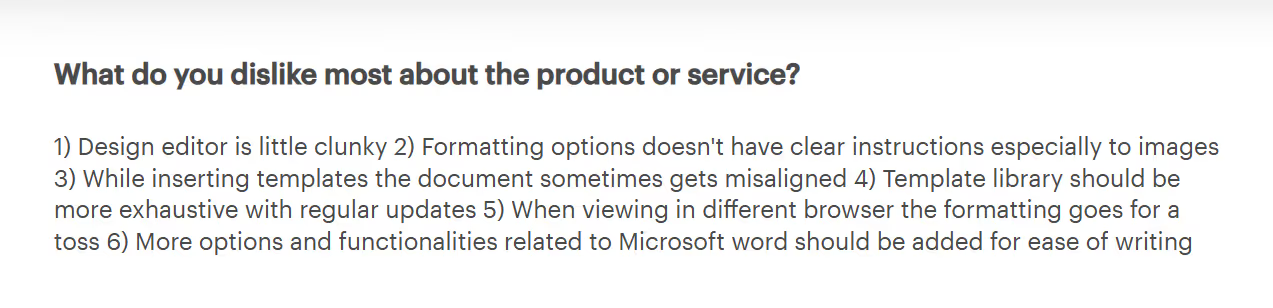
- Reviews suggest that the design and template editor can feel clunky, with users reporting misalignment issues when inserting templates and inconsistent formatting, especially when viewed across different browsers. Several users mention that formatting options, particularly for images, lack clear guidance.
- Pricing-related concerns appear in several reviews, particularly from freelancers and small teams. Users suggest that advanced functionality, including integrations with Microsoft Office files like Excel, requires higher-tier plans, which some reviewers describe as costly or restrictive for smaller teams.
- Compatibility and usability limitations are another recurring concern. Reviews mention limited mobile support, with users stating that proposal creation is not well supported on Android or iOS devices and works best on desktop or laptop environments.
Proposify: Ratings and User Feedback
- Gartner Rating: 4.2
- Here’s an example of critical user feedback on Gartner.
How Inventive AI Outperforms Proposify
Inventive AI outperforms Proposify because it supports end-to-end RFP workflows with AI-driven response generation and quality controls, while Proposify focuses on template-based proposal documents.
1. Response Quality That Drives Higher Win Rates
Inventive AI consistently delivers 2× higher response quality compared to vendors we’ve benchmarked, directly impacting RFP outcomes. With approximately 95% answer accuracy and 66% of responses requiring little to no manual editing, teams spend less time rewriting and more time submitting confident, competitive responses.
2. Multi-Layer Context Engine
Most tools rely on shallow AI lookups that generate generic answers. Inventive AI uses a multi-layer context engine that understands the full RFP, resulting in tailored, complete responses that reflect true intent and nuance rather than surface-level keyword matching.
3. Conflict Detection
Inventive AI automatically identifies conflicting or inconsistent statements across responses, a capability most proposal tools lack. This reduces the risk of submitting contradictory information and helps teams maintain consistency throughout complex RFPs.
4. Outdated Content Detection
Large answer libraries often contain outdated or non-compliant content that requires heavy manual review. Inventive AI flags outdated responses automatically, reducing review effort while increasing confidence in the accuracy and relevance of submitted answers.
5. Quality Benchmarking
Every response generated by Inventive AI is evaluated against gold-standard content to measure accuracy, completeness, and clarity. This ensures consistently higher-quality outputs and eliminates hallucinations that undermine trust in AI-generated responses.
6. Narrative-Style Proposal Generation
Inventive AI supports long-form, narrative proposals such as executive summaries, security overviews, and business proposals. This capability extends beyond question-and-answer workflows and enables teams to produce cohesive, narrative-driven documents that many proposal tools cannot generate.
Inventive AI: User Ratings and Feedback on Gartner
- Inventive AI holds a 5/5 rating on Gartner based on verified user feedback.
- What users say about Inventive AI on Gartner.
Frequently Asked Questions (FAQs)
1. What is the main difference between Inventive AI and Proposify?
The primary difference lies in scope and outcomes. It focuses on creating and managing proposal documents using templates, branding, and basic tracking. Inventive AI focuses on end-to-end RFP response automation, prioritizing response quality, accuracy, compliance, and win-rate through agentic AI workflows.
2. Is Proposify suitable for handling complex RFPs?
The platform is generally better suited for straightforward proposal creation rather than complex, compliance-heavy RFPs. Reviews and feature coverage indicate limitations when managing large RFP volumes, advanced compliance requirements, or deep response automation.
3. How does Inventive AI improve RFP win rates?
Inventive AI improves win rates by focusing on response quality, which directly impacts evaluation outcomes. It uses a multi-layer context engine, conflict detection, outdated content detection, and quality benchmarking to deliver approximately 95% accurate responses, with most answers requiring little to no manual rewriting.
4. Does Inventive AI support different types of RFPs and questionnaires?
Yes. Inventive AI supports a wide range of RFP types, including security questionnaires, compliance-driven responses, narrative proposals, executive summaries, and detailed bid documents. This allows teams to manage diverse RFP formats within a single workflow.
5. Which platform is better for scaling RFP operations?
For teams with growing RFP volume, complex requirements, and the need for automation at scale, Inventive AI offers broader workflow coverage and automation through AI agents. Proposify may be sufficient for smaller teams focused primarily on proposal creation rather than full RFP lifecycle management.

90% Faster RFPs. 50% More Wins. Watch a 2-Minute Demo.
.avif)
Mukund Kumar
Mukund Kumar is Growth Marketing Manager at Inventive AI. An IIT Jodhpur graduate with 3+ years in growth and performance marketing, he specializes in data-driven strategies that connect sales and RFP teams with the automation they actually need, helping revenue teams cut through generic AI hype and win more deals.

Dhiren Bhatia
Dhiren Bhatia has spent over 20 years in enterprise tech solving one problem: RFPs take too long and cost too much. As CEO of Viewics, a healthcare analytics company he founded and sold to Roche, he led teams through countless RFP cycles and saw firsthand how much time manual work wasted. That experience led him to start Inventive AI, where he's now Co-founder and CEO, building AI that helps RFP teams cut response time by up to 90% and win more deals.