Best 8 Qvidian Alternatives & Competitors in 2026 (Compared & Reviewed)
Looking for Qvidian alternatives? Compare the top 8 competitors by AI capabilities, pricing, integrations, reviews, and RFP response quality.
Last reviewed: July 2026. This comparison is based on vendor-published materials, verified G2 and Capterra reviews, and independent third-party analyses. Pricing and feature details change over time, so confirm current specifics directly with each vendor before purchasing.
TL;DR
If Qvidian's manual content maintenance, dated interface, or keyword-based search are slowing your proposal process, these alternatives are worth considering.
- Inventive AI: Ideal for AI-first RFP automation from connected knowledge sources.
- Responsive: Ideal for enterprise teams that need mature workflows and deep integrations.
- Loopio: Ideal for structured content governance and SME approval workflows.
- AutoRFP.ai: Ideal for high-volume AI-powered questionnaire automation.
- QorusDocs: Ideal for Microsoft 365-centric proposal teams.
- RocketDocs: Ideal for enterprise proposal and document automation.
- SiftHub: Ideal for AI-powered presales and security questionnaires.
- 1up: Ideal for smaller teams looking for lightweight AI-powered RFP responses.
If you're looking at Qvidian alternatives, you're probably finding that maintaining your content library takes too much manual effort, finding the right answer isn't always as quick as it should be, or the platform feels more complex than your team actually needs. For some organizations, enterprise pricing can also be difficult to justify when only a handful of features are used regularly.
To help you find the right fit, we compared the 8 best Qvidian alternatives based on AI capabilities, search quality, pricing, integrations, ease of implementation, and verified customer reviews.
Why Teams Are Switching from Qvidian (and What to Look for Instead)
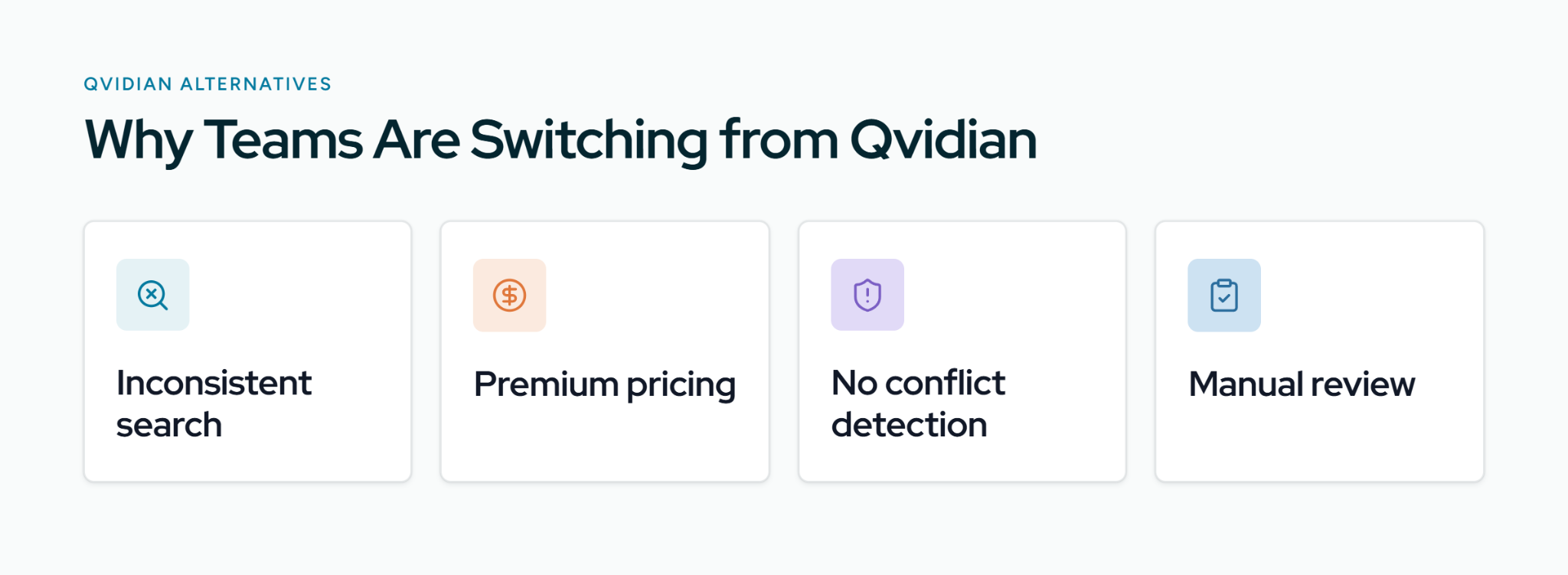
If you're evaluating Qvidian alternatives, these are the most common reasons teams make the switch, and what to prioritize in your next platform.
- Time-consuming content management: Maintaining Qvidian's content library often requires manually uploading, tagging, organizing, and updating responses. Look for AI-native platforms that pull information from connected knowledge sources to reduce ongoing maintenance.
- Keyword-based search: As content libraries grow, keyword matching can make it harder to find the most relevant response quickly. Prioritize platforms with semantic search, contextual retrieval, and source citations for more accurate answers.
- Complex workflows: Navigation, document management, and approval workflows can be challenging for occasional users. Choose software with an intuitive interface that enables sales, presales, and SMEs to contribute with minimal training.
- Limited AI automation: AI-assisted search is useful, but many teams now expect AI to generate first drafts, personalize responses, recommend improvements, and learn from approved content. Evaluate how much manual work the platform actually eliminates.
- Workflow compatibility: Some proposal platforms focus on RFPs, while others also support DDQs, security questionnaires, vendor assessments, and narrative proposals. Select a solution that matches the documents your team handles most often.
- Integrations and total cost: Beyond features, consider how well the platform integrates with Microsoft 365, Google Workspace, Salesforce, Slack, Teams, and your knowledge repositories. Also factor in ongoing administration and licensing costs when evaluating long-term value.
Qvidian Alternatives at a glance
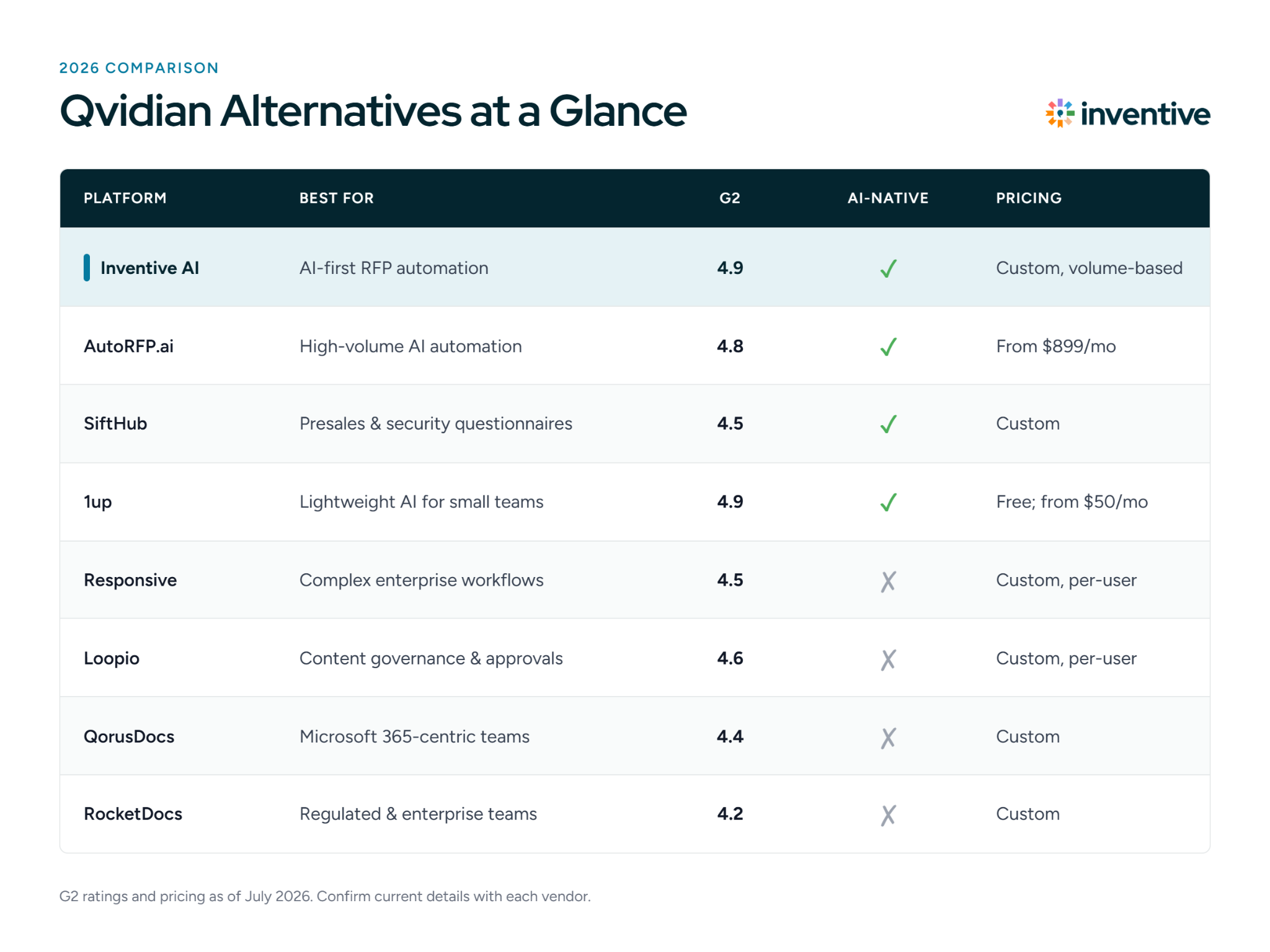
| Platform | Best For | Key Strengths | Pricing Model | G2 Rating |
|---|---|---|---|---|
| Inventive AI | Teams looking for AI-first RFP automation | Generates responses from connected knowledge sources, source-backed AI answers, reduces manual content maintenance | Custom pricing based on RFP volume (no per-seat licensing) | |
| Responsive | Enterprise teams managing complex response workflows | Mature RFP workflows, enterprise integrations, security questionnaires, AI-assisted drafting | Custom pricing with user-based plans | |
| Loopio | Teams focused on content governance and approvals | Structured content libraries, SME collaboration, workflow management, Magic AI recommendations | Custom pricing based on users/features | |
| AutoRFP.ai | High-volume RFP teams wanting AI automation | AI-generated responses with citations, project-based pricing, unlimited users | Starts at $899/month | |
| QorusDocs | Microsoft 365-centric proposal teams | Native Microsoft integrations, proposal creation, centralized content management | Custom pricing | |
| RocketDocs | Regulated industries and enterprise teams | Secure AI environment, Office integrations, compliance-focused workflows | Custom pricing | |
| SiftHub | Presales and revenue teams | AI-powered deal support, RFPs, security questionnaires, enterprise search | Custom pricing | |
| 1up | Smaller teams needing lightweight AI responses | AI questionnaire automation, browser extension, knowledge-source-based answers | Starts free; paid plans from $50/month |
AI-First RFP Automation Platforms
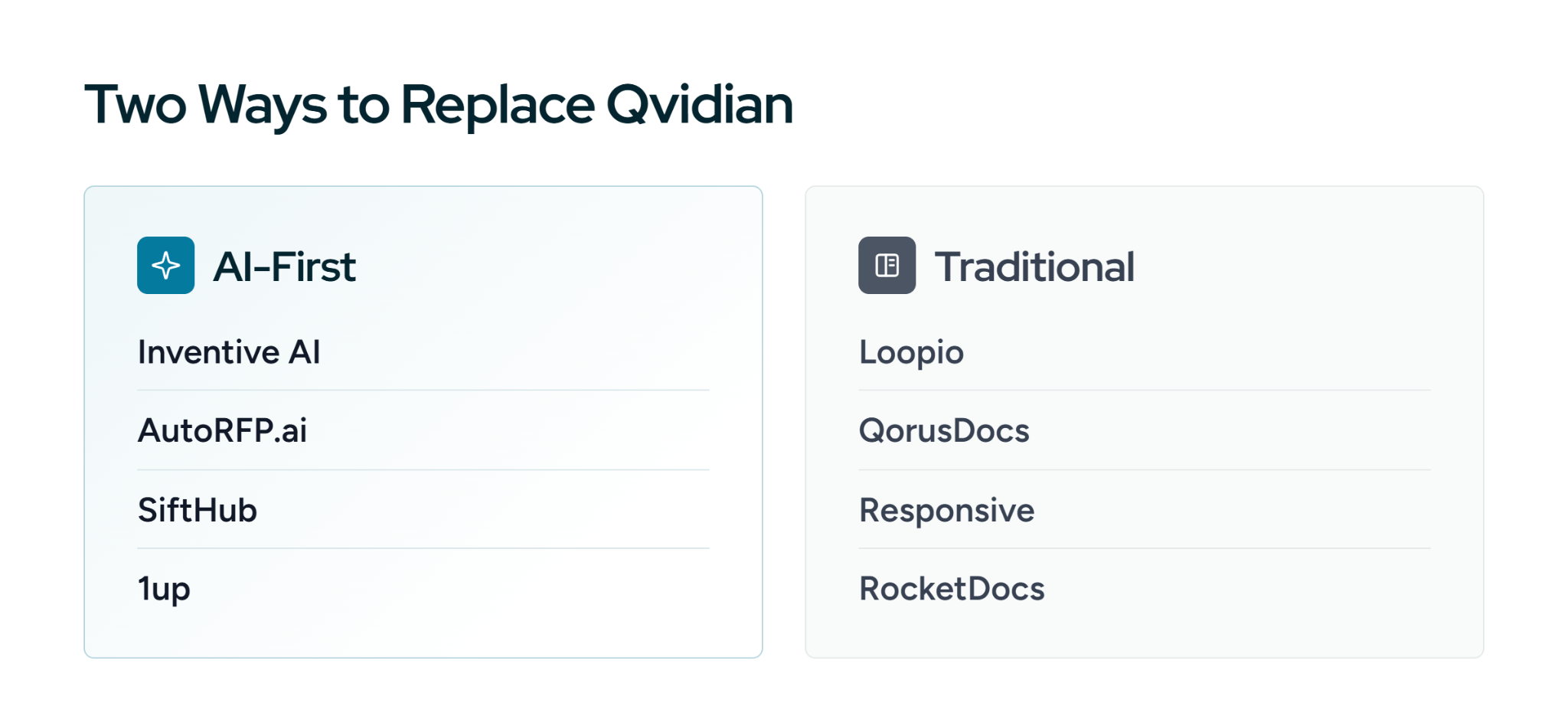
Ideal for teams that want AI to generate responses from connected knowledge sources instead of relying solely on a manually maintained content library.
Inventive AI (Ideal for teams looking for an AI-first alternative to traditional RFP software)
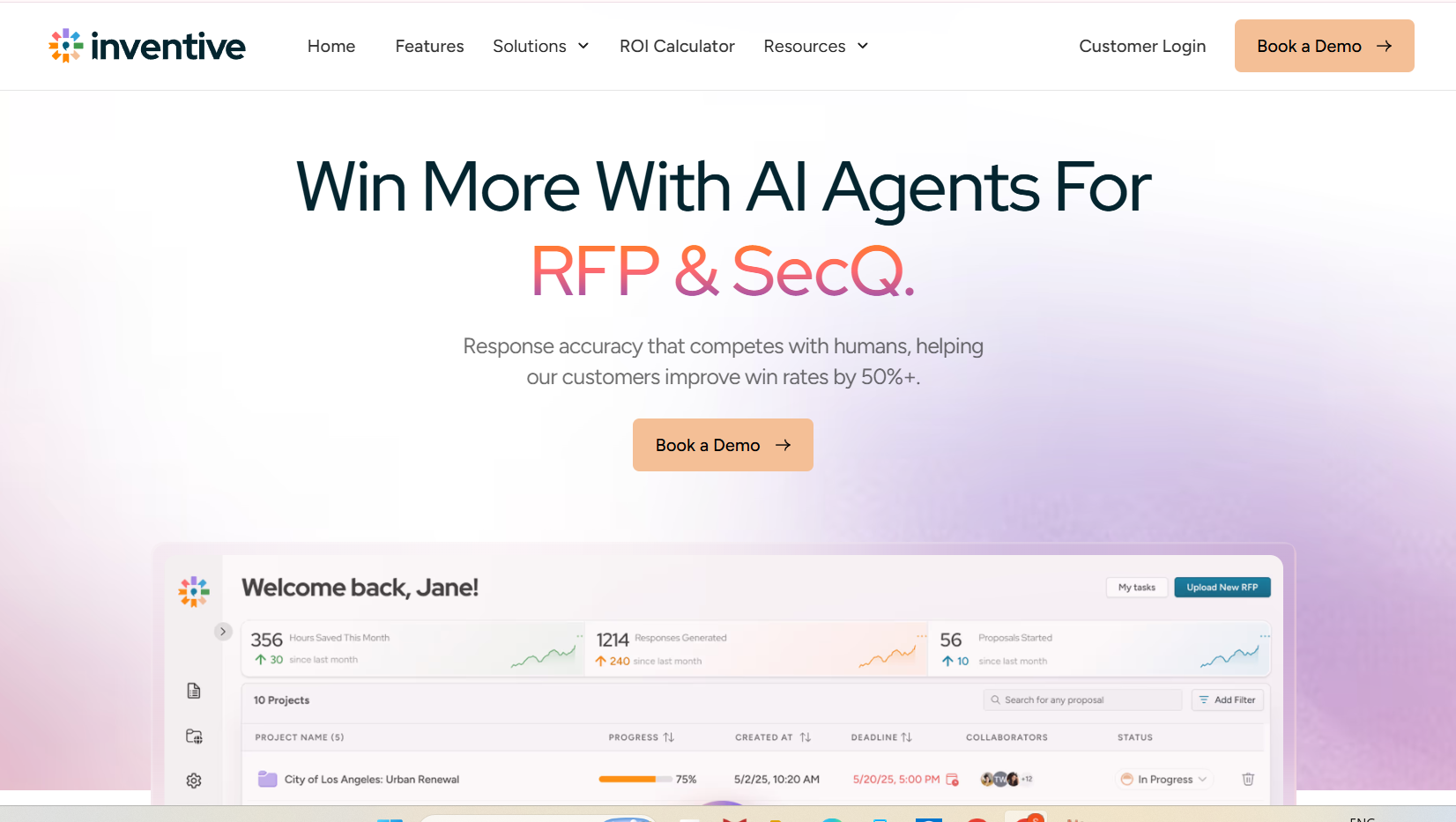
Inventive AI is an agentic AI platform for RFPs, RFIs, DDQs, and security questionnaires that generates responses from connected knowledge sources instead of a manually maintained content library. It's designed for proposal, presales, sales, and solution engineering teams that want faster drafting, more accurate responses, and less library maintenance than traditional RFP platforms.
Inventive AI best features
- Generates responses from live knowledge sources instead of a static Q&A library.
- Connects Google Drive, SharePoint, Confluence, Notion, Salesforce, and past proposals into a single searchable knowledge base.
- Uses contextual retrieval with source citations to improve answer quality and reduce manual verification.
- Creates buyer-specific drafts instead of reusing generic boilerplate responses.
- Flags outdated or conflicting content before responses are generated.
- Supports Excel questionnaires, Word documents, PDFs, and long-form narrative proposals.
- Includes built-in review workflows with approvals, nested sections, and bulk actions.
Inventive limitations
- Reporting and analytics could offer more customizable dashboards.
- No native Jira integration is currently available.
- Some users would like improvements to search, notifications, and the mobile experience.
Inventive pricing
- Pricing is based on the number of RFPs and security questionnaires your team handles, with unlimited users included and no per-seat licensing.
- A fixed platform fee covers setup, onboarding, and all features.
Inventive ratings and reviews
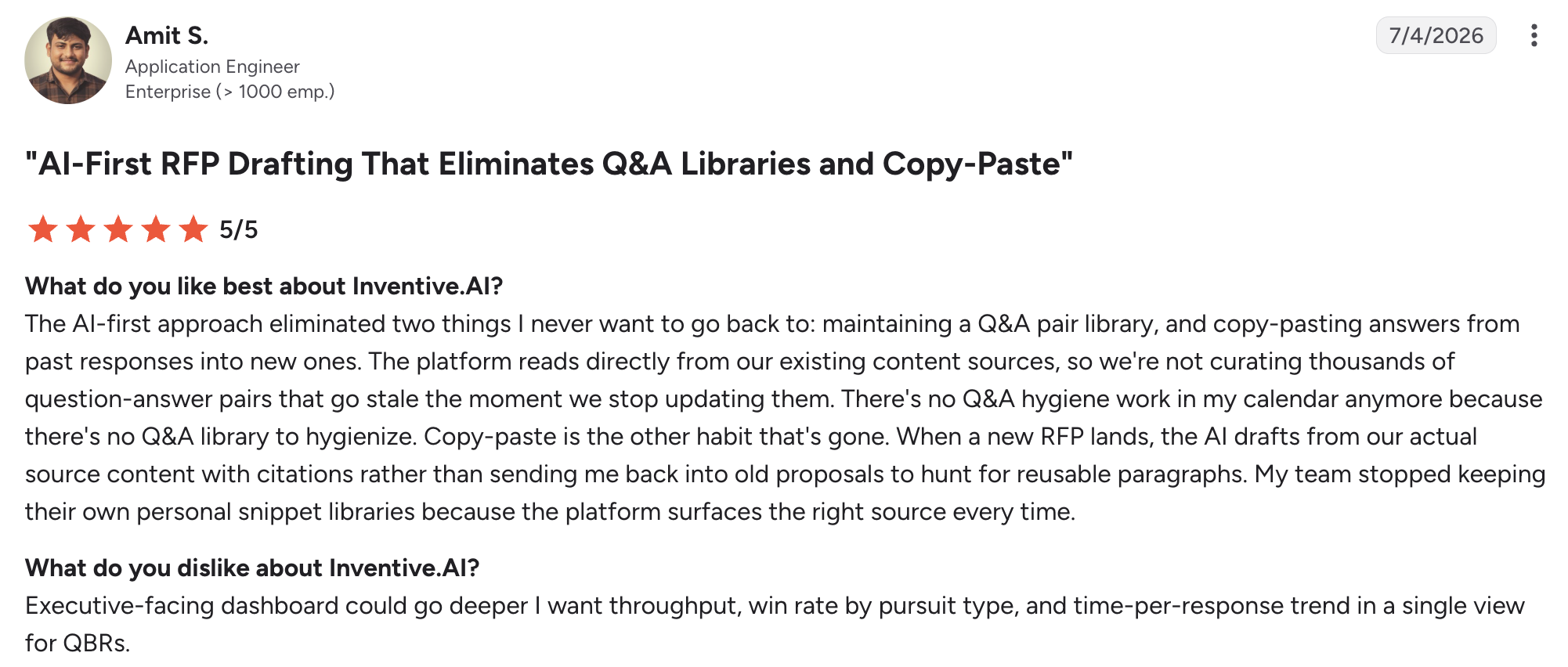
What are real users saying about Inventive?
A G2 user review says:
Want to see how an AI-native RFP platform compares to Qvidian?
Try Inventive AI with one of your recent RFPs to compare response quality, speed, and review effort.
Book a demoAutoRFP.ai (Ideal for teams that prefer project-based pricing over per-seat pricing)
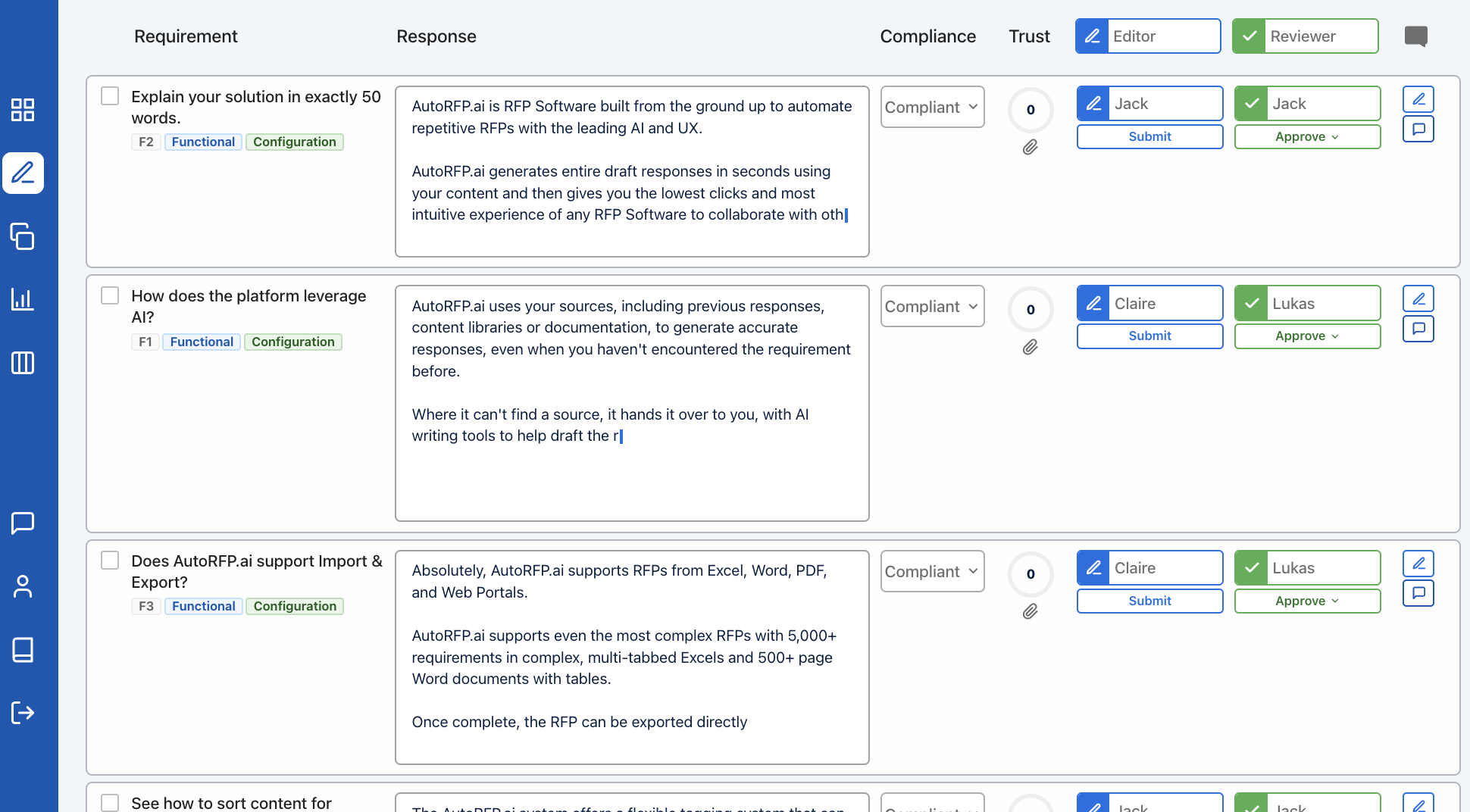
AutoRFP.ai is an AI-powered response management platform that automates RFPs, RFIs, DDQs, and security questionnaires using source-backed AI responses and collaborative review workflows. It's well suited for teams that want AI-first automation without managing large content libraries.
AutoRFP.ai AI best features
- Generates AI responses with source citations and confidence scores for faster review.
- Project Agent automates executive summaries, response revisions, and web research.
- Supports Word, Excel, and PDF questionnaires with output in more than 44 languages.
- Includes unlimited users on every plan with integrations for SharePoint, Confluence, Salesforce, Slack, Microsoft Teams, and Google Drive.
- Project-based pricing avoids per-seat licensing as teams grow.
AutoRFP.ai limitations
- Annual project limits may not suit teams with unpredictable RFP volumes.
- Some advanced AI and workflow capabilities require additional configuration.
AutoRFP.ai pricing
- Scale: $899/month (billed annually) for 24 projects/year, with unlimited users, AI, integrations, and support.
- Accelerate: $1,299/month (billed annually) for 50 projects/year.
- Enterprise: Custom pricing for higher project volumes.
AutoRFP.ai ratings and reviews
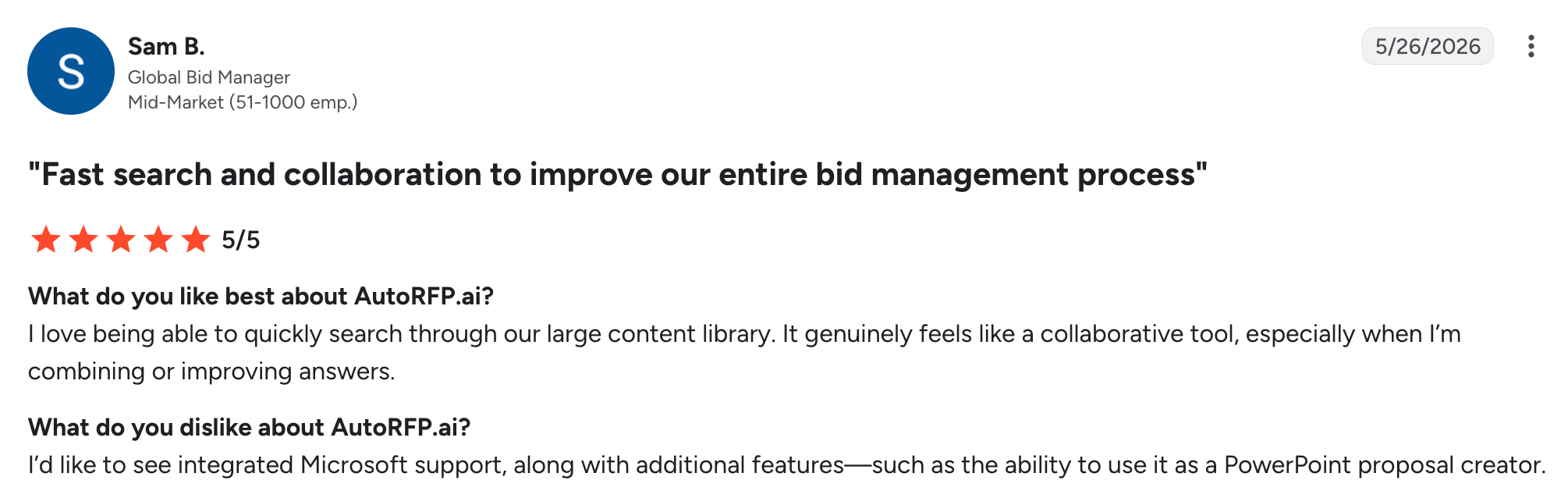
What are real users saying about AutoRFP.ai?
A G2 user review says:
Read more: Top AutoRFP AI Alternatives & Competitors For 2026
SiftHub (Ideal for presales and revenue teams)
SiftHub is an AI-powered deal orchestration platform that helps presales, sales, and proposal teams automate RFP responses, security questionnaires, and buyer-facing content. Unlike traditional RFP tools focused mainly on response libraries, SiftHub connects knowledge sources to support the entire deal cycle.
SiftHub best features
- Automates RFPs, security questionnaires, and proposals with AI-powered intake, drafting, review workflows, and audit trails.
- Generates deal-specific proposals, battlecards, technical briefs, meeting summaries, and sales handoff documents.
- Enterprise Search delivers verified answers through Slack, Microsoft Teams, and email.
- Connects with Salesforce, HubSpot, Gong, Confluence, SharePoint, Google Drive, Highspot, Seismic, Zendesk, Notion, and OneDrive.
SiftHub limitations
- AI-generated responses may require additional verification for accuracy.
- Complex, multi-team RFPs and long-form documents may need more manual handling.
- Editing and formatting large documents can be challenging.
- Some enterprise integrations and SSO configurations require additional setup.
- Analytics provide limited visibility into AI usage and performance.
SiftHub pricing
- Custom pricing based on team size and use cases.
- No fixed pricing tiers or publicly listed plans.
SiftHub ratings and reviews
- G2: 4.5/5
- Capterra: Not enough reviews
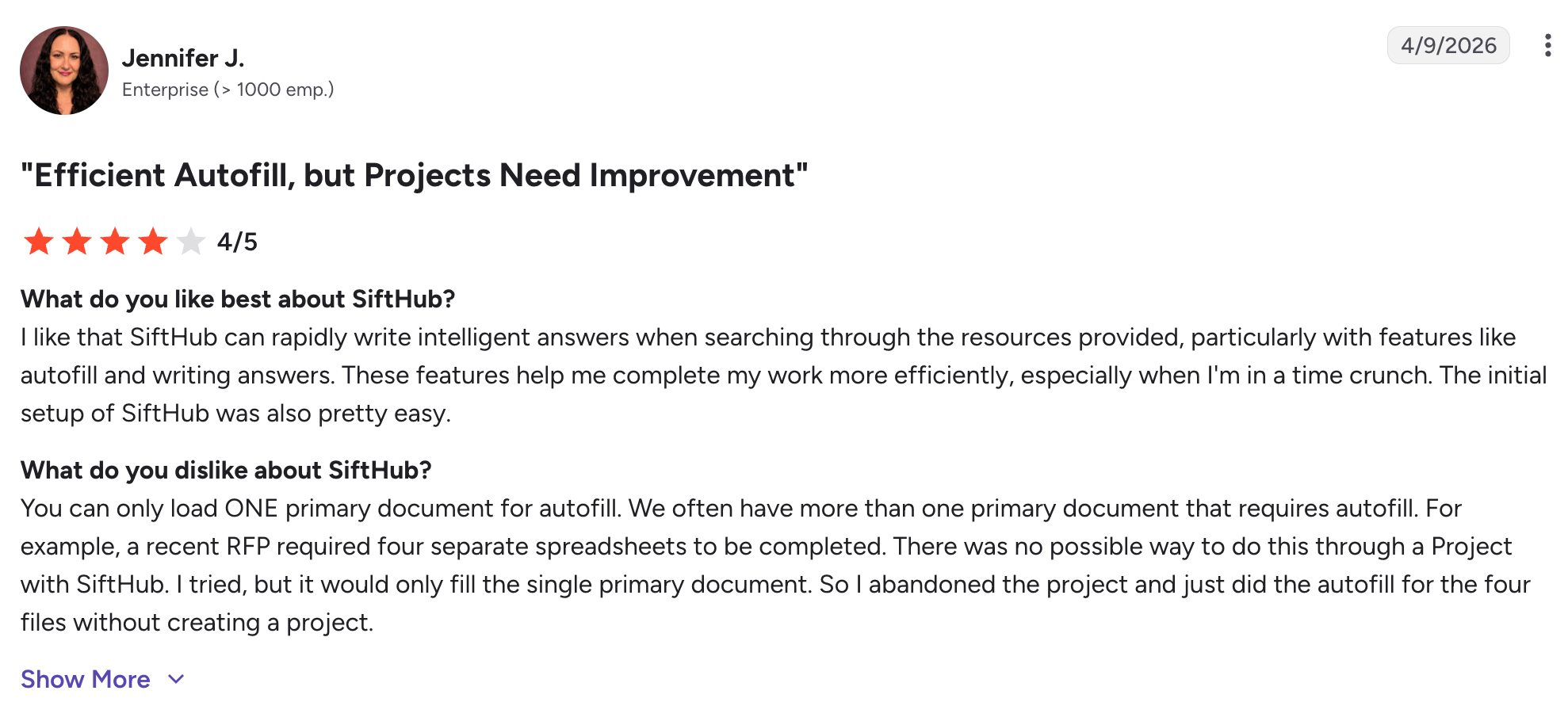
What are real users saying about SiftHub?
A G2 user review says:
Learn more: Best Sifthub Alternatives for RFP Management in 2026
1up (Ideal for lightweight AI-powered RFP automation)
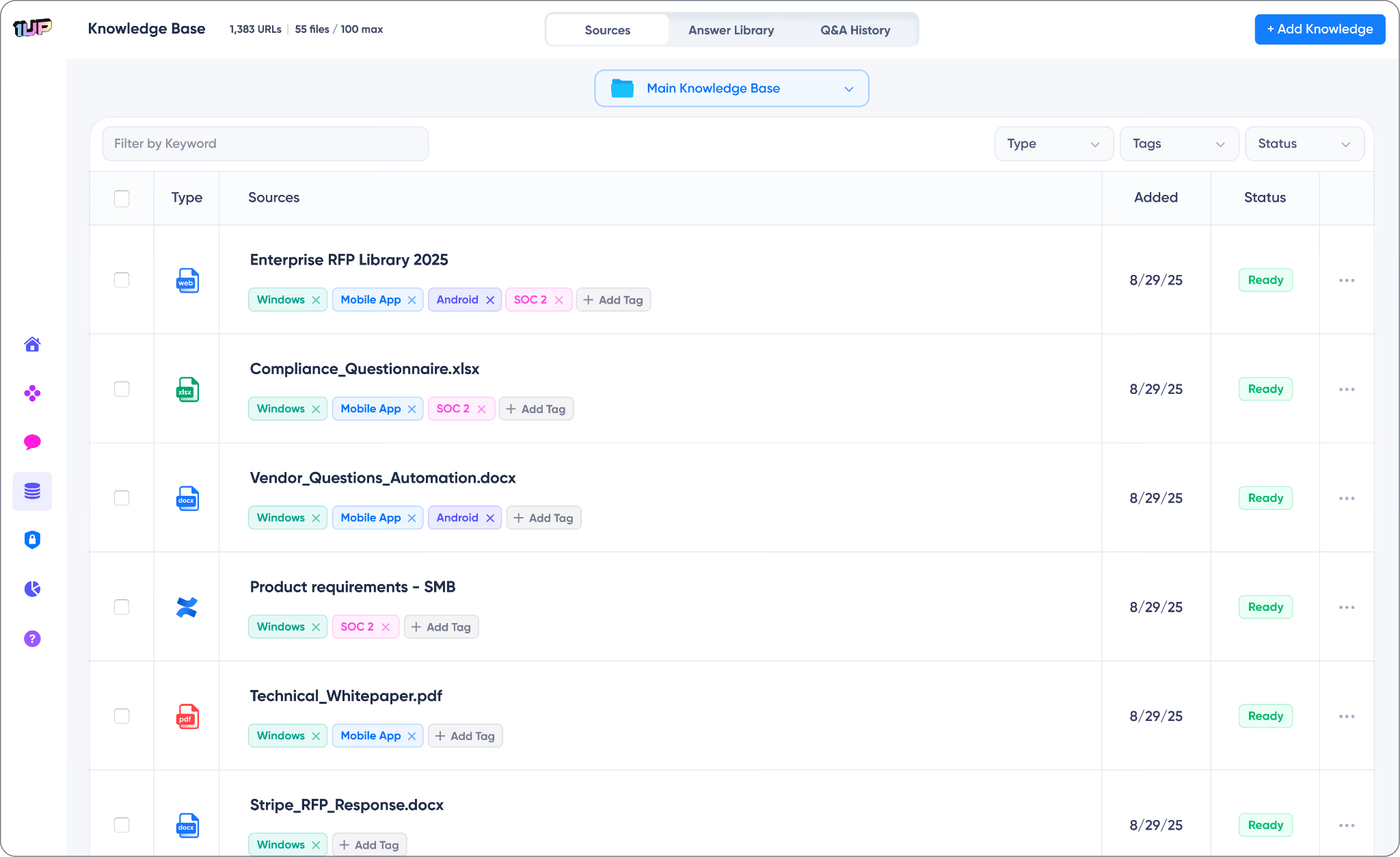
1up.ai is an AI-powered knowledge automation platform that helps sales and presales teams answer customer questions, complete security questionnaires, and automate RFP responses. It connects with internal knowledge sources to generate answers quickly without requiring teams to manually search through documents.
1up best features
- Browser extension that automatically fills web-based questionnaires across different portals.
- Answer Hub enables self-service responses and integrates with Slack and Microsoft Teams for internal Q&A.
- Connects with Confluence, Slack, Google Drive, Notion, Microsoft Office, and SharePoint.
- Uses company knowledge sources to automate repetitive questionnaire responses.
1up limitations
- AI responses may require refinement for technical, security, or compliance-heavy content.
- Less suitable for complex RFPs involving multiple stakeholders and review cycles.
- Can generate responses when source information is incomplete instead of highlighting knowledge gaps.
- Limited collaboration features compared to enterprise RFP platforms.
1up pricing
- Free: Limited plan with 50 AI answers/month.
- MCP: $50/month + usage fees ($5 per 100 answers) for teams using their own AI platform.
- Starter: $300/month, includes 1 questionnaire automation.
- Plus: $900/month, includes 6 questionnaire automations plus Answer Hub, integrations, and browser extension.
- Enterprise: Custom pricing with unlimited knowledge uploads, dedicated success manager, and enterprise features.
1up ratings and reviews
- G2: 4.9/5
- Capterra: Not enough reviews
What are real users saying about 1up?
A Gartner user review says:

Traditional RFP Response Management Platforms
Ideal for organizations with mature content libraries, established review workflows, and structured content governance.
Loopio (Ideal for teams new to response management)
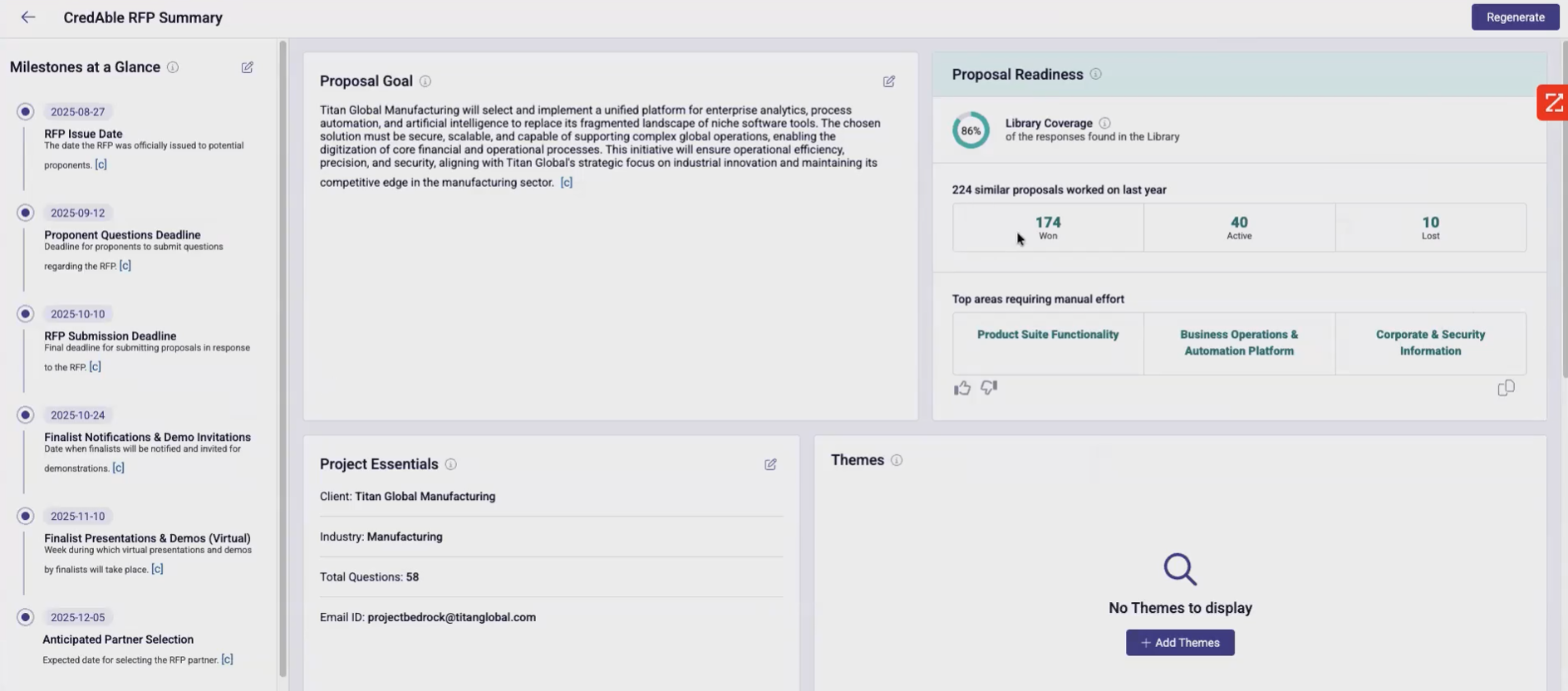
Loopio is a response management platform that helps teams centralize RFP content, standardize workflows, and collaborate on responses. It supports RFPs, due diligence requests, and security questionnaires, with a focus on content management, collaboration, and approval workflows.
Loopio best features
- Organizes approved responses using categories, tags, and content stacks with duplicate detection.
- Uses Magic AI to recommend relevant answers from the existing content library.
- Assigns questions to subject matter experts and tracks response progress.
- Provides analytics to monitor content usage, library health, and project performance.
- Supports responses directly within procurement portals.
- Chrome extension enables teams to complete browser-based questionnaires faster.
Loopio Limitations
- AI recommends existing content rather than creating fully contextual responses.
- Content accuracy depends on regular library maintenance and manual updates.
- Does not provide built-in competitor research or win-theme recommendations.
- Buyer-specific personalization may require additional editing.
- Suggested answers do not include inline source citations for verification.
- Per-user pricing can become expensive as more contributors are added.
Loopio Pricing
- Loopio uses a tier-based subscription model with pricing based on users, features, and deployment scope and does not publish public list pricing
- According to Vendr’s transaction data, typical annual contracts range from $15,000 to $150,000+
- Mid-market deployments (10–25 users) typically fall in the $30,000–$60,000 annual range
Loopio Ratings and reviews
What are real users saying about Loopio?
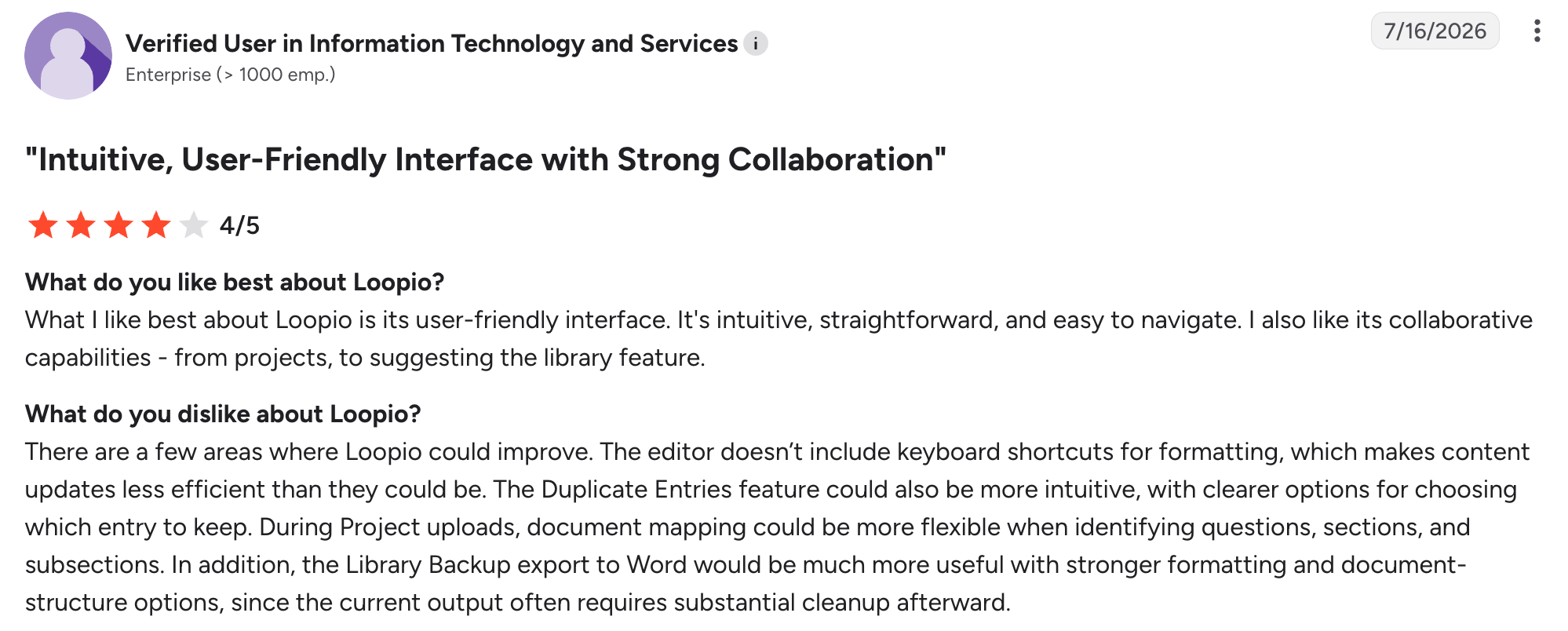
A G2 user review says:
QorusDocs (Ideal for Microsoft 365-based proposal management)
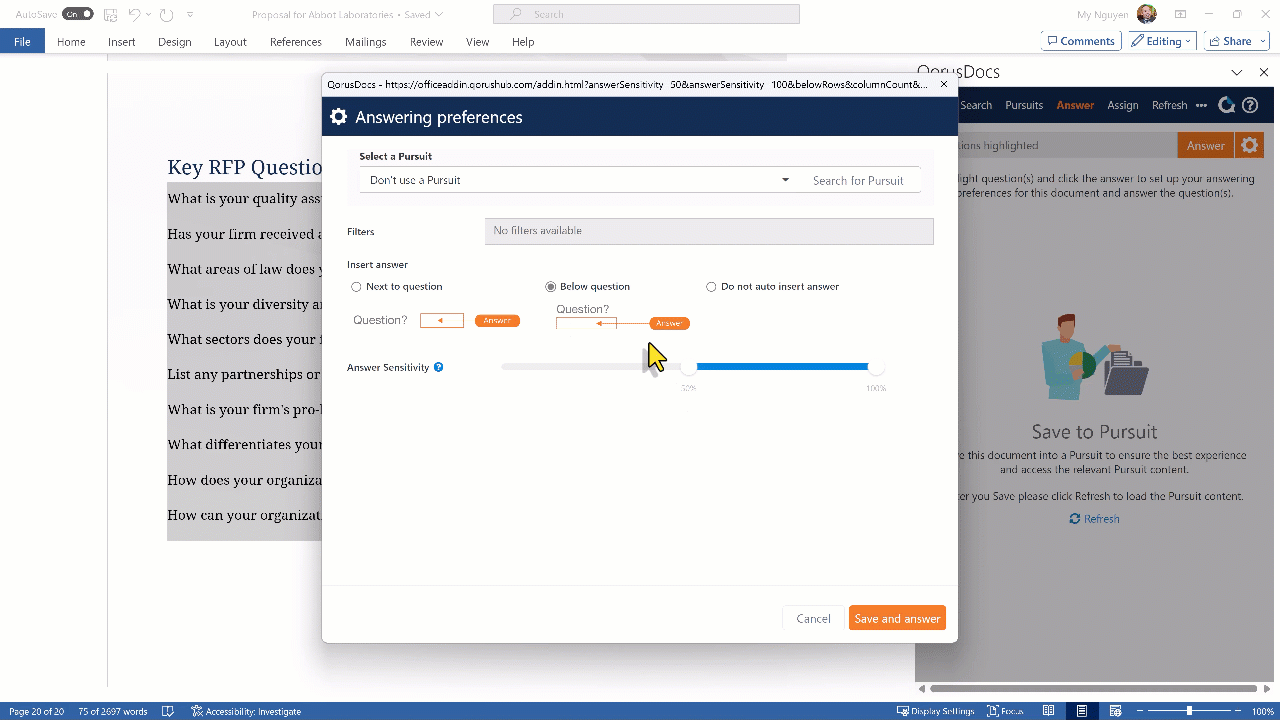
QorusDocs is a proposal management platform designed for teams that work heavily in Microsoft 365. It helps professional services, IT, legal, and business development teams create proposals, RFP responses, and presentations using familiar tools like Word, PowerPoint, SharePoint, and Teams.
QorusDocs best features
- Native Microsoft 365 integration with Word, PowerPoint, SharePoint, Outlook, and Teams for proposal creation and collaboration.
- AI-assisted drafting using approved templates and existing content.
- Centralized library for case studies, templates, presentations, and sales collateral.
- Configurable workflows for proposal teams and business development processes.
QorusDocs limitations
- Delivers the most value only for organizations already using Microsoft 365 and SharePoint.
- Large documents and complex proposals may experience performance issues.
- Advanced customization may require technical support.
QorusDocs pricing
- QorusDocs offers quote-based pricing and does not publish rates on its website.
- Pricing varies based on the selected package (ValueHub, ProposalHub, or PitchHub), team size, and deployment requirements.
QorusDocs ratings and reviews
What are real users saying about QorusDocs?
A G2 user review says:

Read more: Top QorusDocs Competitors & Alternatives for Modern RFP Teams
Responsive (Best for enterprise-scale proposal and questionnaire management)
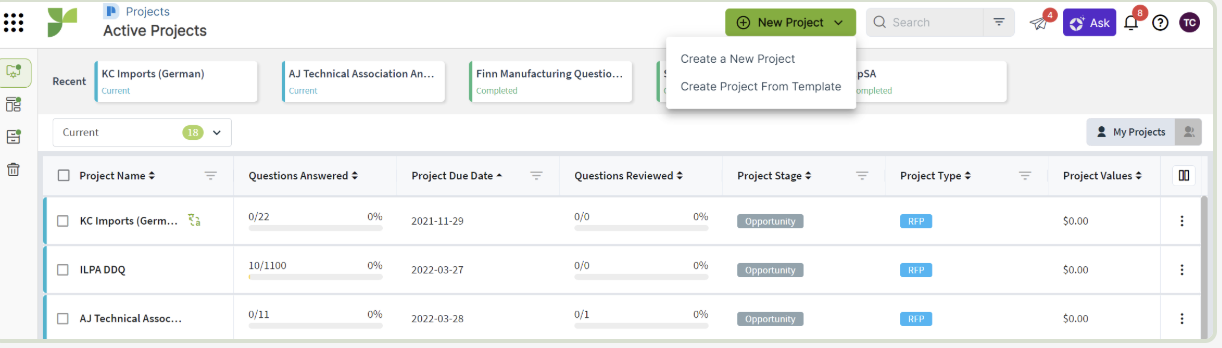
Responsive (formerly RFPIO) is an enterprise response management platform built for teams handling large volumes of RFPs, security questionnaires, DDQs, and proposals. It combines AI-assisted drafting, content management, and collaboration workflows for complex enterprise response processes.
Responsive best features
- AI Assistant and AI agents generate first drafts with source citations.
- Automates security questionnaires, vendor assessments, and compliance responses.
- Supports 30+ native integrations and 75+ APIs for connecting business systems.
- Allows project-based collaboration so occasional contributors can participate without full licenses.
- Supports multilingual responses with linked content versions for global teams.
Responsive limitations
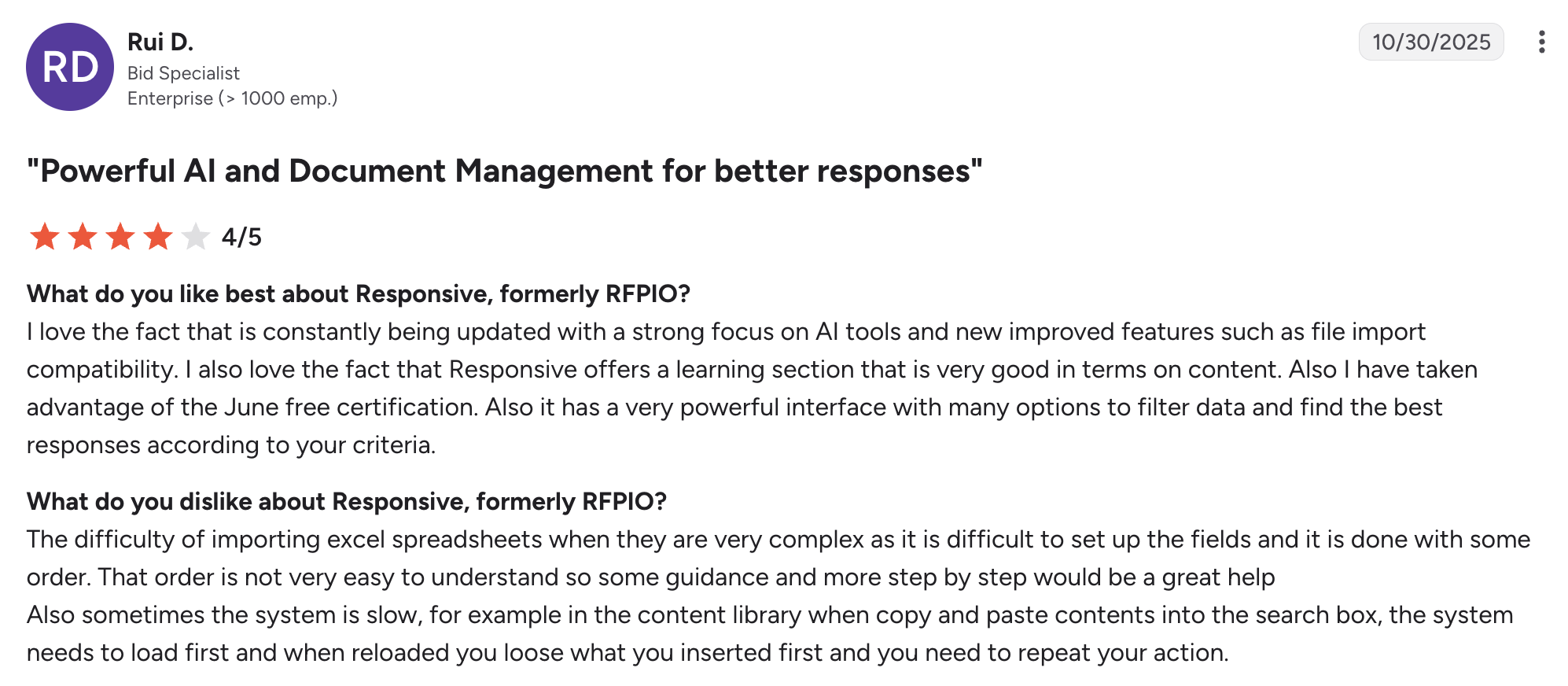
- AI relies heavily on a maintained Q&A library instead of generating from live knowledge sources.
- Does not automatically identify outdated, duplicate, or conflicting content across libraries.
- Lacks built-in competitor intelligence and buyer-specific win-theme recommendations.
- Responses may require additional editing to match specific opportunities or buyer requirements.
- Enterprise pricing can become expensive as more users and features are added.
Responsive pricing
- Starts at $5,000/year for 5 users (Lite plan), with higher tiers for growing and enterprise teams.
- Mid and enterprise plans are custom-priced based on users, features, and deployment needs.
- Overall pricing is quote-based with per-user licensing and add-ons, so costs vary by scale.
Responsive ratings and reviews
What are real users saying about Responsive?
A G2 user review says:
Compare more options: Responsive Alternatives
RocketDocs (Best for regulated industries and Microsoft Office users)

RocketDocs is an enterprise response management platform designed for organizations handling RFPs, RFIs, DDQs, and security questionnaires. It combines AI-assisted responses, content governance, and workflow automation with strong Microsoft Office support and enterprise security controls.
RocketDocs best features
- Private AI environment using a self-hosted Llama model for secure response generation.
- Microsoft Word and Excel integrations for completing questionnaires within Office.
- Centralized content library with AI-assisted answer matching and reusable responses.
- Built-in approval workflows, audit trails, and enterprise security with SOC 2 Type II and ISO 27001 certifications.
RocketDocs limitations
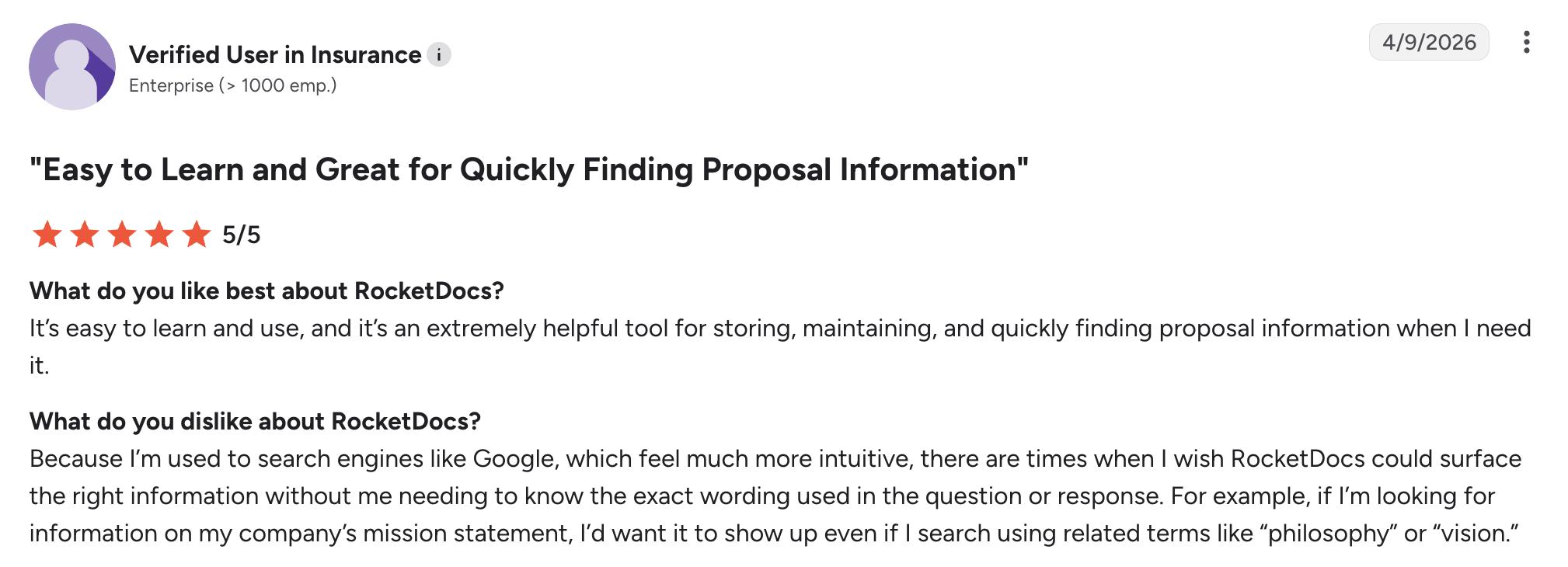
- Search and filtering can become challenging with large content libraries.
- Advanced configuration may require additional training.
- Some users report limitations around formatting, exports, and manual content workflows.
RocketDocs pricing
- RocketDocs offers quote-based pricing based on your team's size and requirements and does not list its pricing publicly.
RocketDocs ratings and reviews
What are real users saying about RocketDocs?
A G2 user review says:
Compare more options: Top 10 RocketDocs Alternatives and Competitors 2026
Which Qvidian Alternative Is Right for You?
| If you want... | Recommended tool |
|---|---|
| AI-first RFP automation | Inventive AI |
| High-volume automation with project-based pricing | AutoRFP.ai |
| Presales and deal orchestration | SiftHub |
| Enterprise-scale response management | Responsive |
| Content governance and approval workflows | Loopio |
| Microsoft 365-based proposal management | QorusDocs |
| Document automation for enterprise teams | RocketDocs |
| Sales proposals and eSignatures | PandaDoc |
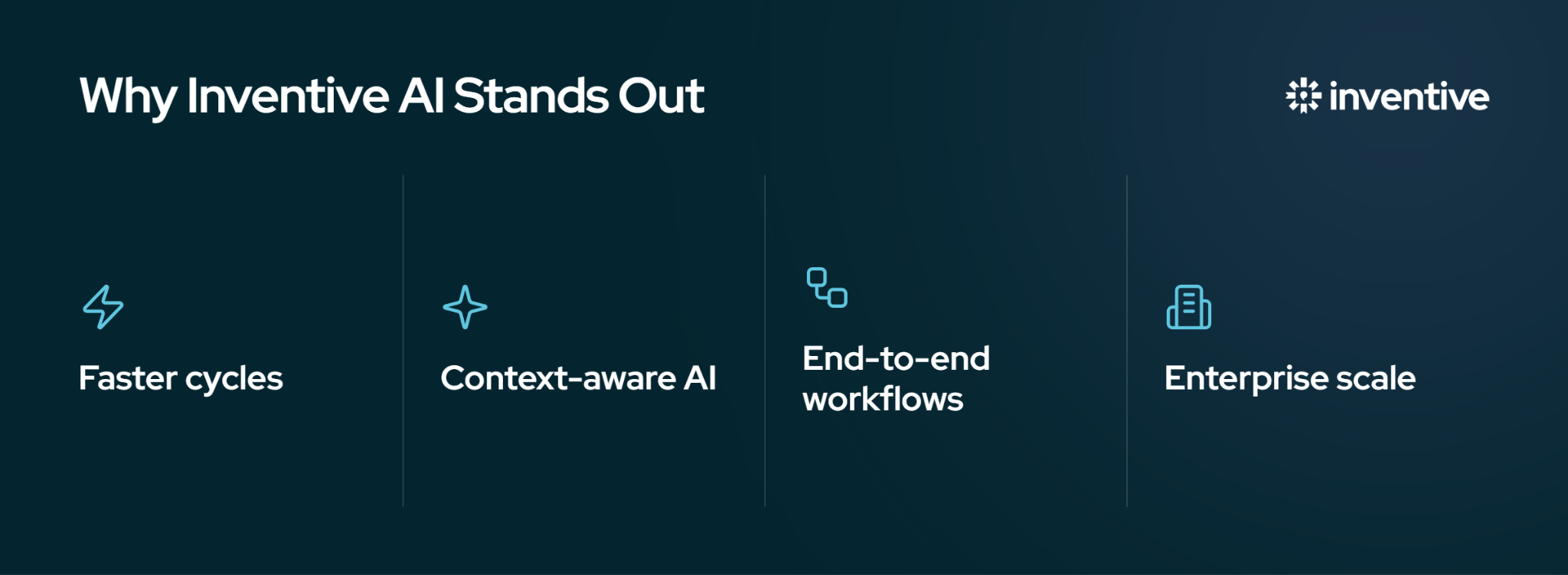
Why Inventive AI Stands Out Among Qvidian Alternatives
Most RFP platforms help teams organize content libraries, manage approvals, and speed up parts of the response process. Inventive AI takes a different approach by using AI agents to generate responses directly from connected knowledge sources, helping teams reduce manual content maintenance and improve response accuracy.
Instead of relying on a static answer library, Inventive AI continuously pulls from verified company information across systems like Google Drive, SharePoint, Confluence, and Salesforce. This helps proposal teams create more relevant, buyer-specific responses while keeping humans involved in the review and approval process.
For teams managing complex RFPs, security questionnaires, and cross-functional proposals, Inventive AI offers a more automated approach to response management.
Faster RFP Response Cycles
- Automates key stages of the RFP workflow, including intake, drafting, review, and collaboration.
- Helps teams reduce manual drafting time and meet tighter proposal deadlines.
- Enables proposal teams to handle higher response volumes without adding more administrative work.
More Context-Aware AI Responses
- Generates responses based on the connected company's knowledge rather than relying solely on pre-written Q&A pairs.
- Creates buyer-specific drafts that require less manual editing compared to generic AI outputs.
- Uses verified internal information to reduce inaccurate or unsupported responses.
- Monitors connected sources to help prevent outdated or conflicting information from entering proposals.
Built for End-to-End RFP Workflows
- Supports RFPs, RFIs, security questionnaires, and long-form proposal documents.
- Combines AI drafting with review workflows, approvals, and collaboration features.
- Handles complex enterprise workflows involving sales, solutions, proposal, and security teams.
Scales Across Enterprise Teams
- Connects to existing business systems to consolidate scattered knowledge into a single searchable workspace.
- Supports teams across sales, presales, revenue operations, and proposal functions.
- Helps organizations maintain consistency and governance across high-volume response processes.
For teams evaluating Qvidian alternatives, Inventive AI is worth considering if the goal is to reduce library maintenance, improve response personalization, and move toward a more AI-native RFP workflow.
90% Faster RFPs. 50% More Wins.
Book a demoFAQs
What are the main drawbacks of Qvidian?
Qvidian’s structured content library works well for teams that need controlled proposal management, but some users find maintaining libraries time-consuming. Common challenges include improving search accuracy, managing content updates, and navigating complex workflows as proposal needs grow.
Is Qvidian an AI-native RFP platform?
No. Qvidian includes AI-assisted features, but its core workflow is built around a centralized content library where teams store and manage approved responses. AI-native platforms generate responses directly from connected knowledge sources instead of relying primarily on manually maintained libraries.
How much does Qvidian cost compared to other RFP software?
Qvidian does not publish fixed pricing and typically uses custom enterprise pricing. Costs depend on factors like team size, features, integrations, and deployment requirements. Some alternatives offer usage-based or project-based pricing models that may be easier for growing teams to scale.
What should companies evaluate before switching from Qvidian?
Teams should compare factors such as response accuracy, content maintenance requirements, AI capabilities, collaboration workflows, integrations, security features, and implementation time. Testing tools with real RFPs or questionnaires can help identify which platform fits existing processes best.
Can Qvidian alternatives integrate with existing business systems?
Yes. Most modern RFP platforms integrate with tools commonly used by sales and proposal teams, including Salesforce, Microsoft 365, SharePoint, Google Drive, Slack, and collaboration platforms. Available integrations vary by vendor.

.avif)