RFP Response Trends, Benchmarks & Win Rates in 2026
See the RFP benchmarks and trends shaping 2026, average win rates, response times, and how top teams outperform, plus what's changing with AI.
RFP response trends in 2026 comes down to three shifts: a move from generative to agentic AI, faster turnarounds of ~20–25 hours per response, and win rates of 45–50% for top-performing teams.
Agentic AI is the biggest of these. Agents that shred documents, run compliance checks, and manage the whole bid lifecycle, not just draft answers. That's a real advantage when a single RFP response still takes an average of 23.8 hours to produce: teams using agentic AI cut that time sharply and win more bids.
This guide breaks down the 2026 trends and benchmarks that separate high-performing RFP teams from the rest.
Key Takeaways
- Top RFP teams win on automation, not headcount; they handle roughly 40% more RFPs (about 14–15 a month versus 10–11 for less mature teams) by reusing pre-approved content instead of hiring.
- Go/No-Go decision frameworks are becoming standard, helping teams focus only on the bids they're most likely to win.
- Custom responses are replacing generic templates, tailored to each buyer's specific requirements and value drivers.
- RFP tools are integrating with collaboration platforms like Slack, Microsoft Teams, and Google Workspace to speed cross-team work.
- Real-time compliance and content checks are rising, especially in regulated industries like healthcare and finance.
How AI is Shaping RFP Responses in 2026?
In 2026, AI does far more than draft text; agentic tools run the full response workflow, from reading the RFP to shaping strategy. Here's what that looks like:
- Reads and shreds the RFP: automatically breaks a long document into individual questions and requirements, so nothing gets missed.
- Pulls from all your connected sources: retrieves the best answer not just from an approved library, but across past proposals, SharePoint, Salesforce, Notion, and other connected systems, so no knowledge is left untapped.
- Drafts with context: tailors each answer to the buyer's specific requirements, not a generic template.
- Runs competitive intelligence: analyzes how competitors are likely to respond and surfaces the differentiators that make your bid stand out.
- Supports Go/No-Go and strategy: scores deal fit early and reviews the full response for gaps or contradictions, so teams pursue only winnable bids and submit stronger ones.
- Checks compliance: flags outdated content, expired certifications, or missing requirements before the response goes out.
- Routes and collaborates: assigns sections to the right experts across Slack or Teams and tracks progress to the deadline.
The result: teams spend less time on repetitive drafting and coordination, and more on the strategy that actually wins the bid.
Also Read: How to Develop Effective RFP Win Themes for Proposal Success
Trends in RFP Response Management 2026
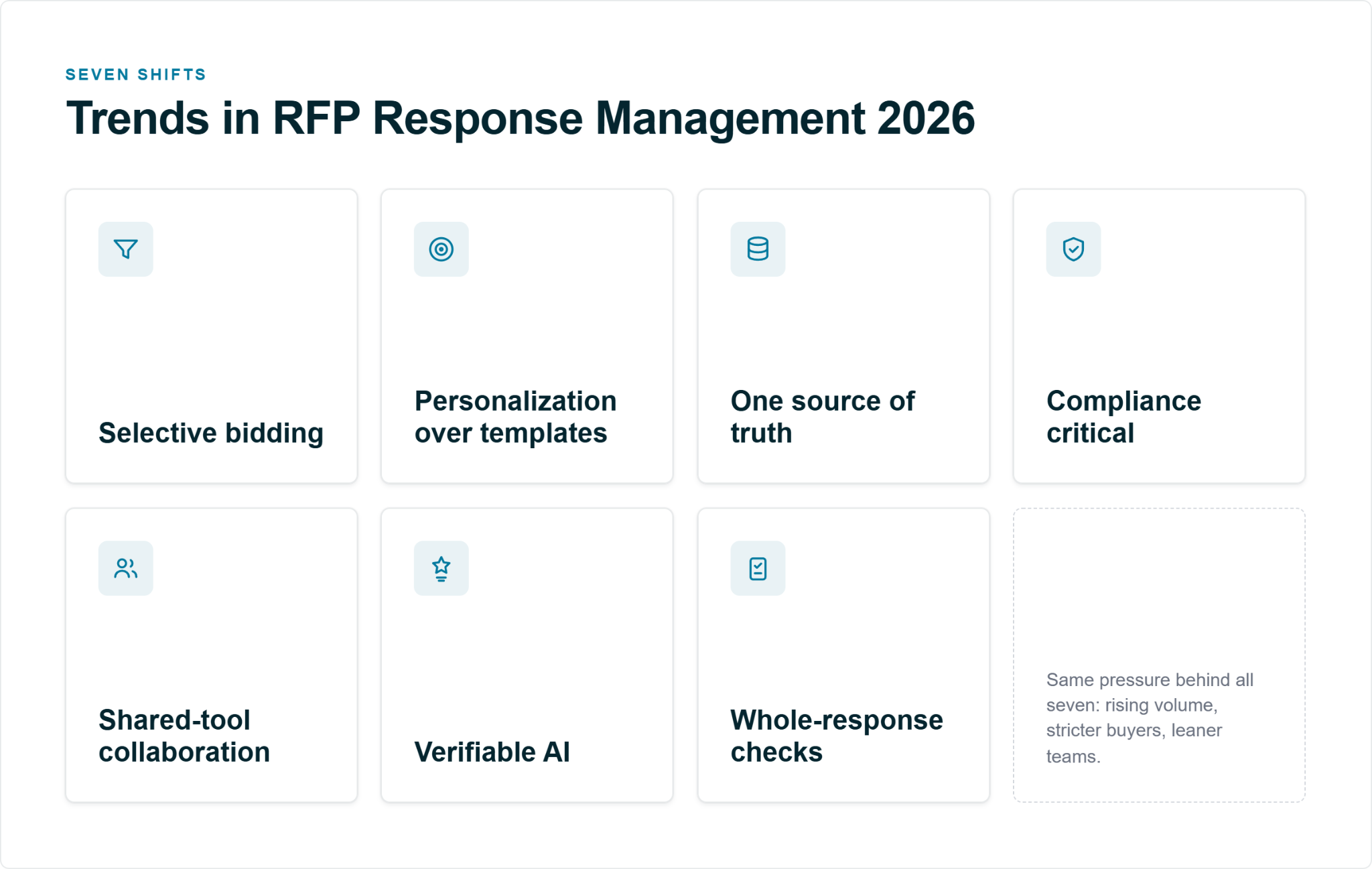
Six shifts are redefining how teams respond to RFPs in 2026. Each reflects the same underlying pressure: rising RFP volume, stricter buyer expectations, and leaner teams.
1. More Selective Bidding
Chasing every incoming RFP spreads teams thin and lowers win rates. So more organizations now apply Go/No-Go criteria, fit, budget, incumbency, and differentiation to decide early which bids are worth pursuing.
The payoff is biggest on government and large-enterprise deals, where a single response runs dozens of pages and win odds are low without an existing relationship. The shift is from volume to focus: fewer bids, better targeted, with senior effort saved for the ones most likely to close.
2. Personalization Over Templates
Evaluators score on how precisely a response fits their situation, not how polished the boilerplate is, so generic, reused answers now cost points. Winning teams map each answer to the buyer's requirements and scoring rubric, then lead with the two or three differentiators that matter most.
What "personalization" means shifts by sector: SaaS buyers want architecture, integration, and data-handling specifics; healthcare and finance want exact compliance and certification detail; public-sector buyers want line-by-line alignment to published criteria. In 2026, relevance matters more than polish.
3. One Source of Truth
A single buyer often sends an RFP, a security questionnaire, and a DDQ within the same deal, and when answers live in separate libraries, spreadsheets, and inboxes, the same question gets answered inconsistently. Teams are consolidating that content into one governed source so every response draws from the same current, approved answers.
This removes the "content drift" that produces conflicting claims across documents, cuts the hours spent hunting for the latest version, and lowers the risk of submitting an outdated figure or expired certification.
4. Compliance is Critical
Security and regulatory sections keep growing, and one missed requirement or lapsed certification can disqualify a strong bid before it's scored. So teams now treat compliance as a built-in, continuous step, not a last-minute audit.
The specifics differ by industry: HIPAA and HITRUST in healthcare, SOC 2 and GDPR in finance, FedRAMP in government, but the pattern is the same: buyers expect current, verifiable compliance answers, and teams with mature compliance both avoid disqualification and score higher on the risk-weighted criteria evaluators use.
5. Collaboration Moves Into Shared Tools
A complete response now needs input from security, legal, product, and sales, and coordinating that over email and shared files causes version conflicts and missed deadlines. Teams are moving the work into Slack, Microsoft Teams, and Google Workspace, where those contributors already are, so assignments, reviews, and approvals happen in one place.
The payoff is biggest on enterprise deals that need InfoSec and legal sign-off, and on distributed teams across time zones, where a clear owner and version history for each section prevent last-minute scrambles.
6. AI You Can Verify
As AI drafts more of every response, teams and buyers expect answers they can verify, not take on faith. The emerging standard pairs each answer with its source and a confidence signal, flags anything unsupported instead of guessing, and keeps a person accountable for final approval.
This matters most in regulated, high-stakes bids, where any claim may be audited, and a wrong answer carries real consequences. Verifiability is moving from a nice-to-have to a baseline expectation.
7. Whole-Response Quality Checks
When several people each write a section, the response can read like several different companies, clashing tone, repeated claims, and answers that contradict each other or cite outdated content. Evaluators notice, and that inconsistency weakens an otherwise strong bid.
So teams are moving from reviewing answers one at a time to checking the full response as a whole: one consistent voice, no contradictions, and no stale content slipping through. The bigger the proposal and the more people involved, the more this final review matters; it's what makes a bid read as one clear voice instead of a patchwork.
Also Read: 15 Best RFP Software in 2026: Features, Prices and Reviews
RFP Response Management Benchmark 2026
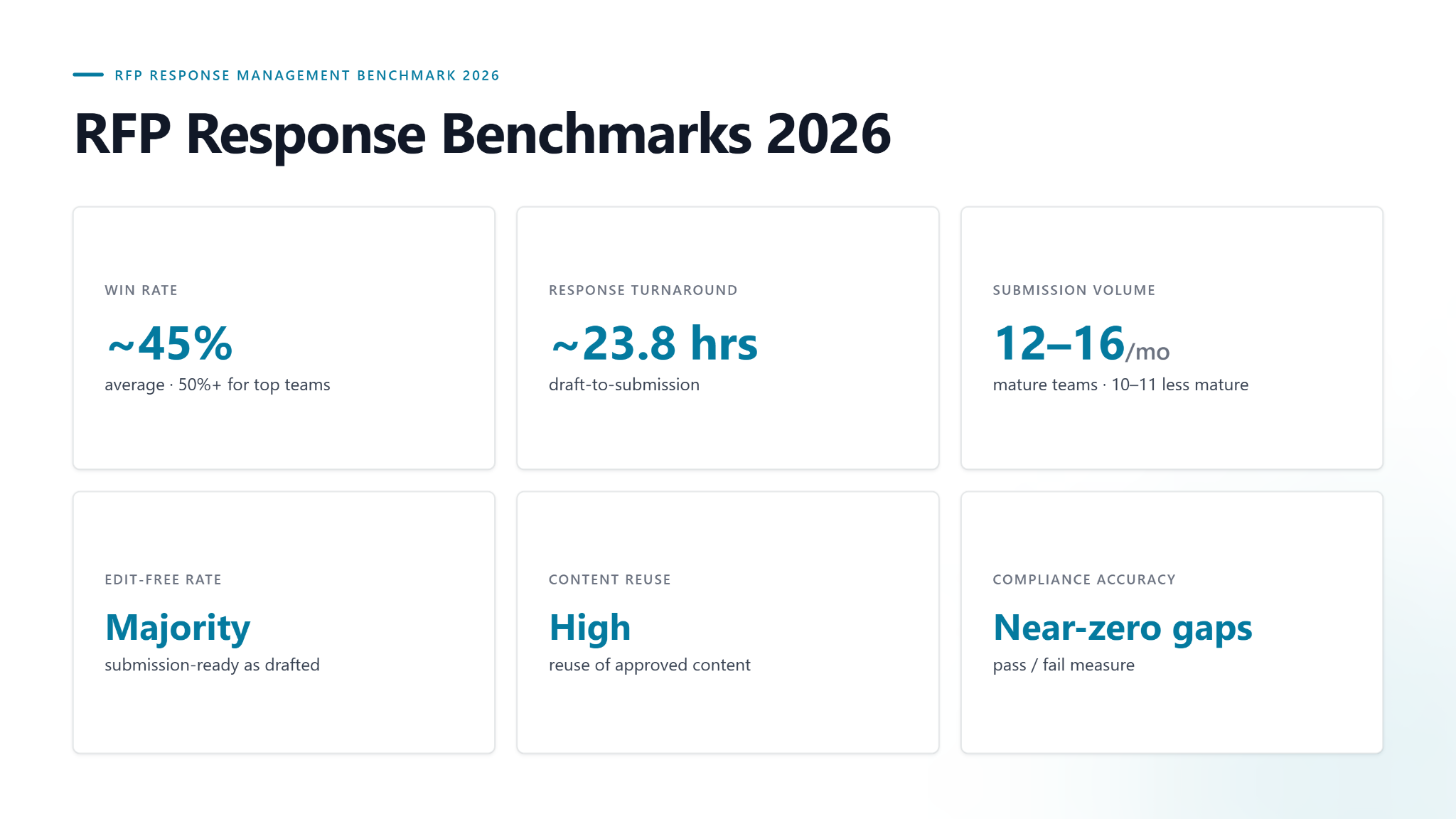
These are the benchmarks to measure your RFP response process against in 2026:
- Win rate: ~45% average, 50%+ for top teams. The gap reflects bid selection and response quality; teams that qualify well and personalize deeply win a larger share of what they pursue.
- Response turnaround: ~23.8 hours per response. This is falling as teams automate; faster turnaround lets you submit earlier and take on more bids. Measure full draft-to-submission time, not just drafting.
- Submission volume: 12–16 responses per month for mature teams (versus 10–11 for less mature ones). The difference comes from automation and content reuse, not added headcount.
- Edit-free rate: a majority of drafts submission-ready with minimal edits. This is the clearest measure of draft quality; a low rate usually signals stale or poorly organized source content.
- Content reuse: high reuse of approved, current content. It cuts time per response and keeps answers consistent across bids, but only when the underlying content stays current.
- Compliance accuracy: near-zero gaps. In regulated bids, this is effectively pass/fail; one missing requirement or expired certification can disqualify a response, so track the share of submissions with zero compliance gaps.
How Compliance Maturity Increases Win Rates
Compliance maturity lifts win rates two ways. First, it prevents disqualification: many RFPs in healthcare, finance, and government automatically reject responses that miss a mandatory requirement or use an expired certification, so a single gap loses the deal before it is scored. Second, it builds evaluator trust: current, consistent compliance answers signal a lower-risk vendor, which scores higher on the risk-weighted criteria buyers use.
Teams with mature compliance rarely lose on technicalities and respond faster, which is why they consistently post win rates above the ~50% average.
Inventive AI is Leading the Market with Performance Benchmarks 2026
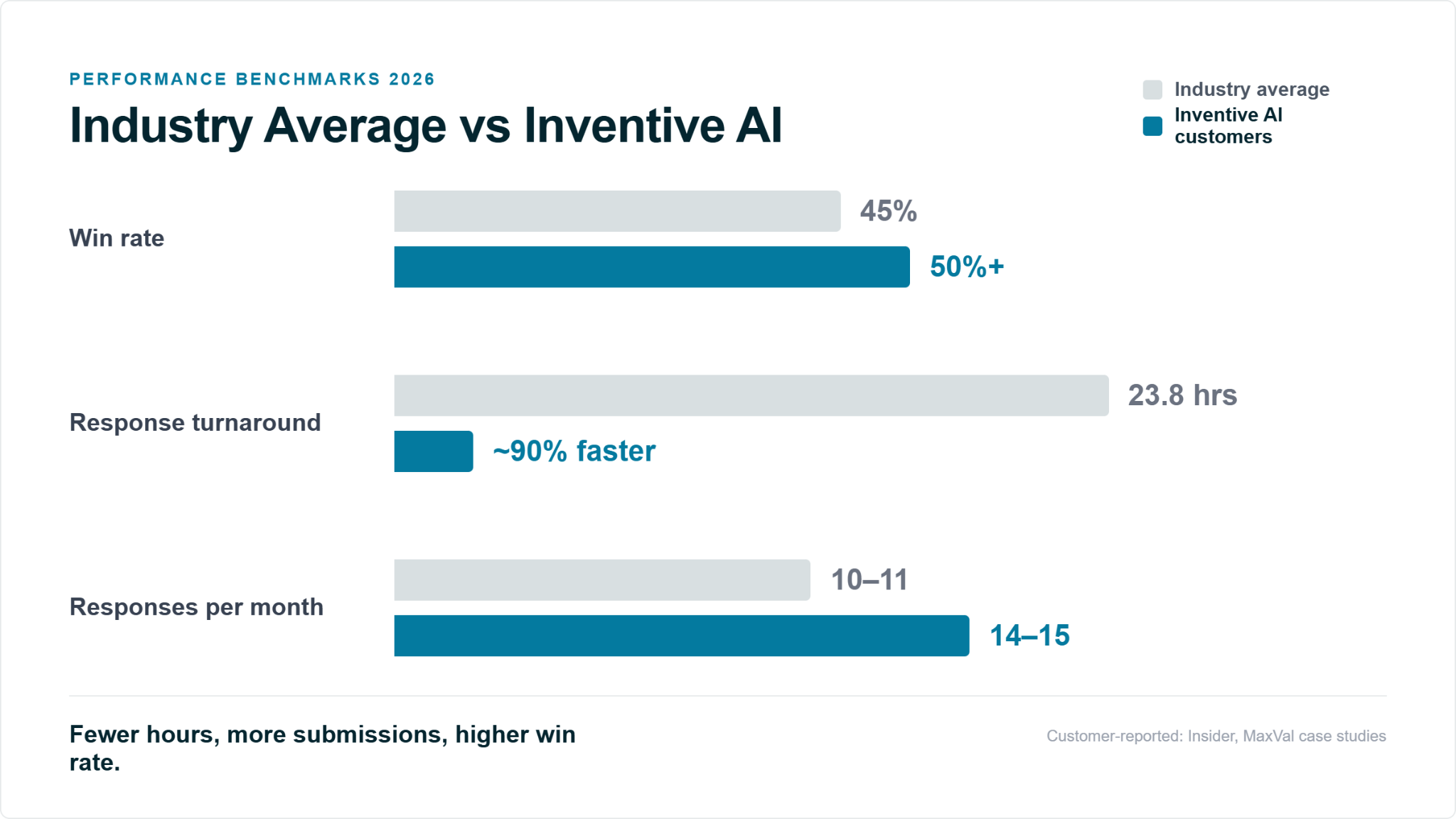
Most of the trends above point in one direction: verifiable AI, response quality, and compliance checks. Inventive AI is one platform built around that model, an autonomous AI agent platform for RFPs, RFIs, and security questionnaires, with people in the loop to approve.
In practice, that means it maps to the benchmarks this guide covers:
- It drafts each answer from your connected knowledge, past proposals, SharePoint, Salesforce, and Notion, so content stays current instead of living in a separate library (content reuse, single source of truth).
- Every answer carries a source citation and a confidence score, and the system flags anything unsupported instead of guessing (verifiable AI, accuracy).
- A governance layer catches outdated, duplicate, or conflicting content before submission (compliance, whole-response consistency).
- Strategic agents score Go/No-Go fit, analyze competitor positioning, and review the full response for gaps (bid selection, response quality).
Against the 2026 benchmarks, here's what customers report:
| Benchmark | What customers report | Source |
|---|---|---|
| Win rate (~45% avg) | Insider improved from ~30% to over 50% | Insider case study |
| Response turnaround (~24 hrs) | MaxVal cut RFP turnaround ~90% — with zero weekend hours lost | MaxVal case study |
| Accuracy / edit-free rate | RAD-AI reported responses 2× more accurate than other RFP AI tools, barely needing a tweak | RAD-AI case study |
Frequently Asked Questions (FAQs)
1. How many of the RFPs we receive should we respond to?
There's no single number, but the trend is toward fewer, better-qualified bids. On average, teams respond to a little over half the RFPs they receive — and selectivity pays off: teams that focus on invited or well-qualified opportunities post far higher win rates than those that bid on nearly everything, where win rates often fall below 20%.
2. Does a formal bid/no-bid (Go/No-Go) process actually improve win rates?
Yes. Teams that add a formal Go/No-Go gate typically see a meaningful win-rate lift within a few months, mostly because declining poor-fit RFPs frees time and senior effort for the proposals they can realistically win. The discipline matters more as submission pressure rises and teams are tempted to bid on everything.
3. What win rate should we expect on renewals versus new business?
They're very different, so measure them separately. Incumbent renewals and follow-on bids often win 60–90%, because you already have the relationship and track record. Cold, new-business bids are much lower — frequently in the single digits to ~15%, climbing toward 40–50% only when you're selective and well-positioned.
4. How do you calculate RFP win rate?
Divide the number of RFPs you won by the number you submitted (or that reached a decision) over a set period, then multiply by 100. For a clearer picture, track it by segment — deal size, industry, and incumbent vs. new business — since a blended number can hide where you're actually strong or weak.
5. Why is our RFP win rate low?
The most common causes are bidding on too many poorly-qualified RFPs, submitting generic responses that don't map to the buyer's criteria, and competing where you have no prior relationship. Tightening bid selection and tailoring each response to the evaluation rubric usually moves the number faster than simply responding to more RFPs.

.avif)

%20(32).avif)

%20(19).avif)