Master the Data Quality RFP: Toolkit Template and Response Strategy for 2026

You finally get shortlisted for an enterprise data quality evaluation. Then the RFP arrives.
It asks about metadata lineage, rule-based validation engines, ML-driven anomaly detection, master data integration, audit logging, governance alignment, and regulatory compliance. Your product team understands the platform. But your proposal team now has one week to translate architecture into structured, scorable answers.
If you sell data quality tools, you know the challenge is not capability. It is answering complex evaluation frameworks clearly and completely.
This guide gives you a practical toolkit rfp template for data quality tools, a response template, and a structured process to help you submit stronger proposals in 2026.
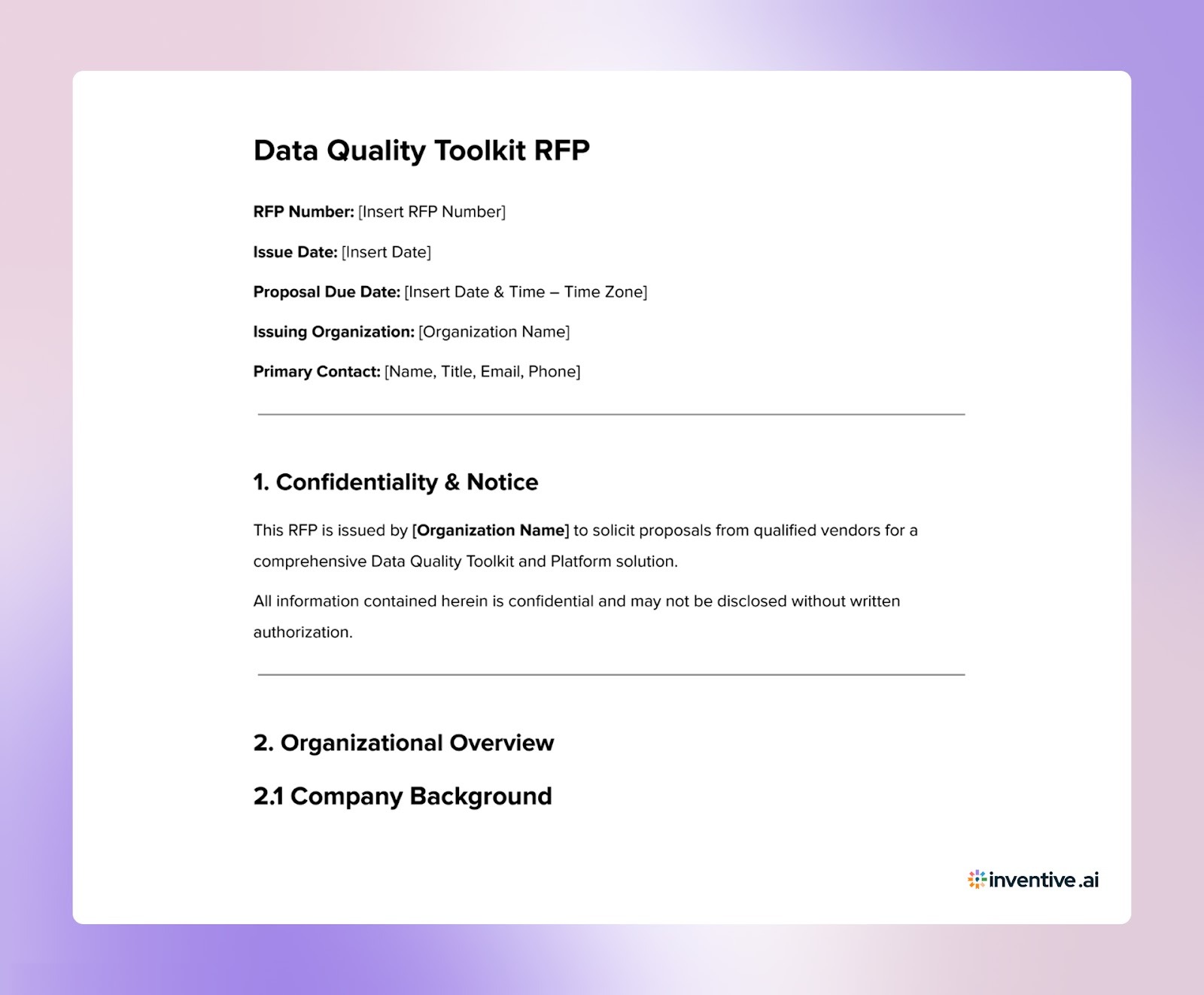
Toolkit RFP Template for Data Quality Tools (For Buyers)
A toolkit rfp template for data quality tools is a structured document that enterprise buyers use to evaluate vendors offering profiling, cleansing, monitoring, and governance solutions.
It standardizes technical requirements, compliance criteria, integration needs, and scoring frameworks so buyers can compare vendors objectively.
We have provided a ready-to-use toolkit RFP template that you can download and review. It shows what buyers typically ask data quality vendors and how evaluation sections are structured. Studying this template helps you prepare before the RFP even arrives.

What Buyers Measure When Evaluating Data Quality Tool RFP?
Data quality RFPs follow consistent patterns. Recognizing these patterns improves preparation.
Key Components
- Data profiling and discovery capabilities
- Rule-based validation and monitoring workflows
- Machine learning anomaly detection features
- Data lineage and traceability requirements
- Integration with ETL, CRM, ERP, and cloud data warehouses
- Security, encryption, and access controls
- Regulatory alignment, such as HIPAA, SOX, or GDPR
- Deployment model (SaaS, hybrid, on-prem)
- Scalability benchmarks and performance metrics
- Total cost of ownership structure
Each section requires measurable answers, not marketing language. When you anticipate these sections early, you reduce coordination pressure during submission.
Also Read: Government AI RFP Response Software: Comparison and Alternatives
Why Structured Data Quality Tools RFP Preparation Gives Vendors a Scoring Advantage?
If you respond to multiple enterprise data evaluations each year, structure improves both speed and clarity.
- Reduces missed functional requirements
- Standardizes collaboration between product, security, and sales teams
- Speeds up SME input with predefined answer sections
- Improves technical consistency across multiple proposals
- Aligns executive summaries with buyer scoring criteria
Using a structured toolkit rfp template reduces reactive drafting and improves response discipline.
Now that you understand how buyers structure their data quality RFPs, the next step is building a response framework that answers every section clearly and competitively.
Toolkit RFP Template for Data Quality That Aligns with Enterprise Scoring Models (For Vendors)
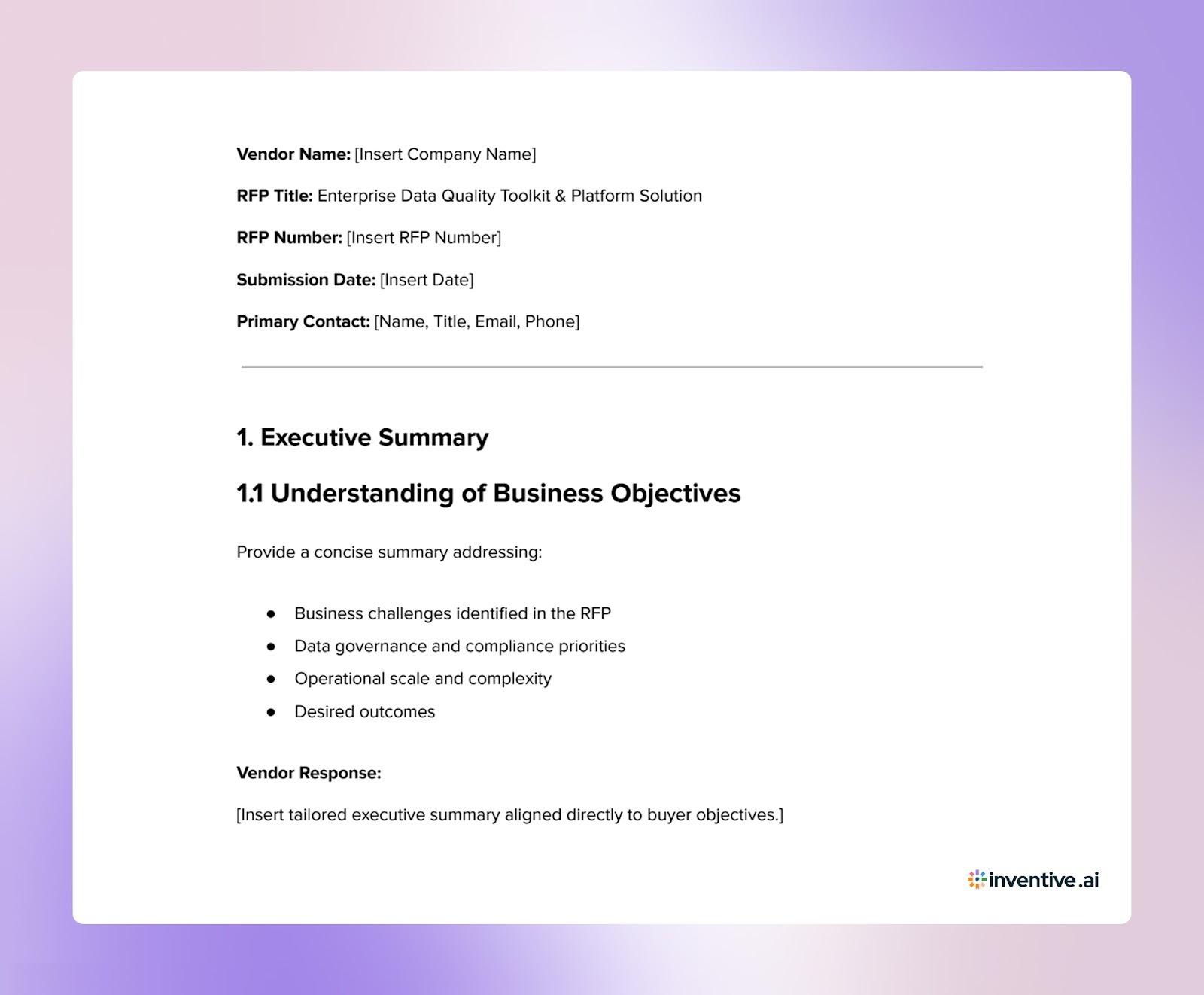
A toolkit rfp response template for data quality tools is a vendor-side, structured framework designed to map directly to buyer evaluation categories.
Instead of drafting from scratch, you respond using predefined sections that cover architecture, governance, compliance, integration, and performance.
This allows your team to focus on customization rather than rebuilding documents for each opportunity.

Turn a Generic Data Quality Tool RFP Template into a Competitive Advantage
A template alone will not win enterprise data quality deals. Precision and relevance will.
Enterprise buyers evaluate vendors against defined governance standards, operational KPIs, and regulatory risk exposure. Your response must clearly connect your platform capabilities to their stated evaluation criteria.
How to Customize
- Map your features directly to their stated data quality KPIs
- Mirror their terminology for governance and compliance frameworks
- Include industry-specific use cases such as healthcare claims validation or financial reporting controls
- Highlight scalability benchmarks tied to record volume
- Reference integration compatibility with their stated tech stack
- Adjust your executive summary to reflect their business risk exposure
- Pre-build compliance mapping tables for common regulations such as HIPAA and SOX before the RFP cycle begins.
Customization demonstrates operational maturity and technical readiness. It shows you understand enterprise data governance, not just software features.
Also Read: VC/Private Equity DDQ Guide: What to Expect and How to Prepare
The Response Strategy That Separates Winners from Average Bidders
Data quality RFPs often involve CIOs, data governance leaders, security teams, and finance stakeholders.
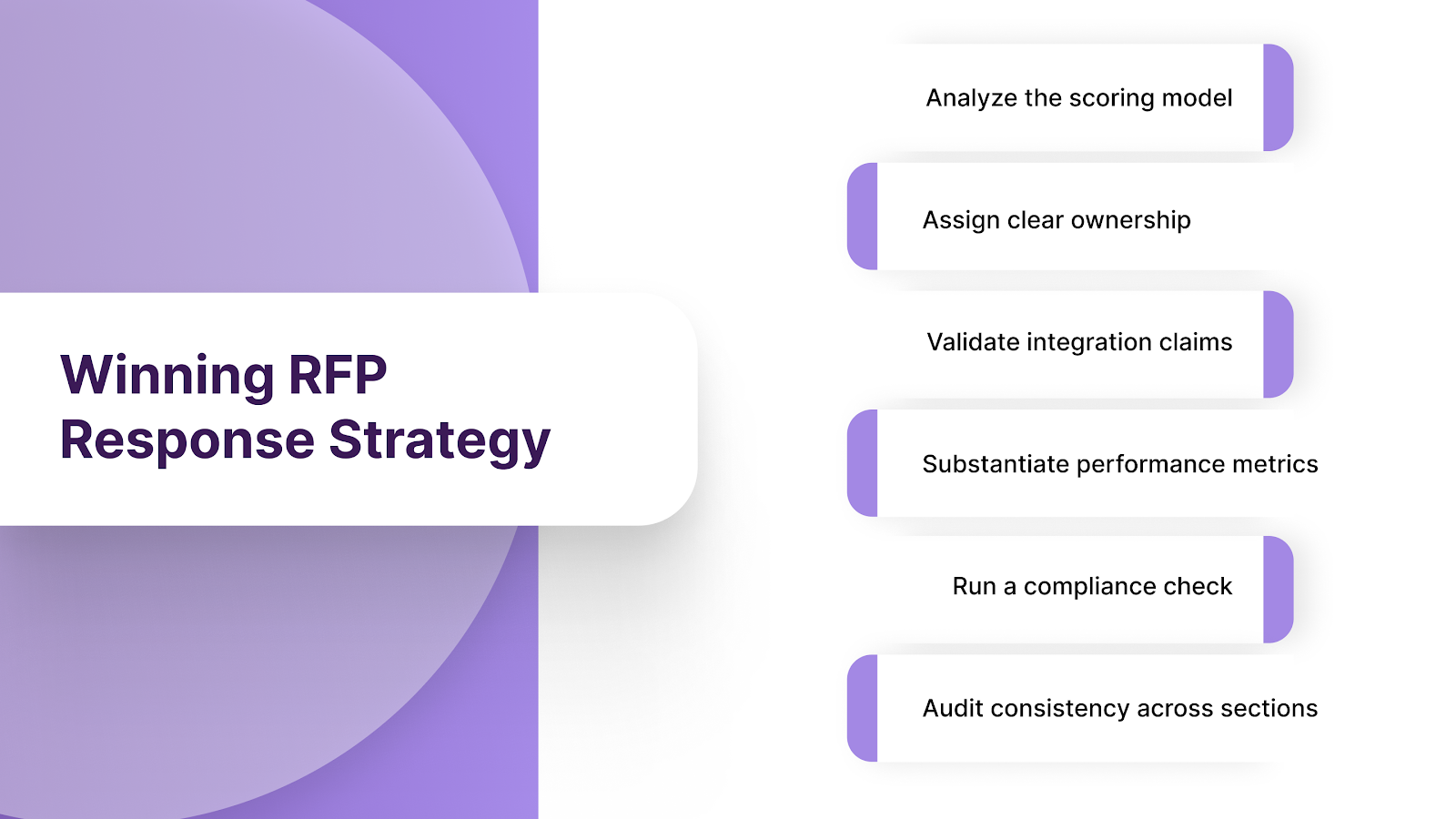
Without structure, responses become fragmented and inconsistent.
1. Analyze the Scoring Model
Start by breaking down the evaluation criteria into weighted categories. Identify which areas carry the highest score, such as governance controls, integration depth, or scalability. Allocate effort proportionally so high-weighted sections receive detailed, measurable responses.
2. Assign Clear Ownership
Do not distribute sections randomly. Governance questions should go to compliance leads. Integration and architecture should go to the product or engineering teams. Commercial and SLA sections should involve finance and operations. Defined ownership reduces conflicting answers.
3. Validate Integration Claims
Before stating compatibility with Snowflake, Azure, SAP, or Salesforce, confirm that technical documentation supports those integrations. Review API documentation and deployment references to avoid overstating capabilities.
4. Substantiate Performance Metrics
If you claim high data processing throughput or anomaly detection accuracy, tie those claims to real deployment benchmarks or documented case studies. Avoid abstract performance language.
5. Run a Compliance Check
Review all regulatory mappings before submission. Confirm that HIPAA, SOX, PCI-DSS, or internal governance standards are properly referenced and supported by documentation.
6. Audit Consistency Across Sections
Verify that pricing tiers, licensing models, SLAs, and feature descriptions match across the document. Inconsistencies between technical and commercial sections reduce credibility.
When your response process is structured, evaluators focus on your strengths rather than documentation gaps.
Respond 10x Faster Without Compromising Accuracy With Inventive AI
Data quality RFPs involve repetitive technical explanations, governance mapping, and documentation validation. With AI-powered RFP response software, Inventive AI automates structured drafting while maintaining 95% accuracy and 0% hallucinate output.
1. 2× Higher Quality Responses
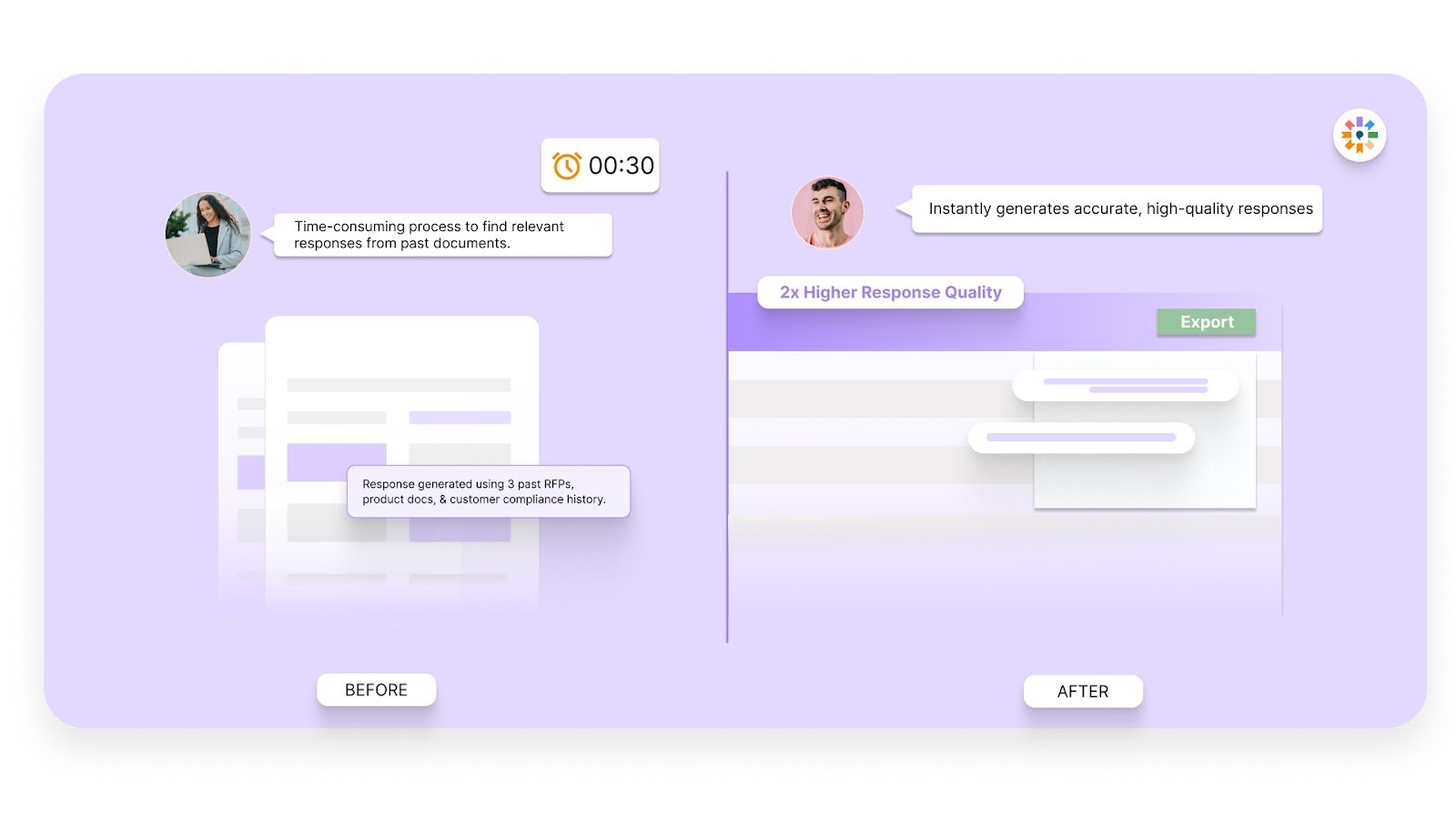
Inventive AI generates structured first drafts 10x faster using your approved past responses and technical documentation. Your team reviews and improves a complete draft instead of starting from scratch. This helps you respond faster while keeping answers consistent across sections.
2. Context Engine
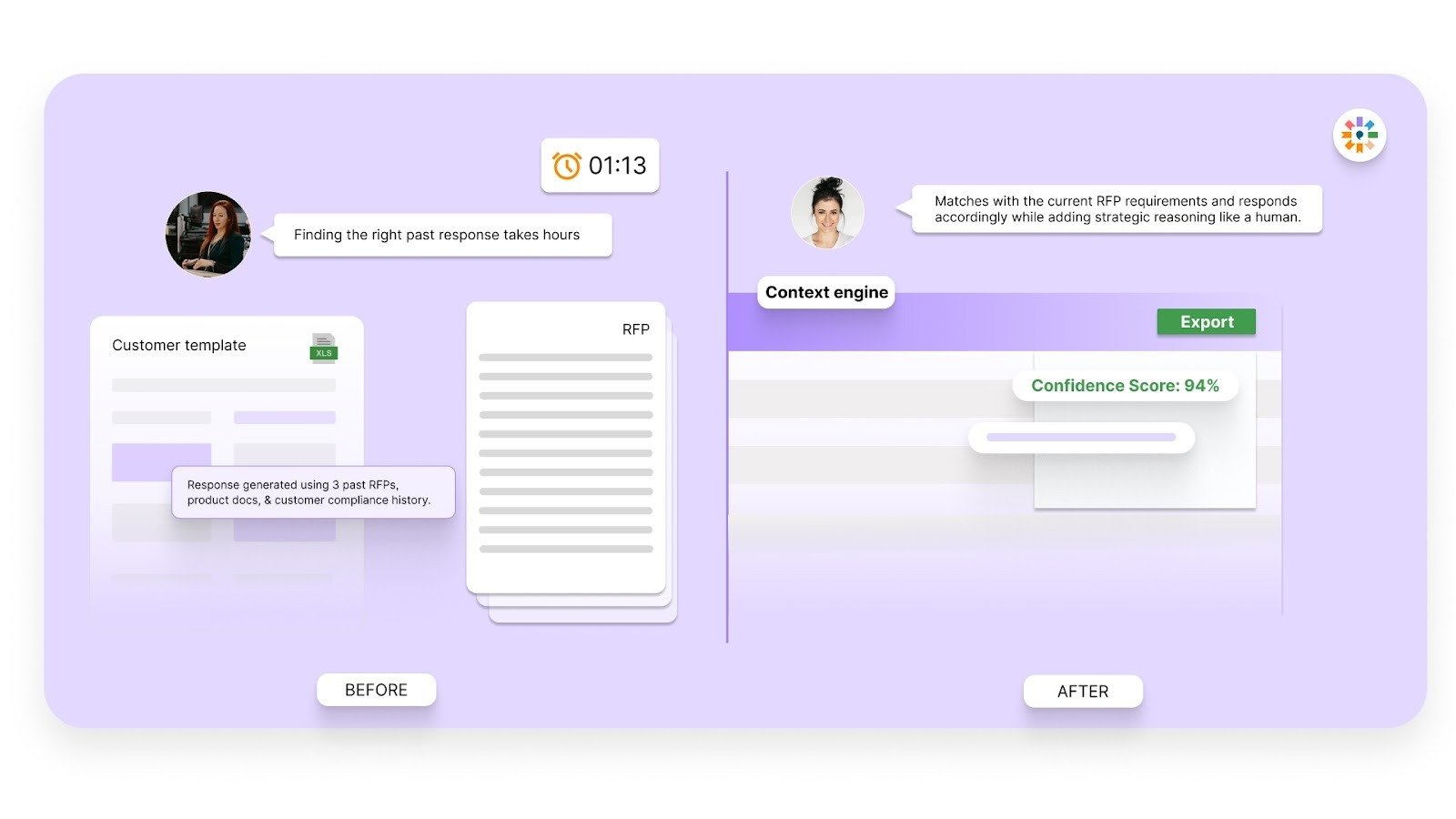
Inventive AI pulls approved content from Google Drive, SharePoint, and past RFPs into one workspace. When you answer questions about lineage, governance, or integrations, the system surfaces relevant content quickly. This reduces manual searching and saves time.
3. Conflict Detection
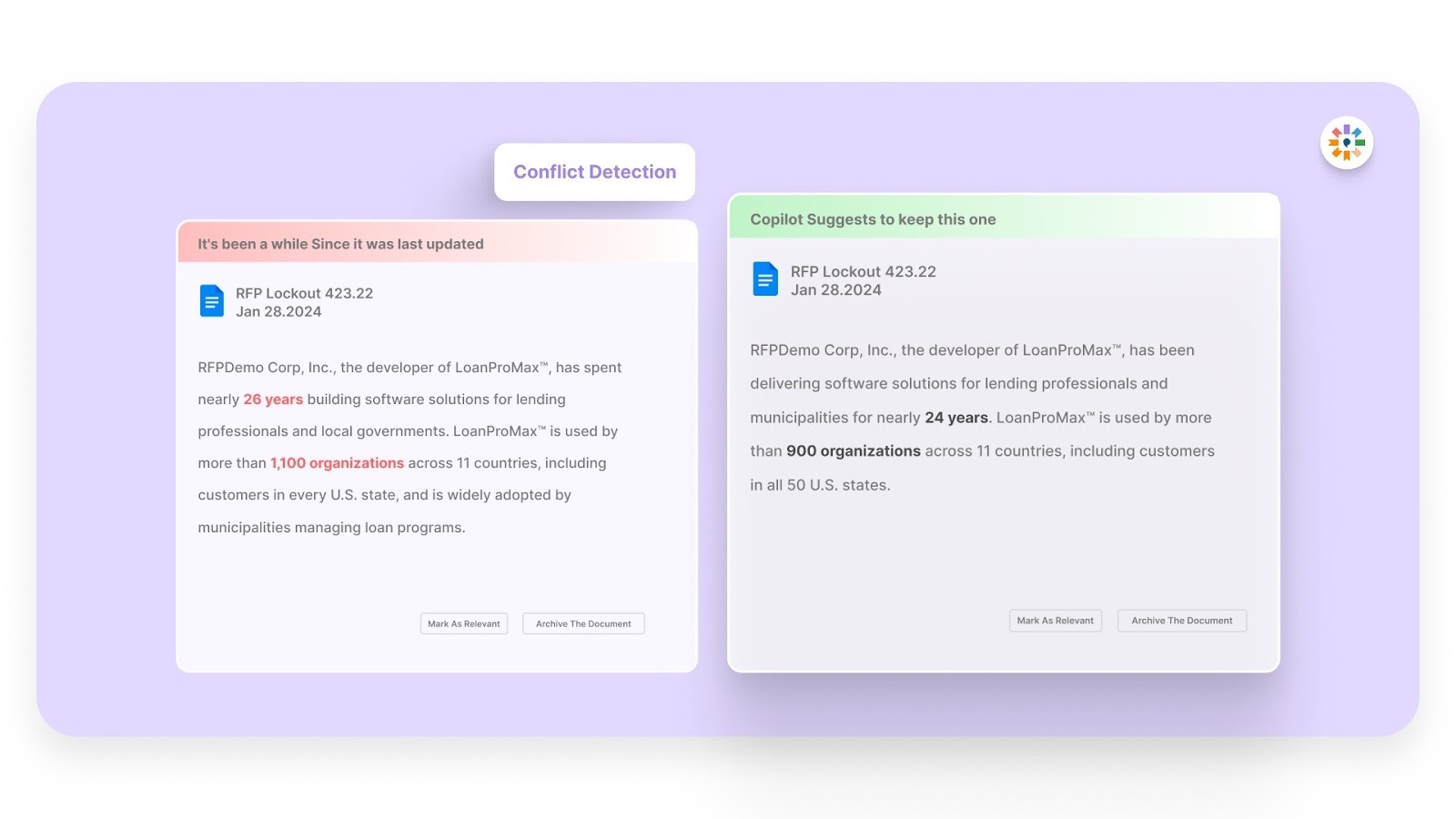
Large RFPs often contain inconsistencies between technical, security, and SLA sections. Inventive AI flags conflicting statements before submission. This helps you fix errors early and submit a more reliable proposal.
4. Outdated Content Detection
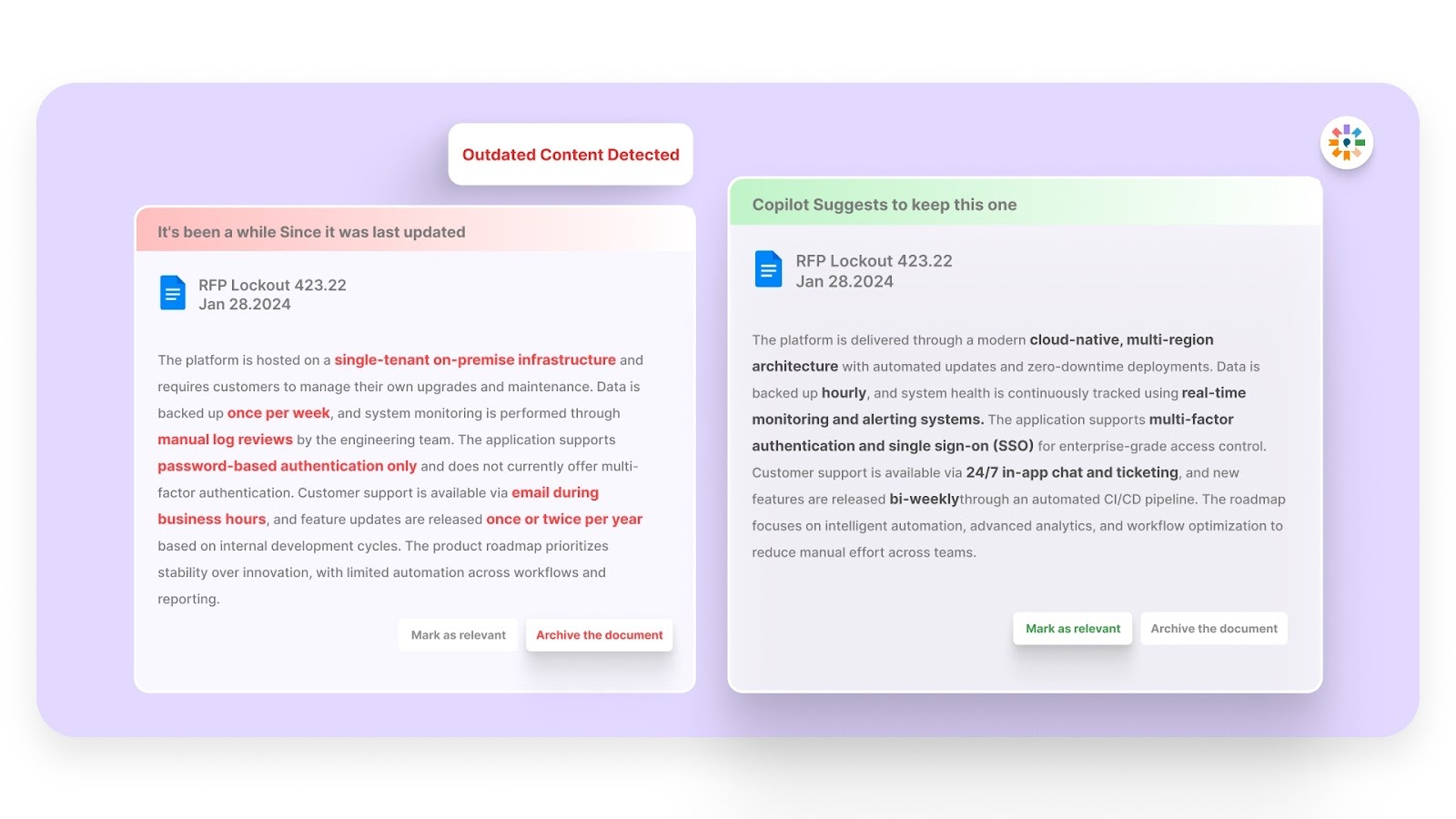
Regulations and product features change over time. Inventive AI identifies outdated compliance references or legacy product details. This keeps your responses aligned with current enterprise standards.
5. Simple, Easy-to-Use Interface
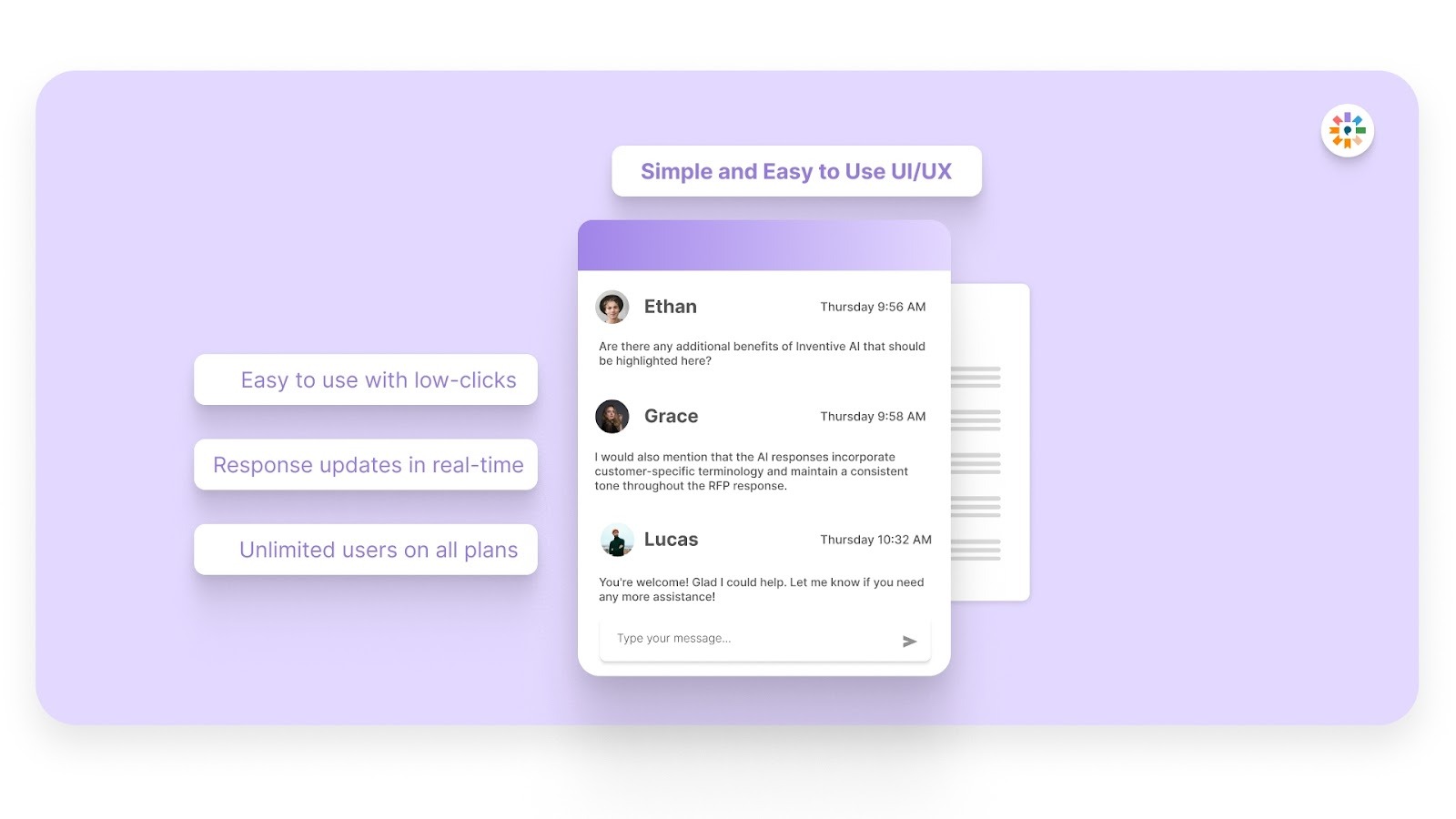
Sales, product, and compliance teams collaborate in one shared workspace. This reduces version confusion, improves visibility, and helps your team move from draft to submission more efficiently.
Inventive AI gives your team structured, accurate, and scalable response support across every enterprise data opportunity.
Frequently Asked Questions (FAQs)
1. What technical capabilities do buyers typically evaluate in a data quality RFP?
Buyers assess profiling accuracy, validation rules, monitoring automation, lineage tracking, scalability limits, integration flexibility, and regulatory compliance readiness.
2. Should vendors include performance benchmarks in their RFP responses?
Yes. Buyers expect measurable proof, such as processing speed, record volume limits, and monitoring accuracy rates.
3. What compliance standards are commonly referenced in U.S. data quality RFPs?
Common references include HIPAA, SOX, PCI-DSS, and internal data governance frameworks aligned with NIST guidelines.
4. How can vendors reduce response time for complex data quality RFPs?
By using structured response templates, pre-built compliance mappings, and centralized knowledge repositories, repetitive drafting work can be reduced.

.avif)

.jpg)