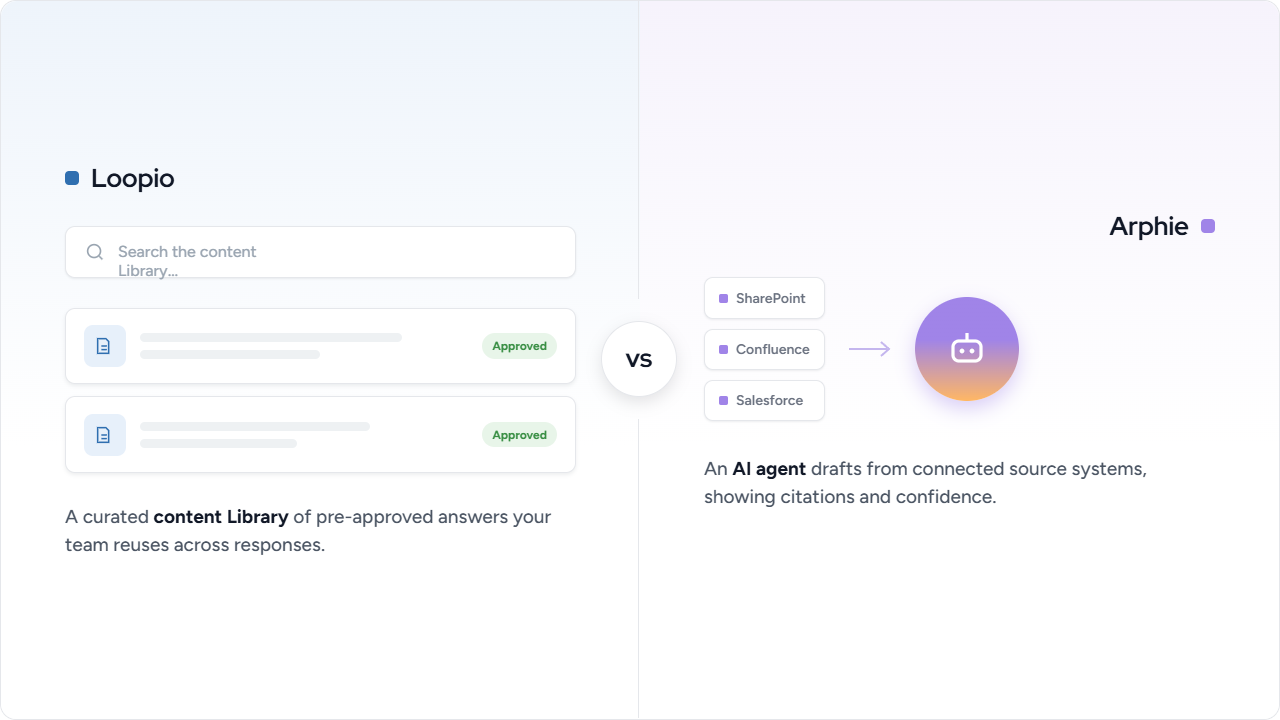
Arphie Alternative: Top 9 Competitors for 2026
This guide helps you compare the top Arphie alternatives and competitors for 2026.
If you are searching for an Arphie alternative, you are probably at a decision point. Arphie can help you draft RFP and questionnaire answers faster, but day-to-day friction often shows up once volume grows.
You start spending time on last-mile work like export cleanup, formatting, and review coordination. You also feel the cost of limited visibility when multiple SMEs touch the same response.
This guide helps you compare the top Arphie alternatives and competitors for 2026. You will get a shortlist, a comparison table, and practical breakdowns of what each tool is good at. You will also see how to choose based on outcomes that affect wins, like answer quality, rewriting load, and trust in the final response.
Key Takeaways
- Where time really disappears: Tools can speed up drafting and reuse, but many teams still lose hours in rewrites, SME follow-ups, and late-stage reviews.
- What usually triggers the switch: Arphie can fit straightforward workflows, but teams often explore alternatives when export friction, reporting visibility, and scaling the content base start slowing execution.
- Your 2026 alternative shortlist: Strong options include Inventive AI, Loopio, Responsive, AutoRFP AI, Tribble, SiftHub, Autogen AI, Upland Qvidian, and Ombud. Most tools help in some areas, but not all cover quality, governance, and scale equally.
- How to shortlist with confidence: Compare tools on outcomes that affect wins, such as answer quality, editing load, content freshness, conflict risk, and how smoothly SMEs can review.
- What separates the top performer: Inventive AI leads with full-RFP context, conflict, and outdated content detection, and Win Themes, backed by proof of 2× more accurate responses and a case study showing 50% higher win rate and 90% faster RFP responses.
Top 9 Arphie Alternatives and Competitors in 2026
Once you hit Arphie’s limits, you usually have the same problem: you still need speed, but you cannot afford weak answers, stale content, or rework across teams.
That is why this list focuses on outcomes first. You are not only buying a place to store answers. You are buying response quality that helps you win, plus the workflows that keep quality consistent when volume goes up.
1. Inventive AI: Best-in-Class Arphie Alternative
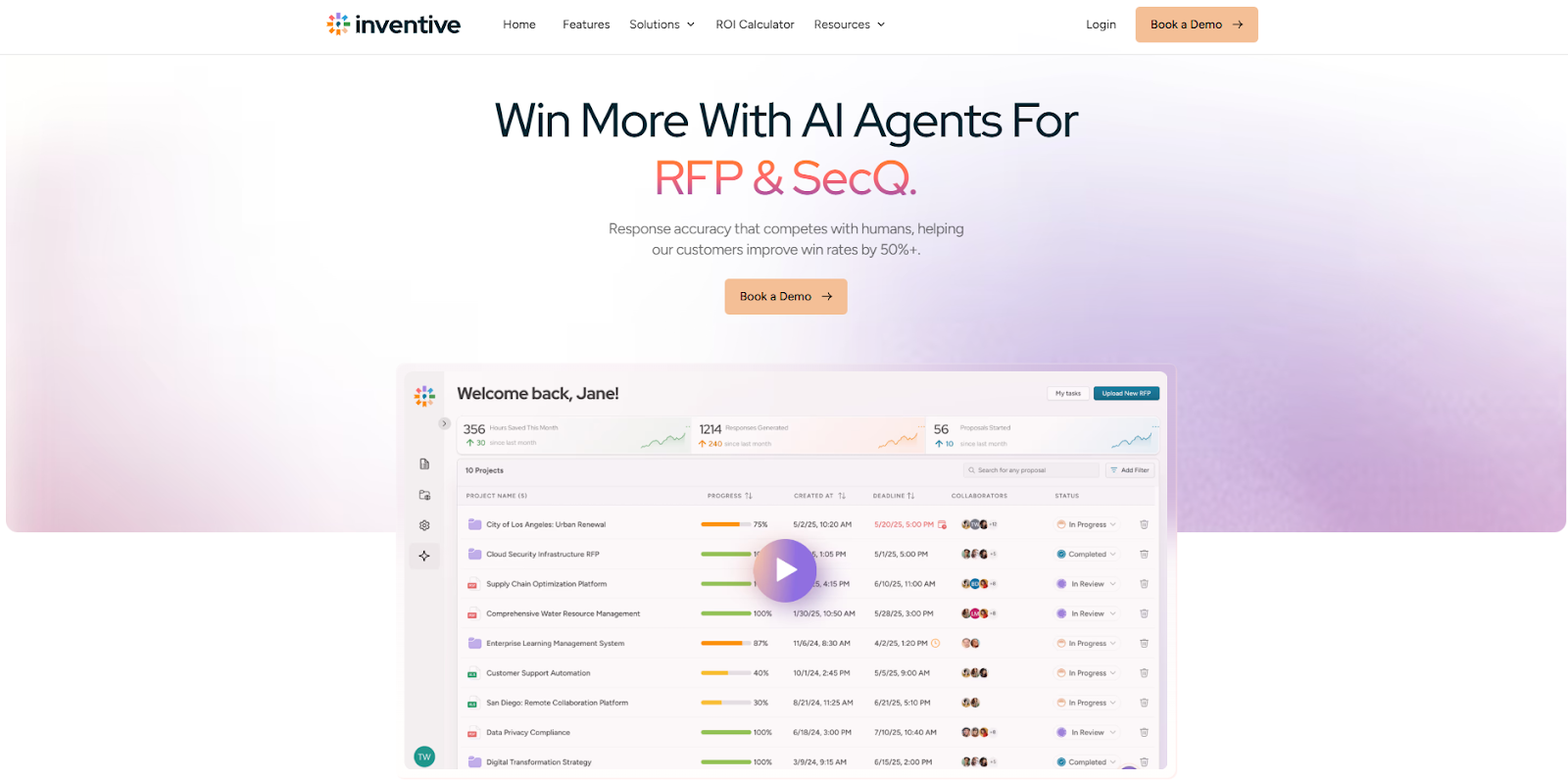
Inventive AI is the industry leader for hyper-contextual, real-time insights across RFPs, RFIs, and security questionnaires. Inventive AI is built for vendor teams that need submission-ready answers, not generic drafts.
If Arphie feels fine until reviews expand, the issue is usually quality at scale. Draft speed helps, but weak answers still create rewriting, extra SME cycles, and late-stage risk.
Inventive AI is designed to reduce that load and leads with one principle: better answers = higher win rate. That is why response quality matters more than pricing or surface-level features.
Features:
2× Better Response Quality

Using a multi-agent AI system, Inventive AI produces strategic answers that go beyond keyword matching. The system understands the why behind every question, resulting in answers with 2x the accuracy, clarity, and completeness of standard industry benchmarks.
Deep Context Engine
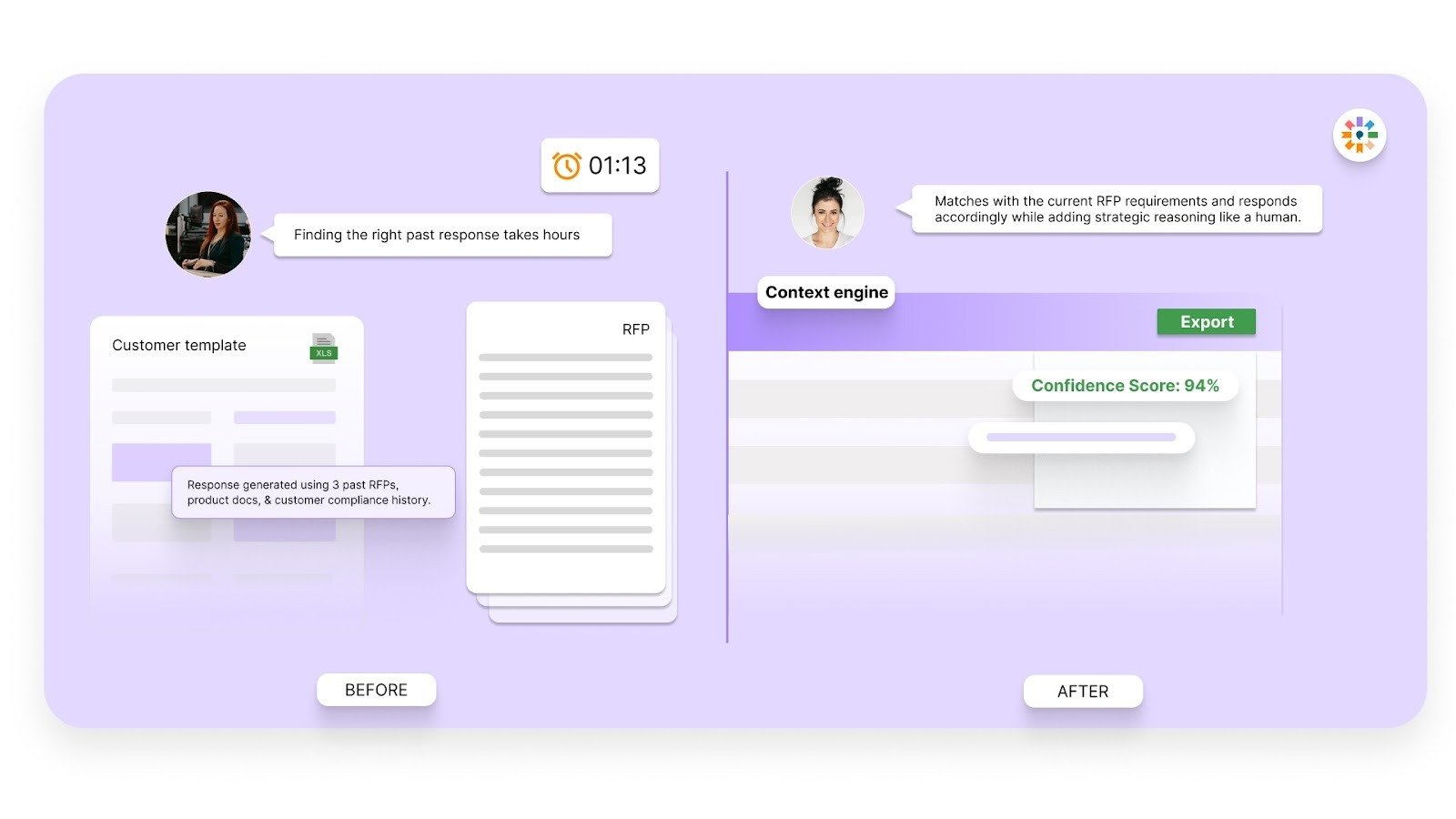
Most tools rely on shallow lookups that lead to generic, robotic results. Inventive AI uses multi-layer reasoning to grasp the full context of your specific RFP and company history. This yields tailored, high-level answers that feel like they were written by your best subject matter expert.
Instant Conflict Detection
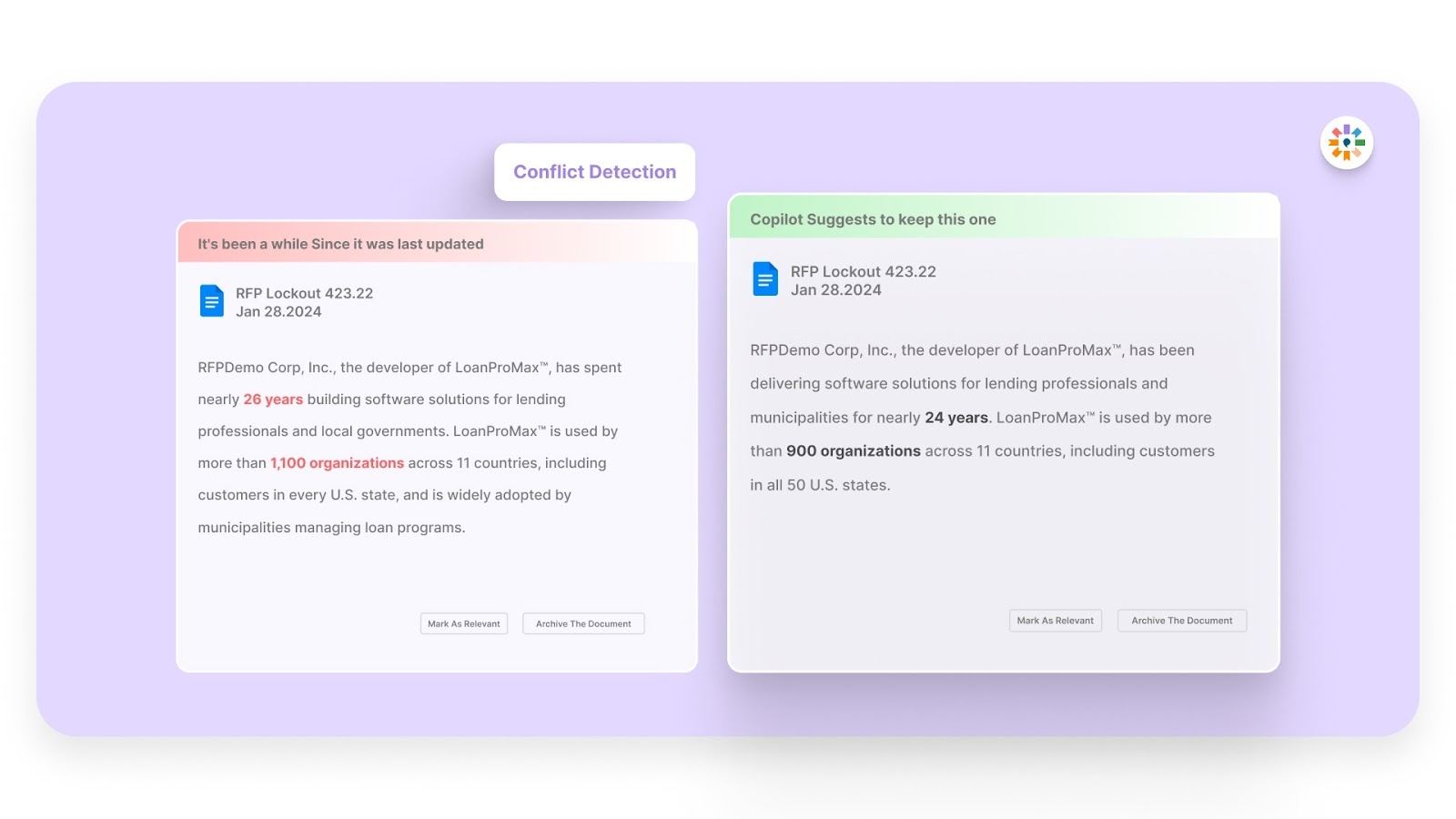
Sending a proposal with internal contradictions is a major risk. Inventive AI scans your document and flags conflicting statements across your sources instantly. This ensures that your technical, legal, and sales answers are always unified and never contradict one another.
Outdated Content Detection
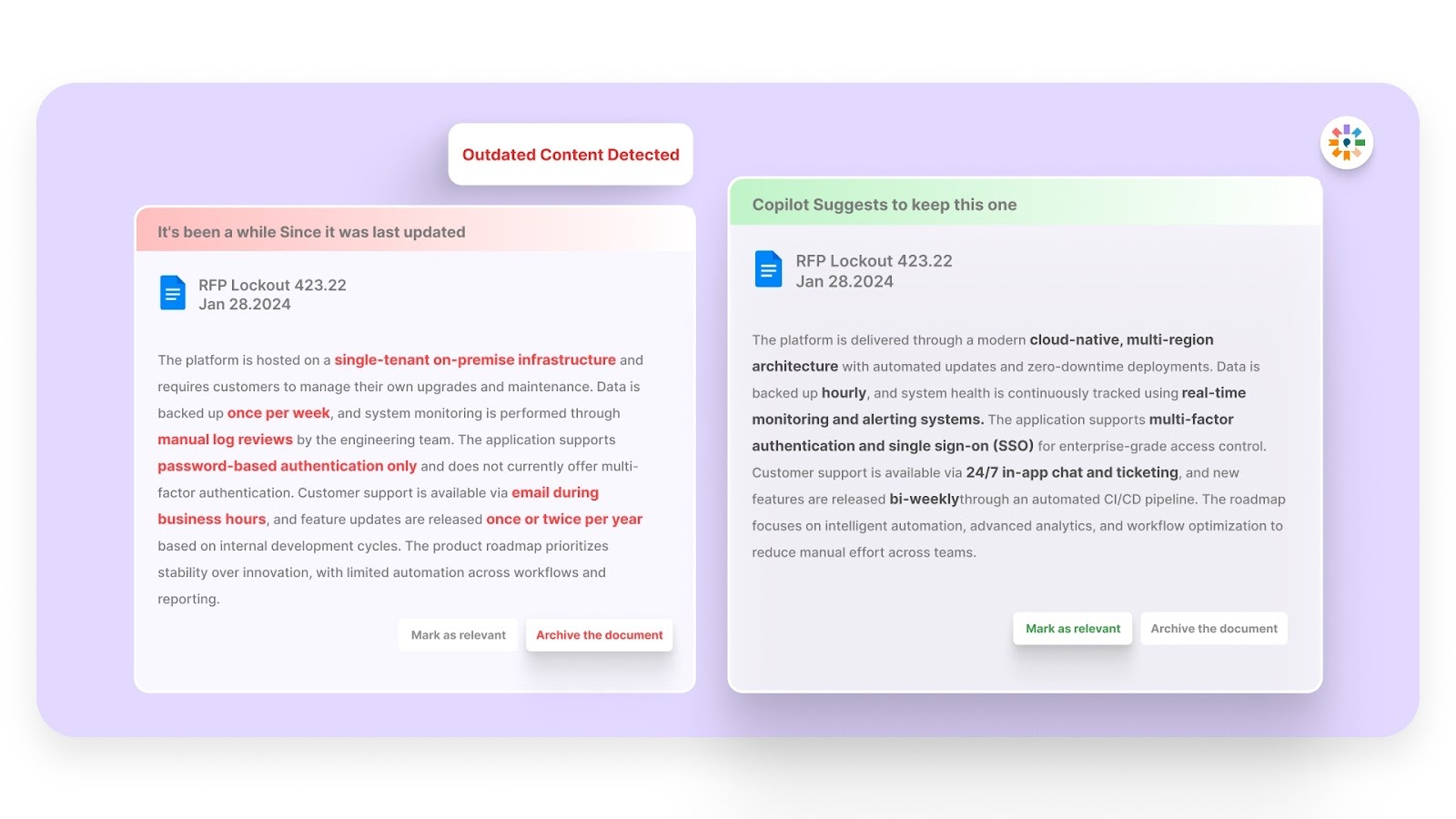
Most vendors store huge libraries of stale answers that lead to errors. Inventive AI automatically catches outdated or non-compliant content before it reaches your final draft. This prevents your team from reusing old files and improves win rate by 50%.
#1 Ranked Ease of Use (G2) for Simple, UI/UX
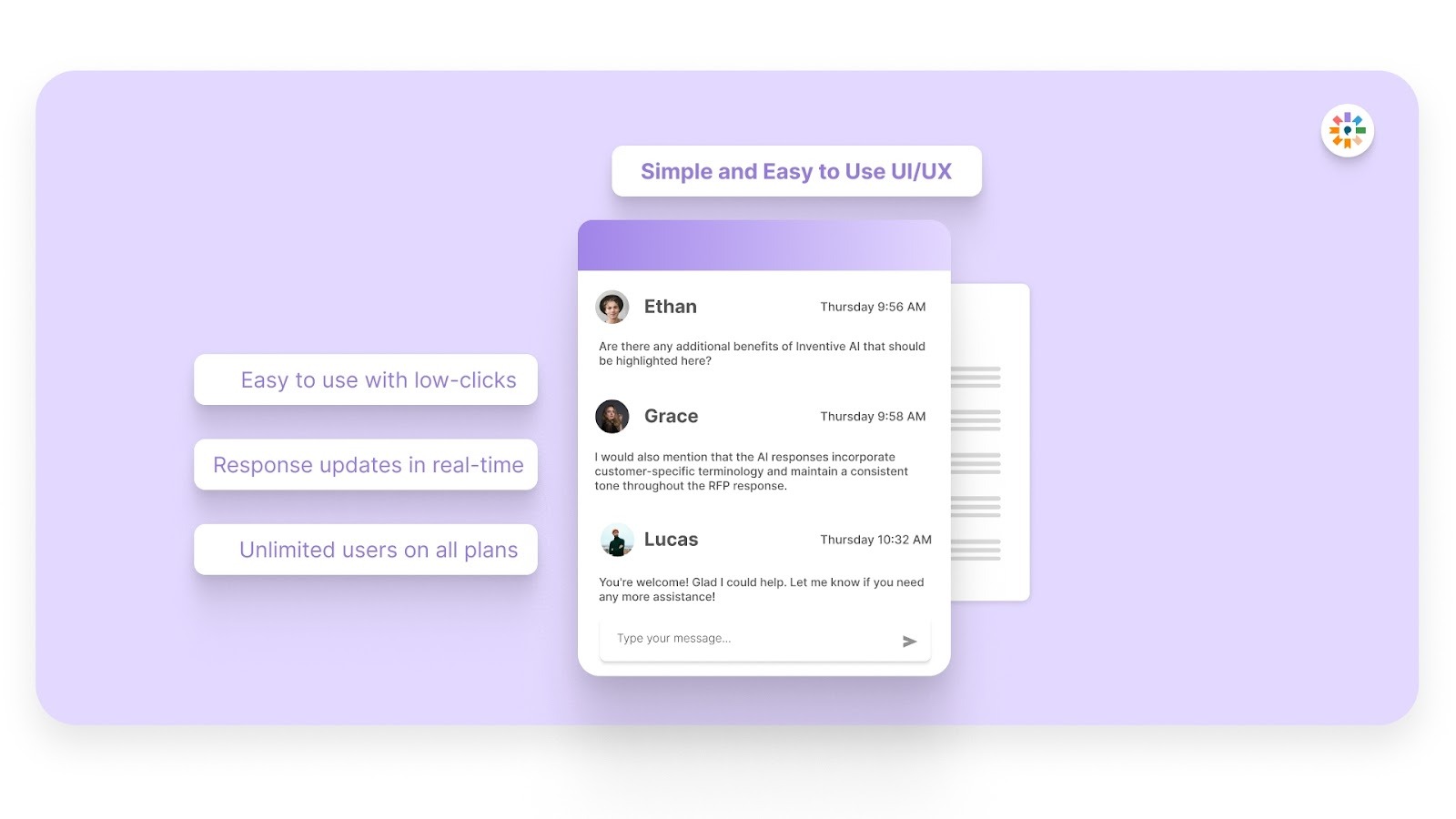
With a 100% adoption rate and a #1 ranking on G2 for easiest-to-use RFP software, Inventive AI is built for everyone. The intuitive interface eliminates the steep learning curve, ensuring your entire team can jump in and start winning deals on day one.
Rare Narrative-Style Proposals:
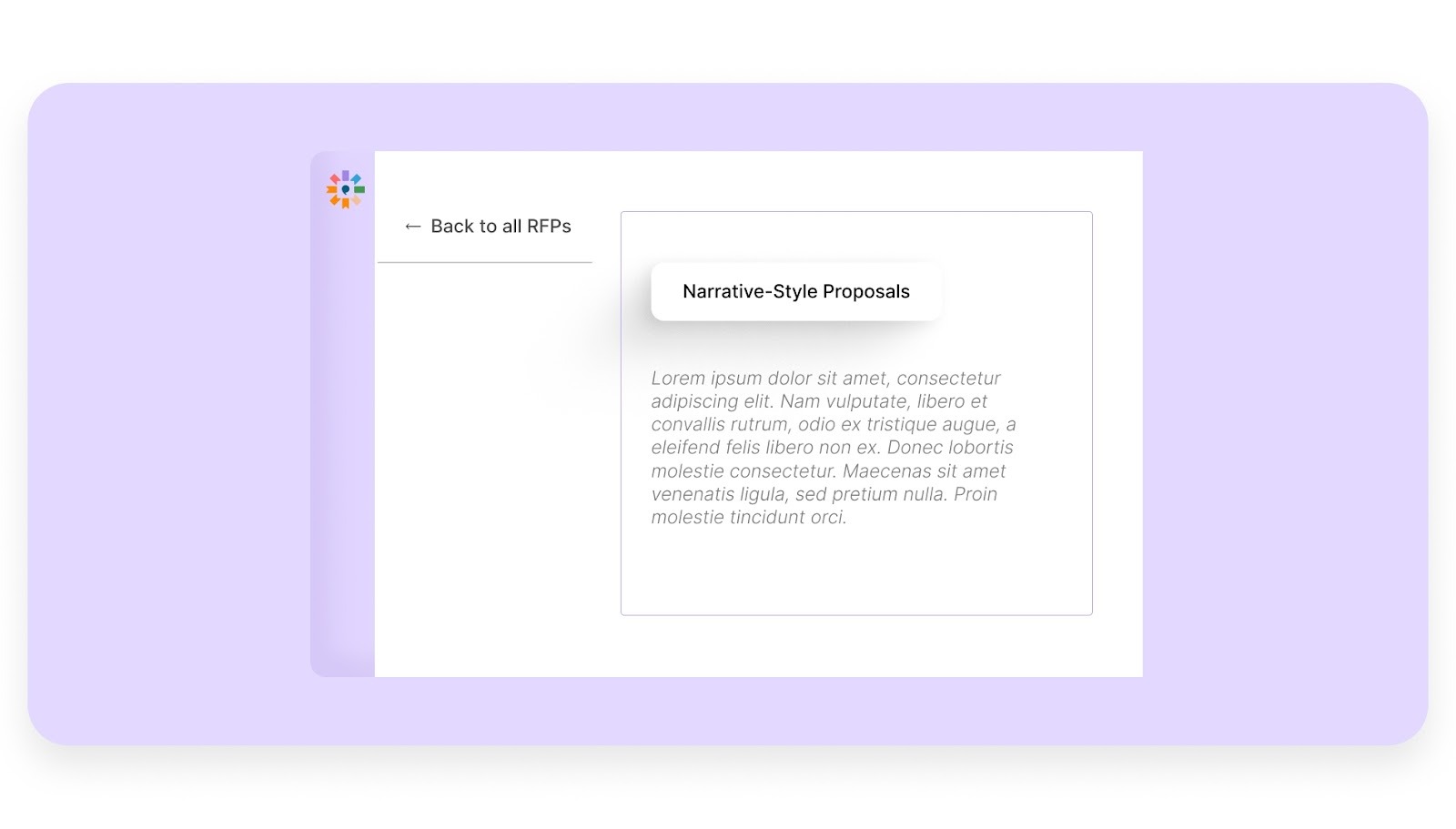
While others are limited to simple Q&A, Inventive AI can generate complete, long-form documents. This includes executive summaries, security briefs, and pitch decks, allowing you to build a persuasive story that highlights your unique value.
Pros
- Higher-quality answers with less rewriting, which speeds up reviews.
- Stronger governance through conflict and outdated content detection.
- Better deal alignment through Win Themes and value-first content gaps coverage.
- Works across RFx formats in one workflow, including security questionnaires.
Cons
- Limited analytics compared to advanced reporting suites.
Best for
- Proposal teams handling tight deadlines and frequent RFP cycles.
- Sales Ops teams are standardising answers across regions and products.
- Solutions and security teams are reducing risk from outdated or conflicting statements.
- Startups that need strong responses without building a large proposal function.
- Enterprises that need governance and narrative proposals at scale.
Pricing
Ratings and Reviews:
Ratings: 5/5
Reviews:
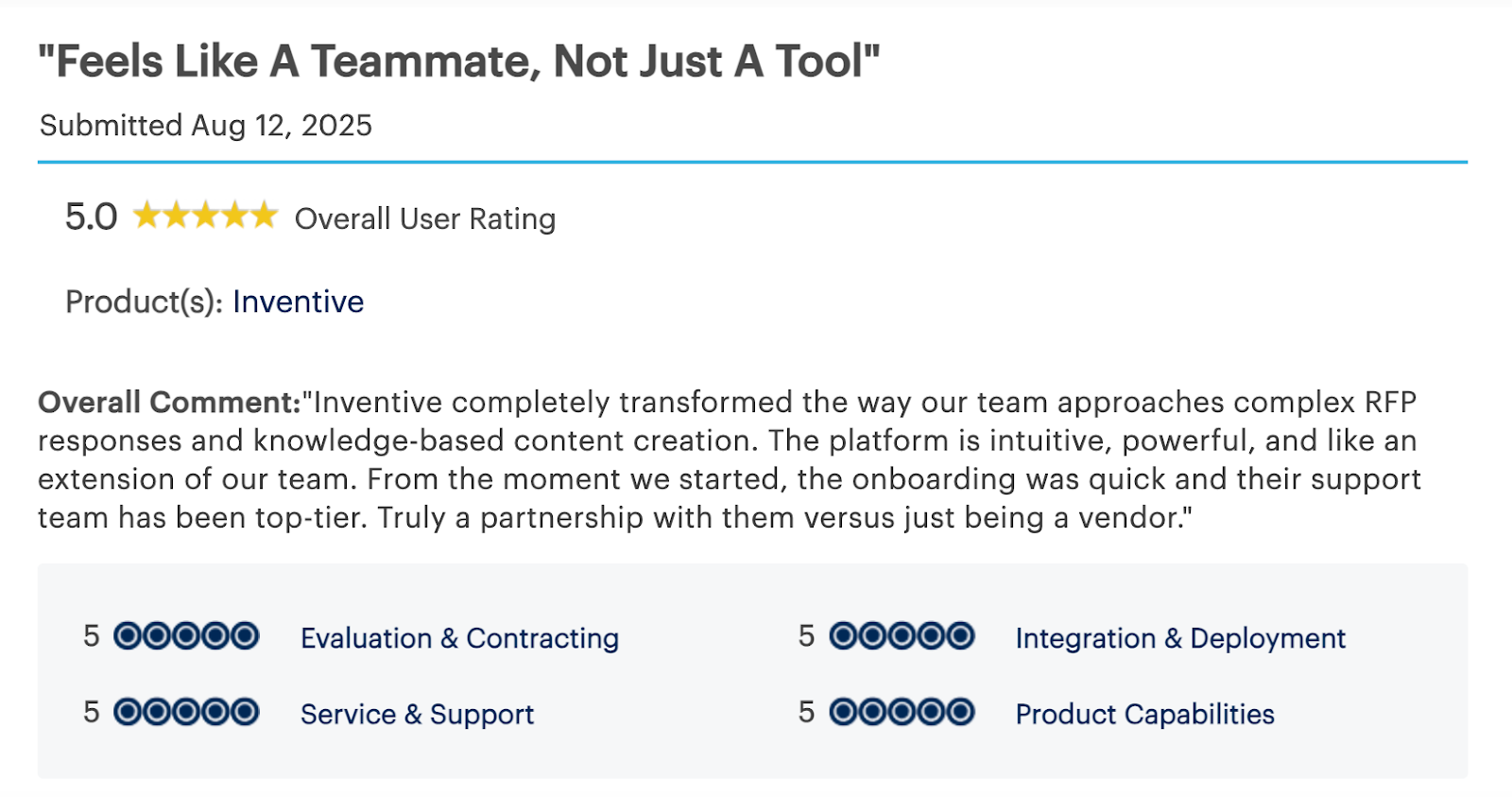
If the goal is to reduce rewriting and protect quality under deadline pressure, Inventive AI is the strongest Arphie alternative in this list. Inventive AI is built to keep answers accurate, consistent, and ready to submit.
Now that Inventive AI sets the quality bar, the next sections break down direct competitors. Each breakdown shows where the tool fits and where teams feel friction in practice.
2. Loopio
Loopio is a legacy RFP response platform that helps you manage a content library, run projects, and reuse past answers. It is often used when you want a structured workspace for intake, assignments, and review cycles.
It can work well for standard questionnaires and repeatable RFPs. The friction often shows up when you need deeper context, tighter governance, and less rewriting across complex deals.
Key features
- Content library for reusable answers and approved snippets. You store responses in a central repository and reuse them across RFPs. This reduces repeated writing and supports consistency when the same claims must appear across bids.
- AI-assisted drafting and answer suggestions. The AI can suggest responses based on existing library content. It is useful for common questions with stable wording. It often needs more manual work when the buyer's language is unique or when the RFP needs value narratives.
- Workflow and collaboration for owners and SMEs. You can assign sections to SMEs, track progress, and manage review cycles. This helps reduce missed questions, but review time can still expand when answers need multiple rewrite rounds.
- Standardisation for repeatable RFP programs. It supports repeatable response processes across similar deals. This works best when the library stays current, and content governance is enforced.
Pros
- Helps standardise responses across repeatable RFPs.
- Provides a clear structure for owners and reviewers.
- Supports content reuse when the library is well-maintained.
Cons
- Answer quality can still require heavy rewriting on complex RFPs. AI suggestions often stay close to existing text. You still rewrite for buyer context, tone, and value.
- Content governance is hard when many teams update answers. Without strong conflict controls, different SMEs can create inconsistencies across sections. That increases review cycles.
- Scaling to multi-region or multi-product teams adds process overhead. Library sprawl grows fast. Owners spend time searching and validating content instead of improving the narrative.
Best for
- Teams handling repeatable RFPs with a stable content library.
- Proposal owners who want structured assignments and review workflows.
- Mid-market teams with consistent products and messaging needs.
Pricing
Ratings and Reviews:
Rating: 4.4/5
Reviews:
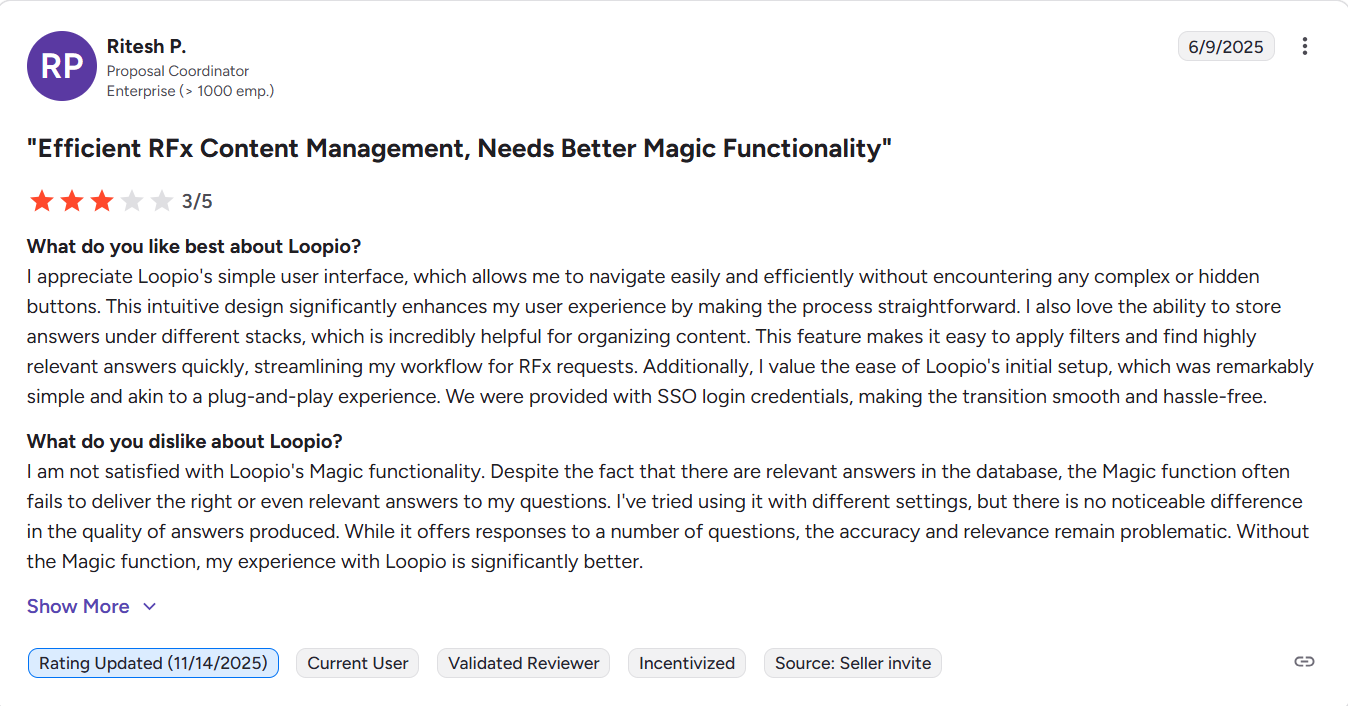
If you want less rewriting and more submission-ready output, Inventive AI is a stronger fit. Inventive AI leads with response quality, since better answers drive win rates. Inventive AI also focuses on structural gaps that slow teams down.
Now that you have one legacy workflow option covered, the next tool is a popular response management suite that many teams compare during shortlisting.
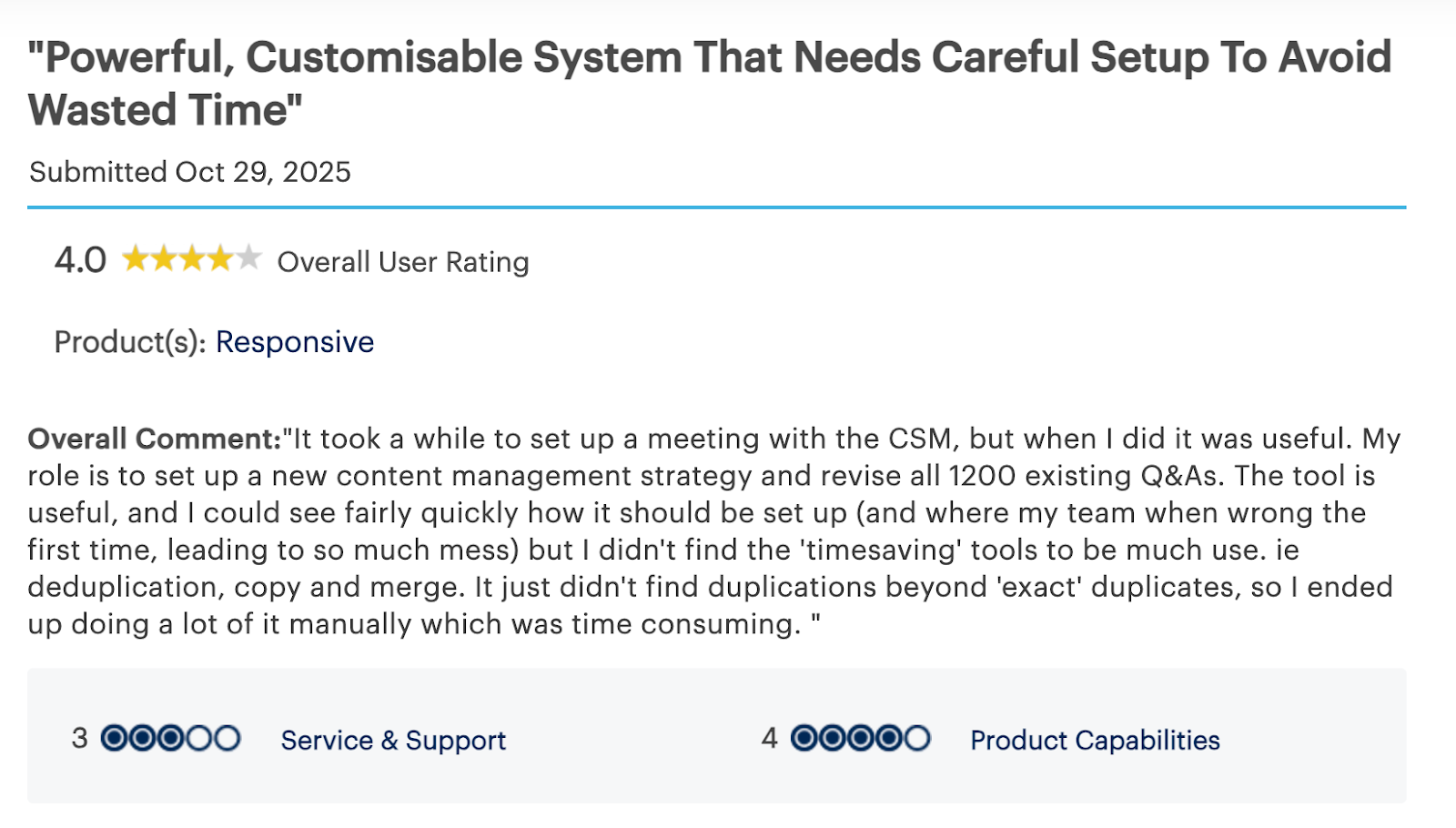
3. Responsive
Responsive is a well-known response management platform that helps you centralise answers, coordinate SMEs, and manage RFP workflows. Many teams shortlist it when they want a mature system for content reuse and structured reviews.
It can be a workable fit for standard RFP programs. The friction tends to show up when you want faster onboarding, cleaner navigation, and stronger quality controls that reduce manual review effort.
Key features
- Central answer repository and content reuse. You can store approved answers in one place and reuse them across RFPs and questionnaires. This helps maintain consistency when the same questions repeat across deals.
- Project workflows for assigning, reviewing, and approving. You can assign sections to SMEs, set deadlines, and track completion. This creates structure for proposal owners, especially when multiple teams contribute.
- AI-assisted drafting and suggested answers. AI can suggest responses based on existing content. It speeds up first drafts for common questions, but teams often still refine for buyer-specific nuance.
- Configuration options for different processes. You can adapt workflows and fields to match internal processes. This flexibility can help mature teams, but it can also add setup and training time.
Pros
- Strong structure for multi-stakeholder RFP workflows.
- Helpful content reuse when your library is well governed.
- Good fit for teams that want configuration flexibility.
Cons
- Interface complexity can slow down onboarding and daily use. When navigation feels heavy, new users take longer to contribute. Proposal owners also spend time guiding SMEs through the system.
- Answer quality improvements can still depend on manual cleanup. If the first draft is not buyer-ready, the review stage turns into rewriting. That keeps turnaround time high, even if drafting feels faster.
- Limited built-in controls for stale or conflicting content. When the platform does not proactively flag conflicts, teams rely on manual checks, which increases risk in security, pricing, and product sections.
Best for
- Teams that want a mature response management suite for repeatable RFPs.
- Organisations with dedicated proposal operations and defined workflows.
- Teams are comfortable investing time in setup, training, and governance.
Pricing
Ratings and Reviews:
Rating: 4.2/5
Reviews:
If your priority is submission-ready answers with less rewriting, Inventive AI is a stronger alternative. Inventive AI is built around response quality, since better answers drive higher win rates.
Now that you have a mature response management suite covered, the next option focuses more on fast drafting for repetitive RFP programs.
4. AutoRFP AI
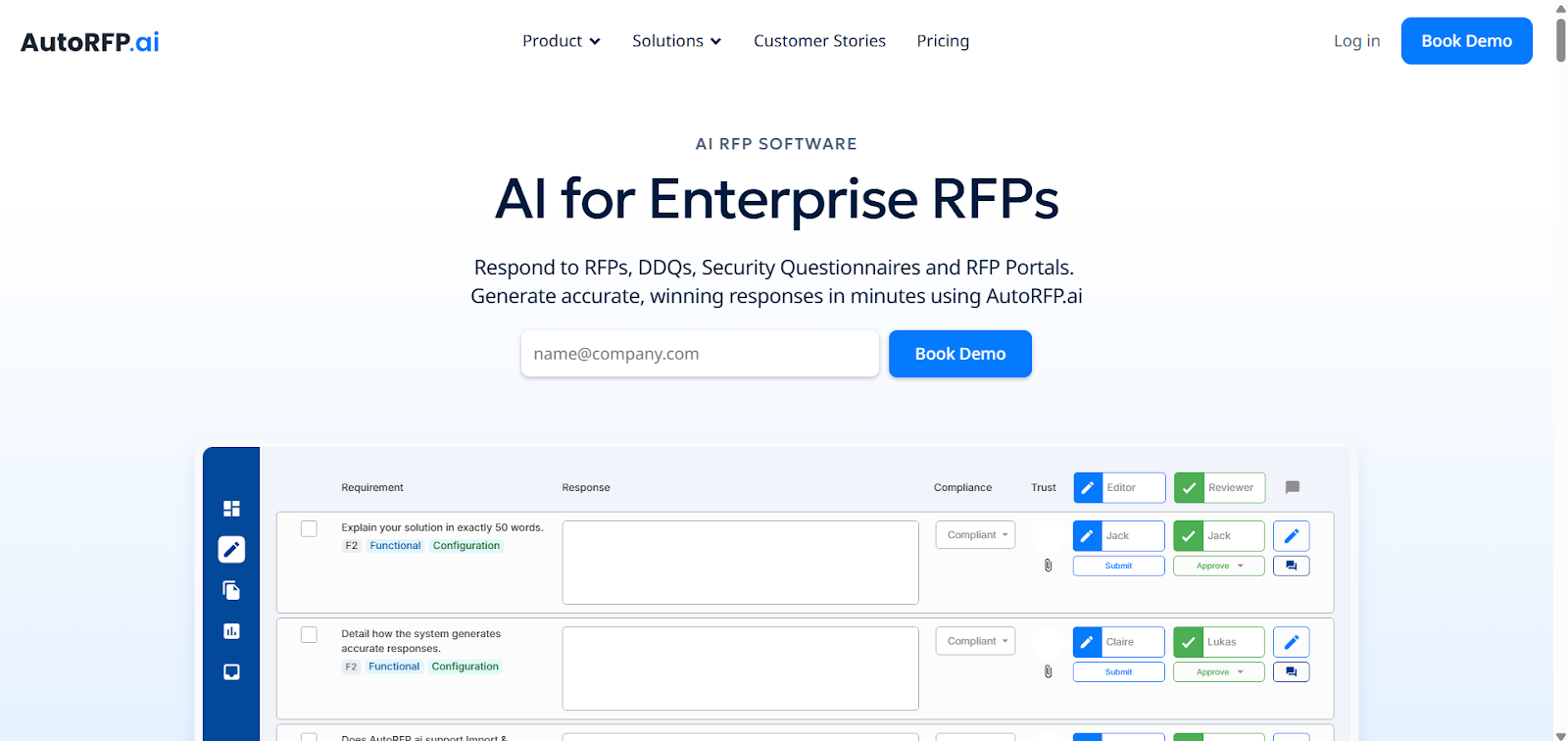
AutoRFP AI is designed to speed up drafting for repetitive questionnaires and high-volume RFP programs. Teams often look at it when they want quick first drafts and a lighter setup path than a full response management suite.
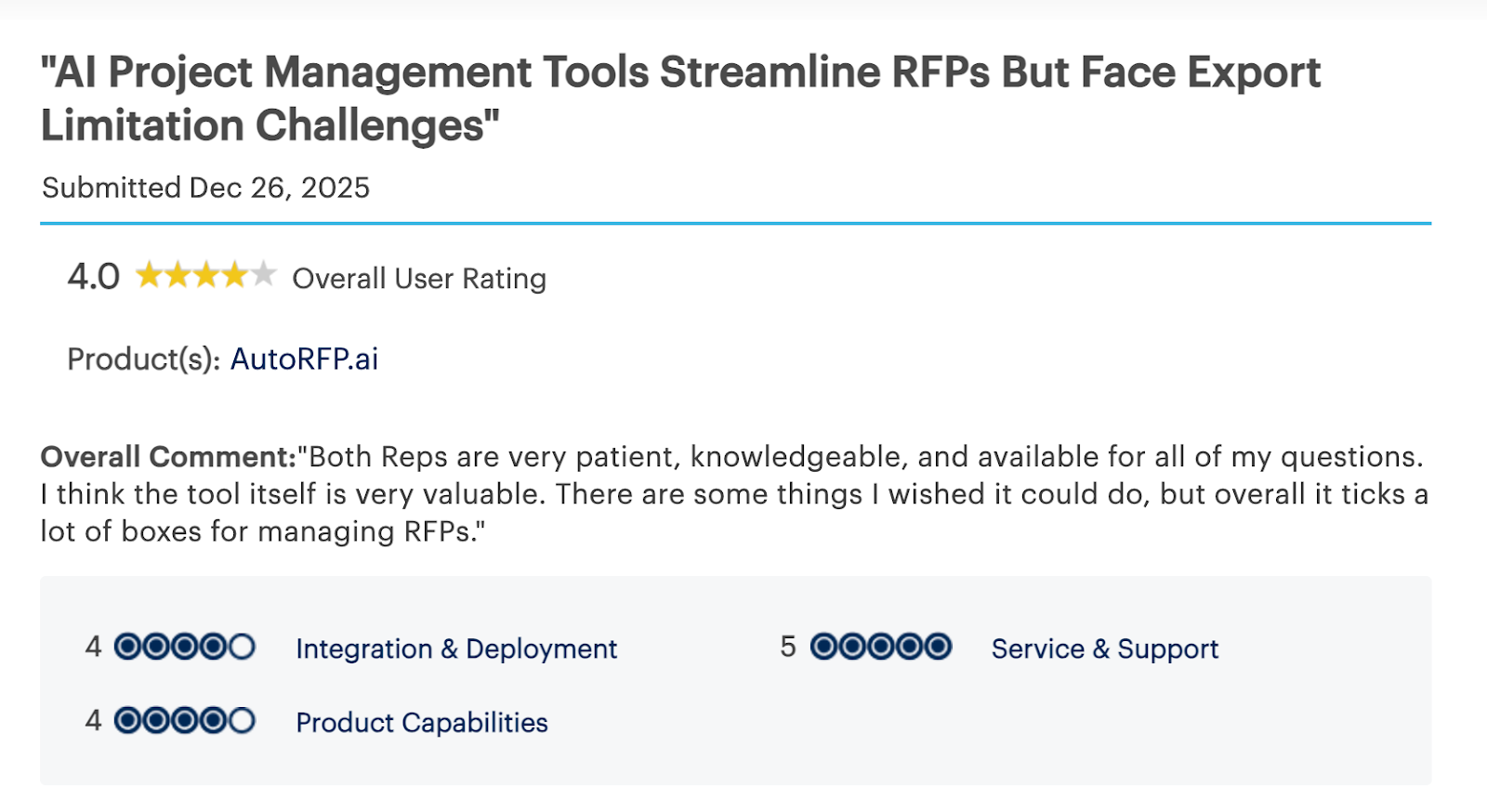
It can help when your RFPs are predictable, and your content is already well structured. The limits usually appear when each deal needs deeper buyer context, tighter governance, and stronger consistency across the full response.
Key features
- Fast first-draft generation for repeatable questions. The platform is built to generate draft answers quickly when your question set is similar across RFPs. This can reduce manual writing time for recurring sections.
- Answer reuse from existing content sources. You can pull from stored answers and internal content, which helps with consistency for standard questions. Results tend to improve when your source content is clean and well-maintained.
- Workflow support for review and approvals. You can route drafts through review steps, which helps when SMEs must validate answers before submission. This matters when security and legal teams are involved.
- Works best when your process is already defined. It supports speed inside a known workflow, but it is less helpful if you need the tool to enforce deeper content governance or deal-specific narrative quality.
Pros
- Strong fit for high-volume, repeatable RFP programs.
- Helps reduce time spent drafting common sections.
- Useful when your content sources are already organised.
Cons
- Complex, buyer-specific RFPs still create rewriting work. When each RFP has unique language and evaluation criteria, teams still rewrite to match the buyer context and value. Draft speed does not always translate into submission-ready quality.
- Quality depends heavily on the structure of your source content. If your library is inconsistent or outdated, the system can surface mixed-quality responses. Proposal owners then spend time validating and cleaning up answers.
- Governance and consistency controls can feel limited for large teams. When many stakeholders contribute, the risk of conflicting statements rises. Without strong conflict and stale-content detection, teams rely on manual checks.
Best for
- Teams handling many similar RFPs and questionnaires each month.
- Smaller proposal teams are trying to increase throughput with limited headcount.
- Organisations with well-maintained content sources and stable messaging.
Pricing
Ratings and Reviews:
Rating: 4.9/5
Reviews:
If you need higher response quality with less rewriting, Inventive AI is the stronger alternative. Inventive AI is built around the idea that better answers drive higher win rates.
Now that you have a speed-first drafting option covered, the next tool follows a more agent-led approach that aims to offload larger parts of the workload.
5. Tribble
Tribble takes a more agent-led approach to RFx work. Instead of only helping you draft inside a platform, it aims to handle larger parts of the response process for you. Teams often evaluate this type of option when they want to reduce hands-on workload and speed up turnaround without building more proposal headcount.
This model can work well when you want to outsource parts of execution. The tradeoff is usually control. Some teams prefer tighter ownership over how answers are structured, reviewed, and governed long term.
Key features
- Agent-led drafting and routing for SME input. The system can draft answers, route questions to SMEs, and coordinate inputs. This reduces the back-and-forth that often slows proposal owners.
- Workflow support that reduces manual coordination. The service-style model can reduce project management overhead. It is helpful when your team is stretched, and you need responses to move without constant follow-ups.
- Fast packaging for submission-ready delivery. The focus is often on getting answers into a usable state quickly. This can be valuable for high-volume programs where timelines are tight.
- Works best when you accept a lighter platform ownership model. If you want full control over every library rule, structure choice, and governance layer, this approach may feel less flexible.
Pros
- Reduces the workload on proposal owners for routing and coordination.
- Useful when your team needs quick execution with minimal setup.
- Can help maintain momentum when multiple SMEs must contribute.
Cons
- Less direct control over response structure and workflow design. When you rely on an agent-led model, you may have fewer ways to fine-tune how answers are organised across sections. That can matter when your team needs consistent formatting and specific buyer-aligned narratives.
- Content governance can be harder to manage at scale. If governance controls are not deep, teams may still need to manually check for stale or conflicting statements. This becomes more important as product, pricing, and security language change.
- Long-term consistency depends on how knowledge is maintained. If updates to answers are not tightly managed over time, your response quality can drift. That creates extra review effort, even if execution feels fast.
Best for
- Teams that want to offload RFx execution without hiring more staff.
- Organisations with high volume and limited internal bandwidth.
- Teams that value fast delivery over deep configuration control.
Pricing
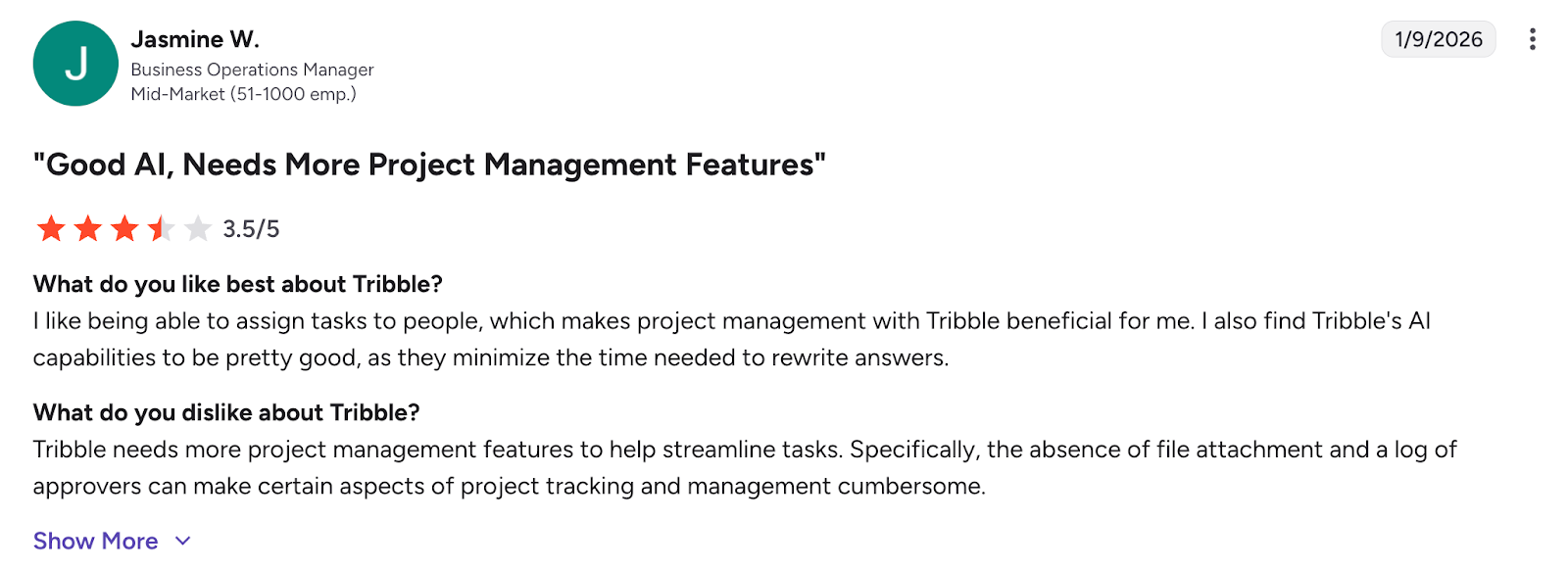
Ratings and Reviews:
Rating: 4.8/5
Reviews:
If you want higher response quality while keeping full platform control, Inventive AI is the stronger alternative. Inventive AI is built for in-house teams that need submission-ready answers with less rewriting.
Also Read: Tribble.ai vs Inventive AI RFP & Proposal Software Comparison
Now that you have an agent-led option covered, the next tool fits teams that want faster autofill and workflow support across common work tools.
6. SiftHub
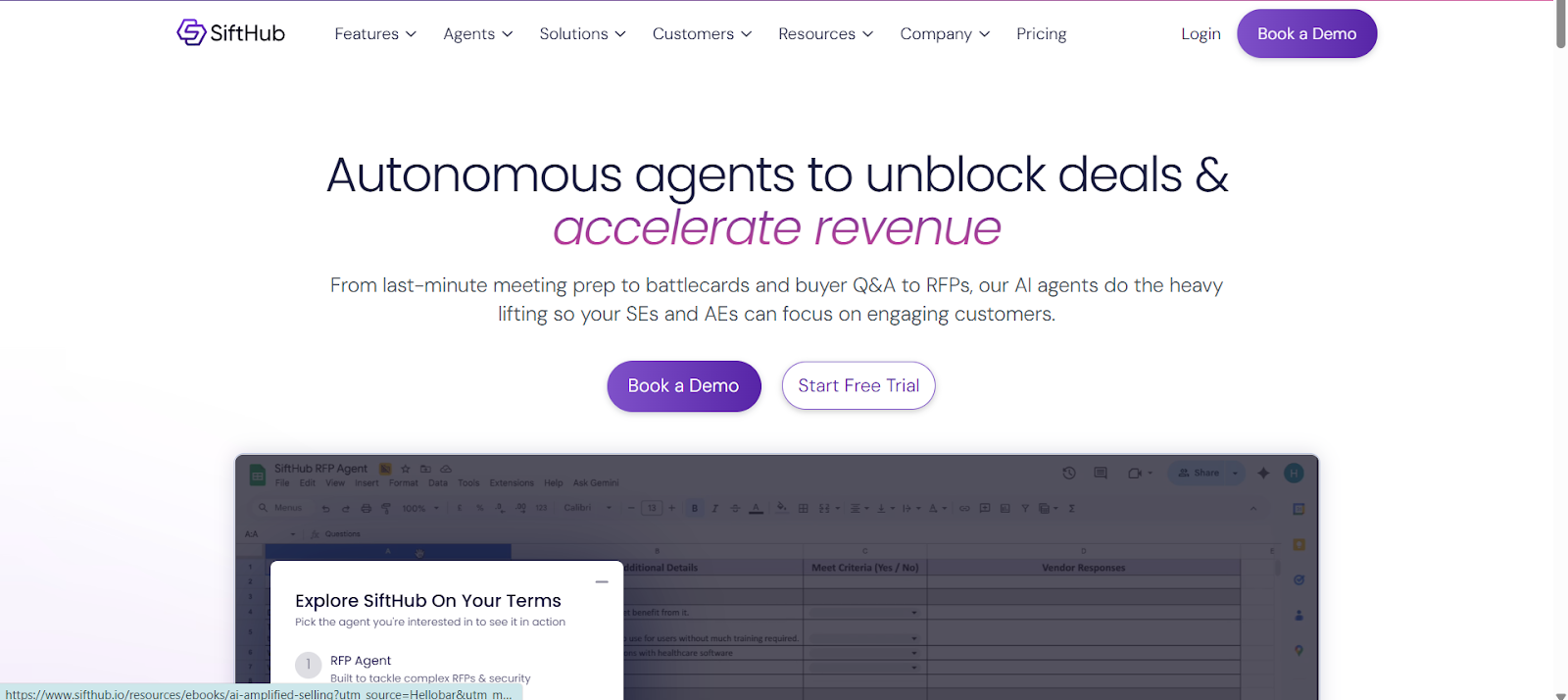
SiftHub is built to help revenue and proposal teams find and reuse the right answers faster across the tools they already work in. It is often evaluated when you want quicker autofill, less copy-paste, and smoother day-to-day execution in documents and portals.
This type of tool can be useful when your RFP load is lighter or your questions are more repeatable. The limits usually appear when you need deeper RFP-wide context, stronger content governance, and more control over narrative proposals.
Key features
- Autofill answers across common formats and portals. You can reuse approved responses inside documents and spreadsheets, which reduces repetitive work. This is most helpful when your content is already structured and stable.
- Progress visibility for what is done and what is pending. You get a view of completion status, which helps proposal owners track momentum and spot bottlenecks early.
- Knowledge access that supports faster response cycles. The focus is on helping teams pull the right answer quickly, so you spend less time searching across systems.
- Security and governance positioning. It positions itself around the secure handling of customer content. This can matter when your organisation is careful about where proposal data lives.
Pros
- Helpful for faster reuse and autofill in everyday work tools.
- Improves visibility into response progress for smaller programs.
- Useful when your content set is clean and repeatable.
Cons
- Less suited for complex, high-volume RFP programs. When deals require deep buyer context and long-form sections, autofill alone does not reduce rewriting. Proposal owners still need to shape the narrative and ensure full consistency.
- Depends on well-maintained source content. If your content is incomplete or outdated, autofill can surface the wrong answer quickly. You then spend time validating and correcting, which reduces the benefit.
- Limited advanced content governance for conflicting statements. When multiple teams contribute, contradictions can slip in. If conflict and stale content controls are not deep, manual review remains heavy.
Best for
- Sales and proposal teams handling lighter or repeatable RFP workloads.
- Teams that want a quick answer reuse across documents and portals.
- Organisations that prioritise the secure handling of proposal content.
Pricing
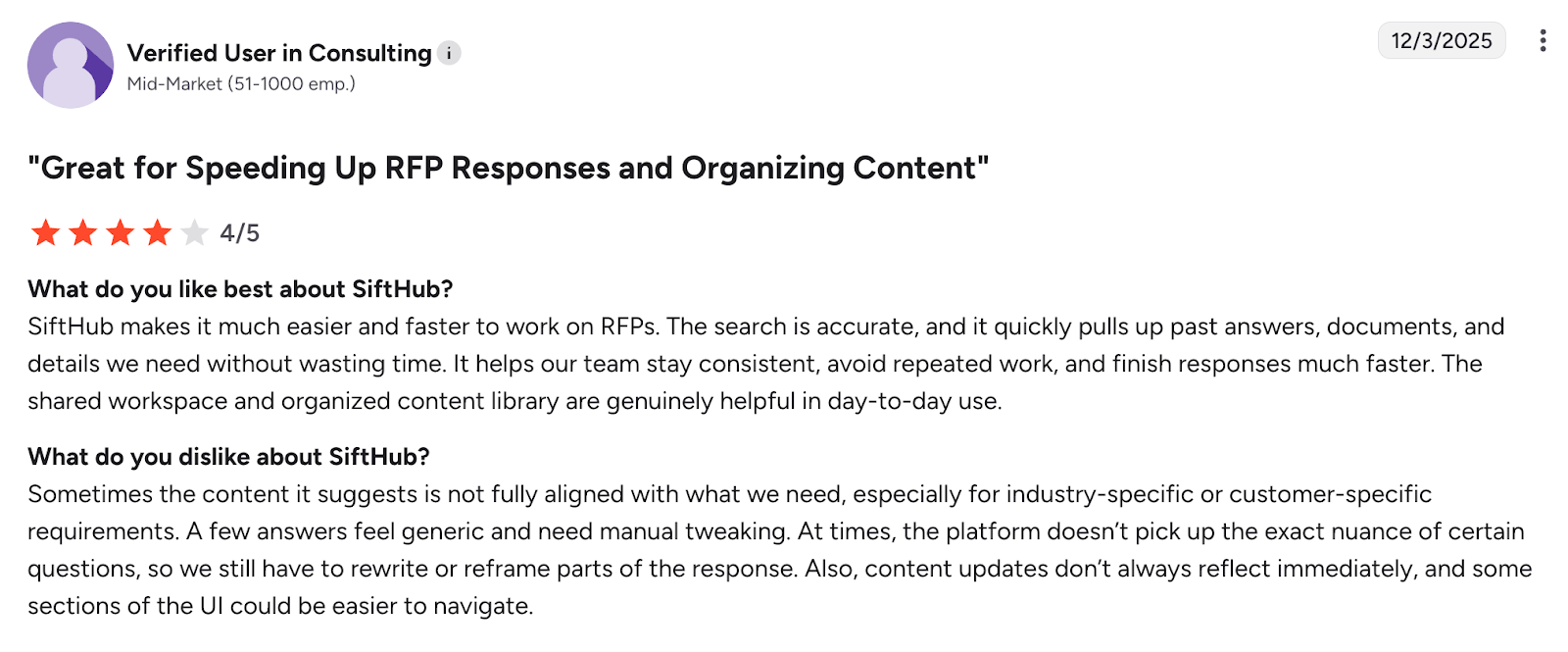
Ratings and Reviews:
Rating: 4.5/5
Reviews:
Also Read: Best Sifthub Alternatives for RFP Management in 2026
Now that you have an autofill-focused option covered, the next tool is more writing-led and often evaluated for drafting support across bids and proposals.
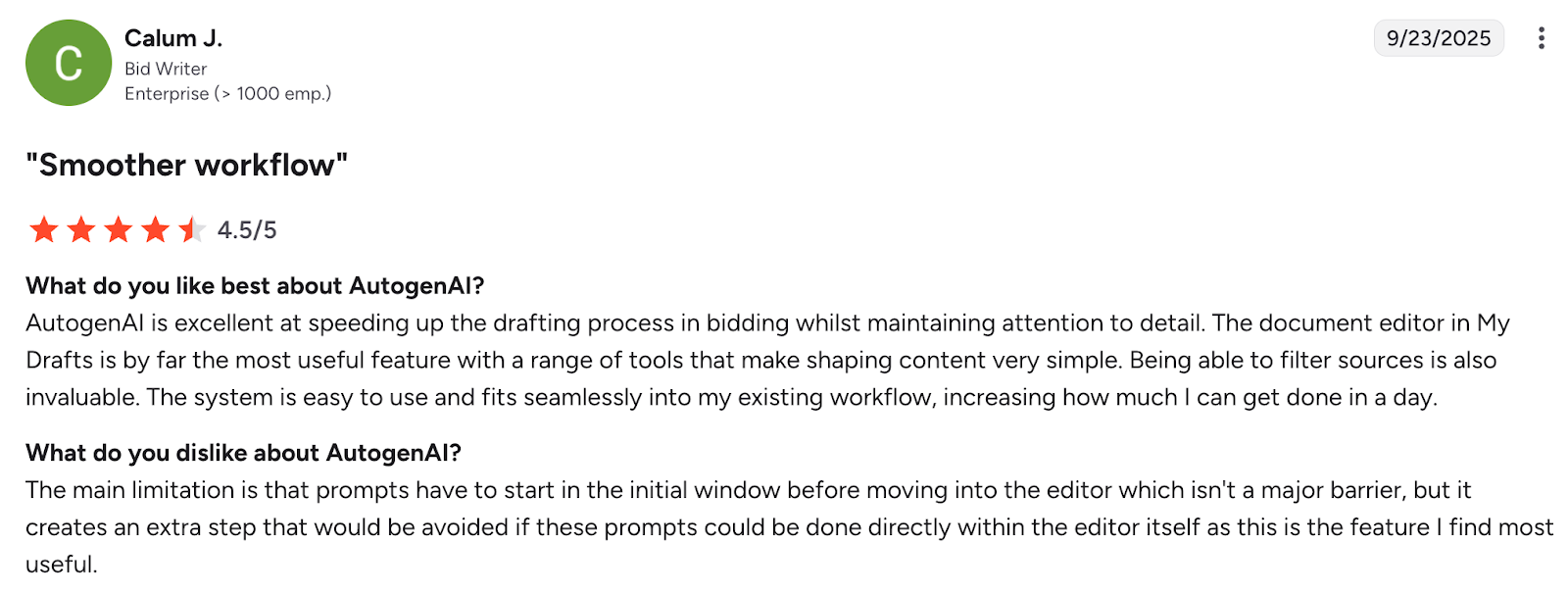
7. Autogen AI
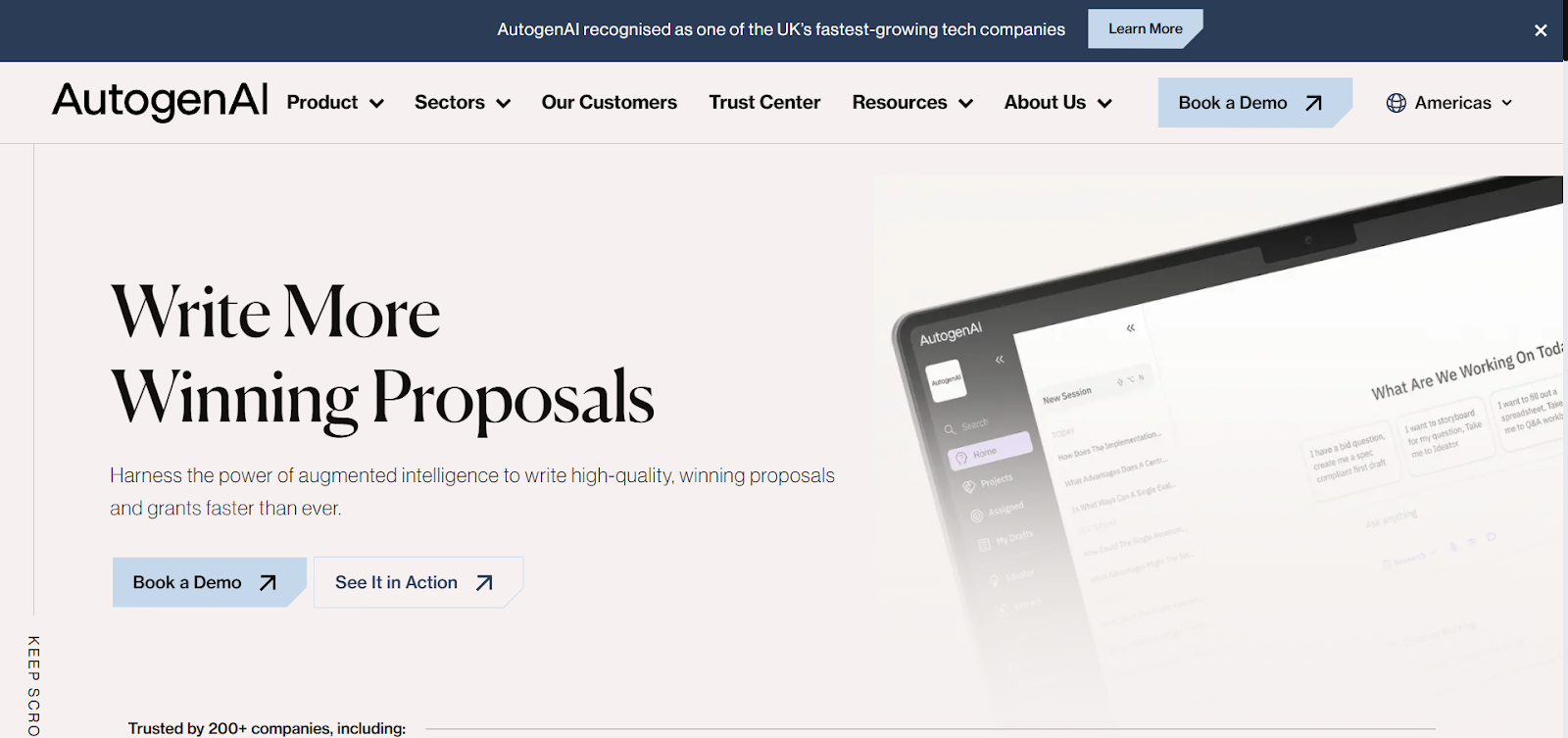
Autogen AI is positioned as a writing-led solution for bids, proposals, and RFP responses. Teams often evaluate it when they want faster drafting, rewriting help, and cleaner language without changing the rest of their process.
This can work well when your main bottleneck is writing capacity. The limits usually appear when you need a complete RFP system that governs content freshness, prevents contradictions, and coordinates multi-team workflows end to end.
Key features
- Drafting and rewriting support for proposal content. You can generate first drafts and rewrite sections to improve clarity and structure. This is useful when teams need help producing content quickly under deadlines.
- Editing helps for tone, readability, and formatting. It can help refine language and improve readability. This matters when you want consistent writing quality across contributors.
- Content reuse when your source material is organised. It can work with stored content, but results depend on how clean and current your inputs are. If inputs are outdated, teams still need to validate and adjust.
- Best fit when your workflow is already defined elsewhere. Many teams still rely on separate tools for intake, assignments, approvals, and tracking. This makes it feel like a writing layer rather than a full operating system.
Pros
- Helpful when proposal teams need faster writing and rewriting support.
- Improves readability and polish for standard response sections.
- Useful for teams that do not want to change their existing process.
Cons
- Less coverage for end-to-end RFP lifecycle management. If you need intake, assignments, approvals, and governance in one workflow, you may still manage the process in separate tools. That adds coordination overhead.
- Limited governance for stale and conflicting content. When content changes often, teams still need manual checks to avoid outdated claims. This becomes risky in security, pricing, and product sections.
- Answer quality can vary without a full RFP context. Writing support improves language, but complex RFPs still need buyer-specific context and consistency across sections. Without that, review cycles can expand.
Best for
- Teams that need writing and rewriting support under deadline pressure.
- Proposal teams with stable workflows already handled elsewhere.
- Organisations that want a drafting layer rather than a full response platform.
Pricing
Ratings and Reviews
Rating: 4.4/5
Reviews:
Now that you have a writing-led option covered, the next tool is more document-driven and often selected for template-based proposal workflows.
8. Upland Qvidian
Upland Qvidian is a long-standing proposal and document automation platform. Teams often evaluate it when they rely on template-driven proposal generation and want a structured way to reuse standard content across documents.
It can work when your organisation runs predictable proposals with stable templates. The limits usually show up when you want more modern AI depth and clearer reporting for day-to-day RFP operations.
Key features
- Template-driven proposal and document automation. You can generate proposals using predefined templates and approved content blocks. This helps maintain consistency in formatting and structure across documents.
- Central content library for reuse. Teams store standard answers, boilerplate language, and reusable sections. This supports repeatability when you answer similar RFPs across deals.
- Workflow support for reviews and approvals. You can coordinate reviews through defined steps, which helps when many stakeholders must approve the same material.
- Best fit for document-centric programs. It is strongest when your process is built around standard documents and templates, rather than dynamic, buyer-specific context generation.
Pros
- Strong fit for organisations that rely on standard templates and proposal books.
- Useful content reuse when your content library is well-maintained.
- Helps produce consistent document structure and formatting.
Cons
- Content expiration limits can create extra maintenance work. When content expires on a schedule, teams must constantly refresh libraries to avoid gaps. This adds operational overhead and can slow response cycles.
- Reporting limitations reduce visibility for proposal owners. If reporting does not surface bottlenecks clearly, owners still chase updates manually. That makes it harder to forecast timelines and improve performance.
- Less AI-first for modern response quality expectations. Template automation helps with structure, but it does not always reduce rewriting when answers must be highly contextual and buyer-specific.
Best for
- Organisations that rely on standard templates and repeatable proposal documents.
- Proposal teams are producing structured proposal books with consistent formatting.
- Teams that prioritise document automation over AI-led context reasoning.
Pricing
Ratings and Reviews:
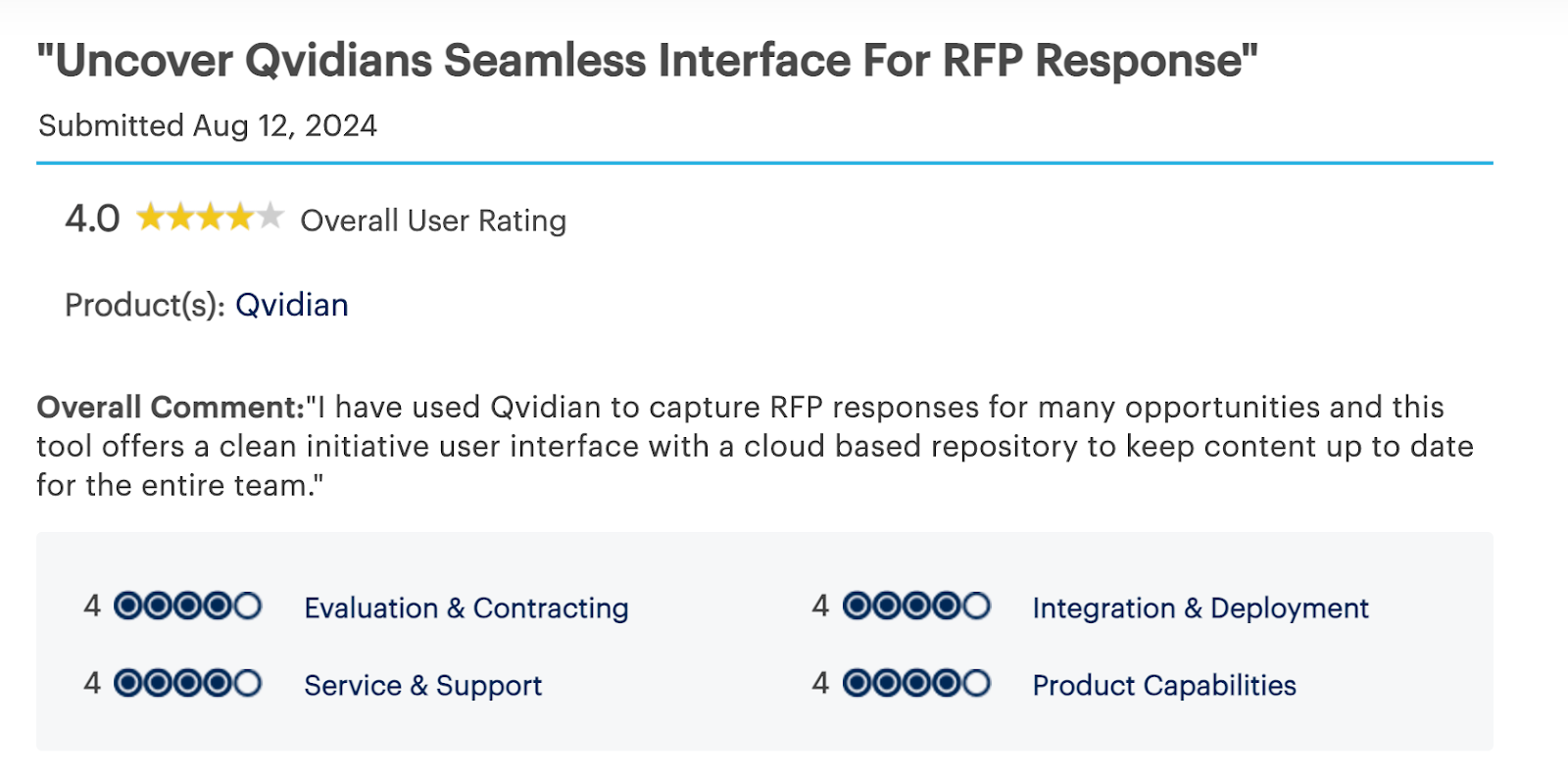
Rating: 4.7/5
Reviews:
Also Read: Qvidian Evaluation for RFP Automation
Now that you have a document-centric legacy option covered, the next tool is more sales-proposal focused and often used for approvals and polished client-facing documents.
9. Ombud

Ombud is a response management tool that aims to help you handle RFPs and questionnaires with more structure and automation. Teams often look at it when they want to reduce manual coordination and make response work more repeatable.
The key point to keep in mind is how the automation works. A lot of the automation is rule-based, so outcomes depend on how well your team defines rules and maintains the underlying content.
Key features
- Rule-based automation for repeatable response steps. You can standardise parts of the process when questions and formats are predictable. This helps reduce repetitive work when your RFPs follow similar patterns.
- Structured workflows to manage ownership and reviews. You can route work across contributors and reviewers. This can help reduce missed questions when multiple teams are involved.
- Content reuse for standard responses. You can reuse existing content for common questions. This works best when your content is current and consistently written.
- Best fit when processes are stable and well-defined. You get more value when your team already has clear workflows, clear approval rules, and a maintained library.
Pros
- Useful for teams that want repeatability through structured rules.
- Can reduce manual steps for standard, predictable workflows.
- Helpful when your process is consistent across deals.
Cons
- Rule-based automation can struggle with buyer-specific nuance. When RFP language changes or value narratives matter, rules do not adapt on their own. You still spend time rewriting for context and intent.
- Quality depends on how well your rules and content are maintained. If the library gets stale or inconsistent, automation can scale the wrong answer faster. That increases review effort and risk.
- Governance can still require heavy manual oversight. If contradictions and outdated claims are not proactively flagged, reviewers must catch issues manually. This slows approvals, especially for security and legal sections.
Best for
- Teams with stable RFP formats that benefit from repeatable rules.
- Proposal owners who want more structure across contributors and approvals.
- Organisations that can maintain governance across content and workflows.
Pricing
Ratings and Reviews
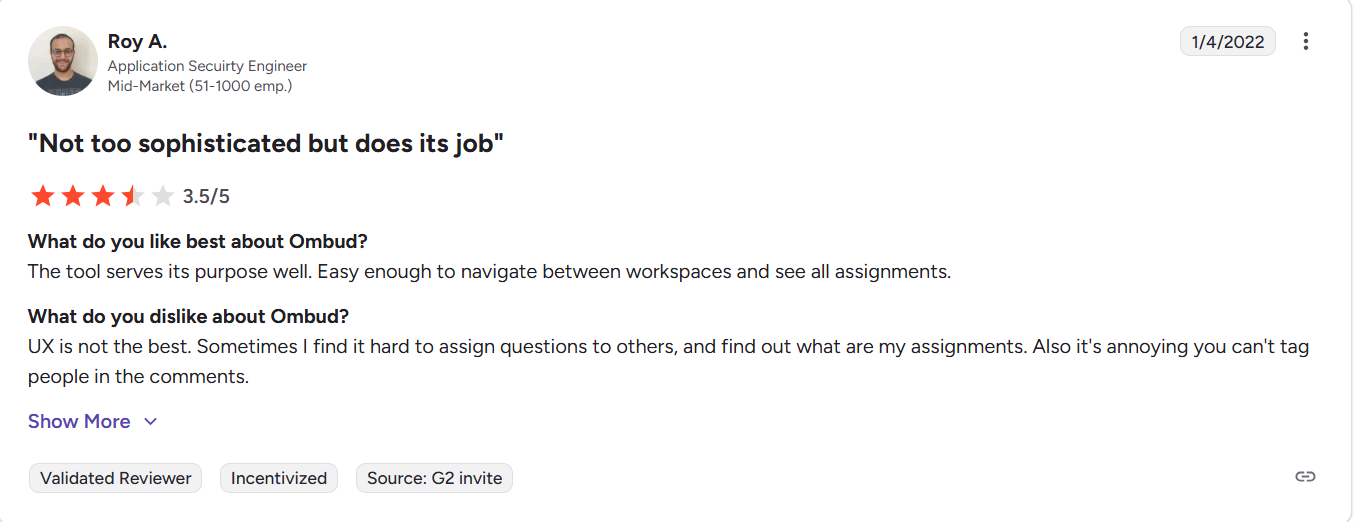
Rating: 4.7/5
Reviews:
You now have a clear shortlist of Arphie alternatives, plus where each tool fits operationally. Next, the blog shifts to two practical questions that help you choose faster: how to pick the right option for your team, and how to run a fair pilot before you switch.
Why are Many Teams Searching for an Arphie Alternative in 2026? 4 Main Reasons
Arphie is an AI RFP and proposal platform that helps you draft responses using company-approved sources. You can use it for RFPs, RFQs, questionnaires, and DDQs when you want faster drafting with guardrails around data access.
It often works well when your workflows are simple, and your content set is still manageable. The friction usually starts when your RFP workload grows, and more stakeholders join each response.
1) Export and submission become “last-mile work.”
Some users call out export limitations and ask for more flexibility. When the output is not ready in the buyer’s required format, you end up doing manual cleanup in Word or spreadsheets.
That creates operational drag:
- You lose time after the draft is “done.”
- You add another review loop just to confirm formatting changes.
- You increase copy-paste risk in security and product sections.
2) Reporting gaps make it harder to manage stakeholders.
Feedback also highlights reporting as an area that can feel incomplete. When you cannot see progress clearly, you manage the process through updates in Slack and email.
That affects delivery:
- SMEs reply late because ownership is unclear.
- Proposal owners spend time chasing status instead of improving answers.
- Deadlines become harder to forecast for complex RFPs.
3) Importing legacy Q and A can slow adoption.
Users ask for more flexibility when importing question-and-answer pairs from older systems. If your content sits across spreadsheets and past proposals, limited import paths force manual restructuring.
That leads to:
- A slower rollout, because content needs cleanup first.
- Teams working in parallel systems, which increases inconsistencies.
- A bigger maintenance burden to keep libraries current.
4) The hidden cost of “good enough” at scale
Small issues become big when deadlines are tight. Users mention occasional interface bugs. Even if the issues are minor, they interrupt the flow during crunch time. Your team repeats steps or falls back to manual work.
Review speed drops when SMEs are not at a desk. A reviewer notes the product is not mobile native yet. If SMEs review between meetings or while traveling, responses stall. The proposal owner often absorbs the delay and ends up rewriting and finalising answers alone.
What this means for your alternatives
If these friction points sound familiar, your “Arphie alternative” shortlist should prioritise tools that:
- Reduce export and formatting cleanup.
- Improve visibility into who owns which answers.
- Make it easier to migrate and govern legacy content at scale.
Now that you have a clear view of where teams feel resistance with Arphie, the comparison table will be easier to evaluate.
How to Choose the Right Arphie Alternative for Your Team?
Choosing an Arphie alternative is really about choosing how your team will work under deadline pressure, poor response quality, and review cycles.
If governance is weak, risk increases. That is why the selection criteria should stay outcome-led.
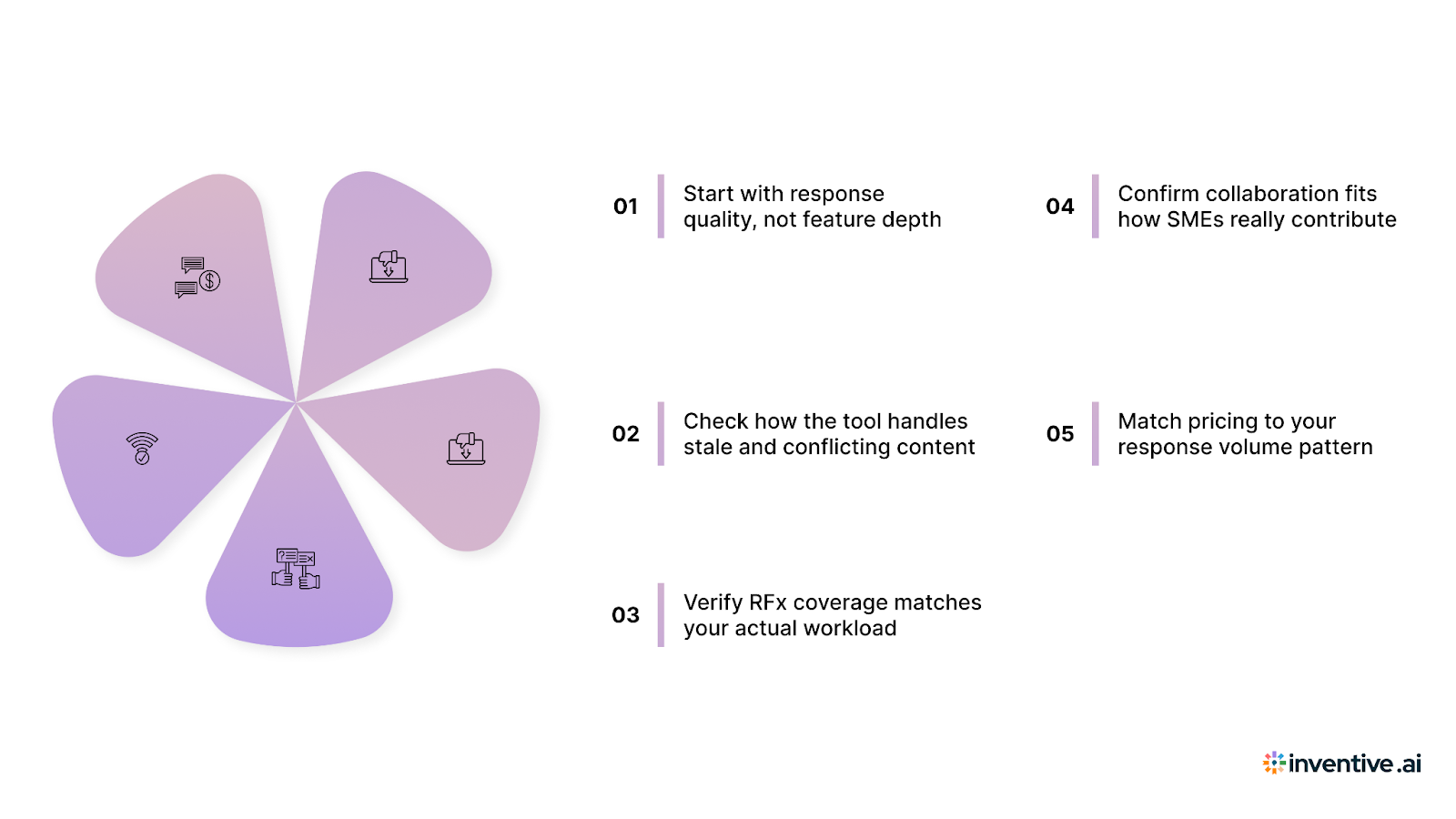
Use this checklist to shortlist the best fit.
1) Start with response quality, not feature depth
Ask one question first: how many answers feel ready with near-zero editing. If your team still rewrites most answers, the tool is not reducing real workload.
Response quality also affects win rate, since stronger answers match buyer intent more closely.
2) Check how the tool handles stale and conflicting content
RFP content goes stale faster than most teams expect. Security language changes. Product claims shift. Pricing and packaging evolve.
If you do not catch outdated or conflicting statements early, the risk shows up in reviews, not in drafts. That adds delay and creates avoidable errors.
3) Verify RFx coverage matches your actual workload
Many teams do not only handle RFPs. You may also manage RFIs and security questionnaires.
If those formats sit outside your main workflow, your process stays fragmented. That increases handoffs and makes it harder to keep answers consistent.
4) Confirm collaboration fits how SMEs really contribute
Your process is only as fast as the SME response time. You need a workflow that makes ownership clear and makes review simple.
If SMEs struggle to find the right place to comment, approvals slow down. The proposal owner then absorbs the load.
5) Match pricing to your response volume pattern
Subscription tools can feel expensive as you add occasional contributors. On the other hand, usage-based pricing can align better if your RFP volume fluctuates. The best model depends on how many people contribute and how often you respond.
If you apply these filters, your shortlist becomes clearer. You move from tool comparison to outcome comparison.
Also Read: 7-Step Buying Guide for AI-Driven RFP Software
How to Run a Fair Pilot Before You Switch?
A pilot should answer one question: which tool produces the most usable, lowest-risk answers with the least rewrite effort? Draft speed matters, but it is not enough.
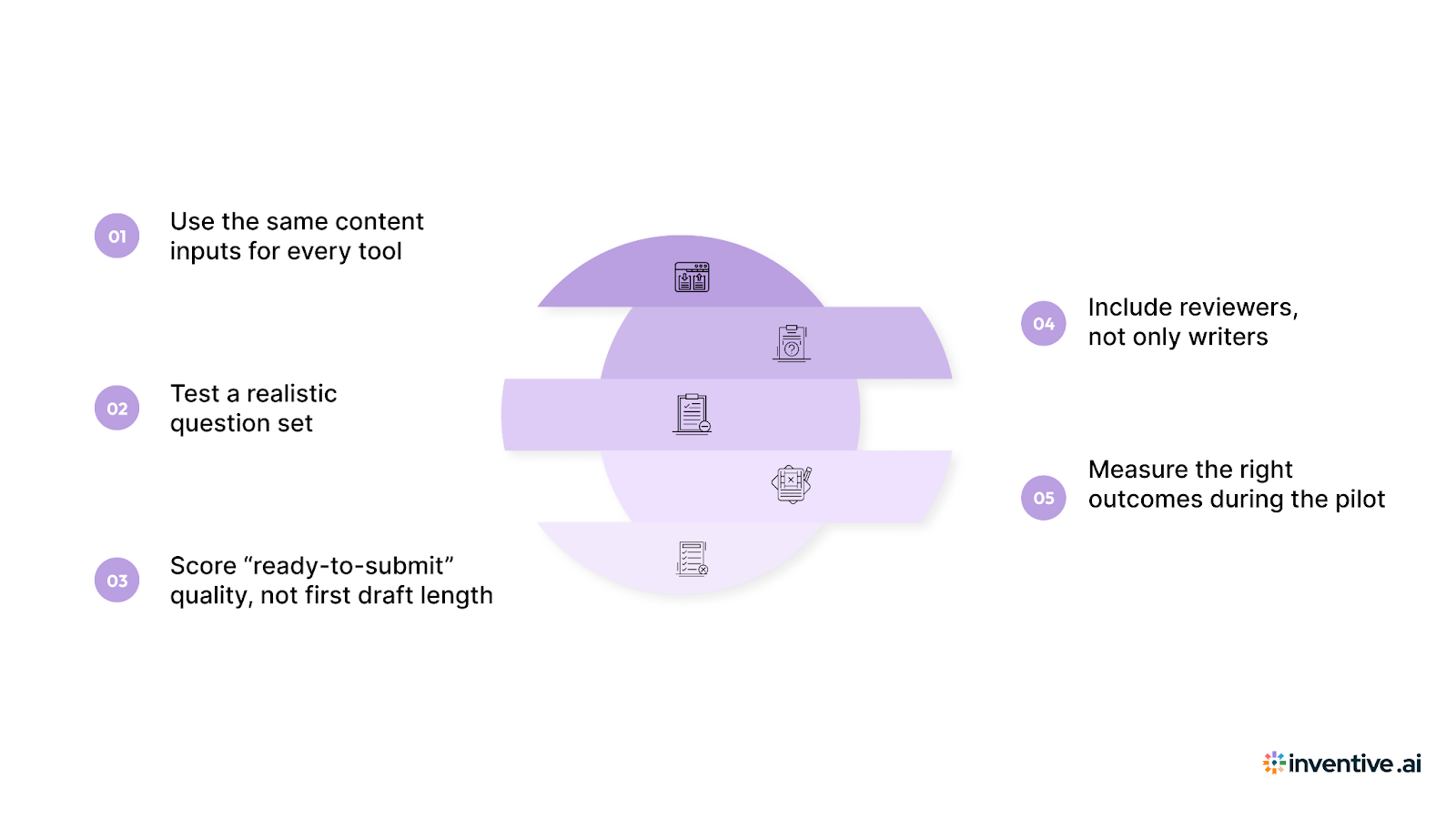
Use this simple pilot plan.
Step 1: Use the same content inputs for every tool
Pick a fixed set of source documents, past answers, and product material. If one tool gets cleaner inputs than another, the test is not fair.
Step 2: Test a realistic question set
Choose questions that represent your real mix:
- A few standard questions you see every week
- A few buyer-specific questions that require tailoring
- A few security or compliance questions where accuracy matters
Step 3: Score “ready-to-submit” quality, not first draft length
Create a simple scorecard for each answer:
- Accuracy and correctness
- Completeness
- Buyer-specific relevance
- Consistency across the full response
- Editing time required
Step 4: Include reviewers, not only writers
Have the same SMEs and reviewers score output across tools. They will spot governance gaps faster than the drafting owner.
Step 5: Measure the right outcomes during the pilot
During the trial, track outcomes that affect wins and workload:
- How many answers are needed for near-zero editing?
- How often did reviewers find contradictions?
- How long did approvals take?
- How quickly did the team reach submission-ready quality?
If you want proof of what higher-quality answers can change, review the case study showing 2× more accurate responses with minimal manual tweaks.
Why choose Inventive AI over other tools for 2026 RFPs?
If you are switching from Arphie, you are usually trying to fix two things. You want answers your team trusts, and you want fewer review cycles. You also want to avoid last-mile surprises like stale security language or mismatched product claims.
What should you prioritise before you decide?
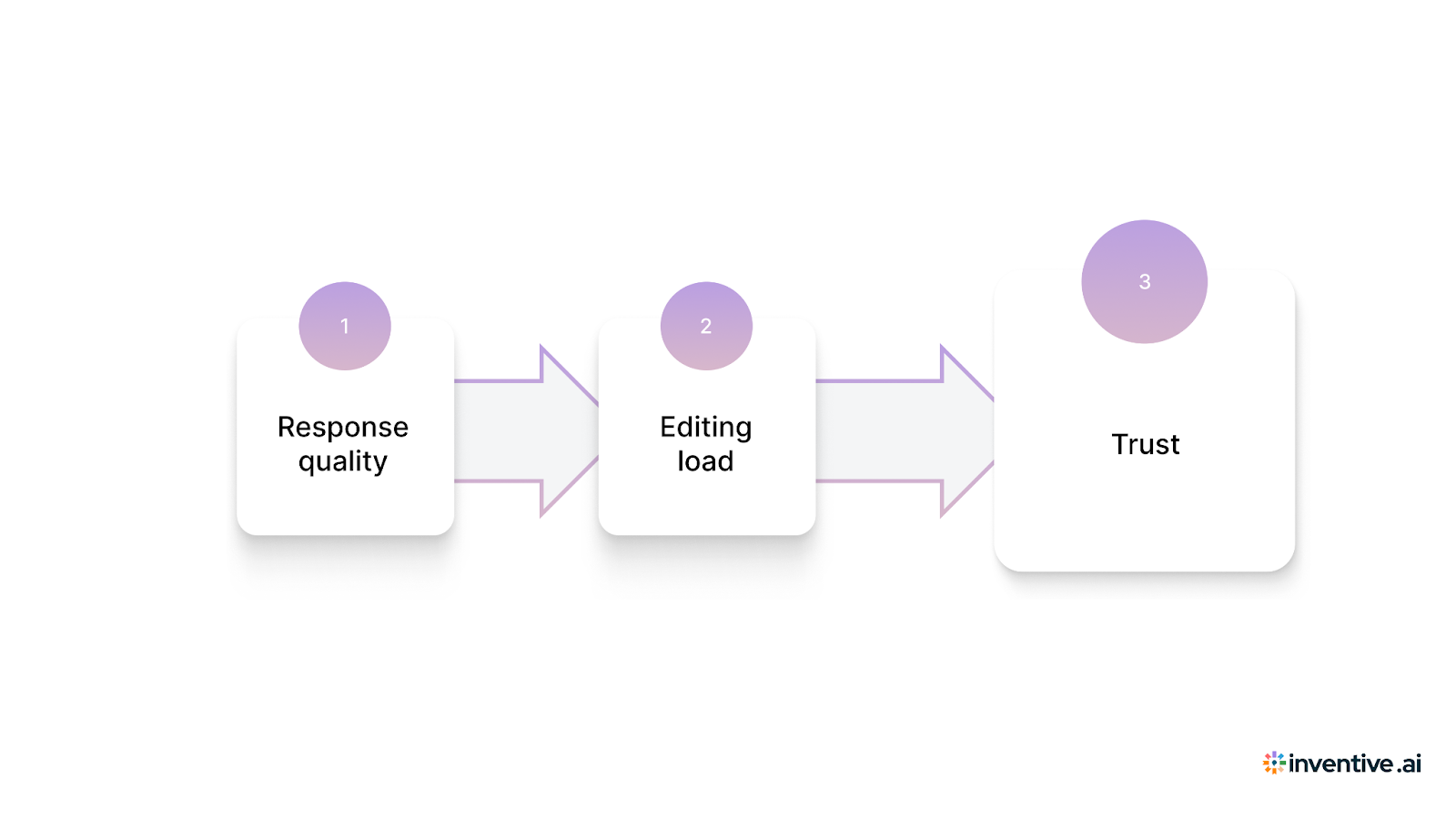
Most tools look similar in a feature table. The real difference shows up in outcomes.
- Response quality: Better answers lead to higher win rates.
- Editing load: If reviewers keep rewriting, speed gains disappear.
- Trust: If content can be outdated or inconsistent, risk increases.
That is why response quality matters more than any feature list or price tag.
You should not have to guess if quality improvements matter. Inventive AI has customer proof tied to real outcomes.
A customer case study reports 50% higher win rate and 90% faster RFP responses after adopting Inventive AI.
If you want an Arphie alternative that improves answer quality and reduces manual cleanup across teams, Inventive AI is built for that outcome.
FAQs
1. Which tool is best for security questionnaires?
You should prioritise accuracy, consistency, and stale content control. Security answers go out of date quickly, and contradictions create risk. Inventive AI supports security questionnaires in the same workflow as RFPs and helps prevent stale or conflicting answers.
2. What matters more, drafting speed or answer quality?
Answer quality matters more, since weak answers expand review cycles and reduce trust. Speed helps only when drafts are usable. A better benchmark is how many answers need near-zero editing.
3. Is usage-based pricing better than subscription pricing?
It depends on volume and contributor patterns. If many occasional SMEs contribute, usage-based pricing can align better with the real workload. If your volume is steady and seats are predictable, subscription pricing can also work.
4. Can startups benefit from Inventive AI, or is it only for enterprise teams?
Startups can benefit when each RFP is high value and rewriting time is costly. Inventive AI is designed for startups, small businesses, and enterprise teams, especially when answer quality and governance matter.
5. How do you reduce rewriting after switching tools?
Choose a platform that improves first-draft quality and prevents stale and conflicting content. Then set clear review ownership, maintain a clean knowledge base, and measure editing time as a core KPI.




.png)