Download Free Bid Proposal Template (Word) + Industry Examples
%20Industry%20Examples.png)
Did you know sales reps dedicate around 31% of their day to administrative tasks such as updating records, formatting proposals, chasing internal approvals, and working across disconnected tools? If you rely on a static bid proposal template (Word document), that administrative load quickly turns into lost selling time and delayed submissions.
You are expected to deliver structured, persuasive bids under tight deadlines while coordinating input from multiple stakeholders. Yet version control issues, outdated sections, and manual formatting often slow you down and introduce avoidable errors.
In this blog, we will explore ready-to-use bid proposal templates in Word format, industry-specific variations, how to customize them for higher win rates, and how AI is improving the way proposal teams draft and manage bids at scale.
Ready-to-Use Bid Proposal Template In Word Format
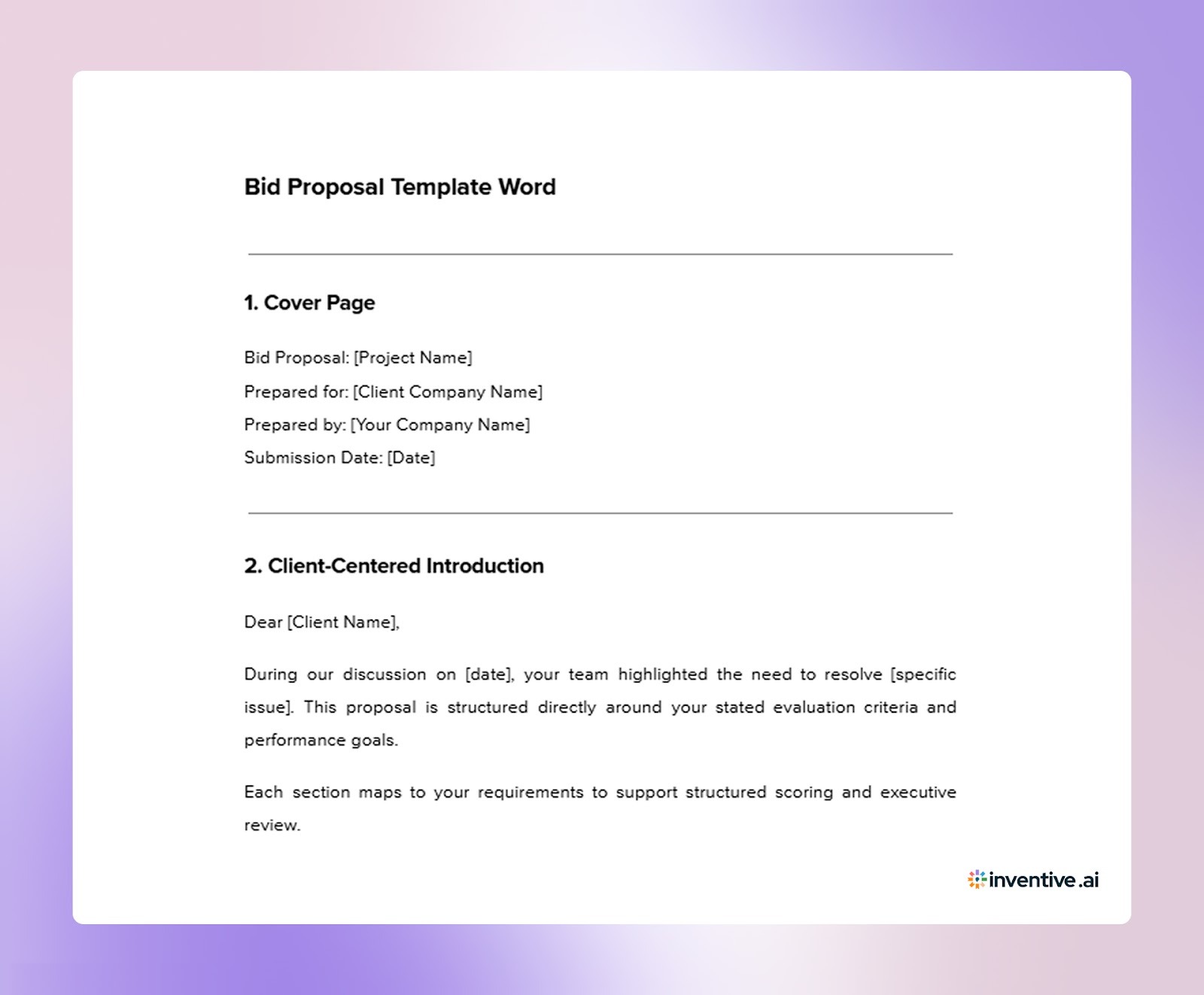
A structured bid proposal helps you present your solution clearly, price it accurately, and respond to buyer requirements without confusion. Below is a ready-to-use bid proposal template (Word format) that you can copy into a Word document and customize based on your opportunity.
You can remove, expand, or reorder sections depending on the RFP or bid request.
1. Cover Page
Bid Proposal: [Project Name]
Prepared for: [Client Company Name]
Prepared by: [Your Company Name]
Submission Date: [Date]
2. Client-Centered Introduction
Dear [Client Name],
During our discussion on [date], your team highlighted the need to resolve [specific issue]. This proposal is structured directly around your stated evaluation criteria and performance goals.
Each section maps to your requirements to support structured scoring and executive review.
Sincerely,
[Your Name]
[Title]
3. Executive Summary (Board-Level TL;DR)
Top 3 Reasons to Partner with Us
- Proven delivery model aligned to your Requirement A with documented outcomes.
- Clear five-year value realization with breakeven projected by Month [X].
- A governance structure that reduces execution risk through defined accountability.
Keep each bullet under 20 words.
Your Stated Objectives
- [Requirement A]
- [Requirement B]
- [Requirement C]
Our Aligned Response
- Solution element mapped to Requirement A
- Solution element mapped to Requirement B
- Reporting structure aligned to Requirement C
Expected Outcomes
- [Quantified KPI]
- Reduced delivery risk
- Improved reporting transparency
Bold measurable impact statements for scan readability.
4. Strategic Value Alignment
(Scoring-Optimized Table)
This directly supports scoring frameworks.
5. Scope of Work and Growth Roadmap
Phase 1: Core Scope
- [Deliverable 1]
- [Deliverable 2]
- [Deliverable 3]
Phase 2 Considerations (Future Growth)
- [Capability X once Phase 1 stabilizes]
- [Enhancement Y based on data maturity]
This reframes “Out of Scope” as expansion potential rather than refusal.
6. Methodology and Governance
- Kickoff workshop
- Weekly reporting
- Risk tracking log
- Executive escalation path
Micro-proof integration example:
“This governance framework was used for [Client X], resulting in delivery two weeks ahead of plan.”
Digital and Print-Ready Proof
Include:
- Short URL: yourcompany.com/case-study-A
- QR code linking to video testimonial
- Appendix reference for dashboard sample
This protects against link rot in printed copies.
7. Relative Timeline and Shared Responsibilities
Project Duration: [X weeks post-contract signing]
Relative weeks keep the proposal evergreen.
8. Pricing, Five-Year Value Realization, and Breakeven Analysis
Total Investment: [Amount]
Five-Year Value Realization
Financial Metrics
- Breakeven Month: Month [X]
- Estimated IRR: [X%]
Cost of Inaction
- Ongoing inefficiency costing approximately [Monthly Estimate]
- Operational delays
- Increased exposure to risk
Place ROI and breakeven in a callout box for visibility.
9. Past Performance and Verifiable Evidence
- [Client A] – Reduced cycle time by [X%]
- [Client B] – Delivered under budget by [X%]
Provide:
- Short URL to full case study
- QR code for video testimonial
- Contact reference upon request
10. Team and Requirement-Based Role Assignment
Project Manager: [Name]
Assigned due to expertise in [specific requirement area].
Technical Lead: [Name]
Selected for prior delivery of [similar project].
Each role ties back to a client objective.
11. Risks and Assumptions
Identified Risks
- [Risk] – Mitigation plan
- [Risk] – Mitigation plan
Assumptions
- [Assumption]
- [Assumption]
Transparent risk documentation increases evaluator confidence.
11b. Social Impact and Sustainability
- Commitment to reduced carbon footprint initiatives
- Workforce diversity metrics
- Ethical sourcing standards
- Data governance and compliance posture
This section supports ESG scoring in enterprise and government RFPs.
12. Terms and Conditions
- Proposal validity period
- Change control framework
- Confidentiality clause
- Liability limitations
13. Acceptance
Authorized Representative
Name: _______________________
Signature: ____________________
Date: ________________________
Not every bid follows the same evaluation criteria, which means your structure must adapt to the buyer’s industry context.
5 Industry Bid Templates to Match Every Buyer Scenario
Different industries require different proposal structures. Below are structured bid proposal templates customized to common procurement environments. Each template is formatted for Word and formal submission use.
1. Construction Bid Proposal Template
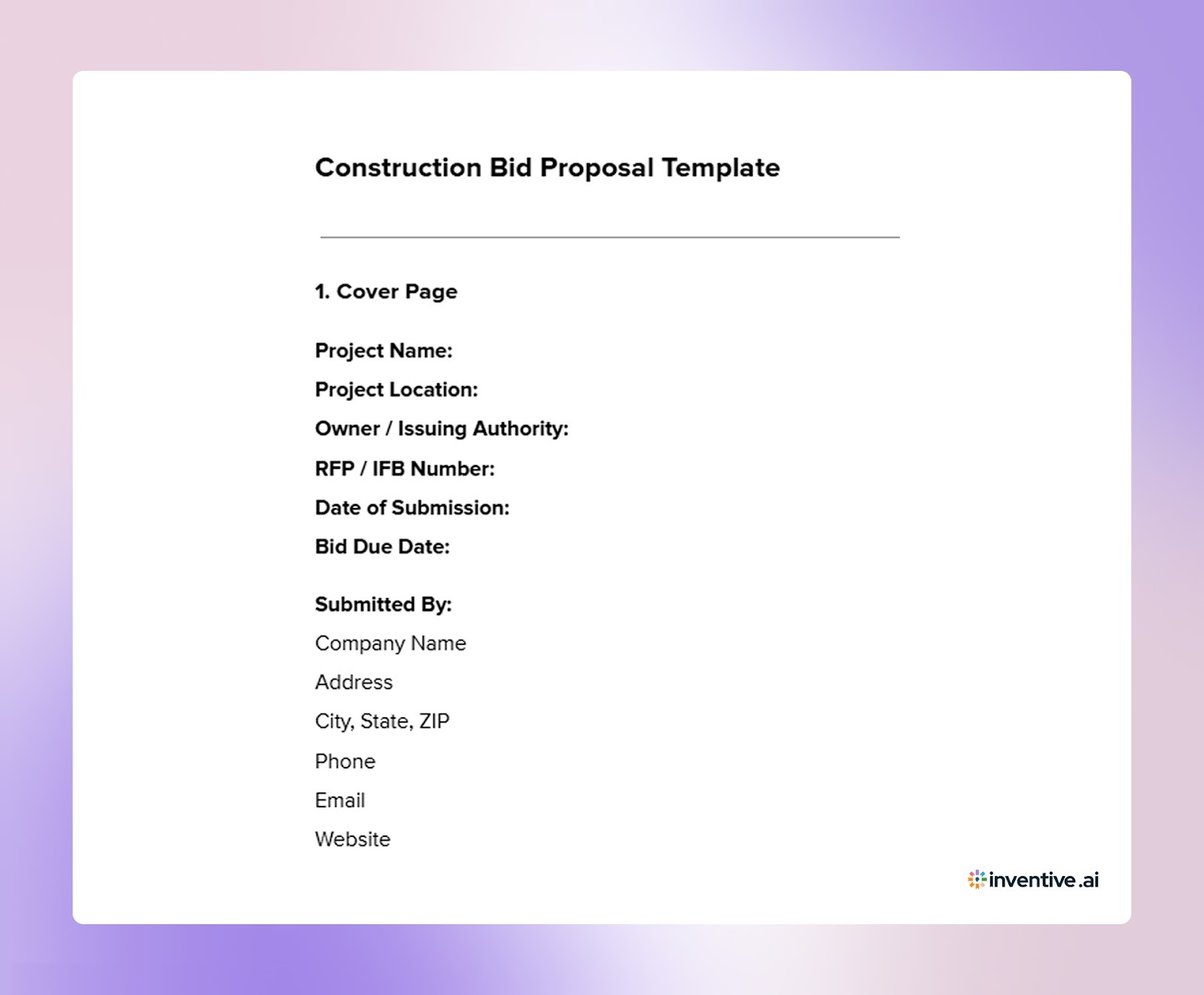
This template is designed for contractors responding to commercial, infrastructure, or public works bids where cost accuracy, safety, and schedule reliability drive evaluation.
The structure includes:
- Cover Page with RFP number and authorized signature
- Executive Summary with project understanding and risk mitigation
- Detailed Scope of Work aligned to CSI divisions
- Project Schedule with relative milestones and CPM reference
- Safety and Quality Control Plans
- Cost Proposal with alternates and schedule of values
- Risk Management and Sustainability overview
This format supports public and private construction bids requiring compliance documentation and structured review.
2. IT / Technical Bid Proposal Template
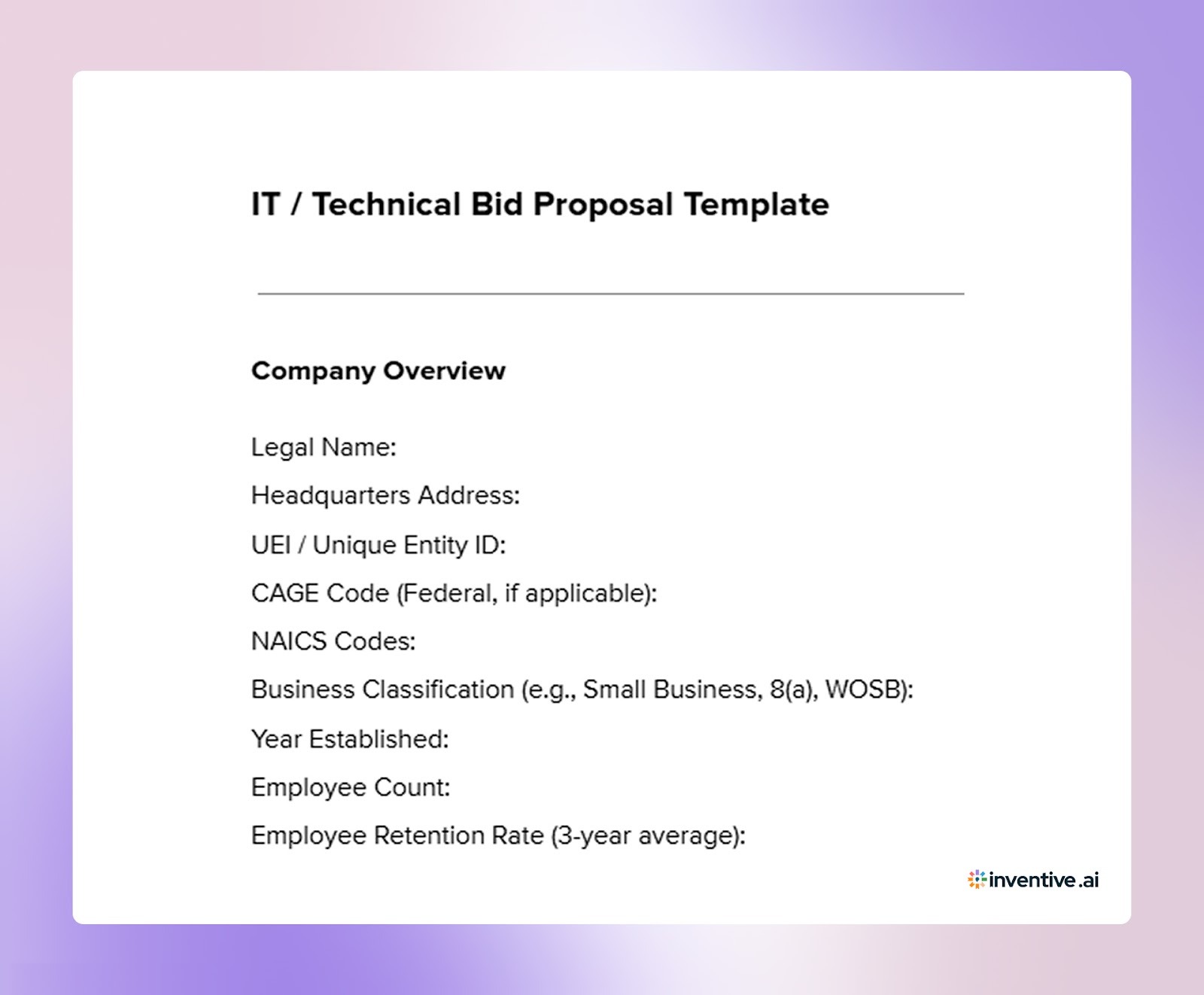
This template supports software, cybersecurity, and enterprise technology bids evaluated by technical, procurement, and finance stakeholders.
The structure includes:
- Company Overview with certifications and eligibility credentials
- Executive Summary with measurable outcome callout
- Compliance Matrix mapping RFP requirements
- Technical Approach and Solution Architecture overview
- Security and Data Governance framework
- Relative Implementation Timeline and Staffing Plan
- Five-Year Value Realization with breakeven projection
This format supports structured scoring and audit-ready evaluation.
3. Government Contract Bid Proposal Template
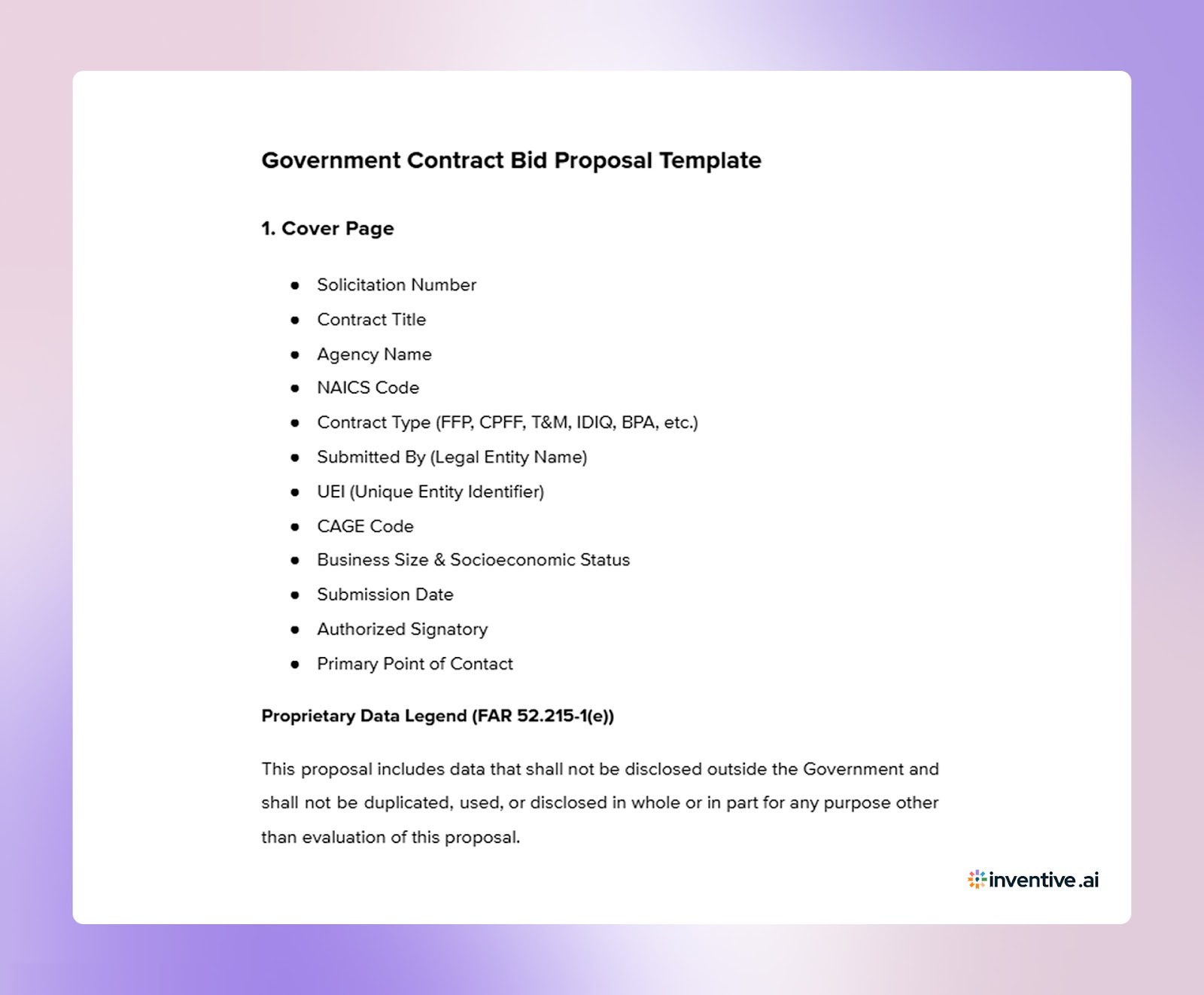
This template is structured for federal, state, and municipal solicitations reviewed against formal evaluation criteria.
The structure includes:
- Cover Page with solicitation number and required legends
- Executive Summary focused on mission understanding and risk reduction
- Compliance Matrix crosswalk aligned to Section L
- Technical and Management Volumes with WBS and staffing
- Relative Schedule and Transition Plan
- Past Performance aligned to CPARS terminology
- Pricing Volume with CLIN breakdown and Basis of Estimate
This format supports regulatory compliance and evaluator scoring efficiency.
4. Consulting Services Bid Proposal Template
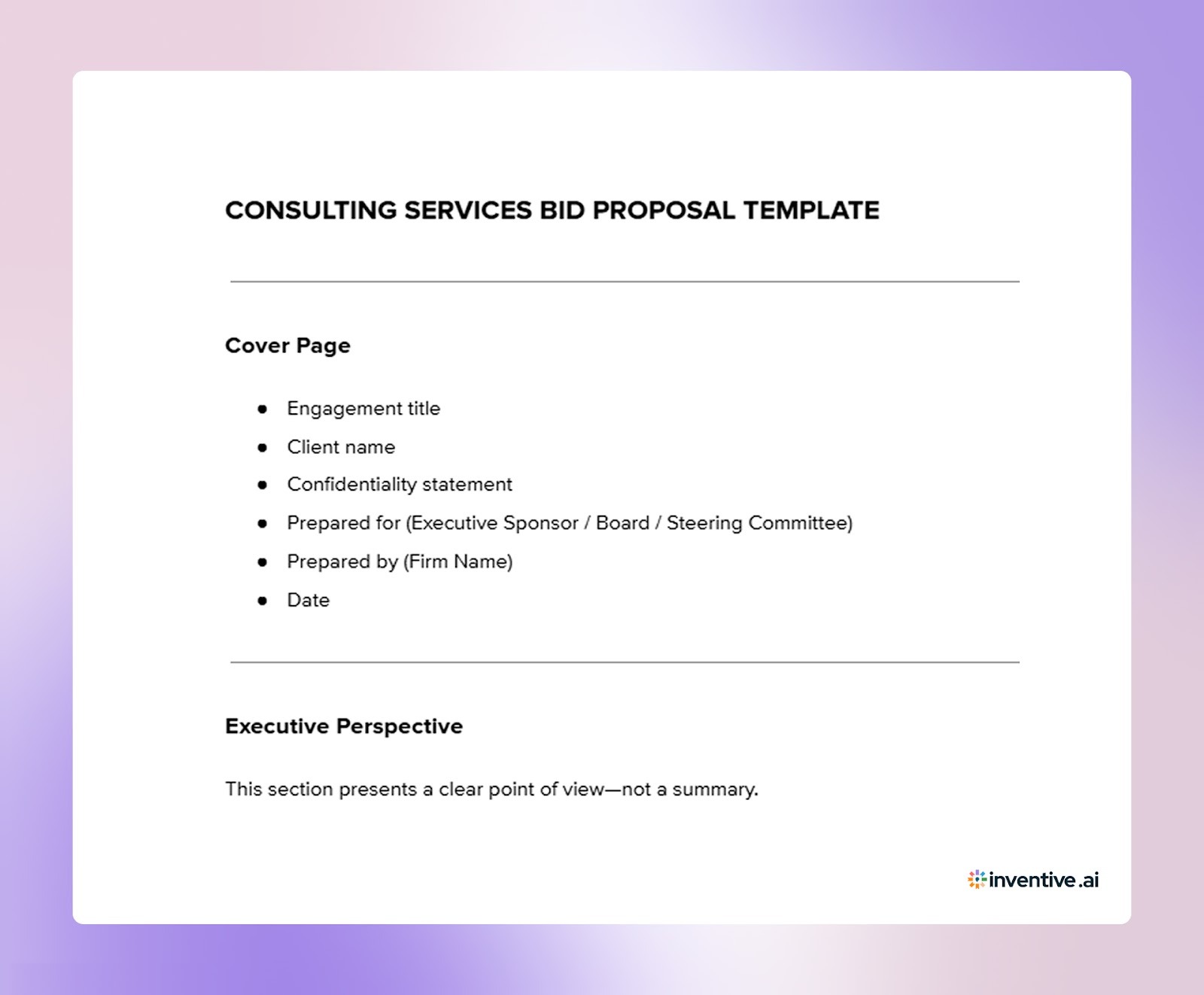
This template is structured for advisory and transformation engagements reviewed by executive sponsors or steering committees.
The structure includes:
- Executive Perspective outlining strategic urgency
- Case for Change with financial and operational impact
- Current State Diagnostic and Target State Vision
- Transformation Blueprint with phased roadmap
- Value Creation Model with multi-year impact
- Governance and Risk Oversight framework
- Investment and Commercial Structure
This format positions the proposal as a business case for executive approval.
5. Subcontractor Bid Proposal Template
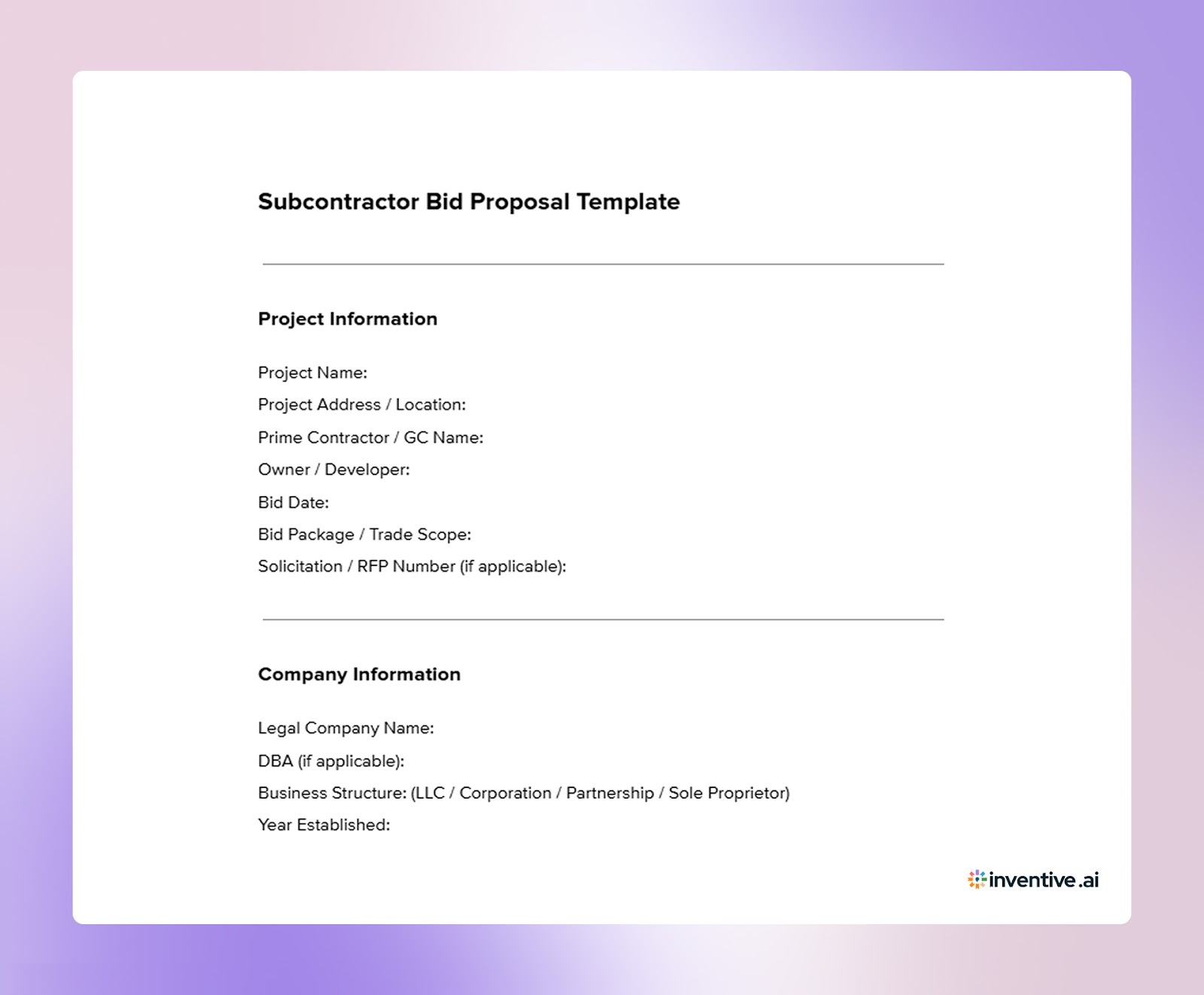
This template supports trade contractors submitting proposals to a general contractor or prime contractor.
The structure includes:
- Project and Company Information
- Detailed Scope of Work with CSI references
- Explicit Exclusions and Pricing Assumptions
- Bid Price Summary with alternates and unit pricing
- Schedule and manpower projection
- Safety record and compliance certifications
- Risk assumptions and change order process
This format protects the margin while demonstrating reliability and scope clarity.
Even the strongest format requires thoughtful edits to reflect the buyer’s goals and internal approval process.
How to Turn a Basic Bid Proposal Template into a Winning Bid?
A strong template gives you structure. Customization is what turns that structure into a persuasive, decision-ready document. Buyers are not selecting a format; they are selecting the partner who best understands their risk, constraints, and performance expectations.
Use the steps below to customize your bid before submission:
- Start with the Client’s Exact Language: Mirror the terminology used in the RFP. If they refer to “program oversight” instead of “project management,” reflect that wording throughout your proposal to show precision and attentiveness.
- Rewrite the Executive Summary Around Their Priorities: Do not reuse generic summaries. Open with their stated objectives, reference their key constraints, and clearly state how your approach addresses those points first.
- Map Requirements to Your Response: Add a requirement crosswalk table that shows where each RFP section is answered. This makes scoring easier for evaluators and reduces the risk of being marked non-responsive.
- Clarify Scope and Future Phases: Define what is included in Phase 1 and frame additional items as structured growth opportunities. This prevents scope confusion while keeping expansion pathways visible.
- Customize the Financial Model: Adjust pricing narratives to reflect the buyer’s approval process. Include breakeven timing, multi-year projections, or cost-of-inaction framing depending on whether finance, procurement, or operations leads the decision.
- Insert Targeted Social Proof: Replace generic case studies with examples from similar industries, contract sizes, or regulatory environments. Add short URLs or QR codes so evaluators can verify claims quickly.
- Address Risk Before They Ask: Identify likely execution, schedule, or compliance risks and document mitigation steps clearly. Proactive risk disclosure signals maturity and builds evaluator confidence.
Customizing each bid manually works at low volume, but scaling high-quality responses requires a more controlled process.
How Inventive AI Is Transforming Bid Proposal Creation?
A template gives you the structure of a bid. The work it leaves you is filling every section with content that is deal-specific, accurate, and current. Inventive AI, an AI-first RFP and proposal response platform, runs that step with autonomous agents and keeps humans in the loop to approve.
- Faster first responses. The Context Engine drafts each answer against the specific opportunity, using customer priorities, deal context, and CRM data, so you start from a tailored first draft instead of pasting reused boilerplate into every bid.
- Cited, scored answers. Every response ships with source citations and a confidence score, and flags "information unavailable" rather than guessing.
- Content Governance Agent. Keeps the knowledge behind your bids accurate on its own, detecting conflicting information, outdated content, and duplicates without a manual review cycle.
- Works with knowledge you already have. Connects to SharePoint, Google Drive, Salesforce, Confluence, and Notion, so there is no separate content library to build and maintain.
- Strategic Agents. A Go/No-Go Agent scores whether a bid is worth pursuing before you commit hours, and the Full Response Analyzer checks the whole document for gaps and contradictions before submission.
FAQs
1. How long should a bid proposal be?
The length depends on the complexity of the project and the buyer’s submission guidelines. Small private bids may require 5–15 pages, while enterprise or government submissions can exceed 50 pages. Focus on completeness, clarity, and compliance rather than page count. If the RFP includes page limits, follow them strictly.
2. What is the difference between a bid proposal and a price quote?
A price quote typically lists costs with minimal context. A bid proposal explains your understanding of the project, outlines your approach, defines responsibilities, and justifies pricing. Buyers use proposals to assess risk, capability, and delivery readiness, not just cost.
3. When should you use lump sum pricing versus unit pricing?
Lump sum pricing works best when the scope is clearly defined and unlikely to change. Unit pricing is more suitable for projects with variable quantities or uncertain site conditions. The pricing model should reflect project risk allocation between buyer and vendor.
4. How do procurement teams typically score bid proposals?
Many procurement teams use structured scoring matrices based on criteria such as technical approach, past performance, staffing, compliance, and price. Some assign weighted percentages to each category. Proposals that clearly map responses to stated requirements are easier to evaluate and often score higher.
5. What causes bid proposals to get rejected even when pricing is competitive?
Common reasons include missing mandatory forms, failure to follow formatting instructions, unclear scope definitions, unrealistic timelines, or weak documentation of past performance. Administrative errors alone can disqualify an otherwise strong submission.
.avif)


%20That%20Gets%20Shortlisted.png)