Best RFI Software in 2026: A Buyer's Guide for Sales and Proposal Teams
Compare 7 RFI software on AI accuracy, pricing, and team fit with real user reviews and a built-in evaluation framework.
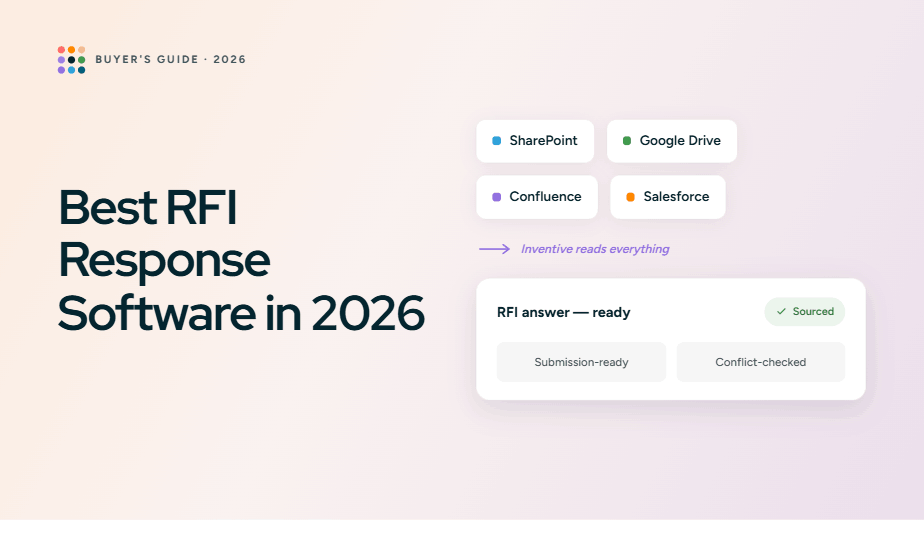
Most RFI responses don't lose deals because the product is wrong. They lose because teams still write responses manually, tracking down answers, digging through old documents, and reformatting 200-row spreadsheets against a deadline, and that produces responses that are slow, inconsistent, or contradict an earlier bid.
The right RFI software fixes this. It connects to your knowledge base, attributes every answer to a verified source, and catches conflicting information before it reaches an evaluator. This guide covers the 7 best tools in 2026 and how to evaluate them before you commit.
Most RFI response tools are built around a content library: the AI responds to incoming questions to pre-approved answers. If a buyer asks something outside that library, the platform can't help and manual writing takes over.
TL;DR
- Inventive AI: A fully autonomous AI agent platform that automates the entire RFI response, delivering 2x higher-quality answers, built-in conflict detection, zero hallucinations, active content governance, and an easy-to-use interface for every contributor.
- Loopio: If your team already runs on an established content library, Loopio's section-based assignment and freshness indicators keep it organized and reviewable. What it won't do is answer outside that library or catch two entries that contradict each other.
- Responsive: Complex approval chains are where Responsive earns its keep, with multi-gate workflows and a Trust Score attached to every answer. That score tells you how closely a response matches stored content, not whether the content itself is still correct.
- SiftHub: Because it pulls live CRM and deal context into every response, SiftHub works best when an RFI is tied to an active deal. The tradeoff is that response quality rises and falls with how clean that CRM data is.
- AutoRFP: For teams handling repetitive, high-volume RFIs, AutoRFP reuses proven language quickly and reliably. Ask it something more technical or buyer-specific, and the answers can start to feel generic.
- Arphie: Every answer comes with its source and reasoning attached, so reviewers can see exactly why the AI landed where it did, which matters for compliance-heavy RFIs. It stops short of flagging conflicts between source documents.
- Qvidian: Living inside Word with a centralized library and a full audit trail, Qvidian fits regulated enterprises already on Upland. Its output is only as current as the library behind it.
The 7 Best RFI Software Tools in 2026
1. Inventive AI
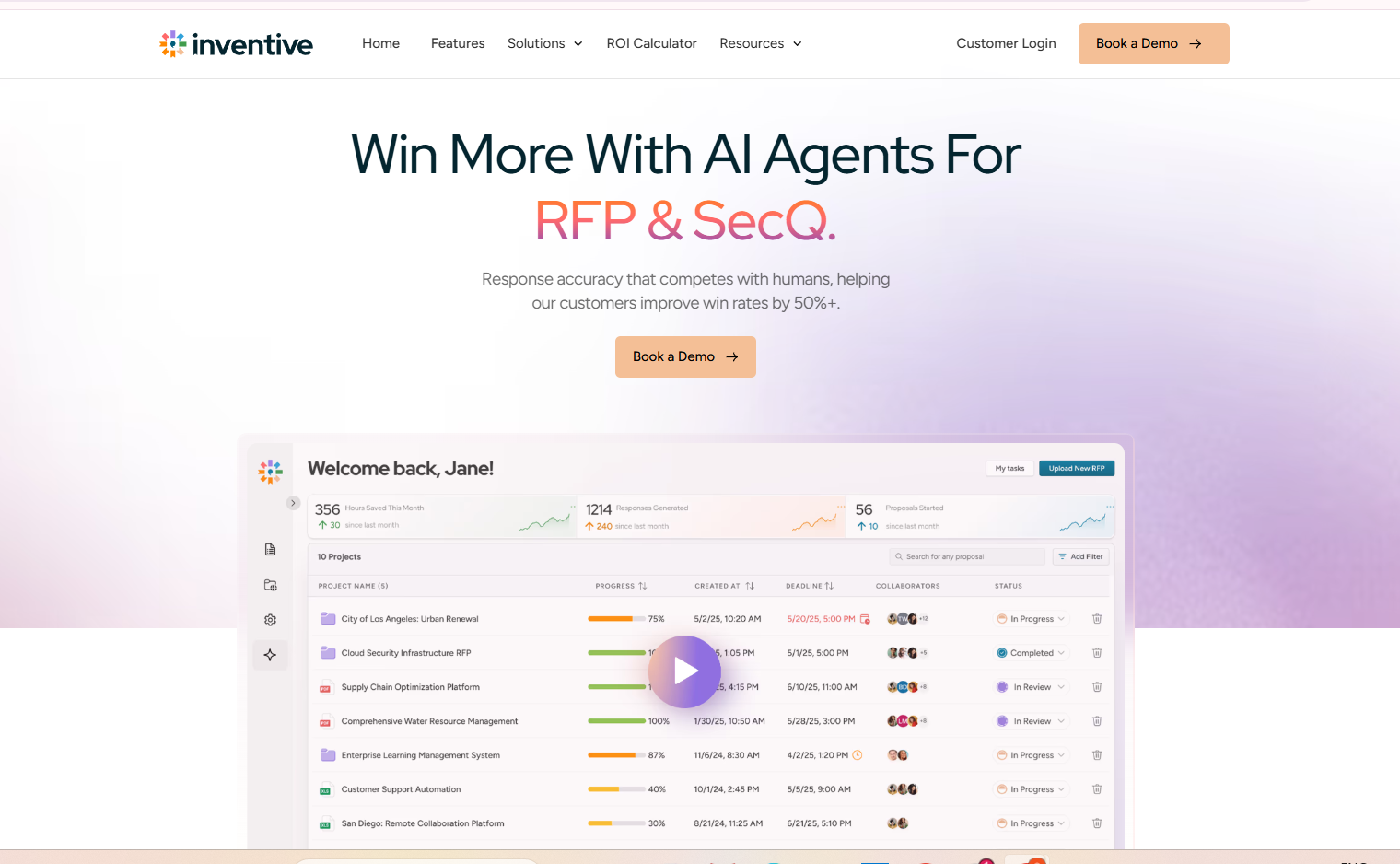
Inventive AI is an AI-agentic platform that helps sales and proposal teams draft, review, and submit RFI responses faster and with fewer errors. It connects to your existing knowledge sources such as SharePoint, Google Drive, Confluence, Notion, Salesforce and uses that live documentation to generate RFI answers. No separate content library to build, no manual file management required.
When an RFI lands, you upload it (Excel, Word, PDF, or portal export) and the platform reads the full questionnaire before writing a single answer. Most tools work question by question, in the order they appear. Inventive AI reads the whole thing first, understands what the buyer is evaluating, and generates answers that stay consistent from the first row to the last.
What RFI teams get out of it
Teams using InventiveAI report first drafts in minutes, not days. The platform reduces the time Proposal Managers spend on setup, particularly for Excel-based RFIs and Portal-based RFIs where section assignment and row population is normally done manually, so that time goes toward reviewing and strengthening the response instead.
Because Inventive reads the full document before writing, responses stay consistent across every section. Terminology, figures, and tone stay aligned regardless of how many contributors are involved. For buyers evaluating multiple vendors simultaneously, a response that reads as one coherent document stands out.
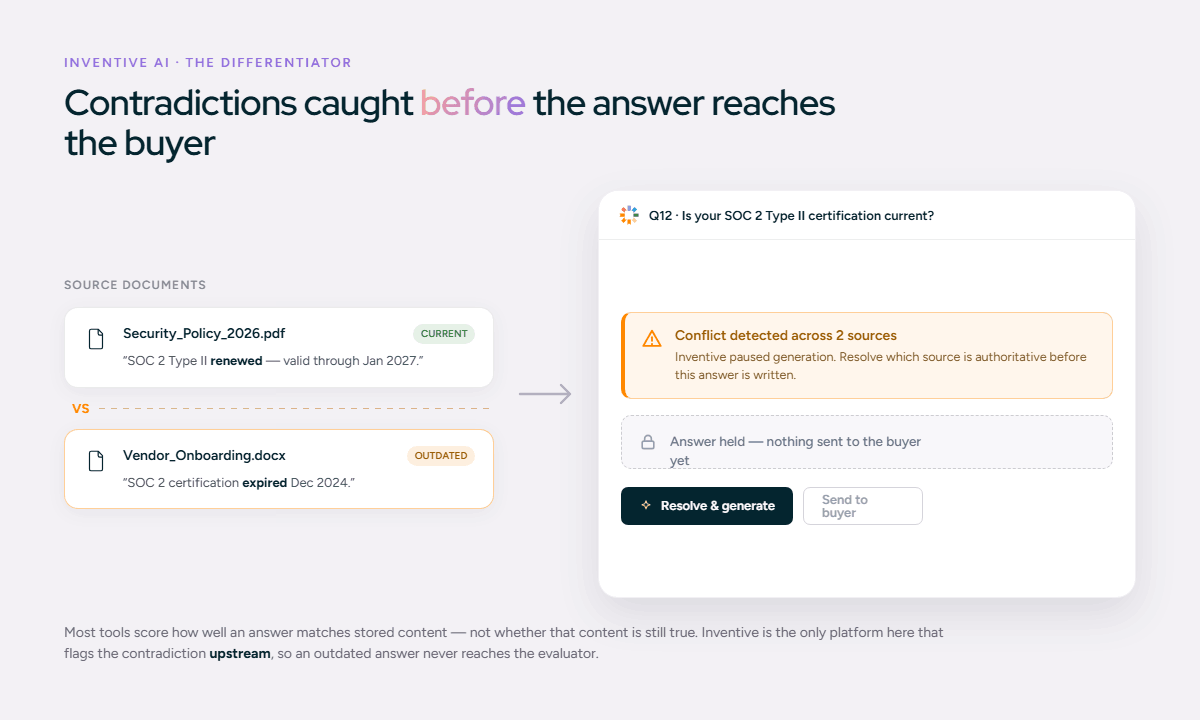
For accuracy, Inventive AI checks for conflicts across your source documents before generating an answer. If two sources disagree on the same topic, it flags the contradiction for your team to resolve. If the information doesn't exist in your sources at all, it marks the answer as unavailable rather than filling the gap with something unverified.
Teams that use Inventive AI for RFI response see win rates improve by up to 50%, driven by 90% faster turnaround, 2x higher response quality, and 66% near to zero editing required.
Where it falls short
In-platform analytics are still developing, detailed reporting on time saved per RFI or win-rate trends needs to be tracked separately. No Jira integration yet, which matters for teams managing RFI workflows inside Jira.
Pricing
Simple & transparent, Usage-based, pricing. Unlimited users & unlimited content at every plan, no seat-based fees, no feature gating.
Customer Review
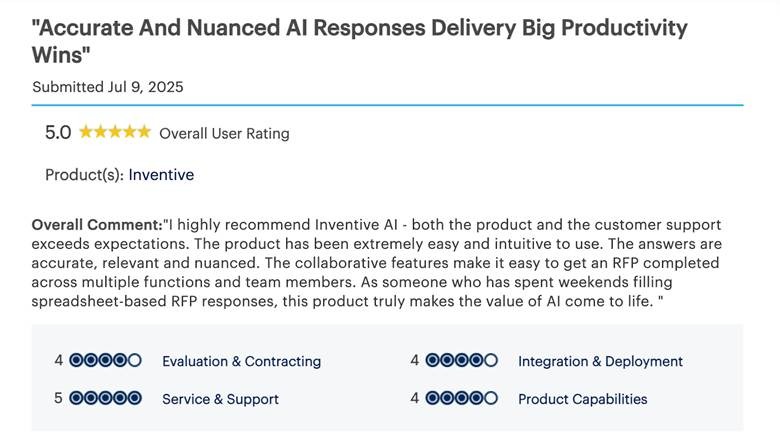
A verified G2 reviewer said the platform is "extremely easy and intuitive to use," with answers that are "accurate, relevant, and nuanced," and pointed out how much better it is than manual, spreadsheet-based RFP work.
Who it's best for
Proposal managers and sales engineers responding to B2B enterprise RFIs who need accurate, consistent, sourced answers without building a content library or spending days on coordination and formatting.
2. Loopio
Loopio is one of the legacy platforms in the RFI response market. It uses a structured answer library with an auto-fill feature that respond to incoming RFI questions to pre-approved content.
For RFI teams specifically, it supports section-based assignment so different contributors can own different parts of the questionnaire simultaneously. Freshness indicators flag answers that haven't been reviewed recently, giving reviewers a way to prioritize verification before submission.
Limitations
When buyers ask questions outside the stored library, the platform doesn't generate answers from broader documentation, manual writing takes over. There's no conflict detection across stored answers.
Pricing
Contact for pricing. Foundations, Enhanced, and Enterprise tiers.
Customer Review
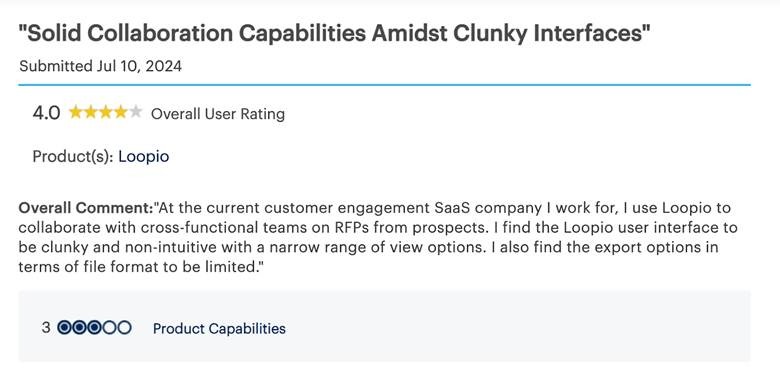
A verified G2 reviewer said Loopio works well for cross-functional collaboration on RFPs. But they also said the interface is "clunky and non-intuitive," with a narrow range of view options and limited export formats.
Who it's best for
RFI teams that respond to similar questionnaires at volume and have the capacity to maintain a content library.
Also Read: Loopio vs Inventive AI: Better RFP Software?
3. Responsive (formerly RFPIO)
Responsive has been in the response management market for nearly a decade as a legacy platform. For RFI teams, it assigns a Trust Score (0–100) to every AI-generated answer based on library match strength, on a long questionnaire, that signal helps reviewers focus on lower-confidence responses rather than checking everything equally.
Multi-gate approval routing, SME assignment by section, and a pre-export quality check that flags missing responses and sensitive data are all built into the platform. It integrates with Salesforce, Slack, and Microsoft Teams.
Limitations
The Trust Score measures how closely an AI-generated answer respond to what's stored in the library, not whether that stored content is still accurate. An answer written 18 months ago can score 95/100 if it matches the library entry, even if the underlying information has since changed. There's no automated flag for stale content, so the review burden still sits with the Proposal Manager. Before moving to any decision, you can check out Responsive alternatives for a detailed platform comparison.
Pricing
Lite edition starts at $5,000/year for 5 users. Emerging, Growth, and Enterprise tiers available through the sales team.
Customer Review
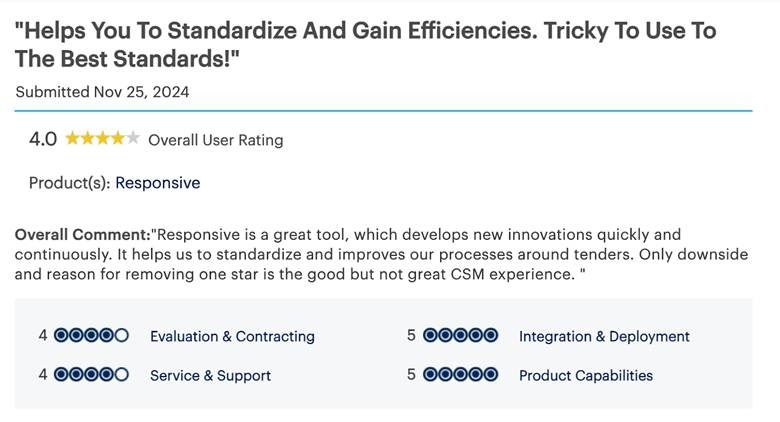
A verified G2 reviewer said Responsive helps standardize and improve their tender process. But they also said the CSM (customer success manager) experience was only "good, not great."
Who it's best for
Large enterprise teams managing RFIs with multi-departmental approval requirements and an existing Salesforce setup.
Also Read: Why AI-Native RFP Software is Replacing Legacy Tools Like Responsive and Loopio
4. SiftHub
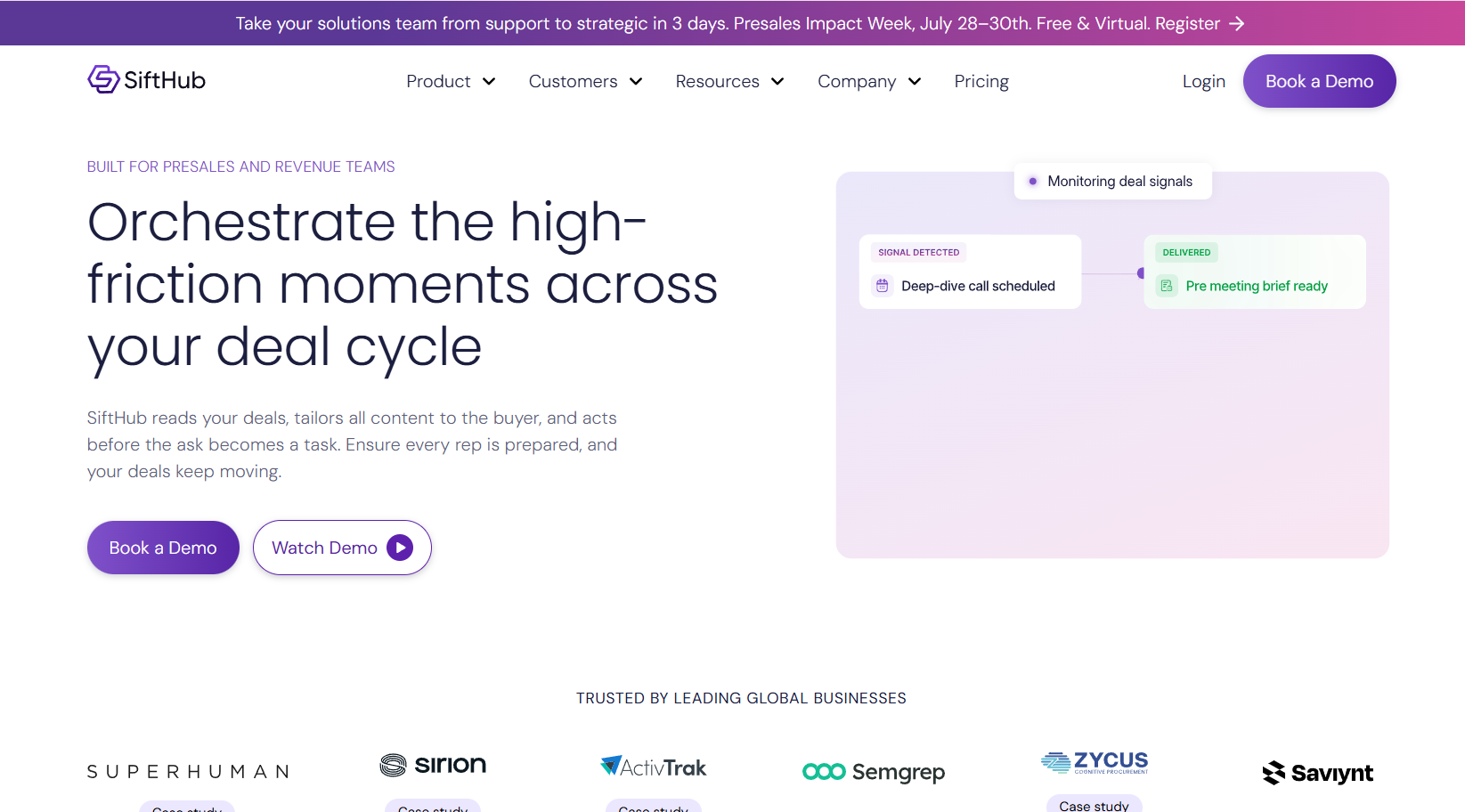
SiftHub is a presales enablement platform that pulls CRM data into the RFI response process. When an RFI comes in, the platform surfaces deal context like buyer details, deal stage, prior interactions, alongside the team's documentation to generate answers. It handles RFI intake across Word, Excel, and procurement portals via browser extension, and tracks contributor assignments so Proposal Managers can monitor progress without manual follow-ups.
Limitations
SiftHub is built primarily for presales workflows, which means its RFI capabilities are tied to how well your CRM data is structured and maintained. If deal data is incomplete or inconsistently updated, the buyer-specific context it generates will reflect those gaps. Response quality still depends on what's stored in the team's documentation, with no conflict detection when sources disagree. The platform is relatively new, with limited independent review data with 1 Gartner review which makes it harder to assess how it performs at scale or across complex, multi-section RFIs. .
Pricing
Contact for pricing. Tailored by team size and use case.
Customer Review
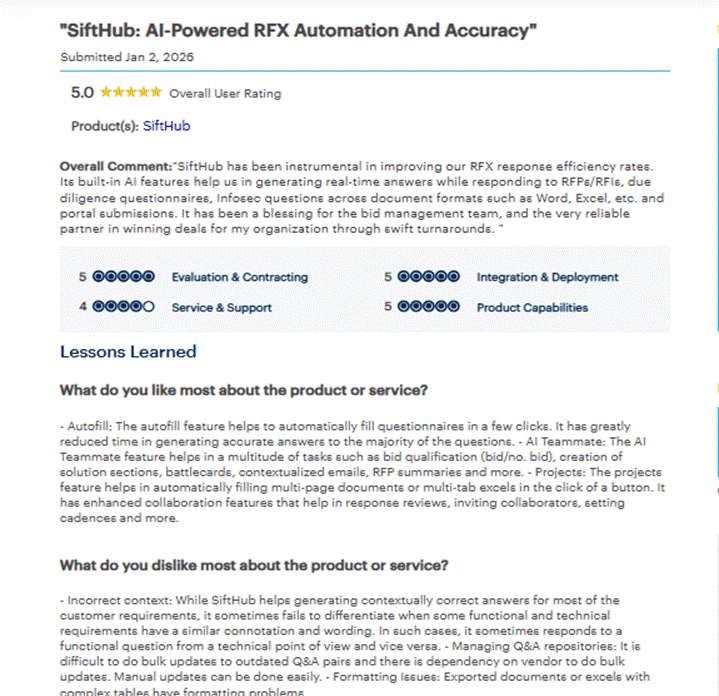
A verified G2 reviewer said the Autofill, AI Teammate, and Projects features cut their response time significantly. But they also said it sometimes answers a technical question from a functional angle, or the reverse, when the wording is similar, and flagged formatting issues on exported Excel files with complex tables.
Who it's best for
Presales teams where RFI responses are tied to an active deal and need to reflect buyer-specific context.
Also read: Top 10 SiftHub Competitors and Alternatives for RFP Management
5. AutoRFP
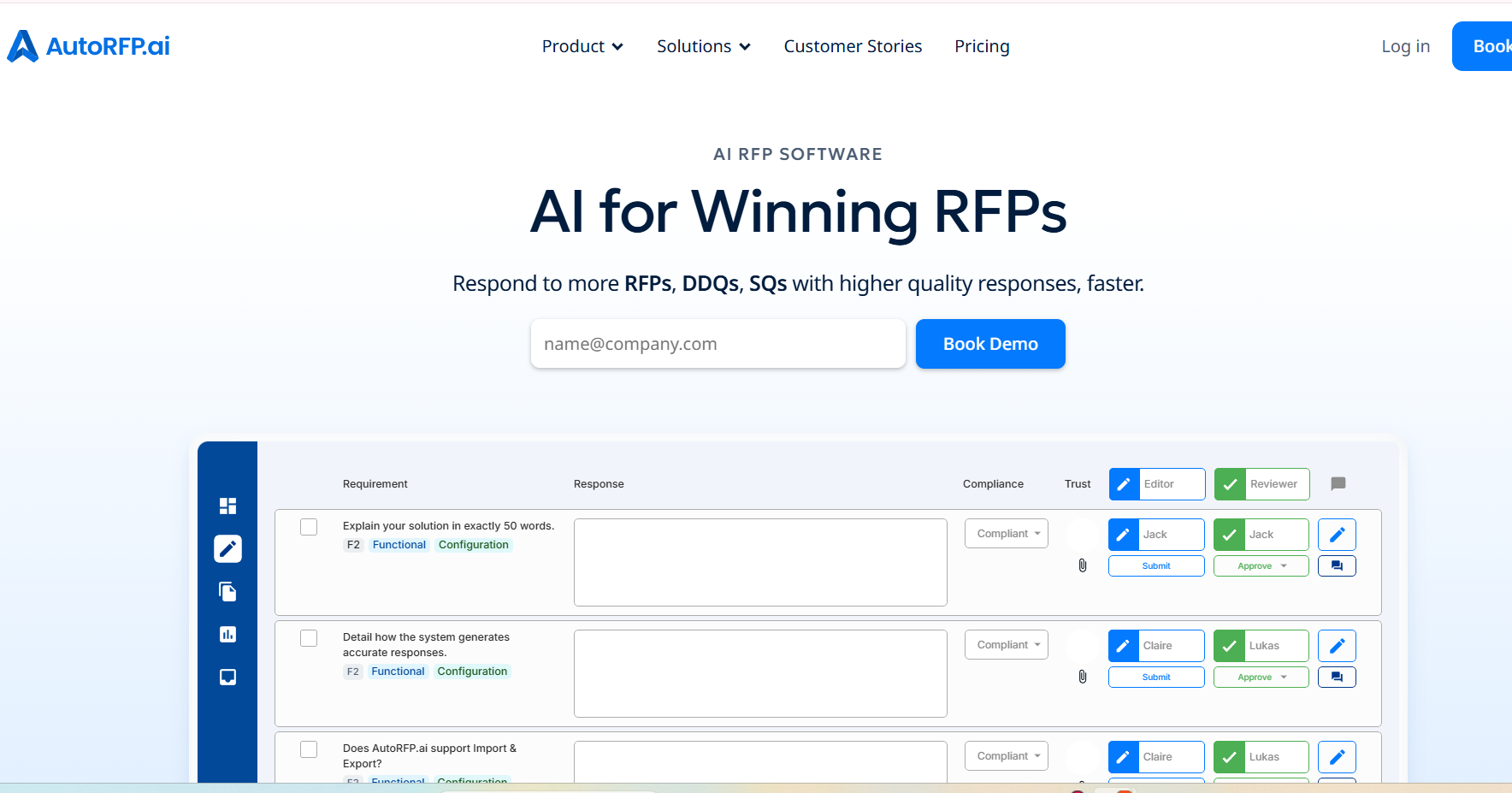
AutoRFP generates first draft responses from a content library built from past approved submissions and uploaded documents. It accepts RFIs in Word, Excel, PDF, and web portal formats, and exports the completed response back in the buyer's original file.
Each answer is assigned a Trust Score that signals how closely the AI's source material matched the requirement, a useful signal for reviewers working through a long questionnaire.
Limitations
AutoRFP works best on repetitive, reusable RFIs. On technically complex or buyer-specific questions, answers tend to run generic. Compliance tagging is automated but surface level, it confirms a response was provided, not whether it actually answers what was asked.
The interface is a real friction point. G2 reviewers call it janky and hard to use, and reorganizing a questionnaire mid-review slows you down when you've got fifty answers to get through before a deadline. Users also lose their place between sessions, so you waste a few minutes just finding where you left off before you can start working again.
Customer Review
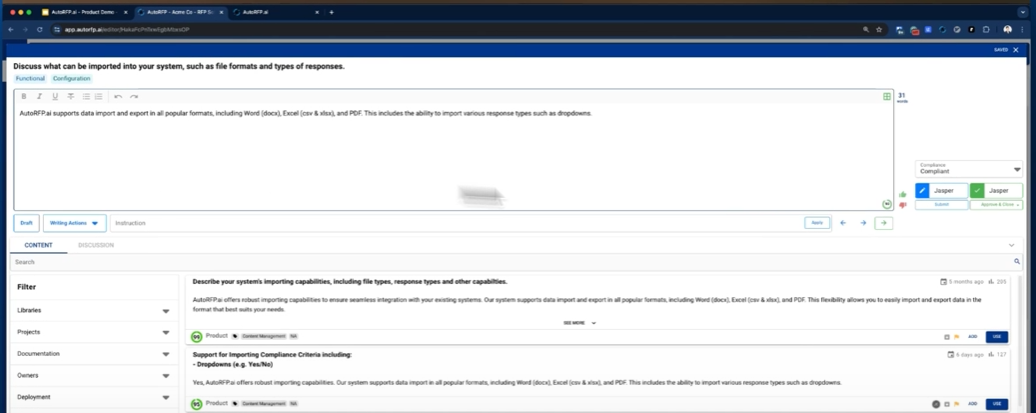
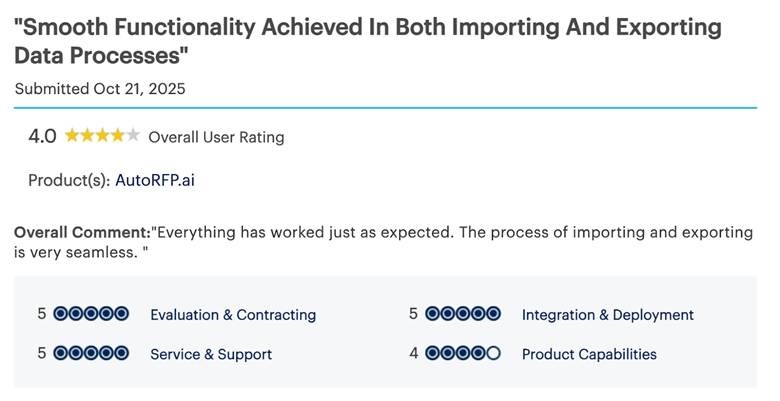
A verified G2 reviewer said the import and export process "worked just as expected" and felt seamless.
Pricing
Scale at $899/month (24 projects/year) and Accelerate at $1,299/month (50 projects/year). Both tiers include unlimited users, SSO, and integrations, no per-seat fees.
Who it's best for
Growing teams that want predictable all-in pricing and fast setup for RFI response without building a content library.
Also read: Top AutoRFP AI Alternatives & Competitors For 2026
6. Arphie
Arphie is an RFI response platform built around reviewer visibility. Each generated answer includes the source it drew from and the reasoning path the AI followed, so reviewers can verify the basis of an answer before approving it, not just the output itself. Questions are routed to the right internal subject matter experts by topic, and approved answers are stored for reuse across future questionnaires. The platform is lightweight to set up and reaches a first draft without a long onboarding process.
Limitations
No conflict detection between source documents, if two sources disagree, the contradiction reaches the reviewer rather than being flagged upstream. With 5 Gartner reviews, independent data on performance at scale is limited.
Pricing
Contact for pricing.
Customer Review
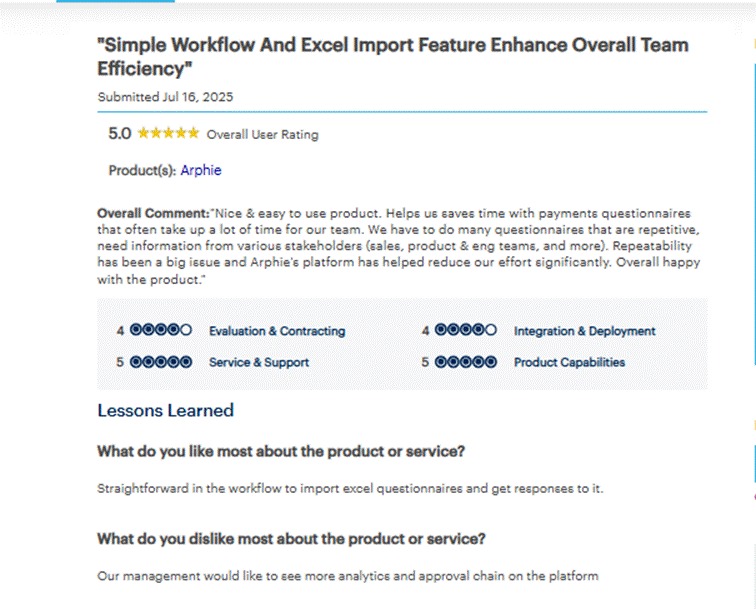
A verified G2 reviewer said the Excel import and response workflow is straightforward for repetitive questionnaires. But they also said their management would like to see better analytics and approval-chain features.
Who it's best for
Teams responding to compliance-heavy RFIs where reviewers need to verify the basis of each answer before approving it.
Also read: Arphie Alternative: Top 9 Competitors for 2026
7. Qvidian (Upland)
Qvidian, part of Upland Software, is built around a Microsoft Word plugin and a centralized content library. For RFI teams, answers are pulled and reviewed directly inside Word, no separate import/export step required during the review cycle.
Every review action is logged with a timestamp: who edited what, who approved it, when. For regulated enterprises where procurement or legal needs to audit the response process after submission, that trail is a practical compliance requirement.
Limitations
The AI layer works on top of the library rather than natively, so response quality is tied to what's stored. There's no automated flagging when stored content goes stale, and keeping the library current becomes its own workstream for teams in fast-moving industries.
Pricing
Contact for pricing.
Customer Review
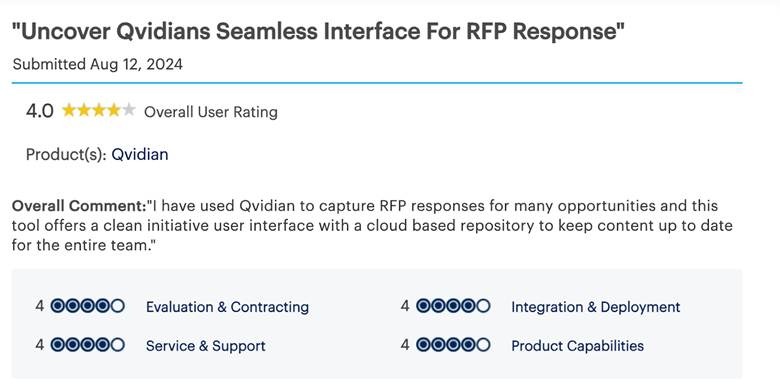
A verified G2 reviewer said the platform has a "clean" interface and a cloud-based repository that keeps content current across the team.
Who it's best for
Large enterprises in regulated industries that need auditable RFI approval workflows and are already within the Upland ecosystem.
Also read: Top 8 Qvidian Alternatives and Competitors in 2026
How to Evaluate RFI Response Software Before You Book a Demo
Most RFI software looks impressive in a demo. The real question is how it performs on your files, your questions, and your team's actual workflow, and that takes more than a vendor walkthrough to find out.
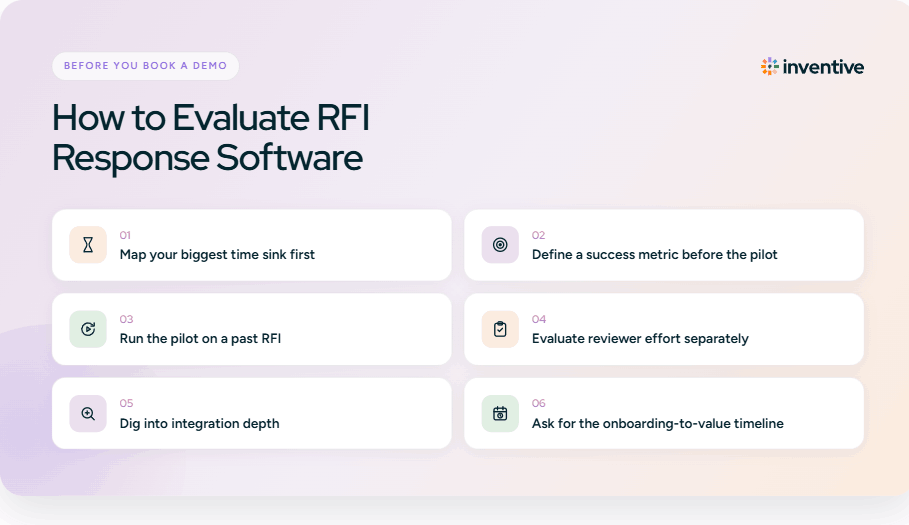
Map your biggest time sink first
Before you look at a single tool, spend 20 minutes auditing where your team actually loses time in an RFI cycle. Is it the first draft? Chasing SMEs for answers? Review cycles? Reformatting the final file? The tool that solves your real bottleneck will deliver more value than the one with the longest feature list. Write down the top two time sinks before your first demo, and use those as the filter for every conversation.
Define a success metric before the pilot
Most teams go into a trial without a clear benchmark. Decide upfront what success looks like: is it hours saved per RFI? First-draft approval rate? Turnaround time? Pick one metric, measure where you are today, and evaluate every tool against that number during the trial. It makes the final decision objective rather than impressionistic.
Run the pilot on a past RFI
Pick an RFI you submitted in the last 60 days, one where you know exactly what the right answer looks like. Run the tool against it, then sit your submitted response next to the AI draft and score it question by question. Where does the AI nail it? Where does it go generic or pull the wrong source? Those gaps tell you more about real-world accuracy than any vendor demo ever will, because vendors always run demos on clean, pre-loaded data that's nothing like your actual knowledge base.
Evaluate reviewer effort separately
The draft is only half the product. Count how many clicks and screens it takes one reviewer to check, comment on, and approve 50 answers. A tool that generates a strong first draft but buries the review workflow in a clunky interface will cost your team more time than it saves. Pay attention to how fast an experienced reviewer can move through the queue.
Dig into integration depth
A tool that "integrates with Salesforce" could mean anything from pulling a contact name to syncing full account history. During the demo, ask the vendor to show you exactly what data flows in, how frequently it syncs, and whether it requires a manual trigger. The integrations that matter are the ones that remove a step your team currently does by hand.
Ask for the onboarding-to-value timeline
Some tools go live in 48 hours; others take three months to reach full coverage. Ask the vendor specifically: at what point in onboarding do teams typically see their first meaningful time saving? What does the library need to contain before the AI draft quality becomes usable? That answer tells you how long you're committing to a ramp period before the tool actually pays off.
Also Read: 7-Step Buying Guide for AI-Driven RFP Software

The Right RFI Software Help you Win the Deals Faster
Choosing RFI response software is not just a productivity decision. The tool your team uses shapes the quality of every response you send, and that quality has a direct effect on whether buyers move forward with you or go with someone else.
The tools in this list take different approaches. Some are built around a content library that gets smarter the more you use it. Others connect to your CRM so answers reflect the specific buyer you're talking to. Some are built for teams with complex approval chains. And some, like Inventive AI, are built for teams where accuracy and consistency across the full questionnaire is non-negotiable.
The right one depends on where your process currently breaks down. If you're not sure, go back to the evaluation framework above, start with one real RFI and measure what actually changes.
More Reads
- 15 Best RFP Software Tools in 2026: Which to Use?
- How to Use AI for RFP Responses to Win More Deals in 2026
- How to Automate RFP Responses for Faster, Accurate Proposals in 2026
FAQs
Can the same tool handle RFIs, RFPs, and DDQs or do I need separate software?
Most platforms in this list handle all three. The workflow is similar across formats, import, generate, review, export. The difference is depth: some tools treat RFIs as secondary to RFPs. Before buying, run a sample from each format you actually respond to. Don't rely on the format the vendor demos first.
How long does implementation take before the tool is actually useful?
Library-based tools like Loopio and Responsive require you to build and populate a content library before the AI generates useful drafts, that process typically takes 4–12 weeks. AI-native platforms that connect directly to your documentation are generating drafts within days because there's no library to build first.
What happens to my content library if I switch tools?
Most platforms export stored Q&A pairs as CSV or Excel, but the formatting rarely transfers cleanly. Plan for a manual cleanup phase. If you're switching to a platform that reads live documentation directly, the migration is simpler, your documentation is already where it needs to be.
Does AI-generated RFI content create any legal or compliance risk?
Two areas to check: data privacy and content accuracy. Confirm the vendor doesn't use your content to train its AI, and verify data residency meets your requirements. On accuracy, AI answers referencing outdated certifications or incorrect product details create downstream liability, which is why source attribution and conflict detection matter before responses reach the buyer.
How do I calculate ROI on RFI response software?
Take your average hours per RFI, multiply by monthly RFI volume, and apply your team's hourly cost. That's your baseline. After 60 days on the new tool, measure the same numbers. Also track first-draft acceptance rate, how much the AI output changes before submission. Win rate on RFI-attached deals is harder to attribute cleanly, but it's the number that justifies the budget.
Can RFI software submit directly into procurement portals like SAP Ariba?
Some can do via browser extension. Inventive AI or AutoRFP both support direct portal submission, the extension populates form fields rather than requiring copy-paste. Not every platform supports every portal, so confirm compatibility with the specific systems your buyers use before starting a trial.
How do I get internal SMEs to actually use the review workflow?
The platforms with the highest SME participation are the ones where reviewing is fast. If a contributor has to navigate multiple screens to approve a straightforward answer, they disengage quickly. During your pilot, time how long it takes a first-time SME to review and approve 10 answers with zero training. That number predicts adoption better than any feature walkthrough.

.avif)