Call Center Outsourcing RFP Template + Response Format

Call center outsourcing RFPs sit at the center of vendor selection. They force companies to define service scope, performance expectations, and operational requirements before engaging providers.
For buyers, the RFP clarifies priorities such as SLAs, staffing models, and integration needs. For vendors, it determines whether the opportunity aligns with capacity, expertise, and delivery model.
When structure is missing, both sides lose clarity. Buyers struggle to compare proposals consistently, and vendors respond with assumptions instead of precision. A disciplined RFP framework reduces that early-stage friction.
To streamline your call center outsourcing RFP process, this blog provides structured templates for both issuing teams and responding vendors.
Call Center Outsourcing RFP Template For Performance-Driven Proposals
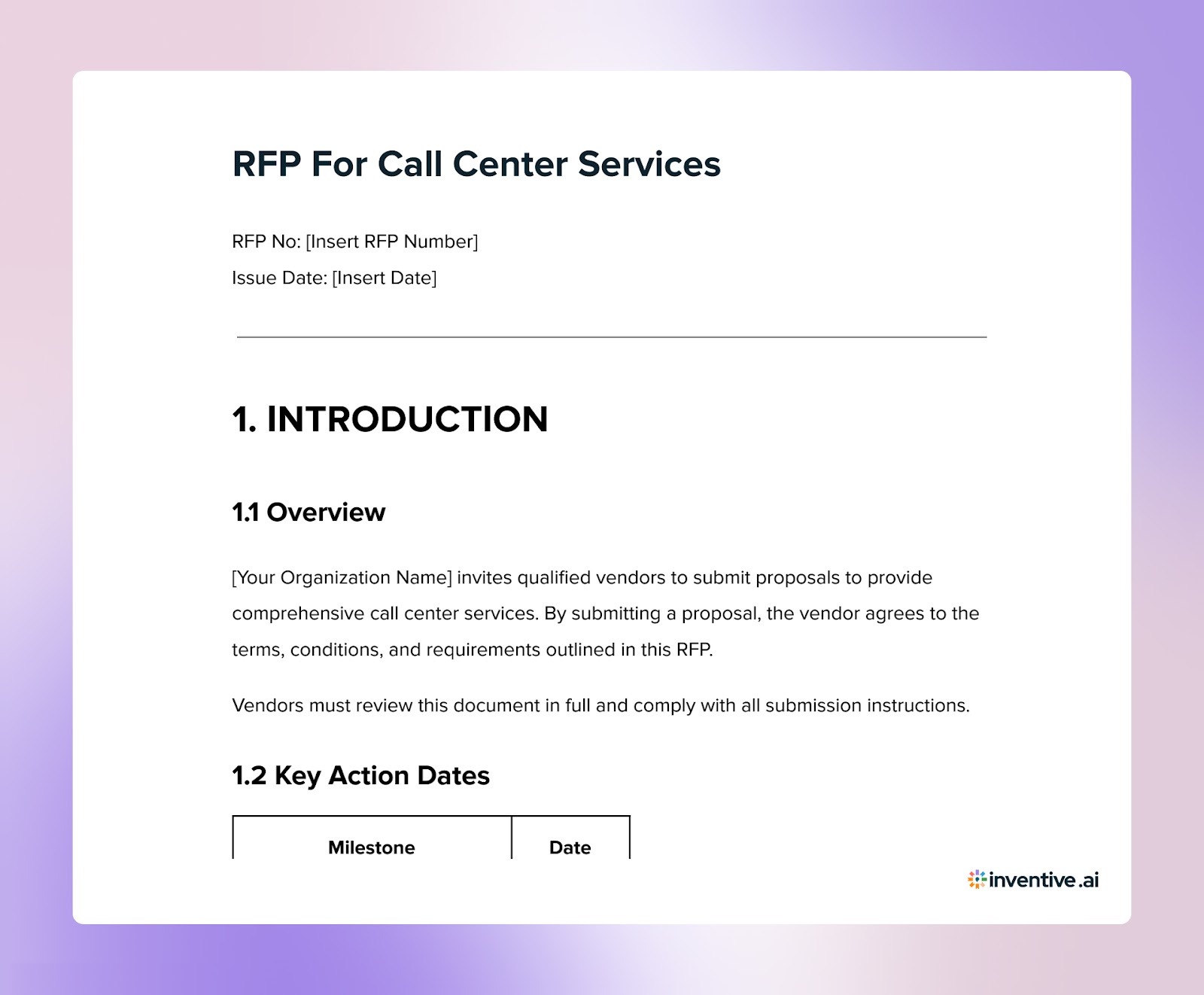
Your call center outsourcing RFP should document the service, performance, and integration requirements that directly impact your customer experience, staffing model, and pricing structure.
Below is the structure senior teams use when issuing a call center outsourcing RFP.

1. Service Scope And Interaction Model
Organize requirements by how your customers actually contact your business so vendors respond to real workflows rather than generic capability statements.
Include:
- Inbound support categories relevant to your customers (account support, order management, billing inquiries)
- Outbound programs tied to your revenue model (sales, renewals, collections)
- Technical support tiers required for your product or service
- Multilingual coverage aligned with your market footprint
- Channel mix across voice, chat, email, and social
- Define the complexity level of each interaction type within your operation.
2. Interaction Volume And Channel Profile
Provide your historical interaction data so pricing and workforce modeling reflect your real demand pattern.
Include:
- Average monthly interaction volume by channel
- Peak period variance within your business cycle
- Intraday distribution patterns
- Average handle time by interaction category
- Escalation percentage across support tiers
- Require vendors to base staffing assumptions on the volumes your business supplies.
3. Performance Standards And SLA Framework
Define the service thresholds your leadership expects from the outsourcing partner.
Include:
- Target average handle time for your program
- First call resolution benchmark
- Abandonment rate limit
- Service level requirement (for example, 80/20)
- CSAT or NPS targets used internally
- Request documented historical SLA performance for programs similar to yours.
4. Technology And Integration Environment
Document the systems your call center must operate within.
Include:
- Your CRM platform
- Your ticketing or helpdesk system
- Your dialer and routing infrastructure
- Your knowledge base tools
- Your analytics and reporting environment
- Require vendors to outline how they will integrate into your existing stack.
5. Workforce Model And Operational Governance
Define the delivery standards required to protect service continuity in your business.
Include:
- Agent qualification standards aligned with your customer expectations
- Training duration and certification requirements
- Supervisor-to-agent ratios
- Attrition reporting
- Quality monitoring structure
- Request clarity on escalation structure and executive reporting cadence.
6. Data Security And Compliance Controls
Specify the customer data protection standards your organization requires.
Include:
- Data handling policies
- Access control structure
- Encryption standards
- Audit and monitoring processes
- Regulatory requirements specific to your industry
- Require vendors to document certifications and incident response protocols.
7. Commercial Structure
Define how you expect financial proposals to be structured for clean comparison.
Include:
- Per-seat pricing
- Per-minute or per-interaction pricing
- Volume-based pricing adjustments
- Transition and setup fees
- Contract flexibility terms
- Require vendors to state pricing assumptions tied directly to your volume data.
8. Vendor Qualifications
Request evidence that aligns with the scale and complexity of your program.
Include:
- Industry experience relevant to your market
- Case studies with measurable outcomes
- Client references
- Delivery center locations
- Business continuity framework
- This ensures proposals reflect capability aligned with your operational requirements.
If you are responding to a call center outsourcing RFP, use the vendor template below to position your capabilities clearly and competitively.
Structured Call Center RFP Response Templates to Win Deals
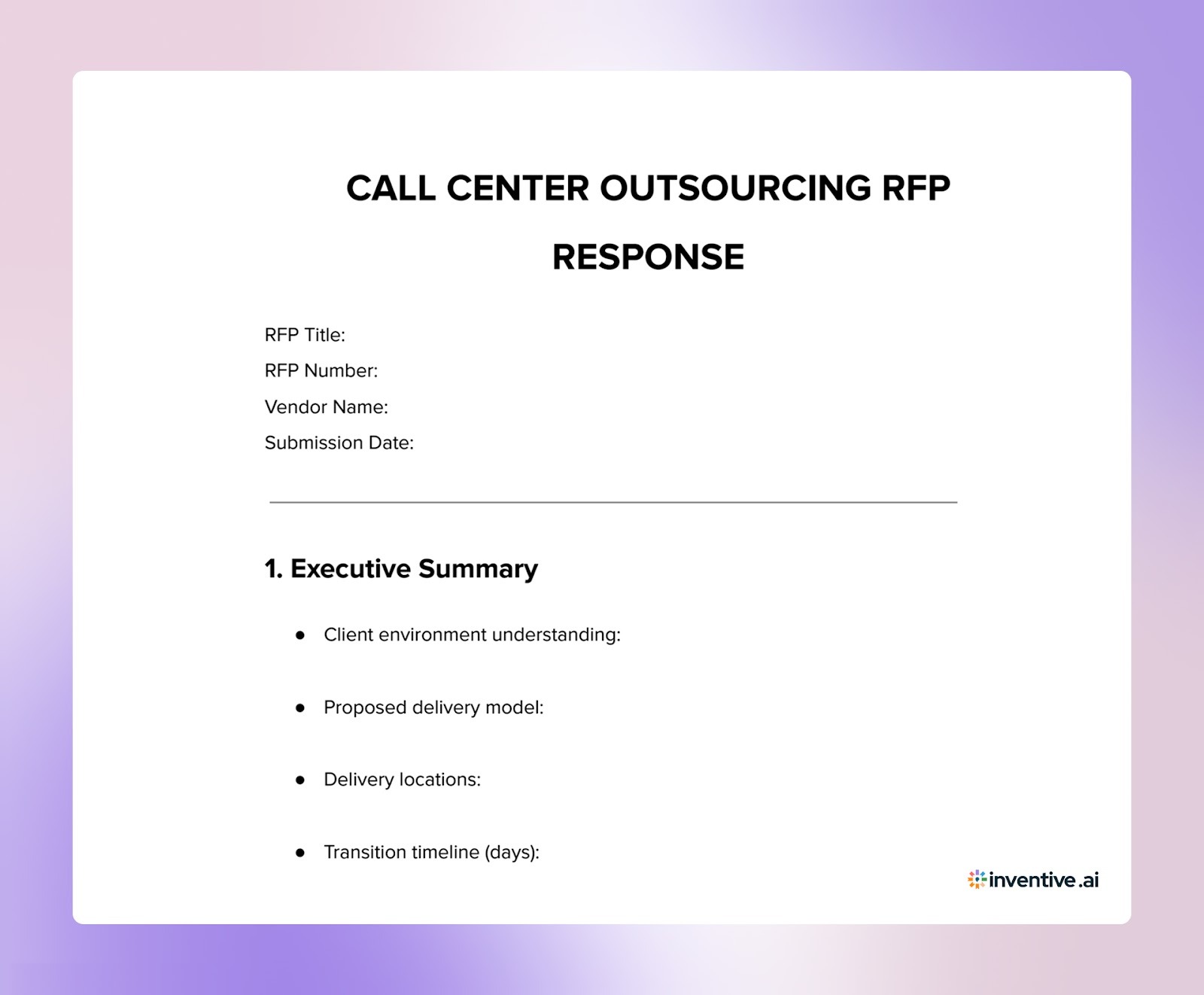
If you are responding to a call center outsourcing RFP, your submission must do more than confirm capability. It must translate your delivery model into commercial clarity, operational confidence, and measurable performance history.
The structure below helps you present staffing logic, SLA performance, governance maturity, and pricing transparency in a way that executive buyers can evaluate quickly.

1. Executive Summary
Open with a clear positioning statement tailored to the buyer’s operating scale and objectives. State your understanding of their service environment, volume profile, and performance expectations.
Include:
- Program understanding
- Proposed delivery footprint
- Transition timeline
- Differentiators relevant to the RFP
Example Response Excerpt:
“We propose a dual-site delivery model supporting 850 peak FTE across voice and digital channels. Our transition plan phases recruitment, knowledge transfer, and systems integration over 90 days, aligned to your July launch timeline.”
2. Service Delivery Model
Describe how you will operate the program on a daily basis. Buyers want clarity on structure, not general capability.
Include:
- Site locations
- Shift coverage
- Escalation tiers
- Channel specialization
- Supervisor ratios
Example Questions You May Be Asked:
- How will you structure Tier 1 and Tier 2 support?
- What is your supervisor-to-agent ratio?
- How do you manage blended voice and chat teams?
Example Response Excerpt:
“Tier 1 handles general account inquiries and billing questions. Tier 2 manages technical escalations and compliance-sensitive cases. Supervisor ratio is 1:12 during steady-state operations.”
3. Workforce Planning And Scalability
Demonstrate how staffing aligns with the provided volume data.
Include:
- Workforce planning methodology
- Shrinkage assumptions
- Attrition rates
- Peak ramp strategy
- Training duration
Example Response Excerpt:
“Based on average daily volume of 6,200 calls and 7.1-minute handle time, we project 312 productive FTE. Shrinkage is modeled at 28%, including training, PTO, and quality calibration time.”
4. Performance Management Framework
Connect your QA model to the buyer’s SLA targets.
Include:
- SLA tracking tools
- QA monitoring frequency
- Calibration process
- Executive reporting cadence
Example Questions You May Be Asked:
- Provide historical SLA performance.
- How do you improve first call resolution?
- How are SLA breaches escalated?
Example Response Excerpt:
“Across comparable healthcare programs, we maintained 92% service level compliance and 87% first call resolution over the past 12 months. Executive dashboards are delivered weekly, with monthly performance reviews.”
5. Technology And Integration Approach
Show how your systems integrate into the buyer’s environment.
Include:
- CRM integration experience
- Data exchange methodology
- Reporting dashboards
- Security controls
Example Response Excerpt:
“Our platform integrates via REST API with Salesforce and ServiceNow. Real-time performance dashboards are accessible through a secure client portal with role-based access controls.”
6. Governance And Account Management
Clarify how the relationship will be managed beyond daily operations.
Include:
- Account leadership structure
- Executive review cadence
- Escalation pathways
- Continuous improvement process
Example Response Excerpt:
“A dedicated Account Director oversees the program. Quarterly executive reviews assess SLA performance, cost efficiency, and improvement roadmap milestones.”
7. Data Security And Compliance
Address regulatory exposure directly.
Include:
- Certifications
- Data access controls
- Encryption standards
- Incident response framework
Example Response Excerpt:
“All data is encrypted in transit and at rest. Access is role-based and audited. Incident response protocols include 24-hour notification and documented remediation procedures.”
8. Commercial Structure
Provide pricing clarity tied to assumptions.
Include:
- Pricing model (per seat, per minute, hybrid)
- Volume assumptions
- Ramp-up costs
- Contract flexibility
Example Response Excerpt:
“Pricing is structured per productive hour with seasonal volume bands. Assumptions are based on the provided monthly average and 38% seasonal variance.”
Increase Call Center RFP Win Rates With Inventive AI
Call center outsourcing RFPs require vendors to align staffing logic, SLA history, governance maturity, and pricing assumptions into one coherent narrative. Most teams assemble responses from past proposals, scattered documents, and manual edits. That approach increases inconsistencies, outdated content risk, and executive review cycles.
Inventive AI restructures how call center RFP responses are created. Instead of copying and stitching content, teams generate context-aligned, conflict-checked, executive-ready submissions that improve shortlist probability and reduce revision loops.
Key capabilities:
Context-Aware Response Generation
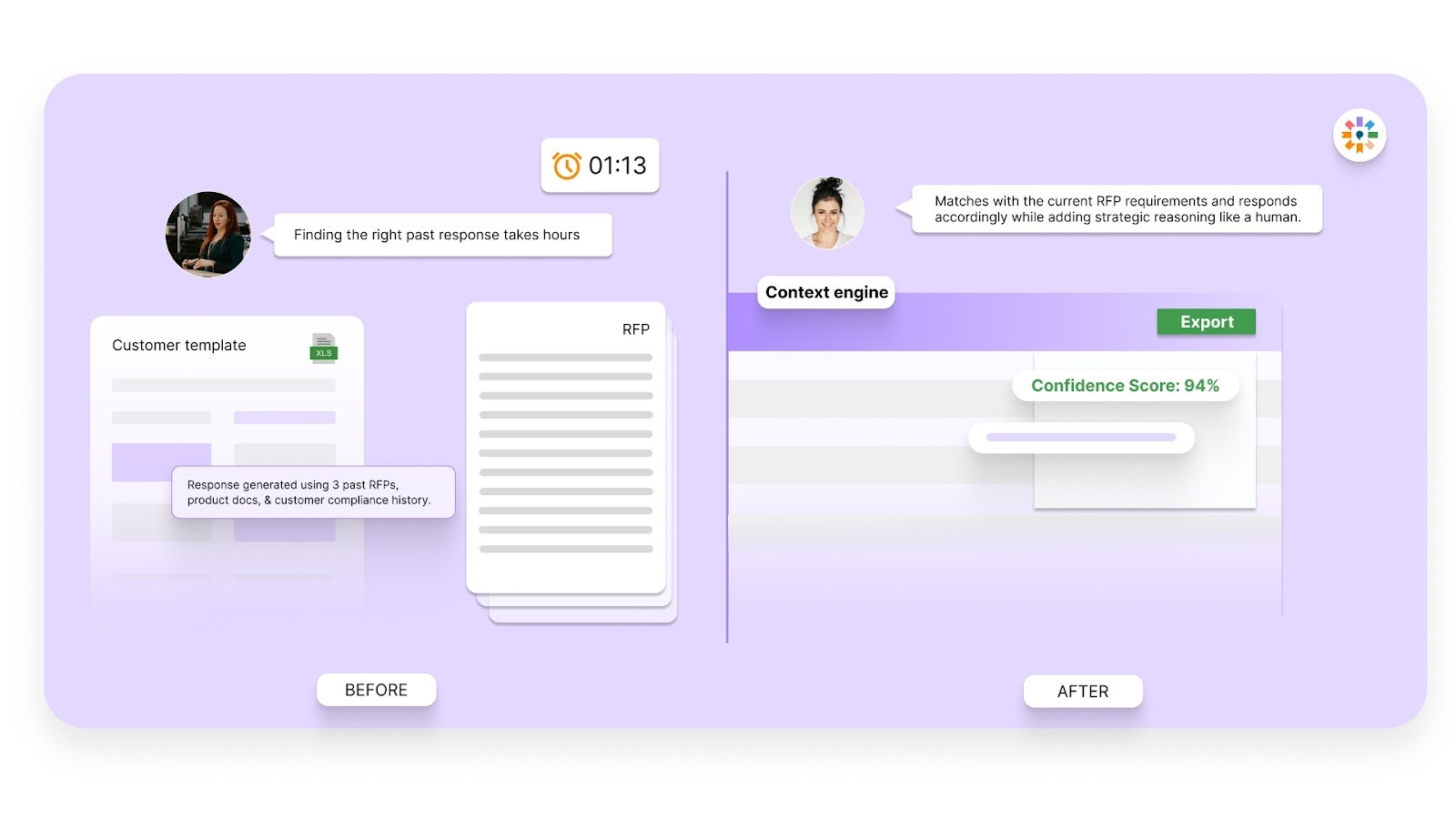
Inventive AI understands the full RFP context, including scope, volume assumptions, KPIs, and pricing logic. Responses align to buyer intent and operational detail rather than generic boilerplate.
For call center RFPs, this means staffing models, SLA commitments, and commercial assumptions stay aligned across all sections.
Conflict Detection
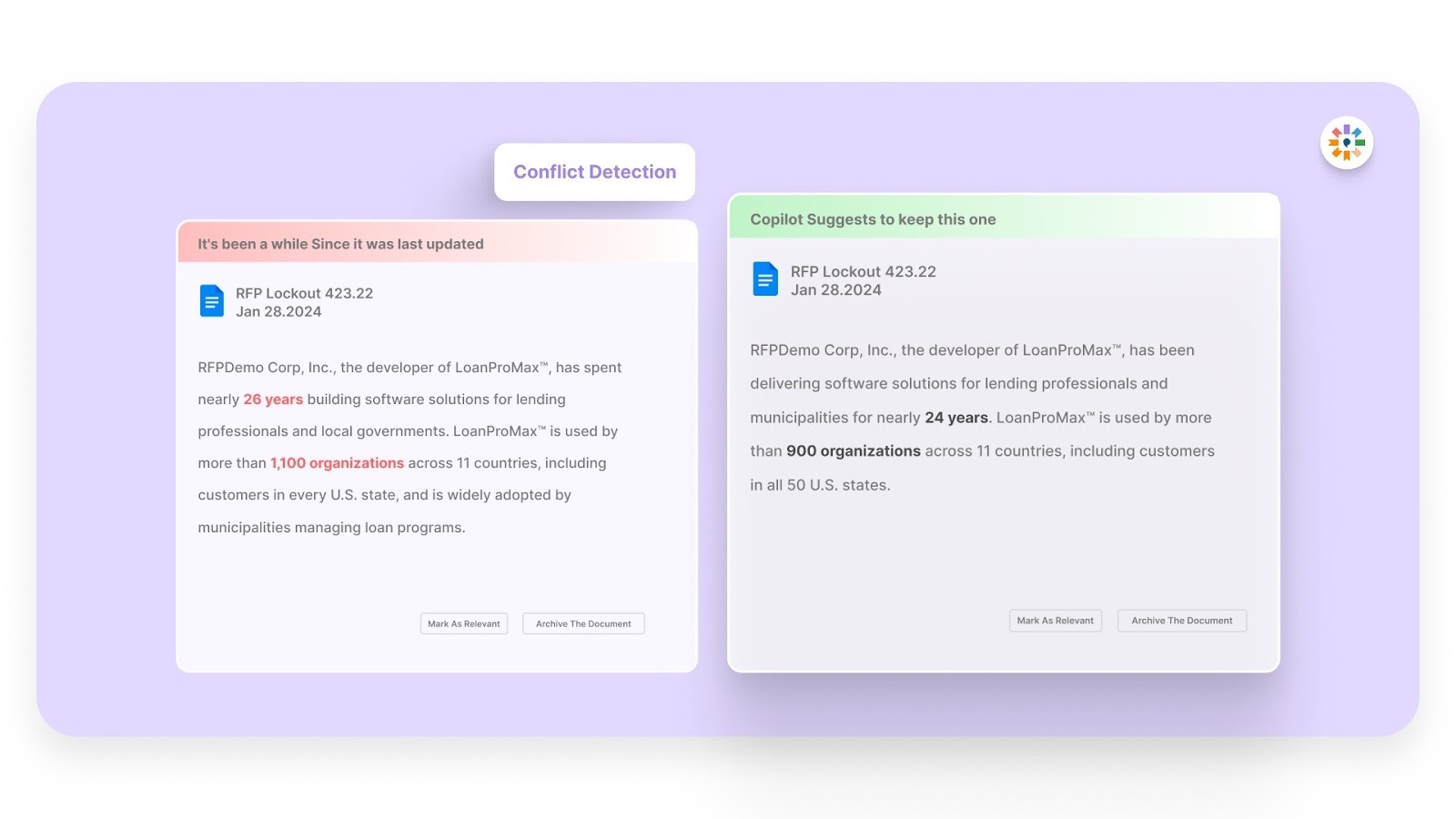
The system identifies contradictions across executive summaries, pricing models, and security responses before submission.
If service level targets differ between sections or volume assumptions conflict with FTE calculations, issues are surfaced prior to delivery.
Outdated Content Detection
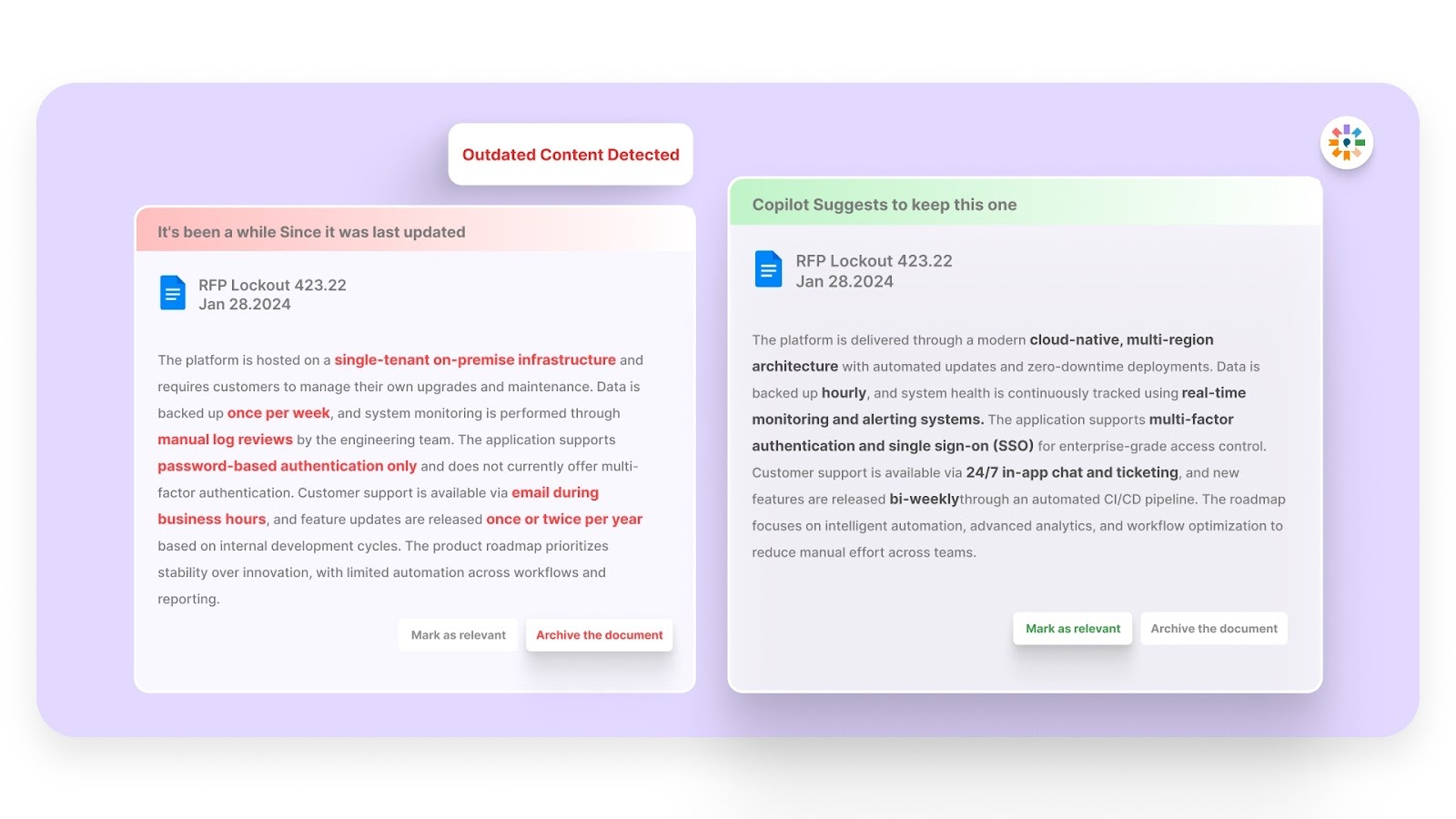
Inventive AI flags expired certifications, outdated case studies, and legacy performance metrics before reuse.
This prevents submission of obsolete security credentials, incorrect SLA history, or outdated delivery footprints.
2x Better Response Quality
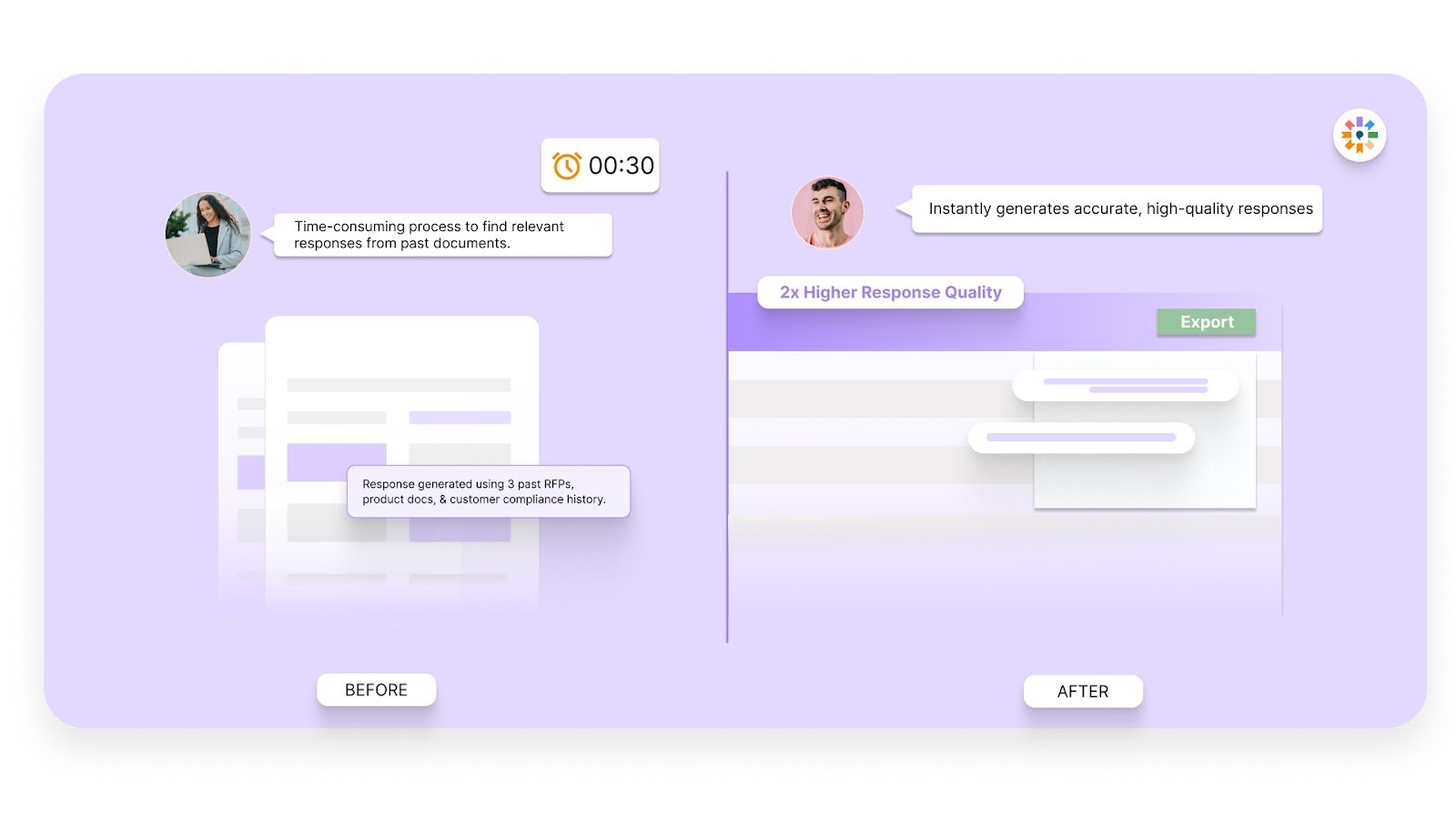
Multi-agent AI produces clearer, more structured, and more complete RFP responses with stronger logical flow.
Call center proposals reflect aligned staffing models, consistent SLA metrics, and an executive-ready structure across all sections.
Simple, High-Adoption Interface
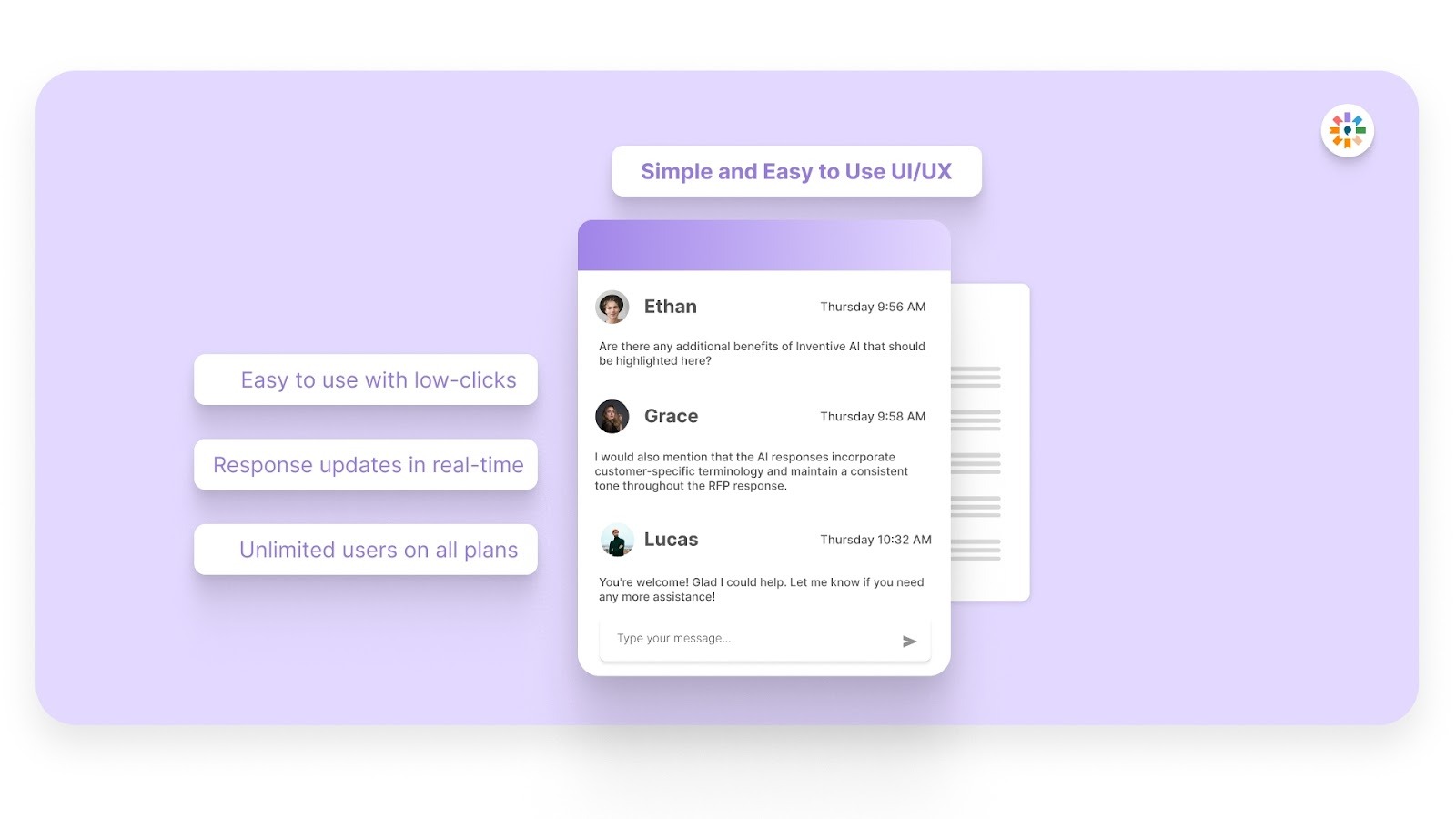
The platform supports daily use across sales, presales, operations, and proposal teams.
Teams can generate, review, and finalize call center RFP responses without disrupting existing workflows.
Narrative Proposal Generation
Inventive AI generates executive-ready business cases, transition plans, ROI narratives, implementation roadmaps, and security documentation.
This supports enterprise outsourcing cycles in which leadership requires structured justification beyond operational details.
FAQs About Call Center Outsourcing RFP Template
1. How Can Vendors Improve Their Call Center RFP Response Quality?
Improvement requires consistent staffing logic, aligned SLA data, a clear governance structure, and transparent pricing assumptions across all sections of the response.
2. What Common Mistakes Reduce Call Center RFP Shortlist Rates?
Common issues include conflicting volume assumptions, inconsistent SLA metrics, outdated case studies, and unclear escalation structures.
3. How Long Does It Typically Take To Prepare A Call Center RFP Response?
Preparation time varies based on complexity and customization, but enterprise-level outsourcing responses often require coordination across sales, operations, finance, and compliance teams.
4. Should Call Center RFP Responses Include Detailed Staffing Calculations?
Yes. Executive reviewers evaluate staffing credibility based on volume data, handle time assumptions, shrinkage modeling, and peak planning logic.
5. What Makes A Call Center RFP Response Stand Out To Enterprise Buyers?
Clear alignment between scope, workforce model, SLA history, governance structure, and pricing assumptions improves executive confidence and shortlist probability.