Compliance Management RFP Template + 6 Industry Response Examples

In compliance management, missing a single regulatory requirement is not a minor oversight. It can lead to audit failures, regulatory penalties, or operational risk. That is why compliance software procurement demands far more precision than typical software purchasing.
For buyers, an RFP must clearly define the regulatory frameworks, monitoring capabilities, and reporting controls that the platform must support. For vendors, responding successfully means demonstrating compliance with requirements by requirement. Generic proposal language or boilerplate templates rarely provide the level of detail needed for regulatory evaluation.
This guide provides a structured compliance management RFP template for buyers and vendor response formats that help document regulatory coverage in a clear and consistent way.
Compliance RFP Template to Evaluate Software Vendors (for Buyers)
If you are issuing a compliance management RFP, your document must establish clarity around regulatory scope, system capabilities, compliance monitoring features, and evaluation criteria. Compliance RFPs vary depending on industry regulations and risk exposure, but several components remain standard across most procurement processes.
While requirements may differ across industries such as healthcare, financial services, or cybersecurity, the following sections form the foundation of a well-structured compliance software RFP.


Compliance Software RFP Components That Attract Qualified Vendors
Below are the core sections every compliance management RFP should contain.
- Project Overview: Background information about the organization, the compliance program, and the objectives of the procurement initiative.
- Compliance Scope: Regulatory frameworks and compliance areas the software must support, such as financial regulations, privacy laws, or industry standards.
- Compliance Monitoring Requirements: Capabilities for tracking compliance status, policy enforcement, and regulatory adherence.
- Risk Management Capabilities: Features required for identifying, assessing, and monitoring organizational risk.
- Audit and Reporting Features: Reporting dashboards, audit trail capabilities, and compliance documentation required for regulatory reviews.
- Security and Access Controls: Data protection standards, user permissions, and system security requirements.
- Integration Requirements: Expected integrations with internal systems such as ERP platforms, HR systems, or security monitoring tools.
- Vendor Qualifications: Required certifications, experience in regulatory environments, and past compliance software implementations.
- Pricing Structure: Expected pricing format and cost breakdown requirements.
- Evaluation Criteria: How proposals will be assessed, including regulatory coverage, product capabilities, vendor experience, and pricing.
- Submission Guidelines: Required documentation, response format, and proposal submission instructions.
If you are responding to a compliance software RFP, structuring your response correctly helps procurement teams evaluate regulatory coverage, technical capabilities, and vendor qualifications consistently.
The following sections outline common formats used by vendors when responding to compliance management RFPs.
6 Specialized Compliance RFP Response Templates to Handle Industry Requirements (for Vendors)
When responding to a compliance management RFP, vendors must tailor their proposals to the regulatory frameworks relevant to the buyer’s industry. The templates below outline common compliance RFP response structures used across different regulated sectors.
1. Responses Template for Financial Services Compliance RFP

Financial institutions operate under strict regulatory oversight across areas such as internal controls, risk reporting, and transaction monitoring. Compliance RFPs in this sector typically focus on capabilities for managing regulatory frameworks, documenting control effectiveness, and maintaining audit-ready evidence across complex financial systems.
Vendors responding to financial compliance RFPs must demonstrate how their platform supports regulatory monitoring, automated control validation, and audit documentation. Responses should clearly explain how the system tracks regulatory obligations, manages compliance workflows, and generates reports used by internal auditors and regulators.

2. Response Template For Healthcare Compliance Management RFP

Healthcare organizations evaluate compliance platforms primarily for their ability to safeguard patient data and maintain detailed audit records across clinical and administrative systems. RFPs in this industry often prioritize controls around protected health information, data access monitoring, and regulatory reporting required for healthcare compliance programs.
When responding to healthcare compliance RFPs, vendors must focus on how their platform protects sensitive patient information, monitors data access, and supports regulatory audits. Responses should explain how the system maintains audit trails, manages compliance documentation, and integrates with existing healthcare systems handling patient data.

3. Response Template For Cybersecurity Compliance Software RFP
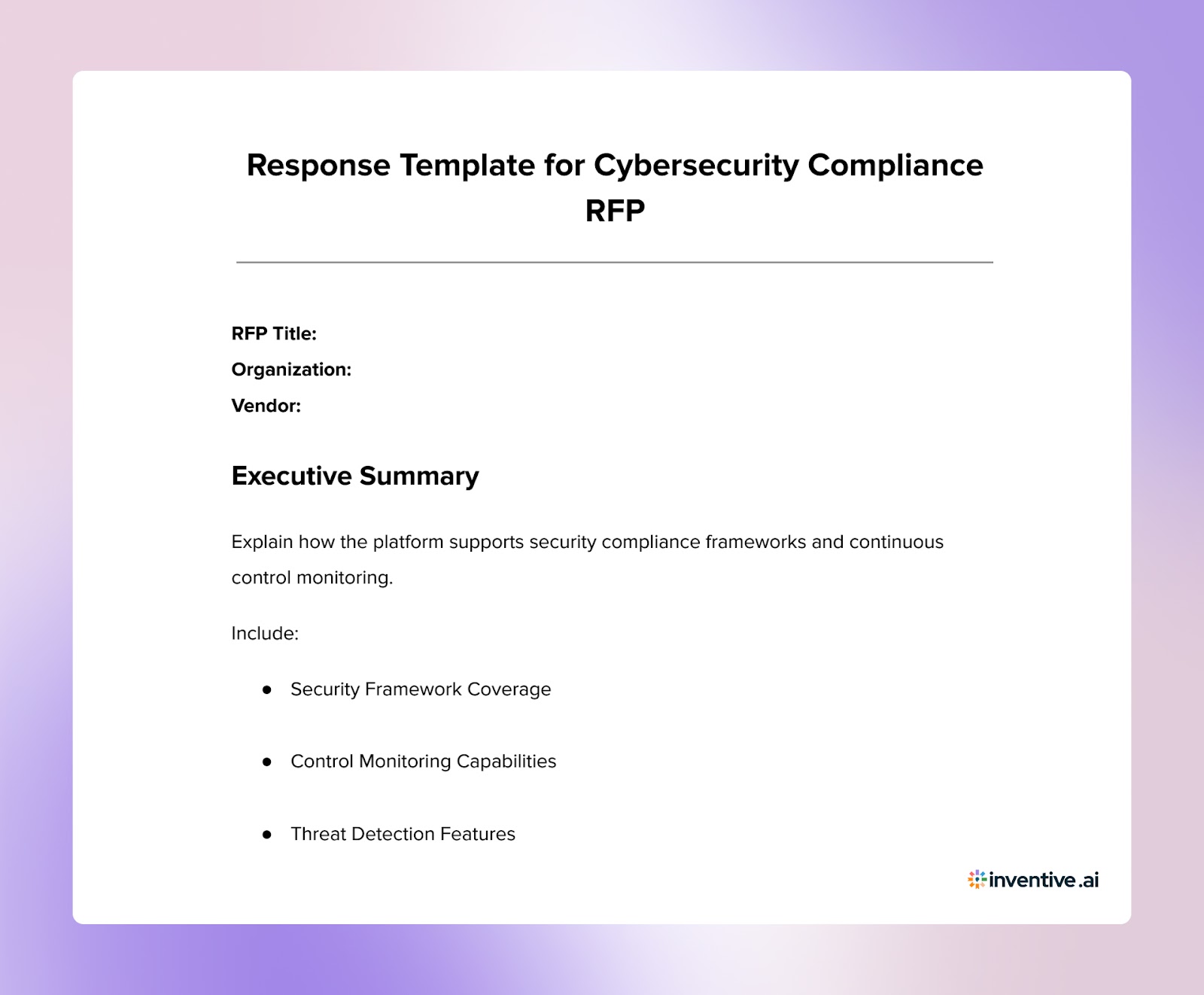
Cybersecurity compliance RFPs typically focus on security control monitoring, system configuration oversight, and incident detection capabilities. Organizations issuing these RFPs want platforms that can continuously monitor infrastructure, track security controls, and generate evidence required for security audits.
Vendors responding to cybersecurity compliance RFPs should focus on how their platform monitors system configurations, detects control failures, and supports security audit preparation. Responses should demonstrate how the system maintains visibility across cloud environments, infrastructure assets, and access control systems.

4. Response Template For Data Privacy Compliance RFP

Organizations handling large volumes of personal data often issue compliance RFPs focused on privacy governance and data protection workflows. These RFPs typically require capabilities for identifying personal data, managing consent records, and documenting regulatory compliance across multiple data systems.
When responding to privacy compliance RFPs, vendors should explain how their platform identifies sensitive data, manages data processing activities, and supports privacy-related reporting requirements. Responses should also demonstrate how the system tracks regulatory obligations and maintains documentation required for privacy audits.

5. Response Template For Government and Public Sector Compliance RFP

Government compliance RFPs often require extensive documentation covering regulatory alignment, security controls, and audit readiness. Public-sector procurement processes also emphasize vendor certifications, reporting transparency, and long-term system reliability.
Vendors responding to government compliance RFPs should focus on demonstrating regulatory expertise, detailed compliance reporting, and the ability to maintain secure operational environments. Responses should clearly document certifications, regulatory alignment, and experience delivering compliance solutions in regulated public-sector environments.

6. Response Template For Enterprise Compliance Management Software RFP

Large enterprises often manage compliance programs across multiple business units, regulatory frameworks, and geographic regions. Compliance RFPs in these organizations typically focus on centralized monitoring, cross-department compliance reporting, and integration with existing governance and risk management systems.
Vendors responding to enterprise compliance RFPs should demonstrate how their platform centralizes regulatory oversight and automates compliance tracking across multiple frameworks. Responses should highlight scalability, system integrations, and reporting capabilities that allow compliance teams to manage regulatory obligations across complex organizations.
Produce Accurate Compliance RFP Responses 10× Faster With Inventive AI
Inventive AI helps proposal teams generate structured compliance RFP responses faster while ensuring accuracy across regulatory documentation. Instead of manually assembling answers from past proposals and internal knowledge bases, teams can generate context-aware responses aligned with the buyer’s compliance requirements.
Below are the key capabilities that improve compliance with RFP responses.
Context Engine

Compliance RFPs frequently contain complex regulatory requirements that vendors must address across multiple sections of the proposal. Inventive AI analyzes the entire RFP document, including regulatory frameworks, technical requirements, and evaluation criteria.
This allows proposal teams to generate responses that directly address the buyer’s documented compliance requirements instead of relying on generic boilerplate language.
Conflict Detection
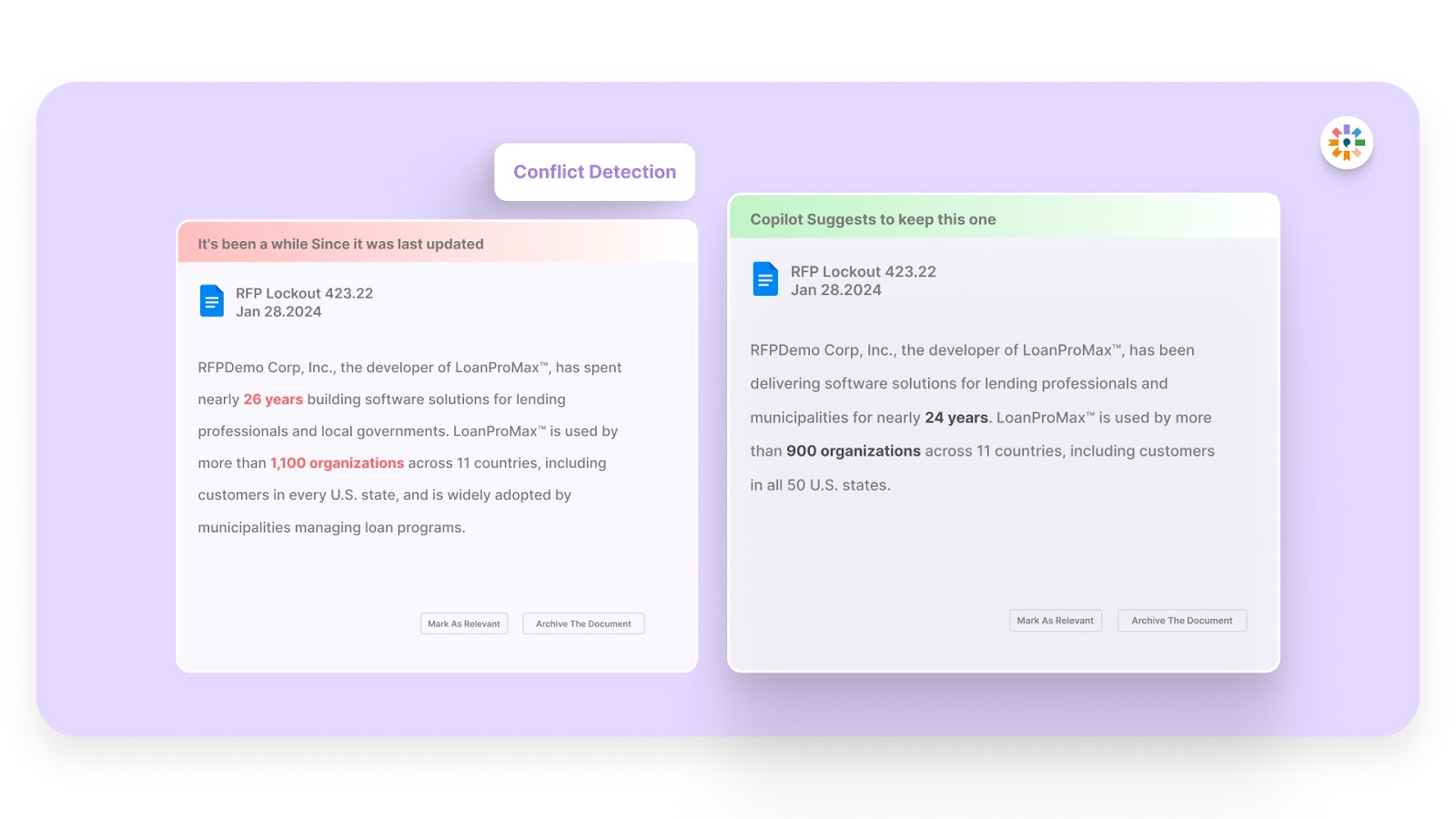
Compliance proposals often reference the same regulatory controls across different sections, such as security architecture, risk monitoring, and audit reporting. When these responses are written manually, contradictions can easily appear between sections.
Inventive AI automatically identifies conflicting statements across the proposal so teams can correct inconsistencies before submission.
Outdated Content Detection

Compliance documentation changes frequently as regulations evolve and certifications are updated. Proposal libraries often contain outdated responses referencing expired certifications or older compliance practices.
Inventive AI scans proposal content and flags outdated information before it appears in the submission, helping vendors maintain accurate regulatory documentation.
2X Higher Quality Responses

Inventive AI’s multi-agent system analyzes buyer requirements and generates responses with greater clarity and completeness. The platform produces structured answers aligned with compliance frameworks, audit requirements, and system capabilities.
This helps vendors produce higher-quality responses that clearly demonstrate regulatory coverage during evaluation.
Narrative Proposal Generation

Compliance RFPs often require detailed narrative responses explaining how a platform supports regulatory monitoring, audit reporting, and risk management workflows.
Inventive AI generates structured narrative responses aligned with buyer requirements, allowing vendors to produce complete proposals without drafting each section manually.
Simple and Easy-to-Use Interface

Proposal teams responding to compliance RFPs often coordinate input from compliance specialists, security teams, product managers, and sales teams.
Inventive AI provides a simple interface that allows teams to generate responses, review content, and refine proposals quickly without complex workflows.
FAQs About Compliance Management RFP Templates
1. What is the difference between a compliance management RFP and a cybersecurity RFP?
A compliance management RFP focuses on regulatory monitoring, audit readiness, and policy enforcement across an organization’s systems. A cybersecurity RFP typically focuses on threat detection, vulnerability management, and infrastructure security. While both may overlap in areas such as access controls and incident monitoring, compliance RFPs prioritize regulatory reporting and control validation.
2. Why do compliance RFPs often include requirement mapping tables?
Compliance RFPs frequently require vendors to map their platform capabilities to regulatory requirements or control frameworks. These tables help procurement teams verify whether a solution supports specific compliance obligations and make it easier to compare vendor responses during the evaluation process.
3. How do buyers evaluate compliance software vendors during an RFP process?
Procurement teams usually evaluate vendors based on several factors, including coverage of the regulatory framework, compliance monitoring capabilities, audit reporting features, system integrations, vendor experience, and total cost of ownership. Many organizations also conduct product demonstrations or proof-of-concept deployments before final vendor selection.
4. What information should vendors prepare before responding to a compliance RFP?
Before responding to a compliance RFP, vendors should gather documentation describing their regulatory framework support, system architecture, security certifications, compliance monitoring features, implementation process, and client references. Having this information prepared helps vendors provide structured responses aligned with the buyer’s evaluation criteria.
5. How long does a typical compliance software RFP process take?
Compliance software RFP processes can range from several weeks to several months depending on the complexity of the organization’s regulatory environment. Highly regulated industries such as finance, healthcare, and government procurement typically require longer evaluation timelines due to extensive compliance and security assessments.



.jpg)