Hiring Proposal Template + 5 Specialized Formats (Free)
.png)
Winning a hiring contract rarely comes down to price alone. It comes down to how clearly, confidently, and strategically you present your recruitment approach on paper.
Yet many staffing firms and recruitment agencies still rely on recycled boilerplate proposals. The same executive summary. The same sourcing paragraph. The same generic “we understand your needs” language. Buyers recognize it immediately. And when proposals sound interchangeable, decisions shift to the lowest bidder.
A strong hiring proposal template changes that dynamic. It gives you structure without sounding scripted. It keeps your messaging consistent without becoming repetitive. And it ensures every proposal communicates strategy, not just process.
To help you avoid boilerplate responses and position your firm more strategically, we’ve created a structured hiring proposal template you can download and customize for your next client bid.
Hiring Proposal Template To Win More Recruitment Contracts (Free Download)
A hiring proposal determines whether a recruitment firm is evaluated on strategy or reduced to a price comparison. Decision-makers review proposals to assess clarity of approach, execution discipline, and commercial transparency. Each component below answers a specific operational or financial question before a staffing agreement is approved.
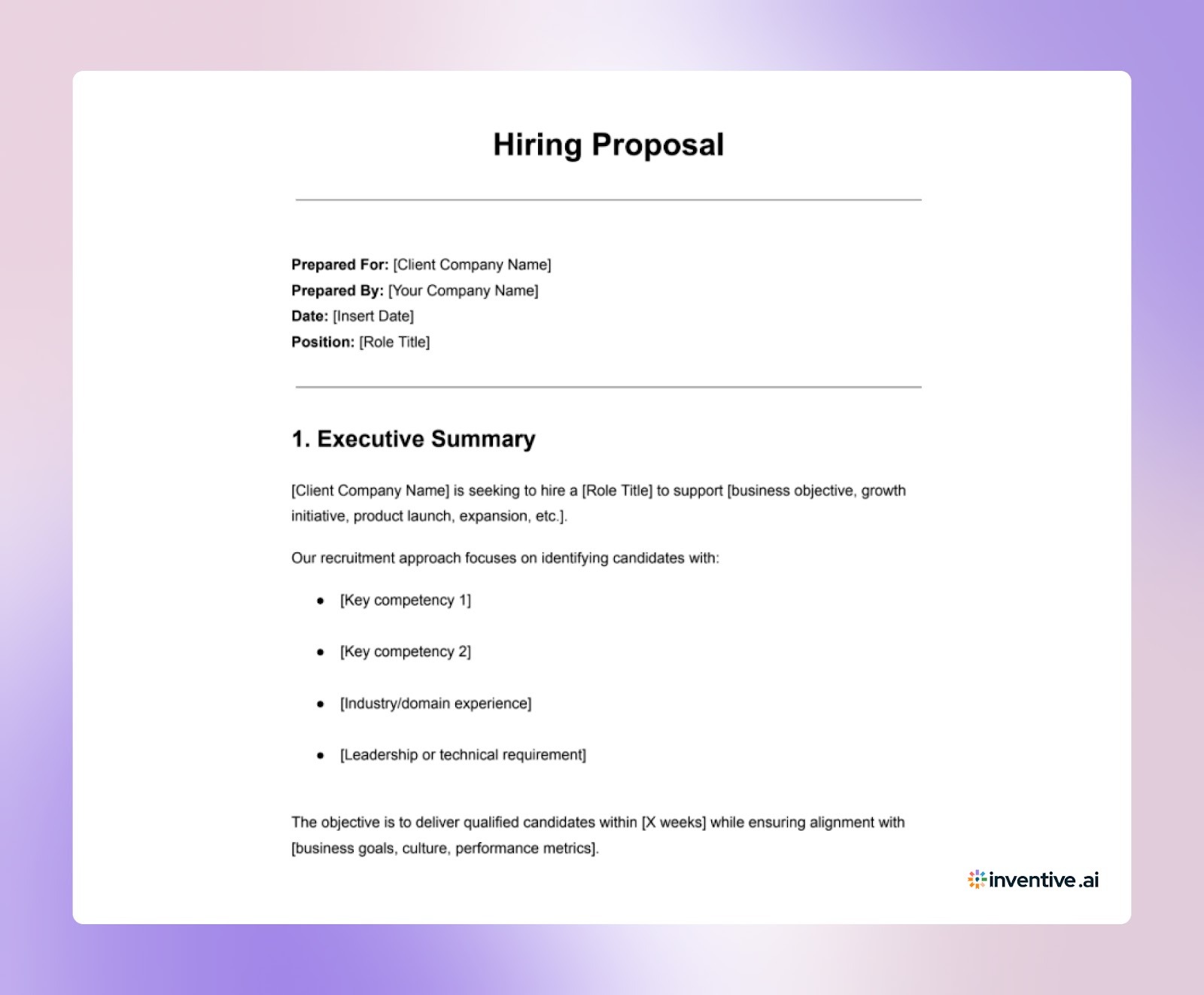

1. Executive Summary
The executive summary establishes why the role matters and how your recruitment approach supports business outcomes. Senior stakeholders often read only this section before forming an initial judgment. If it lacks specificity, the proposal appears generic.
Example: The proposed search for a Senior Data Engineer supports your cloud migration initiative and projected infrastructure cost reduction of 18% this fiscal year. Our approach focuses on identifying candidates who have successfully scaled distributed AWS environments within high-growth SaaS companies.
2. Hiring Context And Role Alignment
Clients expect evidence that you understand their environment, reporting structure, and urgency. When this alignment is missing, proposals feel recycled.
This section should demonstrate awareness of team structure, technical expectations, growth stage, and hiring timeline.
Example: The position reports to the VP of Engineering and requires experience leading cross-functional teams within a Series B SaaS environment. The hiring timeline aligns with a Q3 product release milestone.
3. Recruitment Process And Scope
Decision-makers evaluate operational control before approving recruitment partners. They want to understand how the search will be executed and where responsibilities begin and end.
Clearly defining your recruitment process prevents ambiguity and protects against scope expansion.
Example Scope:
- Market mapping of competitor talent pools and compensation benchmarks
- Targeted candidate sourcing through direct outreach and referral networks
- Structured competency interviews and technical validation
- Offer negotiation support and onboarding coordination
When the process is clearly outlined, clients can assess methodology rather than guess execution quality.
4. Deliverables
Hiring engagements often fail when outputs are undefined. Deliverables convert recruitment activity into measurable progress.
By listing specific outputs, you establish accountability and visibility throughout the search.
Example Deliverables:
- Market intelligence report
- Compensation benchmark summary
- Shortlisted candidate profiles with evaluation notes
- Weekly hiring progress updates
- Final offer documentation support
Concrete deliverables allow stakeholders to track value against fees.
5. Timeline And Milestones
Hiring delays impact product timelines, revenue projections, and team capacity. A defined timeline demonstrates planning discipline and execution control.
Providing stage-based milestones helps clients understand pacing and expected decision windows.
Example Timeline:
- Week 1–2: Market mapping and sourcing activation
- Week 3–4: Screening and shortlist presentation
- Week 5–6: Interview coordination
- Week 7–8: Offer negotiation and closure
A structured timeline reduces uncertainty and sets realistic expectations for both parties.
6. Fee Structure
Pricing clarity prevents negotiation friction and protects margins. Decision-makers evaluate not only the fee percentage but also the structure behind it.
Clearly outline billing model, milestone payments, and guarantees.
Example:
- Contingency model at 20% of the annual base salary.
- Retained search option split across milestone payments.
- 90-day replacement guarantee.
- Additional advisory services are billed separately.
Transparency strengthens commercial credibility.
7. Assumptions And Exclusions
Ambiguity around scope often leads to disputes. Defining assumptions and exclusions establishes boundaries early.
Example:
- Background verification billed separately
- Relocation expenses covered by the client
- Significant role scope changes may affect the timeline or fees
Clear exclusions protect operational efficiency and financial stability.
8. Terms And Conditions
Before approval, stakeholders assess contractual safeguards and ownership terms. This section outlines candidate ownership duration, confidentiality standards, and termination provisions.
Example:
- Candidate ownership is valid for 12 months.
- Two replacement attempts are included under the guarantee.
- Confidential search maintained throughout engagement.
9. Acceptance And Authorization
The proposal should transition seamlessly into formal engagement.
Approved by: ___________________
Date: ___________________
Upon approval, a recruitment services agreement will be issued prior to search commencement.
5 Specialized Hiring Proposal Templates To Close Recruitment Deals Faster
Different hiring situations require different proposal emphasis. While the core framework remains similar, sourcing depth, evaluation rigor, timeline expectations, and fee models change depending on the role and engagement type.
Below are additional templates tailored to common recruitment scenarios. Each template is available in a downloadable format.
1. Contingency Hiring Proposal Template
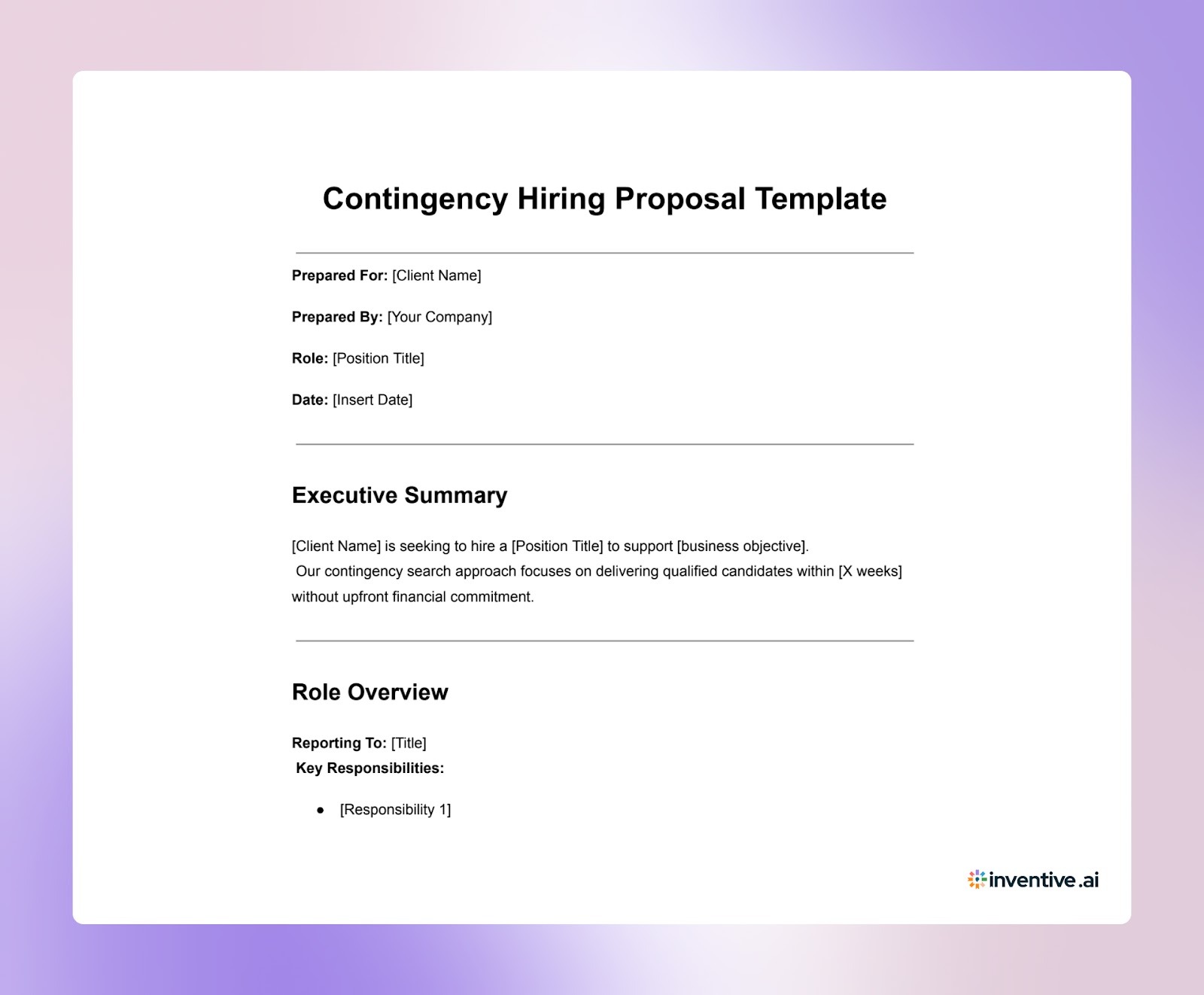
This template works best for companies hiring mid-level professionals where speed and placement success are primary concerns. Clients reviewing contingency proposals want confidence that qualified candidates will be delivered quickly without an upfront financial commitment.
The structure reflects:
- Clear outline of sourcing channels and candidate pipeline strength
- Defined screening and shortlisting process
- Estimated time-to-fill
- Percentage-based success fee
- Replacement guarantee terms
This format suits recruitment firms working on performance-based hiring engagements across technical, operational, and mid-management roles.

2. Executive Search Proposal Template
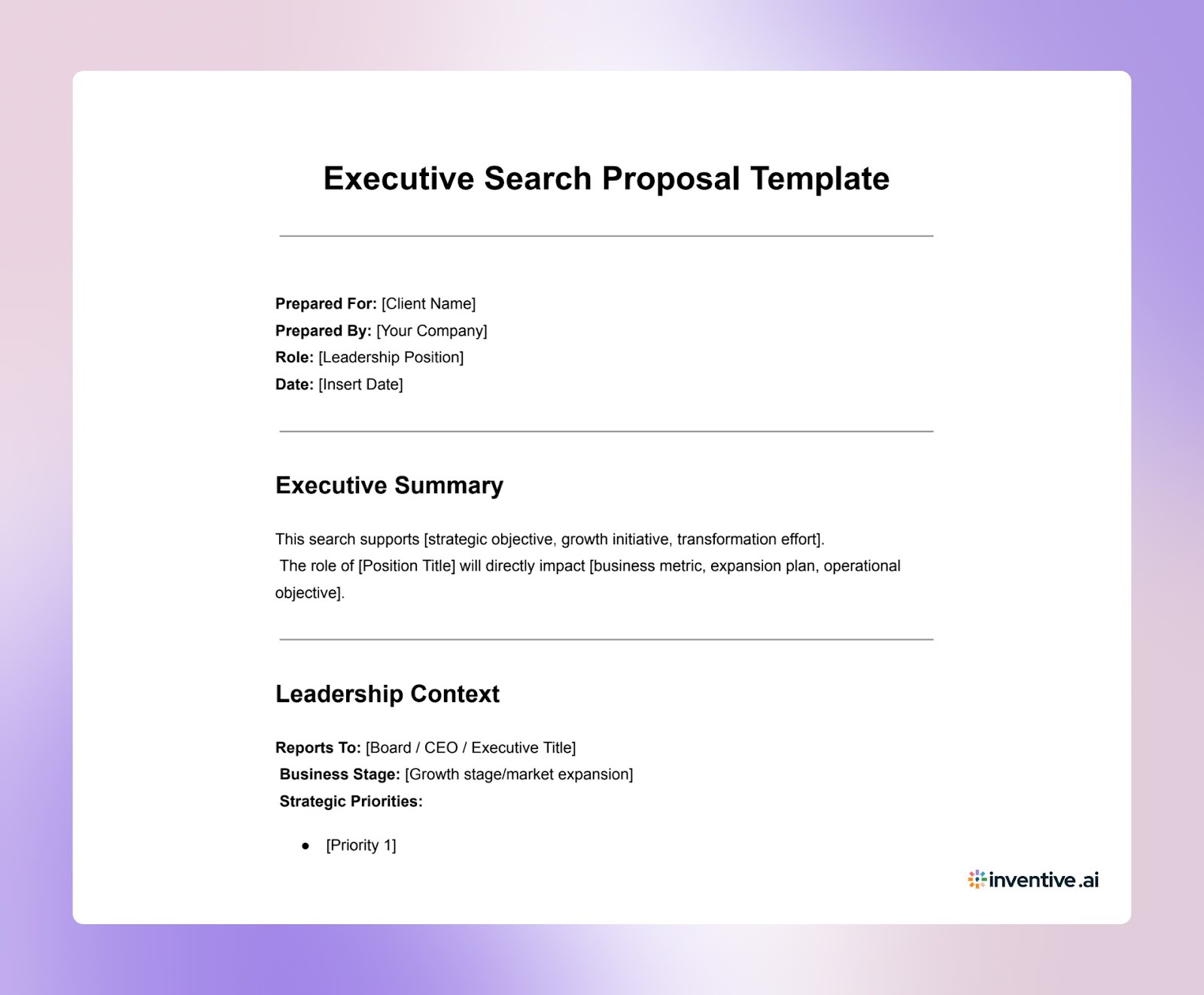
This template supports leadership and senior-level hiring. Clients at this level evaluate discretion, market coverage, and assessment depth before approving engagement.
The structure emphasizes:
- Strategic importance of the leadership role
- Competitor and industry talent mapping
- Multi-stage executive evaluation process
- Stakeholder interview coordination
- Retained fee model with milestone payments
This format fits firms conducting confidential C-suite or senior leadership searches where hiring risk is high, and decision-making involves multiple executives.

3. Recruitment Process Outsourcing (RPO) Proposal Template
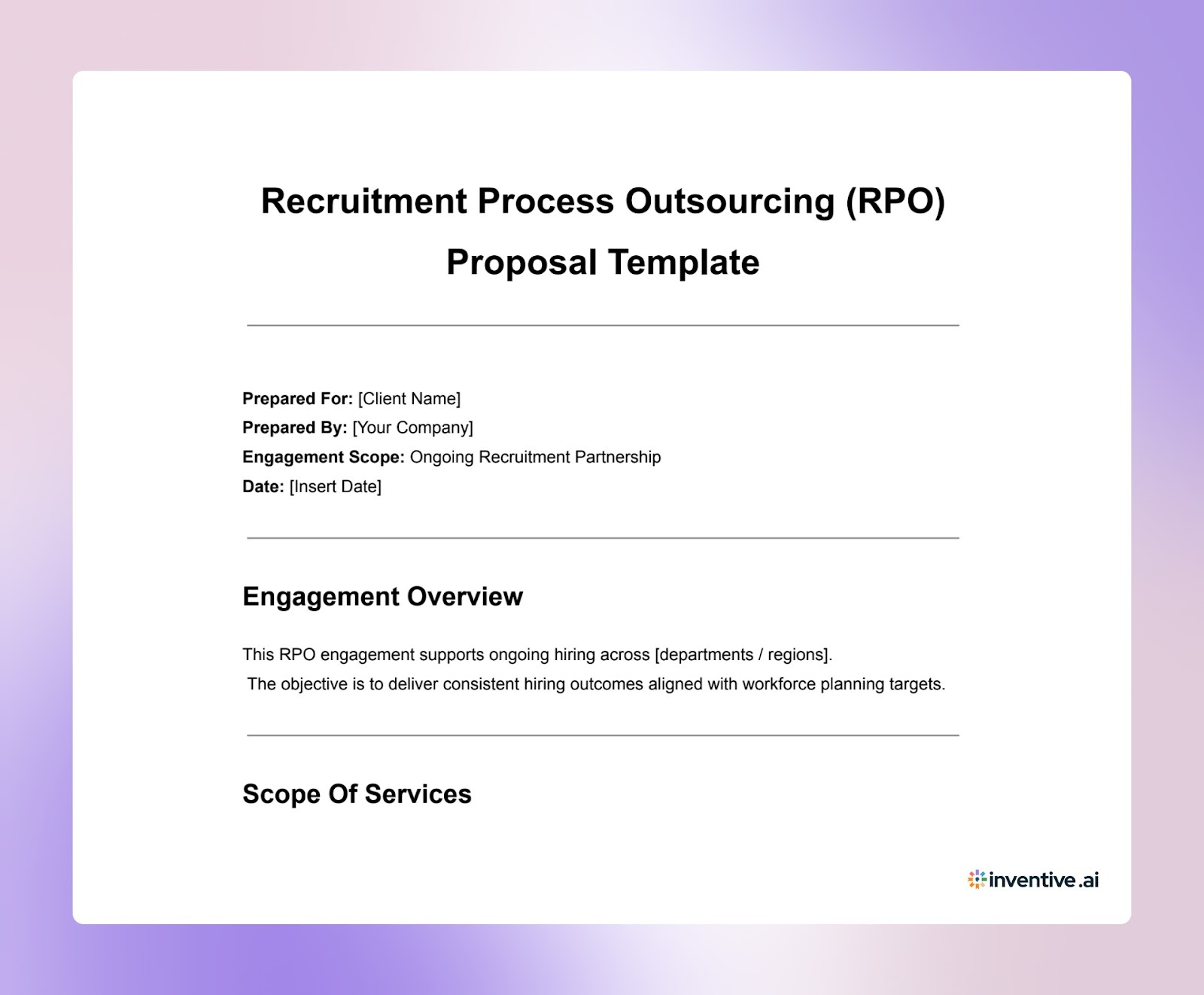
This template applies when companies outsource ongoing hiring operations rather than filling a single position. Clients focus on scalability, reporting structure, and service accountability.
The structure includes:
- Workforce planning alignment
- Dedicated recruitment team structure
- Service level agreements (SLAs)
- Hiring performance metrics and reporting cadence
- Monthly or quarterly fee arrangement
This format works for companies seeking long-term recruitment partnerships across departments or business units.

4. Contract Staffing Proposal Template
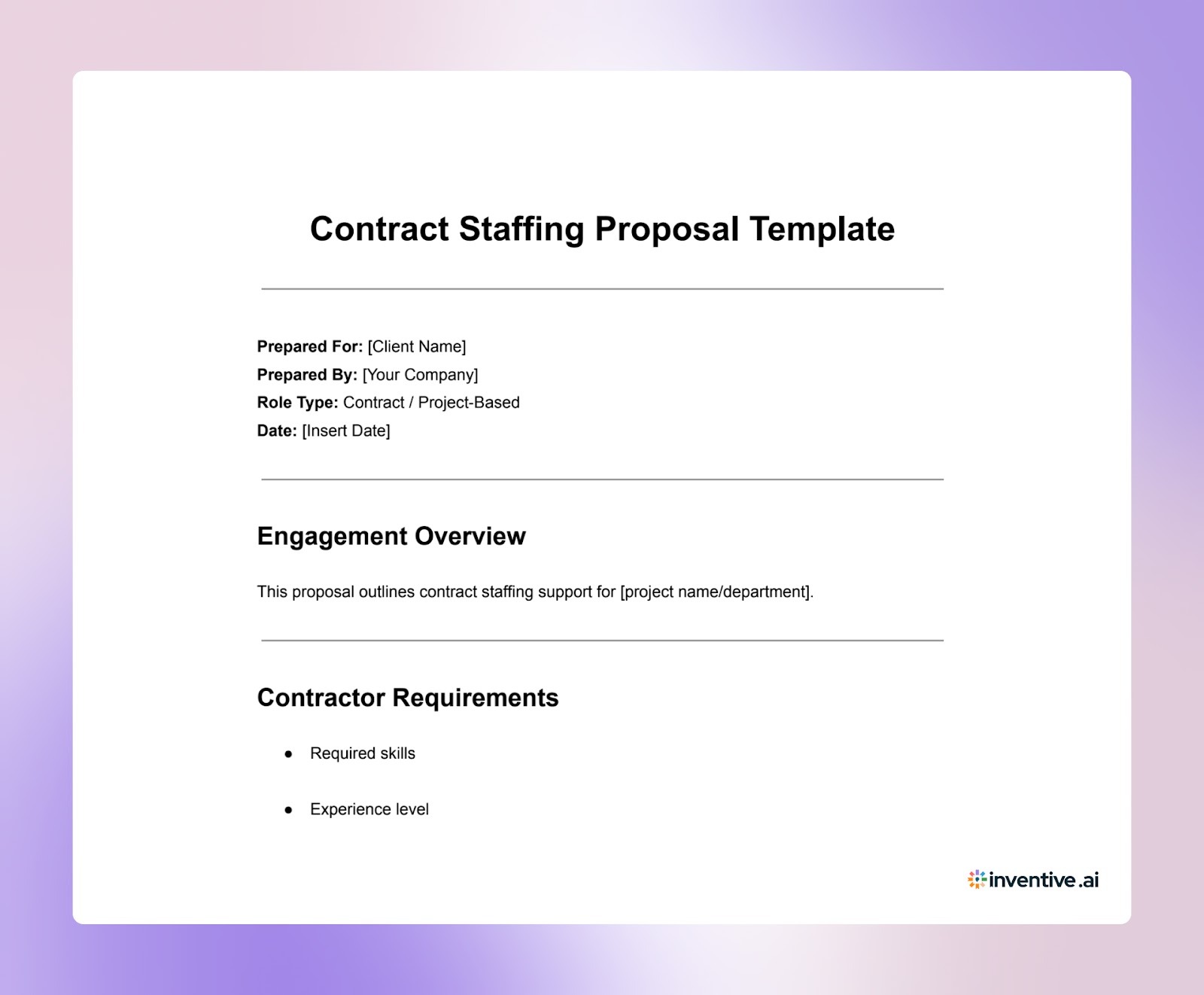
This template addresses short-term or project-based hiring needs. Clients prioritize compliance handling, onboarding speed, and cost predictability.
The structure reflects:
- Contractor sourcing and screening process
- Payroll and compliance management details
- Contract duration and extension terms
- Hourly billing structure
- Conversion-to-permanent terms (if applicable)
This format is commonly used in IT, engineering, and project-driven environments where flexibility is critical.

5. High-Volume Hiring Proposal Template
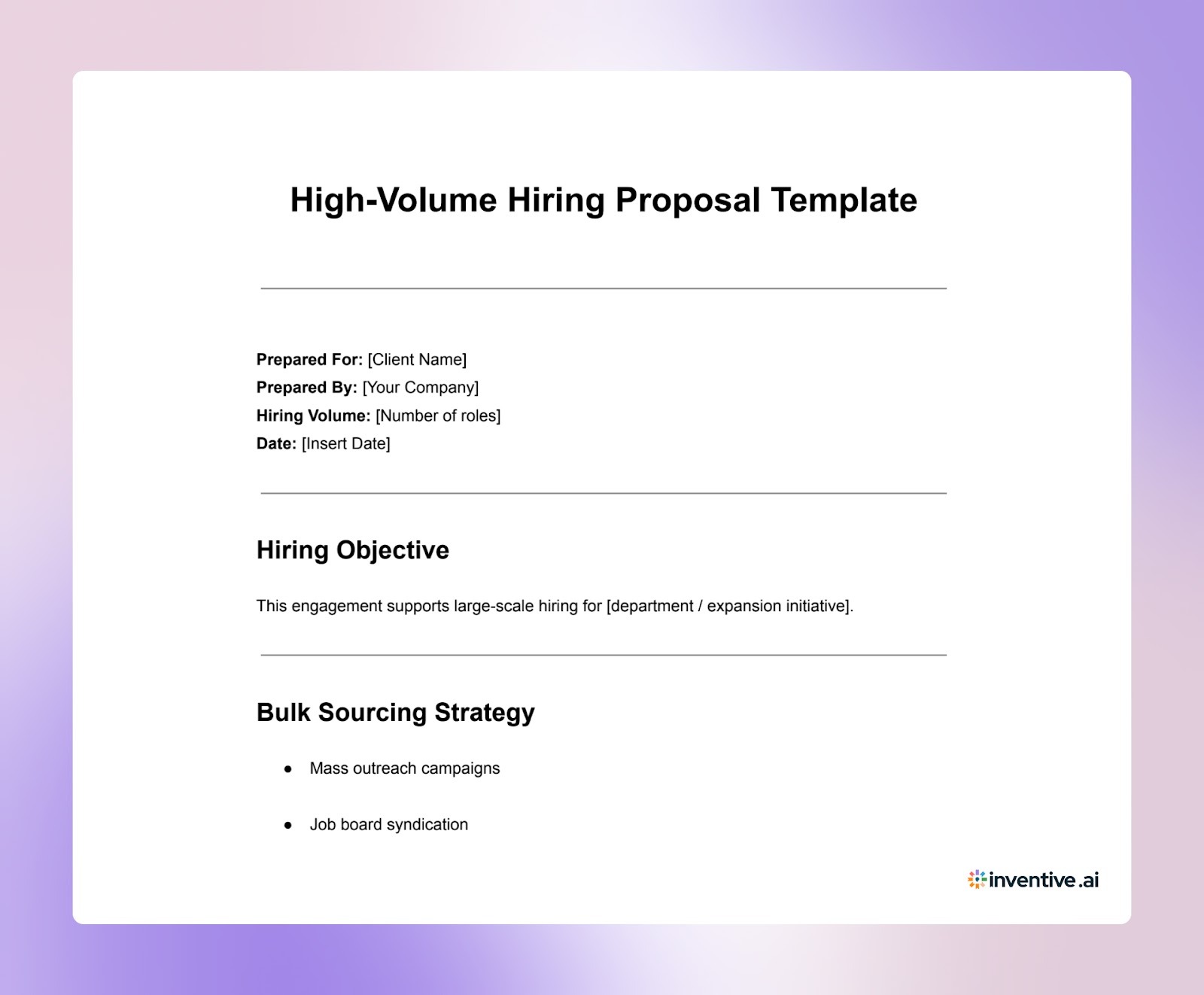
This template supports large-scale hiring initiatives such as call centers, operations expansion, warehouse staffing, or seasonal workforce growth. Clients focus on process efficiency and hiring velocity.
The structure emphasizes:
- Bulk sourcing strategy
- Screening workflows and the interview coordination process
- Hiring timeline benchmarks
- Batch onboarding support
- Volume-based pricing model
This format suits companies scaling teams rapidly within fixed deadlines.

Deliver Stronger, Win-Ready Hiring Proposals With Inventive AI
Recruitment firms frequently reuse executive summaries, sourcing descriptions, screening language, and fee clauses across multiple hiring proposals.
Over time, this creates inconsistencies between timelines and scope, outdated guarantees carried forward, and generic positioning that weakens differentiation.
Inventive AI evaluates the full proposal context before generating or refining content. Instead of drafting sections in isolation, it analyzes hiring objectives, sourcing strategy, deliverables, timelines, and fee structures together to maintain internal consistency and positioning strength.
Capabilities of Inventive AI for hiring proposals:
1. Context Engine
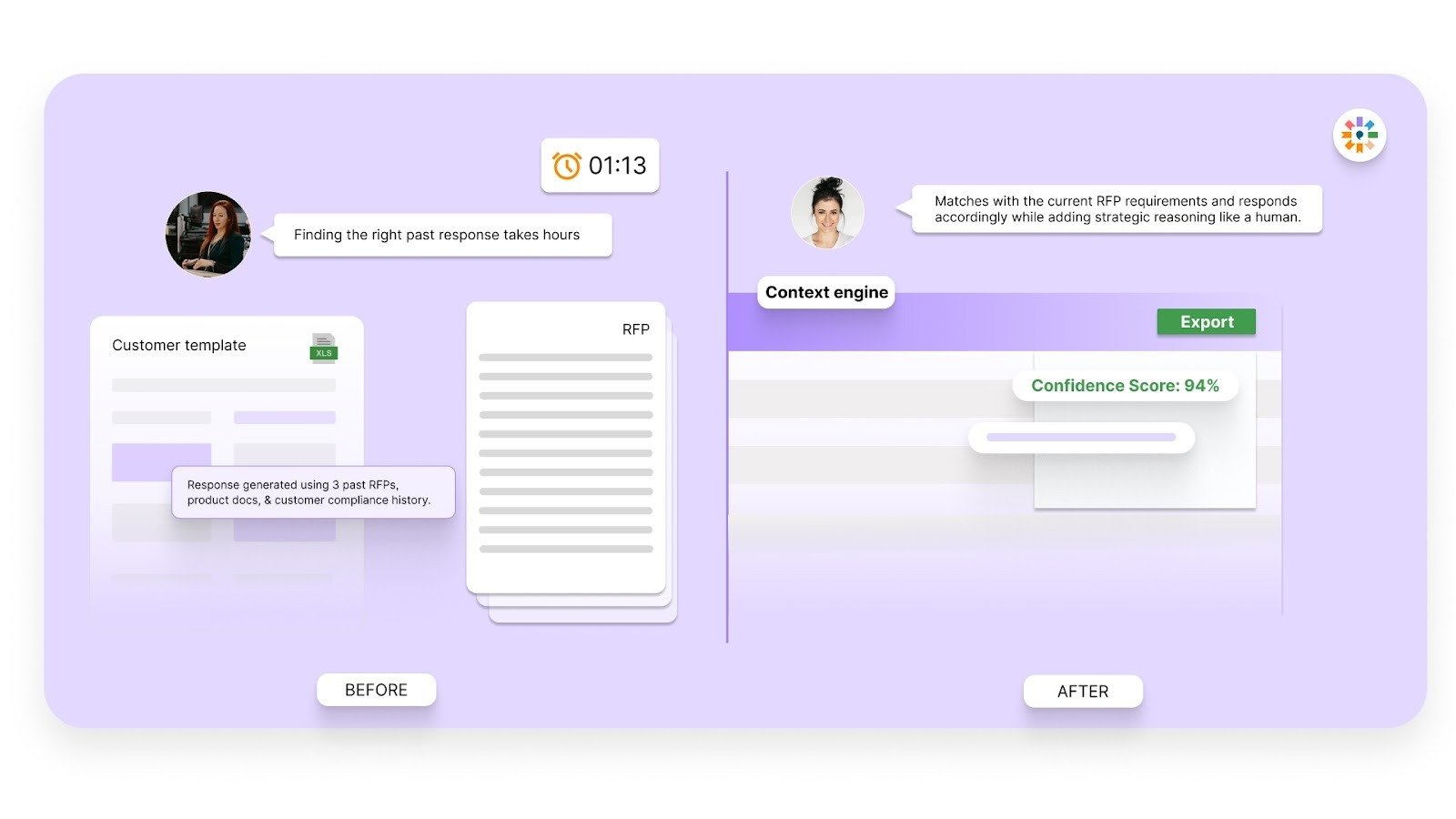
Most AI tools generate sections independently. Inventive AI applies multi-layer reasoning across the entire hiring proposal, understanding how role requirements, sourcing methodology, timelines, and pricing connect.
The result is a hiring proposal that reads cohesive and intentional rather than assembled from reused fragments.
2. Conflict Detection
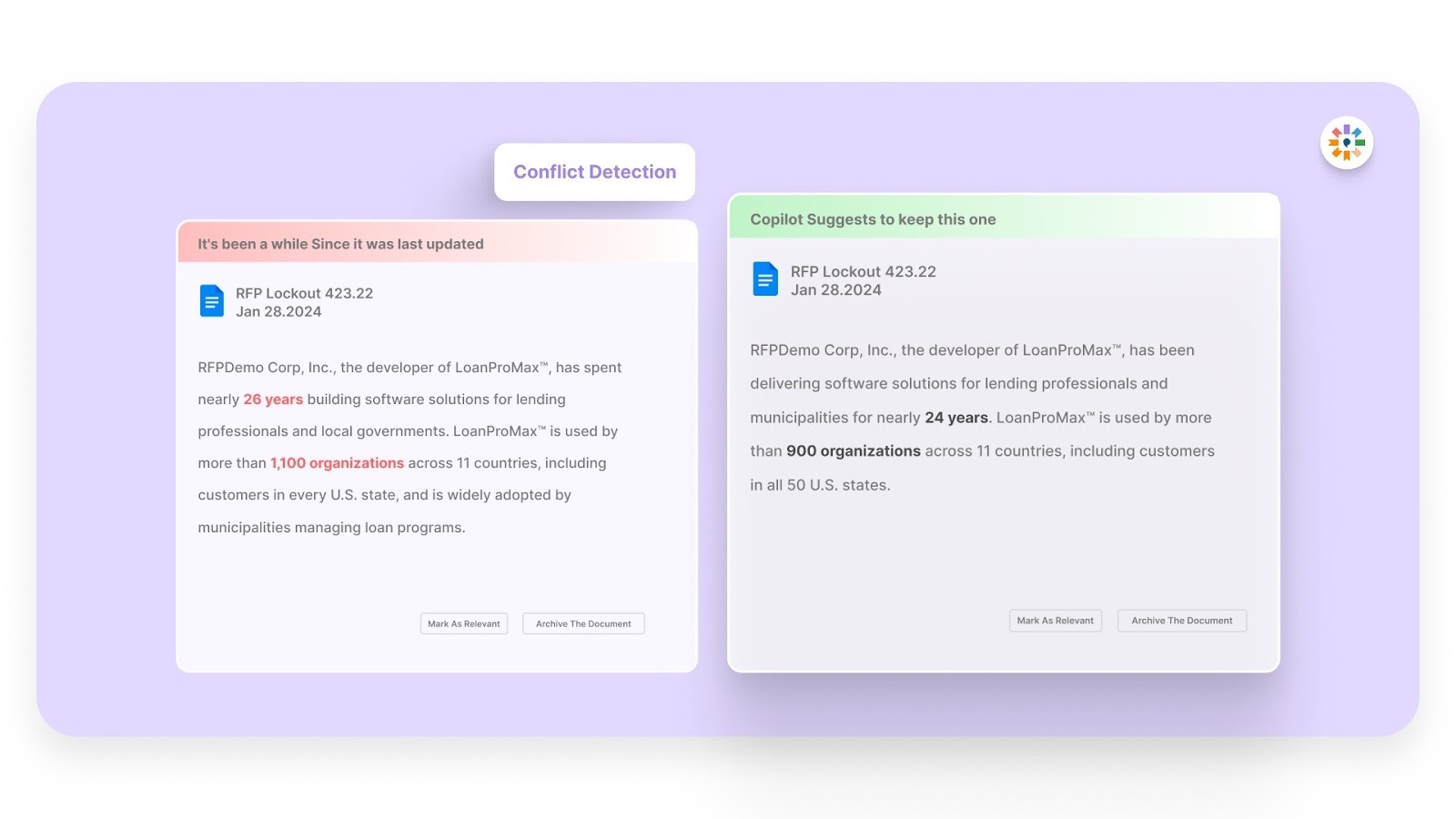
Recruitment proposals often contain subtle contradictions. A timeline promises delivery in six weeks, while the sourcing section outlines a broader market search. A replacement guarantee conflicts with revised scope language.
Inventive AI flags conflicting statements instantly, preventing inconsistencies before proposals reach decision-makers.
3. Outdated Content Detection
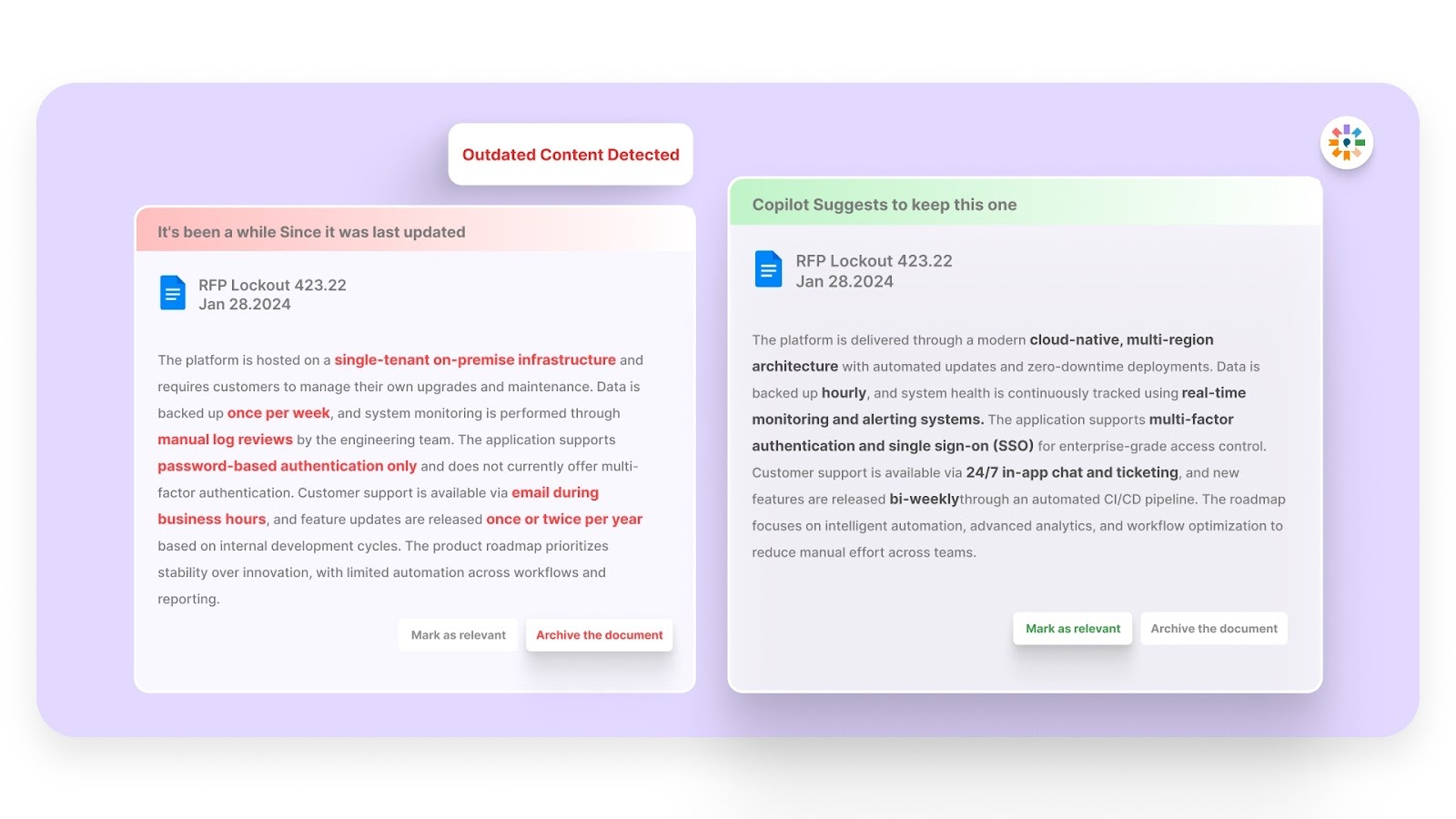
Many firms copy fee models, replacement clauses, or sourcing language from older proposals. Over time, these clauses no longer reflect updated guarantees or operational changes.
Inventive AI automatically detects outdated or superseded content, reducing manual review and protecting commercial accuracy.
4. 2x Higher-Quality Proposal Responses
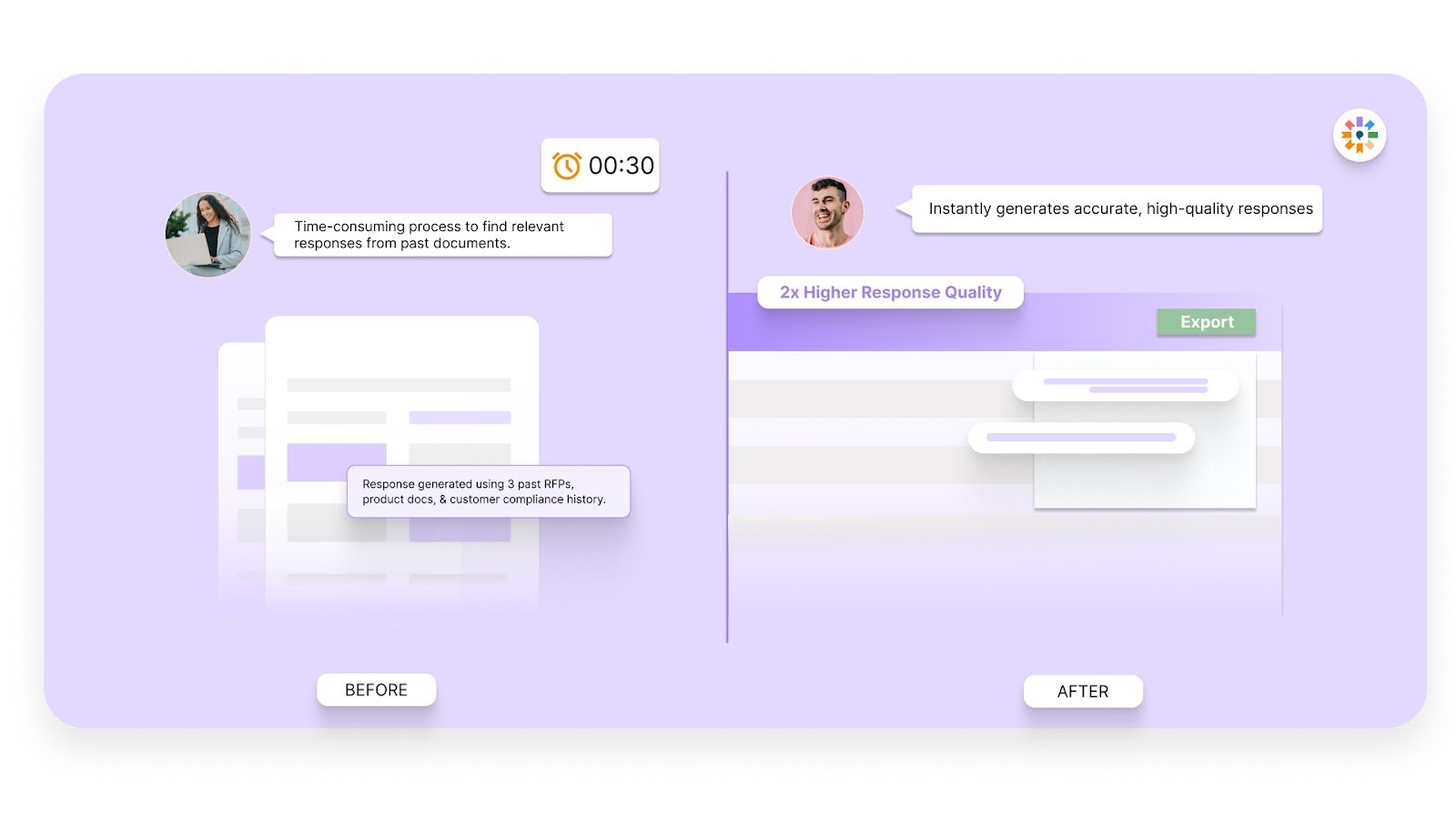
Through multi-agent AI reasoning, Inventive AI produces strategic, accurate, and complete proposal sections aligned with client hiring intent.
The output is 95% accurate, with 0% hallucinations, and requires minimal editing before submission.
5. Simple And Easy-To-Use Interface
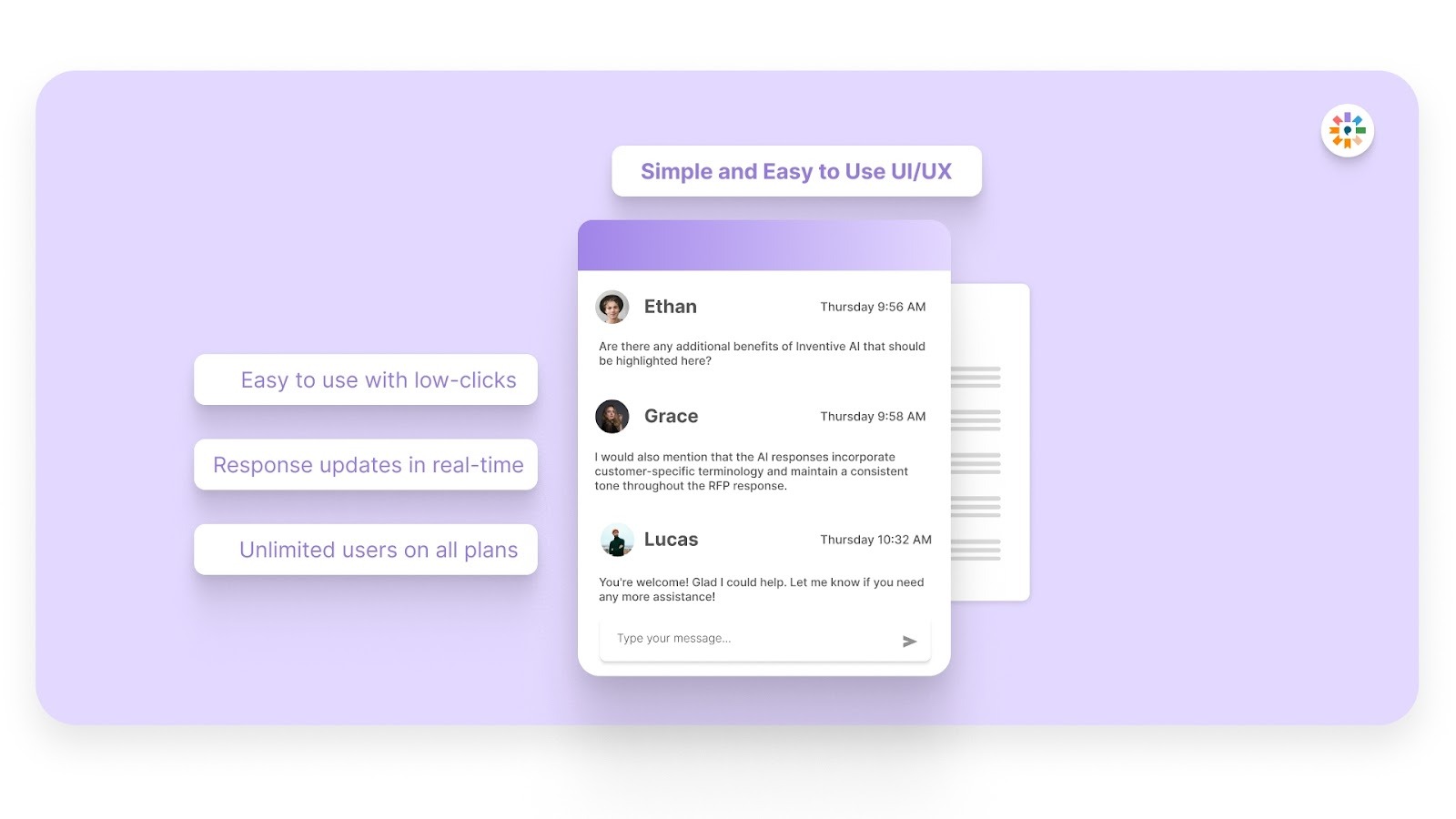
With a 100% adoption rate among current customers and recognition as the easiest-to-use RFP software on G2, recruitment teams can implement AI-assisted proposal drafting without disrupting existing workflows.
6. Narrative-Style Proposal Generation
Most tools focus only on structured Q&A responses. Inventive AI also generates long-form hiring proposal content, including executive summaries, recruitment strategies, evaluation frameworks, and full proposal documents.
Inventive AI improves proposal accuracy, reduces rewriting effort, and increases submission confidence across staffing and executive search engagements.
FAQs About Hiring Proposal Template
1. How long should a hiring proposal be?
A hiring proposal should be long enough to cover scope, process, timeline, and fees clearly without unnecessary filler. For single-role searches, 5–8 pages are typically sufficient. Executive or RPO proposals may extend to 10–15 pages due to added strategic detail.
2. What is the difference between a hiring proposal and a staffing agreement?
A hiring proposal outlines scope, process, and commercial terms before engagement begins. A staffing agreement is a legally binding contract executed after the proposal is approved. The proposal supports the decision; the agreement formalizes it.
3. Should pricing be included in the first hiring proposal?
Yes. A clear fee structure improves transparency and reduces negotiation friction later. Omitting pricing often delays decision-making and creates additional review cycles.
4. How can recruitment firms differentiate their hiring proposals?
Differentiation comes from specificity. Firms that include market mapping insights, defined evaluation frameworks, measurable time-to-fill benchmarks, and structured deliverables stand out from proposals that rely on generic sourcing language.
5. When should you use a retained search proposal instead of contingency?
Retained search proposals are typically used for leadership roles, confidential hiring, or hard-to-fill positions where full market coverage and dedicated search resources are required. Contingency models are more common for mid-level or repeatable hiring needs.

.avif)





%20(19).avif)