Marketing RFI Guide for Vendors: Process, Template & Tips

You’ve seen it before: an RFI lands in your inbox, and it doesn’t feel urgent. No pricing yet, no project plan, just questions. It’s easy to think an RFI is optional or preliminary. But the reality is different for serious buyers.
But buyers don’t see it that way. Procurement teams use RFIs as structured filters. In fact, around 80% of organizations use RFIs to narrow down vendors before moving to formal proposals. That means your RFI response can determine whether you ever reach the RFP stage.
If your response is scattered, inconsistent, or generic, you risk not making the cut before the real proposal stage even begins. That’s a lost opportunity before the true competition starts.
But there’s a solution. When you treat a Marketing RFI as an early, structured chance to show capability and clarity, it becomes a strategic advantage. You can position your services, differentiate your approach, and earn an invite to the more detailed RFP or RFQ stages.
In this guide, you’ll learn what a Marketing RFI really is, how it differs from other procurement steps, what buyers expect to see, and how to structure responses that move your opportunities forward.
Key Takeaways
- Marketing RFIs are early vendor filters that strongly influence who reaches the RFP stage.
- Buyers use RFIs to compare marketing capabilities, processes, tools, and experience side by side.
- Structured, clear responses position you as credible, organized, and ready for larger engagements.
- Common RFI challenges come from scattered information, outdated content, and repeated rewrites.
- AI-powered platforms like Inventive AI help teams respond 10× faster with 95% accuracy by centralizing and validating response content.
What Marketing RFI Actually Signals for Your Opportunity?
A Marketing Request for Information (RFI) is a structured document buyers send to multiple vendors to collect high-level information about marketing capabilities, approaches, and experience before moving to detailed proposals.
At this stage, buyers are not asking for pricing or full execution plans. They are trying to understand how different vendors think, how they structure marketing programs, and how well their services align with business goals. It’s an early comparison of expertise, processes, and strategic fit.
For marketing teams on the buyer side, this step helps shape the shortlist. They use your responses to decide who demonstrates clear thinking, relevant experience, and the ability to work within their environment. That decision determines who moves forward.
An RFI rarely results in a contract on its own, but it strongly influences whether you receive the Request for Proposal (RFP) or Request for Quote (RFQ) that follows. That makes it an early qualification stage, not just an information exercise.
When your response is structured and clear, you show maturity and readiness. That early confidence increases your chances of advancing in the selection process.
How Marketing RFIs Benefit Buyers - And Why That Works in Your Favor?
Marketing RFIs are designed to help buyers make early, informed decisions. Understanding these benefits helps you respond in a way that aligns with what they are trying to achieve.
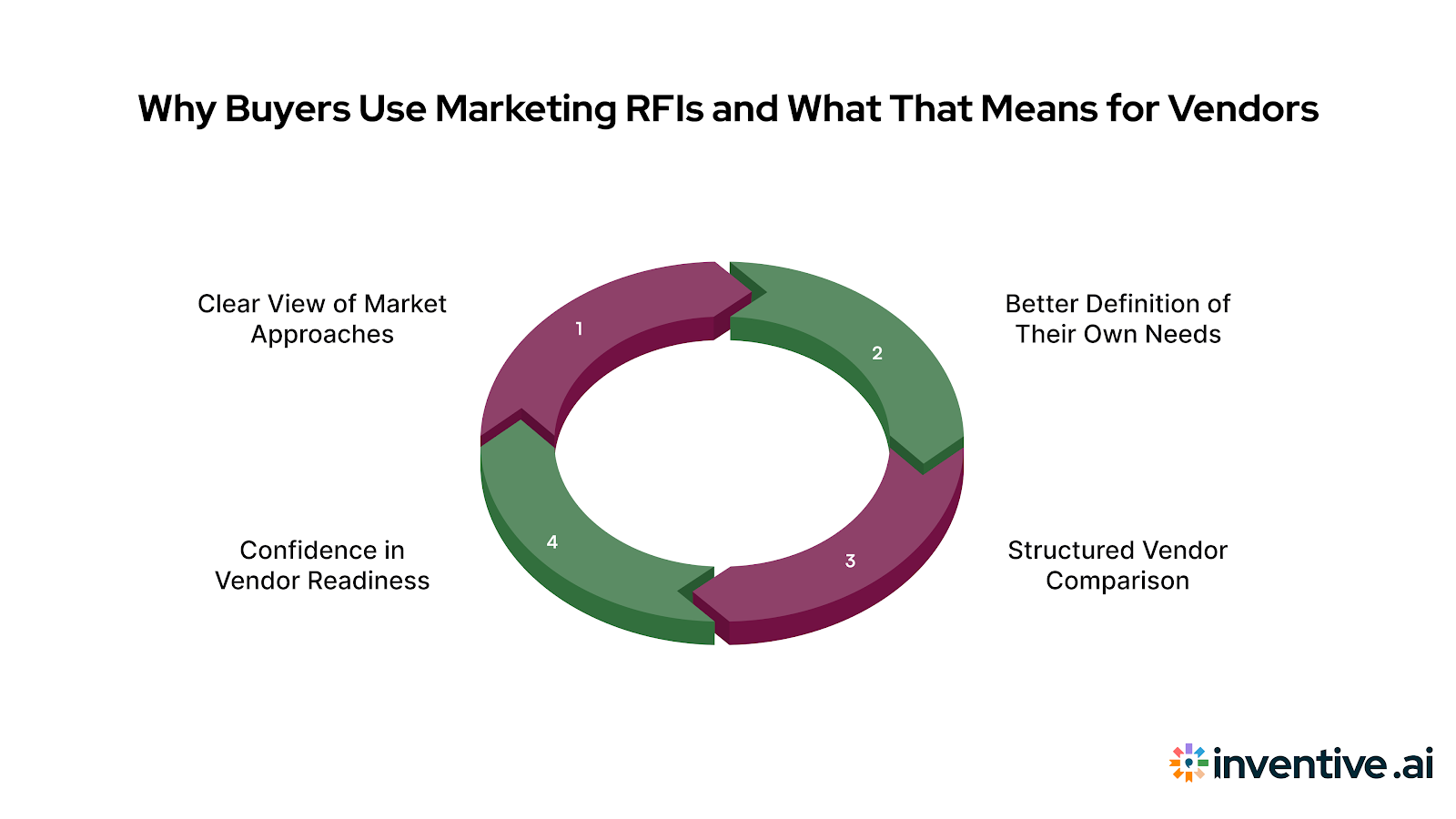
Here’s what buyers gain from the RFI stage:
1. Clear View of Market Approaches
Buyers use RFIs to see how different vendors approach marketing strategy, channels, and measurement. Your response shows how you think before they define final requirements.
2. Better Definition of Their Own Needs
Many buyers use RFI responses to refine their scope. Seeing multiple approaches helps them clarify goals, priorities, and expectations.
3. Structured Vendor Comparison
Standardized RFI questions allow buyers to compare vendors consistently. Clear, well-organized answers make your strengths easier to recognize.
4. Confidence in Vendor Readiness
Buyers look for signs that vendors have structured processes, relevant experience, and operational discipline. Strong responses build early trust.
Here’s why this matters to you as a vendor: when buyers use RFIs to shape direction and assess credibility, vendors who communicate clearly and strategically stand out. A well-prepared RFI response positions you as organized, capable, and aligned with their marketing objectives.
Also Read: How to Develop Effective RFP Win Themes for Proposal Success
RFI vs. RFP vs. RFQ: Understanding the Marketing Procurement Path
Marketing procurement does not happen in one step. Buyers use different documents at different stages to move from exploration to decision. Knowing what each one is meant to achieve helps you adjust the depth, focus, and effort of your response.
RFI (Request for Information)
An RFI is used early to understand vendor capabilities, approaches, and experience. Buyers are still shaping the problem and exploring available options. They want to see how you think, how you structure marketing work, and whether your services align with their direction.
RFP (Request for Proposal)
An RFP comes after buyers define their needs more clearly. They ask for detailed strategies, project plans, timelines, and pricing. This stage evaluates how well your proposed solution solves their specific marketing challenge.
RFQ (Request for Quote)
An RFQ focuses mainly on cost. Buyers already know what they want and are comparing pricing and commercial terms. The emphasis is on accurate numbers and delivery commitments rather than strategic direction.
Here’s a quick comparison:
Understanding this progression helps you allocate effort appropriately. A strong early response positions you well for the more detailed and competitive stages that follow.
Also Read: Tender Management: Process, Software, Best Practices (2026)
9 Core Components of an Effective Marketing RFI
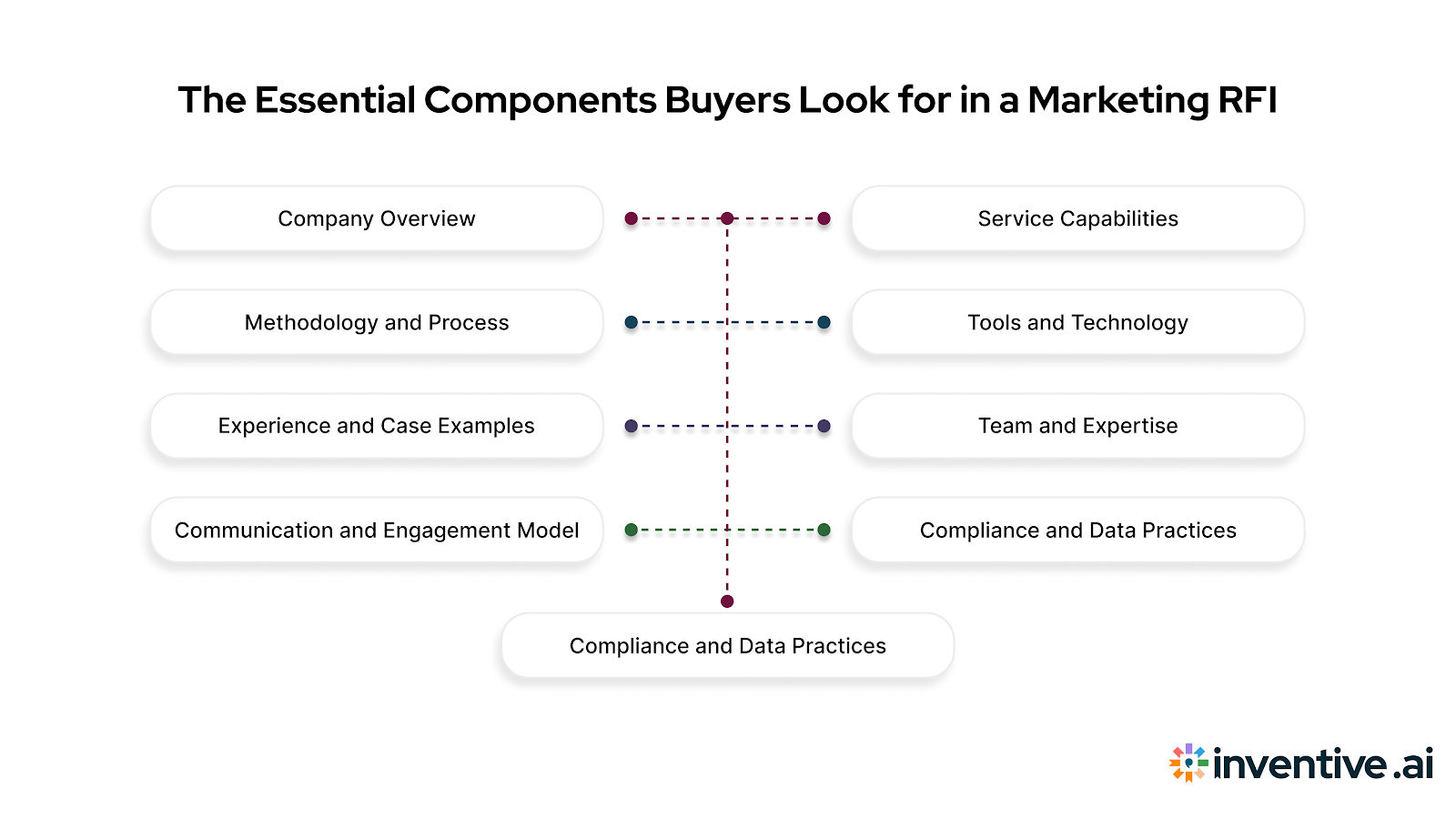
Marketing RFIs follow a structured format so buyers can collect consistent information across vendors. When you know the typical sections in advance, you can prepare answers early and avoid last-minute scrambling.
Here are the key areas you should expect:
1. Company Overview
Buyers start by understanding who they are evaluating.
This section usually asks for:
- Company background and years in operation
- Core service areas
- Industry experience
- Team structure and locations
It establishes credibility and relevance.
2. Service Capabilities
This is where buyers assess what you can actually do.
Expect questions about:
- Strategy development approach
- Channel expertise (digital, content, paid media, etc.)
- Creative and campaign execution capabilities
- Analytics and reporting practices
They want to understand the scope and depth of your services.
3. Methodology and Process
Buyers look for structure in how work is delivered.
Typical focus areas:
- How to build marketing plans
- Campaign planning frameworks
- Collaboration and approval workflows
- Performance optimization process
Clear methodology signals operational maturity.
4. Tools and Technology
Even at the RFI stage, buyers want to see how you operate technically.
You may be asked about:
- Martech platforms you use
- CRM and analytics integrations
- Automation and reporting tools
This helps them understand compatibility with their environment.
5. Experience and Case Examples
Buyers want proof, not just claims.
Expect requests for:
- Relevant client examples
- Types of challenges addressed
- Results achieved
Concrete examples show practical capability.
6. Team and Expertise
This section often looks at who will deliver the work.
Questions may include:
- Roles involved in projects
- Skillsets and certifications
- Subject matter expertise
It helps buyers assess depth and coverage.
7. Communication and Engagement Model
Buyers need clarity on how collaboration happens.
You might be asked about:
- Project kickoff process
- Reporting frequency
- Meeting cadence
- Escalation paths
This shows how structured your client interactions are.
8. Compliance and Data Practices
Marketing engagements increasingly involve data handling.
RFIs may include:
- Data privacy practices
- Security policies
- Data storage and retention approaches
Buyers look for responsible data management.
9. References or Additional Information
Some RFIs ask for:
- Client references
- Supporting materials
- Additional documentation
This supports validation of your claims.
When these components are prepared in advance, responding becomes a structured process instead of a scramble. You can focus on clarity and relevance rather than gathering information under pressure.
A Practical Marketing RFI Template (Example)
Here's what is generally included in a RFI. Feel free to use this template to make an RFI for your company.
Section 1 — Cover Information
Section 2 — RFI Objectives
Purpose of This Request for Information
☐ Evaluate vendor marketing capabilities
☐ Understand strategic approach and methodology
☐ Assess service coverage and expertise
☐ Review operational readiness and tools
Section 3 — Vendor Background
Section 4 — Core Service Capabilities
Section 5 — Methodology and Delivery Process
- Describe your framework for building marketing programs.
- Outline campaign planning and execution stages.
- Explain optimization and performance review cycles.
- Describe client collaboration and approval processes.
Section 6 — Tools and Technology
Section 7 — Team Structure
Section 8 — Experience and Case Examples
Section 9 — Communication and Engagement Model
- Project kickoff structure
- Reporting frequency
- Review cadence
- Escalation procedures
Section 10 — Compliance and Data Practices
Section 11 — Evaluation Criteria (For Buyer Use)
Section 12 — Submission Checklist
☐ All sections completed
☐ Supporting documentation attached
☐ Information current within the last 12 months
☐ Authorized representative approval
This template reflects how marketing RFIs are structured to evaluate capabilities, processes, and readiness in a consistent and measurable way.
11 Best Practices for Responding to Marketing RFIs
Responding to a Marketing RFI isn’t just about filling in answers. Buyers are looking for clarity, structure, and a sense of how you think and operate. The more you tailor responses to their evaluation style, the stronger your early impression.
Below are proven practices top-performing vendors use when responding to RFIs:
1. Understand Buyer Intent Before You Start
Before drafting, read the RFI carefully to grasp not just the questions but the purpose behind them. Ask yourself:
- What problem is the buyer trying to solve?
- What outcomes do they seem to value?
- Are they focused on strategic thinking, technology alignment, or analytics outcomes?
Understanding intent helps you tailor responses that align with buyer expectations.
2. Group Questions by Theme, Not Order
RFIs often mix capability, process, and experience questions. Organize your responses into logical clusters such as:
- Strategy and approach
- Tools and technology
- Results and case evidence
- Delivery and collaboration
This helps reviewers absorb your answers more easily and maintain narrative consistency.
3. Lead With Measurable Outcomes, Not Buzzwords
Buyers want signals of impact, not vague claims. Where possible, use metrics or examples, for example:
- Improved lead conversion by X%
- Reduced customer acquisition cost by Y
- Increased engagement by Z%
Adding measurable results makes your responses more compelling.
4. Showcase Relevant Case Examples With Clear Context
Rather than generic success stories, pick 1–2 case examples that match the buyer’s priorities. Use a consistent mini-framework:
- Challenge
- Solution implemented
- Key activities
- Outcome and metrics
This makes your expertise tangible and easier to compare with competitors.
5. Address Gaps With Clear Alternatives
If a question touches on an area you don’t specialize in, don’t leave it blank or write generic responses. Instead:
- Acknowledge the gap
- Suggest how you would address or partner
- Provide a logical alternative
Buyers appreciate honest, thoughtful answers over filler language.
6. Avoid Repetitive or Redundant Language
RFIs often cover similar areas across questions. Rather than copying the same text, tailor each section so it speaks directly to what’s being asked. This shows attention to detail.
7. Keep Responses Structured and Easy to Scan
Use formatting elements such as:
- Bullet lists
- Short paragraphs
- Headings
- Tables where relevant
Research shows that structured responses are easier for evaluation teams to score and compare.
8. Align With Buyer Terminology
If the RFI uses specific language (e.g., “performance measurement,” “content automation”), mirror that language in your answers. This signals alignment and reduces cognitive load for reviewers.
9. Include Supporting Documentation Thoughtfully
If the RFI allows attachments, include only:
- Case study PDFs
- Process diagrams
- Tool integration maps
- Compliance certificates
Avoid bloating the submission with unnecessary documents.
10. Internal Review and Quality Checks
Before submitting:
- Check for consistency across answers
- Validate case example accuracy
- Eliminate contradictions
- Proofread for grammar and clarity
A quality review reduces clarification cycles and improves buyer confidence.
Pro Tip
Assign one owner for the RFI response. Central ownership reduces conflicting messages and ensures coherent tone and structure.
These practices reflect how experienced vendor teams respond to RFIs in competitive environments. When your answers are strategic, measurable, and aligned with buyer goals, you increase your probability of advancing to the RFP stage.
Also Read: A Practical Guide for High-Quality Cybersecurity RFP Responses
7 Steps of Marketing RFI Workflow: Your Step-by-Step Guide
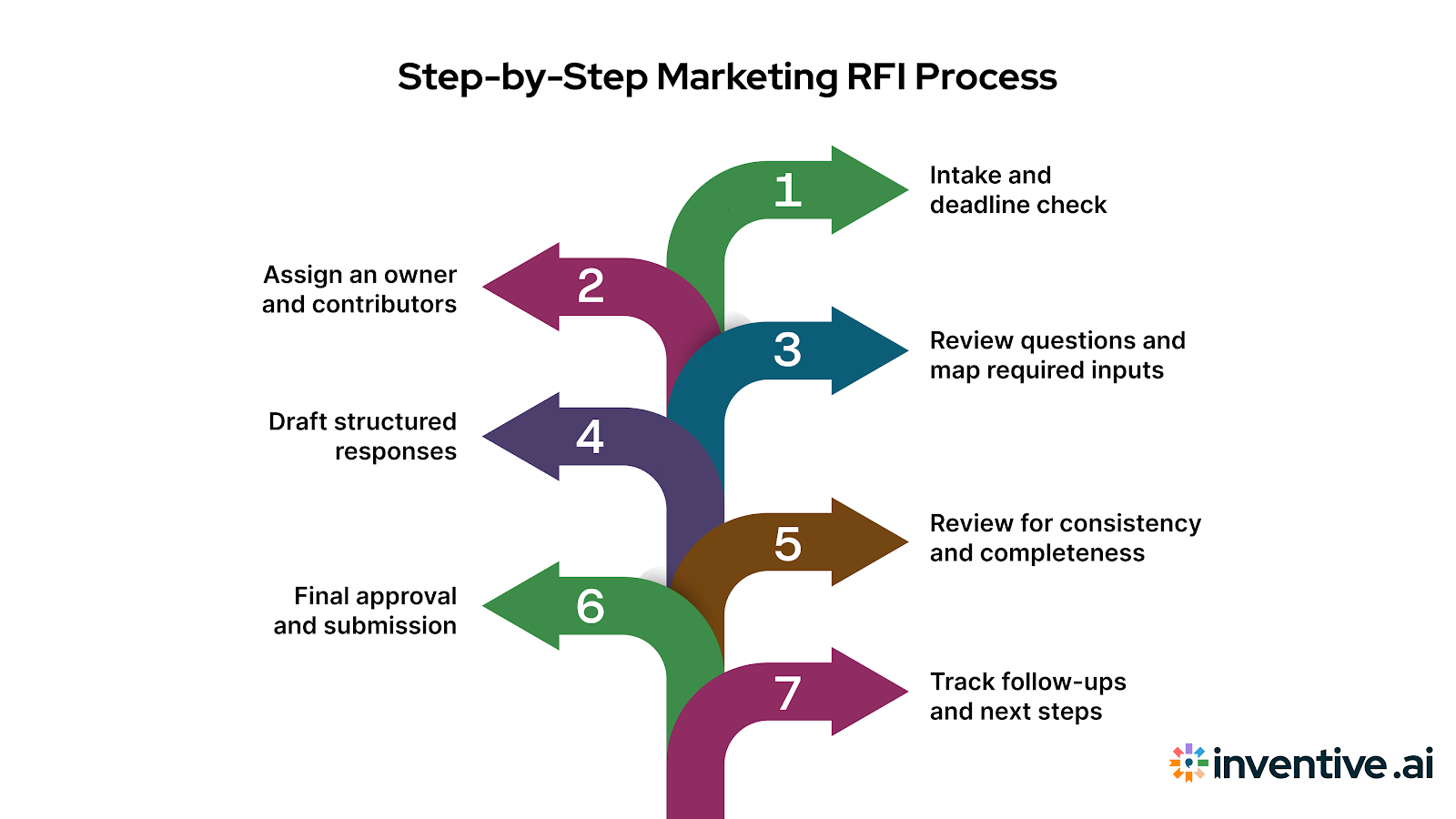
When an RFI arrives, you get better results when you treat it like a defined workflow instead of a quick fill-out task. Most teams follow a similar sequence, even when the RFI format changes.
Step 1: Intake and deadline check
Log the RFI, confirm the due date, and note required formats, attachments, and submission instructions.
Step 2: Assign an owner and contributors
Set one person to own the response and assign sections to the right contributors, such as strategy, analytics, legal, or security.
Step 3: Review questions and map required inputs
Group questions by theme and identify what needs proof, such as case examples, processes, or tools.
Step 4: Draft structured responses
Write clear answers using consistent formatting. Keep claims specific and use examples where they strengthen credibility.
Step 5: Review for consistency and completeness
Check for contradictory statements, outdated language, missing sections, and formatting issues.
Step 6: Final approval and submission
Collect final sign-off, submit through the requested channel, and confirm receipt if possible.
Step 7: Track follow-ups and next steps
Expect clarification questions or a request for an RFP or RFQ. Keep the submitted version saved for reuse and future updates.
When you follow a repeatable process, you reduce rework, avoid last-minute confusion, and submit responses that are easier for buyers to evaluate.
6 Common Challenges Teams Face With Marketing RFI Responses
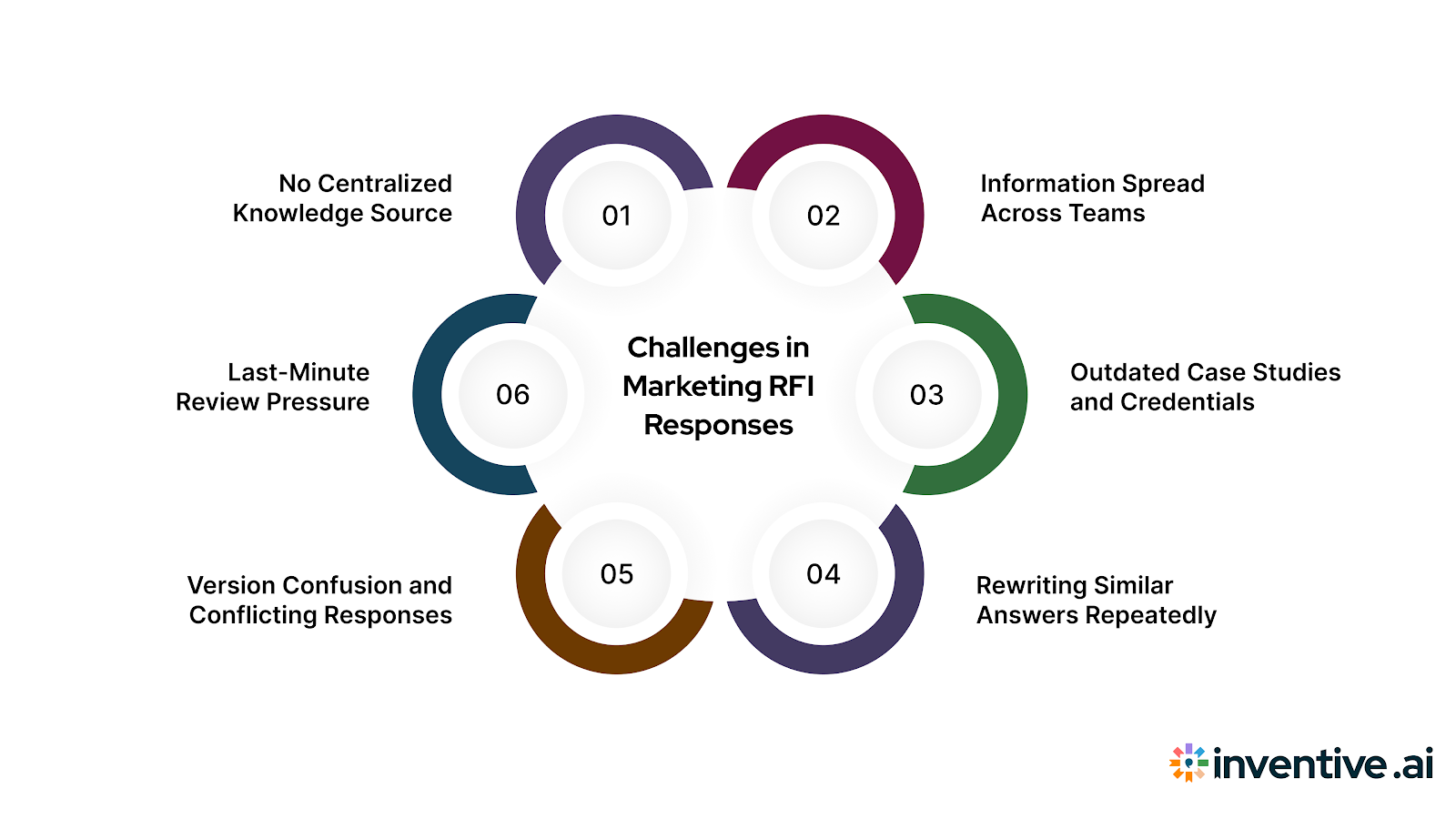
Even experienced teams run into operational hurdles when responding to RFIs. These issues usually stem from how information is stored and shared internally, not from a lack of expertise.
Here are the most frequent challenges:
1. No Centralized Knowledge Source
Marketing capabilities, case studies, process documents, and tool details often live in different systems or files. Teams waste time searching emails, shared drives, and past proposals to find the right information. This slows response time and increases the chance of missing important details.
2. Information Spread Across Teams
Strategy, analytics, operations, and account teams all hold pieces of the answer. Without a clear system, responses depend on who replies first or which document gets reused. That creates inconsistency and increases internal back-and-forth.
3. Outdated Case Studies and Credentials
Marketing programs evolve quickly. When old examples are reused without review, they may reference tools, results, or processes that no longer reflect current practices. Buyers notice these mismatches, which can reduce confidence.
4. Rewriting Similar Answers Repeatedly
Many RFI questions repeat across opportunities with slight wording changes. Teams often rewrite from scratch because past answers are hard to locate or not structured for reuse. This adds unnecessary effort.
5. Version Confusion and Conflicting Responses
Different team members may use different versions of the same information. Without version control, responses can contradict each other, especially when multiple contributors are involved.
6. Last-Minute Review Pressure
When information gathering takes too long, review time gets compressed. This increases the risk of errors, incomplete answers, or formatting issues.
These challenges are operational, not strategic. The knowledge already exists inside your organization, but it is not structured for fast, consistent reuse.
The solution is automation. AI-powered response platforms like Inventive AI centralize approved content, flag outdated information, detect inconsistencies, and make reuse simple. Instead of rebuilding answers each time, teams work from a structured, reliable knowledge base, improving accuracy and reducing response time.
Also Read: Best 8 Enterprise RFP Software in 2026 & How to Choose the Best
How Inventive AI Helps You Respond to Marketing RFIs With Greater Speed and Confidence?
Responding to RFIs should not feel like starting from zero every time. When your knowledge, case examples, and methodologies are already defined, the challenge becomes how to reuse them consistently and accurately.
Inventive AI is designed to simplify your RFP response process, and that includes early-stage RFIs. Instead of scattered documents and repeated rewrites, your team works from a structured system built for proposal workflows.
Here’s how it improves your RFI responses:
1. 2× Higher Quality Responses
Your answers become more complete and structured. This reduces vague language and helps buyers quickly understand your capabilities.
2. Context Engine
The system understands what a question is really asking. It selects the most relevant approved content, not just keyword matches, so your responses stay aligned with buyer intent.
3. Conflict Detection
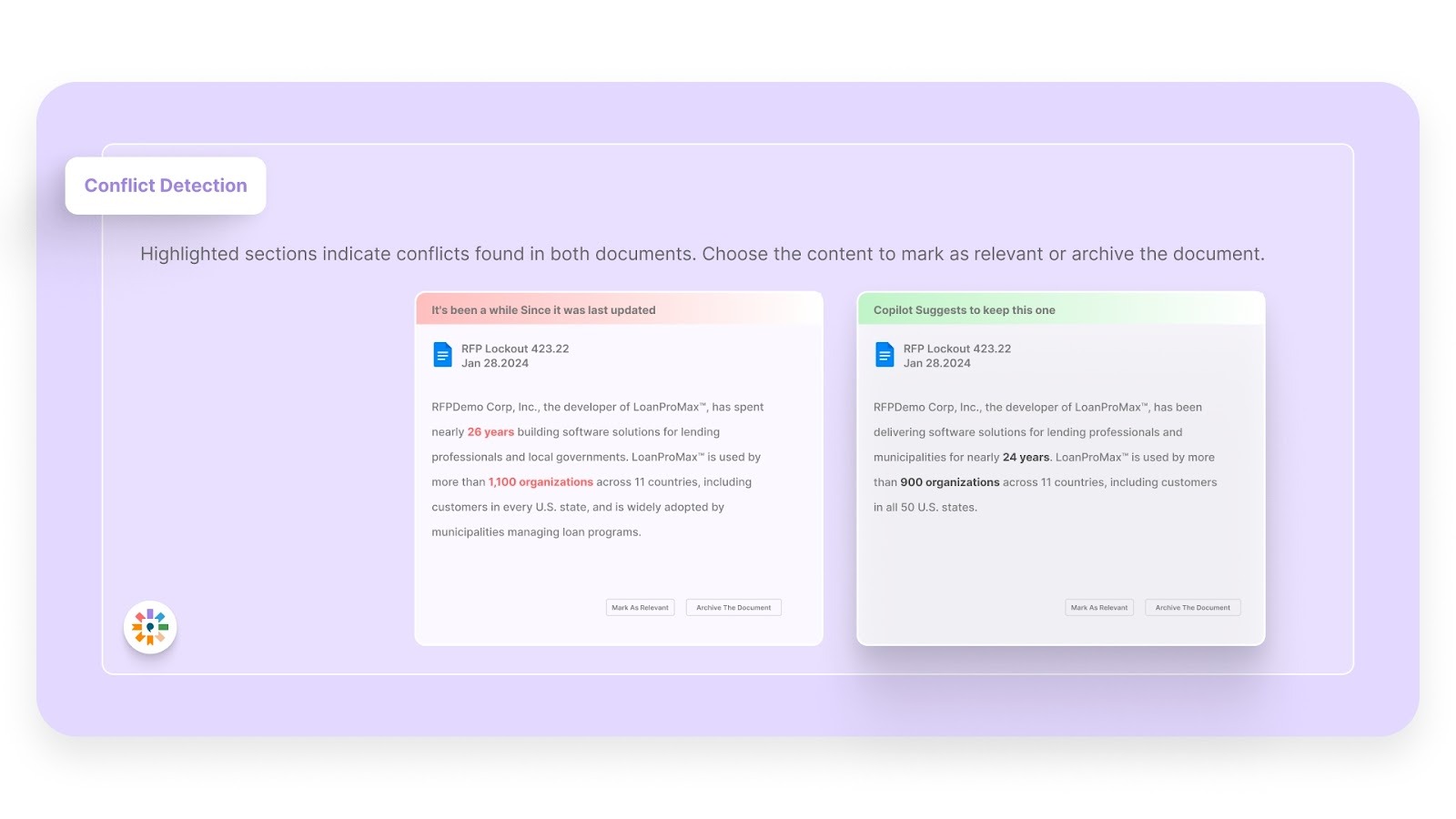
Inventive AI flags inconsistent statements across answers. This helps you fix contradictions before submission and prevents confusion during evaluation.
4. Outdated Content Detection
You receive alerts when examples, credentials, or processes no longer reflect current practices. That keeps your responses accurate and current.
5. Simple, Easy-to-Use Interface
Team members contribute through a clear workflow. This reduces coordination friction and keeps everyone aligned on the same version of the response.
Together, these capabilities help your team respond 10× faster while maintaining 95% accuracy. You spend less time searching for information and more time presenting your strengths clearly.
RFIs shift from reactive tasks to structured opportunities to position your expertise early in the buyer journey.
Final Thoughts
Marketing RFIs play a larger role in vendor selection than they appear to at first glance. They help buyers compare approaches, assess credibility, and shape their direction before formal proposals are even requested.
When your responses are structured, relevant, and supported by examples, you increase your chances of moving forward in the evaluation process.
The biggest challenges teams face with RFIs are not about expertise. They come from scattered information, repeated rewrites, outdated materials, and inconsistent responses across opportunities. These operational gaps slow your team down and weaken your early positioning.
Automation addresses this problem directly. AI-powered response systems bring your approved knowledge into one structured environment, help maintain consistency, and reduce rework across deals.
AI-powered RFP response software like Inventive AI automates the RFI and RFP workflow, helping teams respond 10× faster with 95% accuracy. Your team spends less time searching for information and more time presenting clear, reliable answers.
When your response process is structured, RFIs become an advantage instead of a burden.
Frequently Asked Questions (FAQs)
1. How long does it usually take buyers to review RFI responses?
Review timelines vary, but RFIs are often evaluated within one to three weeks. The speed depends on how many vendors respond and how complex the request is.
2. Can an RFI response affect pricing discussions later?
Yes. Even though RFIs don’t request pricing, your capability positioning and service scope influence how buyers shape future budgets and expectations.
3. Should you include creative samples in an RFI response?
Only if the RFI requests them, overloading responses with attachments can distract reviewers. Include samples selectively when they directly support your answers.
4. Do buyers ever skip the RFP stage after an RFI?
Sometimes. If an RFI clearly reveals a strong fit, buyers may move directly into negotiations or a limited proposal round with fewer vendors.
5. What’s the biggest mistake vendors make in RFI responses?
Treating RFIs like informal surveys. Generic or rushed answers weaken early impressions and reduce chances of advancing to the next stage.

.avif)

.jpg)
.avif)

.avif)

%20in%20the%20IT%20Industry.avif)