Qvidian vs Loopio vs Responsive: Which RFP Software Is Better in 2026?
Compare Qvidian vs Loopio vs Responsive across AI, knowledge management, pricing, customer reviews, and security to choose the right RFP software.
If you're comparing Qvidian, Loopio, and Responsive, you've likely narrowed your shortlist to three established RFP platforms. The next step is to understand how each platform manages knowledge, generates responses, supports collaboration, and scales across enterprise proposal teams.
This comparison is based on official product documentation, real customer reviews to give you a balanced view of each platform's strengths, limitations, and best-fit scenarios.
TL;DR
- Choose Loopio for an intuitive interface and easy-to-manage proposal content library.
- Choose Qvidian if your team relies heavily on Microsoft Office and complex enterprise proposal workflows.
- Choose Responsive if you want AI-powered proposal automation, enterprise governance, and extensive integrations.
Quick Comparison: Qvidian vs Loopio vs Responsive
| Criteria | Qvidian (Upland) | Loopio | Responsive (formerly RFPIO) |
|---|---|---|---|
| Best for | Teams sending high volumes of formal proposals and technical documents | Teams building their first repeatable RFP process | Enterprises with high volumes response operations |
| AI capability | Keyword-based AutoFill plus AI Assist for drafting | Suggests answers from a fixed library | Agents draft answers, but on a legacy library, not AI-native |
| Integrations | CRM + Microsoft/Word | Salesforce, HubSpot, Slack, Teams | 30+ integrations (20+ native) + 75+ APIs |
| Security | SOC 2 | SOC 2, GDPR | SOC 2 Type II, GDPR, ISO 27001 |
| Ease of use | Dated; steep curve | Cleanest; fastest | Feature-dense; steep curve |
| Context Engine | No deal context; responses stay generic | Same library for every deal, regardless of buyer | Generic unless you tailor each response manually |
| Knowledge | Manual library you build and update | Curated Q&A library; duplicate flagging | Enterprise library; AI search + TRACE scoring |
| AI Content governance | Manual; owner updates outdated answers | Manual; flags duplicates only | Manual; more structure, no conflict detection |
| Pricing | Custom pricing | Custom; ~$15K–$150K+/yr (Vendr) | $5000/yr for 5 users (Lite); rest custom |
| G2 | 4.3 | 4.6 | 4.5 |
| Gartner | 4.6 | 4.3 | 4.2 |
| Capterra | 4.4 | 4.6 | 4.5 |
Ratings and pricing reflect reported figures as of mid-2026 and change over time. Confirm directly with each vendor.
Where Each Platform Fits in the Proposal Workflow

Finding and drafting answers
- Loopio: searches your library and pulls up approved answers as you work, then auto-answers covered questions (Magic); browser extension fills questionnaires inside customer portals.
- Responsive: Searches your library and auto-answers covered questions with its AI Assistant, plus AI-powered search (Ask and LookUp) to find answers faster; browser extension fills questionnaires inside customer portals.
- Qvidian: also searches and auto-answers (AutoFill), but users say search is slow; strongest at building long, formatted proposal documents.
SME review and collaboration
- Responsive: deepest controls; granular assignments, role-based access, audit trails.
- Loopio: review cycles are the easiest to run.
- Qvidian: structured review for complex proposals.
Content management
- Loopio: manual upkeep, kept simple.
- Responsive: manual, with more structure for large teams.
- Qvidian: manual, with more structure for large teams.
Across all three, a content owner retires outdated answers and resolves duplicates manually.
Export and submission
- Qvidian: strongest for long, formatted proposal documents.
- Responsive: document exports and portal questionnaires.
- Loopio: exports to standard formats cleanly.
Advance Feature Comparison: Qvidian vs Loopio vs Responsive
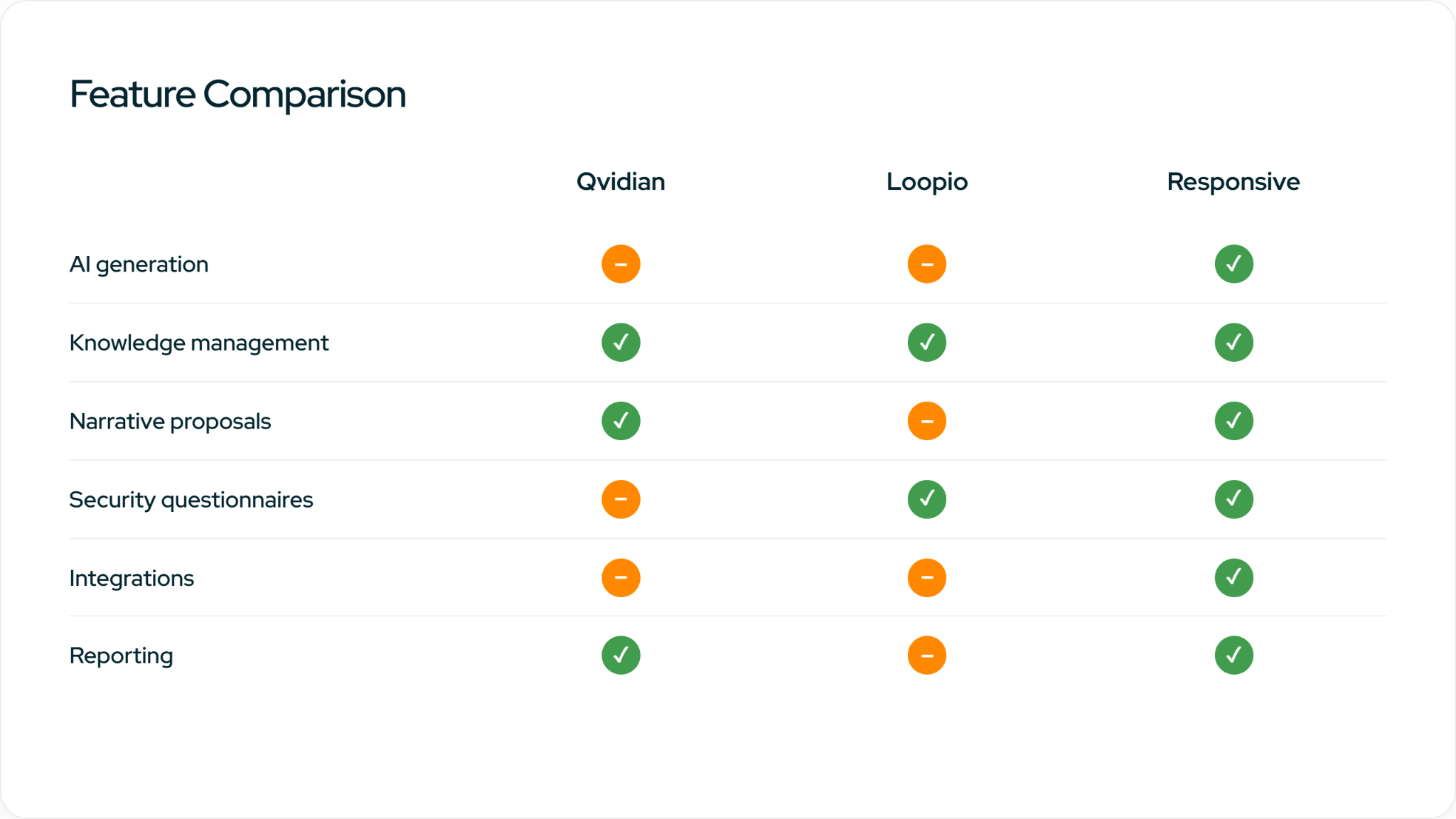
AI Response Generation
- Qvidian: AutoFill finds saved answers by keyword, and its AI Assist generates responses; results still lean on library coverage.
- Loopio: “Magic" reuses approved answers, while its generative AI drafts new answers from your library
- Responsive: agents draft full answers with source citations. Users report occasional hallucinations.
Response quality depends on library quality on all three. Test uncovered questions during the demo.
Knowledge Management
- Qvidian: one central library, curated by hand, built for large teams.
- Loopio: a clean Q&A library that flags duplicate answers.
- Responsive: a large enterprise library with AI search (Ask and LookUp) and TRACE Score checks.
AI Content Governance
Keeping the library accurate is a manual job on all three. A content owner reviews answers to catch conflicts, outdated content, and duplicates. Responsive gives large teams the most structure. Loopio gives the least. None of the three flags contradictions across the library automatically.
Narrative Proposals
- Qvidian: strongest. It assembles complex, branded proposal documents.
- Responsive: handles narrative responses and government bids well.
- Loopio: built more for structured Q&A than long documents.
Security Questionnaires & DDQs
- Responsive: widely used here. Users complete most of a long questionnaire straight from the library.
- Loopio: handles them well. Its browser extension fills questionnaires inside customer portals.
- Qvidian: supported, but built more for formal proposals.
Competitive Intelligence
None of the three researches competitors or builds win themes. Teams do it manually outside the platform, pulling from battlecards, past deals, and win/loss notes, then writing the positioning themselves. The platform won't tell you who you're up against or where to press your advantage.
Go / No-Go Decisions
- Responsive: supports bid/no-bid decisions via Requirements Analysis and scoring templates.
- Loopio: no dedicated go/no-go or opportunity scoring; teams qualify bids manually.
- Qvidian: lighter qualification support.
Confirm whether it's included or costs extra. That affects both budget and adoption.
Integrations
- Qvidian: CRM and Microsoft tools, with strong Word workflows.
- Loopio: Salesforce, HubSpot, Slack, and Teams, plus a basic API.
- Responsive: 30+ integrations (20+ native connectors) and 75+ open APIs
Test the Salesforce sync on your own instance. Users say it's powerful but sometimes fragile.
Reporting & Analytics
- Qvidian offers 70+ prebuilt reports and a drag-and-drop custom report builder
- Responsive provides enterprise dashboards for large teams.
- Loopio's reporting is simpler but sufficient for mid-market.
Ease of Use
- Loopio: the cleanest interface and the fastest to onboard. Teams get productive with little training.
- Responsive: powerful but dense. The learning curve is steeper, and users note the old and new interfaces feel inconsistent.
- Qvidian: the hardest to learn. The interface is dated and setup is complex.
Security
- Qvidian: enterprise security under Upland, including SOC 2.
- Loopio: SOC 2 and GDPR.
- Responsive: SOC 2 Type II, GDPR, and ISO 27001.
Pricing
None publishes list pricing. All three quote custom and charge per user.
- Qvidian: No publicly listed pricing
- Loopio: $15K–$150K+/yr depending on team size (Vendr data)
- Responsive: starts at $5K/yr for 5 users (Lite). Mid and enterprise tiers are custom.
Still deciding what matters most in an RFP platform?
Read our 7-step RFP software buyer's guide before you sit through three demos, and evaluate vendors with a scorecard, not a sales pitch.
Download the EbookQvidian vs Loopio vs Responsive: Pros and Cons From Real G2 Reviews
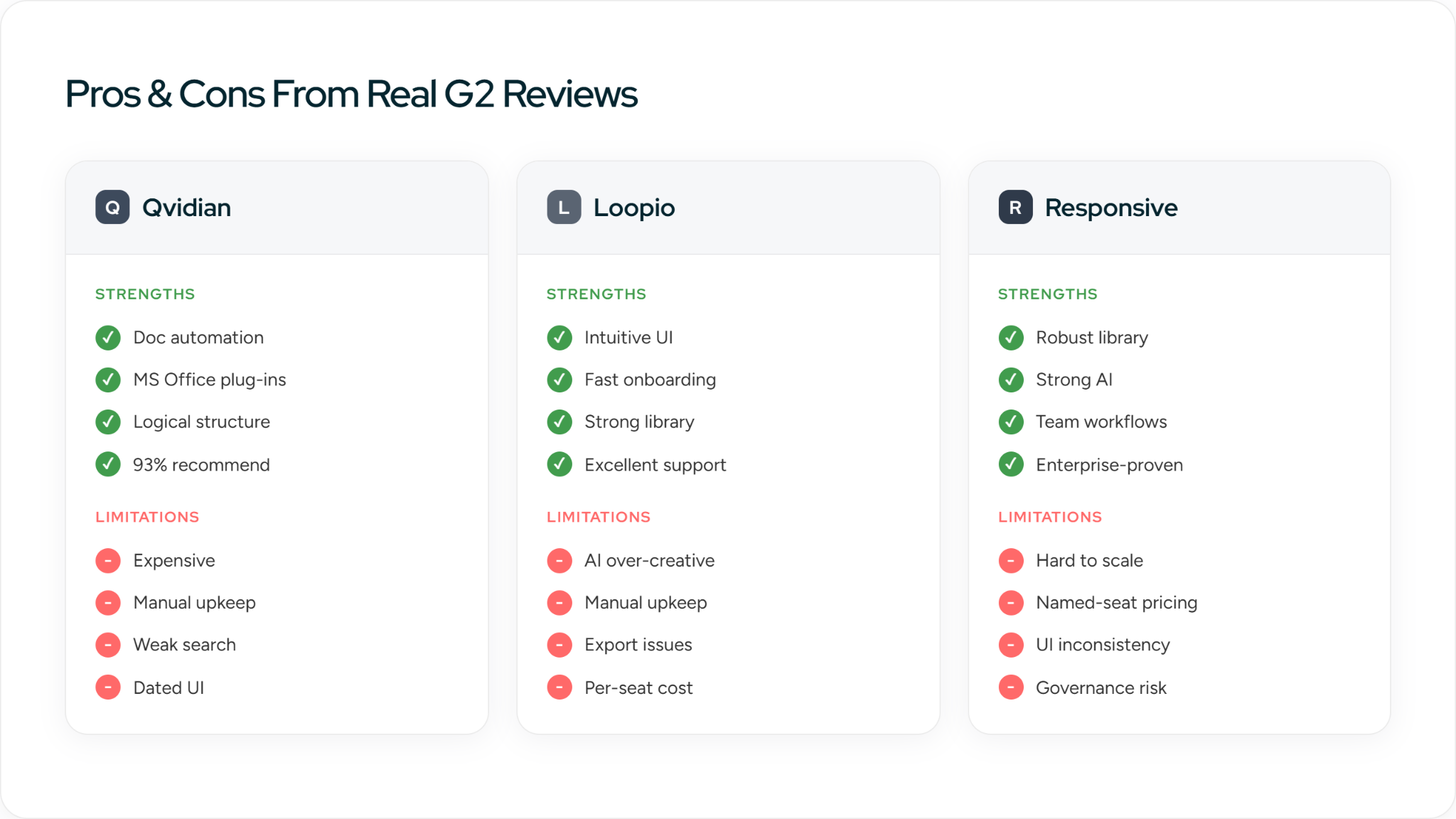
What do real users say about each platform? These strengths and limitations come straight from verified G2 reviews as of mid-2026.
Loopio
Strengths
- Easy to use. Reviewers praise usability and call the interface intuitive.
- Fast onboarding. Teams get productive quickly with little training.
- Strong content library. Tags and categories make finding approved answers fast.
- Excellent support; users call it quick and clear.
- Strong Google and Microsoft integrations.
- AI features cut drafting time, with users reporting significant time savings on first drafts
Limitations
- AI can be too "creative." Get Answers needs more control, and responses often need rewriting.
- Quality drops when the library isn't maintained. Magic returns outdated or irrelevant answers if content falls behind.
- Formatting and export issues. Users manually fix exports and want better graphics options.
- Learning curve to use it fully, despite the clean interface.
- Per-user pricing penalizes teams looping in occasional SMEs.
- No conflict detection and no deal-specific personalization.
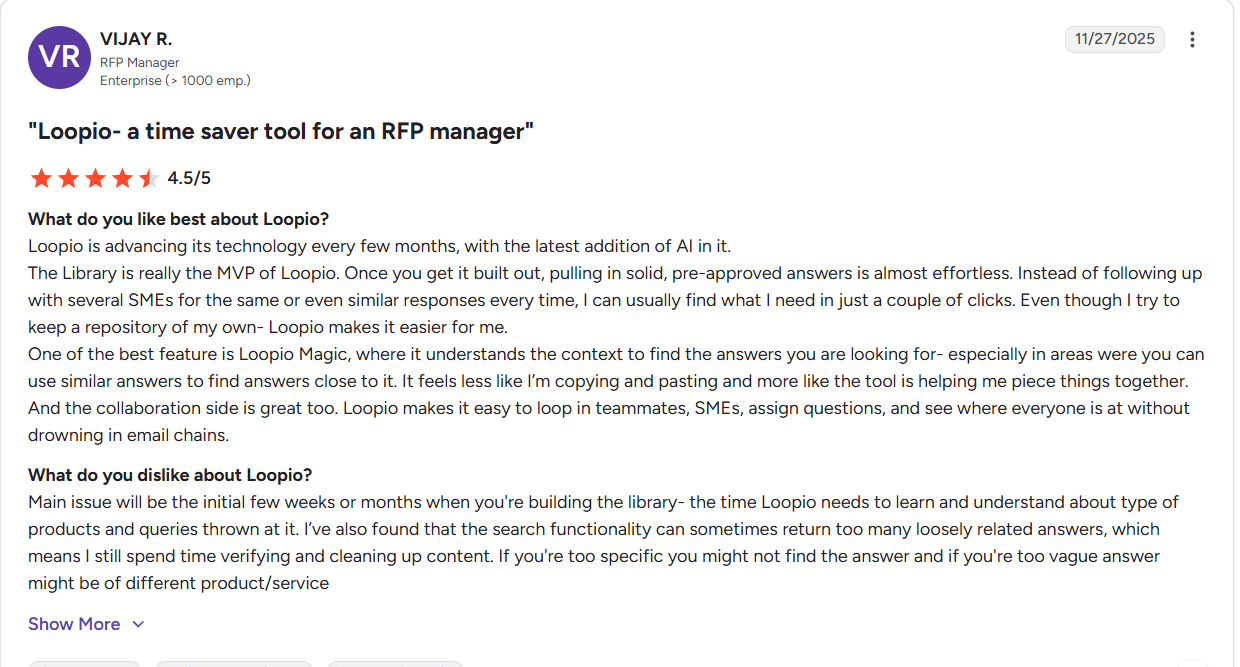
Here’s what a G2 reviewer says about Loopio:
Responsive
Strengths
- Robust content library and AI features, with strong organization.
- Time-saving collaboration and team workflows.
- Improved AI Assistant, plus multi-language translation and answer reuse.
- Useful Ask Responsive browser app for portals.
- Proven at enterprise scale, and a long-standing G2 category leader.
Limitations
- Hard to manage as it grows. Multiple answer versions slow down finding the current one.
- Named-user licensing. Every reviewer, commenter, or approver needs a paid seat, which raises cost.
- UI inconsistency between the old and new interfaces.
- Salesforce integration friction and heavy library-maintenance overhead.
- AI can answer from outside the approved library, a governance risk in regulated industries.
- Reviewers also note wrong product answers and slower page loads in the AI section.
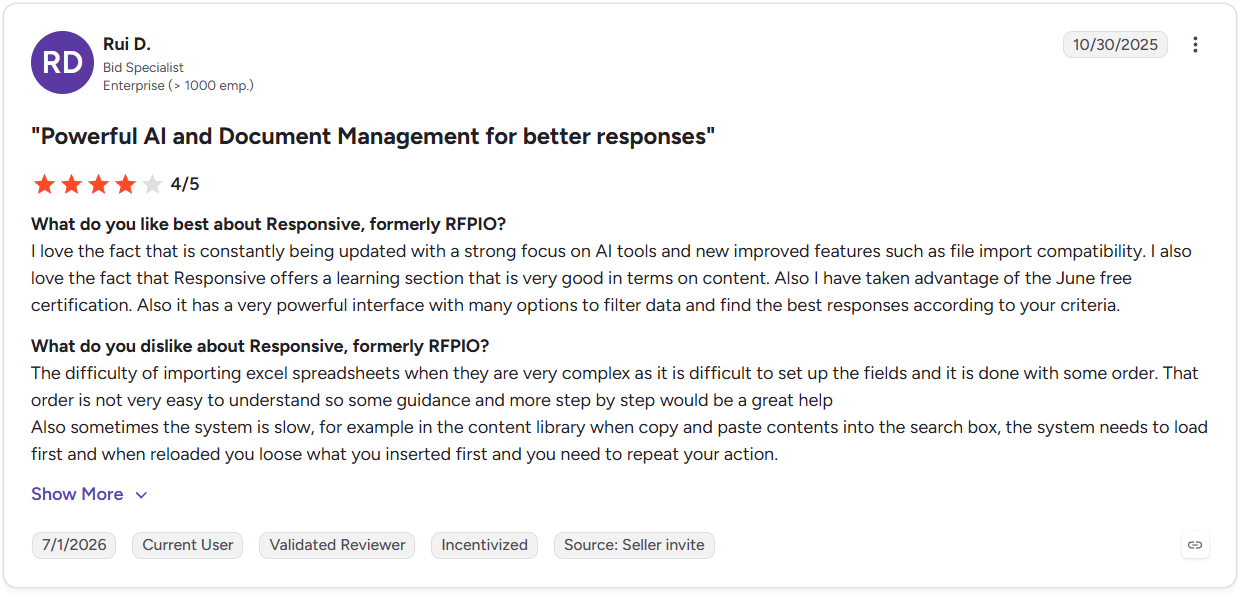
This is what a G2 reviewer says about Responsive:
Qvidian
Strengths
- Strong proposal and document automation. Users build proposal documents with minimal setup.
- Logical library and document-type structure.
- Microsoft Office integration with plug-ins.
- Time-saving content access and collaboration.
- AI Assist feature praised for speed and quality.
- 93% of G2 reviewers recommend it.
Limitations
- Expensive, especially for smaller teams.
- Difficult data upkeep. Uploading and updating content is manual and time-consuming.
- Weak responses. Users want contextual answers search and cite repetitive results.
- Dated, non-intuitive interface that slows new-user adoption.
- Complex implementation that some find overwhelming.
- Support experiences vary, praised by some, criticized by others during updates.
Here’s how a G2 reviewer rate Qvidian:

The AI-Native Alternative to Qvidian, Loopio, and Responsive
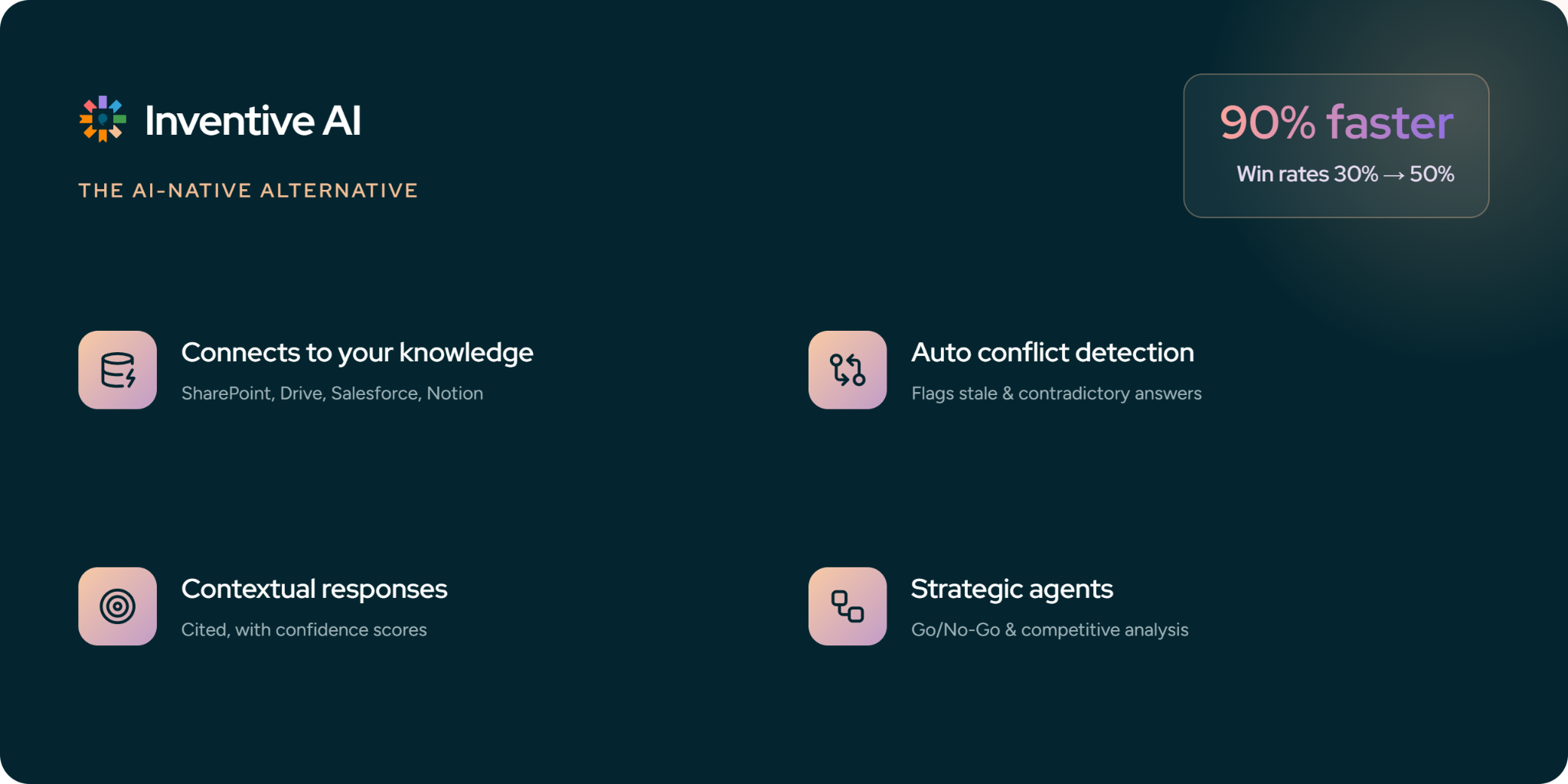
If you're shortlisting these three, it's worth knowing there's a newer category that takes a different architectural approach. Inventive AI is an autonomous AI agentic platform for RFPs, RFIs, DDQs, and security questionnaires, built AI-native rather than layering AI onto a Q&A library.
Where all three legacy tools rely on a manually curated library and lack automated conflict detection, Inventive AI:
- Connects to knowledge you already have — SharePoint, Google Drive, Salesforce, Confluence, Notion, Zendesk, instead of a separate library you maintain.
- Detects conflicts and outdated content automatically, flagging stale or contradictory answers before submission.
- Contextual responses, combining company knowledge with customer and deal context, with source citations and confidence scores on every answer.
- Strategic agents for go/no-go and competitive analysis inside the workflow.
- Reports results: customers cite up to 90% faster response times and win rates improving from 30% to 50%.
Best for: mid-market and enterprise teams replacing manual RFP workflows, especially where reducing library maintenance is a priority.
Final Verdict
No single winner, the right platform depends on your team's size, maturity, and how much complexity you're willing to manage.
Loopio: best suited to teams adopting their first RFP tool. Fastest to onboard, easiest to use, and highly rated for support. Trade-off: manual library upkeep that grows heavier as answers pile up.
Responsive: suited to large, multi-region teams handling high volumes of RFPs and security questionnaires. Offers governance, role-based access, audit trails, and broad integrations. Trade-off: steeper learning curve, named-user licensing, higher pricing.
Qvidian: suited to complex, formatted proposals and regulated industries that need control and consistency. Strong document automation. Trade-off: dated interface, slow search, complex setup, and the highest cost for small teams.
Still weighing the three? Before committing, explore an autonomous AI agentic platform. This newer category offers the same core capabilities; drafting, AI governance, review, integrations, without the manual library upkeep, drafting from systems you already use and keeping content current with live sync, keeping humans in loop for final approval.
FAQs
Can I migrate my content library from one tool to another?
Yes. All three support content import, and some (like Loopio) offer migration help. The heaviest lift is cleaning and de-duplicating content before it moves — not the transfer. Ask whether migration is included or billed as a service.
How long are contracts, and is there a free trial?
All three sell annual contracts, with discounts for multi-year deals. None has a self-serve free trial — expect a demo and a sales call. Responsive publishes an entry price ($5K/yr for 5 users, Lite); Loopio and Qvidian quote custom. Negotiate renewal uplift caps up front, since 3–5% annual increases are standard.
Do I need a dedicated content manager?
ffectively, yes. Each runs on a library someone keeps current, and teams without a content owner usually see quality slip within 6–12 months. Budget for the role — or evaluate AI-native tools that keep content current automatically.
Why do teams switch away from Qvidian?
Dated interface, slow and repetitive search, complex setup, and cost for smaller teams. Teams outgrowing it usually want something more modern and easier to use without losing compliance control — which points them to Loopio and Responsive.
Can occasional reviewers and SMEs use these without a paid seat?
Rarely. Responsive uses named-user licensing — anyone who reviews, comments, or approves needs a paid seat. Loopio also prices per user but separates full users from lighter library/contributor roles. If you loop in many occasional SMEs, model the seat cost first.
Are these tools overkill for a small team?
For a handful of RFPs a year, the enterprise tiers of Responsive and Qvidian are usually more than you need. A small team is better served by Loopio or Responsive Lite. If volume is low and sporadic, weigh whether a dedicated platform is worth it yet.