
How to Respond to RFQ Email: Components and Templates

Responding to RFQ emails looks simple on the surface. It is often a short request asking for pricing. But in reality, this is where many deals quietly fall apart.
The B2B sales cycles are becoming shorter, while decision expectations are rising. At the same time, teams spend significant time handling proposal-related work, which slows down deal momentum.
If your RFQ responses are rushed, inconsistent, or lack context, you risk getting filtered out early. You may never even reach the full RFP stage.
In this article, you will learn how to respond to RFQ emails with structure, clarity, and intent, so you can improve response quality and increase your chances of winning.
Key Takeaways
- RFQ emails may look simple, but they are high-stakes opportunities where your response speed and clarity directly affect whether you move forward. A rushed or unclear response can eliminate you early.
- A strong RFQ response includes clear scope confirmation, structured pricing, assumptions, and context. Buyers compare responses quickly, so clarity and format matter as much as pricing.
- Using the right templates and structure helps you respond faster without sacrificing accuracy. Customizing each response based on the buyer’s requirements improves your chances of selection.
- Common mistakes like slow responses, vague pricing, ignoring instructions, and using outdated content often lead to rejection, even when your pricing is competitive.
- Inventive AI helps you respond 10x faster with 95% accuracy by centralizing your knowledge, improving response quality, and ensuring consistency across every RFQ.
What is an RFQ Email?
Before you can respond to an RFQ email well, you need to understand what it actually is and what it signals about where the buyer is in their process.
An RFQ, or Request for Quotation, is a formal document a buyer sends to vendors when they already know what they need. They're not exploring options. They're not looking for creative solutions. They want pricing, delivery terms, and specifics, fast. The RFQ email is how that request reaches you.
Here's what makes it different from other procurement emails:
- It's transactional, not exploratory: The buyer has done their homework. They're comparing numbers, not ideas.
- It's time-sensitive by nature: Multiple vendors receive the same email. The buyer is building a shortlist from the responses they get back.
- It's closer to a closed deal than an open conversation: When a buyer sends an RFQ, they're actively moving toward a purchase decision.
RFQ emails are common across industries, including manufacturing, SaaS, professional services, healthcare, logistics, and government contracting. In some industries, vendors receive dozens of RFQ emails per month, each one a real revenue opportunity.
The moment an RFQ email arrives, the clock starts. How fast and how accurately you respond directly determines whether you make it to the next stage or get filtered out before the buyer even compares prices.
Think of an RFQ email as the buyer saying: "We're ready to buy. Are you ready to sell?" Your response answers that question.
Also Read: RFI vs RFP vs RFQ Templates + Vendor Response Formats
What's Included in an RFQ Email? 8 Key Components

Reading an RFQ email isn't just about getting to the pricing section. Every part of the document tells you something important about what the buyer needs and how they'll evaluate your response.
Here's what you'll typically find inside an RFQ email and what each component means for you:
1. Requirement or Project Description
This section tells you what the buyer needs. It may be a product, a service, or a combination of both. Read it carefully before anything else. Misunderstanding the requirement at this stage leads to a misaligned quote, which the buyer will notice immediately.
2. Technical Specifications
These are the details: dimensions, quantities, formats, features, materials, licenses and service levels. The buyer has been specific for a reason. Your response must address every specification mentioned. If you're unsure about any spec, flag it before submitting rather than guessing.
3. Quantity or Volume
Buyers include this so you can calculate accurate pricing. If volume varies (e.g., a range or a tiered structure), make sure your pricing reflects that. Don't quote for a single unit if they've asked for 500.
4. Timeline and Delivery Expectations
This tells you when the buyer needs the product or service delivered. Be realistic in your response. Giving an aggressive delivery date to win the bid and then missing it is far more damaging than quoting a longer but accurate timeline upfront.
5. Pricing Format Instructions
Some buyers tell you exactly how they want pricing laid out, per unit, bundled, hourly, or by milestone. Follow this precisely. If they've provided a pricing template, use it. Submitting pricing in a different format creates friction and signals you didn't read the document carefully.
6. Payment Terms
This section covers when and how the buyer plans to pay, upfront, on delivery, net-30, net-60, and so on. Be clear about your own payment terms in your response and flag any misalignment early.
7. Submission Instructions
This is the section most vendors skim, and it's the one that gets them disqualified. It includes the deadline, the format the response must be in (PDF, Word, specific portal), and to whom to send it. Miss a single instruction here, and your response may not even be reviewed.
8. Evaluation Criteria
Sometimes included, sometimes not. When it's there, read it first, before you read the questions. It tells you exactly what the buyer is weighing and where to put your best effort.
Each of these components affects how you structure your response. Missing even one can weaken your position.
5 RFQ Email Response Templates for Different Scenarios
Templates save time, but only when they’re used the right way. A generic, copy-paste template that doesn’t address the buyer’s specific requirements does more harm than good. Use these as starting frameworks and customize every detail to match the actual RFQ.
Template 1: Standard RFQ Response (Products or Services)
Use this when the RFQ is clear, specs are well-defined, and you’re responding with a straightforward quote.
Subject: Re: RFQ Submission – [Product/Service Name] for [Buyer Company Name] | RFQ Ref: [Reference Number]
Dear [Buyer Contact Name],
Thank you for including [Your Company Name] in this RFQ. We’ve reviewed your requirements and are pleased to submit our quotation below.
Summary of Requirements Understood:
[Brief restatement of what the buyer asked for in 2 to 3 lines]
Pricing Breakdown:
Pricing valid for 30 days from the date of this submission.
Delivery Timeline: [Specific date or number of business days]
Payment Terms: [Net-30 / 50% upfront + 50% on delivery / etc.]
Supporting Documents Attached: [List certifications, spec sheets, or terms documents]
Please don’t hesitate to reach out with any questions. We’re available at [email] or [phone].
Best regards,
[Your Name]
[Your Title]
[Your Company Name]
Template 2: RFQ Response With Clarification Request
Use this when the RFQ has ambiguous specs or missing details that would prevent you from quoting accurately. Don’t guess and submit; ask first, then respond.
Subject: Re: RFQ – [Product/Service] for [Buyer Company] | Clarification Request Before Submission
Dear [Buyer Contact Name],
Thank you for sharing this RFQ. We’ve reviewed it thoroughly and are ready to respond. Before submitting our quotation, we’d like to clarify a few points to make sure our pricing is accurate and fully aligned with your requirements.
Questions:
- [Specific question about a spec, quantity, or delivery detail]
- [Second clarifying question if needed]
- [Third clarifying question if needed]
We can turn around our full quotation within [X business hours/days] of receiving your answers. We want to make sure our response reflects exactly what you need.
Thank you for your time. We look forward to hearing from you.
Best regards,
[Your Name]
[Your Title]
[Your Company Name]
Template 3: RFQ Response: Competitive Positioning (When Price Isn’t Your Lowest)
Use this when your pricing isn’t the cheapest, but your value, reliability, quality, or experience justifies it. Don’t just submit numbers; frame them.
Subject: Re: RFQ Submission – [Product/Service] for [Buyer Company] | [Your Company Name]
Dear [Buyer Contact Name],
Thank you for the opportunity to quote on this requirement. We’ve reviewed your specifications carefully and are pleased to present our proposal below.
Pricing Breakdown:
Pricing valid for 30 days.
Why [Your Company Name]:
- [Specific proof point, e.g., “We’ve delivered this exact scope for [similar company type] within [timeline]”]
- [Relevant certification or quality standard]
- [One clear differentiator, e.g., dedicated account contact, guaranteed lead time, warranty terms]
Delivery Timeline: [Specific date]
Payment Terms: [Your terms]
We’re happy to discuss the details further at your convenience. Reach us at [email] or [phone].
Best regards,
[Your Name]
[Your Title]
[Your Company Name]
Template 4: RFQ Response to a Government or Public Sector Buyer
Use this for formal procurement processes where compliance language and documentation are non-negotiable.
Subject: Re: RFQ Reference [Number] – [Product/Service] | Quotation from [Your Company Name]
Dear [Contracting Officer / Procurement Contact],
[Your Company Name] is pleased to submit this quotation in response to RFQ Reference [Number] issued by [Agency/Department Name].
Vendor Information:
- Legal Name: [Your Company Name]
- Address: [Full Address]
- DUNS/UEI Number: [If applicable]
- CAGE Code: [If applicable]
Pricing:
Delivery: [Specific date aligned with solicitation requirement]
Certifications Enclosed: [List all relevant certifications, SAM registration, ISO, etc.]
This quotation is valid through [Date]. All terms comply with the requirements outlined in the solicitation.
Respectfully submitted,
[Your Name]
[Your Title]
[Your Company Name]
[Contact Information]
Template 5: RFQ Follow-Up Email (Post-Submission Check-In)
Use this when you’ve submitted your quote and haven’t received any update by or after the buyer’s stated deadline.
Subject: Follow-Up: RFQ Submission – [Product/Service] | [Your Company Name]
Dear [Buyer Contact Name],
I’m reaching out to follow up on the quotation we submitted on [Submission Date] for [Product/Service Description].
We understand your team is reviewing responses and wanted to make ourselves available for any questions, clarifications, or additional information you might need.
If the timeline has shifted or the project is moving in a different direction, we’d appreciate a quick note so we can plan accordingly.
Thank you for your time. We remain very interested in supporting [Buyer Company Name] with this requirement.
Best regards,
[Your Name]
[Your Title]
[Your Company Name]
[Email | Phone]
Each template gives you a starting structure. You should still customize it based on the buyer’s context.
Also Read: Write RFQ Cover Letters That Strengthen Your Quotation (2026 Guide)
5 Best Practices to Follow for Responding to RFQ Email

A strong RFQ response is not just about speed. It is about sending a response that is clear, accurate, and easy to evaluate. If you rush without clarity, you risk mispricing, misalignment, or getting eliminated early.
Here’s how you can approach RFQ responses more effectively:
1. Clarify Before You Quote
RFQ emails often come with gaps. Missing details around scope, timelines, or specifications are common.
Before you send pricing:
- Identify unclear areas in the request.
- Ask focused follow-up questions.
- Confirm assumptions if clarification is not possible.
This step helps you avoid incorrect pricing and reduces the chances of rework later. It also signals that you pay attention to detail.
2. Structure Your Response Clearly
Buyers often review multiple RFQ responses side by side. If your response is hard to scan, it gets overlooked.
Make your response easy to evaluate:
- Use clear sections like scope, pricing, assumptions, and timelines.
- Keep formatting consistent across responses.
- Use bullet points or tables where possible.
A structured response reduces friction for the buyer and improves readability.
3. Break Down Pricing Transparently
Providing a single total number without context creates uncertainty. Buyers want to understand how your pricing is built.
Instead of lump-sum pricing:
- Break costs into components (e.g., materials, services, timelines).
- Highlight any variable costs or dependencies.
- Show pricing tiers if applicable.
Transparent pricing builds trust and makes it easier for buyers to compare options.
4. Add Context Around Your Quote
Pricing alone does not tell the full story. Buyers also want to know what they are getting.
Strengthen your response by:
- Clearly stating what is included and excluded.
- Highlighting assumptions that impact delivery.
- Adding brief notes on approach or methodology.
This reduces back-and-forth and prevents misunderstandings during later stages.
5. Maintain Consistency Across Responses
When multiple teams contribute to RFQ responses, inconsistencies often appear. This can affect credibility.
To maintain consistency:
- Use standardized templates.
- Align messaging across sales, solutions, and proposal teams.
- Reuse validated content from past responses.
Consistent responses reflect reliability and professionalism, which buyers value when shortlisting vendors.
A well-structured RFQ response helps you stand out early. It shows clarity, attention to detail, and readiness to deliver, all of which increase your chances of moving forward.
Pro Tip: Always include one line explaining why your pricing is structured the way it is. This improves buyer confidence.
6 Common Mistakes to Avoid While Responding to an RFQ Email

Most RFQ losses don't come from bad pricing. They come from avoidable process failures. Here are the mistakes that cost vendors deals, and what to do instead.
1. Responding too slowly
35–50% of deals go to the vendor who responds first. In RFQ processes, buyers often shortlist the first qualified responses they receive. Every hour you delay is a window for a competitor to close in.
Build a response process that doesn't require starting from scratch. A content library of approved pricing, specs, and supporting documents means you can respond in hours, not days.
2. Vague or incomplete pricing
Paragraph-format pricing, missing line items, no unit breakdown, and unclear totals create confusion. Confused buyers don't ask for clarification; they move to the next vendor.
Always use a pricing table. Account for every item the buyer listed. Include pricing validity, payment terms, and any conditions that affect cost.
3. Ignoring submission format instructions
Wrong file format, wrong attachment name, sent to the wrong email address; these disqualify submissions before content is even reviewed.
Read the submission instructions section first. Check format requirements, recipient, and deadline before you write anything else.
4. Sending a generic template response
Buyers can spot a copy-paste response immediately. When your answer doesn't reference their specific product name, quantity, or use case, it signals low effort, and low effort signals low reliability.
Customize every response. At minimum, restate their requirement in your own words and match your pricing structure to what they asked for.
5. Using outdated pricing, specs, or certifications
Submitting last year's pricing or an expired certification damages credibility fast. If a buyer catches an inconsistency between what you submitted and what's verifiable, the trust gap is hard to close.
Validate all supporting information before attaching it. Maintain an updated content library that flags outdated material automatically.
6. Not following up after submission
Most vendors submit and go silent. A single, professional follow-up email after the stated review deadline keeps you visible and gives the buyer an easy way to ask clarifying questions.
Schedule a follow-up reminder when you submit. Use Template 5 above and keep it short.
Avoiding these mistakes improves your chances of moving forward.
Also Read: Request for Quote Template Word - The Ultimate RFQ Templates in 2026
Inventive AI: How It Helps You Win More RFQ Emails
RFQ emails may look simple, but you already know they’re not. You’re expected to respond fast, get pricing right, align multiple teams, and still make your response stand out.
That’s where Inventive AI fits in. With AI-powered RFP response software, you can handle RFQs with more clarity, less back-and-forth, and far better consistency.
1. 2× Higher Quality Responses
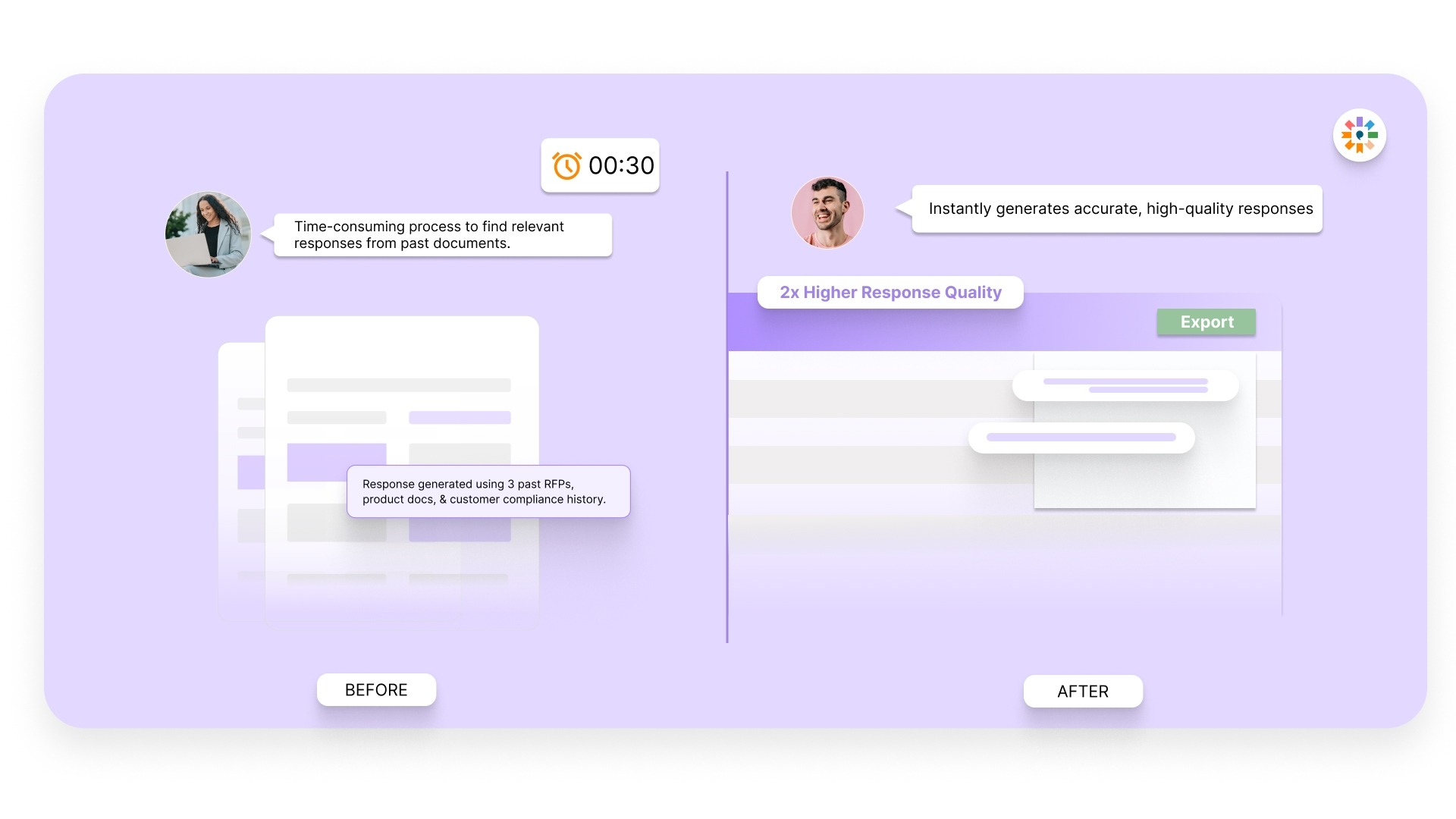
When RFQs come in, the pressure is always on speed. But rushing often leads to incomplete or generic responses.
Inventive AI helps you improve response quality by using your past answers and existing knowledge. Instead of guessing or rewriting everything, you build on proven content. The result is a response that feels complete, aligned, and ready to send without multiple revisions.
2. Context Engine
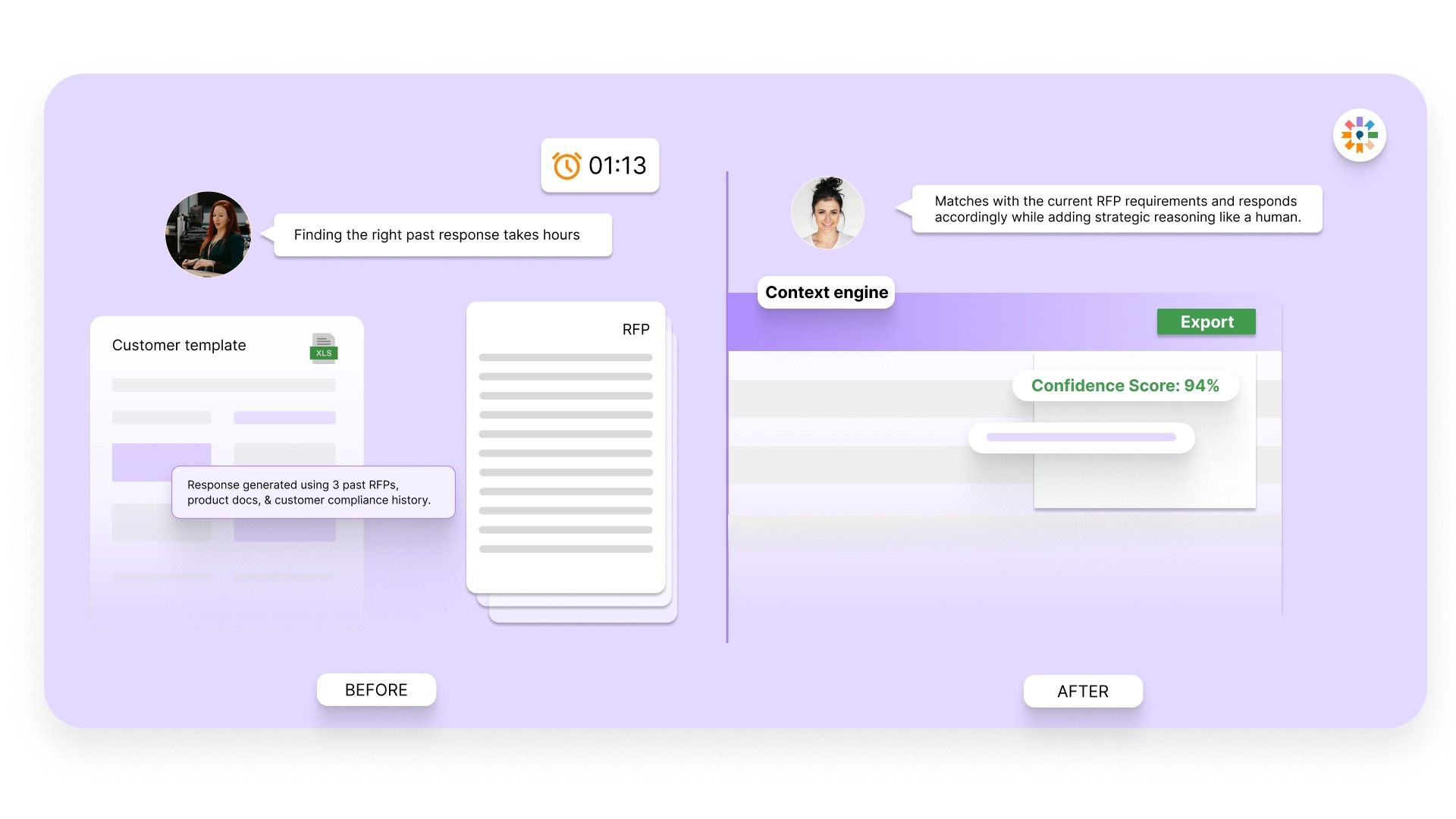
One of the biggest challenges with RFQs is pulling the right information quickly. Pricing may sit with finance, scope details with solutions, and past answers somewhere else.
Inventive AI’s Context Engine connects all of this for you. It brings together relevant information from across your systems so your response reflects the full picture. This means fewer gaps and less time spent chasing inputs.
3. Conflict Detection
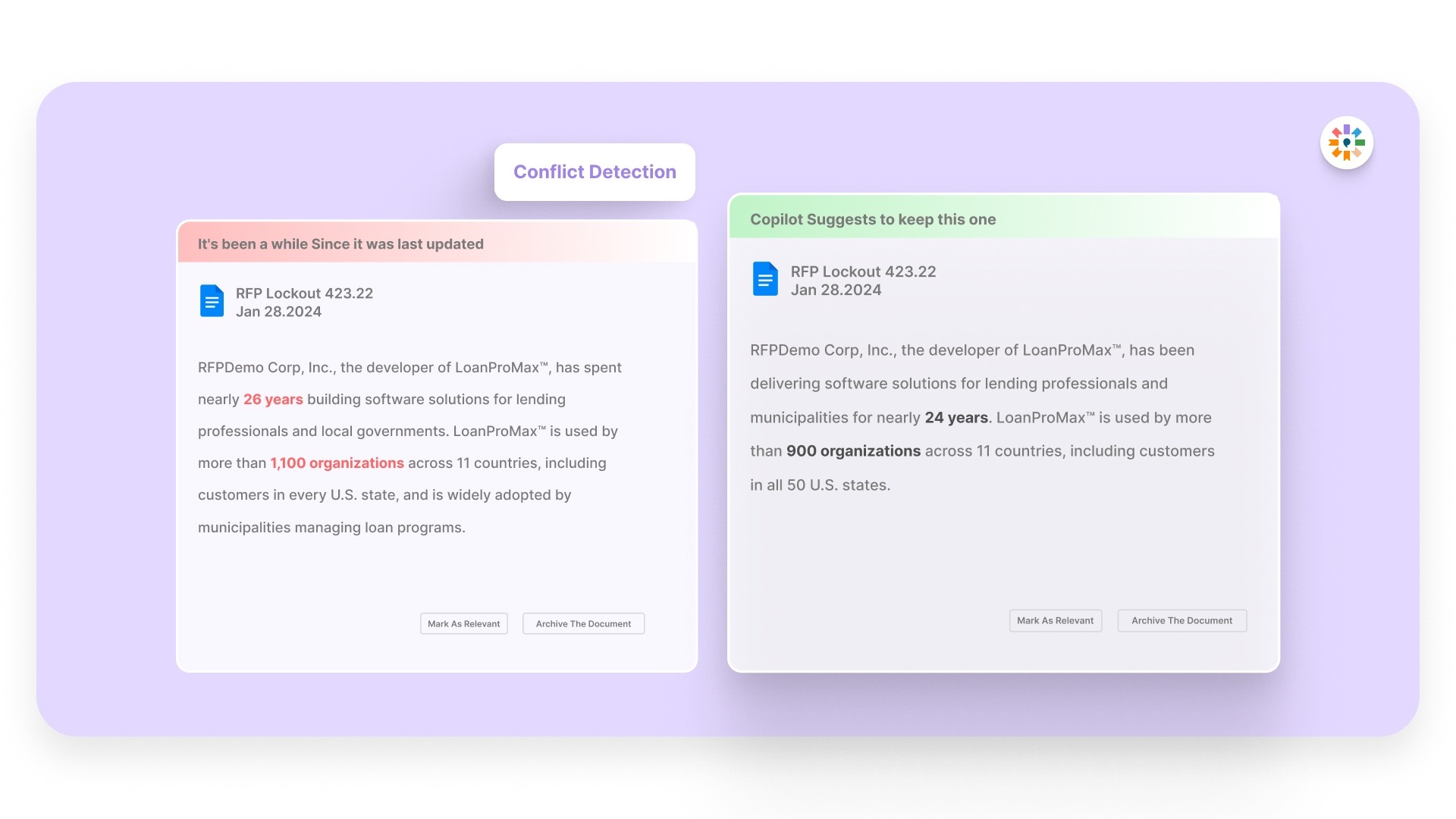
If you’ve ever had to fix last-minute inconsistencies, you know how common this is. Different teams often provide slightly different answers, and that shows up in the final response.
Inventive AI flags these conflicts early. It helps you spot mismatches before you send your response, so everything stays aligned and consistent.
4. Outdated Content Detection
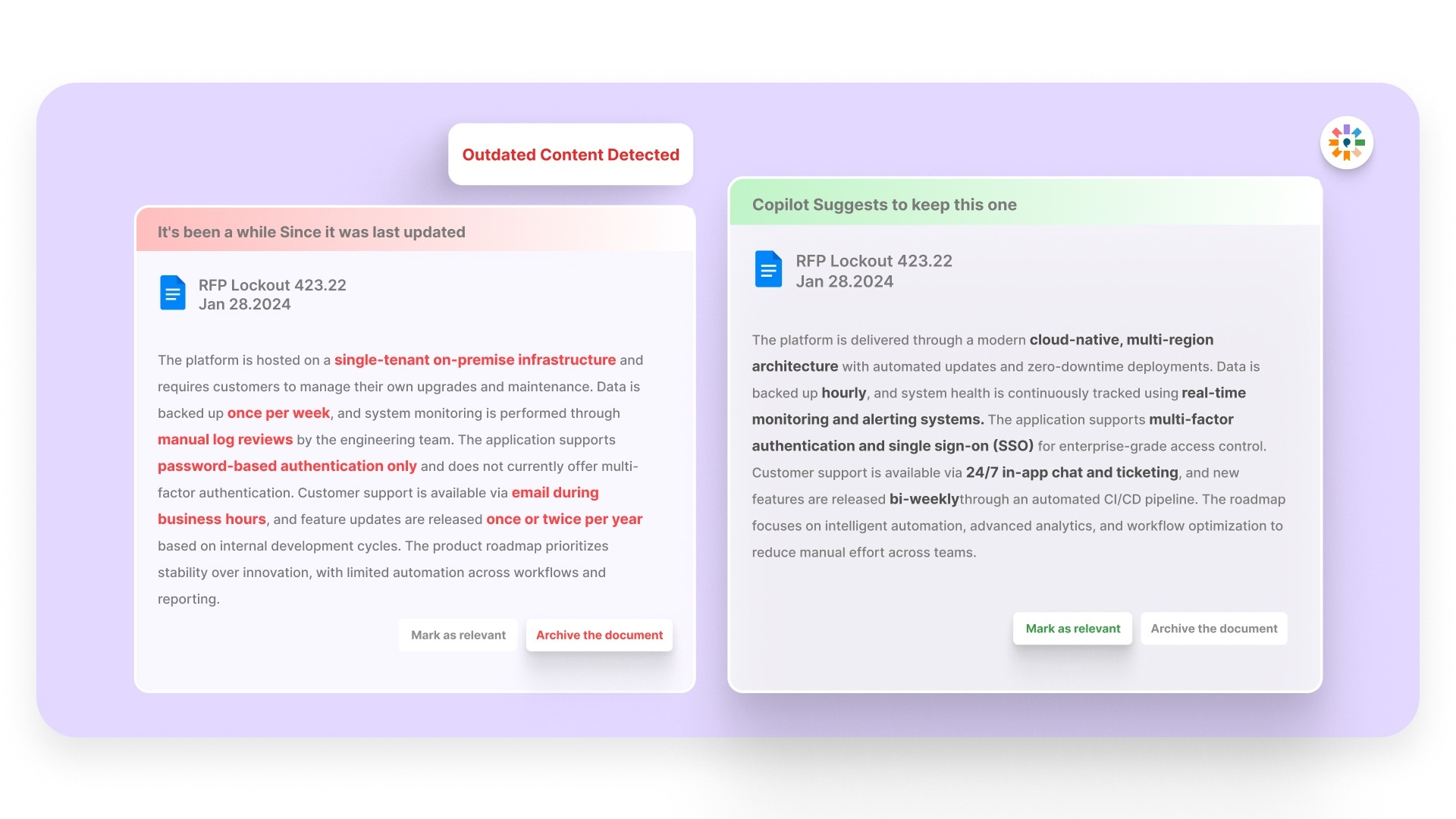
Reusing past responses can save time, but it also creates risk. Old pricing or outdated details can slip in without notice.
Inventive AI checks your content and highlights anything that is no longer relevant. This ensures that what you send is accurate and reflects your current offering.
5. Narrative Style Proposals
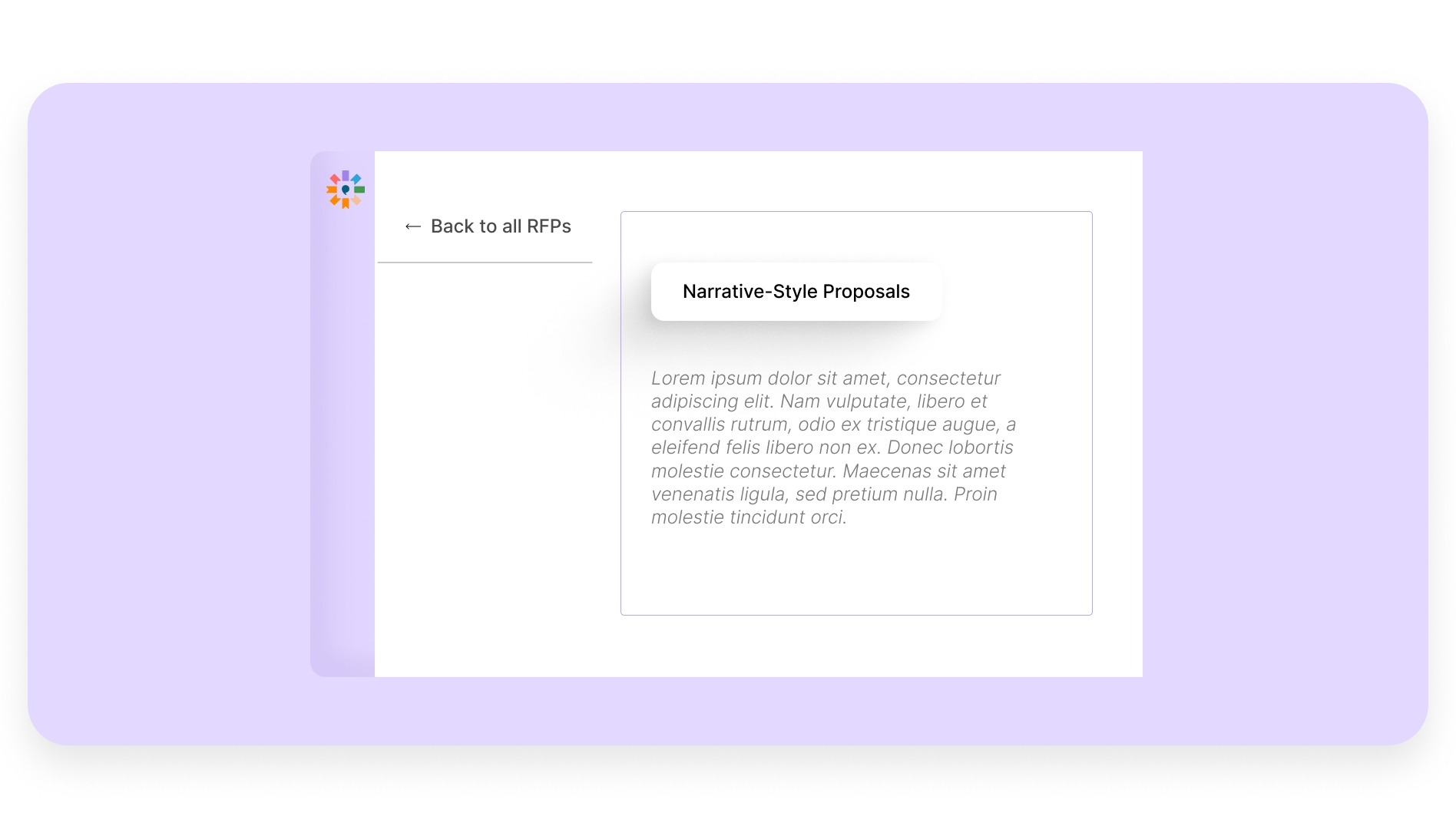
Even in RFQs, how you present your response matters. If your response feels scattered, it becomes harder for the buyer to evaluate.
Inventive AI helps you structure your responses in a clear and logical flow. Your answers feel connected, easy to read, and more professional, which improves how they are received.
6. Simple, Easy-to-Use Interface
When deadlines are tight, you don’t have time to deal with complicated tools.
Inventive AI keeps things simple. Your team can quickly access information, collaborate, and generate responses without friction. This helps you move faster without losing control over quality.
With Inventive AI, RFQ responses stop being rushed tasks and start becoming structured opportunities. You respond faster, stay consistent, and improve the quality of every submission, which gives you a better chance of moving forward.
Frequently Asked Questions (FAQs)
1. What makes an RFQ email response stand out?
A strong RFQ response goes beyond pricing. It clearly confirms scope, provides transparent pricing, and adds context around your approach. Structured responses with clear assumptions and consistent messaging are more likely to move forward.
2. How is an RFQ different from an RFP?
An RFQ email focuses entirely on pricing for a well-defined requirement. An RFP email asks for methodology, strategy, and solution design alongside pricing. RFQs are shorter but require precise responses.
3. How quickly should you respond to an RFQ email?
You should respond as soon as possible, ideally within 24 hours. However, accuracy should not be compromised for speed. Build a response process that allows for same-day turnaround on standard RFQs.
4. Can RFQ responses impact deal outcomes?
Yes. RFQ responses often determine whether you move to the next stage. A weak response can eliminate you early.
5. Why do vendors lose RFQs even with competitive pricing?
Vendors often lose RFQs because pricing alone is not enough. Responses that lack clarity, structure, or context make it harder for buyers to evaluate them. If your response is incomplete, inconsistent, or difficult to review, it can get rejected even when your pricing is competitive.

90% Faster RFPs. 50% More Wins. Watch a 2-Minute Demo.

Gaurav Nemade
After witnessing the gap between generic AI models and the high precision required for business proposals, Gaurav co-founded Inventive AI to bring true intelligence to the RFP process. An IIT Roorkee graduate with deep expertise in building Large Language Models (LLMs), he focuses on ensuring product teams spend less time on repetitive technical questionnaires and more time on innovation.
.avif)
Mukund Kumar
Understanding that sales leaders struggle to cut through the hype of generic AI, Mukund focuses on connecting enterprises with the specialized RFP automation they actually need at Inventive AI. An IIT Jodhpur graduate with 3+ years in growth marketing, he uses data-driven strategies to help teams discover the solution to their proposal headaches and scale their revenue operations.