Claude vs Inventive AI: Comparing two approaches to RFP response automation [2026]
If your team is using Claude or ChatGPT to help with RFPs, you've probably already hit the wall: the tool is genuinely good at answering a question, but an RFP isn't one question. It's 80 of them, tied to product specs that change monthly, security language that has to be exact, and four or five people who all need to weigh in before anything goes out the door.
That gap, between "answers a question well" and "runs a process," is where most RFP teams quietly lose weeks. Here's where it actually shows up, and what a purpose-built RFP platform does differently.
The hidden cost of running RFPs through Claude
Before comparing features, it's worth asking a more basic question: how much is the workflow itself costing you right now?
If you're using Claude or Claude Projects for RFPs today, a few questions tend to surface the real cost:
• Do you find yourself giving Claude the same background context again and again for every new RFP?
• How much time goes into prompting, re-prompting, and refining a single answer until it's usable, or giving up and writing it yourself?
• How much time does your team spend re-copying product specs and security details into Claude every time a new RFP lands?
• How much time have you sunk into organizing information inside Claude Projects, just to keep it current?
There's also a risk that rarely gets tracked. When a product feature changes, how confident are you that five different teammates using Claude aren't sending out five different, possibly outdated or conflicting, answers? And when four or more reviewers need to check, edit, and approve responses before submission, how is that actually happening? In most cases, it's a chat window plus a side spreadsheet plus a Slack thread, which is a lot of surface area for something to slip through.
And then there's the revenue question. If you're responding to more than 15 RFPs a year, every hour spent on prompting and reformatting is an hour not spent finding the next opportunity, or a deadline that quietly gets missed because the response wasn't ready in time.
What teams say when you actually ask them about Claude
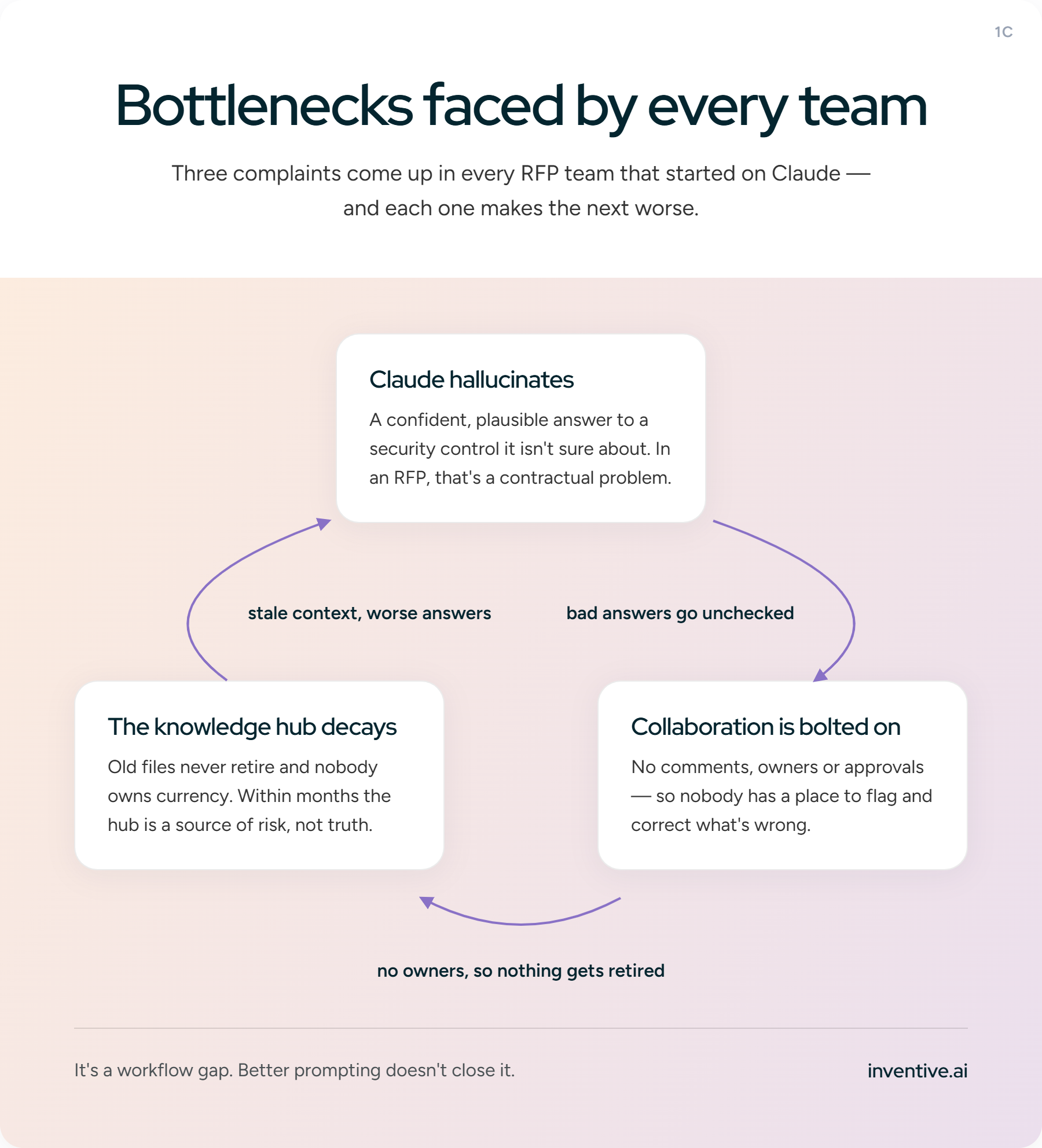
Talk to enough RFP teams that started their AI workflow on Claude, and the same three complaints come up almost every time.
Collaboration is hard. There's no built-in way to comment on a draft, assign a question to a specific teammate, manage the RFP as a project with owners and deadlines, or pull a status report for leadership. All of that has to be bolted on with spreadsheets and Slack threads, which means the "collaboration" is really happening outside the tool that's supposedly doing the work.
The knowledge hub is tedious to maintain. Claude Projects gives you a place to dump reference material, but keeping that a genuinely governed knowledge hub is a manual, ongoing chore. Old files don't get retired automatically. Nobody owns making sure it stays current. Within a few months, the knowledge hub itself becomes a source of risk instead of a source of truth.
Claude hallucinates, constantly. Ask it to fill in a security control, a certification, or a technical spec it isn't fully certain about, and it will often generate a confident, plausible-sounding answer anyway, whether or not it's accurate. In everyday use that's a nuisance. In an RFP, a single hallucinated compliance claim or misstated feature can cost you the deal, or worse, come back on you contractually after you've won it.
These three issues are the actual, lived experience of running RFPs through Claude, and they compound each other. Hallucinations are worse when the knowledge hub behind them isn't governed. A badly maintained knowledge hub is harder to fix when there's no collaborative workflow for anyone to flag and correct it.
Where Claude and Inventive AI actually diverge
The core difference isn't intelligence. Claude is a capable model. The difference is what happens around it.
With Claude or Claude Projects, the workflow is a loop: prompt, refine, copy, repeat. An RFP with 80 questions means running that loop 80 times, and then formatting everything yourself once you're done.
With Inventive AI, the workflow is a pass: upload the full RFP, review and improve the drafted answers, approve, and move on. The context for each individual question is pulled automatically, instead of being re-explained by hand every time, and every answer is grounded in a governed knowledge base rather than generated from scratch.
| Claude / Claude Projects | Inventive AI | |
|---|---|---|
| Start | Prompt the AI question by question | Upload the full RFP |
| Context | You re-enter context every time | The right context is pulled automatically per question |
| Work | Prompt, refine, copy, repeat | Review, improve, approve |
| Team | Collaborate loosely around chats or projects | Assign owners, reviewers, and approvals directly |
As Kristy McDougal, Director of Solutions & Support at Hygraph, put it: "AI-native RFP responses that beat a self-trained GPT + spreadsheet workflow."
The four places this shows up in daily work
Zoom into the actual day-to-day, and the pain points above turn into four specific, recurring problems, along with what fixes each one.
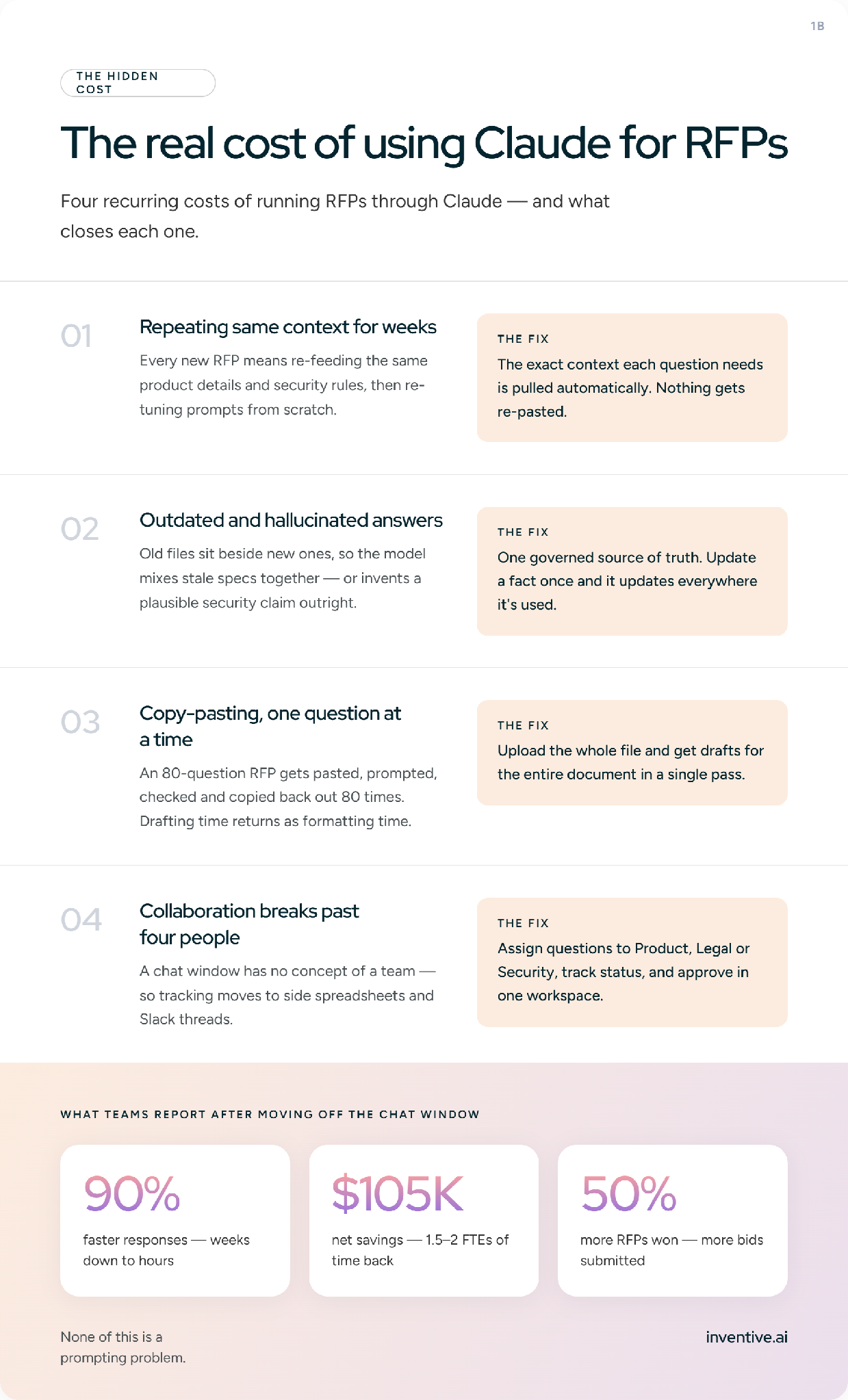
Repeating the same context over and over. Claude doesn't inherently know which product details or security rules apply to which customer. Every new RFP means feeding it the same background information and re-tuning your prompts from scratch. The result is a team that spends hours re-explaining things it already explained last month. A platform built for this pulls the exact context each question needs automatically, so nothing gets re-pasted.
Outdated and hallucinated answers. Upload new files to Claude Projects, and the old ones don't go anywhere; they sit alongside the new material, and the model can mix product details from an old RFP with the current one, or simply invent a plausible-sounding detail when the real answer isn't clearly in context. That's how outdated, incorrect, or fabricated security and feature information ends up in front of a prospect. The fix is a single, governed source of truth: update a fact once in a shared knowledge base, and it updates everywhere it's used, with no stale or hallucinated information left in the mix.
Copy-pasting questions one by one. Claude is a chat box, which means an 80-question RFP has to be pasted in, prompted, checked, and copied back out, one question at a time. Whatever time you saved on drafting gets spent right back on copy-pasting and reformatting. The alternative is uploading the whole file at once and getting draft responses for the entire document in a single pass.
Collaboration breaks down past a handful of people. A chat window has no concept of a team. It can't assign question 12 to Legal, route question 45 to Security, or show you who approved what. Once more than three or four people need to touch a response, teams fall back to side spreadsheets and Slack threads to track it, which is exactly the coordination overhead AI was supposed to remove. The fix is built-in ownership: assign questions directly to Product, Legal, or Security, track status, and approve everything in one shared workspace.
What changes when you move off the chat window
The numbers bear this out. Teams that move their RFP process off Claude/ChatGPT and onto a dedicated platform like Inventive AI report:
• 90% faster responses, cutting turnaround from weeks down to hours.
• $105,000 in net savings, roughly 1.5 to 2 full-time employees' worth of time redirected toward actually closing deals.
• 50% more RFPs won, because responding faster means being able to submit more bids in the first place.
As Jessica Raasch, Solutions Engineer at AssetWorks Facilities, described it: "Now our RFP response time is 90% faster than what we used to get."
Is Claude enough for your RFP process?
For a single question, or a first draft of a paragraph, Claude is a genuinely useful tool, and that's not in dispute. The problem shows up at the process level: collaboration that has to be improvised, a knowledge hub that takes real, ongoing effort to keep governed, and hallucinations that slip through when there's no structured source of truth behind an answer. None of that is a prompting problem, and no amount of better prompting fixes it. It's a workflow gap, and it's the reason RFP teams that started in a chat window eventually move to a platform built specifically to close it.
If your team is still running RFPs through Claude or ChatGPT and recognizes any of the friction above, it's worth seeing what the same process looks like with the right context pulled automatically, a governed knowledge hub that maintains itself, one pass instead of eighty, and a review chain your whole team can actually see.
See how Inventive AI compares on your next RFP → https://www.inventive.ai/
.avif)