Best Tender Management Software to Win More Deals in 2026
Compare the best tender management software for vendor-side teams in 2026, features, pricing, and real user reviews to help you pick the right tool.
Responding to a tender rarely starts with writing. It starts with finding approved content, assigning sections to SMEs, and ensuring every response is accurate and compliant before the deadline.
As the number of bids increases, manual coordination becomes difficult to sustain. Content gets duplicated, reviews stall, deadlines overlap, and teams spend more time managing the process than improving the proposal.
Tender management software simplifies that workflow by centralizing approved content, automating repetitive tasks, and keeping reviews on track.
In this guide, we'll compare eight vendor-side tender management platforms for 2026, explain how they differ, and help you choose the right solution for your bid team.
Key Takeaways
- Most tenders are lost before writing starts. Skipping a strict go/no-go assessment wastes engineering bandwidth on unwinnable deals.
- Inventive AI is an Autonomous AI agentic platform that connects to live files to manage the full response cycle, from intake to compliance checks, without manual library maintenance.
- Legacy libraries (Responsive & Loopio) are established tools built around static database models where generative search and drafting features are bolted on top of older software frameworks.
- Specialized platforms and niche options built for specific pain points, such as SiftHub for generating sales battlecards, SparrowGenie for formatting macro-heavy Excel sheets, and GovDash for federal matrices.
| Tool | Best For | Key Advantage | Pricing | Rating |
|---|---|---|---|---|
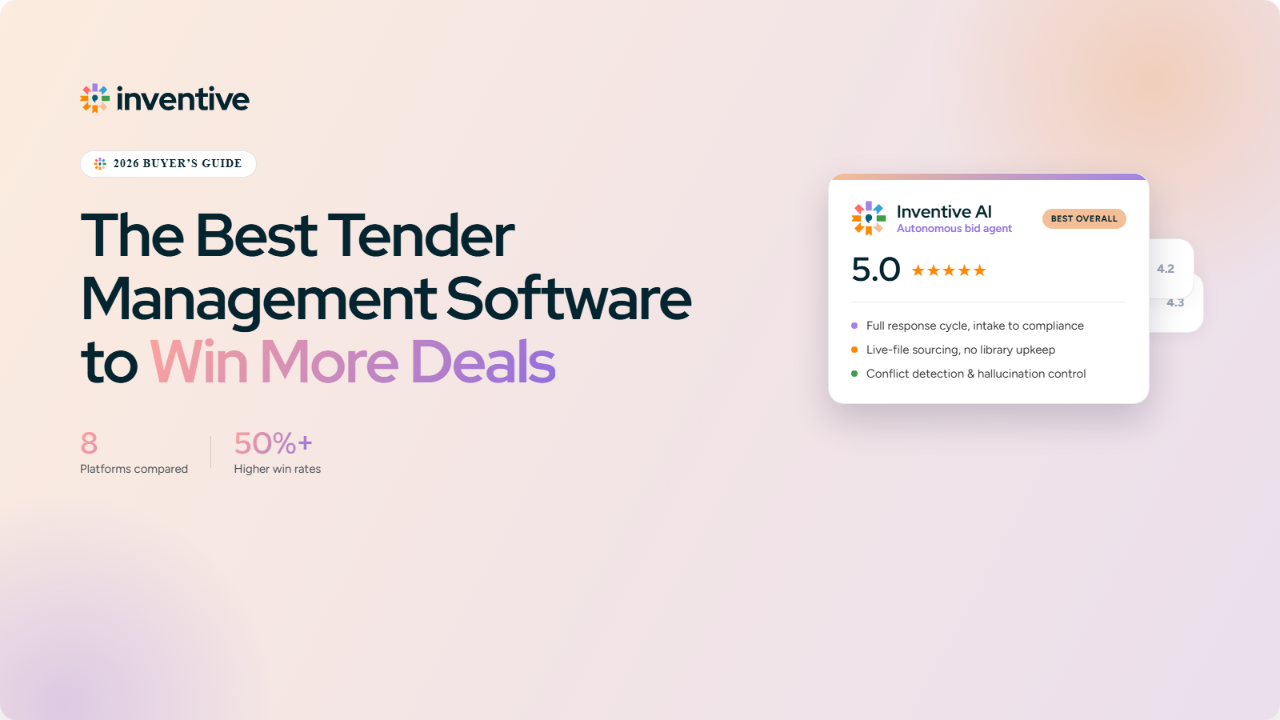
| Inventive AI | Proposal, Bid Management, Sales Ops, and Enablement teams wanting autonomous AI agents to run the full workflow. | Inventive AI is an autonomous AI agentic platform which responds to Bids autonomously, detects text conflicts, and provides complete hallucination control. | Usage-based platform fee (Unlimited users). | 5.0/5 |
| Responsive | Enterprise operations managing high volumes of complex multi-department bids. | The generative AI capabilities are bolted on top of a legacy library database to help pull and draft answers. | Lite plan starts at $5,000/year for 5 users. | 4.2/5 |
| Loopio | Mid-market teams processing highly repeatable, row-by-row questionnaires. | The AI assistant is bolted on as a search-enhancement tool rather than built from the ground up. | Custom quote required. | 4.3/5 |
| SiftHub | Sales engineers using bid answers to support the wider sales pipeline. | Turns proposal data into a multi-purpose asset to generate battlecards and deal briefs alongside standard bids. | Custom transaction-based pricing. | 4.5/5 |
| SparrowGenie | Teams whose primary pain point is dealing with complex, macro-heavy Excel tenders. | Excels at handling complex spreadsheet layouts without breaking or corrupting hidden buyer formulas. | Custom subscription quote required. | 4.5/5 |
| AutoRFP.ai | Lean teams needing quick turnarounds without a library administrator. | Relies on a flat-rate subscription model that lets you include an unlimited number of reviewers without cost inflation. | Scale plan starts at $899/month (Unlimited users). | |
| GovDash | Federal and defense contractors managing strict public procurement rules. | Built specifically for the strict data security and compliance rules of US federal procurement, auto-building matrices natively. | Custom enterprise quote required. | 5.0/5 |
| Rogue | Solo consultants and boutique teams writing long-form government applications. | Instantly generates a complete first-pass narrative draft upon file upload to eliminate blank-page bottlenecks. | Solo plan starts at $400/month. |
Which Side of the Tender Are You On?
Before looking at tools, make sure you are looking at the right category. Buyer-side procurement teams and vendor-side bid teams need entirely different software.
- If you issue tenders and award contracts: You need procurement software to manage suppliers. Look at platforms like SAP Ariba, JAGGAER, Coupa, Ivalua, or Euna Supplier Network.
- If you respond to tenders and manage proposal content: You need vendor-side proposal software to protect your team's bandwidth and win deals. The rest of this guide is for you.
What Actually Breaks When Tenders Are Managed Manually
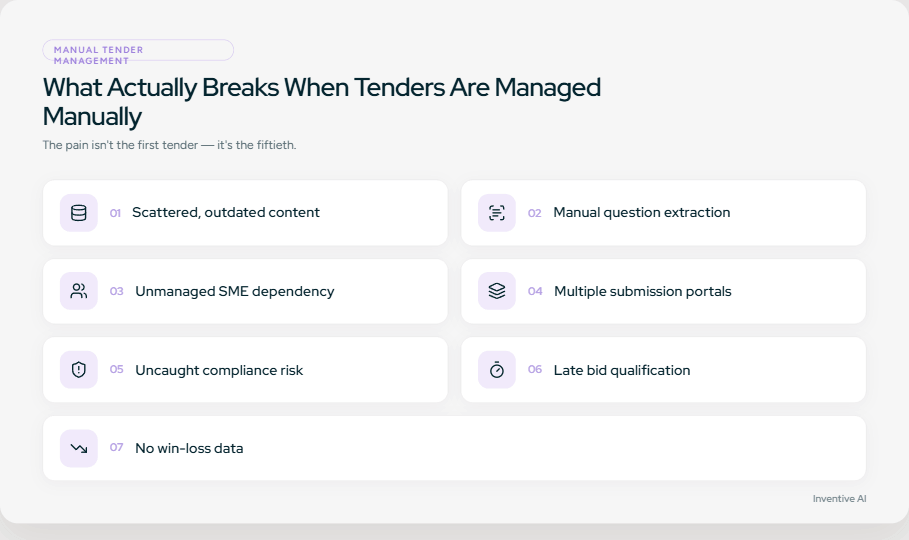
The pain isn't the first tender; it’s the fiftieth. When a scaling business relies on spreadsheets and shared folders, a few things quietly break your process:
- SME Fatigue: Without automated routing, your key product managers or security leads are constantly chased over Slack for repeat answers, pulling them away from their day jobs.
- Outdated Information: Certifications expire, pricing scales, and product lines shift. A manual process has no way to flag that a piece of text is out of date before it goes to a buyer.
- Portal Extraction Bottlenecks: Spending your first 48 hours manually copying questions out of massive PDFs or complex Excel formats leaves your team with less time to tailor the actual strategy.
- Rejection Risks: Every enterprise buyer has a specific format they demand. Manual copying frequently breaks formatting rules, risking immediate technical disqualification by the buyer.

Quick Self-Check: How Many of These Apply to Your Team?

Count how many of these are true for your team right now:
- [ ] No one can say for sure where the absolute latest version of a security answer lives.
- [ ] Stale or outdated product details have previously slipped through to a submitted bid.
- [ ] A team member spends hours manually reading tenders just to pull out the questions.
- [ ] Subject Matter Experts are constantly re-writing answers they have already provided in the past.
- [ ] Compliance gaps or missing attachments are regularly caught at the final hour.
- [ ] Go/No-Go decisions happen after substantial drafting work has already started.
The Scorecard
- 0–2 True: Minor friction. Just keep your documentation tight as your volume grows.
- 3–5 True: Compounding leakage. These operational gaps are quietly draining your technical resources and risking winnable deals.
- 6 True: Severe revenue drag. Your manual workflow is the bottleneck of your growth. It’s time to move to a dedicated platform.
See how RAD AI achieved a 50% higher win rate and 2x higher-quality responses.
Read the case studyBest 8 Tender Management Software to Respond 10 Faster
Manual tender responses eat time your team could spend on strategy and bigger deals. The right software cuts drafting time, keeps content accurate and compliant, and frees your bid team to focus on winning.
1. Inventive AI
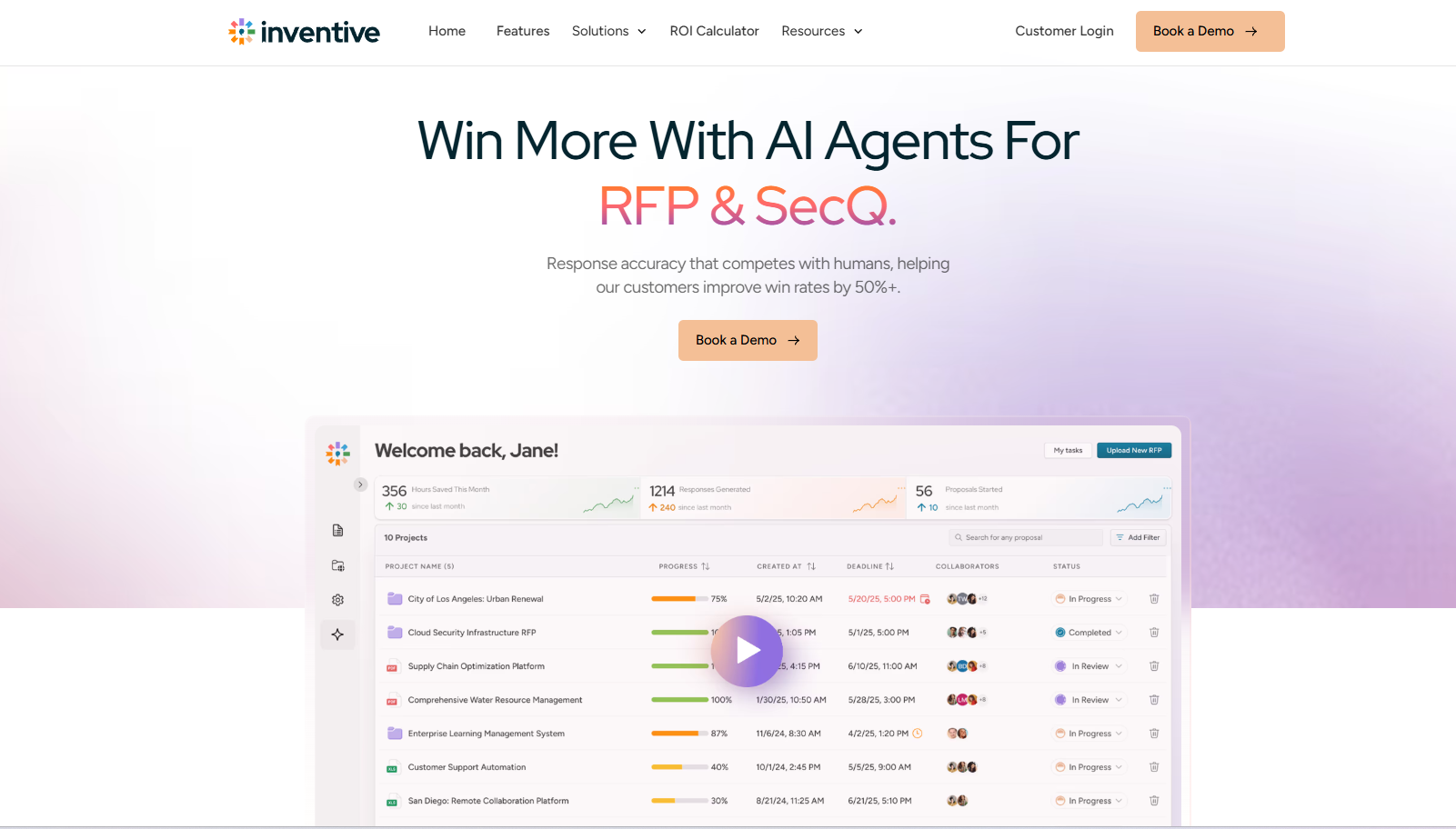
Inventive AI uses autonomous agents to respond to Bids/RFPs, RFIs, DDQs, and SQs, keeping humans in the loop for final approvals. It is built AI-native from the ground up around these agents, rather than functioning as a traditional content-library platform.
Key features of Inventive AI
- Zero Manual Library Upkeep: It links directly to the tools your team already uses (SharePoint, Google Drive, Salesforce, Confluence, Notion). When a technical spec or pricing sheet is updated in your company files, the change live-syncs to your response workflow automatically without manual re-imports.
- Automated Content Governance: A dedicated Content Governance Agent monitors your data streams to automatically detect conflicting technical details, flag outdated proposal content, surface duplicate text, and prioritize your most trusted, verified sources.
- Built-In Hallucination Controls: Every generated response comes with exact source citations and a confidence score. If your connected files lack the specific technical requirement to answer a buyer's question, the system flags it as "Information unavailable" instead of guessing, preventing compliance rejections.
- Built-in Bid Strategy Agents: Features an early Go/No-Go Agent to evaluate if a tender is a weak fit before wasting drafting hours, a Competitive Intelligence Agent to counter rival positioning inside your text, and a Full Response Analyzer to check the complete document for compliance and voice consistency before submission.
Where it stands out
- Simple to use: Inventive AI ranks #1 on G2 for easiest-to-use interface in the RFP software category, and most teams go live within a day. That speed matters because tender deadlines are tight, teams need the tool working immediately, not after weeks of setup.
Where it falls short
- Deep historical win/loss trend reporting and custom native Jira tracking are still maturing.
- G2 reviewers note that they would highly benefit from a native mobile application for on-the-go approvals.
Pricing
- Custom / Usage-Based: Tied directly to the volume of tenders your team processes, featuring unlimited users and full access to all capabilities on all tiers.
Customer review
According to Gartner, a reviewer said confidence scoring helps their team quickly spot which AI answers lack solid documentation behind them, calling it essential for legal risk mitigation, and praised Inventive AI's SOC 2 Type II compliance and secure, no-public-training environment for their data.

Best for
Growth-stage to enterprise B2B teams managing high-stakes tenders who want 10x faster first drafts and deal-specific accuracy without the overhead of maintaining a separate, static content repository.
Security
SOC 2 Type 2 certified, and Inventive AI never uses customer data to train its models.
If this is the kind of system your process is missing, see Inventive AI work through one of your own tenders before deciding anything.
Book a walkthrough2. Responsive
Responsive, formerly RFPIO, is a response management platform built around a centralized content library and AI-assisted drafting for tenders, RFPs, security questionnaires, and due diligence requests. It's positioned for large, multi-team organizations managing a high volume of incoming tenders across departments.
Key features of Responsive
- Structured Intake Triage: Provides a dedicated tracking module to score, risk-assess, and assign incoming questionnaires before your writers spend time drafting.
- External Trust Center: Allows your team to build a secure, customer-facing compliance portal where prospects can access pre-vetted security and legal documents directly.
- Automated Quality Scoring: Uses a built-in verification metric (TRACE Score) to rate the completeness and compliance of your answers throughout the drafting process.
Where it stands out
Responsive excels at enterprise-level scaling and deep software connectivity. With more than 30 native integrations and a massive library of open APIs, it links complex enterprise software stacks together, making it highly dependable for global bid teams that must coordinate responses across thousands of users.
Where it falls short
- The platform was originally built as a traditional database library, meaning its generative AI capabilities are bolted on top of a legacy framework rather than being built into the system from the ground up. This limits its ability to run autonomous workflows or catch content conflicts without manual oversight.
- Reviewers frequently note on G2 that the user interface feels complex, with key actions buried deep inside menus, leading to a steep learning curve.
Pricing
Lite Edition: Starts at $5,000/year capped at 5 users. Emerging, Growth, and Enterprise tiers are custom quoted based on seat and module additions.
Best for
Enterprise proposal operations that need a centralized library and rigid cross-functional sign-off workflows across hundreds of global users.
Customer review
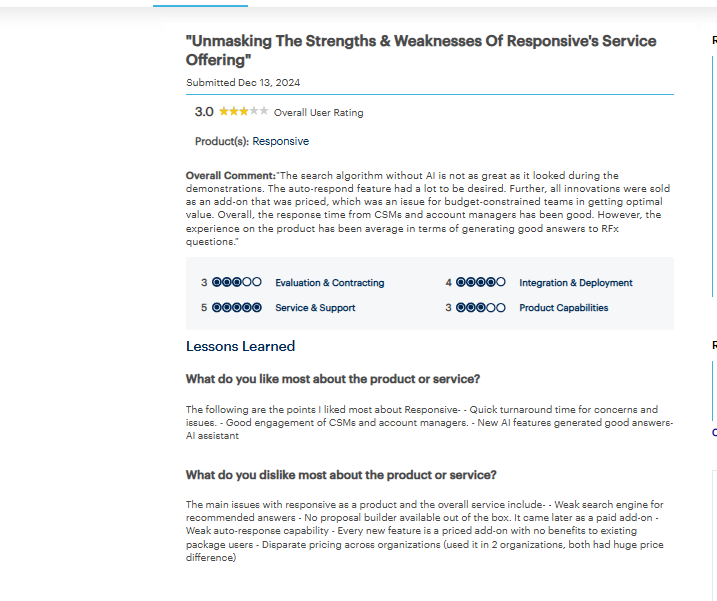
According to Gartner, a reviewer liked the quick turnaround from CSMs and account managers and the newer AI-assisted answers, but flagged the search engine as weak, the proposal builder as a paid add-on, and pricing as inconsistent across organizations.
Also Read: Why AI-Native RFP Software Is Replacing Legacy Tools Like Responsive and Loopio
3. Loopio
Loopio is a response management platform built around a searchable content library and native Word integration, used to manage RFPs, DDQs, and security questionnaires.
Key features
- Response Intelligence™, Loopio's proprietary machine learning layer that surfaces recommendations and flags content health issues during the response process.
- Native Word Integration: Allows your team to search historical company answers and pull approved text directly into Microsoft Word without switching windows.
- Portal Fill Extension: Features a stable browser extension that helps your writers pull saved responses directly into online web-based buyer procurement portals.
Where it stands out
Loopio stands out for its usability and strong customer support. The interface is intuitive, making it easy to onboard non-technical subject matter experts who only contribute to bids occasionally.
Where it falls short
Loopio was also built around a content library first, with AI added on top, so it works within a static library instead of pulling from live sources, and has no dedicated conflict detection or governance layer.
It's built for structured questionnaire formats, not narrative-style proposals. On G2, reviewers report formatting issues after export, occasional inaccurate responses, and limits with complex Excel mapping.
Pricing
Not published. Foundations, Enhanced, and Enterprise tiers are all custom quotes.
Customer review
According to Gartner, a reviewer said Loopio is "very helpful for completing template questionnaires" and liked the Chrome extension, but called online support "a little lacking" and disliked having to manually fix autofill mapping after export.

Best for
Mid-market to enterprise teams that want an established platform with strong content library controls.
Also Read: Best Loopio Competitors & Alternatives for RFP Response Process in 2026
4. SiftHub

SiftHub is an AI RFP and deal orchestration platform that connects directly to a team's CRM, Slack, Gong calls, and document stores instead of relying on a static content library. It's built for presales and solutions engineering teams handling tender responses alongside broader deal support work.
Key features
- Live Communications Ingest: Links directly into your CRM, Slack, and recorded client calls to find details from past deals without forcing you to maintain a separate bid repository.
- Multi-Purpose Deliverables: Uses your saved tender knowledge to automatically generate customer battlecards, sales assets, and deal briefs for your field reps.
Where it stands out
SiftHub turns proposal data into a multi-purpose sales enablement asset. Instead of keeping responses locked in a single project file, it uses your central knowledge base to generate deal summaries, presentation decks, and battlecards alongside standard bids, cutting down on duplicate work for presales teams.
Where it falls short
- Users on G2 report occasional data sync delays when pulling information from deep within connected systems.
- Formatting bugs sometimes surface when exporting complex question grids into final downloadable tables.
Pricing
Custom, transaction-based. Not published; contact for quote.
Customer review
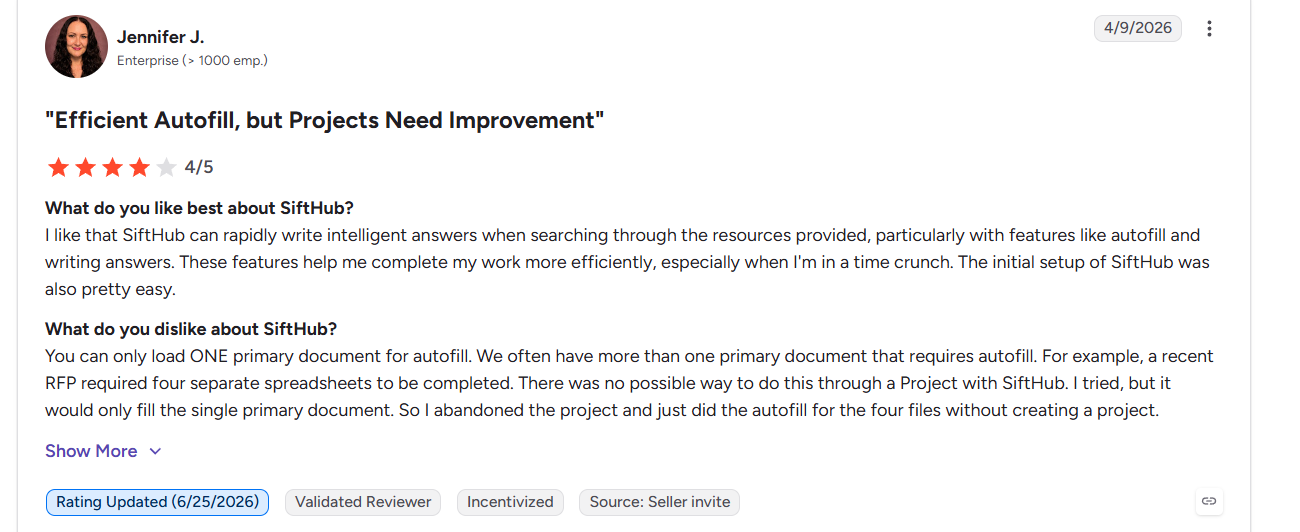
According to G2, Jennifer J. (Enterprise, 1,000+ employees) said SiftHub's autofill and answer-writing help her move fast under deadline pressure, but disliked that it only loads one primary document for autofill, which forced her to abandon a four-spreadsheet RFP project.
Best for
Presales and solutions engineering teams that want tender response folded into a broader deal-support workflow, not just standalone drafting.
Also Read: Top 10 SiftHub Competitors and Alternatives for RFP Management
5. SparrowGenie
SparrowGenie is an AI proposal assistant built for revenue teams responding to RFPs, security questionnaires, and custom proposals. Its core strength is Excel handling: teams import a tender template, collaborate on it, and export back into the original format without breaking formatting or validation rules.
Key features
- Advanced Spreadsheet Mapping: Ingests heavily formatted, macro-locked buyer Excel sheets and exports your answers back into the original format without breaking the client’s validation formulas.
- Shared Review Workspaces: Provides real-time collaboration zones so your legal, technical, and commercial leads can review and sign off on specific sections simultaneously.
Where it stands out
SparrowGenie excels at handling complex spreadsheet layouts. While generic software often breaks or corrupts hidden buyer formulas during document exports, this tool maintains absolute spreadsheet formatting, saving your team from manual layout cleanup right before a tight deadline.
Where it falls short
- According to G2, the project dashboard analytics are highly basic, missing long-term performance tracking metrics.
- The platform currently lacks built-in electronic signature features for final contract execution.
Pricing
Not published; contact for quote.
Customer review
According to G2, Vipin T. (Mid-Market, 51–1,000 employees) said the collaboration flow and answer library finally made security questionnaires manageable across legal, security, and compliance, but noted analytics are still basic and e-signature isn't available yet.

Best for
Bid teams whose primary pipeline consists of extensive, formatting-sensitive Excel grids and technical compliance checklists.
6. AutoRFP.ai

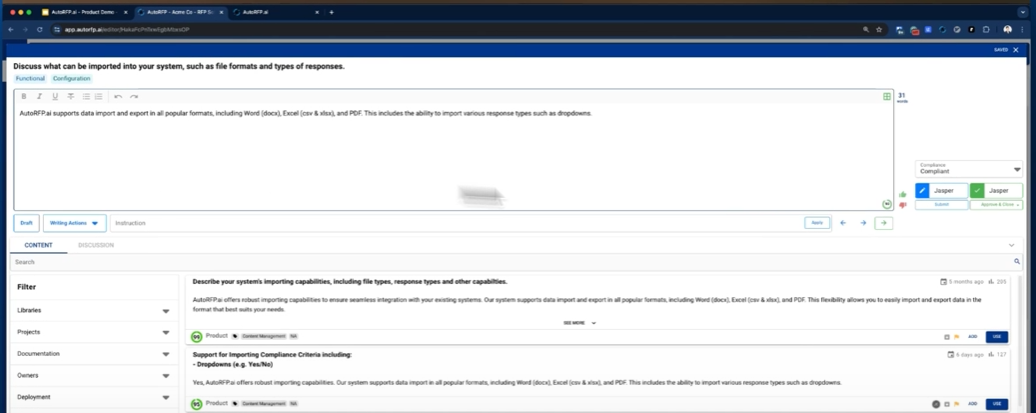
AutoRFP.ai is designed to quickly generate drafts from past proposals and documents without requiring a dedicated library administrator.
Key features
- Automated Term Scrubbing: Automatically finds and replaces past client names or outdated project terms within your historical files to prevent copy-paste errors.
- Source Validation Scores: Displays a clear trust rating on every generated answer, showing your reviewers exactly which past proposal or document the text was pulled from.
Where it stands out
- AutoRFP.ai relies on a predictable, flat-rate subscription model. Traditional platforms often penalize team collaboration by charging an expensive monthly fee for every added seat license; this tool lets you include an unlimited number of reviewers and SMEs without cost inflation.
Where it falls short
- AutoRFP.ai is AI-native, but runs on a single-model layer rather than a multi-agent architecture, which limits how it handles multi-step reasoning across a large tender. It doesn't generate narrative-style proposals or include a conflict detection or governance layer.
- On G2, several reviewers describe the interface as unintuitive, citing navigation difficulty and a learning curve.
Pricing
Scale: $899/month (24 projects/year). Accelerate: $1,299/month (50 projects/year). Enterprise: custom. All tiers include unlimited users and all features.
Customer review
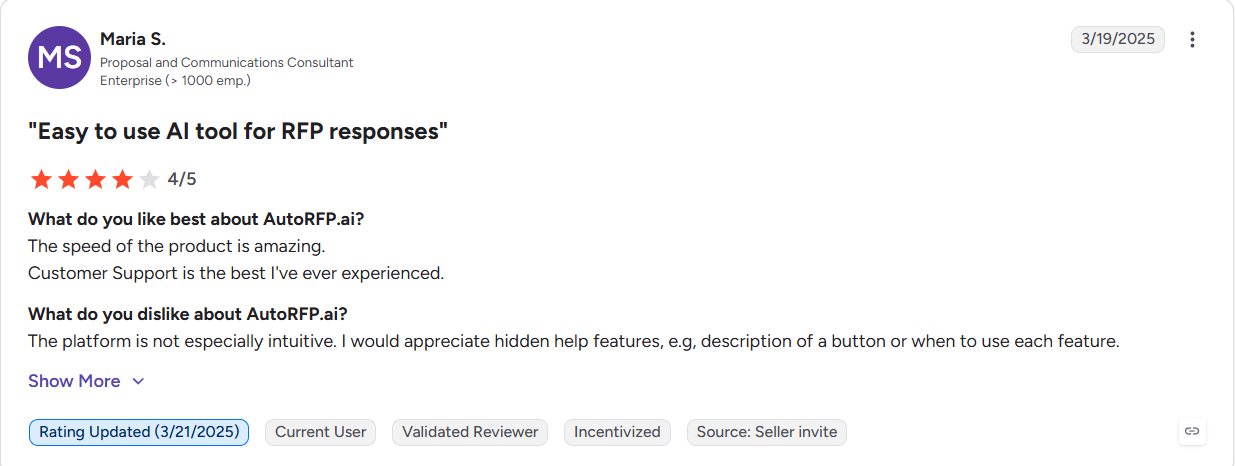
According to G2, Maria S., a Proposal and Communications Consultant (Enterprise, 1,000+ employees), called the product's speed and customer support the best she's used, but said it "is not especially intuitive" and wanted built-in help text for each feature.
Best for
Lean bid teams that want predictable, project-based pricing without per-seat cost creep.
Also Read: Top AutoRFP AI Alternatives & Competitors For 2026
7. GovDash

GovDash is a highly specialized platform purpose-built to address the distinct data security and compliance complexities of US Federal contracting.
Key features
- Government PDF Shredder: Automatically breaks down massive, multi-page federal solicitation documents into structured, step-by-step requirement matrices.
- Lifecycle Tracking: Manages the entire public sector pipeline within one secure space, from early opportunity capture tracking through proposal construction and post-award contract management.
Where it stands out
- GovDash is built specifically for the strict data security and compliance rules of US federal procurement. Rather than forcing you to adapt a generic commercial tool to fit government guidelines, it natively tracks federal updates and auto-builds live compliance matrices directly from your documents.
Where it falls short
- A G2 reviewer notes the platform is not structurally designed for general commercial corporate tenders or international B2B software sales.
- Independent, third-party user review data is still highly limited due to its specialized public sector niche.
Pricing
Not published; contact for quote.
Customer review
No customer reviews available.
Best for
US government contractors managing the full capture-to-contract lifecycle, not just proposal drafting.
8. Rogue (UseRogue)
Recently acquired by Procurement Sciences AI, Rogue offers targeted proposal writing tools optimized for small teams handling government bids and SBIR grants.
Key features
- Instant Narrative Templates: Generates an immediate, comprehensive narrative response template directly from your uploaded past bids so you never start with a blank screen.
- Native Opportunity Tracker: Includes a built-in search tool to scan the official SAM.gov portal for open public bidding opportunities without leaving the software.
Where it stands out
Rogue offers an affordable, lower-cost entry point for solo consultants and agile public sector bid teams. It eliminates the problem of staring at a blank page by instantly generating a complete first-pass narrative draft as soon as you upload your files.
Where it falls short
No independent rating appears on Gartner or G2, so there's no third-party review data available to verify performance claims against.
Pricing
Solo: $400/month (1 seat). Starter: $500/month (2 seats). Professional: $1,250/month (5 seats.
Customer review
No customer reviews available.
Best for
Solo consultants and small GovCon teams that need government-specific proposal tooling at a lower entry price than GovDash.
See how Inventive AI performs on your next tender, no generic demo, your real questions, your real content.
Get startedHow to Evaluate Tender Response Software Before You Buy
Your evaluation should be based on how a tool performs on your real tenders, your real content, and your real team, before you're locked into a contract.
Look at the Maintenance Overhead
Ask the vendor: “Will my team have to manually clean, tag, and upload documents into another content repository, or does the tool keep itself updated by connecting to our live files?” If it requires a human to constantly clean the database, your team will eventually stop using it.
Check for content governance
Content that isn't actively checked for conflicts or outdated information costs you twice, once when someone has to manually verify it, and again if something incorrect reaches the buyer. Ask whether the tool automatically flags outdated or conflicting content across your connected sources, or whether that still depends on manual review.
Check for contextual accuracy
An answer can be factually correct and still be wrong if it ignores the context behind the question. For example, ask "What security certifications do you hold?" on its own, then again ask inside a tender specifying the buyer handles protected health information.
A tool that truly understands context will check whether it actually has HIPAA-related security controls. If it does, it will mention those specific controls first, instead of giving a generic list of certifications. If it doesn't have them, it will say so clearly, instead of avoiding the question.
Check response quality against your own standard
A polished-sounding answer isn't the same as one that meets your team's bar for accuracy, tone, and completeness. Score a real output the way you'd review a tender draft.
For example, ask: "Describe your data backup and disaster recovery process." A tool generates:
"[Company] maintains a robust data backup and disaster recovery process to ensure business continuity. We perform regular backups and have recovery procedures in place to minimize downtime."
It sounds fine, but check it against a few basics:
| Criteria | Check for | Pass? |
|---|---|---|
| Specificity | Real numbers, backup frequency, recovery time, not words like "regular" or "robust" | No |
| Completeness | Covers both backup and disaster recovery in detail | No |
| Compliance fit | Mentions what buyers usually expect, RTO/RPO, backup location, testing cadence | No |
| Tone match | Sounds like your company, not generic template language | No |
An answer that fails most of these is not a submission-ready response. Run a few real outputs through this check before trusting the tool's quality.
Check support and integration depth
Do not settle for a checklist that just says "CRM Integration." Confirm the specifics:
- Is the sync real-time, or does it run on a daily batch? (Real-time matters when your technical specs change mid-bid).
- Does data flow both ways, or is it read-only?
- What happens to your active draft if a connection drops mid-upload?
Check that pricing scales with tender volume
Per-seat pricing can penalize exactly the collaboration a tender needs, more reviewers and more SMEs involved. Get a quote based on your real team size and tender volume, and ask what specifically triggers a price increase as your usage grows.

Common Mistakes When Switching Tender Management Software
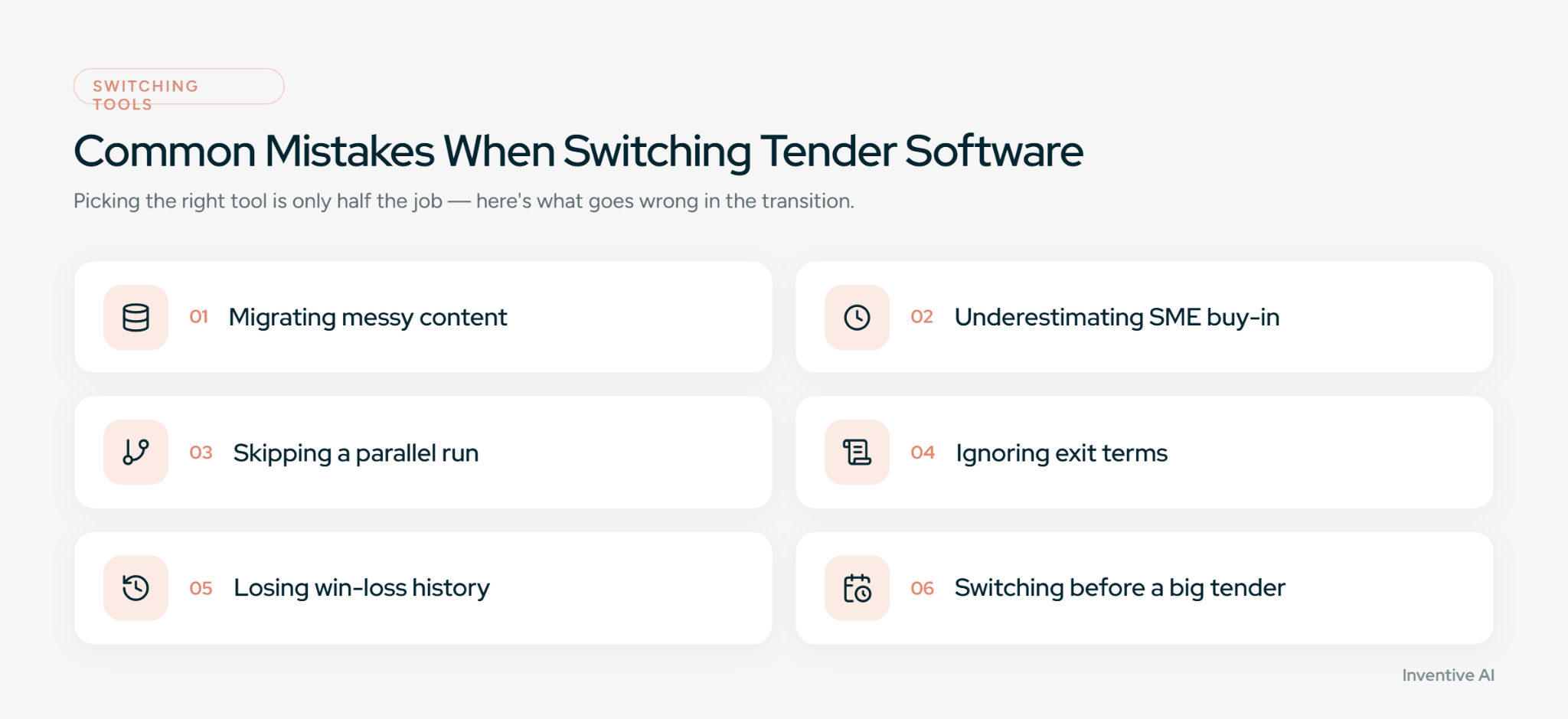
Picking the right tool is only half the challenge, how you actually switch to it carries its own risk. Here's what actually goes wrong during the transition, and how to avoid it.
- Importing a Mess: Do not upload your entire historical drive into a new system all at once. If you feed the tool outdated proposals, it will use that old information to write your new drafts. Clean your core documents before you migrate.
- Skipping the Parallel Run: Never switch platforms right before a massive, high-stakes deal. Run your new software alongside your old manual process for at least two standard bids so your team can get comfortable with the interface without deadline pressure.
- Ignoring Contract Exit Terms: Check the notice periods on your current tools. Planning your transition timeline around those dates prevents you from paying for two platforms simultaneously.
How Inventive AI Cuts Errors and Speeds Up Tender Responses
Tender management covers the full lifecycle, but how well your team responds is what decides whether all that upstream work pays off. The failures we walked through, stale content, missed compliance requirements, late go/no-go calls, aren't random process misses. They're what happens when a high-stakes, deadline-bound workflow runs without a system built for it.
Every tool in this guide addresses part of that gap. Inventive AI was built to close it end to end: pulling from live, connected knowledge instead of a static library, catching conflicts before they reach a buyer, and giving reviewers a confidence score instead of a guess. If your team checked several boxes in the self-assessment earlier in this guide, that's worth treating as a real signal, not something to keep working around manually.
More Reads
Frequently Asked Questions
What's the difference between tender management software and RFP software?
Tender management covers the full lifecycle, from finding and qualifying opportunities to submission and post-award tracking. RFP software focuses on the response-drafting piece. Most tools compared here sit in between, built primarily for response but touching parts of the wider lifecycle like content management or bid/no-bid decisions.
Is using AI to draft tender responses a compliance risk?
Not inherently. The risk is a tool generating a confident response without grounded source material behind it. Tools that flag gaps instead of guessing, and cite the source behind every response, reduce that risk instead of adding to it.
How long does it take to implement tender response software?
It depends on how much existing content needs cleaning up before migration. Some vendors claim same-day setup; budget one to three weeks to properly audit and import content, even when the platform itself configures quickly.
Can small teams or solo consultants use these tools, or are they built for enterprise only?
Both exist in this category. Some platforms price for solo consultants and small teams; others are built around enterprise-scale governance and multi-region deployment. Team size and tender volume should drive the choice, not budget alone.
What happens to our tender content if we switch tools or cancel a subscription?
This depends on the vendor, confirm it before signing. Ask whether your content library, past responses, and edit history export in a usable format, or whether they're locked into a proprietary structure.
Do these tools work for government or public sector tenders specifically?
Some are built specifically for that market, with features like SAM.gov search and FedRAMP-aligned security. General-purpose tools handle public sector tenders as one use case among several. If most of your volume is government contracts, a platform built for that workflow fits better than a generalist tool.

.avif)