How to Write Winning Architecture RFP Responses in 2026

You may have the portfolio, the team, and the technical experience. But when an architecture RFP lands on your desk, none of that wins the bid unless your proposal makes it clear.
Most architecture firms lose points because their response feels too generic. It talks about past work, credentials, and design philosophy, but does not clearly answer what the client is really judging: Do you understand this project, can you reduce risk, and can you deliver without confusion?
This is why more proposal teams are using AI tools to draft architecture RFP responses faster, with more structure, context, and consistency. According to McKinsey’s 2025 Global Survey on the state of AI, 88% of respondents report regular AI use in at least one business function, showing how quickly AI is becoming part of repeatable, high-effort work.
This guide explains how to bid on and win architecture RFPs with a stronger process, from understanding the RFP requirements to writing a response that helps your firm stand out for the right reasons.
Key Takeaways
- An architecture RFP is more than a project brief. It shows how the client will judge your firm’s experience, team, approach, risk readiness, and delivery confidence.
- Different architecture RFPs need different response strategies. Public sector, private development, design services, design-build, master planning, renovation, and on-call RFPs all ask for different proof points.
- A strong architecture RFP response starts with reading the RFP like a scoring sheet. Focus on evaluation criteria, submission rules, project risks, required forms, and what the client needs to trust.
- To write a winning response, show relevant experience, explain your delivery process clearly, assign the right team, address risks early, and make your fee proposal easy to compare.
- Inventive AI helps architecture firms draft stronger RFP responses faster with project-specific answers, Context Engine, Conflict Detection, Outdated Content Detection, narrative-style proposals, and a simple review workflow.
What Is an Architecture RFP?
An architecture RFP is a formal request from a client asking architecture firms to submit a proposal for a specific project. It usually includes the project background, scope of work, submission rules, evaluation criteria, timeline, fee requirements, and contract terms.
But an architecture RFP is not just a project brief. It is also a scoring document.
The client uses it to compare firms on more than design quality. They want to see if your firm understands the project, has relevant experience, can assign the right team, manage approvals, control risks, and deliver within the expected timeline and budget.
Architecture RFPs are commonly issued by:
- Government agencies for civic buildings, schools, public facilities, and infrastructure-related projects.
- Real estate developers for residential, commercial, mixed-use, and hospitality projects.
- Universities and schools for campus buildings, renovations, and master planning.
- Healthcare organizations for clinics, hospitals, and medical office spaces.
- Corporations and nonprofits for offices, community spaces, and specialized facilities.
The biggest mistake firms make is treating the RFP like a design introduction. A general design brief tells you what the client wants to create. An architecture RFP tells you how the client will choose the firm they trust to create it.
That difference matters. If you read the RFP only for scope, your response may sound complete but still miss the scoring criteria. If you read it like an evaluator, you can shape every section around what the client needs to believe before awarding the project to your firm.
Different Types of Architecture RFPs
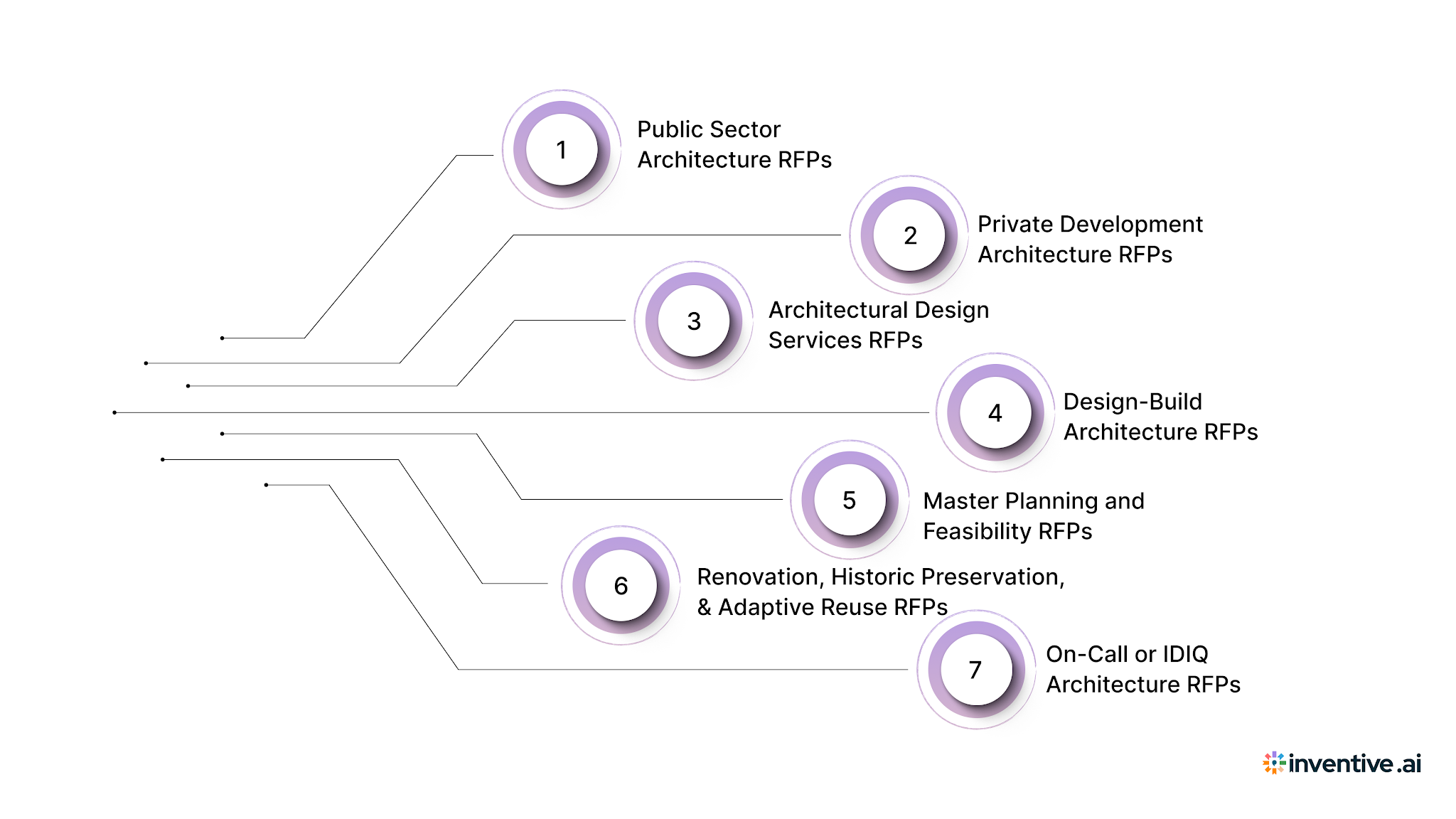
Not every architecture RFP asks for the same kind of response. Some RFPs are shaped by the buyer, some by the project type, and others by the delivery model. That matters because each one expects a different proposal strategy.
1. Public Sector Architecture RFPs
Public sector RFPs are issued by government agencies, municipalities, school districts, universities, housing authorities, and public institutions.
These RFPs usually have strict submission rules, scoring criteria, mandatory forms, licensing requirements, insurance terms, and fixed deadlines. Your response must be compliant first, then persuasive. Even a strong proposal can lose points if it misses a required attachment, signature, format, or qualification.
2. Private Development Architecture RFPs
Private development RFPs are issued by real estate developers, corporations, hospitality groups, commercial property owners, and private institutions.
These RFPs often focus on design quality, speed, budget fit, market understanding, and relevant project experience. The client wants to know if your firm can support the business goal behind the project, not just create a strong design.
3. Architectural Design Services RFPs
These RFPs ask architecture firms to provide professional design services for a defined project. The scope may include feasibility studies, concept design, schematic design, design development, construction documents, permitting support, bidding assistance, and construction administration.
For this type of RFP, your response should clearly explain your design process, deliverables, team structure, coordination plan, and experience with similar project scopes.
4. Design-Build Architecture RFPs
Design-build RFPs are used when the client wants design and construction expertise connected earlier in the process. In this model, the architect may work closely with a contractor or be part of a larger design-build team.
Your response must show collaboration, cost awareness, constructability thinking, delivery planning, and risk control. AIA notes that delivery methods such as design-build and CMAR involve earlier contractor participation, which can affect cost control and project coordination.
5. Master Planning and Feasibility RFPs
These RFPs focus on early-stage planning rather than immediate building design. They may involve campus planning, urban planning, site feasibility, land-use strategy, community planning, or phased development.
Your proposal should show strategic thinking, stakeholder engagement, data gathering, site analysis, phasing, budget awareness, and long-term planning capability.
6. Renovation, Historic Preservation, and Adaptive Reuse RFPs
These RFPs are used when the project involves an existing building. The work may include renovation, restoration, code upgrades, accessibility improvements, reuse planning, or modernization.
Your response should show technical understanding, site investigation experience, code awareness, preservation sensitivity, phasing strategy, and the ability to manage unknown conditions.
7. On-Call or IDIQ Architecture RFPs
On-call or IDIQ architecture RFPs are used when a client wants to select one or more architecture firms for future projects over a set period.
These are common with public agencies, universities, healthcare systems, and large institutions. Instead of responding to one defined project, your proposal must prove that your firm can handle different scopes, respond quickly, assign the right team, and maintain consistent quality across multiple assignments.
The best way to approach any architecture RFP is to first identify what type of opportunity it is. Once you know the buyer, scope, and delivery model, you can shape your response around what the evaluator actually needs to trust before awarding the work.
Also Read: Construction RFP Guide: How Winning Teams Respond
7 Most Important Components Included in an Architecture RFP
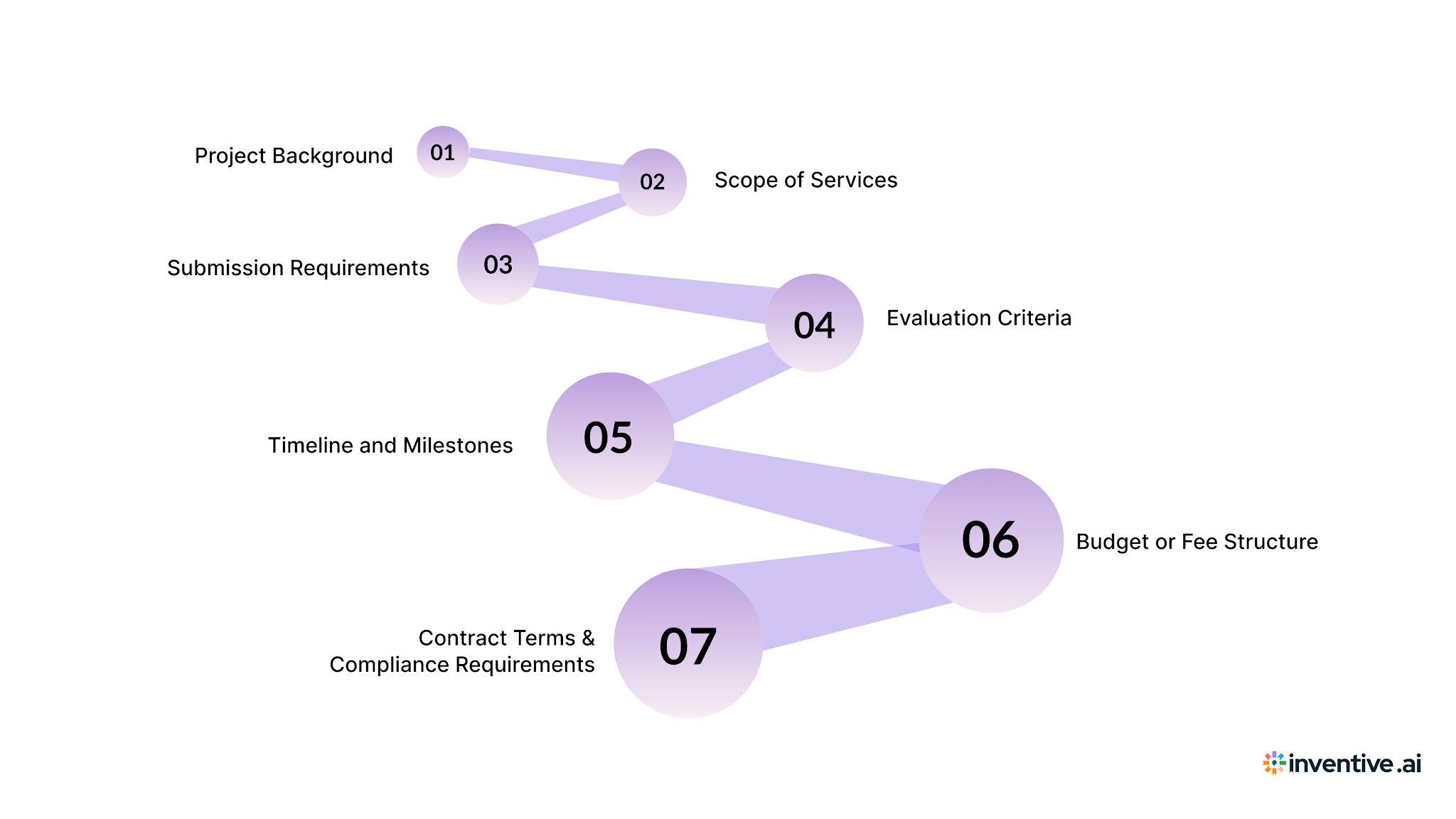
A strong response starts with understanding what the RFP is really asking for. Most architecture RFPs include clear instructions, but the real priorities are often hidden inside evaluation criteria and project context.
1. Project Background
This explains why the project exists, what problem the client wants to solve, and what outcomes matter most.
2. Scope of Services
This may include feasibility studies, concept design, schematic design, design development, construction documentation, permitting, bidding support, and construction administration.
3. Submission Requirements
This tells you exactly what documents, formats, forms, page limits, and attachments the buyer expects.
4. Evaluation Criteria
This is one of the most important sections. It shows how the buyer will score your proposal across experience, approach, team qualifications, price, schedule, and references.
5. Timeline and Milestones
This includes the proposal deadline, interview dates, award date, project start date, and major delivery milestones.
6. Budget or Fee Structure
Some RFPs include a budget range. Others ask firms to propose fees based on scope, staffing, phases, or hourly rates.
7. Contract Terms and Compliance Requirements
Public and institutional RFPs may include insurance, licensing, certifications, legal terms, and procurement requirements.
When you understand each section of the RFP, your proposal becomes easier to shape. You stop writing around your firm and start writing around the client’s decision criteria.
Also Read: RFP Response Trends and Benchmarks: Key Insights for 2026
How to Bid on and Win an Architecture RFP in 2026
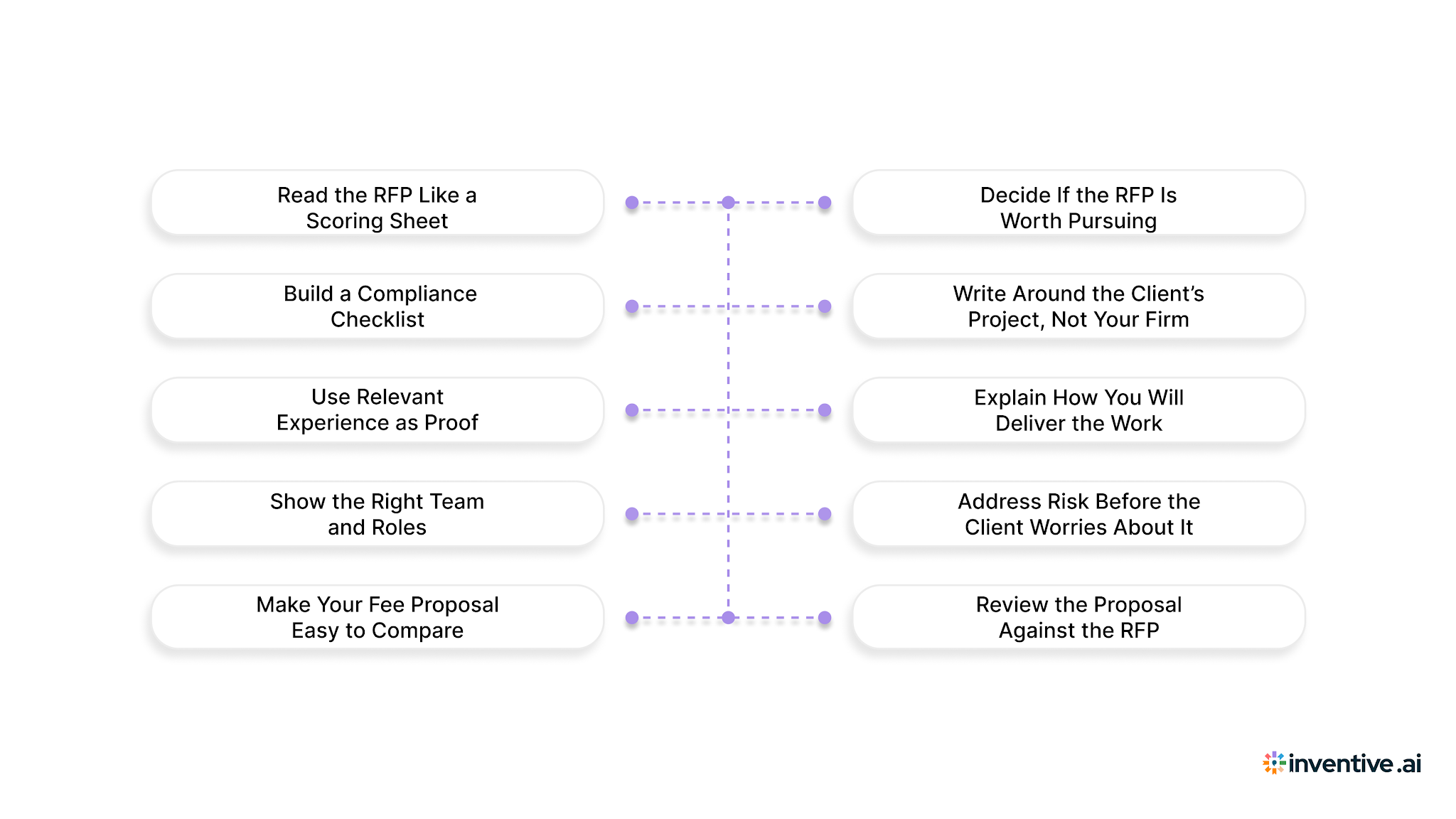
Winning an architecture RFP starts with one simple shift: stop writing about your firm first. Start writing around what the client needs to trust.
The evaluator is asking: Does this firm understand our project, have the right experience, and know how to deliver it without unnecessary risk? Your response should answer that clearly.
Step 1: Read the RFP Like a Scoring Sheet
Before writing, identify what the client will judge. Look at the evaluation criteria, required sections, page limits, forms, deadlines, and disqualification rules.
Then mark the sections that carry the most weight. If the RFP gives more importance to project approach, team experience, or similar work, those areas need the strongest answers. This keeps your proposal focused on what the evaluator actually scores.
Step 2: Decide If the RFP Is Worth Pursuing
Not every RFP is worth your team’s time. Before you bid, check if your firm has a real chance of winning.
Ask:
- Do you have relevant project experience?
- Is the scope clear?
- Is the timeline realistic?
- Do you meet the licensing and insurance requirements?
- Is the budget aligned with the work?
- Can your team submit a strong response without rushing?
A smart no is better than a weak proposal. The goal is not to chase every architecture RFP. The goal is to bid where your firm can show a clear fit.
Step 3: Build a Compliance Checklist
Architecture RFPs often come with strict instructions. Missing a form, signature, license, addendum, resume, or fee sheet can weaken your response before the evaluator even reads it.
Create a checklist for every required item. Assign an owner. Review it before submission. Compliance may not win the bid by itself, but poor compliance can quickly take you out of consideration.
Step 4: Write Around the Client’s Project, Not Your Firm
Your executive summary should not begin with a long firm introduction. Start with the project.
Show that you understand:
- Why is the client issuing the RFP?
- What does the project need to achieve?
- What constraints may affect delivery?
- Why is your firm suited for this specific work?
This makes the proposal feel written for the client, not copied from an old response.
Step 5: Use Relevant Experience as Proof
Do not include project examples only because they look impressive. Choose examples that match the RFP.
A similar school renovation is more useful than a high-end commercial project if the client needs an occupied campus upgrade. A healthcare project with code, phasing, and compliance experience matters more if the RFP is for a clinic or hospital space.
For each example, explain why it is relevant. The evaluator should instantly see the connection.
Step 6: Explain How You Will Deliver the Work
Your approach section should be practical. Avoid abstract design language that sounds good but says little.
Explain how your team will handle:
- Discovery and site review
- Stakeholder input
- Design phases
- Budget coordination
- Permitting and approvals
- Consultant coordination
- Construction support
The client wants to know what working with your firm will feel like. A clear process gives them confidence.
Step 7: Show the Right Team and Roles
Do not just attach resumes. Explain who will work on the project and what each person will own.
Mention the project manager, design lead, technical lead, consultants, and key decision-makers. Tie their experience to the project’s needs. If the RFP involves historic preservation, occupied renovation, sustainability, or public approvals, make sure the right expertise is easy to spot.
Step 8: Address Risk Before the Client Worries About It
Architecture projects often face budget pressure, permitting delays, stakeholder changes, site limitations, phasing issues, and construction coordination problems.
A strong response does not ignore these risks. It shows how your team will manage them.
For example, if the project involves an occupied building, explain how you will plan phasing, site access, documentation timing, and communication to reduce disruption. That kind of detail makes your proposal more credible.
Step 9: Make Your Fee Proposal Easy to Compare
Your fee section should be clear, structured, and easy to understand.
Break it down by phase or service area if the RFP allows it. Explain assumptions, exclusions, reimbursables, optional services, and what is included in each phase.
A confusing fee proposal creates doubt. A clear one helps the client compare your response fairly.
Step 10: Review the Proposal Against the RFP
Before submission, compare your proposal with the RFP one last time.
Check:
- Did you answer every required section?
- Did you follow the format?
- Did you address the scoring criteria?
- Did you remove generic content?
- Did you include all forms and attachments?
- Did the proposal clearly explain why your firm is the right fit?
This final review is where a good proposal becomes a stronger one.
To win an architecture RFP, your response must do more than describe your firm. It must prove fit, reduce doubt, and make the evaluator’s decision easier. Keep the proposal specific, compliant, relevant, and focused on the client’s project.
Sample Architecture RFP and Proposal Examples
This section can include practical examples without turning the blog into a full template library.
Sample Architecture RFP Structure
Sample Architecture Proposal Structure
Use these sample structures as a starting point, but always shape your final proposal around the specific RFP instructions, scoring criteria, project risks, and client priorities.
Also Read: How AI Transforms Proposal and Bid Writing
6 Architecture RFP Response Mistakes That Make Strong Firms Look Average
Even strong architecture firms lose bids when the proposal does not make the evaluator’s job easy. The goal is not just to avoid errors. It is to remove doubt, prove fit, and make your response easier to score.
1. Starting With a Generic Firm Overview
A long firm introduction rarely helps at the beginning. The client wants to know why your team is right for this project.
Start with the client’s goals, the project context, and the specific reason your firm fits the work. Keep the firm background brief and connect every credential to the RFP.
2. Ignoring the Evaluation Criteria
If the RFP gives more weight to project approach, similar experience, or team qualifications, your proposal should reflect that.
Use the scoring criteria as your writing guide. Give more depth to high-value sections and make sure every scored item is clearly answered.
3. Using the Same Project Examples Every Time
A strong portfolio is only useful when it feels relevant. Reusing the same case studies can make your response feel disconnected from the project.
Choose examples that match the building type, scope, client, budget, site constraints, or delivery model. Then explain why each example matters for this RFP.
4. Making the Design Approach Too Abstract
Design philosophy matters, but evaluators also need practical clarity. They want to know how your firm will manage the actual work.
Explain your process for site review, stakeholder input, approvals, documentation, consultant coordination, budget control, and construction support. Make the approach easy to follow.
5. Underexplaining Risk Management
Every architecture project has risks, from permitting delays and budget pressure to phasing, code issues, and stakeholder changes.
Name the risks that apply to the project and show how your team will manage them. This makes your response more credible and helps the client feel safer choosing your firm.
6. Submitting Without a Compliance Review
A proposal can be well-written and still lose because it misses a form, signature, license, addendum, attachment, or formatting rule.
Create a final compliance checklist before submission. Review every instruction, required document, page limit, file name, and deadline before sending the proposal.
The strongest architecture RFP responses do not just avoid mistakes. They make the evaluator feel confident that your firm understands the work, can manage the details, and is prepared to deliver.
How Inventive AI Helps Architecture Firms Create Stronger RFP Responses
Architecture RFP responses require more than speed. Your proposal needs to be accurate, specific, compliant, and persuasive across every section.
Inventive AI helps proposal teams create stronger first drafts, improve response quality, and reduce manual review work.
1. 2× Higher Quality Responses

Inventive AI helps your team move beyond reused boilerplate. It drafts responses based on the actual RFP, your firm’s project history, buyer priorities, and evaluation criteria.
For architecture firms, this means your proposal can speak directly to the project, site, scope, delivery risks, team strengths, and relevant experience instead of sounding like a recycled firm profile.
2. Context Engine
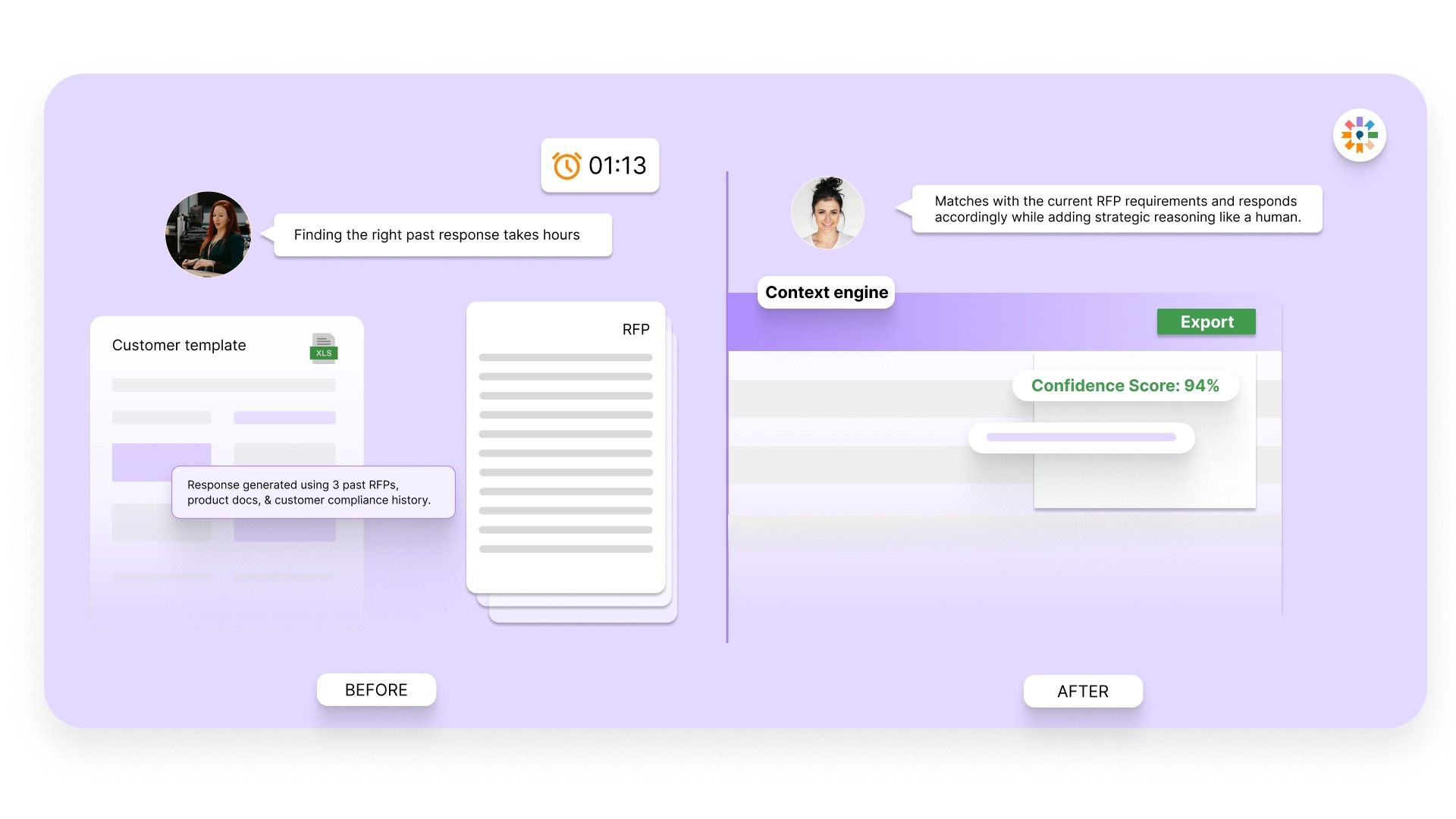
Inventive AI’s Context Engine understands the full RFP along with your company knowledge, past proposals, resumes, case studies, project details, and deal context.
This helps your team generate responses that are specific to the opportunity. If the RFP asks for occupied renovation experience, public-sector project delivery, sustainability planning, or stakeholder coordination, Inventive AI helps pull the right context into the response.
3. Conflict Detection
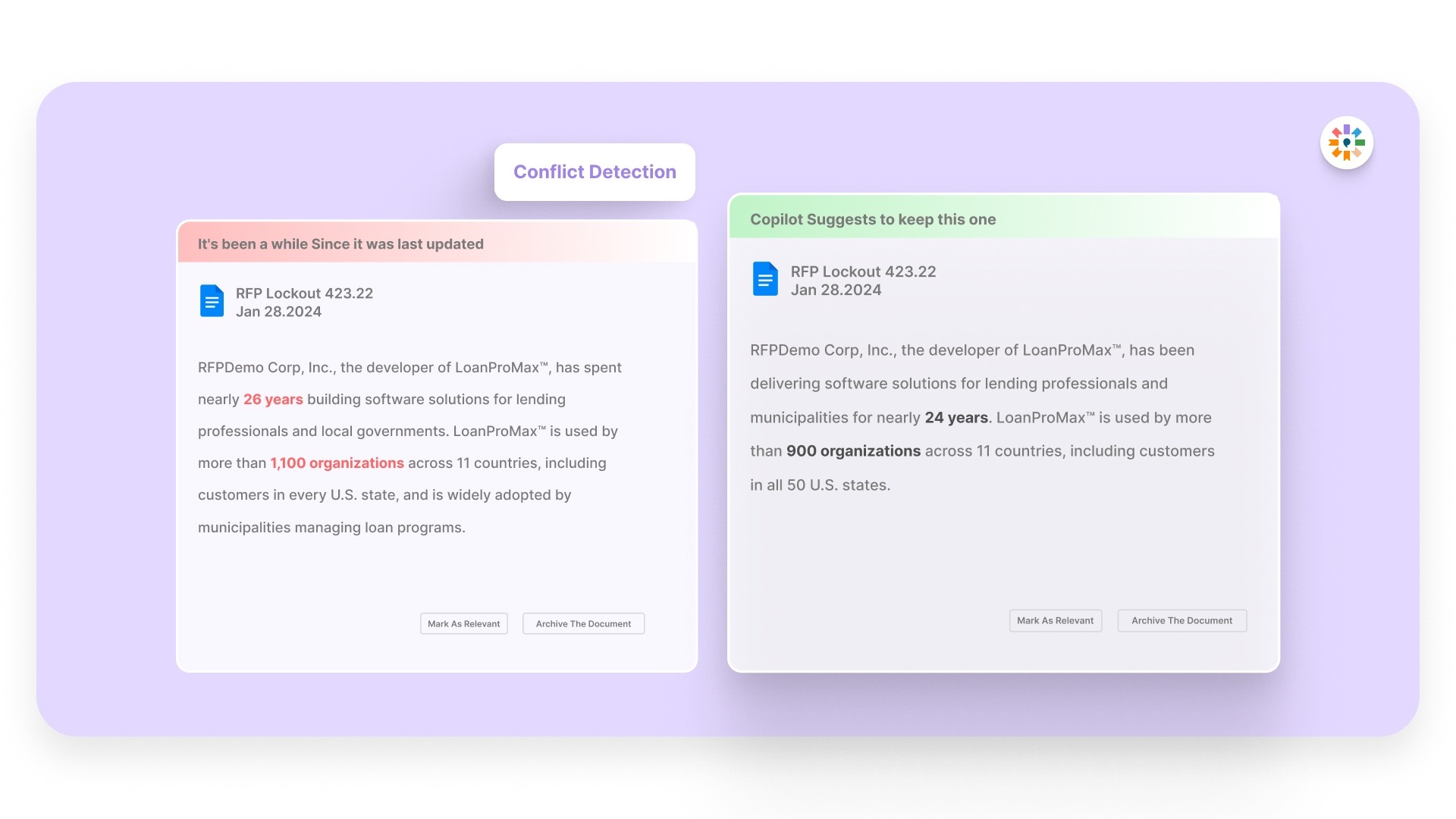
Architecture proposals often include details from multiple sources. That creates room for inconsistencies across sections.
Inventive AI flags conflicting information such as mismatched project timelines, different team roles, outdated certifications, unclear fee assumptions, or inconsistent project claims. This helps your team catch issues before the evaluator does.
4. Outdated Content Detection
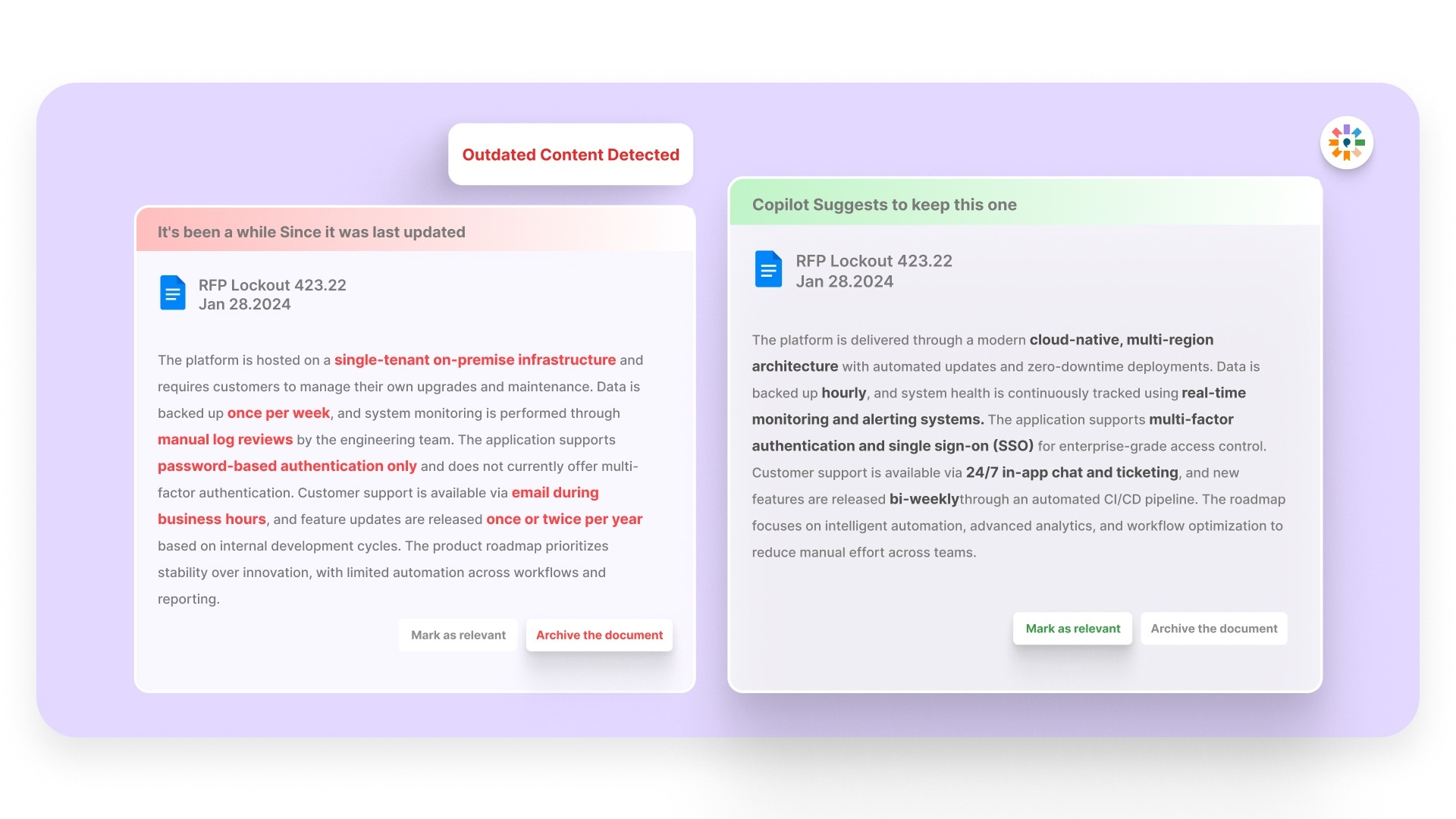
Architecture firms often reuse resumes, project descriptions, awards, licenses, and firm credentials from past submissions. But old content can hurt trust if it no longer reflects your current team or experience.
Inventive AI helps identify outdated content so your response stays accurate, current, and credible.
5. Narrative-Style Proposals
A winning architecture RFP response should not feel like separate answers stitched together. It should tell a clear story: what the client needs, why your firm fits, how your team will deliver, and how you will reduce risk.
Inventive AI helps create narrative-style proposals that connect project understanding, relevant experience, team qualifications, delivery approach, and proof points into one stronger response.
6. Simple Interface
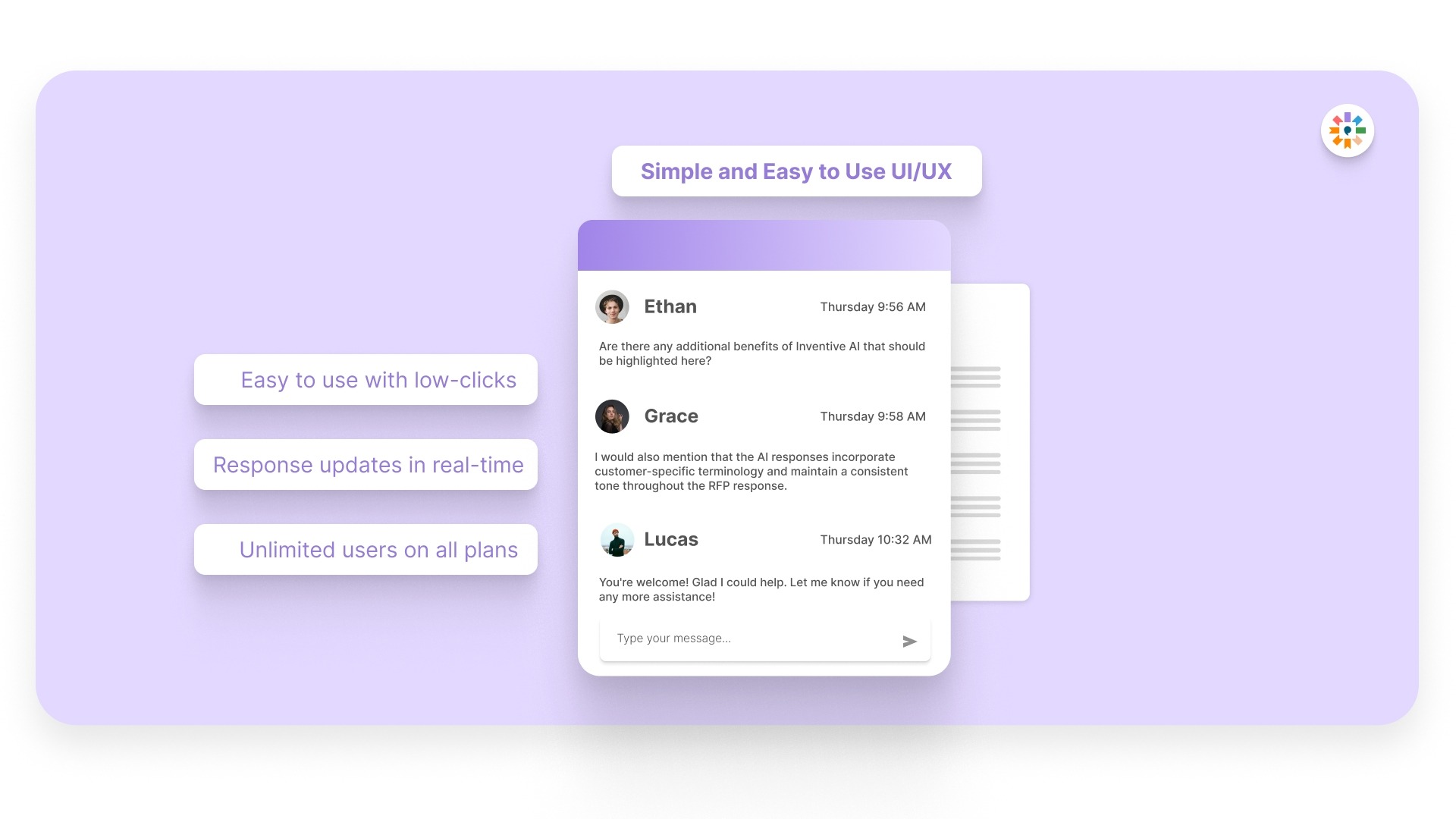
Inventive AI is built for proposal teams, sales teams, and subject matter experts who need to work quickly without adding more complexity.
Your team can draft, review, refine, and improve architecture RFP responses in one place, making it easier to create higher-quality proposals without slowing down the submission process.
With Inventive AI, architecture firms can draft better RFP responses faster, reduce inconsistencies, and submit proposals with more confidence.
Frequently Asked Questions (FAQs)
1. What is the difference between an architecture RFP and an architecture proposal?
An architecture RFP is issued by the client to request bids. An architecture proposal is your firm’s response to that RFP. The RFP explains what the client needs, while the proposal explains how your firm will deliver it.
2. How long should an architecture RFP response be?
It depends on the RFP instructions. Some responses may be 10–15 pages, while larger public or institutional projects may require detailed submissions with resumes, case studies, work plans, pricing, and forms.
3. What makes an architecture RFP response stand out?
A strong response shows project understanding, relevant experience, a clear delivery plan, the right team, and practical risk management. It should feel specific to the client, not reused from another proposal.
4. Should architecture firms use AI for RFP responses?
Yes, but AI should support the proposal team, not replace expert review. AI can help generate drafts, organize content, check consistency, and improve speed. Your team should still review technical details, fees, compliance, and final messaging.
5. How can architecture firms improve their RFP win rate?
Start by qualifying opportunities carefully, writing against the evaluation criteria, using relevant project examples, making the work plan clear, and reviewing every response for compliance before submission. Tools like Inventive AI can help improve quality and consistency across the process.




.avif)

%20(1).avif)