What Is an RFI? Full Form, Meaning & Examples
An RFI is a request for information. See how buyers use RFIs to research vendors, how construction RFIs differ, and how vendors should respond.
RFI stands for request for information. An RFI is a formal document one party sends another to gather facts before making a decision. The abbreviation applies in three distinct contexts in US business: procurement, construction, and audit or compliance.
Key takeaways
- An RFI (request for information) is a document used to gather facts before a decision. It has three common uses: procurement, construction, and audit or compliance.
- In procurement, a buyer sends an RFI to vendors early, before an RFP or RFQ, to learn what solutions and suppliers exist.
- In construction, a contractor sends an RFI to the design team to clarify drawings, specs, or site conditions during a project.
- In audit and compliance, an RFI is a formal request for documents or explanations from an auditor, regulator, or legal counsel, usually with a fixed deadline.
- A procurement RFI is not a bid and is not binding. Responding creates no obligation, and no award follows directly from it.
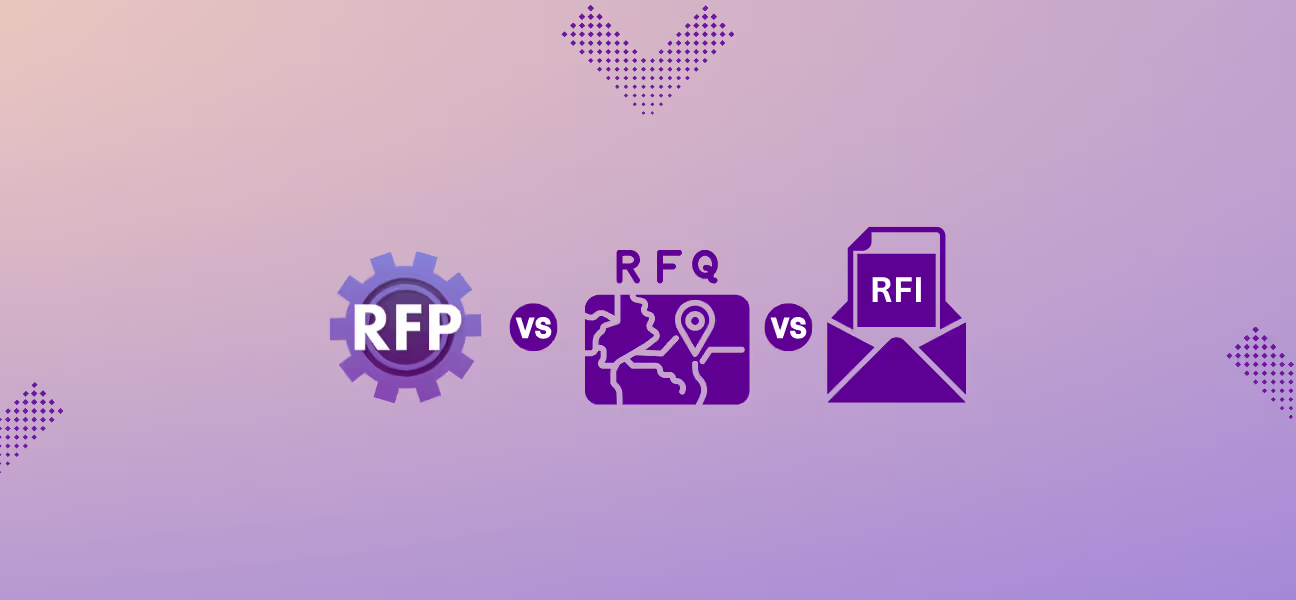
- In the sourcing sequence, an RFI comes before the RFP (full proposal) and the RFQ (firm pricing).
This guide explains all three. It also covers what belongs in an RFI, how RFI differs from RFP and RFQ, and how vendors should decide whether and how to respond.
RFI in procurement: the buyer's research document
A procurement RFI is market research in document form. The buyer knows it has a problem but does not yet know the full range of solutions, the capable suppliers, or sometimes even the right requirements. So it asks the market before it asks for proposals.
A well-built RFI requests facts a buyer can compare: company background, relevant experience, solution capabilities, compliance credentials such as SOC 2 or ISO certifications, integration options, and implementation approach. It does not request detailed pricing or a full proposed solution. Those belong to the RFQ and RFP stages that may follow.
What happens after an RFI
The buyer compares responses, refines its requirements based on what it learned, and typically shortlists vendors for the next stage. Three outcomes are common:
- An RFP follows: The buyer now understands the market and asks shortlisted vendors for full proposals.
- An RFQ follows: The buyer's requirement turned out to be a defined product or service, so it goes straight to pricing.
- Nothing follows: The research showed the project is premature, too expensive, or already solved internally. This outcome is normal, and vendors should factor it into how much effort a response deserves.
RFI in construction: how contractors get answers on-site
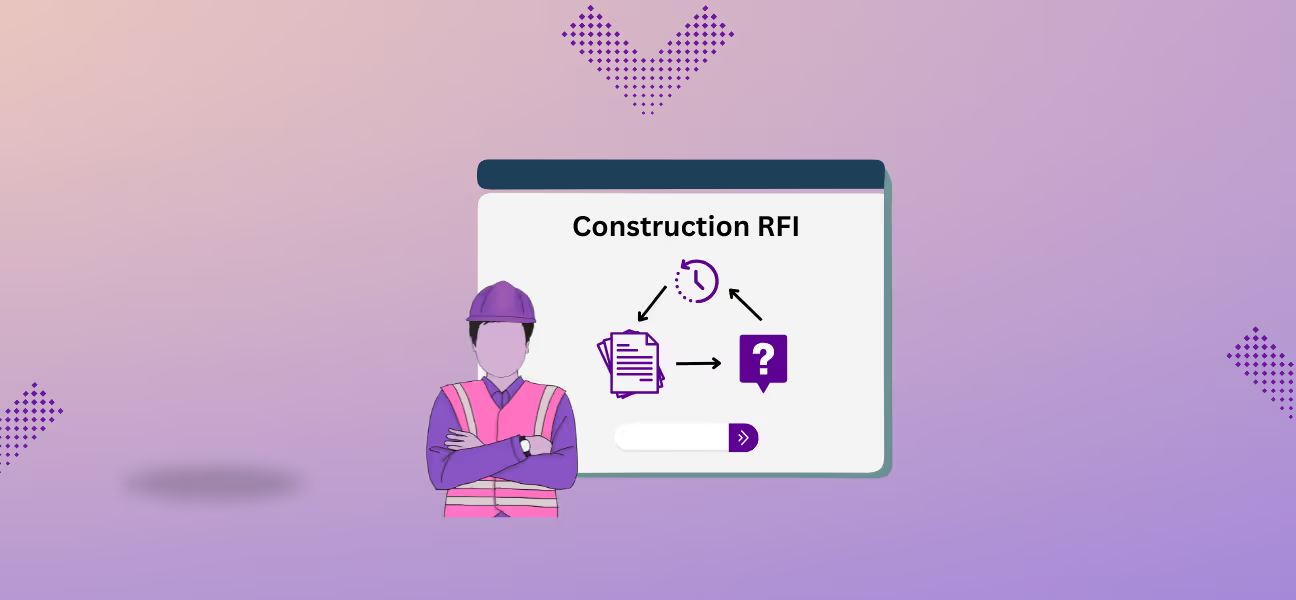
A construction RFI works a little differently. It is a formal, logged question from the contractor to the design team when the drawings, specifications, or site conditions are unclear, incomplete, or contradictory. The response then becomes part of the project record and, if it affects cost or schedule, can trigger a change order.
And there can be a lot of them. A study by the Navigant Construction Forum analyzed 1,362 projects and more than one million RFIs, finding an average of 796 RFIs per project. Each one cost about $1,080 to review and respond to, while the average first response took 6.4 days. On a typical project, those costs can add up quickly, which is why construction teams rely on RFI logs, standardized formats, and response deadlines to keep the process moving.
A good construction RFI should identify the exact location, reference the relevant drawing or specification section, ask one clear question, and, where possible, propose a solution for the designer to confirm or reject. RFIs can cover everything from design clarifications to unforeseen site conditions. Our overview of the different types of construction RFIs breaks down each type in more detail.
.png)
RFI in audit, compliance, and legal matters
In audit and compliance work, an RFI is a formal request for documents, records, or written explanations, issued by an auditor, a regulator, or opposing counsel, with a stated response deadline.
The mechanics differ from procurement in one important way. A procurement RFI is voluntary, and vendors choose whether to respond. An audit or regulatory RFI is not. It usually carries a compliance obligation, a deadline, and consequences for an incomplete or late answer.
Where you will encounter it:
- External and internal audit: Auditors issue RFIs, sometimes called information request lists or PBC (prepared by client) lists, asking for contracts, reconciliations, policy documents, or written explanations of a control. Responses become part of the audit file.
- Regulatory examinations: Regulators issue RFIs during examinations or investigations. In financial services, healthcare, and data protection, these carry statutory response windows, and the record of what was provided matters as much as the substance.
- Third-party risk and vendor due diligence: Compliance teams send RFIs to vendors to verify certifications, subprocessor lists, incident history, and data handling practices before onboarding or at annual review.
- Legal discovery and immigration: Opposing counsel may issue formal information requests during litigation. Separately, USCIS issues a Request for Evidence, often informally called an RFI, when a petition needs supporting documentation.
For teams on the receiving end, the discipline is the same one that governs security questionnaires: answer precisely what was asked, cite the source document, keep a record of what was provided and when, and never guess. An answer that overstates a control is worse than one that states a gap honestly.
The overlap with vendor work is larger than most teams realize. The questions a compliance RFI asks about your security posture, certifications, and data handling are the same ones that appear in every security questionnaire you receive, which is why the answer source should be the same.
What an RFI letter looks like in audit and compliance
An RFI letter is the formal written version of a request for information used in audit, regulatory, and legal settings. It names the sender, the recipient, the records or explanations requested, the authority behind the request, and the response deadline. The content lands in the audit file or regulatory record, so precision on every line matters. Procurement teams rarely use the letter format; they package the same content as a document or portal submission.
Key components of an RFI and how issuers write one
.png)
The components
A complete RFI contains seven parts:
- Basic request details: Issuer name, RFI title and reference number, issue date, response deadline, and a contact for questions.
- Statement of purpose: What decision the information will support and why the organization is going to market now.
- Company background: A short profile of the issuer so vendors can tailor their responses to the size and industry involved.
- Project summary and scope: The problem, the current environment, known constraints, and the approximate scale.
- Information requested: Structured questions covering company profile, relevant experience, solution capabilities, compliance credentials, integration options, implementation approach, and pricing model. Each question should map to something the buyer will evaluate.
- Response instructions: Format, submission method, page limit, and deadline. A standard response template keeps answers comparable.
- Next steps: What follows the RFI, and when respondents will hear back.
Step by step writing process for RFI
- Define the decision first: Write down what you need to decide after reading the responses. Every question earns its place by serving that decision.
- Draft the seven components: Keep the question list short. Twenty focused questions produce better responses than fifty broad ones.
- Prescreen the distribution list: Sending an RFI to every vendor in the category produces a pile of responses nobody can process. Target vendors that plausibly fit.
- Send it with a response template and a realistic deadline: Two to three weeks is a reasonable floor for a substantive RFI.
- Evaluate consistently and close the loop: Score responses against the same criteria, notify respondents of the outcome, and record what you learned for the RFP stage.
A ready-made structure speeds this up, and our RFI template provides the full document skeleton.
RFI example
Why RFIs are valuable
.png)
An RFI is cheap and fast: one document and a few weeks. It saves you from spending the far more expensive RFP and RFQ stages on vendors that were never a fit. An RFI delivers this value in five ways:
- It reduces vendor-selection risk early: Compliance credentials, certifications such as SOC 2 or ISO 27001, and financial stability get verified before any vendor reaches the expensive RFP stage.
- It sharpens the requirements: Responses reveal capabilities, constraints, and options the buyer did not know existed, so the eventual RFP asks better questions.
- It narrows the field cheaply: Evaluating a full proposal takes real hours on both sides. An RFI filters a long vendor list down to the few worth that effort.
- It creates an audit trail: Documented market research supports due diligence and shows regulators, auditors, or leadership why the shortlist looks the way it does. Public-sector buyers are often required to produce exactly this record.
- It maps the market: Even when no purchase follows, the buyer learns current pricing models, technology directions, and which suppliers are investing in the category.
For vendors, the RFI is an opportunity, not a chore. Because the buyer has not finalized its requirements yet, a clear response that explains your approach can influence the RFP that every competitor will later have to answer. Getting your strengths written into the buyer's evaluation criteria at this stage is worth more than a polished proposal after the requirements are locked.
RFI vs. RFP vs. RFQ
The three documents form a sequence from least to most commitment. The US General Services Administration uses the same three-way distinction in its guidance for federal vendors.
Two clarifications prevent most confusion. First, an RFI is not a bid: responding creates no obligation on either side, and no award follows directly from it. Second, RFQ has a second expansion, request for qualifications, used in construction and professional services to prescreen firms. Read the document itself rather than assuming from the abbreviation. Buyers do not always run these in strict sequence either, which is why the difference between an RFI, RFQ, and RFP matters most when you are deciding how much effort a response deserves.
For vendors: how to decide whether an RFI is worth answering
Most guides cover RFIs from the buyer's side only. If you sell for a living, the harder questions are whether to respond and how much effort to spend. Use these tests:
- Check what the RFI feeds: In government contracting, an RFI or Sources Sought response can influence whether the eventual contract is set aside for small businesses and how the requirement is written. That influence makes responding valuable even without a direct award. A purely informational commercial RFI with no budget behind it deserves a leaner response.
- Answer the questions asked, not the questions you wish were asked: Generic capability statements read as marketing and get skimmed. Map your answers to the issuer's structure, and where the RFI includes a statement of work, respond task by task.
- Handle the no-questions RFI deliberately: Some RFIs, especially federal ones, provide a scope but no explicit questions. Respond with a short company profile, your relevant experience mapped against the scope, and your contract vehicles or certifications. Contact the listed point of contact if an attachment seems to be missing.
- Follow up once, briefly: Silence after an RFI response is normal, particularly in government. Confirm receipt with the point of contact, then monitor for the follow-on solicitation rather than sending repeated messages.
- Reuse your answers: RFIs across buyers ask overlapping questions about your company, security, and capabilities. A maintained answer library turns each response from a writing project into an assembly job. Structure and content are covered in depth in our guide to writing an effective RFI response.
Best practices for issuing an RFI
For buyers, the quality of RFI responses is set by the quality of the RFI. These five practices produce responses you can actually compare, and each carries a note for the vendors reading them.
1. State the problem, not the presumed solution
Describe the business problem, the current environment, and the outcome you need. Naming a specific solution too early narrows the market research the RFI exists to perform. For vendors: when a buyer describes a problem openly, your response can shape their requirements. No later stage of the sales cycle offers that much influence.
2. Ask questions you will actually evaluate
Every question should map to a decision criterion. Question lists padded with nice-to-know items lower response quality across the board, because vendors budget effort by total length. For vendors: answer every question, even briefly. Skipped questions read as capability gaps.
3. Do not ask for detailed pricing
An RFI precedes defined requirements, so any detailed pricing you collect will be built on vendor guesses. Ask instead for pricing models and rough ranges if you need budget guidance. For vendors: if an RFI demands firm pricing, flag your assumptions explicitly. Unstated assumptions become expectations later.
4. Give a standard response format and a realistic deadline
A fixed structure makes responses comparable, and two to three weeks is a reasonable floor for a substantive RFI. For vendors: matching the requested format exactly is the cheapest credibility signal available.
5. Tell vendors what happens next
State whether a shortlist, an RFP, or a decision timeline follows, and inform respondents of the outcome. Vendors remember buyers who close the loop, and the next RFI from that buyer gets better responses. For vendors: if the RFI states no next step, ask about one in your response. The answer tells you how much this opportunity is worth.
f you’re comparing RFI tools, our breakdown of the best RFI software covers how the main options differ.
How Inventive AI helps vendor teams respond to RFIs
Every RFI a vendor receives asks questions the company has answered before: security posture, integrations, experience, compliance. Inventive AI is an autonomous AI agent platform that turns those repeated questions into reusable work. Its agents draft the response from your existing knowledge, and your team reviews and approves.
In practice:
- Intake that reads the document: Upload the RFI in PDF, Word, Excel, or PowerPoint, and an agent extracts every question and requirement, including unstructured scopes with no explicit question list.
- Answers drawn from systems you already use: The Knowledge Hub connects to SharePoint, Google Drive, Salesforce, Confluence, Notion, and more. There is no separate answer library to build and maintain.
- Drafts with citations and confidence scores: Every answer shows its source, and missing information gets flagged as unavailable instead of guessed.
- Governance that keeps content current: The Content Governance Agent flags outdated, conflicting, and duplicate answers automatically, so the next RFI starts from trustworthy material.
The same platform handles RFPs, DDQs, and security questionnaires, so the effort you invest in RFI answers compounds across every document type that follows.


.avif)