
Evaluating the AI Tech Company Conveyor on Automated Security Questionnaires
Compare Conveyor's narrow security focus and shallow RAG to Inventive AI's Deep Reasoning. Inventive AI handles all complex responses with 95% accuracy and drives a 50% higher win rate across Sales and Security RFPs.
This evaluation aims to interpret the core question behind selecting an AI solution for security assurance: Can a tool like Conveyor effectively automate the high-stakes, audit-ready process of security questionnaire and due diligence response management?
The assessment focuses on Conveyor in the context of automating security (infosec) questionnaires (e.g., SOC 2, ISO 27001, CAIQ). The goal is to analyze how well this purpose-built software meets the rigorous demands of enterprise security teams, especially when compared to broader, more outcome-focused platforms like Inventive AI’s RFP automation software.
The key decision criteria identified for this evaluation are AI Response Accuracy, Evidence Mapping/Auditability, Compliance Framework Coverage, and Integration with GRC/Security Tools.
How Conveyor Performs Against Security Questionnaire Automation?
While Conveyor offers a dedicated platform focused on security response management, the audit-readiness and complexity of modern security questionnaires demand a suite of superior AI and workflow tools that ensure both accuracy and compliance.
The assessment below provides a criteria grid for its performance against core requirements.
Conveyor can partially meet requirements by providing a focused environment for security content storage and basic task management. However, it is structurally limited by its narrow focus and reliance on standard AI methods, which ultimately constrain the quality, accuracy, and enterprise-wide scalability required for the full spectrum of high-value responses (Security, IT, Sales).
Where Conveyor Performs Well and Key Limitations of Using Conveyor for Security Questionnaire Automation?
As a purpose-built tool, Conveyor offers distinct advantages over general-purpose solutions when the scope is strictly limited to security:
- Focused Solution for Security-Centric Teams: Provides a structured environment optimized for managing security and compliance workflows.
- Dedicated Features for Managing Incoming Vendor Security Requests: Its interface and features are tailored for handling incoming questionnaires and due diligence requests.
- Standardized Workflow for Common Questionnaire Formats: Works efficiently for common, repeatable formats (e.g., SIG, CAIQ, ISO).
Key Limitations of Using Conveyor for Security Questionnaire Automation
Conveyor’s focused, security-only approach becomes a liability when confronting the need for a comprehensive response management platform that can handle all high-value, complex proposals (Sales, IT, Security) across the enterprise.
- Limited Scope: It is focused only on security, missing the capabilities for broader sales/business RFPs, which limits its value to only one team.
- Lack of a Sophisticated Context/Knowledge Engine: It relies on shallow RAG lookup, which is inadequate for complex, non-standard questions or synthesizing answers from unstructured, multi-source evidence compared to superior competitors.
- Inadequate Features for Narrative-Style Proposal Creation: It is strictly question-and-answer focused and cannot reliably generate long-form strategic documents, executive summaries, or business proposals.
- Limited Depth in Enterprise Integration: Integrations are often basic or centered around the core security stack, lacking the deep, two-way syncs needed for seamless, enterprise-wide workflow automation (e.g., in Sales or IT).
- Potential for High Cost: The licensing model can present a high cost barrier when it needs to be scaled across multiple functional teams (Security, Sales, etc.) that all deal with response-based revenue.
- How Inventive AI is Unbeatable Compared to Conveyor and All Other Purpose-Built RFP Software Out There?
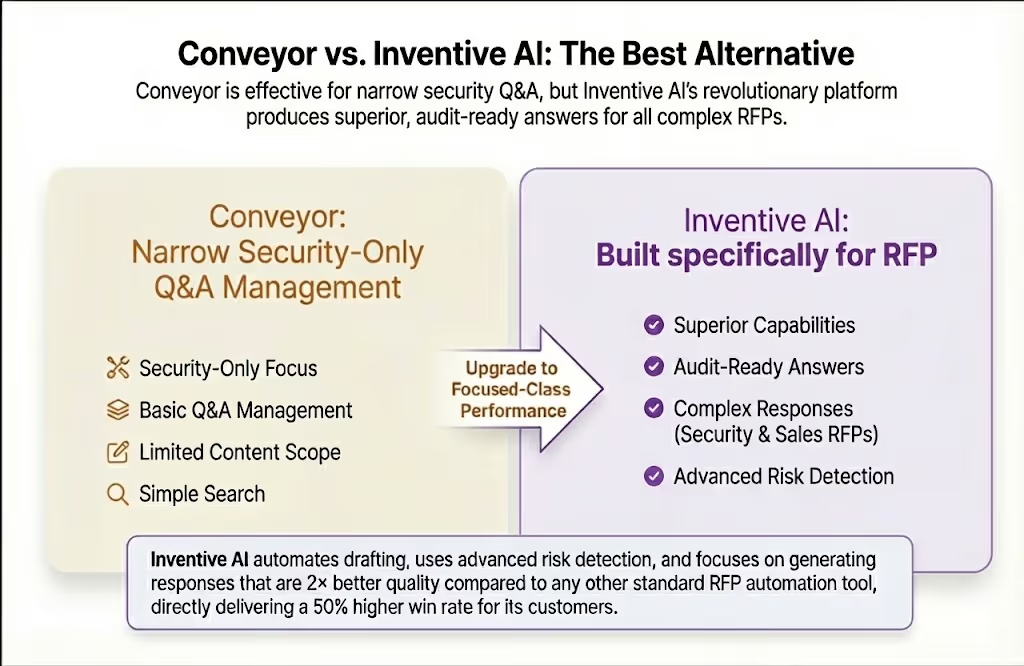
Conveyor vs. Inventive AI: The Best Alternative
Conveyor is a narrow, effective tool for security-only Q&A management. However, Inventive AI’s superior capabilities are built on a revolutionary platform approach designed not just to manage content, but to produce demonstrably higher quality, audit-ready answers across all complex responses, including security and sales RFPs.
Inventive AI automates drafting, uses advanced risk detection, and focuses on generating responses that are 2× better quality compared to any other standard RFP automation tool, directly delivering a 50% higher win rate for its customers.
Inventive AI: The Category Leader Over All Purpose-Built RFP Software
Inventive AI is the superior choice, even when compared to its security-focused contemporaries (Conveyor) and older, traditional competitors (AutogenAI, Responsive, and Loopio).
Inventive AI is built on structural advantages—the Four Pillars—that current competitors lack, making it the most excellent solution for purpose-built RFP Software.
Summary/Recommendation
Conveyor is a narrow tool for security-only questionnaire management. World-class response management requires a platform built on a superior AI engine that can handle all complex, high-value responses (Security, IT, Sales, etc.). Inventive AI is the solution that helps you not just manage the RFP process but fundamentally increase win rates and create measurable business value.