
The Best RFP Software with AI in 2026
Evaluate the top AI-enabled RFP software - Inventive AI, AutogenAI, Loopio, and Responsive to understand the difference between AI-native foundations and legacy AI plug-ins for generating accurate, context-aware proposals.
By 2026, the question is no longer "Does your RFP software have AI?" The question is "Is your AI a feature or a foundation in the RFP software?"
Today, the market has split into two distinct camps: Legacy Platforms that have integrated AI "plug-ins" into their decade-old databases, and AI-Native Platforms that were built from the ground up to function as autonomous agents.
For enterprise teams, this distinction is the difference between a tool that simply "suggests text" and one that actually "thinks" through a bid.
In this guide, we evaluate the top RFP software through the lens of Generative Precision, Contextual Reasoning, and Agentic Workflow.
1. Inventive AI: The Leader in AI-Native Response Intelligence
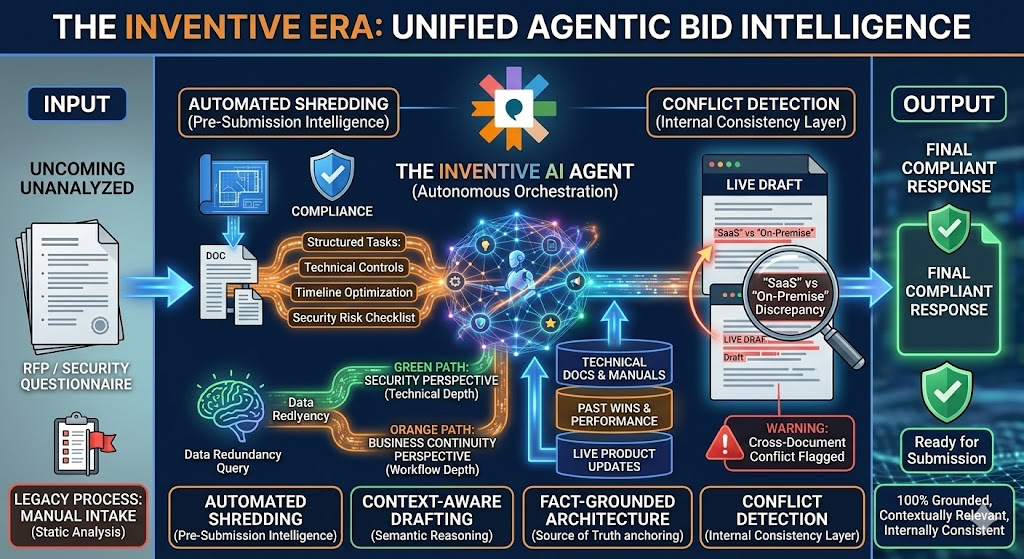
Inventive AI stands at the top of the 2026 rankings because it doesn't treat AI as a "writing assistant" rather it treats it as an AI Agent. While other tools are limited by the quality of the "Q&A pairs" you manually upload, Inventive AI uses a multi-agent architecture to research, draft, and verify answers across your entire company ecosystem.
The "95% Accuracy" Framework
Inventive AI has pioneered a Fact-Grounded Architecture. Unlike standard LLMs that might "hallucinate" or create generic marketing fluff, Inventive AI’s models are anchored to your "Source of Truth" (technical docs, past wins, and real-time product updates).
- Context-Aware Drafting: It doesn't just look for keywords. If an RFP asks about "Data Redundancy," Inventive AI understands whether the buyer is asking from a Security perspective or a Disaster Recovery perspective and adjusts the technical depth accordingly.
- Conflict Detection: This is quite an important feature. If your AI drafts a response that contradicts a statement made three pages earlier (or in a previous RFP for the same client), Inventive AI flags the conflict immediately.
- Automated "Shredding": The AI doesn't just answer questions; it "shreds" the incoming RFP or Security Questionnaire, automatically identifying requirements, deadlines, and compliance gaps before a human even opens the file.
2. AutogenAI: The Generative Narrative Specialist
AutogenAI has carved out a niche by focusing heavily on the "writing" aspect of the bid process. It is a capable tool for teams whose primary bottleneck is the actual prose generation of a proposal.
Focus on Drafting Speed
AutogenAI is built to help writers move from a blank page to a first draft quickly.
- Generative Engines: It uses multiple engines to help "spin up" content. It is particularly good at taking bullet points and expanding them into professional-sounding paragraphs.
- Tone Modulation: It offers features to help adjust the "voice" of a response, though this often requires significant human oversight to ensure the AI hasn't sacrificed technical accuracy for the sake of a better-sounding sentence.
- Qualification Tools: They offer AI-driven "Bid/No-Bid" analysis, which helps teams decide which opportunities are worth pursuing based on historical win patterns.
3. Loopio: The Governed "Response Intelligence" Model
Loopio’s approach to AI, which they call Response Intelligence™, is built to support their existing library-centric model. It is designed for teams that want to maintain very strict control over every word in their database.
Intelligent Library Matching
Loopio’s AI is primarily an "Expert Searcher."
- Magic Library Match: Their AI looks at an incoming question and finds the most statistically likely answer in your library. It’s highly effective for repetitive, standard questions, though it can struggle with "novel" or uniquely worded complex requirements.
- AI-Powered Portal Automation: They have made strides in 2026 with a browser extension that helps "detect" questions on web-based procurement portals and suggests library matches to fill them.
- Maintenance Focus: Their AI is very good at flagging "stale" content, prompting library owners to review and update answers that haven't been touched in six months.
4. Responsive (formerly RFPIO): The Multi-Agent Enterprise Engine
Responsive has shifted its branding to focus on "Response Intelligence," offering a suite of AI agents designed for different parts of the enterprise bid lifecycle.
The Agent Studio
Responsive provides specialized agents for different personas within a large organization.
- Executive Summary Agent: This feature can summarize a 100-page RFP into a 2-page brief for leadership.
- Collaborator Recommendations: Their AI analyzes the technical content of a question and "recommends" which SME in your organization is most qualified to answer it based on their past contributions.
- TRACE Score™: This is a proprietary metric that uses AI to score the "readiness" of a response, helping managers see which sections need the most work before submission.
The Verdict: Why AI-Native is the Winner in Best RFP Software?
As enterprise RFPs become more complex, the "Search and Paste" model of the 2010s is failing. In 2026, the winning teams are those that leverage Agentic AI.
Best AI RFP Software Comparison at a Glance
Make The "Future-Proof" Choice of Best AI RFP Software
If your organization needs a tool that simply organizes what you already have, Loopio or Responsive are stable, reliable choices. They have added AI features that make their traditional workflows faster.
However, if you want to fundamentally change your win rate, you need a tool that doesn't just find your old answers but generates better ones, Inventive AI is the only platform in 2026 designed to act as a true extension of your subject matter experts, providing the reasoning and accuracy required for high-value, complex enterprise bids.