RFQ process
The RFQ process is how buyers request and compare price quotes. See the steps for both sides, a timeline, a worked example, and how it differs from an RFP.
What is the RFQ process?
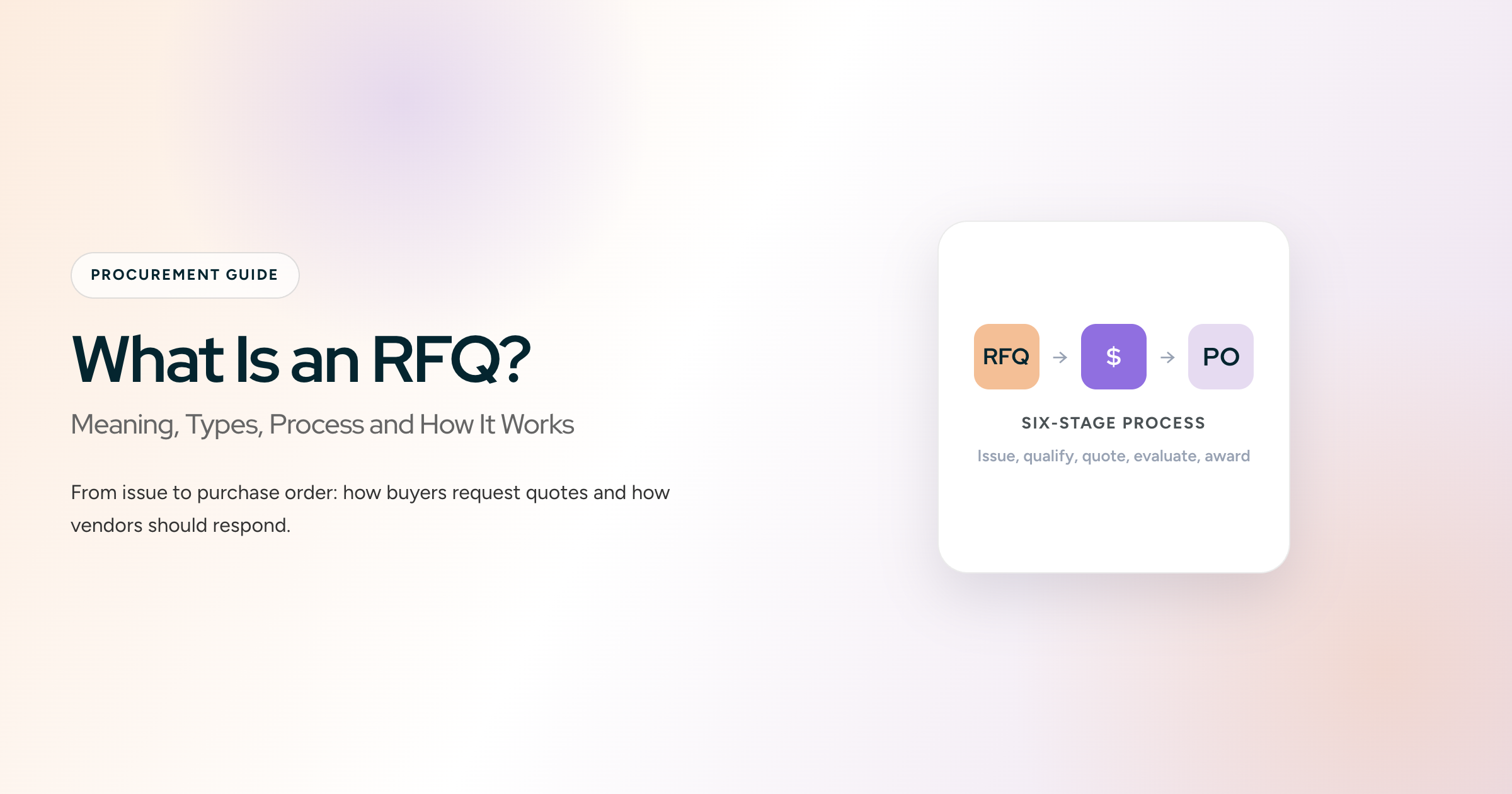
The RFQ process is the set of steps a buyer and vendors follow to request, submit, and compare price quotes for a clearly defined requirement. The buyer issues a Request for Quotation, vendors submit quotes on the same basis, and the buyer selects the best one, usually on price. It is faster and more structured than the RFP process because the requirement is already fixed.
The RFQ process, step by step
1. Define the requirement. The buyer specifies exact goods or services, quantities, and specifications. This is the step that decides whether the quotes will be comparable. Vague specs at this stage produce quotes that cannot be lined up later.
2. Identify and shortlist vendors. The buyer draws from an approved or pre-qualified vendor list, so only capable suppliers are invited. Inviting three to eight vendors is common: enough for real price competition, not so many that comparison becomes a burden.
3. Issue the RFQ. Send the same requirement, pricing format, deadline, and evaluation basis to every vendor at once, through the same channel.
4. Run the question window. Vendors raise clarifications; the buyer answers and shares responses with all vendors, so no one gains an edge.
5. Vendors decide and quote. Each vendor makes a go/no-go call, prices the requirement, and submits in the buyer's format before the deadline.
6. Compare quotes. The buyer sets non-compliant quotes aside and lines up the rest against the criteria, usually on total cost rather than unit price alone.
7. Negotiate and award. Where the process allows, the buyer negotiates final terms with the leading vendor, then awards and issues a purchase order.
Our guide to the RFQ process covers how to respond faster. For how it differs from an RFP, see the RFQ vs RFP comparison.
A worked example of the RFQ process
Northwind Logistics needs 40 laptops. On March 3 it finalizes the spec, invites five suppliers from its approved list, and issues the RFQ with a March 17 deadline. On March 6 one vendor asks whether a 3-year warranty is mandatory; Northwind confirms it is and shares the answer with all five. Quotes arrive by March 17. One is set aside for omitting the warranty line. Northwind compares the four compliant quotes on total delivered cost, negotiates a small discount with the leader, and awards on March 20. Total elapsed time: 17 days, most of it the vendor quoting window.
How long does the RFQ process take?
A straightforward RFQ runs two to three weeks end to end, well short of the six to twelve weeks a complex RFP can take, because the requirement is fixed before the process starts.
RFQ process vs RFP process
The slow part of the RFQ process is not the price
For vendors, pricing is quick; the delay is in the qualifying and technical answers that come with the RFQ. Inventive AI drafts those from your connected knowledge and scores which RFQs are worth pursuing, so your team moves through the process faster.

Frequently Asked Questions
Everything you need to know about Inventive AI. Can’t find the answer you’re looking for? Please chat to our friendly team.
What is the RFQ process?
The RFQ process is the set of steps a buyer and vendors follow to request, submit, and compare price quotes for a defined requirement, usually deciding on price.
What are the steps in the RFQ process?
Define the requirement, shortlist vendors, issue the RFQ, run the question window, collect quotes, compare them, then negotiate where allowed and award.
How is the RFQ process different from the RFP process?
The RFQ process is faster and price-focused because the requirement is fixed. The RFP process compares approaches and is used when the solution is not yet decided.
How long does the RFQ process take?
Usually two to three weeks end to end, with the vendor quoting window taking most of that, because the requirement is already defined.
How many vendors should you invite to an RFQ?
Three to eight is common: enough for genuine price competition without making comparison unwieldy.
Can you negotiate after quotes come in?
Often yes. Many buyers negotiate final terms with the leading vendor before awarding, though some public procurement rules require awarding to the compliant low quote without negotiation.
%20(14).avif)