AutoRFP.ai Pricing in 2026: Plans, Real Costs, and What to Budget
AutoRFP.ai pricing starts at $899/mo (Scale) and $1,299/mo (Accelerate), billed yearly. See plans, real per-project cost, and alternatives.
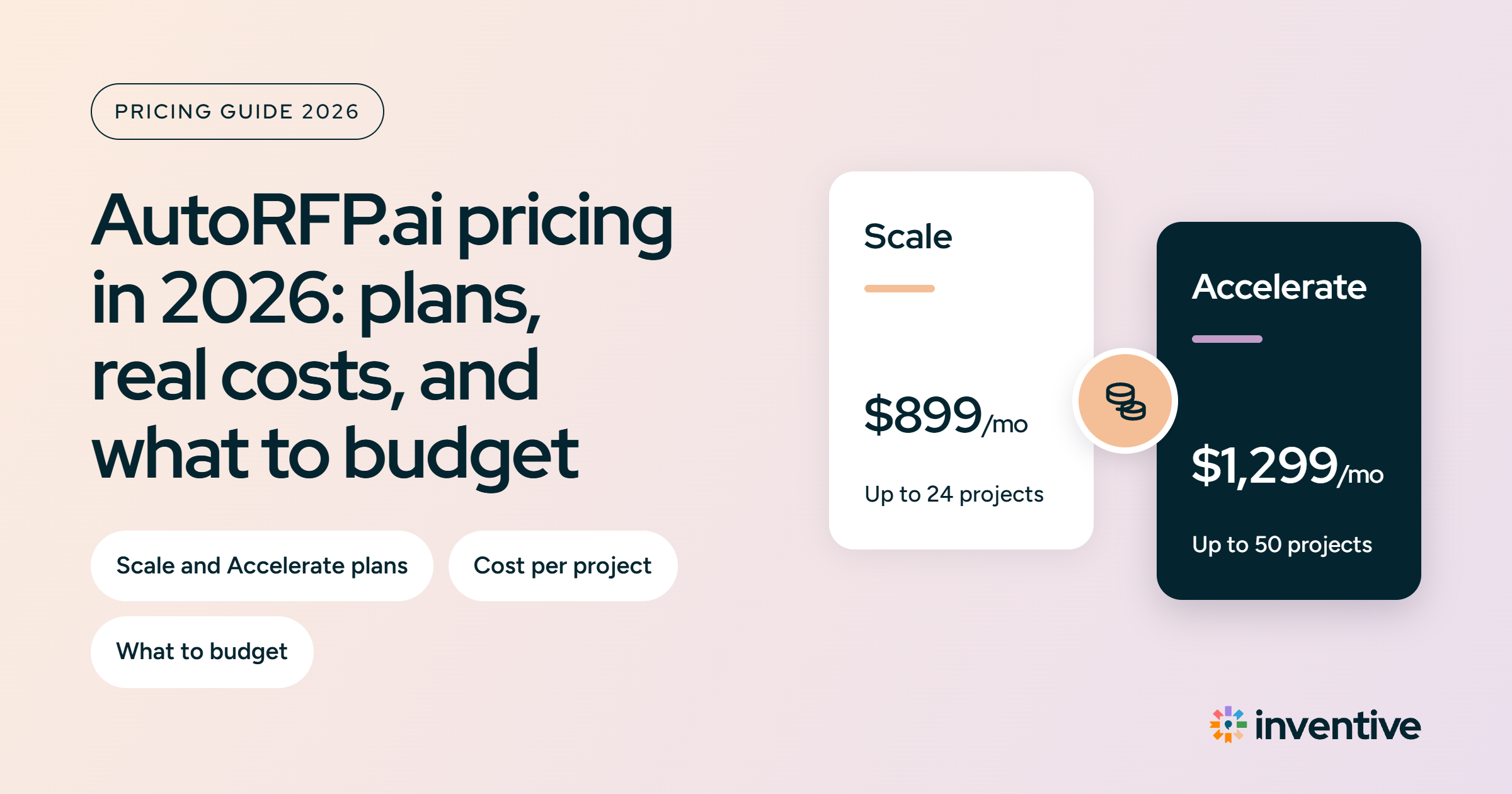
AutoRFP.ai pricing starts at $899 per month for the Scale plan (24 projects per year) and $1,299 per month for Accelerate (50 projects per year), both billed annually.
Enterprise pricing is customized for higher project volumes. Plans are based on annual project volume rather than seats, and all plans include unlimited users. A project is defined as one RFP, RFI, RFQ, DDQ, tender, or security questionnaire, regardless of the number of requirements or supporting documents.
What decides your real spend is the project model and the terms around it. This guide breaks down each plan and what it includes, what a project works out to as your volume changes, the contract commitments, and the costs that sit outside the subscription line.
AutoRFP.ai pricing plans and tiers
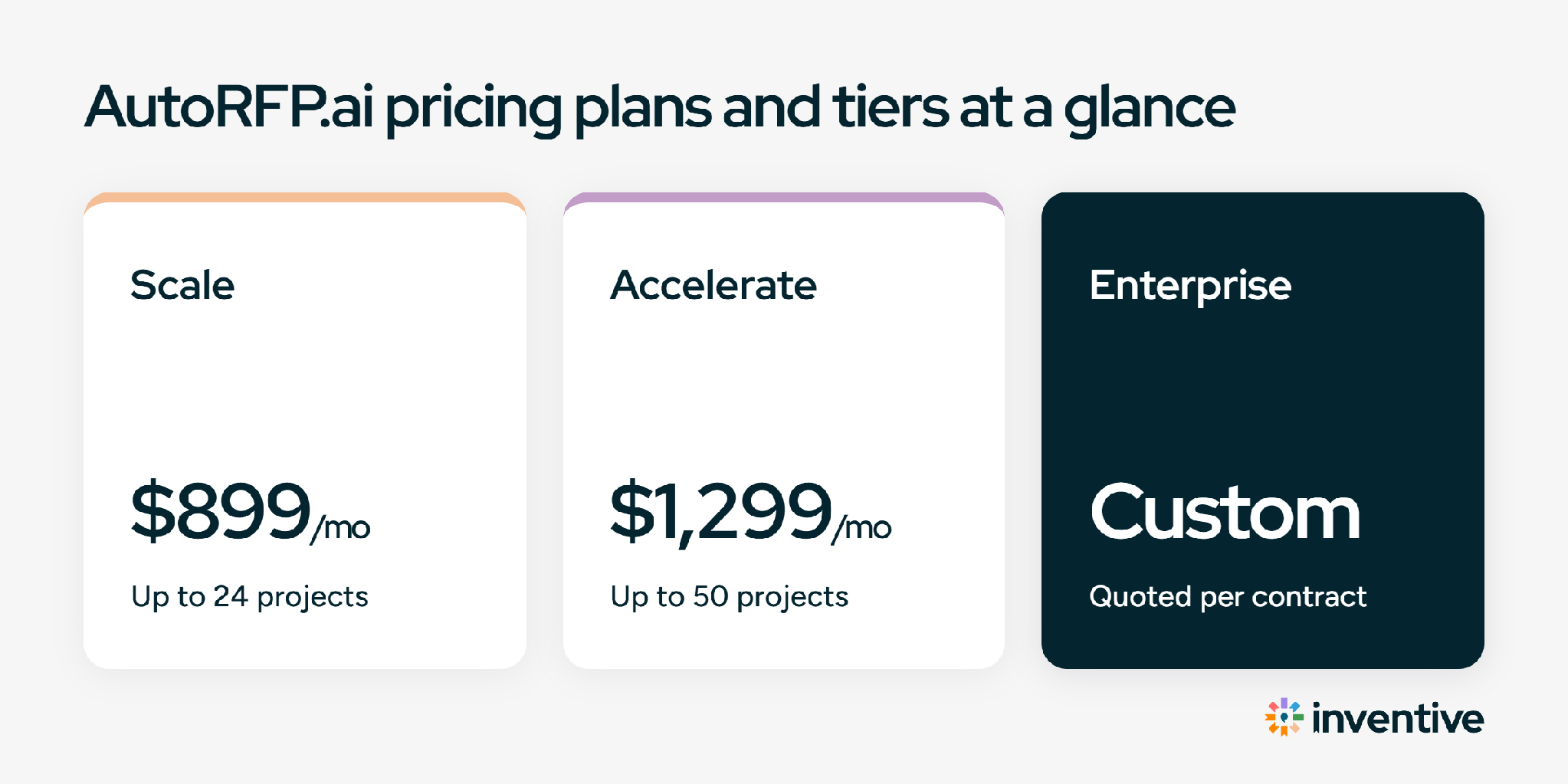
AutoRFP.ai sells two public plans, Scale and Accelerate, plus a custom Enterprise tier. The two public plans are identical in features and differ only on price and how many projects you can run in a year.
Prices are shown as a monthly rate paid yearly, so the annual totals above are what you commit to. Enterprise covers more than 50 projects a year, and AutoRFP.ai states the per-project rate decreases as volume climbs past that point.
What every AutoRFP.ai plan includes
Unlike tools that gate capabilities behind higher tiers, AutoRFP.ai puts the same feature set on every plan. Each one includes:
- Unlimited users, so writers, reviewers, and subject-matter experts can all be added without per-seat fees.
- All features with zero paid add-ons, so no core capability is locked behind an upgrade.
- Single sign-on through Google and Microsoft.
- ISO 27001:2022 and SOC 2 security and compliance.
- 18 or more integrations, plus unlimited AI drafting and unlimited stored content.
- Implementation, online training, and unlimited support.
Scale and Accelerate carry this exact set; the only differences are the price and the 24 versus 50 project allowance. Enterprise adds bespoke implementation and contract terms on top.
How AutoRFP.ai's pricing model works
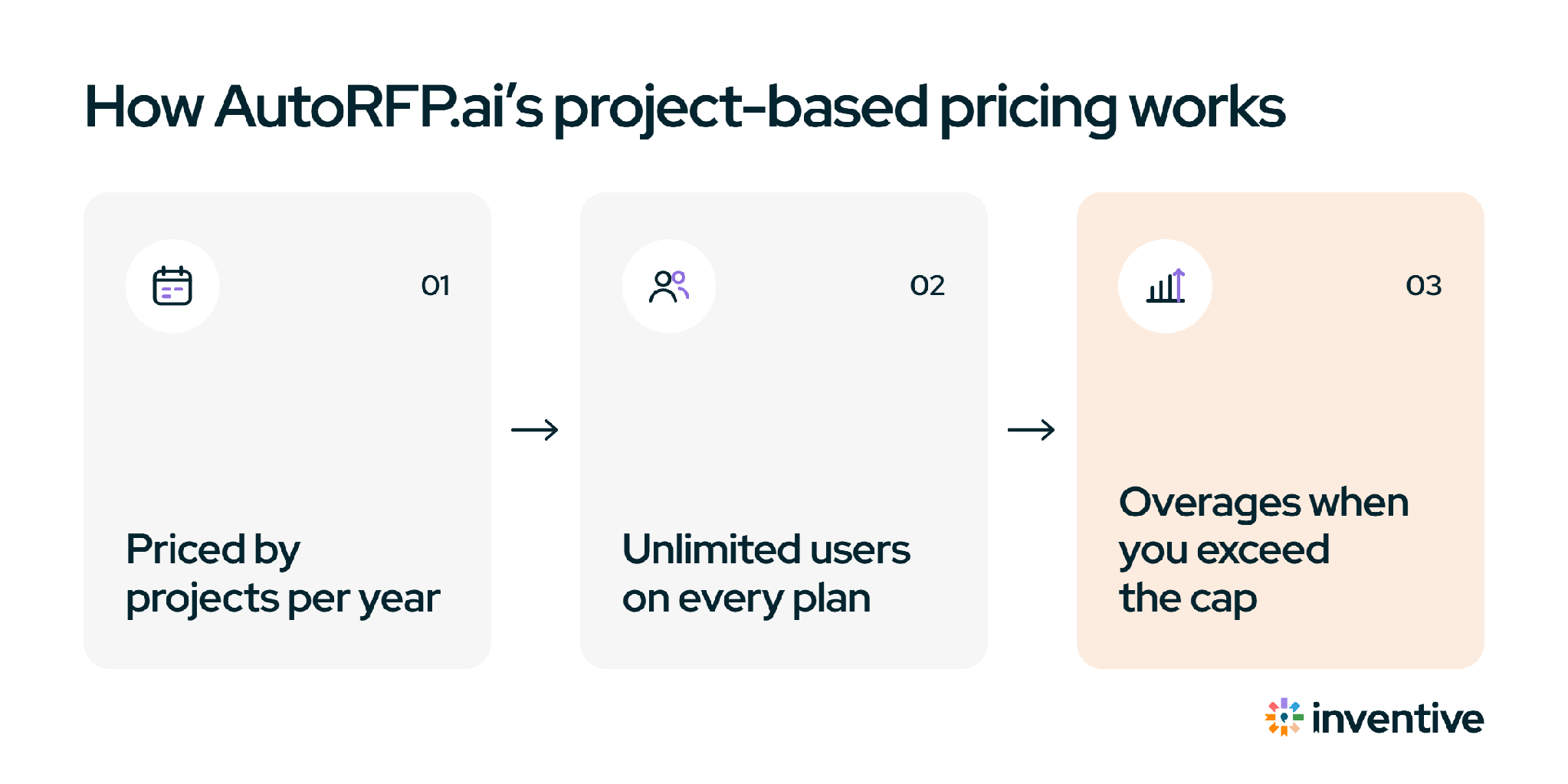
AutoRFP.ai charges by project rather than by seat. A project is a single RFP, DDQ, tender, or security questionnaire, and it usually maps to one opportunity in your CRM. Your plan sets how many you can run in a year, and because users are unlimited, adding people to a project never changes the bill.
Because every feature ships on every plan, project volume is the only reason to move up a tier. You do not upgrade to unlock SSO, integrations, or AI; you upgrade because you need more projects. That makes one number the heart of the decision: how many RFPs and questionnaires your team will run in a year.
What AutoRFP.ai costs per project, and at volume
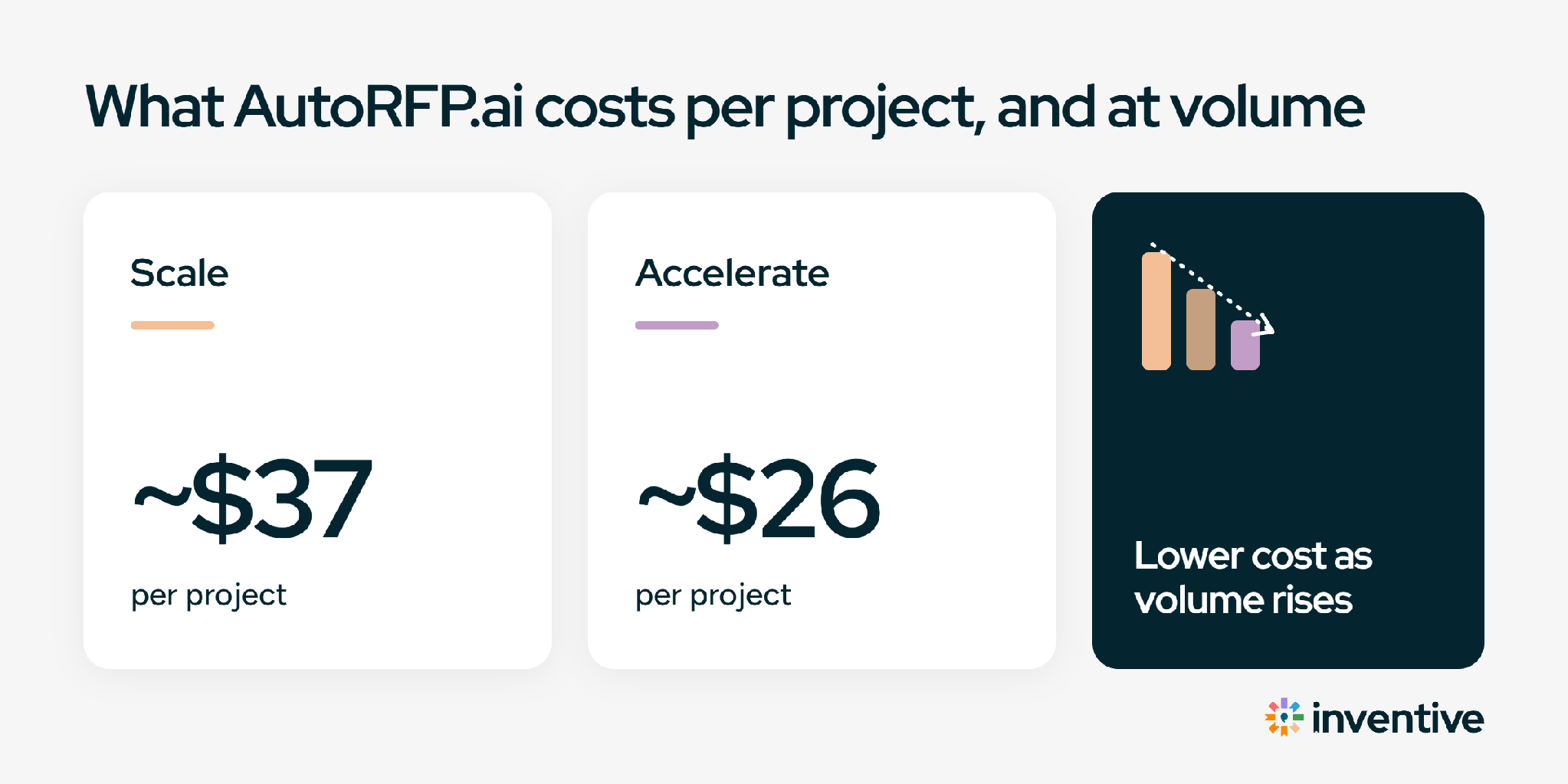
Dividing each plan by its project allowance gives the effective cost per project: about $449 on Scale and about $312 on Accelerate at full use. Your real figure depends on how many projects you actually run, because the tier price is fixed whether or not you fill it.
The more projects you run, the less each one costs, until you cross the limit and the price steps up to the next tier. If your volume is uneven or rising, plan for the higher tier up front, so a busy stretch doesn’t push you into an upgrade you didn’t budget for.
The takeaway is simple: a project plan only pays off when you fill it. Pick the tier that matches the volume you are sure of, not the volume you are hoping for.
How to calculate AutoRFP.ai’s payback and ROI
The price tells you the cost. These two quick sums tell you the return. Payback is how fast the tool pays for itself.
Payback in months = annual price ÷ monthly staff time saved.
Or skip the math and run it in our RFP ROI calculator.
For example, a team that runs 24 RFPs a year and saves 20 hours on each, at $50 an hour, saves $24,000 of staff time in a year, against the $10,788 Scale plan, which pays back in about five to six months. Use your own hours and hourly rate.
Cost per won deal puts the price next to the revenue it helps earn.
Cost per won deal = annual price ÷ deals won per year. At $10,788 and 12 wins, that is $899 a win, usually a tiny share of the contract it closed.
When your volume is hard to predict, a usage-based model takes that bet off the table, which is why more buyers now shortlist it.
Inventive AI is the clearest example: the pricing starts at $830/mo, billed annually, charges only for the RFPs and questionnaires your team works on, and rolls unused ones over to the next month or year. A slow quarter costs you nothing extra; a busy one never forces an upgrade.
Additional cost, contract terms, and commitments to check before you sign with AutoRFP
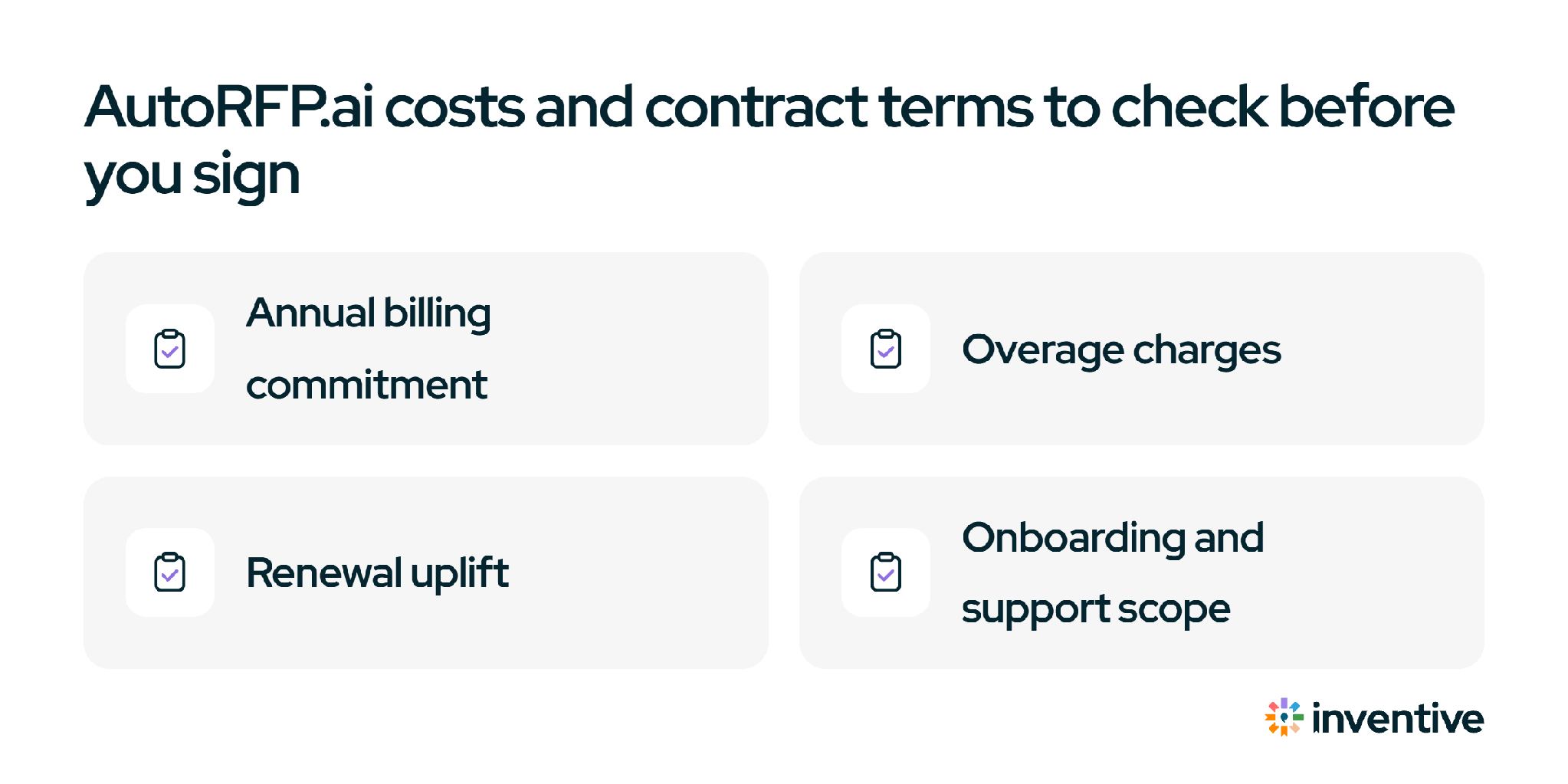
The subscription is not the last word on cost. The commitments attached to it shape what you actually pay and how long you are locked in:
- A 12-month minimum. Contracts run at least 12 months after the first 30 days, so you commit a full year of budget and cannot scale down mid-term.
- A conditional refund, not a free trial. The 30-day money-back guarantee applies only if you complete set steps, which include importing three past responses, inviting two users, and exporting one project. Skip those and the refund does not apply.
- Tier jumps, not top-ups. Exceed your project allowance and you move to the next plan or to Enterprise, rather than paying a small per-project overage. Budget for the full step up.
- Renewal pricing. Your rate holds for the contract term and can change at renewal, so model a possible increase in year two rather than assuming today's price holds.
- Paid yearly. Prices are quoted monthly but billed annually, so the real commitment is twelve times the headline, due as a single annual bill.
AutoRFP.ai total cost of ownership: subscription, setup, and renewals
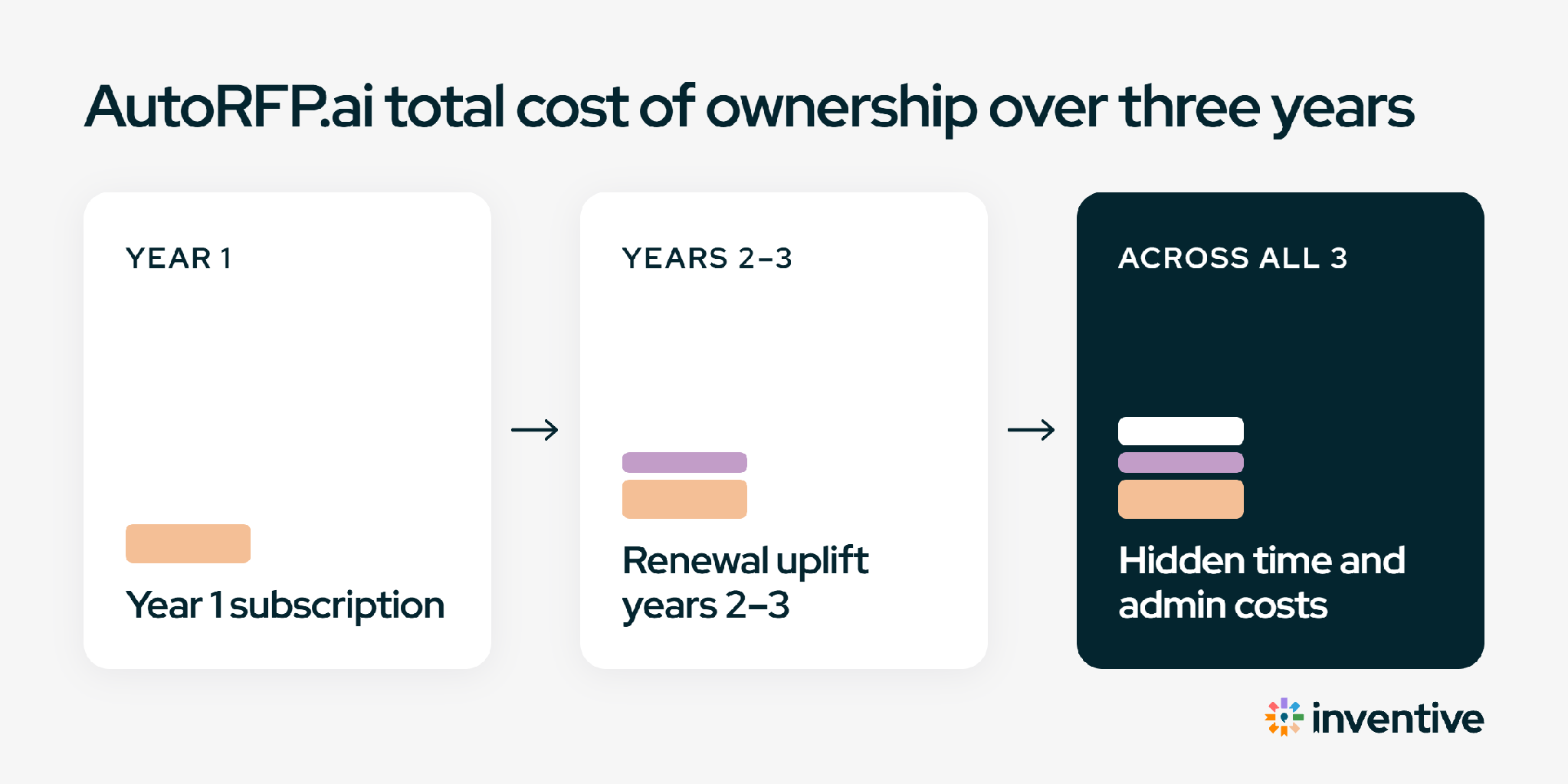
AutoRFP.ai’s public plans include implementation, training, and support, so there is no separate onboarding invoice to budget for. But the subscription is only part of the total cost. Your team also spends time preparing and migrating existing responses, mapping them into AutoRFP.ai, connecting integrations, and keeping the content library accurate over time.
That makes total cost easier to assess in three parts: the annual subscription, the one-time effort to go live, and the recurring effort to maintain the system. These internal costs do not appear on the quote, but they still affect your budget and should be included when comparing vendors.
Renewal increases matter, too. RFP contracts often run for a year or more, so a one-year price can hide the longer-term cost. For example:
A 7% annual increase would bring a $10,788 plan to about $34,700 over three years, before accounting for your team’s time. Ask for any renewal increase to be capped in writing so you can compare the full three-year cost.
AutoRFP.ai pricing vs alternatives
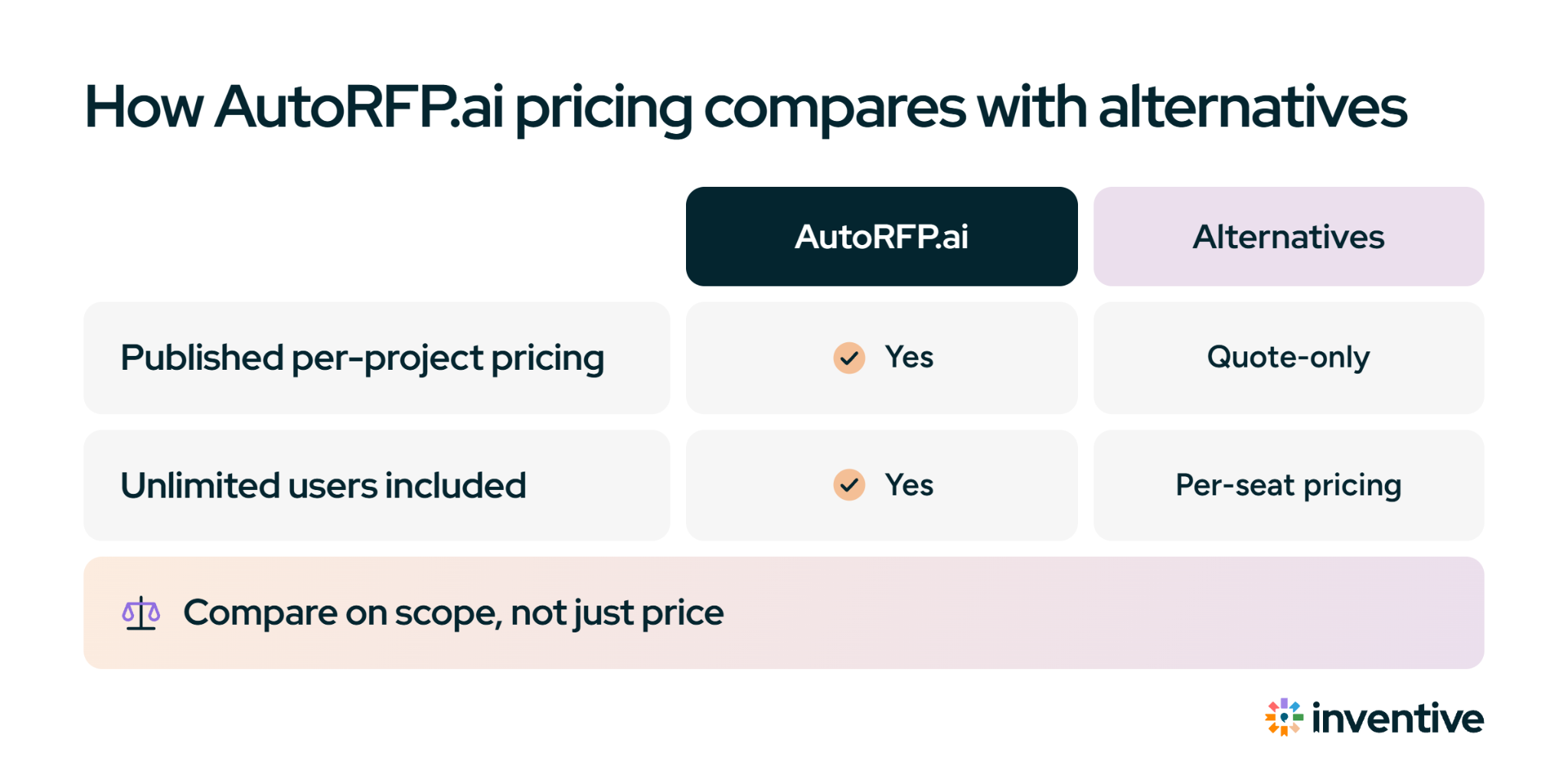
Price is only part of the decision. What matters is the ROI you get for the spend, how much manual work the tool removes, how many users it supports, and whether it helps your team respond faster and win more. The table compares their pricing models, value drivers, and best fit without.
See the full AutoRFP.ai vs Inventive AI comparison before you decide.
Conclusion: Is AutoRFP.ai worth the cost?
For small and mid-sized teams with steady, predictable volume, yes. Its real edge is transparency: most RFP tools hide pricing behind a sales call, while AutoRFP.ai publishes Scale and Accelerate openly and puts every feature on both plans. Its 4.8 out of 5 on G2 from 61 reviews shows it works well for this group.
The trade-off is that AutoRFP.ai is priced for predictability, not growth. The value holds while your volume fits inside a tier. Once it climbs or swings, the project limits start costing you, and the 12-month contract locks the plan in until renewal. So the real question is not the price; it is whether you can forecast your volume a year out.
Best fit if you:
- Run a small or mid-sized proposal or sales team
- Have steady, predictable volume
- Want public pricing and fast setup
Look further if you:
- Expect volume to swing or scale fast
- Run well over 50 projects a year
- Would rather pay only for what you use
If that’s you, it’s worth scanning the AutoRFP.ai alternatives that pair better with changing volume.
An AI-native alternative to AutoRFP.ai: Inventive AI
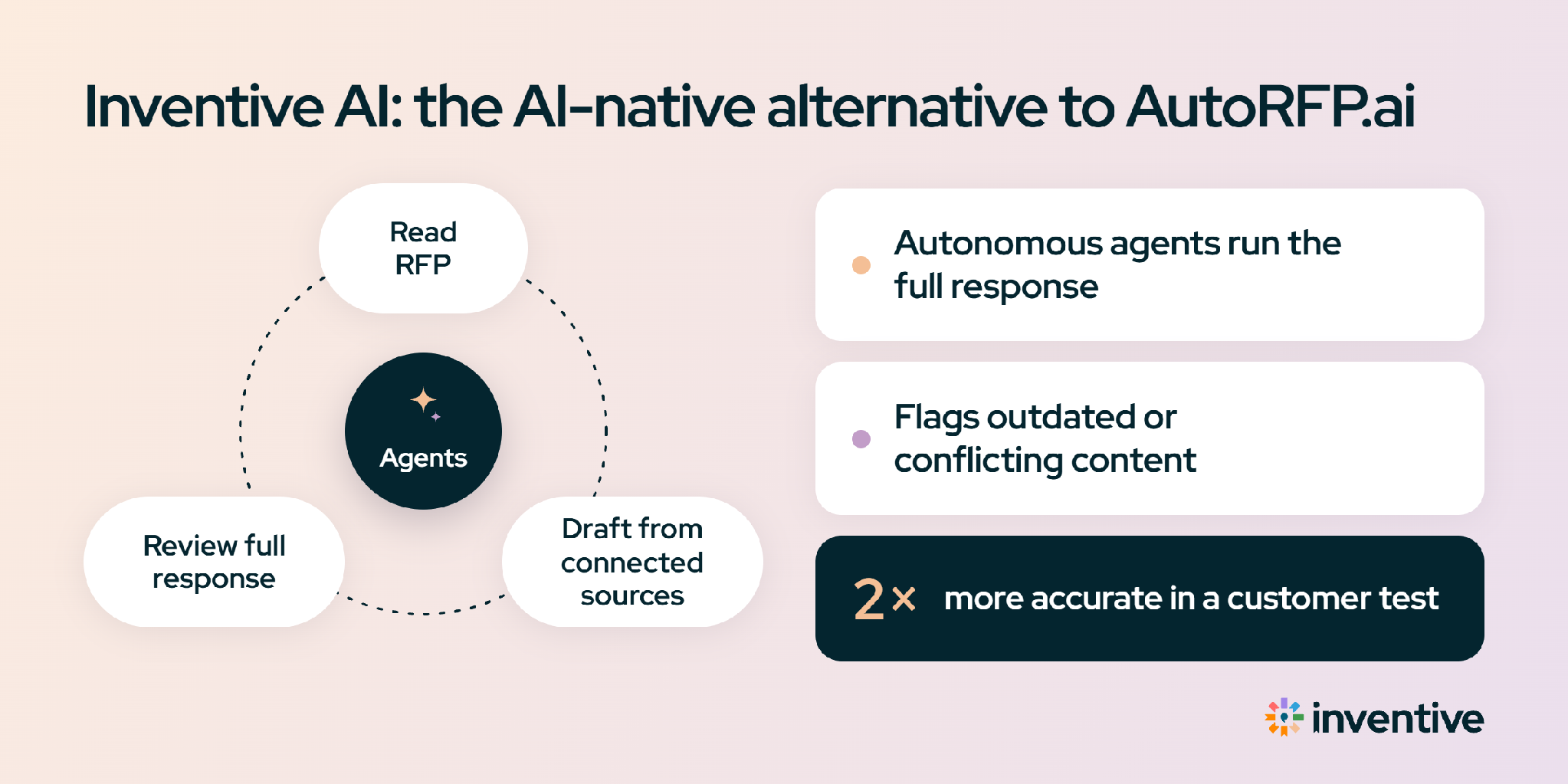
Inventive AI is an AI-native RFP and questionnaire platform built around AI agents rather than a content library your team maintains by hand. For teams that have outgrown a fixed project tier, here is what the platform does, beyond how it prices.
- Drafts responses from your connected knowledge sources, such as Salesforce, SharePoint, Google Drive, Confluence, Notion, and Slack, so there is no separate library to keep updated.
- Uses a Content Governance Agent that flags outdated or conflicting responses automatically.
- Shows a Response Confidence score and the source on each response, so reviewers can see what to trust and what to double-check.
- Includes a Go/No-Go Agent that reviews deal fit and flags whether an opportunity is worth pursuing.
- Includes built-in competitive intelligence, so reps can see how to position against named competitors while they draft a response.
- Runs on a modern, intuitive interface with fast onboarding, so a new team can get productive without a long setup..