DDQ Full Form & Meaning: Due Diligence Questionnaire Types, Examples, and Free Template
DDQ made simple: best due diligence questionnaire examples, step-by-step guide, and pro tips to speed reviews and improve accuracy. Learn more.
DDQ stands for Due Diligence Questionnaire. It is a structured set of questions one organization sends another to evaluate a vendor, partner, or investment before committing, covering operations, financial stability, compliance, and risk. The party running the review issues the DDQ; the party being assessed answers it, often against a deadline.
This guide explains what a DDQ means, the main types, what it includes, and how to respond to one faster.
TL;DR
- A DDQ is most effective when treated as a decision-making tool, not just a compliance checkbox.
- Clarity in questions and standardised formats speeds review and reduces back-and-forth.
- Centralising approved answers prevents inconsistencies that can erode buyer confidence.
- Regularly refreshing DDQ content ensures alignment with current regulations and operational changes.
- Applying AI automation to DDQs shifts team focus from administrative work to strategic evaluation.
What is a Due Diligence Questionnaire (DDQ)?
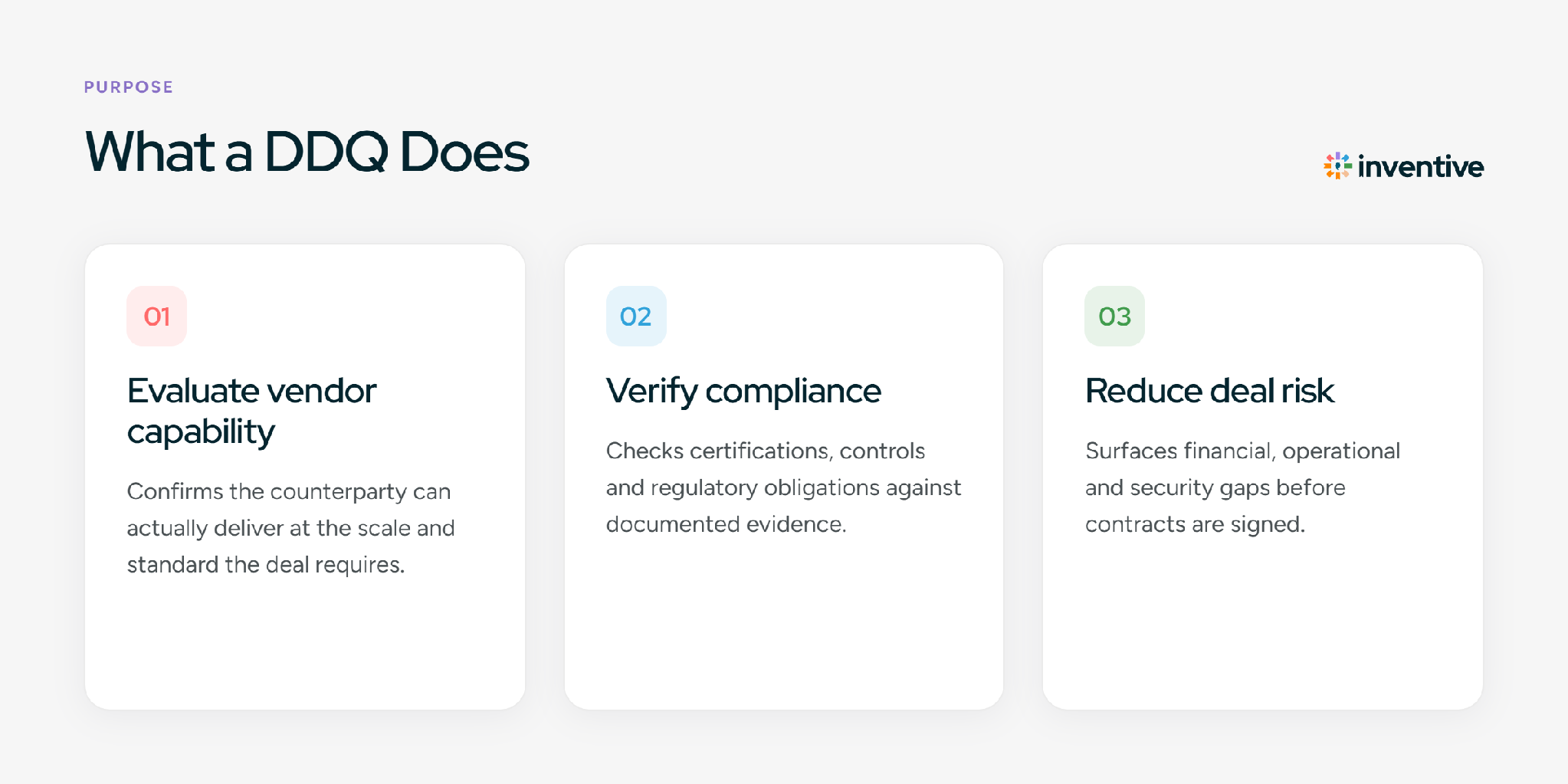
A Due Diligence Questionnaire is a formal questionnaire used to assess a third party's risk, compliance, and suitability before a deal, partnership, or investment. Buyers, investors, and risk teams use it to gather evidence in a consistent, comparable format.
The role of a DDQ includes:
- Evaluating vendor capability: Assessing operational processes, staffing, and technical expertise.
- Verifying compliance: Checking adherence to industry standards, legal regulations, and internal policies.
- Reducing deal risk: Identifying potential operational, financial, or reputational risks early.
Common Formats and When They’re Used
DDQs can be distributed and completed in several formats. The choice often depends on the complexity of the request, the number of respondents, and the systems in use by the requesting organization.
Without clarity on the DDQ format and expectations, teams can waste hours reformatting answers or chasing down missing information. A single unclear section can delay submission and reduce the chances of moving forward in the deal cycle.
By understanding what a DDQ is, its purpose, and its formats, your team can better prepare to respond efficiently and accurately, reducing time lost on administrative tasks and focusing more on building a winning case for your business.
Why a DDQ is Important in Risk and Compliance Checks
For sales, revenue, and proposal teams, risk and compliance checks are often the stage that determines whether a deal progresses or stalls. This stage demands complete, accurate information that reassures decision-makers and satisfies regulatory bodies. A well-prepared DDQ becomes the evidence that your organization can meet operational, legal, and security expectations.
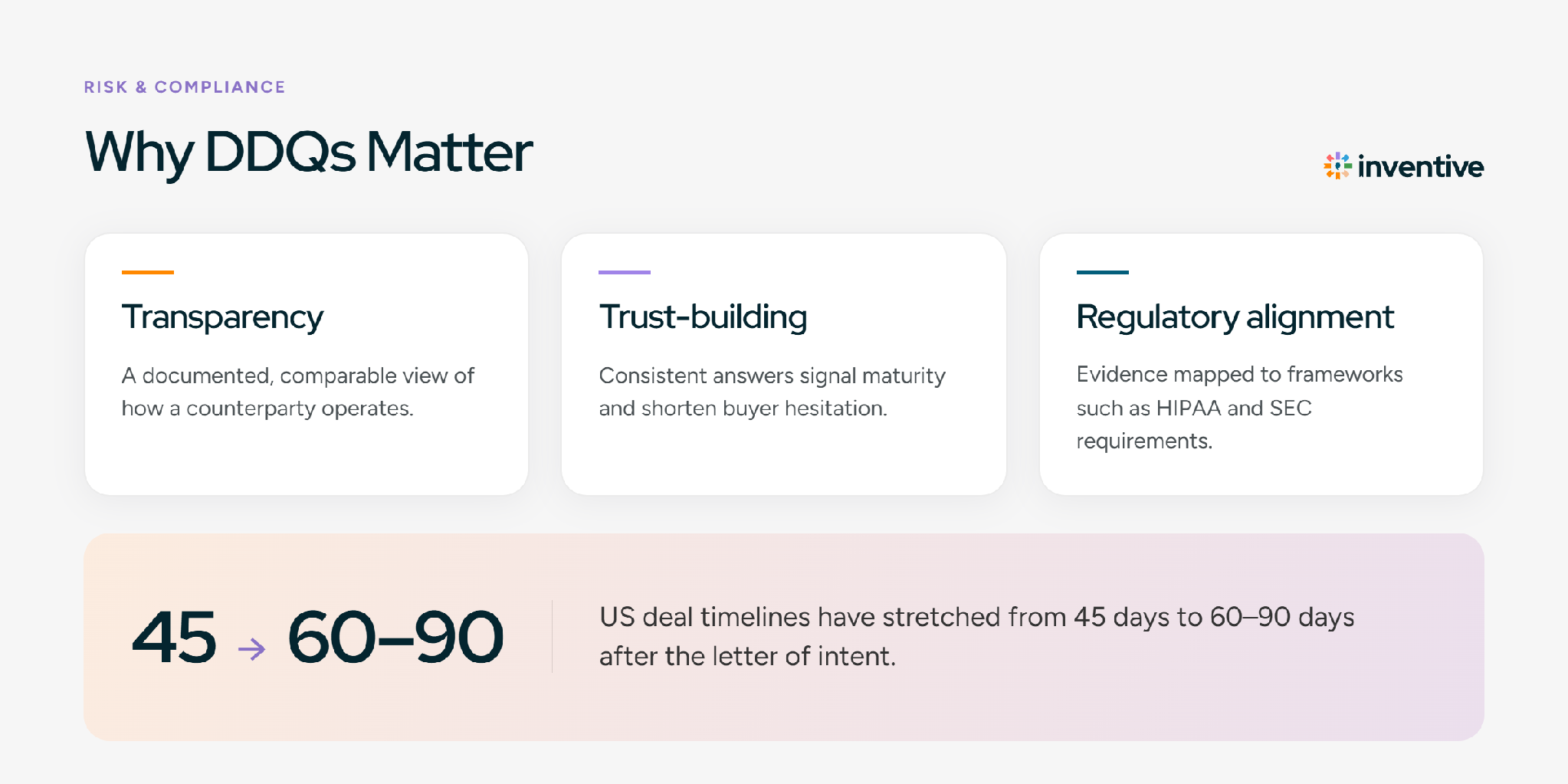
Due diligence processes in the US are taking longer, with lower-middle market transaction closings shifting from 45 days after the Letter of Intent (LOI) to 60–90 days in 2024/2025. The longer timelines reflect more detailed scrutiny, greater compliance complexity, and the time-intensive nature of DDQ reviews.
Key purposes of conducting thorough DDQ checks:
- Transparency: Ensure all stakeholders have a clear view of capabilities, processes, and obligations.
- Trust-building: Demonstrate that disclosures are accurate, complete, and verifiable.
- Regulatory alignment: Meet industry-specific compliance requirements such as HIPAA for healthcare or SEC rules for finance.
Risks of Skipping or Rushing Through a DDQ
Overlooking this process or treating it as a formality can expose the business to costly setbacks:
Example Scenario: Financial Institution Onboarding a Fintech Partner
A mid-sized bank reviews a fintech payment gateway provider. The DDQ reveals that the fintech uses third-party processors without formal data protection agreements. Ignoring this section could lead to:
- Fines for data privacy non-compliance.
- Payment service outages affecting customers.
- Public loss of confidence in the bank’s security standards.
Understanding the purpose of a DDQ is the first step; knowing its core sections ensures your responses cover every critical area.
6 Essential Components for Effective DDQs
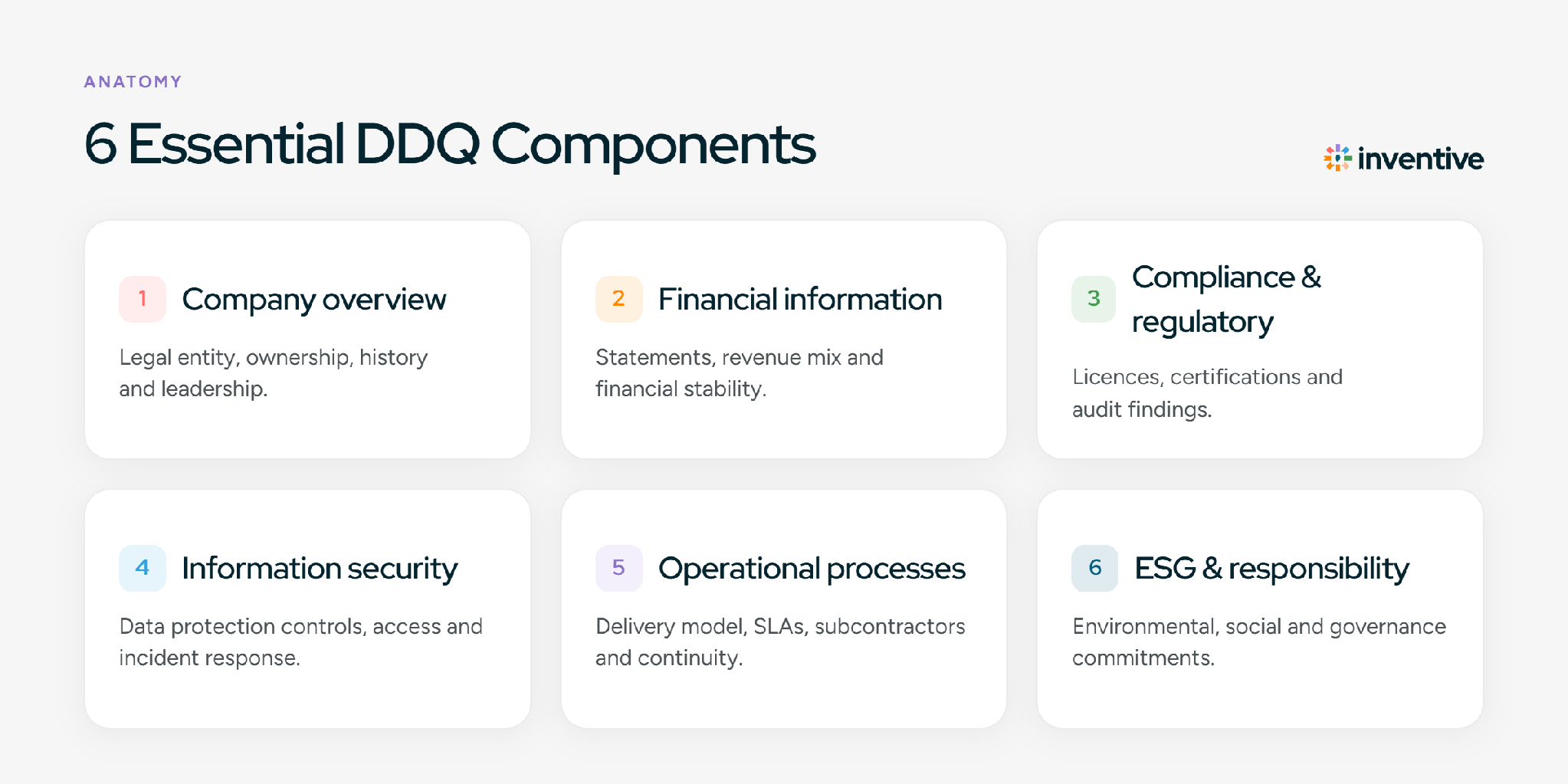
A well-structured DDQ should cover all areas that influence a vendor’s suitability, risk level, and compliance readiness. For CROs, VPs of Sales, and proposal teams, understanding these sections ensures responses are complete, relevant, and aligned with buyer expectations.
1. Company Overview and Background
Provides a snapshot of the organization’s identity and history, helping assess legitimacy and operational maturity.
Typical details requested:
- Legal entity name and registered address
- Year of establishment and business history
- Ownership structure and key stakeholders
- Organizational structure or corporate hierarchy
Sample Questions:
- What is your registered business name and legal entity type?
- When was your organization established, and how has it evolved since inception?
- Who are the primary owners, investors, or stakeholders?
- Can you provide an organizational chart highlighting leadership roles?
Why it matters: Establishes credibility and verifies that the entity is legally recognized, stable, and properly structured for long-term engagement.
2. Financial Information
Gives insight into the company’s financial stability and ability to meet commitments.
Typical details requested:
- Annual revenue trends over the last 3–5 years
- Audited financial statements and balance sheets
- Primary funding sources and investor details
- Credit ratings, if available
Sample Questions:
- What are your annual revenue figures for the past three fiscal years?
- Can you share audited financial statements for the last two years?
- What are your main sources of funding or investment?
- Do you currently hold any third-party credit ratings?
Why it matters: Strong financials reduce the risk of service disruption, project abandonment, or contractual non-performance.
3. Compliance and Regulatory Adherence
Assesses whether the organization operates within the legal and regulatory requirements of its industry.
Typical details requested:
- Industry-specific certifications (e.g., ISO 27001, SOC 2)
- Licences or permits required for operation (depending on industry and jurisdiction, e.g., business registration, data handling licenses, export/import permits, or healthcare-specific authorizations).
- Compliance with local, national, or international regulations such as GDPR, HIPAA, or CCPA
- Internal compliance monitoring procedures
Sample Questions:
- Which regulatory certifications or accreditations does your company hold?
- Are all operational licences current and valid in the regions you serve?
- How do you ensure compliance with industry-specific laws and standards?
- Do you have an internal compliance officer or team?
Why it matters: Minimises legal exposure for both parties and ensures smooth operations without regulatory conflicts.
4. Information Security and Data Protection
Examines how the organization safeguards sensitive data and defends against cyber threats.
Typical details requested:
- Cybersecurity policies and access control measures
- Encryption standards for data at rest and in transit
- Incident response and breach management history
- Adherence to laws like GDPR, HIPAA, or CCPA
Sample Questions:
- What encryption methods do you use for data at rest and in transit?
- Do you have a formal incident response plan?
- Have you experienced any data breaches in the past five years?
- How do you comply with GDPR, HIPAA, or equivalent data laws?
Why it matters: Protects against financial loss, reputational damage, and legal action resulting from data breaches or mishandling of personal information.
5. Operational Processes
Evaluates how the organization delivers its products or services and handles disruptions.
Typical details requested:
- Supply chain management practices
- Quality assurance frameworks
- Disaster recovery and business continuity plans
- SLAs (Service Level Agreements) and uptime commitments
Sample Questions:
- What quality assurance processes do you follow during service delivery?
- Can you describe your business continuity and disaster recovery plans?
- What SLAs do you offer for service uptime and performance?
- How do you manage risks in your supply chain?
Why it matters: Ensures service reliability and the ability to recover quickly from operational disruptions.
6. ESG and Corporate Responsibility (only if relevant)
Analyses the organization’s environmental, social, and governance practices.
Typical details requested:
- Environmental sustainability policies and carbon footprint reduction plans
- Diversity and inclusion metrics in the workforce
- Ethical sourcing and fair labour practices
- Community engagement or CSR initiatives
Sample Questions:
- Do you have a formal sustainability or carbon reduction policy?
- What diversity and inclusion programs are in place within your workforce?
- How do you ensure ethical sourcing and fair labor in your supply chain?
- Can you provide examples of recent CSR or community engagement efforts?
Why it matters: Many buyers now weigh ESG performance alongside financial and operational criteria, especially in regulated or investor-sensitive sectors.
Also Read: How to Automate Due Diligence Questionnaires (DDQs): Your Complete 2025 Guide
Key Types of Due Diligence Questionnaires (DDQs)
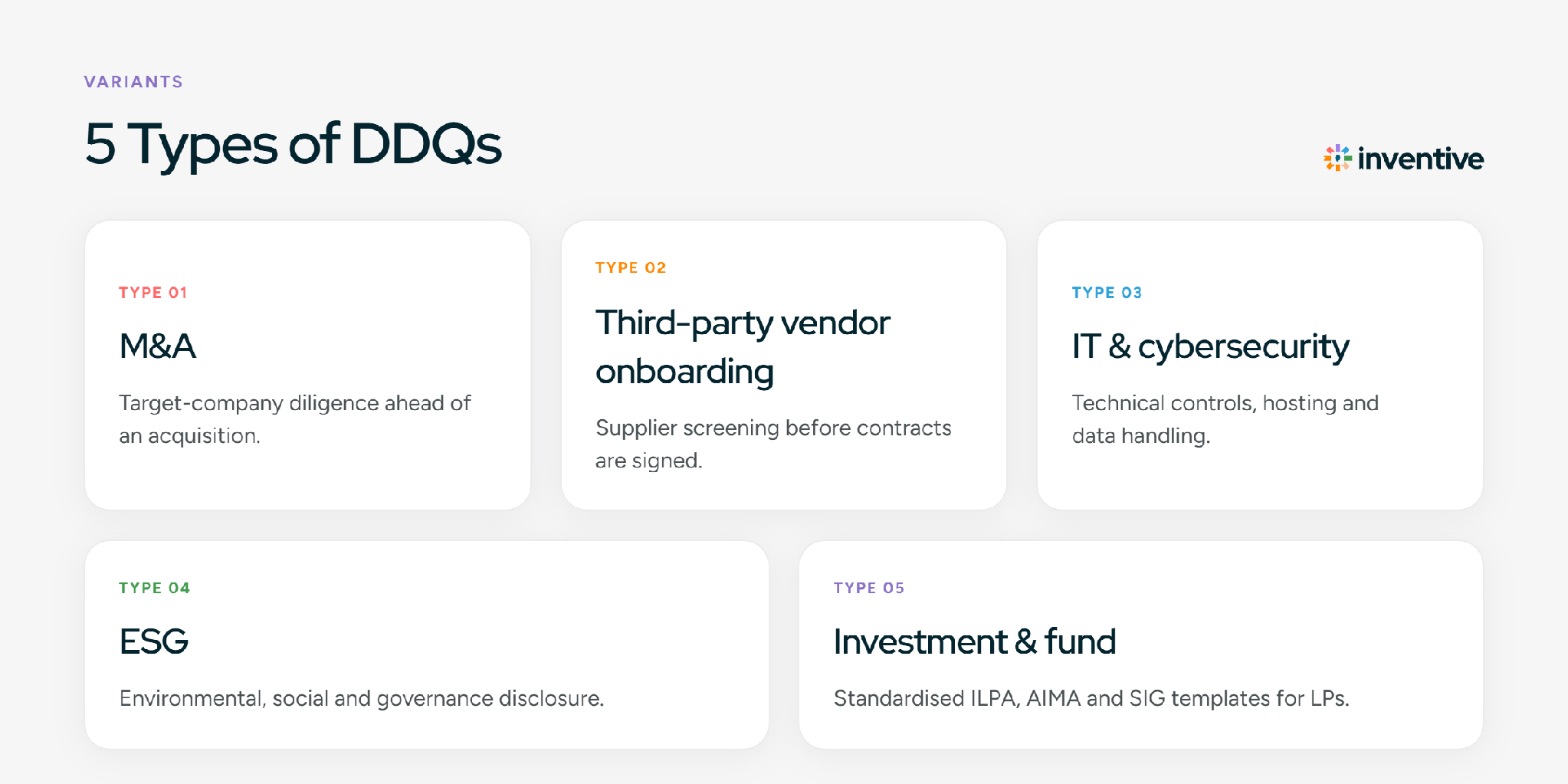
Not all DDQs serve the same purpose. Depending on the context, different types of questionnaires are used to address specific risks and requirements. Here are the most common ones:
1. Mergers & Acquisitions (M&A) DDQ
Used during company buyouts, investments, or mergers. These DDQs focus on corporate structure, financial health, compliance, contracts, and potential liabilities. They help investors uncover hidden risks before closing deals.
2. Third-Party Vendor Onboarding DDQ
Applied when bringing in new suppliers, technology partners, or service providers. These questionnaires assess operational stability, compliance posture, financial strength, and information security measures to ensure long-term vendor reliability.
3. IT and Cybersecurity DDQ
Designed to evaluate how an organization protects sensitive data, manages cyber risks, and complies with privacy laws. They typically cover access control, encryption, incident response, and third-party security practices.
4. ESG (Environmental, Social, and Governance) DDQ
Focused on corporate responsibility and sustainability. These DDQs examine policies around carbon footprint, workforce diversity, ethical sourcing, and governance practices—important for investor scrutiny and regulated industries.
5. Investment and fund DDQ.
Used by limited partners (LPs), allocators, and institutional investors to evaluate a fund manager, such as a private equity, venture, or hedge fund, before investing. It covers strategy, track record, team, valuation policy, operations, service providers, and compliance. This is the original home of the DDQ, and the industry uses standardized templates for it: the ILPA Due Diligence Questionnaire for private equity and AIMA's Illustrative Questionnaire for hedge funds.
Many DDQs start from a recognized template rather than a blank page. The most common are the ILPA DDQ (private equity), AIMA's Illustrative Questionnaire (hedge funds), and the SIG (Standardized Information Gathering) questionnaire from Shared Assessments for third-party and vendor risk. Responding teams see the same frameworks repeatedly, which is exactly why a reusable, approved answer library pays off.
The next step is applying methods that make each section accurate, clear, and easy to review.
Practical Methods to Build Accurate, Clear, and Review-Ready DDQs
Efficient DDQs reduce delays, minimise rework, and improve the quality of decisions during vendor or partner selection. For CROs, VPs of Sales, and proposal managers, applying best practices ensures responses are clear, accurate, and more likely to progress to deal closure.
Follow these best practices to streamline the process:
- Keep questions precise and relevant
Avoid overly broad or vague queries. Target only the information that is directly useful for risk assessment and decision-making. - Standardize formats
Use a consistent question format across all assessments to speed up review and comparison. Pre-approved templates can save hours on recurring DDQs. - Update regularly
Review DDQ content periodically to ensure all sections reflect current regulatory requirements, industry standards, and internal processes. - Validate responses before submission
Cross-check answers with subject matter experts (SMEs) to avoid inaccuracies that can cause follow-up delays. - Include supporting documentation where applicable
Attach certifications, audited reports, and policy documents directly in the DDQ rather than sending them separately. - Use centralised content management
Storing past responses and supporting documents in one system reduces search time and ensures consistency across submissions.
Even with sound practices, manual processes can create bottlenecks that slow completion and increase errors.
Operational and Accuracy Issues That Slow Down Manual DDQ Workflows
Manual DDQ processes demand significant time and coordination across teams. For CROs, VPs of Sales, and proposal managers, this can mean stalled timelines, inconsistent answers, and lower win probability. These issues are amplified when multiple questionnaires need to be completed simultaneously.
Frequent challenges include:
- Time-intensive preparation
Gathering data from different departments, formatting answers, and verifying accuracy can consume several hours per DDQ, especially when tailoring responses for specific clients. - Inconsistent information
Without a central source of truth, responses may vary between submissions, leading to credibility concerns or follow-up queries. - Version control issues
Multiple team members working on separate files can result in outdated or conflicting answers being sent to the client. - Limited tracking of changes
Manual edits often lack an audit trail, making it difficult to verify when and why certain answers were modified. - Follow-up delays
Missing or unclear information in the initial submission can trigger additional review cycles, extending the overall deal timeline.
Also Read: The Ultimate Guide to Streamlining Your DDQ Process
Addressing these challenges starts with having structured, ready-to-use formats that simplify and standardize responses
Structured Samples and Ready-to-Use Templates for Faster Due Diligence
Standardized DDQs help reduce ambiguity, speed up review, and ensure that no critical details are missed. For sales, revenue, and proposal teams, having a ready reference can make the difference between meeting a deadline and losing the opportunity.
Below are sample structures for different industries, showing the type of information typically requested.
Example 1 – Financial Services Vendor Assessment
- Company Overview: Registered legal name, business history, ownership details.
- Financial Information: Three years of audited financial statements.
- Compliance: Confirmation of adherence to FINRA and SEC requirements.
- Information Security: Cybersecurity framework (e.g., NIST) and incident response plan.
- Operational Processes: Business continuity plan and disaster recovery procedures.
Example 2 – Healthcare Technology Partner Onboarding
- Company Overview: Date of incorporation, board structure, key management bios.
- Compliance: HIPAA and HITECH certification details.
- Information Security: Data encryption methods and third-party vendor security practices.
- Operational Processes: Uptime commitments and technical support escalation process.
- ESG: Policies for ethical sourcing of hardware components.
Templates make the process consistent, but automation can take efficiency and accuracy to a much higher level.
DDQ vs. RFP: What’s the Difference?
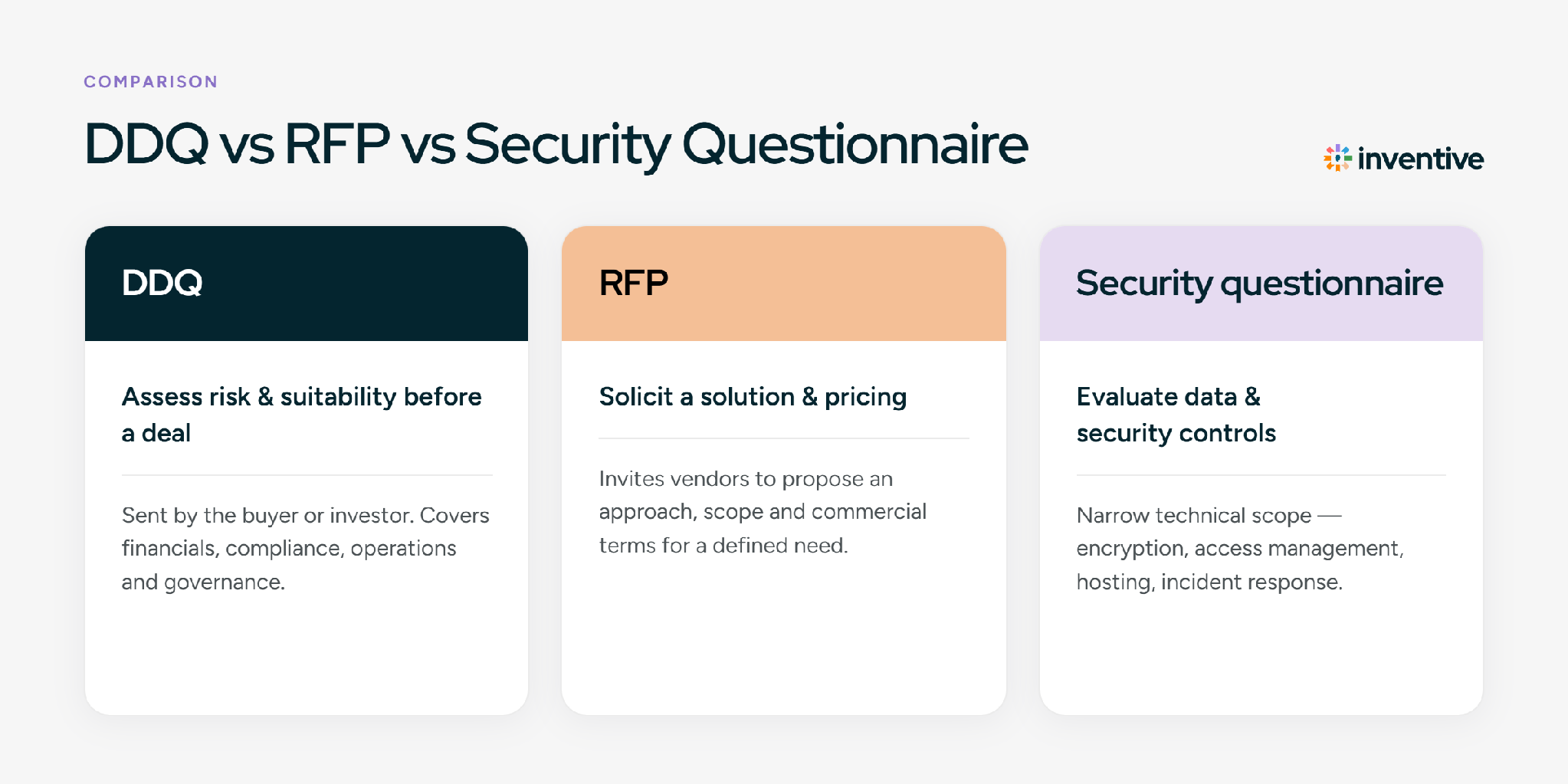
Although a Due Diligence Questionnaire (DDQ), a Request for Proposal (RFP), and a Security Questionnaire often get mentioned together, they serve different purposes. Here’s how they compare at a glance:
How AI RFP Automation Improves DDQ Creation and Review
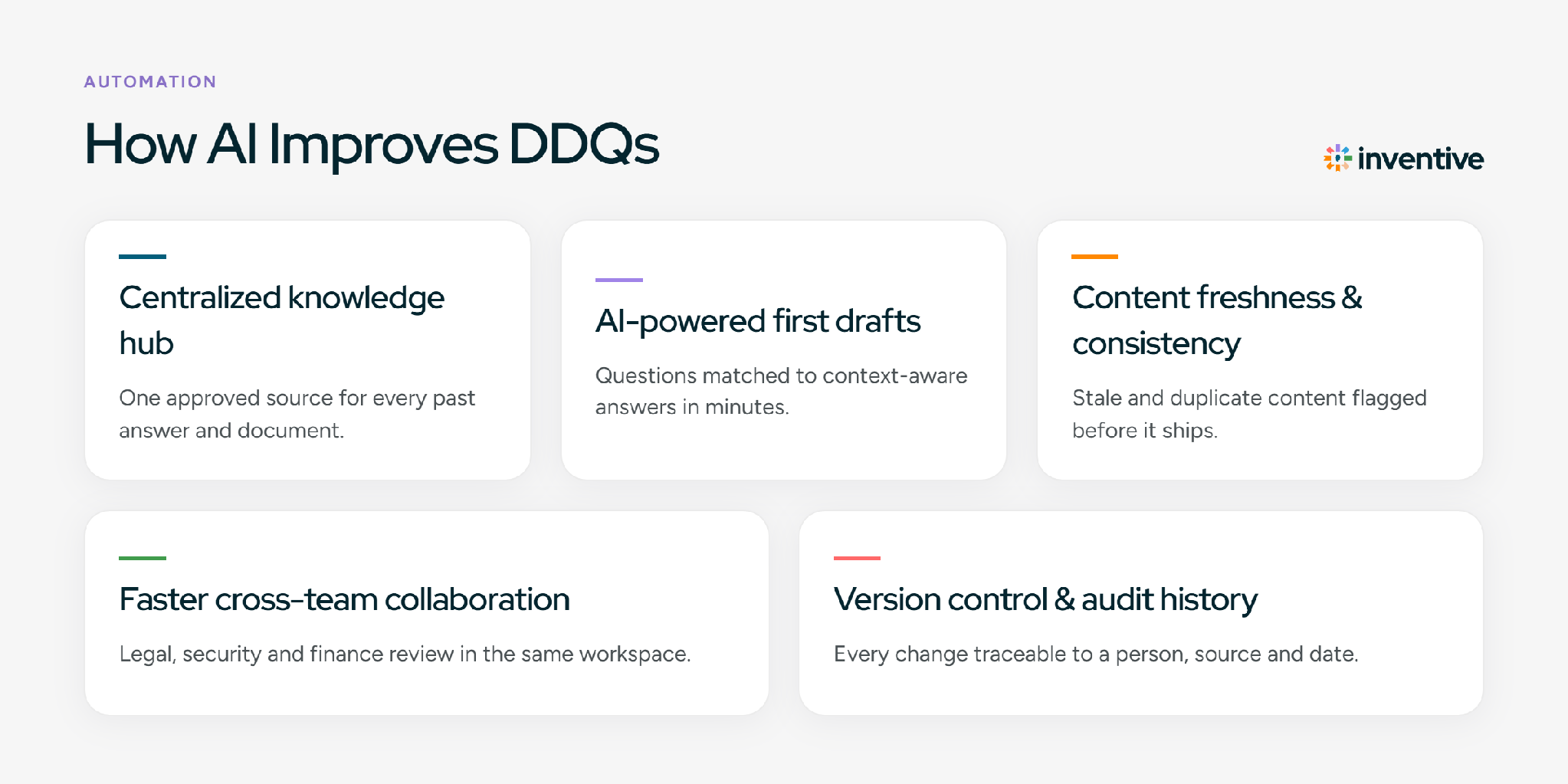
While a DDQ is not the same as a Request for Proposal (RFP), both require structured, accurate, and timely responses across multiple stakeholders. The automation principles used in AI RFP automation apply directly to DDQs, making the process faster, more consistent, and less prone to errors.
Manual DDQ preparation often consumes hours collecting information, formatting answers, and ensuring compliance. Automation reduces this burden by centralising information, generating draft responses, and keeping content current.
Key benefits of applying AI RFP automation principles to DDQs:
- Centralised knowledge hub
Store company, compliance, and financial information in one secure repository. Teams can access approved content instantly, eliminating repetitive requests to subject matter experts. - AI-powered first drafts
AI DDQ agents like Inventive AI use past responses and integrated knowledge sources to generate accurate initial answers for standard DDQ questions, reducing first-draft preparation time by up to 90%. - Content freshness and consistency
AI automatically flags outdated or conflicting information, ensuring responses remain accurate across all questionnaires. - Faster cross-team collaboration
Integrations with tools like Slack and Microsoft Teams allow sales, compliance, and proposal teams to review and refine answers without managing multiple document versions. - Version control and audit history
Every change is tracked, allowing proposal managers to verify updates and maintain compliance records.
For CROs, VPs of Sales, and proposal managers, applying AI RFP automation to DDQs means fewer bottlenecks, faster deal progression, and higher-quality submissions — without sacrificing accuracy or compliance.
The principles of AI RFP automation are valuable, and Inventive AI applies them directly to streamline DDQ preparation.
How Inventive AI Helps with Faster and More Accurate DDQ Responses
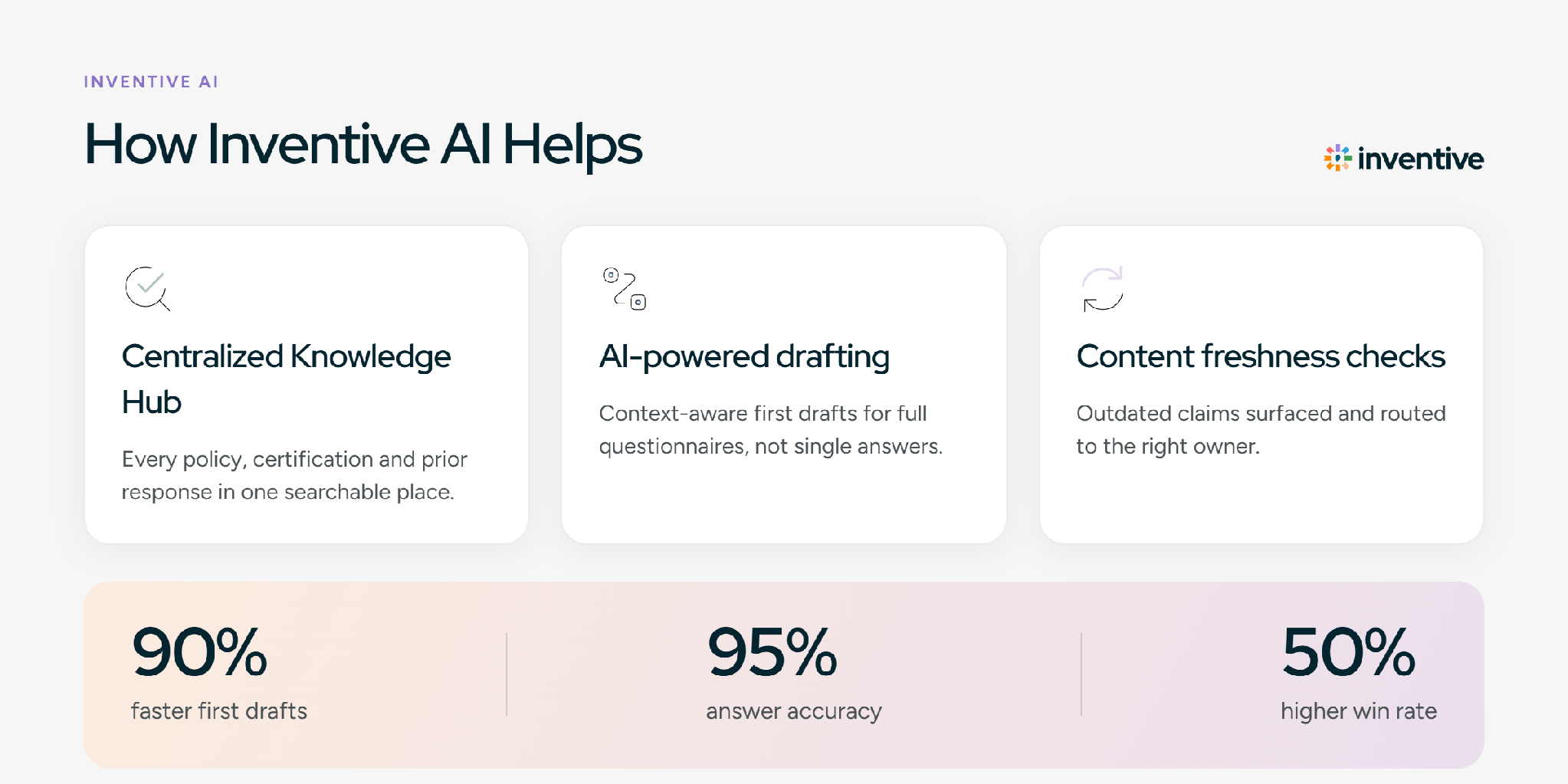
DDQs are long, repetitive, and high-stakes, and the same risk, compliance, and security questions return for every deal. Inventive AI is an autonomous AI agent platform that responds to DDQs, RFPs, RFIs, and security questionnaires, with humans in the loop for approvals. The capabilities that matter most for DDQ teams:
- Question extraction. Upload the DDQ in Excel, Word, or PDF, and an agent reads it and tags every question and section, so you skip manual sorting.
- Go/No-Go Agent. For deal and risk teams juggling multiple assessments, it evaluates each opportunity against fit and requirements early, so you prioritize the DDQs worth completing first.
- Answers from your connected systems. Inventive AI drafts from the tools you already use, such as SharePoint, Google Drive, and Confluence, and past DDQs, so there is no separate library to maintain.
- Evidence-backed drafts. Every answer ships with a source citation and a confidence score, and the agent flags "information unavailable" instead of guessing, which matters when a reviewer will check your claims.
- Content Governance Agent. It continuously scans your connected sources for outdated or conflicting answers, so a stale compliance or security statement never reaches the reviewer.
- Full Response Analyzer. Before you submit, it checks the entire DDQ for missing requirements, contradictions, and gaps, the manual review step that usually slows a response down.